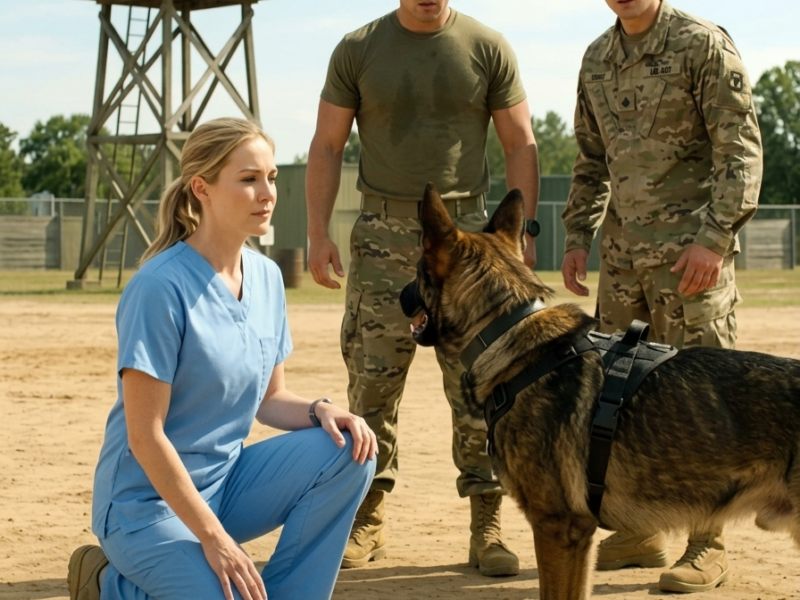
The Navy SEALs could not control the snarling K9 at the Virginia memorial
The autumn wind whipping off Chesapeake Bay was sharp enough to slice through the thin fabric of my medical scrubs. Along the immaculate emerald lawns of the Virginia Beach Veterans Memorial Park, rows of white folding chairs stood in rigid formation, facing a granite monolith engraved with the names of fallen operators from Naval Special Warfare Group Two. Brass instruments from the Navy band gleamed beneath a dull, iron-gray sky, their somber chords drifting over hundreds of attendees—active-duty SEALs in dress blues, tearful gold-star widows holding folded triangular flags, and high-ranking brass wearing chests full of ribboned valor.
I stood fifty yards back by the mobile triage and first-aid canopy, checking the seal on an emergency oxygen bottle. My name is Claire Vance. For the past eight years, I had worked as a civilian trauma nurse at Naval Medical Center Portsmouth. It was safe work, clinical and sterile, filled with predictable heart monitors, antiseptic gauze, and the quiet dignity of recovery wards. It kept me close to the only world I had ever known, while sparing me the agony of the front lines.
Twelve years earlier, my world had ended in that front-line dirt.
A violent crash of folding chairs shattered the reverent quiet of the memorial.
A collective gasp ripped through the crowd as three civilian families scrambled backward onto the turf. Near the flag line, an eighty-pound Belgian Malinois with a broad, scarred chest and dark fawn coat was lunging against two braided nylon tracking leads. His jaws snapped shut with a hollow, concussive crack that sounded like dry pine snapping under a boot. The heavy leather agitation harness around his torso strained against the combined weight of two muscular handlers wearing tactical coyote-tan trousers.
“Clear out! Give him room!” one of the handlers barked, his knuckles bloodless as he dug the heels of his combat boots into the sod. “Call the transport van! He’s throwing his harness!”
“Grab the pinch collar!” another shouted. “He’s slipping the catch!”
The dog was wild with adrenaline. His lips curled back over gleaming ivory fangs, frothing pink spit flying into the wind as a deep, guttural roar vibrated in his throat. A third SEAL rushed in with an oversized padded bite sleeve, attempting to bracket the animal, but the Malinois twisted in mid-air with savage, acrobatic fury, snapping the left nylon lead with a sickening pop of ripped stitching.
The dog spun, free of his primary anchor, his hackles raised in a jagged ridge from his neck to the base of his spine. Spectators screamed, stumbling over each other to put distance between themselves and the thrashing animal. The remaining handler was dragged five feet across the grass before losing his footing, sliding face-first into the mud.
“Back up! Everybody back up!” an officer yelled, reaching for his sidearm holster.
I dropped the box of rolled gauze I was holding. The white rolls tumbled into the damp clover, unspooling across the grass.
In that frantic chaos, above the shouting and the wailing brass horns, I caught the name the handler bellowed into his handheld radio:
“Ranger is loose! Code Black at the main gazebo!”
My pulse didn’t race; it stopped completely. The cold wind blowing off the bay suddenly seemed to carry the distinct, phantom reek of cordite, burning desert scrub, and mountain dust.
Ranger.
Twelve years. Twelve years since I had last said that name out loud.
My feet moved before my conscious mind gave the order. My white clinic sneakers barely made a sound on the manicured grass as I walked away from the safety of the medical tent, moving straight toward the snarling beast that had four trained combat veterans backing away with drawn tasers and batons.
“Ma’am, get the hell back!” the lead handler screamed, stepping into my path with his palm raised outward. “He’s an unsanctioned military working dog under psychiatric evaluation! He’ll tear your throat out!”
“Out of my way,” I said.
My voice was not loud, but it possessed a cold, vibrating authority that caused the young petty officer to blink in astonishment. I brushed past his shoulder.
The dog heard my approach. He spun on his haunches, his golden eyes wide, pupils dilated into black pools of defensive rage. His chest heaved with ragged breaths, his snout dripping with foam as he lowered his head, gathering his hind legs to spring. The growl tearing out of his ribcage was a primeval warning that made the hair on my arms stand up.
I stopped four paces away. I didn’t raise my hands. I didn’t turn sideways into a defensive posture. I stood before him just as I had stood in the sunlit backyard of our little brick cottage in Coronado over a decade ago, holding a worn tennis ball while a playful puppy tore circles through the grass.
I sank slowly to my knees in the wet grass, letting my eyes drop from his gaze to the damp turf between us.
Then I whispered the word that had lived only in my nightmares:
“Ranger.”
The transformation was terrifying in its absolute stillness.
The growl died in his throat with an audible click of his jaw. The violent tension running along his spine evaporated like smoke in the sea breeze. His ears, pinned back in combat aggression, flicked forward, twitching at the frequency of my voice. The black nostrils flared wide, drinking in the scent of my skin, my clothes, the lavender soap I had used every morning since I was twenty-two years old.
The enormous Malinois stared at me for three long, agonizing seconds. Then, with an almost human groan of exhaustion, his front legs gave out, and he lowered his belly directly onto the cold pavement of the memorial walkway.
The four SEALs froze, looking at each other as if they had just witnessed an incoming mortar round turn into flower petals in mid-air.
“Good boy,” I choked out, a hot tear spilling over my lower lid and cutting through the salt air on my cheek. “Good boy, Ranger. Come here.”
The dog didn’t walk. He crawled.
He pulled himself across the wet clover on his stomach, whimpering—a high, delicate, heartbreaking sound that completely shattered the terrifying aura of the war dog. He dragged his heavy body toward me until his broad, scarred snout pressed hard against the center of my chest, right over my thudding heart.
I wrapped both arms around his neck, burying my face into the thick, coarse fur behind his ears. He smelled of rain, metal kennels, and the distinctive pine-needle tang that he had carried since he was eight weeks old. He leaned the entirety of his eighty-pound frame against me, trembling so violently that my own knees shook beneath his weight.
“That’s impossible,” someone muttered behind me. “That animal tried to kill two kennel masters in Rota last week. Nobody touches him without a bite suit.”
I didn’t care about their regulations. I knew why he was shaking.
Ranger had belonged to my husband, Lieutenant Daniel Vance.
Daniel had been a point man and canine handler for SEAL Team Six. Twelve years ago, Daniel, his seven-man element, and Ranger had deployed on a black-budget mission into the desolate mountains of eastern Yemen. Officially, their helicopter had suffered catastrophic rotor failure over an uncharted ravine, plunging into an inaccessible gorge before exploding in a secondary fuel fire. Officially, Daniel had died alongside his brothers.
When the notification team arrived at my door, they told me Ranger had died in the impact as well. They told me that the fire was so intense there were no remains to send home—just an engraved silver box filled with ceremonial desert sand and a folded flag presented to a twenty-four-year-old widow.
I had built a quiet, hollow life on the foundation of that lie.
Now, my fingers traced a thick, jagged ridge of pink scar tissue running from behind Ranger’s left ear down to the corner of his eye—a wound caused by a high-velocity rifle round, not a burning helicopter crash.
“Who did this to you, buddy?” I whispered into his fur. “Where have you been?”
Ranger’s head suddenly jerked up. His whimpering cut off instantly.
He didn’t look at the handlers or the gawking crowd. His ears swiveled toward the raised wooden stage where the commanding officers were standing beneath the Navy seal. His body stiffened, a low, barely audible rumble vibrating deep in his diaphragm.
I followed his gaze.
Standing near the podium, clutching a ceremonial leather-bound program, was a tall, silver-haired officer wearing the three stars of a Vice Admiral.
Vice Admiral Arthur Hayes.
Twelve years ago, he had been Captain Hayes—the somber, tight-lipped officer who had stood on my front porch in Coronado, handed me that triangular mahogany flag box, and told me that looking for answers would only bring dishonor to Daniel’s memory.
Hayes was staring down at the grass, his face drained of every drop of blood. His hands were gripping the podium rail so tightly that the polished wood groaned under the pressure. He wasn’t looking at me; he was looking at the dog, and his eyes held the absolute, naked terror of a man who had just watched a corpse climb out of a grave.
I slowly stood up, keeping my left hand anchored in Ranger’s heavy collar. The dog rose with me, gluing his flank to my leg, his eyes never leaving the stage.
I looked at the nearest SEAL handler, a senior chief with a deeply lined face and an anchor tattooed behind his ear.
“Where did you get this dog?” I asked. My voice was calm, but every person within twenty feet heard the iron beneath it.
The senior chief hesitated, glancing nervously toward the stage where Hayes was already waving an aide over to his side. “Ma’am, that’s classified operational property.”
“I am Lieutenant Daniel Vance’s widow,” I said, stepping closer. “This dog was bred in my kitchen. His whelping papers bear my signature. You tell me where you got him, Chief, or I will stand on this memorial stage and scream it into the microphones until every camera crew here turns their lenses on that podium.”
The chief swallowed hard. He looked at the dog, then down at the wet grass, the code of silence cracking under the weight of human truth.
“Six months ago, ma’am,” the chief whispered, his voice barely carrying over the wind. “A joint task force breached an unregistered black-site compound near the border of Oman. The installation was supposed to be abandoned ten years ago. We found him locked in an underground isolation cell beneath the generator room.”
My breath seized in my throat. “An isolation cell? For a dog?”
The chief didn’t answer with words. His eyes flicked nervously toward Admiral Hayes, who was now hurrying down the stage steps flanked by two armed naval security officers.
I reached down to Ranger’s neck, my fingers sliding beneath the thick nylon of his field collar. There was an old, scratched aluminum cylinder screwed into the ring—a tactical ID tag that had been blackened with matte spray paint to prevent light reflection.
I scraped the paint away with my thumbnail.
Beneath the black coating was an eight-digit number engraved in standard military font:
0488-DV-75.
Daniel’s original service number.
The moment my fingers touched the metal cylinder, Ranger let out a sharp, high-pitched whine. He took two steps forward, pulled against my grip, and pressed his nose firmly against the inner palm of my right hand, turning his head toward the northwest highway leading out of the base.
He wasn’t acting confused. He was performing a trained operational sequence.
Twelve years ago, Daniel had spent eight months teaching Ranger a specialized tracking sequence for off-the-books extraction. A sequence designed to be used only if Daniel was separated from his element and needed to send his dog to an emergency rallying point.
The command word was not written in any training manual. Daniel had chosen it late one night over a cup of black coffee while the pup slept on our rug.
Find her.
I looked across the lawn at Admiral Hayes, who was marching toward us with three security guards, his jaw set into a furious, panicked line.
For twelve years, I had mourned a dead husband. But as Ranger pulled toward the highway with the desperate, unyielding strength of an operational war dog on a mission, the terrible truth tore through my soul:
Daniel had never died in Yemen. And Ranger had just spent six months looking for me to deliver his final message.
“Step away from the animal, Claire,” Admiral Hayes said, his voice dropping into a harsh, controlled baritone as he stopped six feet away. The two armed Master-at-Arms personnel with him kept their hands resting near their holstered sidearms, their eyes darting nervously between the scarred Malinois and the gathering crowd of mourners. “This is an active military security incident. You are interfering with naval property.”
Ranger didn’t bark. He simply shifted his weight forward, his front paws digging into the wet grass, his upper lip pulling back just enough to expose the glistening white enamel of his canines. The low vibration in his chest was a warning that needed no translation.
“Naval property?” I asked, refusing to back down. I kept my fingers wrapped firmly around the dog’s brass collar ring. “You stood in my living room, Arthur. You sat on my sofa, drank the tea I poured for you, and told me Daniel’s body was incinerated in a turbine fire. You watched me sign the death certificate.”
“Claire, this is not the time nor the venue,” Hayes whispered, his gaze darting to the nearby families who were beginning to murmur among themselves. “There are operational realities you do not understand. Walk back to your medical tent. Let my men secure the dog. I will come to your house tonight, and we will talk through everything.”
“You won’t come to my house,” I said, cold certainty washing through my veins. “Because if I let you take this dog, he will be euthanized before the sun goes down, and whatever is inside this tag will be melted into scrap.”
Hayes’s eyes narrowed to cold, gray slits. For a fraction of a second, the polished veneer of the high-ranking flag officer slipped, revealing the ruthless intelligence director who had spent decades burying bodies in dark corners of the world.
“Chief Miller,” Hayes snapped, looking at the senior canine handler. “Secure the dog. Use a tranquilizer dart if necessary.”
Miller hesitated. “Admiral, with respect, the animal has bonded with the subject. In this crowd, a dart discharge carries a risk of—”
“That is a direct lawful order, Senior Chief!” Hayes barked.
Miller reached toward his tactical vest, his face tight with conflict.
Before his fingers could touch the pneumatic dart gun, Ranger moved.
He didn’t attack the men; with the terrifying, explosive intelligence of a Tier-One war dog, he lunged sideways, slamming his entire weight into Miller’s knees, knocking the senior chief off-balance into the wet grass. In the same fluid motion, Ranger clamped his jaws onto the handle of Miller’s tactical equipment bag resting on the ground, yanked it free, and bolted toward the open perimeter fence bordering the parking lot.
He stopped thirty yards away, looking back over his shoulder, barking once—a sharp, commanding crack that echoed off the granite memorial wall.
Move.
“Stop that dog!” Hayes roared.
I didn’t think about my job. I didn’t think about the hospital pension, my spotless record, or the laws of military jurisdiction. I turned on the heels of my white clinic shoes and sprinted after Ranger.
“Claire! Stop!” Hayes shouted behind me. “Security, detain her!”
Two young sailors lunged to grab my arms as I cleared the gazebo, but I had spent eight years lifting immobilized trauma patients and sprinting down narrow emergency bay corridors; I dropped my shoulder, spun out of their reach, and cleared the open wooden gate into the gravel parking lot.
Ranger was already waiting at the passenger door of my eight-year-old Subaru Outback, the canvas tactical bag held firmly between his teeth.
I slapped the key fob, unlocked the doors, and hauled the rear hatch open. Ranger leaped inside in a single, athletic bound, curling his massive frame into the footwell behind the driver’s seat, his golden eyes locked onto the rear window.
I dove into the driver’s seat, hit the ignition, and threw the car into reverse just as the two Master-at-Arms guards rounded the hedge line, their weapons drawn. Gravel erupted from my tires as I slammed into drive, accelerating hard toward the unguarded service exit that led directly onto Atlantic Avenue.
In the rearview mirror, Admiral Hayes stood in the center of the gravel lot, speaking frantically into a black satellite phone, his face gray with fury.
I drove with my hands locked onto the steering wheel at ten and two, my knuckles white, my heart hammering against my ribs like a trapped bird. My breathing was ragged, shallow gasps filling the quiet cabin. Every siren in Virginia Beach felt like it was converging on my bumper, but as I merged into the heavy Friday afternoon traffic along Shore Drive, the blue lights never appeared.
Hayes wasn’t calling the local police. He couldn’t. If civilian law enforcement arrested me, the dog, the tag, and the incident at the memorial would enter the public record.
Hayes had to hunt me in the dark.
Ten miles down the coast, tucked into a dense grove of live oaks and loblolly pines near the edge of First Landing State Park, was an old cedar-shingled fishing cabin that had belonged to Daniel’s grandfather. It had no internet, no smart meters, and sat half a mile down an unpaved sand road that didn’t appear on modern GPS mapping.
I pulled the Subaru into the rusted tin carport, killed the engine, and sat in the absolute silence of the woods.
From the back seat, a warm, wet nose pressed against the back of my neck. Ranger let out a long, shuddering sigh, resting his chin on my shoulder.
“We did it, boy,” I whispered, reaching back to scratch his scarred ears with a trembling hand. “We got away.”
I grabbed the heavy tactical bag Ranger had stolen from Senior Chief Miller and carried it inside the cabin, bolting the heavy oak door behind us. The cabin smelled of old cedar, dry woodsmoke, and salt air. Dust motes drifted through the narrow shafts of sunlight piercing the closed wooden shutters.
I dropped the bag onto the pine kitchen table and unzipped the reinforced nylon teeth.
Inside were four spare magazines for a SIG Sauer P226, three rolls of heavy cohesive medical bandage, an encrypted handheld military GPS receiver, and an olive-drab waterproof canvas pouch stamped with red grease pencil: RECOVERY DOSSIER: PROJECT OMEGA.
My hands shook so violently I could barely unhook the plastic buckles.
I pulled out the contents. There were thirty pages of high-resolution, full-color surveillance photographs, typed interrogation transcripts, and hand-drawn tactical maps.
The first photograph was dated six months ago.
It showed a low, concrete compound surrounded by triple-strand concertina wire, set into the barren limestone cliffs of the Dhofar Mountains on the Yemen-Oman border. The architecture was unmistakable—a CIA black-site facility designed in the early 2000s, meant to disappear from official military records.
The second photograph made the room spin around me.
It was taken through a high-powered thermal imaging lens. Inside a concrete courtyard, sitting on a wooden bench beneath an iron overhang, was a man.
He was thinner than the husband I remembered. His hair was long, fell past his shoulders, and was heavily streaked with silver. A thick, unkempt beard hid the familiar lines of his jaw, and his left arm hung at a slightly unnatural angle, as if a shoulder fracture had healed without proper orthopedic reduction.
But his posture—the straight, unbroken spine of a scout sniper who had spent his life watching horizons—was unmistakable.
Daniel.
The tears that I had held back for twelve years finally tore through my throat in a ragged, suffocating sob. I collapsed against the kitchen table, pressing the glossy photograph against my chest, crying until my ribs ached and my vision blurred into gray static.
He was alive. While I had spent twelve years laying flowers on an empty granite stone, Daniel had been breathing, bleeding, and surviving in a concrete hole five thousand miles away.
Ranger walked up to the table, rested his heavy head on my knee, and gave a low, questioning whine.
I wiped my face with the sleeve of my scrubs, taking a deep, shuddering breath. “I’m okay, boy. I’m okay.”
I turned the page.
Beneath the photograph was an operational debriefing memo signed by an intelligence operative with the code-name SHEPHERD.
SUBJECT: Lieutenant Daniel Vance (Ret./Ghost Status)
STATUS: Surviving Asset. Interrogation Phase Complete.
DISPOSITION: Subject refuses to surrender cryptographic keys to the GIBRALTAR Ledger. Asset maintains that primary decryption algorithm was split and cached prior to capture. Containment site compromised by regional irregulars on March 14. Subject extracted by private contractor element under direct orders of Task Force Blue.
CURRENT LOCATION: Site 4 (Auxiliary Naval Munitions Depot, St. Juliens Creek, Chesapeake, VA).
FINAL DIRECTIVE: Total liquidation scheduled for 2100 hours, October 24.
I looked at the digital clock on the cabin wall.
It was October 24.
The time was 1642.
Daniel had less than five hours to live. And he wasn’t across an ocean—he was sitting in an abandoned ammunition depot twenty miles from where I stood.
I reached down to Ranger’s collar, unscrewed the blackened aluminum cylinder, and tipped the contents onto the table.
A tiny, micro-machined brass key slid out, accompanied by a tightly rolled strip of waterproof synthetic paper.
Unfurled, the paper contained a single line of Daniel’s handwriting, scrawled in faded blue ink that had survived twelve years of darkness:
If Ranger brought you this, you are the only one left who knows my face. St. Juliens Creek, Magazine 11. Don’t trust the uniform. Bring the fire.
I looked at the dog. Ranger’s ears were perked, his tail giving a single, rhythmic thump against the pine floorboards.
“You knew, didn’t you?” I whispered to the dog. “You knew the whole time.”
I looked down at the tactical bag on the table, my eyes landing on the loaded SIG Sauer pistol resting beside the extra magazines. I had never fired a weapon at a human being in my life; I was a healer, someone who stitched wounds and pumped chests to keep the dying from slipping into the dark.
But as I looked at the photograph of my husband sitting in a concrete cage, the gentle nurse who had spent twelve years mourning ceased to exist.
I picked up the heavy steel weapon, checked the chamber with a sharp, mechanical click, and looked Ranger in the eye.
“Let’s go get your father,” I said.
Night fell over Hampton Roads with the suffocating heaviness of an approaching coastal storm. Rain began to patter against the windshield in fat, greasy drops, blurring the halogen glow of the highway lights as the Subaru crept south along Route 17 toward the industrial waterways of Chesapeake.
St. Juliens Creek Annex was an old, sprawling naval installation that dated back to the nineteenth century. Most of its five hundred acres consisted of decommissioned brick ammunition magazines, overgrown earthen berms designed to deflect blast waves from gunpowder explosions, and rusted rail spurs swallowed by black marsh water. The modern Navy used only a tiny fraction of the facility for administrative storage; the rest was a dark, forgotten wasteland of decaying concrete and maritime swamp.
I killed the Subaru’s headlights two miles before the secondary perimeter gate, turning onto a narrow, rutted gravel road that skirted the marsh. The engine hummed in low gear, tires crunching softly against wet oyster shells.
Ranger sat upright in the passenger seat, his snout pressed against the defroster vent, his breath fogging the glass. His ears were swiveling with surgical precision, tracking sounds that my human ears couldn’t register—the distant hum of diesel generators, the bark of marsh foxes, and the rhythmic drone of a patrol boat idling on the Southern Branch of the Elizabeth River.
I parked the car deep inside a stand of overgrown sweetgum trees, cutting the ignition. The darkness wrapped around us like a wool blanket.
I reached over and zipped Senior Chief Miller’s oversized black tactical jacket over my scrubs. The fabric was stiff with waterproofing and smelled of gun oil, but the holster at my hip felt solid, anchoring me to reality. I checked the SIG Sauer one last time: fifteen rounds in the magazine, one in the pipe, safety off.
“Ranger,” I whispered, turning to him in the shadows. “Quiet. Work mode.”
The Malinois didn’t make a sound. His posture changed instantly. The tail dropped, his center of gravity lowered, and his head extended forward in the low, predatory stalk of a combat working dog. When I cracked the passenger door, he slipped out into the wet grass like a phantom, not snapping a single dry twig.
The perimeter fence was a ten-foot chain-link barrier topped with rusty coils of razor wire, but decades of coastal storms had eroded the drainage ditches beneath it. Fifty yards from the road, a concrete culvert ran under the fence, carrying murky marsh water toward the creek.
Ranger trotted directly to the culvert, sniffed the iron grating, and looked back at me.
The rusted iron had been cut; someone had sheared through the three center bars years ago and tied them back into place with black telephone wire. I pulled the wire free, moved the iron aside, and crawled through the mud and cold water, Ranger sliding through the gap behind me without a splash.
We were inside.
Ahead lay a desolate grid of earthen mounds—the ammunition magazines. They looked like ancient burial barrows covered in weeds and saplings, each with a reinforced concrete blast wall and a heavy steel door facing a derelict railway track.
A heavy mist hung over the swamp, glowing faintly with the yellow amber lights of three portable floodlight trailers parked four hundred yards away.
Beside the floodlights sat two unmarked black Chevrolet Suburbans, their exhaust pipes pulsing with thin white plumes in the chilly drizzle. Four men dressed in sterile gray tactical gear and black balaclavas stood around the tailgate of the nearest vehicle, smoking cigarettes and drinking coffee from paper cups. They carried customized short-barrel carbines fitted with long suppressors, their movements relaxed, like executioners waiting for an execution clock to run down.
Above the blast door of the mound they were guarding was a faded concrete placard:
MAGAZINE 11.
My heart hammered against my ribs, each thud loud enough to ring in my ears. I pulled the encrypted GPS unit from my jacket pocket.
The time was 2018. Forty-two minutes before the scheduled liquidation.
“Ranger,” I breathed, crouching low behind the iron rim of an old rail car fifty yards from the Suburbans. “Distraction. Hard right. No teeth unless they corner you. Break them up.”
Ranger looked at me, his golden eyes burning through the mist. He understood the tactical flow as clearly as any human commando. He gave my hand a brief, wet nudge with his snout, turned, and dissolved into the dark cane brake bordering the eastern rail spur.
Thirty seconds passed. The silence of the marsh was thick, broken only by the hum of the generator and the low laughter of the contractors.
Then, fifty yards to the east of their position, an industrial metal drum crashed off an elevated loading dock, slamming into the concrete with a deafening, echoing clatter that shattered the swamp’s stillness.
The four men reacted instantly. Cigarettes were dropped and crushed into the mud. Muzzles snapped up, weapon-mounted flashlights cutting through the rain in blinding white spears.
“Movement on the east spur!” one barked, his voice carrying the flat, clipped cadence of a private contractor. “Bravo, check the perimeter! Miller, watch the door!”
Two of the guards broke into a jog toward the loading dock, their carbines held high, scanning the dripping trees. A third man moved toward the secondary vehicle to check the perimeter sensors, leaving a single guard standing directly in front of Magazine 11’s blast door, his back partially turned toward my rail car.
It was now or never.
I stepped out from behind the iron wheel of the rail car, moving with the silent, fluid footwork Daniel had taught me on long hiking trips in the Blue Ridge Mountains. The mud deadened the sound of my steps. The rain drowned out my breathing.
Ten yards. Seven yards. Five yards.
The guard heard the brush of nylon against wet brush. He spun around, his weapon coming up with terrifying speed.
“What the—”
I didn’t give him time to aim. I didn’t hesitate. With all the force of an adrenaline-charged trauma nurse who had spent hours fighting thrashing, combative patients in psychiatric holds, I drove the heavy steel slide of the SIG Sauer directly into his face.
The impact was brutal. The steel connected with the bridge of his nose with a wet, splintering crunch.
The man gasped, dropping his rifle, but his tactical training took over; he lunged forward, his massive gloved hands reaching for my throat. I drove my knee upward into his groin, caught him by the tactical vest, and threw my entire body weight sideways, slamming his head against the reinforced concrete blast wall of the magazine.
His eyes rolled back. His knees turned to jelly, and he slid down the concrete into the wet gravel, unconscious.
I grabbed his dropped carbine, tossed it into the deep drainage ditch where it sank into the black mud, and pulled the brass key from my pocket.
The heavy steel padlock securing the master latch of Magazine 11 was old, coated in a thick layer of grease. I slid the brass key into the cylinder.
It turned with a sharp, heavy thunk.
I grabbed the iron handle, hauled back with both arms, and dragged the six-inch-thick steel door open just enough to slip through.
The air that poured out of the bunker was ice-cold, smelling of damp limestone, ancient rust, and the metallic copper tang of blood.
I pulled the door shut behind me, plunging the space into absolute blackness.
I clicked on the low-output red LED flashlight on the front of my jacket. The red beam pierced the dark, revealing a cavernous, barrel-vaulted concrete tunnel thirty yards long. The walls were lined with rusted iron ammunition racks, empty and covered in white mold.
At the very end of the tunnel, illuminated by a single battery-operated halogen lantern resting on a wooden crate, was an iron cage originally used to store high-explosive detonators.
Inside that cage, sitting on an overturned plastic bucket, was my husband.
He was wearing a torn gray prison jumpsuit, his bare feet covered in dried mud and bruising. His hands were bound behind his back with heavy, industrial-grade plastic zip-ties, and his face was covered in cuts, swelling, and a week-old purple bruise that closed his right eye.
He didn’t look up when the door opened. He thought I was the executioner.
“Save the speech, Shepherd,” Daniel said, his voice a ruined, raspy croak that barely carried across the concrete floor. “You aren’t getting the ledger. Pull the trigger and get it over with.”
My knees nearly gave out. I stumbled forward, the red light dancing across the wet floor, my breath hitching in my chest until I couldn’t speak.
“Daniel,” I whispered.
The man in the cage froze.
Slowly, agonizingly, as if turning his head required lifting a thousand pounds of stone, Daniel looked up into the red light.
His one good eye widened, the pupil dilating in pure, unadulterated shock. His cracked lips parted, his breath catching in his throat in a dry, rattling gasp.
“Claire?” he breathed, his voice breaking into a thousand shattered pieces. “No… no, this is an interrogation hallucination… they pumped me with scopolamine…”
I ran to the cage, dropping to my knees on the cold concrete, shoving my hands through the iron bars until my fingers touched his face. His skin was burning with fever, rough with weeks of gray stubble, but he was real. His pulse hammered beneath the scarred skin of his jaw.
“It’s me, Daniel,” I sobbed, tears washing the grime from my cheeks as I pressed my forehead against the rusted iron bars. “It’s me. Ranger found me. He brought me the key.”
Outside the blast door, a sudden volley of automatic gunfire ripped through the night air, followed by the terrifying, savage roar of a charging war dog.
The sound of gunfire echoing through the six-inch steel door was muffled, but the sharp, concussive cracks of short-barrel carbines were unmistakable. Ranger was engaging the perimeter guards, using the darkness and the dense marsh brush to draw their fire, but he couldn’t hold out against three trained operators indefinitely.
“Claire, the key!” Daniel rasped, his voice regaining its command focus with terrifying speed. The shock of my presence was instantly overridden by a decade of survival training. “In the base of the red lantern—there’s an emergency EMT shears in the toolbox! Cut these ties!”
I scrambled to the wooden crate, kicked open an old rusted steel toolbox, and retrieved a pair of heavy serrated shears.
I reached through the iron bars behind his back, wedged the thick blade beneath the industrial zip-ties binding his wrists, and squeezed with all my strength. The plastic snapped with a sharp pop.
Daniel gasped as the circulation rushed back into his swollen, blackened fingers. He didn’t waste a second rubbing his wrists; he reached through the bars, grabbed the heavy brass key I had dropped on the floor, and slid it into the master padlock of the cage. With a violent twist of his shoulders, he threw the iron door open, stepped out onto the concrete, and pulled me into an embrace so fierce it knocked the breath from my lungs.
His heart beat against mine—hard, fast, and unbroken. His beard scratched my cheek, smelling of sweat and damp iron, but it was the sweetest scent I had ever known.
“Twelve years, Claire,” he whispered against my hair, his voice breaking into a ragged sob. “Every single day. I kept you in my head every single day.”
“I thought you died in Yemen,” I choked out, clutching the rough fabric of his prison suit. “Hayes gave me a flag. He gave me an empty box.”
“Hayes was the architect,” Daniel said, pulling back, his one good eye burning with cold, lethal clarity. “In 2014, my unit uncovered an off-the-books logistics network run by Hayes and a private defense syndicate called the Gibraltar Group. They were running unregistered weapons shipments, stolen military technology, and black-budget funds through allied ports in the Middle East. When my team refused to sign off on the false manifests, Hayes ordered an airstrike on our own extraction helicopter.”
“The turbine failure,” I realized, the horror making the hair on my arms stand up.
“It was an AGM-114 Hellfire missile fired from an unmarked drone,” Daniel said grimly. “My men burned to death in that ravine. Ranger and I were thrown clear into the brush before the secondary detonation. I crawled forty miles through the desert with a shattered shoulder, carrying the cryptographic drive that held every transaction, every bank account, and every dirty signature Hayes ever made.”
“The Gibraltar Ledger,” I breathed.
“Yes,” Daniel said. He knelt down beside the third ammunition rack, reaching deep into the hollow cinderblock base that supported the iron shelving. His bruised fingers probed the darkness, finally pulling out a heavy, cylindrical steel canister wrapped in green military waterproof tape. “I hid the primary drive in this bunker twelve years ago, the night before I was captured in Baltimore. Hayes has kept me alive in that Oman black-site because the ledger is protected by a rotating multi-key encryption that requires my physical presence to unlock.”
“Why didn’t they kill you once they had the key?”
“Because they didn’t have the key until today,” Daniel said, looking toward the blast door as a heavy metallic thud vibrated through the steel. “Hayes thought Ranger died in the desert. When his contractors accidentally recovered the dog six months ago, Hayes realized Ranger was the courier. He brought the dog to the memorial today to test a theory—he wanted to see if Ranger would lead his team to the final cipher. He knew the dog would seek out the only person on earth who could read his behavioral extraction cues.”
“He used me,” I whispered, the rage rising like bile in my throat. “He used Ranger to find you, and he used me to find the drive.”
A sudden, concussive detonation slammed into the outer blast door.
The heavy steel groaned against its iron hinges, expanding inward with a shower of rust and powdered concrete. The contractors had attached a linear shaped thermite charge to the exterior lock. The steel was already beginning to glow a cherry-red, bubbling with molten metal as the chemical fire ate through the latching pins.
“They’re breaching,” Daniel said, his voice flat and calm. He snatched the SIG Sauer pistol from my hand, his grip effortless and familiar despite his damaged fingers. He checked the magazine with a single flick of his wrist. “Claire, behind that iron rack, there’s an old ventilation shaft that leads to the southern drainage ditch. It’s tight, but you can crawl through it.”
“I am not leaving you again, Daniel,” I said, stepping between him and the blast door, my voice trembling with fury. “I spent twelve years without you. If we die in this hole, we die together.”
Daniel looked at me, a faint, proud smile touching his cracked lips—the same smile he had worn the day he asked me to marry him on the cliffs of Torrey Pines.
“Nobody is dying tonight, Claire,” he said softly.
He reached into his pocket and pulled out the handheld GPS unit I had brought from Miller’s bag. He tapped a four-digit override sequence into the keypad, activating an emergency satellite link that bypassed local cellular repeaters.
“What is that?” I asked.
“An open broadcast,” Daniel said. “Senior Chief Miller isn’t one of Hayes’s contractors. Miller was one of my closest friends before I disappeared. He was forced to bring Ranger to that memorial under Hayes’s direct orders, but Miller left this bag where Ranger could grab it on purpose. This GPS is linked to the Naval Special Warfare Command tactical operations center in Little Creek.”
He hit the send toggle.
On the screen, a green indicator flashed: BROADCAST CONFIRMED. TARGET DATA: GIBRALTAR MASTER FILE. RECIPIENT: REAR ADMIRAL K. SULLIVAN, COMMANDER, US NAVAL SPECIAL WARFARE COMMAND.
“The ledger is out,” Daniel said, tossing the unit onto the floor. “Hayes’s entire empire just landed on every command terminal in the Atlantic fleet. In ten minutes, this entire county will be crawling with federal marshals and active-duty SEALs.”
“We don’t have ten minutes,” I pointed out.
The center of the blast door suddenly blew inward with a deafening roar.
A wall of white-hot thermite sparks, acrid gray smoke, and shattered concrete fragments washed down the length of the barrel-vaulted tunnel. Through the smoke strode two contractors wearing full night-vision helmets and body armor, their carbine suppressors spitting three-round bursts of lethal fire down the narrow corridor.
The rounds ricocheted off the concrete walls with terrifying, high-pitched whines, throwing sparks into the darkness.
Daniel shoved me down behind the heavy iron rim of the ammunition rack, leaned around the corner, and fired three controlled double-taps.
The first contractor took two rounds to the center chest plate and staggered backward into the smoke. The second contractor dove behind the doorframe, sweeping the tunnel with a weapon-mounted high-intensity strobe light designed to blind and disorient anyone looking toward the entrance.
“Cease fire! Cease fire!” a loud, arrogant voice echoed through the ruined doorway.
The strobe light held steady on our position.
Stepping through the shattered threshold, stepping over the burning puddle of thermite slag, was Vice Admiral Arthur Hayes.
He had shed his service dress coat; he was wearing an unmarked black tactical jacket over his uniform trousers, holding a customized Kimber .45 pistol in his gloved right hand. His silver hair was plastered to his forehead by the rain, and his eyes were wild with the desperate, cornered madness of a man who realized the gallows were being built for him.
“You should have stayed buried in the sand, Daniel,” Hayes shouted down the tunnel, his voice bouncing off the concrete arches. “You gave twelve years of your life to keep a secret that nobody cares about anymore. Do you really think Sullivan will save you? The men who built Gibraltar are sitting on the Senate Appropriations Committee! They will bury that broadcast before it clears the morning news cycle!”
Daniel leaned against the cold iron of the rack, his weapon held tight against his chest, his breathing steady.
“They won’t bury it, Arthur,” Daniel called back, his tone conversational, almost mocking. “Because I didn’t just send the ledger to Sullivan. I sent it to every commercial media bureau from New York to London. You’re an international headline in forty seconds.”
Hayes’s face contorted into a mask of pure, murderous hatred. He raised his pistol, aiming directly at the edge of the rack where we were pinned.
“Then we all die in this ditch,” Hayes whispered, his finger tightening on the trigger.
Before his hammer could fall, a sound ripped through the tunnel that froze the blood in Hayes’s veins.
A low, vibrating, primeval roar from behind him.
Through the burning, smoking mouth of the shattered blast door leaped eighty pounds of scarred, mud-soaked, furious muscle.
Ranger had circled the bunker through the marsh drainage ditch, tracking the scent of the man who had ordered his master’s execution. He didn’t hesitate. He launched himself through the air, clearing the rubble in a six-foot leap, his jaws snapping shut on Hayes’s right forearm with the bone-crushing force of an industrial press.
Hayes screamed—a high, shrill shriek of agony that echoed through the concrete cavern as the .45 pistol clattered harmlessly onto the wet floor.
The impact of the eighty-pound war dog threw the vice admiral backward into the rubble. Ranger didn’t let go; he shook his massive head with brutal, rhythmic power, using his body weight to pin Hayes’s arm to the concrete, his front paws planted on the admiral’s chest, his golden eyes burning with twelve years of locked-away vengeance.
The remaining contractor at the door swung his carbine toward the dog, aiming for Ranger’s ribs.
Daniel broke from behind the ammunition rack like a lightning strike.
Despite twelve years of captivity, despite his broken shoulder and fever-wracked body, the muscle memory of a Tier-One operator took over. He closed the ten-yard distance before the contractor could pull the trigger, slapping the carbine’s barrel upward toward the ceiling just as three rounds tore into the concrete arches above.
Daniel drove an open palm strike under the contractor’s chin, followed by a vicious knee to the solar plexus. The man collapsed into the gravel, clutching his ribs, gasping for breath, before Daniel brought the heavy butt of the captured SIG Sauer down onto the base of his neck, rendering him instantly unconscious.
Silence fell over the bunker.
The only sounds were the crackle of the dying thermite fire, the heavy, rhythmic panting of the dog, and the pathetic, whimpering groans of Vice Admiral Arthur Hayes lying pinned in the dirt.
“Ranger,” Daniel said quietly, his voice dropping into that calm, flat tone he had used on training ranges a lifetime ago. “Out. Stand fast.”
The Malinois released his grip instantly. He took two steps back, his chest heaving, his lips pulled back over his teeth, standing like an iron sentinel three inches from Hayes’s throat. A single twitch from the fallen officer would have ended his life.
I walked up beside Daniel, my hands trembling as the adrenaline began its slow, cold retreat from my veins.
Daniel looked down at the man who had stolen his youth, his brothers, and twelve years of his marriage.
Hayes was clutching his shredded arm, blood soaking through the sleeve of his jacket, his silver hair coated in limestone dust. He looked up at Daniel with eyes full of bile and terror.
“You’re a ghost, Vance,” Hayes spat, his voice trembling. “You have no identity. No rank. You don’t exist.”
Daniel slowly reached down and picked up the aluminum cylinder from Ranger’s collar, holding the small metal tube between his thumb and forefinger.
“I exist, Arthur,” Daniel said softly. “And so do the seven men you murdered in Yemen. You’re going to spend the rest of your life looking at their faces on every court-martial document they serve you.”
Outside, the darkness of the marsh was suddenly torn open by the deafening, rhythmic thrum of heavy twin-rotor turbines.
The earth shook.
Through the shattered blast door, the glare of three fifty-million-candlepower searchlights turned the misty night into blinding, brilliant daylight. Two MH-47 Chinook heavy assault helicopters were descending into the marsh clearing, their downwash flattening the cane brake and sending sheets of water spraying across the concrete apron.
Rappelling ropes dropped from the open cargo ramps.
Dozens of active-duty Navy SEALs in full desert camouflage and black body armor poured down the lines, their weapons raised, securing the perimeter with surgical, overwhelming speed.
Stepping through the shattered entrance of Magazine 11 was Rear Admiral Kenneth Sullivan, commander of Naval Special Warfare. Behind him was Senior Chief Miller, carrying an open first-aid kit, his eyes wide as he looked at the three fallen contractors, the pinned admiral, and the battered couple standing in the center of the vault.
Sullivan stopped three paces from us. He looked at Hayes on the ground, then at the cylindrical drive in Daniel’s hand, and finally at the gaunt, bearded face of the man who had been declared dead in 2014.
Slowly, deliberately, the two-star admiral removed his service cap, tucked it under his arm, and snapped a textbook, trembling salute to the starving lieutenant in the prison jumpsuit.
“Lieutenant Vance,” Sullivan said, his voice thick with unspent emotion. “The Department of the Navy acknowledges your presence. Your command has been restored, sir.”
Daniel didn’t salute back; his battered right arm was wrapped around my shoulders, holding me tight against his ribs. He looked at Sullivan, then down at the dog sitting quietly at his feet.
“Permission to stand down, Admiral,” Daniel whispered, his voice cracking. “My mission is finished.”
Sullivan nodded, his eyes shining with tears. “Permission granted, son. Bring him in, Chief.”
Two hours later, the storm had passed out to sea, leaving the Virginia sky washed clean and clear.
Daniel and I sat on the lowered tailgate of a naval ambulance parked on the gravel apron of St. Juliens Creek. A warm green wool medical blanket was draped over our shoulders, our fingers intertwined around a single metal canteen of sweet, hot black coffee.
Across the gravel lot, three unmarked federal prisoner transport vans were idling, their red and blue lights flashing silently against the wet pines. Admiral Hayes and his contractors were being loaded into the rear in heavy leg irons, flanked by armed federal marshals and naval investigators.
Senior Chief Miller walked over to our ambulance, carrying a large bowl of fresh water and a thick cut of roasted beef from the base mess hall. He set them down in front of Ranger, who was lying flat on the tailgate between Daniel and me, his chin resting comfortably across my knees.
Miller looked at Daniel, his weathered face breaking into a wide, tearful smile. “He never forgot you, Dan. Not for one single second.”
Daniel reached down, his scarred fingers gently stroking the fur behind the dog’s ears. “He’s a good boy, Miller. The best in the fleet.”
The first rays of the morning sun began to climb above the tree line, painting the still waters of the Elizabeth River in shimmering ribbons of rose, gold, and pale violet. The air was cool and crisp, carrying the clean, sharp scent of pine needles, wet marsh grass, and new beginnings.
Daniel turned his head, looking at me in the soft morning light. The bruises on his face were dark, but his eye was clear, bright, and filled with an endless, bottomless peace.
He reached up with his trembling, calloused thumb and gently wiped a streak of dried mud from my cheek.
“Where do we go now, Claire?” he asked softly.
I looked at the rising sun, feeling the steady, rhythmic warmth of his hand in mine, and the heavy, reassuring weight of the war dog sleeping across our laps.
“Home, Daniel,” I whispered, a smile touching my lips as a tear of pure joy slipped down my face. “We’re finally going home.”
The end









