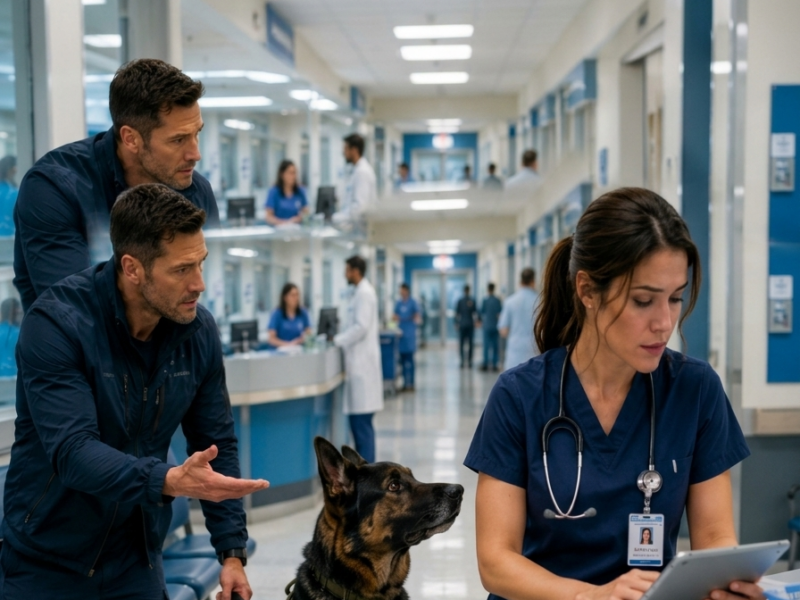
The Navy SEAL sat alone in the hospital chapel, his uniform stained with rain and grief, then quietly asked me, “Can I sit here?” while his K9 stared at me like he knew my face
The air inside the hospital chapel smelled faintly of beeswax, damp wool, and polished mahogany. Outside, rain lashed against the stained-glass windows, turning the figures of saints into trembling smears of crimson and blue. I had sought out the chapel at two in the morning to escape the sterile glare of the Intensive Care Unit, where the steady, rhythmic chirping of heart monitors usually served as the soundtrack to my night shifts.
I was sitting in the back pew, nursing a paper cup of lukewarm black coffee, when the heavy oak doors swung open without a sound.
A man stepped into the warm glow of the sanctuary, accompanied by a jet-black Belgian Malinois. The soldier wore damp Navy Working Uniform camouflage, stripped of unit patches save for a single Trident emblem above his breast pocket. He looked hollowed out—his jaw shadowed with stubble, his dark eyes shadowed by a bone-deep exhaustion that no amount of sleep could fix. The dog walked with a measured, tactical heel, one of its front paws slightly bloodied at the pad.
The SEAL sat alone in the hospital chapel, his uniform stained with rain and grief, then quietly asked me, “Can I sit here?” while his K9 stared at me like he knew my face—and the dog’s reaction made the grieving soldier suddenly stop breathing.
I had been working the night shift at Walter Reed when I found them there.
The SEAL looked exhausted.
His black K9 lay beside him, one paw resting over his boot.
“Can I sit here?” he asked.
I glanced at the empty chair beside me.
“Of course.”
He sat down without another word, leaning forward with his elbows on his knees, staring straight at the altar. For several minutes, neither of us spoke. The silence between us was heavy, the kind that forms around people who spend their lives looking at trauma and death.
Then the dog lifted his head.
His eyes locked onto mine.
He stood slowly.
The SEAL frowned.
“Ghost?”
The K9 walked toward me, his tail held low and rigid. I held out my hand, palm open, offering my knuckles the way I always did with service animals on the ward. Ghost sniffed it once, a deep, raspy intake of air.
Then he backed away and began whining—a high-pitched, desperate sound that felt shockingly human.
The SEAL immediately stood, his hand instinctively dropping to the leash handle.
“He doesn’t do that.”
“Do what?” I asked, pulling my hand back slightly.
“React to strangers like he knows them. He’s an active-duty assault dog. He ignores civilians.”
Ghost stepped closer again, ignoring his handler’s unspoken tension. Then he pressed his wet nose against my right wrist, right where the elastic cuff of my blue hospital scrubs met my skin.
I felt a strange, cold chill cascade down my spine, as if a draft had swept through the airless chapel.
The SEAL stared at the dog, his expression shifting from fatigue to sharp vigilance. “What is it, boy?”
Ghost suddenly began pawing at my sleeve, his blunt claws hooking into the cotton fabric, tugging gently but insistently.
I pulled it back, exposing the pale skin of my inner wrist. A small, faint white scar crossed the skin vertically—a jagged line about an inch long that I had carried for as long as I could remember.
The SEAL’s face went pale, every drop of color draining from his features until he looked like a ghost himself.
“Where did you get that?” he demanded, his voice dropping an octave.
“I… I don’t know,” I stammered, pulling my hand back against my chest. “I’ve always had it. A childhood fence injury, my parents told me.”
He reached into his pocket with a trembling hand and pulled out a worn smartphone. His fingers flew across the glass, scrolling through a password-protected gallery of old photographs. Finally, he turned the screen toward me.
A little boy of about eight stood beside a smiling six-year-old girl on a sunlit porch. Behind them sat an older German Shepherd-Malinois mix—a dog that bore an undeniable resemblance to Ghost.
My heart stopped.
The woman in the photograph was me. Or rather, she had my eyes, the same crooked curve of the left eyebrow, the exact same slight asymmetry in her smile. But I had never seen the picture before in my life.
The SEAL whispered, “That’s my sister, Clara.”
I couldn’t speak. My breath caught in my throat like glass.
“She disappeared eleven years ago,” he said, his voice cracking. “From our backyard in Virginia. We searched for three years before the federal investigators told us to accept the reality.”
I stared at the screen, my head spinning. The girl looked exactly like me. Except for one distinct detail. She wore a silver, tear-shaped locket on a delicate chain.
I looked down at my own neck.
The same necklace hung beneath my hospital badge—a piece of jewelry I had worn every single day since childhood.
The SEAL noticed it too. His eyes tracked down to my chest, locking onto the silver teardrop.
“Where did you get that?” he rasped.
“My mother gave it to me,” I said, my voice barely audible. “When I was little. She told me it was a family heirloom.”
He shook his head slowly, taking a step backward as if struck. “My mother died of cancer two years before my sister disappeared. That locket belonged to her. It was custom-engraved on the back with her initials.”
My fingers flew to the clasp. I unhooked the chain with shaking hands, turned the tarnished silver casing over, and held it under the dim candlelight. On the back, faint and worn smooth by decades of skin contact, were three engraved letters: E.M.H.
Evelyn Marie Hayes. My mother’s name was Sarah Miller.
Before I could process the terrifying void opening up beneath my feet, Ghost suddenly growled at the chapel doors.
The heavy wood creaked open. An elderly man stepped inside—Dr. Arthur Vance, the retired Chief of Medicine who still held an emeritus desk in the hospital’s research wing. He was a wealthy philanthropist who had personally funded my nursing scholarship five years ago.
Dr. Vance looked at me and froze in the doorway, his umbrella dripping wet onto the carpet. His eyes darted from my face to the silver locket resting in my palm, then to the Navy SEAL standing beside me.
Then he whispered, “You survived.”
The SEAL turned toward him with the speed of a coiled spring, his hand dropping toward his belt line out of habit. “What did you just say?”
The old man didn’t answer. He didn’t run. He only stared at my necklace with an unreadable, hollow expression.
Then Ghost barked once—a deafening boom that echoed off the vaulted ceiling—and lunged forward, standing squarely between Dr. Vance and me, his teeth bared in a silent, lethal snarl.
The SEAL looked back at me, his voice barely a whisper against the background hum of the storm. “My sister had that necklace the night she vanished.”
I touched the silver metal with trembling, numb fingers. For the first time in my twenty-five years of existence, I looked down at the name Nurse Hannah Miller printed on my plastic hospital ID badge, and wondered whether a single word of my life had ever been real.
The chapel sank into a suffocating quiet, broken only by the low rumble of Ghost’s growl. Dr. Vance took a slow step backward into the vestibule, his wet shoes squeaking on the marble tile.
“Who are you?” the SEAL demanded, moving with practiced tactical positioning to cut off Vance’s path to the main exit. “And what do you know about my sister?”
Dr. Vance’s hand hovered near his coat pocket. “Lieutenant Hayes,” he said, reading the officer’s chest tape with an eerily calm voice. “You are grieving your fallen team members. You are exhausted. You are mistaking a coincidence for a miracle.”
“I don’t believe in coincidences,” Hayes replied coldly. “And my dog doesn’t mark strangers. He was bred from my father’s line. He recognized her scent.”
“Hannah,” Dr. Vance said, turning his gaze entirely to me, ignoring the gun-barrel stare of the Navy SEAL. “You have worked under my roof for five years. You know who I am. You know your parents—your real parents—brought you to my pediatric clinic when you were a child.”
“My parents…” My voice cracked. My hands were shaking so violently I almost dropped the locket. “My parents died in a car crash when I was in high school, Dr. Vance. You paid for my tuition. You set up my trust fund. You said it was out of respect for my father’s research!”
“Your ‘father’ was a thief, Hannah,” Vance said softly, taking another small step toward the shadowed hallway. “He took something that didn’t belong to him from my laboratory eleven years ago. And he thought he could raise it as his own.”
“That’s enough!” Lieutenant Hayes lunged forward, grabbing Vance by the lapels of his heavy wool coat and slamming him against the wood-paneled wall of the chapel. Ghost instantly flanked his handler, his jaws hovering inches from the old man’s throat. “What did you do to Clara? Where has she been for eleven years?”
“Ask her mother,” Vance wheezed, his eyes bulging slightly as Hayes pressed a forearm against his collarbone. “Ask Sarah Miller where she found the girl… or ask the hospital registry why there’s no birth certificate for ‘Hannah’ anywhere in the state of Virginia.”
Hayes turned his head slightly toward me, his eyes wide with dark realization. “Is that true?”
“I… I don’t know!” I cried, tears finally breaking through and burning down my cheeks. “I have a social security card! I have a driver’s license!”
“All issued when you were fourteen years old,” Vance croaked, a faint, bitter smile touching his thin lips. “Check the state archives, Lieutenant. Your ‘Hannah’ didn’t exist before 2015. She was created out of paper and lies.”
Suddenly, the chapel’s heavy double doors didn’t just open—they were shoved inward with violent force. Two men in dark gray suits with brass security pins on their lapels stepped into the sanctuary, their hands drawn beneath their jackets.
“Hospital Security! Stand down!” one of them yelled, drawing a high-caliber sidearm. “Lieutenant Hayes, release Dr. Vance immediately!”
“They aren’t hospital security,” Hayes muttered under his breath, recognizing their stance instantly. “Contractors. Private military.”
“Step away from the girl, Lieutenant,” the lead contractor ordered, raising his weapon. “Dr. Vance is a board member of this facility. You are trespassing in a restricted clinical zone.”
“Ghost, TAKE!” Hayes roared.
The black Malinois flew through the air like a dart. The dog’s jaws clamped onto the lead contractor’s forearm before the man could clear his holster, bringing eighty pounds of momentum straight into the man’s chest. The weapon clattered across the chapel floor, spinning toward my feet.
The second contractor drew his gun, but Hayes was already moving. He swept the man’s leg, threw a rapid left hook that broke the guard’s nose, and drove his knee into his abdomen, disarming him in under three seconds with brutal, military efficiency.
“Hannah! GET THE GUN!” Hayes screamed at me.
I dropped to my knees, my fingers clutching the cold steel of the dropped pistol on the carpet. My heart pounded in my ears like a war drum. I had never held a weapon in my life, but looking at Dr. Vance, who was currently reaching for a small silver device inside his pocket, a sudden, primal instinct took over.
I pointed the gun directly at Dr. Vance’s chest. “Don’t move,” I said, my voice surprisingly steady despite the tears streaming down my face.
Dr. Vance stopped, his hand freezing inside his coat. He looked at me—not with fear, but with a horrifying, detached fascination. “Remarkable,” he murmured. “Even after eleven years of suppression therapy… the neural response is intact.”
“Shut up!” Hayes barked, securing the two unconscious contractors with their own zip-ties. He marched over to Vance, ripped the coat off the old man, and pulled a black leather notebook and a electronic keycard from his inner pocket.
“We have to go,” Hayes said, grabbing my arm firmly but gently. “The real security will be here in two minutes. Their radios are already chirping.”
“Where?” I stammered, looking around the chapel that had been my sanctuary only twenty minutes ago. My whole life was crumbling into ash around me.
“To my truck,” Hayes said, his dark eyes locking onto mine with an intensity that made my chest ache. “You aren’t Hannah Miller. Your name is Clara Hayes. You’re my sister. And I am not losing you a second time.”
The rain was falling in blinding sheets as we sprinted across the hospital’s lower parking garage. Hayes kept one hand on Ghost’s tactical harness and the other tightly wrapped around my wrist, right over the jagged white scar that had started this nightmare.
We piled into a matte-black Ford F-150. Ghost leaped into the rear seat, his wet fur smelling of rain and asphalt, while Hayes turned the ignition. The engine roared to life, and we slammed through the plastic parking arm, exiting onto the slick, dark streets of Bethesda.
“Where are we going?” I gasped, clutching the silver locket in my fist so tightly the edges bit into my palm.
“Out of the district,” Hayes said, checking his rearview mirror every three seconds. “Vance isn’t just a doctor. The name ‘Vance’ is tied to a defense technology contractor that operates out of Northern Virginia. My team… my team was doing security audits on their medical research division before we deployed to Syria.”
He paused, his knuckles turning white on the steering wheel.
“What?” I asked. “What aren’t you telling me?”
“My SEAL team… we were ambushed three weeks ago,” Hayes said, his voice dropping into a register of quiet rage. “Four of my men died. The official report said it was an insurgent mortar strike. But three days before we hit the ground, I sent a routine intelligence query to Navy CID about a cold case—my sister’s abduction. Because I found a medical document in a target compound overseas that carried Dr. Vance’s personal clearance stamp.”
My head whipped toward him. “You found my case file… overseas?”
“It wasn’t a case file for a missing child,” Hayes said, turning onto a dark, unlit back road through the trees. “It was an asset inventory. You weren’t kidnapped for ransom, Clara. You were taken because of who our mother was.”
“Evelyn Hayes,” I whispered, repeating the name from the back of the locket. “Who was she?”
“She wasn’t a housewife,” Hayes said grimly. “She was a senior geneticist at the Army’s Infectious Disease Institute at Fort Detrick. She died of ‘cancer’ when I was six and you were four. But three years ago, before I deployed, I went through her old journals. She didn’t die of cancer. She was exposed to a synthetic biological marker—something her team had developed to tag specific human lineages for long-term tracking.”
He pulled the truck into an overgrown clearing inside a dense stretch of woods, cutting the headlights. The forest was pitch black, illuminated only by the faint green glow of the dashboard instrument cluster.
Ghost leaned forward between the front seats, resting his heavy chin on my shoulder, letting out a soft, reassuring sigh. I reached up and buried my fingers in his soft neck fur, drawing strength from his steady warmth.
“If she was my mother…” I began, staring out into the dark trees. “Then who were the people who raised me? The Millers?”
“They were former lab technicians who worked under Vance,” Hayes said, reaching into his jacket and pulling out the black leather notebook he had ripped from Vance’s coat in the chapel. He flipped open the pages under a small tactical flashlight.
The pages were dense with handwritten dates, medical jargon, and blood-chemistry values spanning over a decade.
“Look at this,” Hayes said, pointing to an entry dated August 14, 2015.
I leaned close. Written in sharp, precise cursive was a short entry:
Subject ‘Clara’ successfully relocated to Sector 4 under proxy guardians (Miller, R. & S.). Amnestic baseline established via deep-REM protocol. Subject demonstrates 94% retention of basic motor skills, zero episodic recall of pre-abduction environment. Silver catalyst worn as secondary sensory anchor.
My skin went ice-cold. “Sensory anchor… the necklace.”
“It’s not just a souvenir,” Hayes realized, his eyes narrowing as he looked at the teardrop pendant in my hand. “It’s a low-frequency RFID transponder. That’s how Vance always knew where you were. That’s why he paid your tuition, kept you inside his hospital, kept you right where he could monitor you every single day!”
“He made me a nurse,” I whispered, horror rising in my chest like bile. “He guided me into critical care… he put me in his own facility…”
“Because he was waiting for something,” Hayes said. He flipped to the last page of the notebook. The final entry was dated yesterday.
Phase 3 Initialization: Subject ready for extraction to Site B. Memory baseline holding. Final blood draw scheduled upon arrival of Team 6 deployment logs.
“Site B,” I breathed. “What is Site B?”
Before Hayes could answer, Ghost’s ears spiked forward. His soft breathing stopped instantly, replaced by a deep, vibrating growl that vibrated through the truck’s seats.
Out in the dark woods, two hundred yards behind us, a faint red laser beam cut through the rain, reflecting off the truck’s side mirror.
“Hold on!” Hayes yelled, slamming the truck into reverse just as a heavy rifle shot shattered the windshield, sending a spiderweb of safety glass flying across the cab.
The truck roared backward through the narrow dirt lane, tree branches scraping against the metal doors like screaming voices. Hayes slammed on the brakes, spun the wheel, and floored the accelerator, sending the vehicle plunging deeper into the dark forest trail.
“Down! Keep your head down!” he barked over the engine’s roar.
I pressed myself against the floorboard beneath the glove compartment, holding Ghost’s collar with one hand while the dog hovered over me like a shield. Behind us, the dull thud-thud-thud of suppressed automatic weapon fire hit the steel tailgate of the truck.
“They tracked the truck’s GPS!” Hayes shouted, maneuvering the vehicle through a thick muddy trench. “Vance must have activated the base’s internal locator!”
“No!” I shouted back, looking down at the silver locket still clutched in my fist. “It’s not the truck! It’s this!”
Hayes glanced down at me, his eyes wide. “The transponder!”
“He said it was a sensory anchor!” I yelled, my nurse’s mind frantically putting together the technical terms from the notebook. “It broadcasts a signal! If I throw it away—”
“No!” Hayes yelled. “If you throw it, they’ll know we figured it out and they’ll change tactics. We use it!”
He yanked the steering wheel hard to the right, crashing through a wooden forestry gate onto an abandoned gravel access road that led toward an old water treatment facility near the river.
He slammed the truck to a stop beside a row of rusted storage tanks, jumped out, and pulled me from the passenger side. “Ghost! HEEL!”
We ran toward the dark concrete structure of the treatment plant as the distant headlights of three dark SUVs broke through the trees behind us.
“In here!” Hayes guided me through a rusted side door into a massive, cavernous room filled with empty dry-settling basins and catwalks suspended thirty feet over concrete pits.
The air inside was damp, smelling of river silt and old iron. Rain hammered deafeningly on the corrugated metal roof above.
Hayes led me beneath a low concrete staircase, pulling a tactical combat knife and his sidearm from his vest. He took the silver locket from my hand, walked twenty yards away, and hung it conspicuously on a low-hanging electrical conduit right beneath a bright emergency light fixture.
“They’ll follow the ping straight to that light,” Hayes whispered, coming back to our hiding spot in the shadow of the staircase. He pressed his back against the wall, pulling me behind him. Ghost sat motionless at his left hip, not making a single sound.
“David…” I whispered, using his real name for the first time. The word felt strange on my tongue, yet strangely familiar, like an old song I had forgotten the lyrics to.
He looked back at me, his dark eyes softening for a fraction of a second in the dim light. “Yeah?”
“Did… did I really have a dog named Ghost when I was little?”
A faint, sad smile touched his lips. “Ghost is his grandson. The dog in that picture was named Shadow. You used to steal his dog biscuits and hide them under your pillow.”
A sudden, sharp spike of warmth bloomed behind my eyes—a memory, clear and brilliant, breaking through the fog of eleven years. A sunlit bedroom, a rug with yellow flowers, and a large black dog nudging my knees under a wooden bed frame.
“I remember,” I breathed, tears filling my eyes. “I remember the yellow rug.”
David’s hand tightened around mine, giving it a fierce, quick squeeze. “I promised Dad I’d bring you home, Clara. I’m not breaking that promise.”
The heavy metal doors of the treatment facility burst open.
Four men in full tactical gear, wearing night-vision goggles, stepped onto the upper catwalk, their rifle barrels sweeping the shadows below. Behind them walked Dr. Arthur Vance, holding a portable signal tracker that blinked with a steady, rhythmic beep.
“It’s right here,” Vance’s voice echoed through the massive chamber. “The signal is static. She’s in this room.”
The contractors moved down the metal stairs, their boots ringing out against the iron rungs.
“Search the perimeter,” the team leader ordered. “Dr. Vance wants the girl alive. The SEAL is disposable.”
They moved closer to the hanging light fixture where the silver locket gleamed in the air like a tiny pendulum.
Vance stepped up to the necklace, reaching out with a gloved hand to touch it. When he saw it was hanging from an empty conduit, his face twisted in sudden panic. “It’s a trap—”
“GHOST, FLANK!” David roared from the shadows.
The black Malinois surged out of the dark like a nightmare. He didn’t attack the men with the guns—he lunged directly for Dr. Vance, hitting the old man in the chest and driving him backward over the safety rail of the lower catwalk. They both crashed six feet down into an empty concrete settling tank with a bone-shattering impact.
“COVER!” David yelled, stepping out from beneath the staircase and firing three rapid shots.
The lead contractor dropped as the heavy rounds hit his chest plate. The remaining two guards scrambled behind a row of industrial water pumps, opening fire into our position. Sparks flew as bullets chewed through the concrete stairs above my head.
David dropped his empty magazine, slapped a fresh one into his sidearm with lightning speed, and leaned out to fire a two-round burst that suppressed the left shooter.
“Clara! Stay down!” he commanded.
“I’m not sitting here!” I screamed back.
I spotted a heavy steel control lever mounted on the wall three feet to my right—the manual floodgate release for the river intake pipes. A thick yellow warning sign above it read: DANGER: HIGH PRESSURE AUTO-FLUSH.
I didn’t think. I scrambled out from under the stairs, grabbed the iron handle with both hands, threw my entire body weight onto it, and yanked it downward.
A deafening pneumatic screech echoed through the facility as massive iron gates at the far end of the chamber swung open. Thousands of gallons of swollen, rain-whipped river water roared into the lower basins with the force of a flash flood.
The torrent of mud and water slammed into the lower level where the two contractors were taking cover. The sheer force of the flood swept their feet out from beneath them, dragging them into the deep drainage channels toward the main river outlet.
“DAVID!” I screamed over the roaring water.
David sprinted toward the edge of the settling tank where Vance and Ghost had fallen. He reached down, grabbing the dog’s tactical harness with one hand and hauling eighty pounds of soaking-wet Malinois out of the rising water just as the basin filled.
Dr. Vance was clinging to a iron ladder on the far wall of the pit, the water rising to his chest, his face pale with shear terror.
“Hayes! Help me!” Vance screamed, his fingers slipping on the slimy metal rungs. “I have the keys to your sister’s medical records! You’ll never prove who she is without me!”
David stood at the edge of the pit, looking down at the man who had stolen his sister and ruined his family. His face was cold, unreadable—the face of a combat veteran who had seen the worst of humanity across the globe.
He reached into his tactical vest, pulled out Dr. Vance’s black leather notebook, and held it up in the air.
“We don’t need you,” David said, his voice carrying over the sound of the rushing water. “You wrote it all down.”
He turned his back on the old man, grabbed my hand, and called Ghost to his side.
We walked out of the roaring treatment facility into the cool, clean rain of the early morning. Behind us, the siren of the automated flood system began to wail, signaling the arrival of emergency services and local law enforcement.
Three hours later, as the sun began to rise over the Potomac River, painting the sky in soft shades of gold and violet, we sat on the tailgate of an unmarked federal vehicle parked outside the Department of Justice in downtown Washington.
A team of federal investigators was already processing the black notebook, cross-referencing the blood-chemistry logs with military intelligence databases. The conspiracy that had hidden me for eleven years was finally unraveling, thread by thread.
I sat shivering under a heavy wool blanket, holding a hot paper cup of tea. Ghost lay stretched out across my feet, his chin resting securely on my shoes, his tail giving a lazy, contented thump every time I moved.
David sat beside me, his uniform still stained with rain and dirt, but the hollow, grieving look in his eyes was gone—replaced by a quiet, steady peace.
He reached into his pocket and pulled out the silver teardrop locket, cleaned of mud, its chain restored. He held it out to me.
“Do you want to put it back on?” he asked softly.
I looked at the silver metal, then up at the clear morning sky breaking through the storm clouds.
“No,” I said, taking it from his hand and holding it in my palm. “I don’t need it to know who I am anymore.”
David smiled—a genuine, wide smile that reached his eyes for the first time since we met in that dark hospital chapel. He reached over, wrapped his arm around my shoulders, and pulled me close against his side.
“Welcome home, Clara,” he whispered.
I leaned my head against his shoulder, closed my eyes, and listened to the steady beat of my brother’s heart, knowing that for the first time in eleven years, I was finally right where I belonged.
The end.









