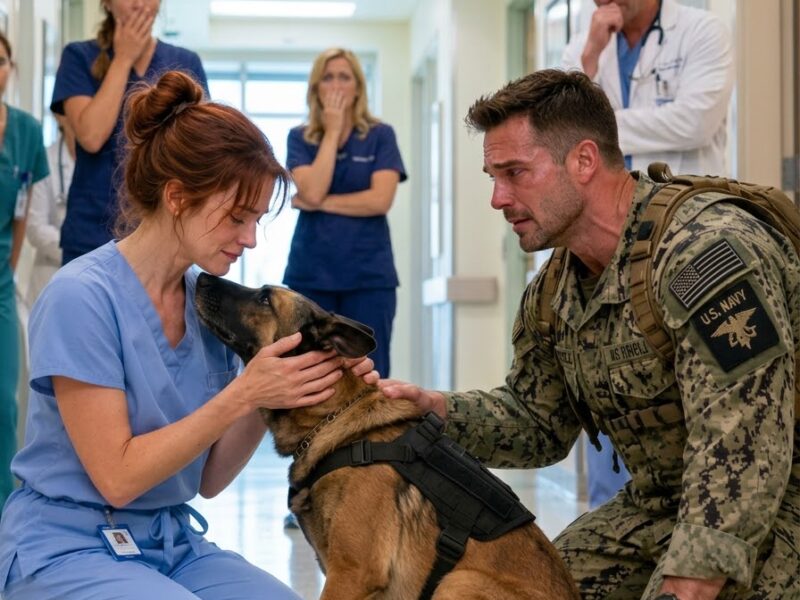
The Navy SEAL sat alone in a quiet corner of a California hospital, his head bowed beside his battle-scarred K9
The rainy afternoon had turned the glass windows of the hospital cafeteria into a silver blur. Outside, the coastal wind swept off the Pacific, rattling the heavy metal frames of the building. Inside, the room was steeped in a heavy, sterile quiet, punctuated only by the low hum of the industrial refrigerator and the occasional squeak of my rubber-soled shoes against the polished vinyl floor.
I was restocking paper coffee cups behind the counter, keeping my head down, as I had done every single day for the past six years. In a busy hospital like this one, survival meant staying invisible. If you didn’t look people in the eyes, they didn’t ask you about your past. They didn’t ask why a woman with surgical precision and the reflexes of a combat operative was wasting her life filling coffee urns and wiping down plastic trays in a quiet California facility.
Then I saw him.
He was sitting alone in the furthest, darkest corner of the cafeteria, near the emergency exit doors. His head was bowed, his thick shoulders hunched under a worn tactical jacket. Even in civilian clothes, his posture gave him away immediately—the absolute stillness, the subtle scanning of the exits, the deep, rhythmic breathing of a man who had spent his adult life in kill zones. According to the small visitor’s identification badge clipped to his lapel, his name was Captain James Carter. A retired Navy SEAL.
Beside his chair lay a massive Belgian Malinois. The dog was a scarred veteran of his own wars: his muzzle was dusted with white hair, a jagged silver scar ran across his left eye, and his ears twitched at every distant sound in the facility. He didn’t sleep. He sat with his paws tucked beneath him, his dark eyes fixed on the main glass doors.
James barely touched his coffee. He looked like a ghost lingering in the land of the living—a man who had survived terrible things, only to realize he no longer knew how to exist in a world that moved so carelessly around him.
I filled my plastic caddy with fresh creamers and walked past his table, keeping a respectful distance. I didn’t want to trigger whatever dark memories were keeping him glued to that chair.
As I passed, the Belgian Malinois suddenly lifted his broad head. His ears snapped straight up. His dark nostrils flared, taking in a sharp, deep breath of the air I had just walked through.
“Easy, Ghost,” James muttered, his voice low, gravelly, and bone-tired. He reached down to touch the dog’s leather harness. “Sit down, buddy.”
Ghost ignored the command completely. With a low, desperate whine, the dog pushed himself up on all four legs, his tail stiffening. Before James could wrap the leather leash around his hand, Ghost lunged forward, dragging the heavily built SEAL two feet across the slick linoleum floor.
“Whoa! Ghost, heel!” James barked, his voice carrying the sharp edge of a military command.
I froze beside the medication cart, my heart slamming against my ribs like a trapped animal. Ghost sprinted straight toward me, stopping mere inches from my waist. The eighty-pound dog wasn’t aggressive; his body was trembling violently, his dark eyes wide with an expression that bordered on human heartbreak. He pressed his cold, wet snout directly against the fabric of my scrub top, right over my sternum, and began to whine hysterically.
“I am so sorry, ma’am,” James said, stepping up rapidly and pulling back hard on the leather lead. His knuckle knuckles were white. “He’s never done this before. He’s a retired multi-purpose military working dog. He doesn’t break heel for civilian staff.”
“It’s… it’s alright,” I stammered, my chest tightening so hard I could barely draw breath.
Without thinking, driven by a muscle memory that six years of quiet living hadn’t erased, I reached out my right hand. I didn’t reach for his nose or his ears. I slid my palm under Ghost’s jaw, pressed my thumb firmly into the nerve junction right behind his left shoulder blade, and applied a steady, three-pound downward pressure.
The moment my fingers connected with his skin, Ghost let out a long, shuddering breath. His trembling stopped instantly. He sank to the floor, resting his heavy chin flat against the toes of my shoes, looking up at me with an expression of absolute, unadulterated devotion.
James stopped. His hand froze on the leash. He wasn’t looking at my face anymore. He was staring at my right hand, his eyes wide and completely unblinking.
“Where did you learn that?” James whispered. The color was slowly draining from his weathered face.
I pulled my hand back into my scrub pockets, my throat going bone-dry. “Learn what? It’s just a way to calm a dog.”
“No,” James said, his voice dropping an octave, turning cold as glacier ice. “That is a pressure-point displacement command taught exclusively to handlers in Naval Special Warfare Development Group. There are only six people alive who know that specific tactile cue.”
My stomach turned into a heavy ball of lead. “I… I must have read about it somewhere.”
“You didn’t read about it anywhere,” James countered, taking a slow, deliberate step toward me. His posture shifted from apologetic visitor to lethal predator. “Because it was never written down. What is your name?”
“Sarah,” I lied smoothly, forcing myself to maintain steady eye contact. “Sarah Miller.”
James stared at me for three long, agonizing seconds. He slowly reached up with his left hand, pulled off his faded dark-blue ballcap, and let it fall onto the floor beside the dog.
“Sarah Bennett,” James breathed, his voice cracking slightly. “Your name is Lieutenant Sarah Bennett. Combat Trauma Medic,attached to SEAL Team Seven.”
I couldn’t speak. Air refused to enter my lungs. Nobody had spoken that name aloud in six years. As far as the United States Department of Defense was concerned, Sarah Bennett was dead.
“You’re dead,” James said, his blue eyes filling with a mixture of terror and utter bewilderment. “Your file was closed six years ago. You were listed as Killed in Action during the extraction failure in the Kunar Province.”
“You’re mistaken, sir,” I whispered, taking a step backward, my heels bumping into the steel frame of the medication cart. “I’m just a nurse.”
“Daniel talked about you every single night,” James said, ignoring my denial completely. “Before we stepped off into the valley. Before the bird took RPG fire. He carried a laminated photo of you in his left breast pocket over his body armor.”
The mention of that name felt like a physical knife plunging straight through my ribs.
Daniel.
Lieutenant Daniel Brooks. My primary operator. My tactical commander. My partner. The man who had held my face in his blood-stained hands six years ago, pushing me into the belly of an evacuation helicopter while he stayed behind on a burning ridge in the mountains of Afghanistan to cover our retreat.
“Daniel died in the valley,” I choked out, tears suddenly burning behind my eyelids, destroying my carefully constructed mask of professional calm. “I watched the ridge get overrun from the bay door of the bird. I watched the fuel store detonate.”
“Daniel survived,” James said softly.
The world seemed to tilt on its axis. The fluorescent lights overhead buzzed louder, blurring into bright white streaks.
“What?” I gasped.
“He survived the initial breach,” James explained, stepping closer, his voice urgent and desperate. “His body was never recovered because he wasn’t killed by the enemy. He was pulled out by a secondary covert element. But Ghost… Ghost stayed behind in the snow for three days until a recovery team found him beside Daniel’s broken gear.”
James looked down at the Belgian Malinois, who was still lying at my feet, his dark eyes shifting between the two of us.
“For six years, Ghost has refused to work for any other handler,” James said softly. “He was retired from active service. But Daniel trained him before that final mission. He programmed one single, final search protocol into this dog’s training. A command meant to be activated only if the unit was compromised from the inside.”
My hands were shaking so violently I had to grip the edge of the medication cart to stay upright. “What command?”
James looked at me, his eyes dead serious. “Try it.”
I swallowed hard, the taste of copper filling my mouth. I looked down at the dog who had once guarded my life in the darkest corners of the earth.
“Ghost,” I whispered, my voice trembling with six years of buried grief. “Find home.”
The dog’s reaction was instantaneous.
He didn’t bark. He bounded to his feet with an explosive, powerful motion, his body tensing like a coiled spring. Without waiting for James to give a directional command, Ghost spun around, took four long strides toward the cafeteria’s restricted exit doors, and turned his head back toward us, letting out a sharp, urgent whine.
“He knows where it is,” James said, his hand gripping the leash tightly. “Follow him.”
We moved quickly out of the cafeteria, leaving behind the quiet afternoon routine I had built over six long years. Ghost led us down the service corridors, past the bustling main nurses’ station, and down into the basement levels of the hospital—a wing currently shut down for structural renovations.
The air grew cold, damp, and smelled of wet concrete and dry-wall dust.
Ghost stopped in front of a heavy, faded green wooden door marked REHABILITATION STORAGE – SECTOR 4. The door was secured with an old, rusted chain and a heavy brass padlock.
Without hesitation, James pulled a heavy tactical multitool from his pocket, slipped the steel pry-bar into the mechanism of the lock, and applied his full body weight. With a loud, metallic SNAP, the ancient lock gave way, showering the floor with rust dust.
James pushed the heavy door open. The hinges groaned loudly in the dark, silent corridor.
The room was filled with forgotten medical equipment, old iron bed frames covered in plastic, and dusty cardboard boxes stacked against the brick walls. In the very center of the room, resting on a rusted metal gurney, sat a heavy, green steel military footlocker.
Ghost walked directly over to the footlocker, sat down beside it, and raised his left paw, placing it firmly onto the green paint.
“I found this locker in a classified storage facility in San Diego three days ago,” James said, his voice echoing in the concrete room. “It belonged to Daniel. His personal effects were supposed to be incinerated after the operational review. Someone hid it here.”
James stepped up to the locker, unlatched the heavy iron clasps, and threw the lid back.
Inside lay a collection of dusty tactical gear: a scorched Kevlar vest, a cracked radio headset, a combat knife in a worn leather sheath, and a thick, yellowed manila envelope.
James picked up a faded, water-damaged photograph resting on top of the gear and handed it to me.
My knees nearly gave out.
The photograph showed three young soldiers standing shoulder-to-shoulder in the dusty sunlight of an airfield in Bagram. In the center stood Daniel, his crooked, handsome smile radiating energy, his arm thrown around my shoulders. I was standing beside him in full combat gear, looking young, terrified, and fierce. On Daniel’s other side stood James Carter, looking cold and disciplined. And lying at our feet was Ghost.
“I thought you were dead,” I whispered, tears spilling over my cheeks and dripping onto the glass frame.
“I thought you were, too,” James answered quietly. “When the chopper pulled out, the official after-action report stated that Lieutenant Sarah Bennett died of massive internal trauma before reaching the field hospital. I was told your body was cremated per special intelligence directives.”
“Who signed that report?” I asked, a sudden, ice-cold chill washing over my spine.
James reached into the locker and pulled out a small, sealed white envelope. Written across the front in dark blue ink was a single line of handwriting—handwriting I would recognize anywhere in the world.
For Sarah.
“Daniel wrote this,” I breathed, my fingers reaching out to touch the paper.
“Open it,” James said.
My hands trembled so badly I could barely tear the top of the envelope. Inside was a single index card. Written on it was one terrifying sentence:
Sarah, if Ghost finds you, it means I finally know who betrayed us. Do not trust the man standing beside you.
Before I could process the words, before I could lift my head to look at James, the mobile phone inside my scrub pocket began to vibrate furiously.
The display showed an unknown, blocked number.
I pressed the phone to my ear, my eyes locking onto James, who was watching me with a deadpan, unreadable expression.
“Hello?” I whispered.
Through the receiver came the heavy, distorted sound of someone breathing through an oxygen mask. Then, a raspy, weak, but unmistakable voice whispered:
“Sarah… don’t let James open the second box.”
I looked down at the floor beneath the gurney. Tucked into the shadows behind the steel legs was a second, smaller black hard-shell case.
Ghost’s ears flattened against his skull. The Belgian Malinois let out a low, guttural growl, his dark eyes leaving my face and locking onto the wooden door behind us.
Heavy footsteps were approaching down the concrete corridor outside.
And the door clicked shut.
The heavy click of the door locking shut resonated through the small, concrete storage room like a gunshot. The ambient red glow of the emergency exit sign cast long, violent shadows across the dusty medical equipment.
James didn’t flinch. He didn’t turn around quickly or reach for a weapon. He simply stood beside the gurney, his tall frame blocking the narrow gap between the metal table and the wall.
“Who was on the phone, Sarah?” James asked. His voice had lost every trace of the grieving comrade I had seen in the cafeteria. It was smooth, flat, and chillingly precise.
I slowly lowered the phone from my ear, keeping my thumb pressed firmly against the screen to keep the line active. “Nobody. It was a dropped call.”
“Lie,” James said softly. He turned his body toward me. In the dim, bloody light, I saw the subtle shift in his right hand—his fingers rested lightly near the hem of his jacket, right over the hidden holster resting against his ribs. “Daniel was always terrible at timing. Even when he was dying, he never knew when to keep his mouth shut.”
My blood ran cold. Ghost let out another low growl, his teeth bared, his entire body rigid with tension. But the dog wasn’t growling at the locked door anymore.
He was growling at James.
“You,” I whispered, the horrifying truth settling over me like a suffocating blanket. “It wasn’t an enemy RPG that took down our support line six years ago. It was you.”
“We were tactical operators, Sarah,” James said, taking a slow, calculated step toward me. “We were paid ninety thousand dollars a year to take bullets for politicians who couldn’t find Afghanistan on a map. When a private security contractor offered three million dollars for the satellite target grid in our possession, Daniel wanted to report it to Internal Affairs. He was a fool. An honorable, idealistic fool.”
“He was your brother!” I shouted, my voice echoing off the concrete walls.
“He was my teammate,” James corrected coldly. “And survival in our line of work requires adaptability. I planted the charge on the secondary fuel transport. I ensured that the extraction team came under heavy fire. But I didn’t count on Daniel surviving the blast. And I certainly didn’t count on him hiding the encrypted drive before he went under.”
He pointed toward the second, smaller black hard-shell case tucked into the shadows beneath the gurney.
“For six years,” James continued, “I searched every military network for that drive. I knew Daniel was being kept alive in an unlisted medical facility, completely brain-damaged, unable to speak. But three weeks ago, his vitals spiked. He uttered two words to his attending physician: Sarah Bennett.”
James stepped closer, pulling a sleek, suppressed black handgun from beneath his jacket. The cold steel frame gleamed under the red light.
“He didn’t just hide the drive in that second box, did he, Sarah?” James asked, raising the barrel until it was aligned directly with my forehead. “He encrypted the drive using your genetic sequence. An old field-medic protocol. The drive won’t open without a live blood sample from Lieutenant Sarah Bennett.”
I stared at the black circle of the suppressor, my mind racing through tactical options. I was unarmed, wearing flimsy cotton scrubs, standing in a dead-end room with a former Navy SEAL who had decades of advanced hand-to-hand combat training.
“If you shoot me,” I said, my voice amazingly steady, “my blood coagulates within minutes. The secondary destruction circuit in that box will activate, and the drive will melt into slag. You’ll get nothing.”
James smiled—a thin, cruel, joyless line. “I don’t need you dead to take your blood, Sarah. I just need you immobile.”
Ghost barked—a sharp, deafening sound that shattered the quiet of the basement.
Before James could pull the trigger, the Belgian Malinois launched himself off the concrete floor. The dog didn’t go for James’s throat; he went straight for his weapon arm, his heavy jaws snapping shut around James’s right wrist.
The gunshot went off with a quiet, muffled PHT, the round ricocheting off the steel gurney in a shower of bright orange sparks.
James roared in pain and rage, his left arm coming around in a crushing hammer-fist that struck Ghost hard across the side of his skull. The dog let out a sharp yelp but refused to release his grip, his powerful jaws locking deeper into the leather and Kevlar lining of James’s jacket sleeve.
“Run, Sarah!” James snarled, trying to shake the eighty-pound dog off his arm while bringing his left fist down again.
I didn’t run.
Six years of living as a quiet nurse vanished in a fraction of a second. The combat medic who had survived three deployments in the worst hellholes on earth took over. I grabbed a heavy iron IV pole standing beside the gurney, swung it with every ounce of momentum in my body, and slammed the solid steel base straight into the side of James’s knee.
A sickening CRACK echoed through the room.
James screamed, his right leg buckling instantly under his weight. He fell sideways against the heavy wooden storage shelves, bringing down dozens of cardboard boxes and rusted surgical trays in a thunderous avalanche of metal and paper. The gun slipped from his fingers, clattering across the wet concrete floor toward the door.
Ghost released his hold, panting heavily, a smear of blood across his grey muzzle.
I didn’t waste a second. I dove across the floor, scooped up the black hard-shell case from beneath the gurney, grabbed James’s fallen weapon, and aimed it straight at his chest as he lay groaning among the debris, holding his shattered knee.
“Stay down!” I ordered, my thumb flicking the safety off with practiced ease.
James looked up at me through the dust, his face pale with shock and blinding pain, a stream of blood running down his temple. “You… you can’t get out of this building, Sarah. My people are monitoring the perimeter. The moment you step outside, you’re dead.”
“I’ve been dead for six years, James,” I said coldly, my finger tightening on the trigger. “A few more hours won’t make a difference.”
I reached back with my left hand, found the heavy iron latch of the door, and yanked it open.
“Ghost! Heel!” I commanded.
The Belgian Malinois scrambled to his feet, falling into step right beside my left leg. Together, we backed out into the dark service corridor, slamming the heavy wooden door shut and jamming the iron IV pole through the door handles, trapping James inside.
I turned and ran down the dark hallway, holding the heavy black case against my chest, the phone still pressed to my ear.
“Daniel?” I cried into the receiver as I sprinted up the concrete stairs toward the main floor. “Daniel, are you still there?”
Through the static of the connection, the weak, raspy voice answered:
“Sarah… get to the roof. The extraction team… isn’t James’s. They’re mine.”
The stairwell was a vertical maze of gray concrete, yellow handrails, and buzzing emergency lights. Every step I took felt like running through wet cement. My heart pounded in my ears, a frantic rhythm that echoed the pounding of my rubber-soled shoes against the steps. Ghost ran alongside me, his nails clicking sharply against the concrete, his nose elevated, constantly scenting the air coming from the upper levels.
“Daniel,” I panted into the phone, clutching the black hard-shell case to my ribs as we reached the third-floor landing. “What extraction team? You told me you were stuck in an unlisted facility!”
“I was…” Daniel’s voice was getting weaker, cut through by thick bursts of static and the high-pitched hum of medical telemetry equipment. “For five years… I couldn’t move. I couldn’t speak. They kept me under heavy sedation… keeping my brain locked in a fog so I wouldn’t remember where I hid the encryption keys.”
I paused at the fourth-floor door, pressing my back against the wall, holding James’s suppressed pistol pointed up the stairwell. Silence filled the shaft, save for the hum of the ventilation system.
“Who kept you sedated, Daniel?” I asked quietly. “Was it the government?”
“No…” Daniel choked out a harsh, wet cough. “A private intelligence firm… Paragon Security. They bought my medical record from the military… when the unit was disbanded. James was working for them the whole time, Sarah. Our entire final deployment… was staged to cover up the theft of the satellite network.”
My teeth grank together. Paragon Security was one of the largest private defense contractors in the nation. They had billions of dollars in government contracts, deep ties to federal law enforcement, and an army of former special operations personnel on their payroll.
“Why didn’t they just kill you?” I asked.
“Because the secondary encryption… requires two live biometric markers,” Daniel explained softly. “Mine… and yours. If either of us died before the drive was unlocked… the data inside auto-destructs. They needed us both alive, but separated… until James could track you down.”
“James knew where I was,” I realized, the horrifying puzzle pieces clicking together. “He didn’t find me by accident today. He brought Ghost to the cafeteria because he knew the dog would recognize my scent!”
“Yes…” Daniel rasped. “Ghost was the key. He couldn’t force the dog to track you… so he let Ghost wander through every major hospital in San Diego… under the guise of a therapy animal visit… until Ghost found your trail.”
A cold shudder ran down my spine. The quiet, anonymous life I had spent six years building hadn’t been safe at all. I had been living inside a spider’s web, totally unaware that the trap was closing around me.
Suddenly, Ghost let out a low, sharp growl from the top of the stairwell. His ears flattened, and he retreated two steps down, his body crouching in a defensive strike posture.
Heavy, deliberate footsteps echoed from the top floor—the roof access landing.
“Sarah,” Daniel’s voice rose in panic over the phone. “They’re already on the roof! Paragon’s tactical team… they intercepted my signal!”
I looked down at the gun in my hand. Eight rounds remaining in the magazine. No spare ammunition. Against a fully equipped tactical team with body armor and assault rifles, I had virtually zero chance in a direct gunfight.
“How far away are you, Daniel?” I demanded, moving slowly up the stairs, keeping my weapon trained on the heavy steel door at the top.
“Two minutes…” Daniel whispered. “A private transport unit… I managed to secure it through an old contact in Naval Intelligence… but you have to clear the roof LZ so they can set down!”
“Two minutes,” I repeated. “Got it.”
I ended the call, slipping the phone into my pocket. I turned to Ghost, dropping to one knee, looking into his dark, intelligent eyes.
“Ghost,” I whispered, touching his scarred muzzle. “Distraction protocol. On my mark.”
The dog gave a single, firm nod, his muscles flexing under his dark coat.
I approached the heavy steel door marked ROOF ACCESS – AUTHORIZED PERSONNEL ONLY. Through the small, wire-reinforced glass window, I could see the rain sweeping across the gravel surface of the hospital roof. Through the gray haze of the storm, three men in dark, unmarked tactical gear were fanning out around the central HVAC units, carrying short-barreled carbines.
They were professional, methodical, and completely focused on securing the perimeter.
I took a deep breath, feeling the cold, familiar clarity of combat take over my mind. The fear vanished, replaced by pure tactical calculation.
“Mark,” I whispered.
I kicked the crash bar of the steel door with all the force in my body. The door burst open with a deafening bang, crashing against the exterior brick wall.
Ghost exploded through the opening like a black missile. He didn’t bark. He didn’t make a sound. He crossed the fifteen feet of open roof in a split second, leaping over a low concrete pipe and slamming his entire body weight into the chest of the lead tactical operator.
The man let out a choked yell as he was driven backward onto the wet gravel, his carbine flying from his hands and skittering off the edge of the roof.
“Hostile! Roof entrance!” the second operator screamed, spinning his weapon toward the door.
I stepped out into the pouring rain, raised James’s suppressed pistol, and fired two precise rounds into the chest plate of the second operator. The heavy kinetic impact knocked him off balance, forcing him back three steps. Before he could raise his weapon again, I closed the distance, drove the heel of my palm under his chin, snapped his head back, and swept his legs out from under him. He hit the wet gravel hard, his head bouncing off the concrete coping, knocking him instantly unconscious.
The third operator was already turning, his carbine leveled straight at my chest.
“Freeze!” he roared over the sound of the wind and rain.
I froze. The cold rain soaked through my blue scrubs in seconds, plastering the thin fabric to my skin. The black hard-shell case sat heavy in my left hand.
“Drop the weapon and the case,” the operator commanded, his finger resting flat along the trigger guard of his rifle. “Now!”
Behind him, Ghost was standing over the first operator, holding the man down with a powerful paw on his throat, his jaws inches from the soldier’s face, waiting for my command.
“You’re making a mistake,” I said loudly over the howling wind. “Paragon isn’t going to pay you. The moment this drive is unlocked, they’re going to scrub every asset connected to this operation.”
“Save the speech, medic,” the operator sneered, taking a step toward me. “Set the case down.”
Suddenly, a deafening thrumming sound shattered the storm.
The air above the roof violently shifted as a massive black rotor blade sliced through the rain clouds. The sudden, violent downdraft of a twin-engine Sikorsky MH-60 Blackhawk helicopter slammed onto the roof, blowing gravel, rain, and loose debris in every direction.
The operator instinctively glanced up, flinching against the blinding white glare of a high-intensity spotlight cutting through the darkness.
It was all the distraction I needed.
I stepped forward, grabbed the barrel of his rifle, swept it upward as a burst of automatic fire tore harmlessly into the stormy sky, and slammed my elbow hard into his nose. Bone shattered beneath my strike. He reeled backward, clutching his face, as I yanked the rifle from his grip and drove the butt of the stock into his temple, dropping him into the wet gravel.
“Ghost! Go!” I screamed, turning toward the center of the roof.
The black helicopter hovered just five feet above the roof surface, its wheels hovering over the gravel, the side cabin door slid wide open.
Standing inside the open doorway, supported by a heavy tactical harness, was a man in a faded military jacket. His hair was streaked with gray, his face thin and pale, but his eyes… his blue eyes were blazing with a fiercer light than I had ever seen.
Daniel.
He reached out his right arm—his hand trembling with immense effort—extending it toward the storm.
“Sarah!” he roared over the deafening thunder of the rotor blades. “Jump!”
The wind created by the Blackhawk’s massive rotors was a physical wall, whipping freezing rain across the roof in blinding sheets. The scent of hot jet fuel cut through the damp salt air of the ocean.
I didn’t hesitate. I grabbed the handle of the black hard-shell case, wrapped my arm securely around Ghost’s harness, and leaped off the edge of the wet gravel roof.
For one terrifying second, we hung in open air above the four-story drop.
Then Daniel’s hand locked onto my wrist. His grip was surprisingly powerful, hardened by years of stubborn survival. With a guttural roar of physical effort, he hauled both me and Ghost through the open side door, dragging us onto the aluminum floor of the helicopter cabin.
The door slammed shut instantly, cutting the deafening roar of the engines in half. The chopper banked sharply to the left, dropping its nose and accelerating rapidly out over the dark, white-capped waves of the Pacific Ocean.
I collapsed onto the cabin floor, panting frantically, the rain dripping from my hair onto the metal deck. Ghost immediately pushed himself against Daniel’s legs, letting out high-pitched, emotional whines, resting his head heavily against Daniel’s knee.
Daniel collapsed back against the cabin wall, his chest heaving, sweat pouring down his pale face despite the freezing air in the unheated bay.
I looked up at him, my vision blurring with tears that had nothing to do with the storm outside.
His face was lined with deep, permanent scars. A thick surgical track ran from his throat down beneath his collar. He looked ten years older than the young lieutenant who had smiled so brightly in that airfield photograph in Bagram. But as he looked down at me, his crooked, familiar smile slowly touched his lips.
“You’re late, medic,” Daniel rasped, his voice trembling with sheer exhaustion.
I let out a shaky, hysterical laugh, scrambling across the cabin floor on my hands and knees until I was right in front of him. I reached up with trembling fingers, gently touching his jaw, feeling the warmth of his skin, the sharp ridge of his cheekbone.
“You idiot,” I sobbed, tears spilling over my cheeks. “You absolute idiot. You were supposed to be dead.”
“I tried,” Daniel whispered, covering my hand with his own. His palm was rough, calloused, and real. “I tried to die on that ridge, Sarah. But every time I closed my eyes, I kept hearing you say, ‘Keep breathing, Daniel. Don’t you dare leave me.’ So I stayed.”
We sat there in the dark, swaying cabin as the helicopter sliced through the night storm, holding onto each other like two ship-wrecked survivors clinging to a piece of driftwood in an endless ocean. Ghost lay across our lap, his tail thumping softly against the metal deck.
After several minutes, the pilot’s voice came over the cabin intercom system:
“Lieutenant, we have crossed into secure federal airspace. Heading thirty minutes out from Sector Nine landing facility. We have clear skies ahead.”
Daniel took a deep, painful breath, nodding his head toward the black hard-shell case sitting between us on the floor.
“We have to open it, Sarah,” he said quietly, his tone turning serious. “Before we land.”
I reached down and placed the case squarely on his lap. “James said this drive holds satellite target grids. He said you tried to stop him from selling them six years ago.”
Daniel looked down at the box, a long, tragic shadow falling across his face. He slowly shook his head.
“James lied to you, Sarah,” Daniel said softly. “It wasn’t a satellite target grid.”
I blinked, confused. “Then what is it?”
“It’s a complete roster,” Daniel explained, his voice low and heavy with tragic weight. “Six years ago, our unit discovered that a rogue faction within high-level defense intelligence had created a shadow program called Project Chimera. They were using active-duty special operations personnel—men like James, men like me—to execute unauthorized black-budget assassinations across foreign territories. When those operatives became a political liability, their extractions were deliberately sabotaged.”
My breath caught in my throat. “Like our team in the Kunar Valley.”
“Exactly,” Daniel said, his blue eyes cold and burning. “Our entire team wasn’t killed by the enemy. We were scrubbed by our own command structure to keep Project Chimera a secret. The drive inside this box doesn’t just hold files—it holds the financial records, the execution orders, and the real names of the forty officials who signed off on those missions. It’s the only thing that can tear down that network and bring justice to the families of every soldier they murdered.”
He pulled a small, silver biometric reader from his pocket and connected it to the side port of the black case. A small LCD screen flickered to life, glowing with a soft blue light.
INPUT PRIMARY BIOMETRIC MARKER: DANIEL BROOKS.
Daniel placed his thumb flat onto the glass scanner. A soft tone chimed.
PRIMARY MARKER ACCEPTED. INPUT SECONDARY BIOMETRIC MARKER: SARAH BENNETT.
Daniel looked up at me, his eyes filled with absolute trust. “If we open this drive, Sarah, there’s no going back. Our names will be splashed across every news network in the world. Paragon and their political backers will use every resource they have to hunt us down. The quiet life you built in San Diego… it’s over.”
I looked down at my hands—the hands that had spent six years wiping down cafeteria tables, changing bandages, and hiding in the shadows of a world that had forgotten me. Then I looked at Daniel, who had suffered five years of medical torture to protect this truth, and at Ghost, who had guarded our memory through years of silence.
I didn’t hesitate.
I reached out my right hand and pressed my thumb firmly onto the glowing blue glass.
SECONDARY MARKER ACCEPTED.
ENCRYPTION OVERRIDDEN. WELCOME, LIEUTENANT BENNETT.
With a heavy hydraulic hiss, the latches of the hard-shell case unlatched, and the dark cover popped open.
Inside lay a high-density military storage array, glowing with thousands of tiny green data lights, downloading its contents directly into the secure satellite relay transmitter built into the box.
“It’s transmitting,” I whispered, watching the progress bar on the small screen rapidly climb toward 100%. “To who?”
“To every major federal prosecutor, internal affairs director, and news agency in the country,” Daniel said, a look of profound relief washing over his worn face. “It’s done. The truth is out.”
Suddenly, the red warning light above the cabin door began to flash violently.
The chopper lurched violently to the right, a deafening explosion rocking the air outside, shattering the glass of the starboard window in a shower of sharp crystals.
The cabin filled instantly with roaring wind, freezing mist, and the blaring siren of the master warning system.
“MISSILE APPROACH! MISSILE APPROACH!” the pilot screamed over the intercom as he threw the Blackhawk into a violent dive, deploying flares that lit up the night sky in brilliant bursts of orange fire. “WE’VE BEEN TRACKED BY A SECONDARY SURFACE-TO-AIR UNIT! BRACE FOR IMPACT!”
Through the shattered starboard window, I saw a second black helicopter hovering two thousand feet above us—a heavy, weaponized gunship bearing the red-and-gold emblem of Paragon Security.
Standing in the open bay of the gunship, holding a heavy shoulder-fired missile launcher, was a man with a heavy brace strapped around his shattered knee.
James.
He had escaped the storage room in the basement. He had tracked our chopper’s transponder. And he was determined to erase us from the sky before the transmission could finish.
“The drive!” Daniel yelled over the roar of the wind, shielding the box with his body as the progress bar reached 94%. “It needs thirty more seconds!”
“He’s locking on again!” I screamed, looking through the broken window as the gunship’s thermal optic system tracked our erratic flight path.
James raised the shoulder-launcher again, the red tracking laser painting the side of our cabin with a deadly red dot.
I reached down, grabbed the suppressed pistol I had taken from James in the basement, and leaned half my body out of the shattered starboard window, bracing my elbows against the metal frame against the crushing force of the 100-knot wind.
“Sarah! No!” Daniel shouted, reaching for my belt.
I didn’t listen. The world narrowed down to a single point of focus—the cold steel sight of the pistol, the red laser dot flicking across our hull, and the face of the man who had betrayed our brothers six years ago.
I didn’t aim at James. I knew at this distance and speed, a 9mm round would never penetrate his body armor.
I aimed at the heavy, unshielded fuel manifold sitting directly beneath the gunship’s main rotor housing.
PHT. PHT. PHT.
I fired three precise rounds into the storm.
The first two rounds missed, disappearing into the dark rain. But the third round struck the exposed high-pressure fuel line. A bright, blinding flash of orange light erupted from the gunship’s engine housing as the pressurized aviation fuel ignited instantly.
The Paragon gunship spun out of control, its tail rotor failing as a massive fireball engulfed the main cabin. The helicopter plunged sideways down through the clouds, disappearing into the dark, roaring waves of the Pacific Ocean below.
Inside our cabin, a soft, high-pitched chime echoed over the warning sirens.
TRANSMISSION 100% COMPLETE. ALL FILES SENT.
The progress bar turned solid green. The data array inside the box let out a quiet pop as its internal micro-charges detonated, melting the physical chips into a useless lump of fused alloy, destroying the physical drive forever.
The truth was gone from the box. It was now everywhere.
The pilot brought the Blackhawk out of its dive, leveling off at five thousand feet as the storm clouds began to part ahead of us, revealing the first golden rays of dawn breaking over the distant California coastline.
The deafening alarm system slowly shut off, leaving only the steady, comforting thrum of the main engines.
I pulled my body back inside the cabin, letting the empty pistol fall onto the floor, and slid down against the metal wall beside Daniel.
Daniel looked at the melted box, then up at me, a profound, peaceful stillness settling over his features for the first time in six years.
“It’s over,” he whispered.
“It’s over,” I agreed, resting my head against his shoulder.
Ghost walked over, letting out a long, heavy sigh, and laid his massive body directly across our feet, his tail wagging slowly against the deck.
Outside the window, the dark night storm was dissolving into a brilliant, golden sunrise. The ocean below gleamed like liquid gold under the morning light.
For six years, I had lived as a ghost—a woman running from a past built on lies, hiding behind a false name in a sterile hospital corridor. But as the Blackhawk carried us toward the landing facility where federal authorities were already mobilizing to dismantle Project Chimera, I realized the darkness had finally lost its grip on us.
I reached down, taking Daniel’s hand in mine, feeling the strong, steady pulse under his skin, while Ghost rested his chin on my knee.
I was no longer running. I was no longer hiding.
Lieutenant Sarah Bennett had finally come home.
The end.









