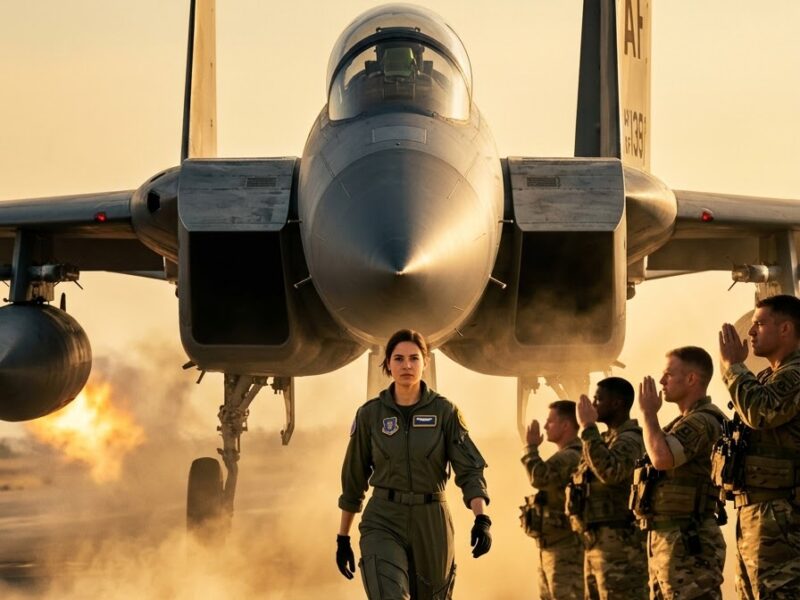
The Navy SEAL commander slammed his fist against the briefing table and demanded a combat pilot
The air inside Tactical Briefing Room B at Naval Station Norfolk was heavy, thick with the sharp tang of cheap coffee and the unspoken stench of desperation. Fluorescent lights hummed against the concrete walls, casting a stark, uncompromising light over twenty-five men in tactical gear. Every eye was fixed on the massive topographical map pinned to the wall, where a glowing red perimeter shrank by the minute around a trapped convoy in the treacherous teeth of the Hindu Kush.
Commander Hayes slammed his fist onto the mahogany briefing table, the sound detonating through the room like a gunshot. The heavy oak shuddered under the force.
“I don’t give a damn about protocol anymore!” Hayes’s voice was a gravelly roar, torn ragged by eighteen straight hours of failed extractions. His eyes, bloodshot and sunken, scanned the rows of assembled operators, contract specialists, and aviators. “We have an entire team of SEALs pinned in a dead-end canyon. Hostile artillery is walking toward their position meter by meter. They have less than six hours before they are completely overrun, and I have two down aircraft sitting in the dirt burning!”
He leaned over the table, his knuckles turning white as he bore his weight down. “I don’t need a politician. I don’t need a paperwork jockey. I need a combat pilot who can fly an MH-47 Chinook through an anti-aircraft envelope under zero-visibility blackout conditions, through a canyon narrower than a runway, with absolutely no margin for error. Who in this room can fly that route?”
Silence stretched over the room, heavy and suffocating. No one moved. The operators looked down at their combat boots; the staff officers stared at their notebooks. The mission had already swallowed two elite crews. The canyon was a kill box, controlled by hostile forces with low-altitude radar and heavy surface-to-air hardware. It was not a flight path; it was an execution chamber.
Hayes exhaled a sharp, bitter laugh that echoed off the cold concrete. “Nobody? An entire division of naval aviation, and I’m looking at a room full of corpses.”
In the very back row, tucked away in the shadows of the low ceiling where the light barely reached, I quietly pushed my chair back. The metal legs scraped softly against the floor. I stood up silently.
The movement was deliberate, unhurried. I was wearing an unadorned, olive-drab flight suit, devoid of squadron patches, unit insignias, or decorative ribbons. To the men in this room, I had been invisible—a nameless contract transport pilot hired to ferry personnel and light cargo along safe, mundane coastal routes.
Every head in the room pivoted.
A murmur rippled through the ranks of operators. Near the double doors, a young SEAL captain turned, looked me up and down, and leaned over to whisper to his teammate, “Her? Is he serious?”
I ignored the whisper, my eyes locked entirely on Commander Hayes. I stepped out from behind the desk and walked down the central aisle. My combat boots made a slow, rhythmically steady thud against the polished concrete.
Hayes watched me approach, his eyebrows pulling down into a hard, incredulous scowl. As I stopped at the edge of the briefing table, he looked me up and down, his gaze lingering on my faded flight suit and the thin, pale scars winding across the back of my left hand.
“Ma’am,” Hayes said, his tone dripping with condescension and exhaustion. “This isn’t a training exercise. This isn’t a logistics run to Jacksonville.”
“I know,” I said. My voice was calm, low, and devoid of tremor.
“Then sit back down and let the men figure this out.”
I didn’t move. Instead, I reached into the breast pocket of my flight jacket, pulled out a worn, leather-bound flight logbook and a set of steel-embossed military aviator credentials, and placed them flat on the map, directly over the red target zone.
Hayes stared at the credentials for a second. His expression shifted slightly, a flicker of doubt crossing his face, but he quickly recovered his gruff demeanor. He picked up the leather binder, flipped it open, and ran his thumb over the stamped seals.
“Captain Morgan,” he read aloud, his eyes widening almost imperceptibly as he tracked the flight hours listed on the inner pages. “Flight time: over four thousand hours. Aircraft certifications: rotary, fixed-wing, tilt-rotor… hostile low-altitude operations.” He snapped the book shut and stared at me. “Where did you serve? These unit designations are redacted. All of them.”
“Classified,” I replied smoothly.
A couple of officers at the side table exchanged amused, disbelieving glances. One chuckled under his breath. “Classified flight hours. Right. We’re taking contract ferry pilots off the bench now?”
Hayes pushed the logbook back across the glass table toward me. “We don’t have time for games, Captain. I have lives on the line.”
I reached down, picked up the book, and slid it back into my pocket without taking my eyes off his. “Then stop wasting it, Commander.”
The room went dead silent again. The amused glances vanished. The tone in the room shifted instantly from quiet dismissiveness to a taut, vibrating tension.
For six years, I had kept my military past buried beneath a clean, mundane civilian identity. To the personnel at Norfolk, I was Sarah Morgan, an unassuming contractor who flew routine medical evacuations and dull supply routes down the Eastern Seaboard. I answered no questions about the past. I deflected every inquiry about the jagged silver scars that tracked across my left wrist and hand—scars left behind by shrapnel and shattered cockpit glass.
Nobody in this room knew that before I was a contract pilot, I had been an operative for a covert joint-spec-ops aviation unit. I had flown low-level insertion missions into places that didn’t exist on public maps, where the terrain was as much an enemy as the armed insurgents on the ground.
Nobody knew why I had abruptly resigned my commission and vanished into the private sector.
And nobody knew the name of the high-ranking officer who had signed the catastrophic order that sent my final military mission straight into a trap.
Hayes stared at me for three long seconds, measuring the stillness in my posture against the ticking clock on the wall. He turned back to the map and pointed to the jagged red canyon carved into the digital topography.
“Our ground element is trapped here,” Hayes said, his tone shifting into businesslike severity. “The passage is less than ninety feet wide in some places. Vertical granite walls rising eight hundred feet on either side. Hostile forces hold both ridges with heavy machine guns and shoulder-fired anti-aircraft missiles. The extraction route is completely blocked.”
I stepped closer, leaning over the glass map to examine the elevation lines. “What was the entry vector of the first two downed birds?”
“High-altitude drop, descending into the canyon mouth at three hundred feet,” Hayes said. “Standard night-vision approach.”
“That’s why they’re dead,” I said bluntly. “They came in over the ridgelines. You gave the enemy gunners five full seconds of silhouette against the sky. At three hundred feet, a thermal tracking missile won’t miss.”
The SEAL captain who had whispered earlier stepped forward, his eyes burning. “That’s standard procedure for low-light insertion, Captain. You can’t fly a heavy transport helicopter through the floor of that canyon at zero altitude without painting the rotors against the rocks.”
“You can’t if you stay on the center path,” I replied, looking directly at him. “Not at the altitude you’re planning.”
Hayes squinted at me. “Then what do you suggest?”
“Fly lower. Drop into the river bed two miles before the canyon entrance. Stay ten feet off the surface of the water. Use the thermal wash of the river to mask the engine heat signature, and use the canyon walls themselves to block their radar horizon.”
“Ten feet off a rushing river in complete darkness?” the captain barked, shaking his head. “That’s suicide.”
I looked back down at the coordinates written at the bottom of the map page. My chest tightened, a cold sensation spreading through my veins. The coordinates for the canyon base were $34^\circ 52′ 11”\text{ N}, 69^\circ 14′ 08”\text{ E}$.
I knew those numbers. I didn’t need a map. I had flown those exact coordinates six years ago on the night my wingman, Lieutenant Daniel Vance, was shot down and burned alive in the cockpit of Flight Seven.
“It’s only suicide if you follow the original route,” I whispered.
Hayes noticed the sudden shift in my gaze. He looked at the coordinates, then up at my face. The clock on the wall chimed softly—five hours remaining.
“Take the aircraft,” Hayes said, slamming a clearance folder onto the desk. “Flight Deck Four. The Chinook is prepped and fueled. You have fifteen minutes.”
The rain was falling in heavy, wind-whipped sheets across the tarmac of Naval Station Norfolk as I walked toward the towering silhouette of the MH-47G Chinook. The twin rotors whipped in the gale, and ground crews cleared away fuel lines and grounding cables.
As I marched toward the ramp, my hands began to tremble. I clamped them into tight fists, driving my fingernails into my palms until the pain grounded me.
It wasn’t fear. It was memory.
The last time I had strapped into a cockpit for a mission in that canyon, I had watched Daniel’s helicopter hit the ground in a brilliant, blinding ball of orange flame. Command had radioed us mid-flight, overriding our low-level vector and commanding us to climb to five hundred feet—right into the waiting crosshairs of an anti-aircraft battery that shouldn’t have been there. Someone inside the operations center had sent us directly into an ambush. When I survived and demanded an investigation, my records were scrubbed, Daniel’s death was ruled pilot error, and I was quietly forced out of the service.
Now, six years later, those exact same coordinates had reappeared on a crisis briefing map in Norfolk.
I climbed the rear ramp, stepping into the dim red light of the Chinook’s cargo hold. Eight SEALs sat along the webbed jump seats, their faces painted in green and black camo, their weapons resting between their knees. Commander Hayes walked in right behind me, strapping himself into the jump seat directly behind the cockpit door.
I slid into the pilot’s seat, pulled on my helmet, and adjusted the night-vision goggle mount. My fingers flew across the overhead panels, flipping switches, bringing the twin turbine engines screaming to life. The vibration hummed through the frame, settling into my boots, into my teeth, into my spine.
The helicopter lifted off the wet pavement, nose pitching down as we accelerated into the dark, storm-swept night sky.
Two hours into the transit, as we entered the simulated long-range blackout transport envelope, the terrain below changed from dark ocean to rugged, moonlit peaks. The operational grid of the host country swallowed us whole.
Commander Hayes flipped his intercom switch. His voice sounded clear and tense over the headset. “Captain… I looked at your sealed personnel file right before we took off. Your record was cleared by an executive order from a top-level Pentagon director six years ago. How do you know this specific terrain so damn well?”
I stared out through the green tint of the night-vision display at the dark, jagged teeth of the mountain ridge rising ahead of us.
“Because I’ve been here before,” I said coldly. “And I left half my crew in the dirt.”
Before Hayes could respond, the horizon ahead ignited with flashes of distant artillery. The ground team’s canyon was just three miles out. Tracers arced through the sky like lines of fire, tearing through the cloud cover.
“Entering the canyon approach,” I announced over the comms, my hands completely steady now. “Going low. Hold on.”
I jammed the flight stick forward. The heavy helicopter plummeted toward the earth, dropping out of the clouds at terrifying speed. The ground rushed up to meet us—dark, jagged rocks, swirling white foam of the raging river—until we were hovering just twelve feet above the water, roaring between the massive granite walls of the gorge.
The air frame rattled violence as rounds from the rim struck the outer titanium hull. Thump-thump-thump! Sparks showered off the starboard side.
“Hold tight!” I barked into the mic, banking the massive dual-rotor machine sharply to the left, missing a protruding rock face by less than five feet. The rotor wash blasted thousands of gallons of river water into mist behind us, blinding any ground-based heat sensors.
Behind me, the SEALs braced themselves, clutching their weapons, eyes wide as they watched the canyon walls blur past the side bubbles.
Suddenly, a loud burst of static tore through the operational frequency in my headset. The encrypted military channel flared red on the dashboard screen.
An iron-cold voice came through the speaker, cutting cleanly through the ambient roar of the engines.
“All units, this is Command Directive Nine. Abort mission immediately. I repeat, abort mission immediately. Turn back to base status.”
Hayes unbuckled his harness slightly, leaning forward and slamming his hand onto the cockpit console, grabbing his mic. “Who the hell is this? This is Commander Hayes on operational authority! We are thirty seconds from the drop zone! We are not aborting!”
The static cleared. The voice on the other end was slow, calm, and hauntingly familiar.
“Commander Hayes, you do not have command authority over this vector. Turn the aircraft around, or you will be court-martialed for treason. Your pilot knows why.”
My heart stopped. The breath vanished from my lungs.
I knew that voice. I would know it if I heard it from the depths of hell. It was the calm, aristocratic tone of General Arthur Vance—the man who had signed my wingman’s cover-up report six years ago. The man who had sent his own nephew, Daniel, to die in this very canyon to protect a shadow weapons operation.
And he was still sitting at the head of the military command structure.
Hayes turned toward me in the dim red cockpit light, his face pale, his eyes wide with sudden suspicion and dread.
“Captain Morgan…” Hayes demanded, his hand reaching toward the secondary control override switch. “What the hell is going on? Who is that?”
I tightened my grip on the collective stick, my knuckles turning bone-white, and slammed the throttle forward, thrusting the helicopter deeper into the jaws of the canyon.
“Ask him what happened to Flight Seven,” I snarled.
Before Hayes could speak, the radio display screen flashed wildly, and the secondary frequency went completely dead.
And high up on the mountain ridge directly ahead of us, a set of heavy military floodlights flared to life, illuminating the narrow mouth of the canyon in a blinding wall of white light. Someone was waiting for us.
The blinding glare of the floodlights pierced through the front canopy, washing out my night-vision goggles in a flash of brilliant green overdrive. I ripped the goggle mount upward with one hand while holding the collective pitch steady with the other.
“Visual light overload!” I yelled over the engine roar. “Going raw optical!”
The canyon exploded into stark, terrifying detail. High on the eastern cliff edge, three heavy industrial spotlights mounted on armored vehicles were casting thick beams down into the riverbed, pinning our massive Chinook in a spotlight like a moth in a lantern.
“They were waiting for us!” the SEAL captain shouted, slamming his shoulder against the bulkhead as I pulled the helicopter into a steep bank. “How did they get heavy equipment onto that ridge? That’s restricted airspace!”
“It’s not restricted to them,” I growled through my teeth.
Tracers ripped through the darkness—heavy .50-caliber armor-piercing rounds stream-lining down from the cliffs. They slammed into the Chinook’s reinforced belly. Clack-clack-clack-clack! The aircraft shivered, the cockpit lights flickered violently, and a yellow master caution alarm began to chime on the main console.
“HYDRAULIC SYSTEM TWO PRESSURIZATION DROPPING,” the automated computer voice warbled calm and cold.
Hayes scrambled into the jump seat right beside me, his face illuminated by the red hazard indicators. “Morgan! That was General Vance on the secure net! Why is a member of the Joint Chiefs ordering a stand-down on a combat rescue operation? Talk to me!”
“Because the men you’re trying to save aren’t just an infantry unit, Commander!” I shouted over the deafening slap of the dual rotors and the incoming fire. “Look at your target dossier! Who is the ground commander down there?”
Hayes pulled up the digital tablet strapped to his thigh, his fingers flying across the touchscreen to open the classified roster of the trapped convoy. His eyes widened, reflecting the blue glow of the screen.
“Lieutenant Colonel Thomas Vance…” Hayes muttered, his voice dropping into shock. “General Vance’s youngest son.”
“Six years ago, General Vance ran an illegal arms-trafficking ring through this sector using black-budget military transports,” I said, banking hard to the right to dodge a ridge of jagged granite that tore away half of our landing gear light. “My unit found out. My wingman, Daniel Vance—the General’s eldest son—refused to play along. Daniel was going to go to the Inspector General. So the General altered our flight plans. He sent Daniel’s helicopter straight into a prepared insurgent kill box right here in this canyon.”
Hayes looked at me in total horror. “He murdered his own son?”
“He covered it up as an enemy ambush!” I yelled back, pulling the control stick back to lift the nose over a massive rock outcropping. “And now, Thomas must have found Daniel’s original logbooks. Thomas brought his team into this canyon to find the crash site and retrieve the flight recorder. The General isn’t trying to stop an insurgent attack, Hayes—he’s trying to bury his second son before the truth gets out!”
“Jesus Christ,” Hayes breathed, staring out at the storm of bullet fire cascading off the mountain walls.
“He didn’t account for me being the one to answer your call,” I said, my teeth clenched so hard my jaw ached. “Now hold on!”
I slammed the collective down, dropping the forty-ton helicopter into a radical headlong dive. We descended to within five feet of the roaring, foaming river rapids. The spray hit the windscreen in violent torrents, masking our thermal signature from the tracking arrays mounted on the cliff top.
Above us, the high-caliber fire raked empty air, missing us by twenty feet as the enemy gunners lost our vector against the dark water.
“Target perimeter down to one thousand yards!” the co-pilot yelled from my right. “I’ve got light signals from the ground! Strobe lights on the beach!”
Through the thick mist, I saw them: three infrared strobes flashing in a tight triangle on a tiny, gravel riverbank wedged beneath an overhang of towering granite. Around the beach, a small squad of six men had set up a defensive perimeter behind shattered rocks, returning fire upward against an enemy force that held the higher ground.
They were completely pinned. Behind them was an unscalable rock wall; in front of them was a raging river; above them was an enemy army.
“Preparing to land!” I shouted into the cabin comms. “Get the ramp down! Move, move, move!”
The rear ramp of the Chinook creaked open, admitting the cold night air and the deafening roar of ambient gunfire. The eight SEALs unbuckled their safety harnesses, weapons raised, ready to charge down the ramp the second rubber touched gravel.
I brought the Chinook into a flare, pitching the tail down to scrub off airspeed. The rear wheels touched down on the slippery river stones with a heavy, crunching thud. The front wheels hovered two feet over the water.
“Go! Go! Go!” the SEAL captain roared, leading his team off the ramp and into the icy water, firing their rifles into the darkness to cover the extraction.
I held the heavy aircraft rock-steady amidst the fury of wind, water, and lead. Through the side window, I watched four men drag two wounded soldiers down the bank toward the ramp. Leading them was a tall officer with blood running down the side of his tactical helmet—Lieutenant Colonel Thomas Vance.
In his hand, wrapped in a waterproof tactical bag, was a bright orange metal box.
The flight recorder from Flight Seven.
“Got the package!” Hayes yelled from the cabin. “They’re coming aboard!”
Suddenly, a loud, piercing screech echoed through my helmet headset. The master threat-warning system screamed in a continuous, high-pitched tone.
“MISSILE LOCK. MISSILE LOCK.”
High on the western wall, an operator stepped out onto a ledge with a shoulder-fired laser-guided missile launcher. The red target dot painted the nose of my helicopter.
“Out of the craft!” I yelled, but it was too late to maneuver. We were anchored to the ground by the weight of the boarding troops.
The launcher flared with a flash of bright white light. The missile burst from the tube, trailing a thick spiral of grey smoke, diving straight down toward the cockpit.
I didn’t hesitate. I jammed the left rudder pedal down, hauled back on the stick, and surged the engines to max power.
sequence of events slowed to a crawl. The rear wheels lifted, the tail swung wildly to the right, and the nose dipped into the river.
The missile missed the cockpit by less than three feet, streaking over the roof and detonating against the solid granite cliff directly behind us.
The blast wave hit the Chinook like a physical hammer. The force blew out the left-side cockpit windows, raining safety glass over my helmet and flight suit. The helicopter tilted dangerously to the left, the main rotors slicing through the top of a massive boulder on the shoreline.
CRASH!
The sound of shattering metal and titanium screamed through the air. A vibration so powerful it nearly tore my hands from the flight controls ripped through the entire frame. The left engine sensor panel erupted in red warning lights.
“ENGINE ONE FIRE! ENGINE ONE FIRE!” the computer shrieked.
The left engine died with a coughing gasp of smoke and flame. The single remaining engine screamed under the sudden, immense strain, its temperature gauges spiking into the red zone.
“We’re losing lift!” the co-pilot screamed, pulling his hands back from the controls as hot oil sprayed across his side panel.
“I have the aircraft!” I snarled, pulling the emergency fire-suppression handle for Engine One and pouring full power into the single remaining engine.
The Chinook groaned, shuddering like a dying beast, but slowly, miraculously, rose out of the mist and gravel. The rear ramp slammed shut as the last SEAL dragged Thomas Vance inside the cargo bay.
“We’re airborne!” Hayes yelled over the intercom. “But we’re burning! Morgan, we aren’t going to make it out of this canyon on one engine!”
I looked up through the shattered windscreen. The canyon exit was two miles ahead, but blocking the gap was a massive ridge line, and sitting right on top of it was the command center of the hostile force—illuminated by floodlights, bristling with heavy weaponry.
And sitting on the primary display map of my tactical console was a direct incoming transmission from the command cruiser sitting fifty miles off the coast.
General Vance’s face appeared on the small digital screen inside my cockpit. He looked immaculate, composed, and utterly cold.
“Captain Morgan,” the General said, his voice ringing through my helmet with terrifying clarity over the sound of my dying engine. “You were always an inconvenient survivor. You will not leave this valley alive. None of you will.”
I wiped a streak of blood from my forehead where a piece of flying glass had cut my skin, looked directly into the camera lens mounted on the dashboard, and bared my teeth.
“Watch me, General,” I whispered.
The single engine of the MH-47 Chinook howled in agony, a metallic, screeching whine that echoed off the sheer canyon walls. Thick black smoke rolled from the left engine housing, trailing behind us like a shroud in the moonlit sky.
Inside the cockpit, red light bathed everything. Alarms blared in a chaotic chorus: hydraulic pressure loss, rotor imbalance, engine overheat.
In the back, the heavy steel door of the cockpit swung open, and Commander Hayes stepped inside, accompanied by a tall, mud-splattered officer holding a dented, orange flight-data recorder.
Lieutenant Colonel Thomas Vance stared at me through the smoke-filled cockpit, his eyes wide with shock as he recognized the face behind the flight helmet.
“Sarah?” Thomas whispered, his voice trembling over the engine roar. “Sarah Morgan? You… you’re alive?”
I glanced back for a microsecond, my hands fighting the wild, violent bucking of the flight stick. “ Barely, Thomas. Sit down and buckle in before I lose control of this bird.”
Thomas stepped closer, gripping the back of my seat with a gloved hand. He held up the orange box. “I found it. I found Daniel’s flight recorder in the wreckage deep in the cave network. He logged everything before he went down. The illegal weapons shipments, the altered flight paths… my father’s authorization codes are embedded in the encrypted black-box memory.”
“I know,” I said, banking hard to avoid a looming wall of rock as the canyon narrowed even further. “He’s monitoring us right now. He gave the abort order. When we ignored it, he turned on the perimeter tracking lights.”
“He’s going to shoot us down,” Thomas said, his face going pale with the terrible realization of what his own father was capable of. “He can’t let this recorder reach the Joint Chiefs. It would destroy everything he built.”
“He tried it six years ago,” I said, my voice hardening to ice. “He isn’t going to succeed tonight.”
“Captain!” the co-pilot yelled, pointing to the primary flight display. “Engine Two temperature is at 1050 degrees! Turbine blades are melting! We have less than three minutes of powered flight before the rotor assembly seizes completely!”
I looked out the forward canopy. The canyon exit was visible ahead—a narrow, daylight-colored gap in the mountains where the moon was rising. But bridging that gap was a massive, fortified ridge line held by the General’s private military contractors. They had positioned two heavy dual-barrel anti-aircraft cannons right in the center of the passage.
We couldn’t fly over the ridge—our single remaining engine didn’t have the lift to carry a forty-ton helicopter up three thousand feet of vertical climb.
We couldn’t fly through them—the anti-aircraft guns would tear our unarmored hull into confetti before we got within a mile.
“We can’t climb out,” Commander Hayes said, looking at the altimeter dropping steadily. “Morgan, what are your options? Is there another turn? A side valley?”
“No,” I said calmly. “This is the only way out.”
“Then we’re dead,” the co-pilot whispered, his hands trembling on his knees. “That’s a wall of heavy flak ahead. We don’t have the speed to outrun it, and we don’t have the altitude to clear it.”
I didn’t answer. I looked down at the terrain map, my eyes fixing on a tiny, dashed line running directly beneath the fortified ridge.
It was an abandoned, flooded train tunnel built during the Soviet invasion in the late 1970s—a mountain cut designed to carry supply tracks through the granite ridge to the plains beyond. It was forty feet wide, thirty feet high, and ran straight through the mountain for nearly two miles.
The width of an MH-47 Chinook’s rotor span is eighteen feet… per rotor. The total clearance was less than four feet on either side.
“Sarah…” Thomas said, reading the terrain map over my shoulder, his voice dropping into absolute horror. “You can’t. That’s impossible. You’ll clip the blades on the tunnel entrance. You’ll instantly disintegrate the aircraft!”
“If we stay in the open, we die in thirty seconds,” I said, adjusting my grip on the collective pitch lever. “If we go into the tunnel, we might die in twenty. I like those odds better.”
“You’re insane!” the co-pilot yelled, reaching out to touch the controls.
“Touch those controls and I will throw you out of this shattered window myself!” I snapped, my eyes locking onto his with absolute, terrifying intensity. The co-pilot froze, pulling his hand back as if burned.
Hayes looked at me, then at Thomas, and finally down at the orange flight box. He took a deep breath, reached back, and grabbed the shoulder harness straps, pulling them tight against his chest.
“Do it, Captain,” Hayes ordered softly. “Get us home.”
I pushed the throttle forward to maximum override, pushing the screaming Engine Two past its operational limits. The helicopter surged forward, picking up speed as it plummeted down toward the dark base of the ridge.
On the ridge above, the anti-aircraft gunners saw us dropping. The twin barrels of the cannons flared with brilliant, blinding flashes of light. Heavy 30mm explosive shells streaked through the night sky, passing right over our roof as we dropped below their minimum depression angle.
“They can’t depress the guns far enough!” the co-pilot shouted in realization. “They’re firing over us!”
“They don’t need to hit us,” I warned. “The mountain will do it for them if I miss the opening by two inches.”
The mountain wall rushed toward us at one hundred and twenty knots. The dark, black square of the Soviet tunnel mouth appeared in the rock face—a pitch-black void surrounded by rough, unforgiving jagged granite.
It looked like the eye of a needle. We were a forty-ton thread travelling at terrifying speed.
“Hold on to something!” I screamed.
I lined up the nose with the exact geometric center of the dark opening. I pulled the rotor trim to absolute neutral, shutting off all automatic stability control systems. I needed raw, direct manual control. I had to feel the air currents through my fingers.
The tunnel mouth exploded into view.
SWOOSH!
The bright moonlight instantly vanished. Total, suffocating darkness swallowed the helicopter as we slammed into the mountain cavern.
The sound was unbelievable. The deafening, supersonic echo of our twin rotors beating against the enclosed stone walls roared through the cabin, threatening to shatter the glass that remained in the cockpit.
Clack-clack-clack-clack!
Sparks flew off the wingtips as the turbulence pushed us sideways, the rotor tips missing the jagged rock walls by inches. I fought the flight stick with every ounce of physical strength in my arms, my muscles burning, my lungs screaming for air. The scars on my left hand throbbed with white-hot pain as the scar tissue stretched under the immense physical strain.
“Left two feet! Left two feet!” the co-pilot screamed, reading the laser distance sensors. “Rock outcropping on the right!”
I kicked the left rudder pedal, sliding the tail sideways in a controlled drift through the subterranean darkness.
Ahead, a tiny pinpoint of natural light appeared at the far end of the tunnel—the exit leading out to the open plains of the border.
But as the light grew larger, the single remaining engine gave out a violent, metallic CLANG.
A cloud of black smoke exploded into the cockpit from the overhead vents. The rotor RPM gauge dropped off a cliff. The engine had finally disintegrated.
The helicopter lost all forward power, beginning to fall like a stone toward the concrete floor of the tunnel while still sliding forward at ninety knots.
“We’re losing lift!” Hayes yelled. “We’re crashing!”
“We’re gliding!” I snarled through gritted teeth.
I pushed the nose down, using gravity to maintain forward airspeed, converting our altitude into raw velocity. The belly of the Chinook scraped the concrete floor of the tunnel, sending a shower of bright yellow sparks through the darkness.
SCREEECH!
The metal frame skidded across the ground, bouncing wildly as we shot toward the light at the end of the tunnel.
We burst out of the mountain face into the bright, clear moonlight of the open valley, airborne for one brief, miraculous second—before plunging down toward a steep, sloping field of soft snow and gravel.
“Brace for impact!” I screamed.
The belly hit the slope. The remaining landing gear sheared off instantly. The massive Chinook slid down the mountain slope like a runaway sled, throwing up a towering wall of white snow and dirt, tearing through small trees and brush, before finally grinding to a halt at the bottom of the valley, resting on its side in absolute, dead silence.
Silence fell over the cockpit.
The roaring engines were dead. The alarms had flickered out. The only sound remaining was the quiet, steady dripping of hydraulic fluid on hot metal and the sound of my own ragged, desperate breathing.
I sat motionless in the pilot seat, my hands still gripping the dead flight stick.
Beside me, Hayes let out a long, shuddering breath. He unbuckled his harness, turned to Thomas, and checked his pulse. Thomas was breathing, bleeding from a cut on his head, but alive—and his hands were still locked tightly around the orange black box.
“Everyone… check in,” Hayes called out into the darkened cargo hold.
One by one, voices responded from the back. Cuts, bruises, a broken arm—but every single man who had entered that helicopter in Norfolk was alive.
Hayes looked at me, his eyes filled with an overwhelming, profound respect. “Captain Morgan… that was the most insane piece of flying I have ever seen in my life.”
I didn’t answer. I unclipped my helmet, pulled it off, and wiped the blood and sweat from my face.
Through the shattered front windshield, I looked out across the valley floor. Three miles away, a squad of friendly rescue humvees and armored transports was rushing across the plains toward our crash site, their headlights flashing in the dark. We had made it across the international border. We were in safe territory.
But as I reached down to unbuckle my harness, the radio console on the dashboard—powered by a surviving emergency backup battery—flickered to life one last time.
A quiet, low voice spoke through the speaker.
“You think you’ve won, Sarah?”
It was General Vance. He was speaking from his secure office, his voice devoid of anger, replaced by a dark, chilling certainty.
“You have a broken helicopter and an old flight recorder. I have the entire Pentagon communications grid. By the time those rescue vehicles reach you, the news media will report that Captain Sarah Morgan went rogue, hijacked a military transport, and executed an unauthorized strike. You will be arrested for high treason the moment you step out of that wreckage.”
I sat back in my seat, slowly leaning forward toward the dashboard microphone. A slow, quiet smile spread across my face.
“You forgot one thing, General,” I whispered into the mic.
“And what is that?” Vance sneered over the static.
I reached out and pressed a small, green button on the side of the tactical console—a button that had been illuminated throughout our entire flight through the canyon.
“I didn’t just record the black box,” I said softly. “When I took this aircraft, Commander Hayes activated the live tactical broadcast system. Every word you’ve spoken—every abort order, every threat, every order to open fire on your own son—has been broadcast live to the Joint Chiefs of Staff and the Senate Armed Services Committee for the last forty minutes.”
Silence fell over the radio line. The arrogant composure on the other end vanished instantly, replaced by a sudden, sharp intake of breath.
“Check your secure comms, Vance,” I added, my voice dripping with cold triumph. “I think your door is about to get kicked in.”
The radio line died with a faint, static click, leaving behind only the whistle of the cold night wind passing through the shattered canopy of the Chinook.
For a long moment, no one inside the downed helicopter moved. The silence in the cabin was total, heavy with the incredible weight of what had just transpired.
Commander Hayes sat back in his seat, a low, breathy chuckle escaping his lips. He looked at the glowing green indicator light on the secondary console—the live tactical relay switch that he had silently flipped the moment we cleared the air base at Norfolk.
“He never checked the secondary telemetry channel,” Hayes said, his voice rich with satisfaction. “He was so focused on stopping us in the gorge that he didn’t realize the entire High Command was listening to his voice on a five-second delay.”
Lieutenant Colonel Thomas Vance unbuckled his harness, painfully swinging his legs out onto the tilted floor of the cockpit. He held the orange flight-data recorder against his chest like a holy relic. Blood trickled down his cheek from a gash along his hairline, but his eyes were bright, filled with a mixture of profound grief and absolute relief.
“It’s over,” Thomas whispered, staring at the small metal box. “Six years… and it’s finally over.”
“It’s not over until we hand that box directly to the Federal Prosecutor,” I said, unlatching my safety harness and sliding out of the pilot’s seat.
My knees buckled slightly as my feet hit the tilted deck, the adrenaline that had sustained me for the last three hours finally beginning to drain from my muscles. The scars on my hand throbbed, a dull, deep ache that reached all the way to the bone, but for the first time in six years, the heavy, suffocating pressure in my chest felt lighter.
Outside, the heavy roar of diesel engines signaled the arrival of the friendly extraction force. Headlights washed over the shattered fuselage of our helicopter, illuminating the dense cloud of steam still rising from our destroyed engines.
The rear ramp of the Chinook creaked open from the outside, pushed down by a team of heavily armed military policemen and field medics.
“Clear the area! Secure the perimeter!” an officer shouted from the daylight outside.
Hayes stepped down the ramp first, holding his hands up to signal the medics. “Stand down! We have wounded onboard, including Lieutenant Colonel Vance. Get the medical team up here now!”
Medics rushed into the cargo hold, setting up stretchers and attending to the injured SEALs. The operators, bruised and battered but alive, refused to be carried, walking out on their own strength, their arms wrapped around each other’s shoulders.
As I stepped down the ramp onto the cold, snowy grass of the valley floor, the night air hit my face like a slap of freezing water. I pulled off my flight gloves, stuffed them into my pocket, and turned back to look at the wreckage of the Chinook.
The tail section was twisted at a sharp angle; the main rotor blades were sheared into jagged stubs; the left engine was a blackened shell of warped metal. The aircraft was a total loss—a pile of metal resting at the base of an impossible mountain.
Yet, it had brought us through the fire.
A black armored SUV detached itself from the convoy of rescue vehicles and pulled up directly beside the ramp. The rear door opened, and a tall woman in a sharp navy-blue suit stepped out into the snow, escorted by two plainclothes federal agents wearing brass badges on their belts.
It was Assistant Director Evelyn Reed of the Department of Justice—the lead investigator for military corruption whom I had attempted to contact six years ago before my records were scrubbed.
Reed walked past the armed guards, her eyes scanning the scene until they locked onto me. She looked at my blood-spotted flight suit, the silver scars on my hand, and the quiet, unyielding posture I held.
“Captain Sarah Morgan,” Reed said, her tone professional, though a flicker of immense respect showed in her eyes. “It’s been a long time.”
“Director Reed,” I replied, stepping forward. “You listened to the broadcast?”
“The entire Joint Chiefs of Staff listened to it in Emergency Briefing Room 4 at the Pentagon,” Reed said, stepping closer. “General Arthur Vance was taken into federal custody four minutes ago at his desk in Arlington. His security clearance has been revoked, his assets frozen, and federal Marshals are currently raiding his residential compound.”
Thomas Vance stepped down the ramp, supported by Commander Hayes. He walked over to Director Reed, holding out the orange black box with trembling hands.
“This is the flight recorder from Flight Seven,” Thomas said, his voice thick with emotion. “It contains the unedited voice logs, the altered navigational markers, and the direct encrypted orders signed by my father that sent Daniel and his crew to their deaths.”
Reed took the heavy metal box with great care, passing it to the federal agent beside her, who placed it into a secure, padded evidence case.
“This box will never leave federal custody, Colonel,” Reed assured him gently. “Your brother’s name—and the names of every crew member on that flight—will be fully cleared by morning.”
Thomas nodded slowly, tears cutting pale tracks through the soot and grime on his face. He turned to me, his hand reaching out to grasp mine. His grip was tight, filled with a gratitude that words could never fully express.
“Thank you, Sarah,” Thomas whispered. “You didn’t just save my men tonight. You saved my brother’s memory.”
“Daniel was my wingman,” I said softly, squeezing his hand back. “I don’t leave my crew behind. Not then. Not now.”
Hayes stepped up beside me, clapping a heavy hand on my shoulder. “Captain Morgan… your civilian contract status is officially terminated as of this moment.”
I looked at him, raising an eyebrow. “Is that so, Commander?”
“Effective immediately,” Hayes said, a rare, genuine smile breaking across his scarred face. “The Navy is reinstating your active commission at the rank of Commander. And if I have any say in the matter, you’re going to be leading the entire tactical flight instruction division at Miramar.”
I looked back at the towering mountain ridge looming in the distance—the dark, jagged peak where I had lost my wingman six years ago, and where I had finally brought his killers to justice tonight. The first rays of dawn were beginning to break over the Eastern horizon, painting the sky in deep shades of gold, rose, and brilliant amber.
The shadows that had haunted my life for six years were finally vanishing in the light.
“I’ll think about it, Commander,” I said, a faint smile touching my lips. “But first… I think I’ve earned a decent cup of coffee.”
Six months later.
The morning sun over Southern California washed the tarmac of Naval Air Station Miramar in bright, blinding gold. The desert air was crisp and clear, carrying the sharp scent of jet fuel and warm asphalt.
A line of six brand-new MH-47G Chinooks sat in a neat, impressive row outside Hangar 3, their polished dual rotors glistening under the summer sky. Ground crews in neon vests moved around the aircraft, conducting pre-flight checks, hauling equipment, and loading training ordnance.
I stood near the open doors of the hangar, wearing a crisp, tailored green flight suit bearing new silver oak leaves on the collar—Commander Sarah Morgan. On my left breast was pinned the Distinguished Flying Cross, awarded three months ago in a private ceremony at the White House.
The scars on my left hand were still there, jagged and pale against my skin, but they no longer felt like a reminder of defeat or betrayal. They felt like armor.
Footsteps echoed across the polished concrete floor of the hangar behind me. I turned to see a young lieutenant walking up, holding a flight clipboard. He stopped two paces away, coming to a crisp, perfect military salute.
“Commander Morgan!” the young pilot said, his voice full of tight, nervous energy. “The student aviators are assembled in Briefing Room A. They’re waiting for your introductory address.”
I looked at the young pilot. He couldn’t have been more than twenty-five—bright-eyed, ambitious, eager to prove himself in the sky, completely unaware of how dark the sky could become when power and greed intervened.
“Thank you, Lieutenant,” I said smoothly. “Is Commander Hayes in position?”
“Yes, ma’am. He just landed from Norfolk. He’s in the observer gallery right now.”
I nodded, reaching into my locker to retrieve my leather flight jacket. As I zipped it up, my eyes caught a framed photograph resting on the small shelf inside the locker.
It was a faded, sunny photograph taken seven years ago. In it, Daniel Vance stood beside me in front of an older model transport, his arm thrown over my shoulder, both of us laughing under a wide, blue sky. Resting right beside the frame was the restored flight stick handle from Flight Seven, retrieved from the wreckage and presented to me by Thomas Vance after his father’s sentencing.
General Arthur Vance had been convicted on twenty-six counts of treason, murder, and high-level military corruption. He was currently serving a life sentence without the possibility of parole in a federal maximum-security facility. The network of black-market contractors he had built was dismantled down to the last dollar.
The truth had won. The debt had been paid.
I reached out, touched the edge of the wooden frame softly, and closed the locker door.
I walked down the long, echoing corridor toward Briefing Room A. As I reached the heavy double doors, I could hear the muted hum of twenty young voices inside—the elite selectees of the new Joint Special Operations Aviation Command training initiative.
I pushed the doors open and stepped inside.
The room immediately went dead silent. Twenty young men and women in pristine flight suits stood up as one, coming to attention with military precision.
I walked down the central aisle, my combat boots clicking rhythmically against the floor, exactly as I had done six months ago in that dim, hopeless briefing room in Norfolk.
I stopped at the head of the mahogany briefing table, turning to face the class. In the back row, standing near the glass observer gallery, Commander Hayes gave me a quiet, approving nod. Beside him stood Thomas Vance, now serving as a senior tactical advisor for ground forces.
I looked across the faces of the young pilots staring back at me. I saw ambition, I saw skill, but most of all, I saw the unspoken arrogance that comes with youth and raw talent.
“Sit down,” I said softly.
The room settled as one, twenty pairs of eyes locked onto me.
I leaned forward, resting my hands flat on the wooden table, allowing the bright sunlight streaming through the windows to catch the silver scars across my left wrist.
“You are here because you are the absolute best aviators your squadrons had to offer,” I began, my voice carrying clearly through the room, low, powerful, and commanding total attention. “You have thousands of flight hours. You have mastered every simulator, passed every physical test, and cleared every security check.”
I paused, letting my eyes sweep slowly across every single person in the room.
“But none of that matters when you enter the canyon,” I said softly. “In this command, you will not just learn how to fly an aircraft through textbook maneuvers. You will learn how to make decisions when every instrument on your panel fails, when every order coming over your headset is compromised, and when the mountain itself seems determined to swallow you whole.”
I pulled up a digital file on the main screen behind me. A topographical map of a dark, jagged canyon in the Hindu Kush appeared on the wall—the elevation lines, the riverbed, the narrow Soviet train tunnel.
“This was Flight Seven,” I continued, pointing to the screen. “Six years ago, a crew was sent into this canyon under false orders. They were betrayed by the very authority that sent them. For six years, the truth was buried beneath classified stamps and lies.”
The young pilots leaned forward, hanging on every single word, the atmosphere in the room turning dead quiet and thick with intense focus.
“You will hear people tell you that a pilot’s only duty is to obey orders,” I said, looking each of them in the eye. “I am here to tell you that your highest duty is to the men and women flying beside you, and to the truth of the mission you carry. When the lights go out, when the alarms shriek, and when everyone else runs for cover… you fly straight through the storm.”
I turned to the whiteboard behind me, picked up a marker, and wrote five digits cleanly across the top:
$34^\circ 52′ 11”\text{ N}, 69^\circ 14′ 08”\text{ E}$
I capped the marker, turned back to the room, and crossed my arms over my chest.
“Open your flight manuals to page one,” Commander Sarah Morgan said, a quiet, unbreakable fire burning in her eyes. “Let’s begin.”
The end.









