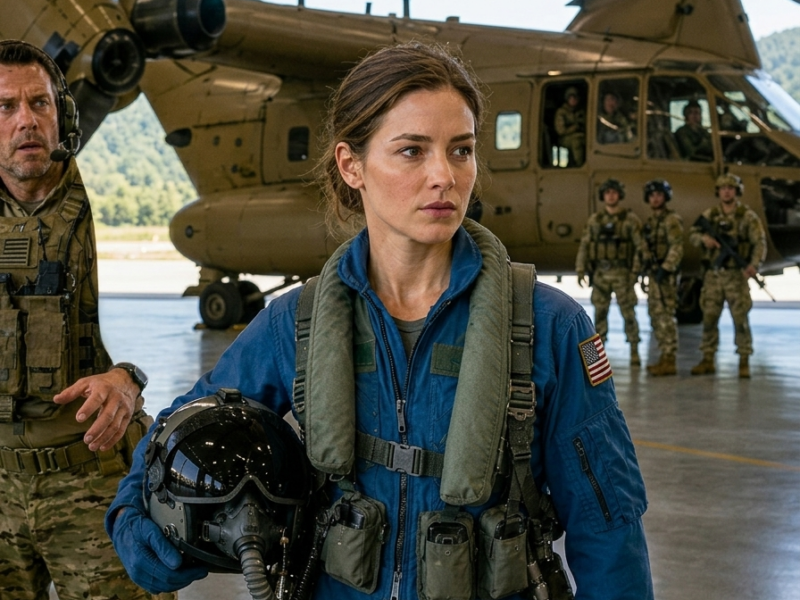
The Navy SEAL commander laughed when I volunteered to pilot the massive experimental aircraft that had grounded three senior aviators
The laughter inside the ready room of Fighter Squadron 103, the famous “Jolly Rogers,” at Naval Air Station Oceana was loud enough to vibrate the steel doorframe.
It was a cold November morning, and the room was packed with the navy’s most competitive strike fighter pilots. Flight suits were decorated with tactical patches from deployments across the Persian Gulf and the South China Sea. Helmets rested on leather-backed chairs, and steam rose from battered coffee mugs. At the center of the noise stood Lieutenant Mark “Grizzly” Vance, a broad-shouldered F/A-18E Super Hornet pilot who boasted sixty combat sorties and had never met a room he couldn’t dominate with his voice.
Then the door swung open.
A young woman stepped across the threshold, carrying a heavy flight bag in one hand and a freshly typed set of duty orders in the other. She was short, slender, and wore a flight suit that looked slightly too crisp, as if it had been issued only a few days prior. Her boots were spotless. Her dark hair was tied back in a tight, practical knot, and her face carried a quiet, unreadable calm that immediately set her apart from the loud, boisterous energy of the room.
“Well, look at what the carrier mail delivery brought us,” Grizzly called out, leaning back in his chair and crossing his arms. “Did the flight school accidentally drop off a tour guide?”
Laughter rippled across the ready room. Several pilots grinned into their coffee cups, while others shook their heads in amused disbelief.
“She doesn’t even look heavy enough to keep the ejection seat balanced,” another pilot chimed in, tossing a crumpled paper cup toward the trash bin. “You lost, Lieutenant? The administrative building is two hangars down.”
Lieutenant Maya Lin did not flinch. She kept her eyes focused straight ahead, walking with a measured, deliberate pace until she reached the desk at the front of the room. She placed her orders flat on the surface and stood at attention.
“Lieutenant Maya Lin reporting for duty as assigned,” she said. Her voice was surprisingly deep for her frame—clear, low, and completely devoid of nervousness.
Grizzly stood up, walking over with a smirk playing on his lips. He looked down at her orders, then at her flight chest badge. “Lin… Lin… right, the replacement wingman from Pensacola. Look, kid, Oceana isn’t flight school. We fly low-altitude intercept missions over the Atlantic in zero-visibility weather. We don’t have time to hold your hand while you figure out how to trim your throttles.”
“I don’t require my hand to be held, sir,” Maya replied softly.
“Is that so?” Grizzly laughed, turning back to the room to make sure everyone was watching. “You think you’re ready to fly slot on my wing for this morning’s radar intercept exercise?”
“I am ready to fly wherever the squadron commander assigns me,” she said.
The door to the ready room opened again, and a sudden hush fell over the pilots. Commander Richard “Viper” Hayes, the Commanding Officer of VFA-103, walked into the room. He was a veteran aviator with silvering hair at his temples and a face lined by thousands of hours in high-G maneuvers. He scanned the room, his sharp eyes landing instantly on Maya.
“Drop the chatter,” Hayes commanded, his voice slicing through the remaining murmurs. “Lin, you made it. Orders in order?”
“Yes, Commander,” Maya said, handing him her folder.
Hayes glanced through the paperwork, nodding slowly. “Good. We’re short on airframes today, but two Super Hornets are prepped on the flight line. Lin, you’re flying tail number 204 in thirty minutes for a low-level navigation and tactical engagement trial against Grizzly.”
Grizzly smirked. “I’ll go easy on her, Commander. Don’t want her turning around before we even clear the coast.”
Hayes didn’t smile. “Just fly your profile, Vance.”
Twenty minutes later, the flight line was cold and windy. Gray clouds hung low over the Virginia coast, and the smell of jet fuel filled the damp air. The ground crew was making final checks on two F/A-18E Super Hornets parked side by side on the concrete apron.
Grizzly walked toward his aircraft, still making casual jokes with his crew chief about ending the dogfight drill early so they could get lunch. Maya walked quietly toward aircraft 204, her flight helmet tucked under her arm.
Commander Hayes stepped out onto the tarmac to watch the startup sequence, standing beside the maintenance chief. As Maya climbed up the boarding ladder, Hayes looked at the canopy rail of tail number 204. The ground crew had just finished painting her official call sign beneath the cockpit canopy—a standard procedure for newly assigned squadron pilots based on their permanent records sent from naval intelligence and flight evaluation commands.
Hayes took a step closer, squinting against the glare of the ground lights.
Beneath the pilot’s name, painted in crisp, bold black letters against the haze-gray paint, was a single word:
“SPECTRE-01”
Hayes froze. The color slowly drained from his face.
The maintenance chief glanced at Hayes, noticing his expression. “Something wrong with the lettering, Boss?”
Hayes didn’t answer. His eyes were wide, fixed on the painted letters. “Spectre-01…” he whispered to himself, his fingers tightening into a fist against his coat pockets. “That’s not a flight school designation. That’s a black-budget classified call sign.”
He remembered a briefing five years ago at the Naval War College in Newport—a highly classified debriefing regarding an experimental stealth aggressor unit that operated out of Tonopah Test Range in Nevada. The unit was composed of pilots who had flown dark missions over restricted airspaces without official flight plans, radio signatures, or radar footprints. Only three pilots had ever qualified for the program. Two had died in classified incidents. The third was nicknamed The Ghost of Tonopah—the only aviator to ever log a flawless zero-detection score against an entire integrated air defense grid.
Hayes turned abruptly and looked up at the cockpit. Maya was already strapped into her ejection seat, her oxygen mask connected, her gloved hands moving across the instrument panels with a speed and mechanical precision that looked inhuman. She didn’t look at the switches; her fingers moved by pure muscle memory, flipping breakers and arming systems without a single second of hesitation.
Grizzly’s jet roared to life next to hers, its twin GE F414 engines whining loudly as he taxied out onto the runway, giving a mock salute toward her cockpit.
Maya did not return the salute. She closed her canopy, lowered her dark visor, and brought her engines to idle.
Hayes grabbed his radio headset, pressing the push-to-talk button on his belt. “Vance, listen to me,” Hayes said, his voice tense and urgent over the radio frequency. “Change the drill profile. Do not engage in a visual dogfight. Maintain safe distance and observe.”
“Say again, Commander?” Grizzly’s voice crackled through the helmet speaker, sounding confused. “It’s just a rookie evaluation flight. I’m going to run her through a basic split-S and teach her how to keep up.”
“Vance, that is an order!” Hayes snapped. “You don’t know who—”
Before Hayes could finish his sentence, Maya’s jet surged down the runway. Aircraft 204 didn’t use full afterburner for a standard takeoff; she executed a short-field tactical roll, rotated the nose violently at the exact minimum speed required for lift, and pulled the Super Hornet into a vertical climb that broke through the gray cloud ceiling in less than four seconds.
On the ground radar display in the control tower, aircraft 204 flickered once… and then completely vanished.
“Tower, this is Grizzly, I’ve lost visual on 204!” Vance’s voice echoed through the control room speaker, no longer sounding smug or relaxed. “She punched right through the soup at cloud base. Radar isn’t picking up her transponder!”
Inside the tower, Commander Hayes pushed past two air traffic controllers and leaned over the main tactical radar screen. The screen showed Grizzly’s aircraft—designated Jolly 01—circling at twelve thousand feet over the Atlantic, five miles off the coast of Virginia Beach. But the space around him was entirely empty.
“Check her transponder code!” Hayes ordered the radar operator.
“Sir, her squawk code is completely clear, but there’s no primary radar return,” the operator replied, his hands flying across the keyboard. “It’s like the airframe isn’t reflecting our signal at all. How is that possible on a standard F-18?”
Hayes knew the answer. It wasn’t the airframe itself—it was the way she was flying it.
Pilots trained in high-level low-observable warfare knew how to align an aircraft’s wings, nose, and control surfaces relative to ground-based radar emitters to minimize radar cross-sections, using local atmospheric density and radar dead zones to render even non-stealth aircraft practically invisible to standard tracking networks.
Up at fifteen thousand feet, inside the cockpit of aircraft 204, Maya Lin felt the heavy hum of the Super Hornet through her spine.
Her heart rate was a steady fifty-eight beats per minute. The cockpit around her was an extension of her own nervous system. To Maya, the jet was not a complex collection of metal, hydraulics, and wire; it was a breathing organism, and she understood its limits better than the engineers who had designed it.
She adjusted her throttle by a fraction of an inch, banking the aircraft into a hard seven-G turn that brought her jet directly into Grizzly’s radar blind spot—the precise zone behind his tail where his radar dishes could not tilt far enough to track.
“Grizzly, this is Spectre,” her voice came over the tactical frequency, calm and smooth. “Check your six.”
Grizzly violently turned his head in his cockpit, looking back over his left shoulder. There was nothing there except open gray sky and clouds.
“Where the hell are you, Lin?” Grizzly growled, his breathing heavy as he yanked his stick to the left, trying to force his radar to scan the airspace behind him. “Quit playing games with the transponder!”
“I haven’t touched the transponder, Lieutenant,” Maya replied softly. “You’re looking with your radar. You should be looking with your eyes.”
Grizzly reversed his turn, banking hard into a descending spiral to gain speed, his eyes frantically searching the empty sky. Sweat began to bead on his forehead inside his helmet. For six years, he had been the undisputed top stick in VFA-103. He had won every mock engagement in training exercises against air force and navy pilots alike. But now, in his own home airspace, he felt completely exposed—like an animal being tracked by a predator it couldn’t see.
Suddenly, a loud, continuous tone sounded inside Grizzly’s helmet.
WARNING. SYSTEM LOCK. MISSILE ENGAGEMENT.
Grizzly flinched, staring down at his tactical display screen. A simulated weapons lock indicator was flashing red in the center of his glass cockpit. The lock wasn’t coming from ahead, above, or behind. It was coming from directly below him—less than two hundred feet under his belly, matching his altitude, speed, and roll rate perfectly.
He looked down through his cockpit deck window.
Positioned mere meters beneath his fuselage was aircraft 204. Maya was flying upside down, canopy to belly, her dark visor raised just enough for him to see her eyes. She was holding her aircraft inverted with absolute, unwavering stability in turbulent air, perfectly locked onto his flight path.
If this had been a live combat scenario, Grizzly’s aircraft would have been shredded by cannon fire before he even knew she was there.
Grizzly’s breath caught in his throat. “How… how did you get down there without setting off my collision warning?”
“Your collision warning operates on Doppler radar shifts,” Maya explained over the radio, her voice showing no sign of exertion despite holding a complex inverted maneuver. “If I match your airspeed vector down to the knot, your computer assumes I’m ground clutter.”
She smoothly rolled aircraft 204 right-side up, pulled ahead of his wing, and stabilized in formation beside him.
In the control tower, Hayes watched the tracking data reappear as Maya intentionally turned her transponder back on.
“Commander,” the radar operator whispered, looking up at Hayes with wide eyes. “She was behind him for three minutes without a single radar blip. Who is this girl?”
Hayes stood silently, watching the two jet icons on the screen side by side. He pulled out his secure military phone and dialed a private extension at the Pentagon’s Chief of Naval Operations office.
The line connected after two rings.
“This is Hayes at VFA-103,” Hayes said in a low voice. “I have a pilot here named Maya Lin. Her canopy carries the call sign Spectre-01.”
There was a long pause on the other end of the line. The sound of papers shuffling echoed through the receiver.
“Commander Hayes,” a stern voice replied from the Pentagon. “You were not supposed to be notified of her assignment until tomorrow morning. Secure the hangar immediately. Maya Lin is not at Oceana for routine flight duty.”
Hayes felt a chill run down his back. “What is she here for?”
“An hour ago, an unidentified airborne threat entered restricted airspace over the North Atlantic, three hundred miles off the eastern seaboard,” the voice answered. “It bypassed two carrier strike group radar nets. We believe it is an autonomous high-altitude experimental platform carrying classified telemetry. We needed the only pilot in the U.S. Navy capable of intercepting an target that doesn’t exist on radar.”
Hayes looked through the tower glass at the darkening sky. “You sent her here to hunt a ghost.”
“No, Commander,” the voice corrected. “We sent her because she is the ghost.”
The brief inside the secure compartment of the VFA-103 headquarters was conducted in near-total darkness, illuminated only by the blue light of satellite maps projected onto the wall.
Only three people were in the room: Commander Hayes, Lieutenant Grizzly Vance, and Lieutenant Maya Lin.
Grizzly sat in the front row, his former arrogance completely gone. He kept glancing over at Maya, who sat two chairs away, her hands folded neatly in her lap, her expression entirely relaxed despite the heavily armed guards standing outside the door.
Hayes pointed a laser pointer at a satellite thermal image on the screen.
“At 0400 hours, NORAD sensors picked up a faint thermal anomaly passing over Greenland at an altitude of seventy thousand feet,” Hayes explained. “It didn’t register on radar networks because its skin is coated with an active radar-absorbent polymer that scatters high-frequency signals. It bypassed our air defense zone in Maine and is currently holding a holding orbit over the Atlantic, two hundred miles off the coast of Norfolk.”
“Is it foreign?” Grizzly asked, his voice subdued.
“We don’t know,” Hayes replied. “It’s not transmitting an identification signal, and it’s flying at an altitude that standard atmospheric fighters can’t easily reach or sustain. The Pentagon wants a visual identification and a telemetry scan before it clears our territorial waters.”
“Why not launch the alert fighters from NORAD?” Grizzly pressed. “They have F-22s standing by at Langley.”
“The F-22s launched two hours ago,” Hayes revealed. “They couldn’t acquire a stable weapons or camera lock. The target’s thermal signature is shifted into a non-standard spectrum, and every time the F-22s tried to close distance, the object executed automated evasive maneuvers that matched their radar sweeps. It’s using an AI flight controller that predicts human radar engagement patterns.”
Hayes turned his eyes toward Maya.
“Which brings us to Lieutenant Lin,” Hayes said. “The Pentagon believes this object is using flight algorithms derived from the Spectre Project—a dark-budget drone initiative that was stolen from a defense contractor three years ago. Maya was the lead test pilot who developed the counter-intercept tactics for that exact flight profile.”
Maya spoke for the first time since entering the brief. “The program was called Project Archangel. The drone doesn’t dodge aircraft; it dodges radar waves. If you fly toward it using standard tactical radar, its sensors feed off your emissions to calculate your exact approach vector and slip through your blind spots.”
“So how do we catch it?” Grizzly asked.
“You don’t catch it with radar,” Maya said, standing up and walking toward the screen. “You catch it by flying completely dark. No radar, no radio, no heat-tracking link. You fly on dead reckoning and visual reference, placing your aircraft in the exact geometric dead zone where its AI logic assumes no human pilot can stay.”
“That’s insane,” Grizzly muttered. “At seventy thousand feet, the air is so thin your control surfaces barely bite. One slip in angle of attack and you enter a flat spin you can’t recover from.”
“I know,” Maya said calmly. “That’s why I’m flying the primary airframe.” She turned to Grizzly. “And I need you as my high-altitude relay.”
Grizzly blinked, caught off guard. “Me?”
“You have the highest flight-hour count in this squadron, Lieutenant,” Maya said, looking him dead in the eye. “Your instincts are heavy-handed, but your stick control in high-G environments is stable. I need a wingman who can hold altitude at sixty thousand feet without drifting while I make the intercept underneath.”
Grizzly looked at her for a long moment. The mock confidence he had worn earlier in the day was replaced by a solemn, deep respect. He nodded once, firmly. “Tell me what you need me to do.”
Thirty minutes later, two Super Hornets sat at the end of Runway 05 Right, their twin engines roaring in full afterburner, blue fire shooting twenty feet out of their exhaust nozzles.
Unlike the morning flight, both jets were loaded with specialized long-range fuel tanks and pod-mounted optical sensors under their wings.
“Jolly Flight, you are cleared for departure,” the tower controller’s voice sounded over their helmets. “Godspeed.”
Maya pushed her throttle past the detent. Aircraft 204 leaped forward, taking to the night sky like a phantom, with Grizzly’s jet climbing tightly beside her. They climbed straight into the blackness above the Atlantic Ocean, leaving the lights of the Virginia coast behind as they ascended into the frozen, quiet outer layer of the atmosphere.
As they passed forty thousand feet, the sky transformed from dark blue to an absolute, starlit black. The air temperature outside dropped to sixty degrees below zero.
“Passing fifty thousand feet,” Grizzly reported, his breathing heavy through his oxygen regulator. “Control surfaces are getting soft. Stick feels like butter.”
“Stay steady, Grizzly,” Maya’s voice echoed in his helmet, firm and steady. “Passing sixty thousand. Disengaging radar systems now.”
Inside Maya’s cockpit, every electronic display screen went dark. She flipped off her primary radar, her tactical data link, and her radio transmitters. She was flying entirely blind to the outside world, relying solely on her optical HUD display and her inner ear.
Above them, hovering quietly in the thin, void-like atmosphere at seventy thousand feet, a massive, dark, diamond-shaped object drifted silently through the night—completely unaware that a ghost was rising from the darkness below.
At sixty-five thousand feet, the upper atmosphere was eerie and silent. The horizon of the Earth curved gently below, marked by a thin, glowing blue line of oxygen scattered against the black expanse of space.
Grizzly’s jet was struggling. At this extreme altitude, the thin air provided barely enough lift to keep his heavy F/A-18 flyable. His cockpit warning lights flickered repeatedly as his engines hovered near the margin of an aerodynamic stall.
“I’m… at my ceiling, Spectre,” Grizzly gasped into his mask, pulling his stick gently to keep his nose level. “I can’t go higher without losing engine compression!”
“Hold sixty-two thousand, Grizzly,” Maya replied over the short-range, low-frequency laser communications link—a tight-beam system that could not be intercepted by radar receivers. “Maintain your position as my visual anchor. If I go offline, transmit your telemetry directly to Norfolk.”
“Copy that… don’t stay up there too long, Maya. The air is empty down here, but up there, it’s vacuum.”
Maya didn’t answer. She pulled her stick back, pitching Aircraft 204 into an aggressive climb toward seventy thousand feet—a ceiling far beyond the operational design limit of a standard Super Hornet.
To compensate for the lack of atmospheric lift, she engaged her engine’s full emergency thrust, forcing the airframe past Mach 1.8. The airframe began to vibrate violently. Small metal stress creaks echoed through the cockpit as the extreme cold of the stratosphere clashed with the friction heat generating along the leading edges of her wings.
WARNING. ALTITUDE CEILING EXCEEDED, the automated voice warned in her helmet.
Maya reached out and silenced the warning system.
She leaned forward against her harness, her eyes searching the pitch-black sky through her canopy. Through her night-vision optical visor, she saw it.
Five miles ahead and two thousand feet above her, the target floated like a dark shadow against the stars. It was a massive, tailless flying wing—a dark, sleek autonomous reconnaissance drone with no cockpit, no windows, and no visible propulsion trail. It was gliding along the thin atmosphere using high-efficiency ion thrusters, collecting intelligence on naval installations along the coast.
As Maya closed the distance, the drone’s automated sensors detected a disturbance in the air currents.
Because Maya was transmitting zero electronic signals, the drone’s AI couldn’t lock onto her with radar. However, its optical sensors picked up the faint friction heat of her nose cone.
The drone reacted instantly. Its wing flaps flexed, and it dropped into a sudden, steep dive, turning hard to the left to break line of sight—executing the exact evasive maneuver Maya herself had programmed into Project Archangel years ago.
“I knew you’d do that,” Maya whispered to herself.
She didn’t chase the drone down into its turn. She did the opposite.
Maya pulled her stick hard right, executing a high-altitude vector shift that bled off her speed, causing her jet to enter a controlled, momentum-driven slide across the sky. She let gravity grab her airframe, dropping Aircraft 204 straight down through the drone’s predicted escape path.
For five agonizing seconds, both aircraft plummeted through the black expanse at twice the speed of sound.
The drone tried to adjust its trajectory, but Maya had placed her fighter directly in its flight corridor—blocking its path with physical space rather than weapons tracking.
The drone’s AI, hardwired to avoid mid-air collisions, was forced to level its wings and freeze its evasive flight loop for two critical seconds to compute a new recovery route.
Those two seconds were all Maya needed.
She stabilized her dive, brought her optical camera pod to bear on the drone, and pressed the high-resolution imaging trigger on her stick.
CLICK-CLICK-CLICK-CLICK.
High-intensity optical pulses illuminated the dark drone, capturing thousands of detailed, high-definition images of its stealth coating, its guidance array, its engine intakes, and the serial numbers stamped along its fuselage.
“Data capture complete,” Maya said, her voice remaining completely steady even as her cockpit air pressure began to drop rapidly.
Suddenly, a loud bang echoed through her airframe.
Her left engine violently shuddered. A bright red warning screen flashed across her dark instruments:
ENGINE 1 COMPRESSOR STALL. FIRE DETECTED.
At seventy thousand feet, the thin air had starved her left engine of oxygen while operating at maximum thrust. The engine had flamed out, and burning fuel was spraying back into the secondary engine bay.
The jet lurtered violently to the left, spinning out of control into a high-altitude flat spin—the most lethal aerodynamic scenario a fighter pilot could face.
Inside the dark cockpit of Aircraft 204, the world turned into a dizzying vortex of stars, clouds, and black horizon.
The spinning G-forces were immense, pulling Maya’s body sideways against her seat straps, threatening to force the blood into her head and cause a fatal blackout. The artificial horizon indicator on her dashboard was spinning wildly, completely useless.
“Spectre-01, this is Grizzly! You’re spinning!” Grizzly’s panicked voice cut through her helmet speaker. “I have visual on your engine flame! Eject! Eject now! You’re too high to recover!”
“Negative!” Maya shouted through her mask, straining her core muscles against the crushing G-forces to keep her vision clear. “I am not punching out over the ocean!”
If she ejected at seventy thousand feet, her flight suit would instantly freeze, and the extreme low pressure would rupture her lungs before her parachute could even deploy. She had to stay with the aircraft.
She closed her eyes for half a second, tuning out the flashing red warning lights and the screaming alarm tones. She felt the motion of the jet through the small of her back—the precise rhythm of the spin.
In a flat spin, standard flight controls were useless because there was no airflow moving over the wings. The only way to stop the rotation was to force the nose down into a steep dive to reintroduce airflow over the tail.
Maya cut the throttle on her remaining right engine to zero, completely starving the aircraft of forward thrust.
“What are you doing?!” Grizzly yelled over the radio. “You just shut off your only good engine!”
Maya didn’t answer. She shoved her flight stick all the way forward against the instrument panel and jammed her right rudder pedal flush against the floorboard.
For three terrifying seconds, the jet continued to spin into the darkness, dropping like a stone through sixty thousand feet… fifty-five thousand feet… fifty thousand feet.
The dense air of the lower atmosphere began to hit the control surfaces.
Maya felt a subtle bite in the rudder pedal.
She immediately applied full asymmetrical airbrakes, using the drag of the right wing to counter the spin momentum. The violent rotation slowed down… then stopped.
The nose of Aircraft 204 dropped straight toward the dark ocean below, entering a vertical dive.
“Airflow restored,” Maya said, her breath raspy as she flipped the engine reignite switch on her control panel.
Fuel surged into her right engine. The turbine whined, caught air, and roared back to life with a blast of heat and power.
Maya gently pulled back on her stick at twenty thousand feet, leveling her aircraft out smoothly into the night air, leaving a long trail of white condensation behind her wingtips.
She took a deep, shaky breath, wiping a bead of sweat from her eye beneath her visor.
“Grizzly, this is Spectre,” she said softly into her mic. “Engine one is shut down and secured. Flying on single engine. I have the data.”
Silence filled the radio frequency for three long seconds.
Then, Grizzly’s voice came back, sounding breathless, awestruck, and deeply humble. “Spectre… you… you just recovered a flat spin at fifty thousand feet.”
“I told you, Lieutenant,” Maya replied, a tiny, rare smirk forming on her lips in the dark cockpit. “I don’t require my hand to be held.”
Twenty minutes later, the two Super Hornets descended through the fog over Naval Air Station Oceana.
Emergency fire trucks and ambulances lined the runway, their red and blue lights flashing against the wet concrete. Maya lined up her crippled aircraft on the center line, bringing Aircraft 204 down on a single engine with a textbook touchdown that barely produced a chirp from her landing gear tires.
She taxied the jet slowly back to the VFA-103 hangar, where dozens of ground crew members, pilots, and officers were standing outside under the rain, watching her approach.
As the jet ground to a halt and the engine spooled down into silence, Maya opened her canopy.
Commander Hayes was the first to reach the ladder. He stood on the top rung, looking into the cockpit.
Maya handed him a small, encrypted data drive pulled from her flight suit pocket. “Complete optical telemetry of the target, sir. The drone turned back toward international waters after its flight control loop was broken. It won’t be returning.”
Hayes took the drive, holding it tightly in his hand. He looked at Maya, then down at the painted call sign beneath her canopy—SPECTRE-01.
“Lieutenant Lin,” Hayes said, his voice filled with an undeniable sense of quiet respect. “That was the most impossible piece of flying I have ever witnessed in thirty years of naval aviation.”
Grizzly walked up to the ladder, pulling off his flight helmet. He looked at Maya, his face completely devoid of the arrogance he had displayed earlier that morning. He extended his gloved hand toward her.
“I stand corrected, Spectre,” Grizzly said loudly enough for the surrounding crew to hear. “It’s an honor to have you in the Jolly Rogers.”
Maya looked at Grizzly’s hand, then reached out and shook it with a firm, solid grip.
“Happy to be here, Grizzly,” she said quietly.
As she stepped down from the aircraft ladder onto the wet tarmac, the pilots and ground crew around the hangar broke into a loud, spontaneous round of applause—no longer laughing at the quiet rookie, but saluting the master of the sky.
The end,









