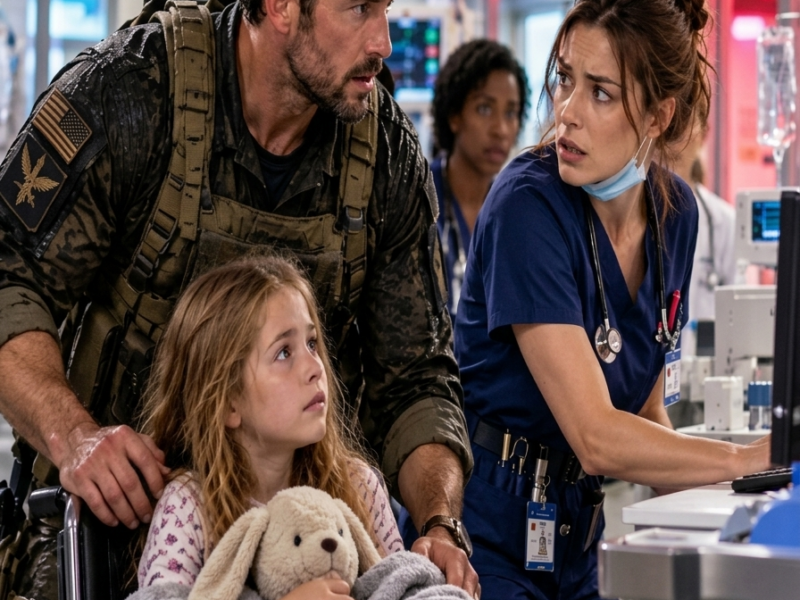
The Navy SEAL collapsed onto the emergency-room floor at Walter Reed, clutching his unconscious daughter as the nurse he had just accused of failing her calmly looked down
The fluorescent lights of the trauma bay buzzed with an irritable, relentless hum that set my teeth on edge. It was twenty minutes past three in the morning at Walter Reed National Military Medical Center, the hour when the world outside hung suspended between exhaustion and oblivion. I had been on my feet for eleven straight hours, charting endless vitals, changing sterile dressings, and running on lukewarm, bitter coffee that sat like lead in my stomach. My scrubs smelled of industrial antiseptic and cold rain.
Then the double doors at the end of the ambulance bay were battered open with the force of an oncoming train.
The glass rattled in its metal frames, and the heavy pneumatic hinges groaned in protest. A man stumbled through the threshold, moving not with the hesitation of a wounded civilian, but with the brutal, forward-driving momentum of a soldier caught in an open field under sniper fire. He wore civilian clothes—a dark utility jacket soaked through with rain, jeans stained at the knees with grease and mud—yet the posture was unmistakable. The square set of his shoulders, the low center of gravity, and the feral vigilance in his eyes screamed elite military.
He was carrying a bundle against his chest. A little girl, limp as a rag doll, her head lolling back against his forearm.
“Help her!” he roared. The sound tore through the quiet unit, bouncing off the polished linoleum floors and slicing through the quiet chatter of the admitting desk. “Somebody get over here! Help my daughter!”
Two orderlies rushed forward with a gurney, but the man didn’t wait for them. His knees buckled under the weight of sheer panic and physical exhaustion, and he collapsed onto the emergency-room floor right in front of Trauma Bay 4. He hit the tiles with a sickening thud, shielding the child with his own body so her frail frame never touched the cold concrete.
I dropped my clipboard onto the counter and moved before my conscious mind gave the order. In the ER, you learn to let your training lead your feet. I sprinted across the bay, my rubber-soled shoes squeaking against the wet floor.
“Sir, stay down, let us take her,” I said firmly, dropping to my knees beside him. “Let go of her, sir. We’ve got her.”
He looked up.
His face was streaked with sweat, road grime, and dried blood across his left cheekbone. But when his gaze locked onto mine, every drop of blood seemed to evacuate his features. The wild, ferocious terror in his eyes froze instantly into pure, paralyzing disbelief. He didn’t blink. His jaw slackened, and his breathing hitched in his throat with a dry, rattling gasp. It was the look of a man who had kicked open a door in a war zone only to find a specter waiting on the other side.
“You,” he breathed. The word wasn’t angry; it was crushed by an unbearable weight. “You came back.”
A chill, sudden and needle-sharp, traced the path of my spine. I had never seen this man before in my life. I was sure of it. I worked hundreds of active-duty soldiers, veterans, and military dependents through these doors every month, but a face cut like his—sharp cheekbones, a crooked nose broken more than once, and slate-colored eyes rimmed with raw red—was not a face anyone could easily forget.
“Sir, you’re in shock,” I said, forcing my voice to maintain the measured, flat authority required to keep hysterical family members from derailing a rescue. “I need you to release your grip. We need to get her onto the bed right now.”
His grip tightened around the little girl’s limp wrist. The knuckles of his right hand were split and swollen. “Save my daughter,” he begged, his voice dropping from a command to a shattered, ragged plea. “Please. She’s slipping. I can feel her heart slowing down.”
The orderlies carefully lifted the girl from his arms and transferred her to the trauma bed. I stayed on the floor for half a second longer, watching him struggle to his feet, swaying like an oak tree cut at the base, before I sprang up and positioned myself at the head of the bed.
“What’s her name?” I asked, pulling my penlight from my pocket and peeling back her left eyelid. The pupil was sluggish, barely constricting against the bright white beam.
“Lily,” he croaked, leaning heavily against the stainless steel crash cart, his knuckles white against the metal rail. “Her name is Lily. Please… do something.”
“Lily, can you hear me?” I called out, applying a firm sternal rub with my knuckles. No response. Not even a whimper. Her skin was unnaturally cool, slick with a clammy sweat that felt like parchment.
I hooked the pulse oximeter onto her small index finger. The monitor screamed to life, filling the small room with a rapid, erratic cadence. Blood pressure was dropping: eighty over forty-five. Heart rate spiking at one hundred and forty. But her respiratory rate was dangerously depressed—only eight shallow, ragged breaths a minute.
“Get a pediatric line started,” I instructed Marcus, the resident who had just scrambled into the room, adjusting his stethoscope. “Draw a full tox screen, CBC, metabolic panel, and arterial blood gas. We need an oxygen mask on her, fifteen liters, non-rebreather, right now.”
I cut away the sleeve of her oversized pink hoodie to expose her arm for an IV. As the cotton fabric fell away under my trauma shears, something caught my eye near the crook of her elbow.
It wasn’t a standard bruise, and it certainly wasn’t the mark of a fall. It was a precise, circular puncture, surrounded by a ring of deep, mottled purple and an outer halo of burst capillaries. A localized chemical reaction.
My breath caught in my throat. I had seen plenty of accidental overdoses, allergic reactions, and septic shocks in my eight years at Walter Reed, but this pattern was distinct. It looked like an injection site from a specialized pressurized dart or an auto-injector loaded with an atypical neurotoxin.
“She wasn’t sick when you left home?” I demanded, looking straight at the man standing rigid by the wall.
“No,” he said immediately.
Then he stopped.
That one second of hesitation hung in the air like a noose. His jaw tightened so hard I could hear the grinding of his molars. In that single, fractured second, his eyes shifted from desperate father to a trained operative calculating how much truth he could afford to surrender without triggering an explosion.
“Who did this to her?” I pressed, my voice low, dropping below the noise of the monitors so Marcus and the respiratory therapist wouldn’t catch the sudden dread in my tone. “This isn’t an illness, sir. This is a puncture wound. She’s been dosed with something.”
His face drained completely, turning the color of wet ash. “I don’t know,” he said.
It was a lie. A blatant, desperate lie written across every tight line of his weathered face.
Before I could demand an explanation, the rhythm on the monitor hitched. A sharp, high-pitched gasp cut through the mechanical beeping. Lily’s chest heaved upward, straining against the restraint straps of the bed. Her head rolled toward me, and her eyelids fluttered violently before snapping open.
Her eyes were striking—an extraordinary, translucent gray, flecked with gold around the pupils. They locked directly onto my face. There was no confusion in them, no childhood delirium. There was only pure, unadulterated recognition.
“Mom?” she whispered.
The sound was tiny, fragile, but in that sterile trauma room, it landed with the concussive force of an artillery shell.
Marcus paused with the IV needle hovering millimeters above her skin. The respiratory tech stopped adjusting the flow valve. The entire room seemed to plunge into an unnatural, vacuum-sealed silence where only the hum of the overhead lights remained.
I froze. My hands hovered over her chest, motionless. My breath seized in my lungs, choking me.
“What did she say?” Marcus muttered, glancing sideways at me with a confused frown. “Claire, do you know these people?”
“I… no,” I stammered, my voice sounding distant to my own ears, like I was speaking through several feet of water. “I don’t. I’ve never seen her before.”
I was thirty-four years old. I had spent my entire adult life focused entirely on my career, living alone in a modest brownstone in Silver Spring, Maryland. I had never been married. I had never carried a child. I had never given birth. I was biologically, undeniably childless.
Yet, as Lily looked at me, a sensation of vertigo slammed into my skull so violently that the edges of the room blurred. A phantom pain flared somewhere deep in my chest, an ache of familiarity so visceral and suffocating that my knees actually trembled.
The man stared at me, his chest heaving, his hands trembling visibly at his sides. “It’s you,” he whispered again, his voice barely carrying over the monitors. “God help us… it really is you.”
“Step back, sir,” I ordered, trying frantically to regain control of the room, of my voice, of my own racing heart. “You need to wait outside. You can’t be in here while we stabilize her.”
“I am not leaving her!” he snarled, taking a heavy step toward the bed. “And I’m not leaving you.”
“Claire,” Marcus said warningly, stepping between the man and the bed. “Security. Call them.”
“No,” the man said softly. The rage vanished, replaced by an agony so ancient and profound it knocked the breath from my lungs. “Please. Look at me. Just look at me.”
He reached deep into the inside breast pocket of his soaking wet jacket. Marcus instinctively reached for the emergency duress button under the counter, assuming he was going for a firearm. But the man didn’t pull a weapon.
He pulled out a small, worn piece of paper.
It had been folded and refolded so many times that the white creases had split, and the glossy finish was rubbed completely matte. He extended it toward me with fingers that trembled like dry leaves in a gale.
“Take it,” he said. “Take it and tell me I’m crazy.”
My hands shook so violently I nearly dropped the paper as my fingers brushed his. His skin was burning hot, running a fever that contradicted the icy chill in his eyes.
I looked down.
It was a printed photograph, slightly faded by sunlight and age. In the center of the frame stood a woman wearing a navy-blue sweater, her hair pulled back into a messy bun, standing on the rocky shore of what looked like an alpine lake. She was smiling at the camera—a bright, genuine smile that reached her eyes. Standing right beside her, holding her hand with fierce devotion, was a little girl of about three years old, looking up at her with clear, striking gray eyes.
The woman in the picture was me.
Not a passing resemblance. Not someone who shared my cheekbones or the curve of my nose. It was me. But the photograph was weathered, scratched, and aged. It looked at least fifteen, maybe twenty years old. Yet the woman in the picture looked exactly as I did right now, in my early thirties, while the child beside her looked almost identical to the eight-year-old girl fighting for breath on the gurney.
The impossible geometry of time struck me like physical violence.
“This is impossible,” I whispered, the paper crinkling under the spasms of my fingers. “This is… this is a fake. A digital composite.”
“Turn it over,” the man said.
I flipped the photograph over with numb thumbs. Across the yellowed back, written in blue ballpoint ink, were four words:
Keep her safe. Always.
The handwriting was unmistakably mine. The exaggerated loop of the K, the sharp slash through the crossbar of the t, the tiny curl at the tail of the y. I had signed a thousand medical charts with that exact hand. I could not deny it any more than I could deny my own pulse.
Yet, I had no memory of that lake. No memory of that blue sweater. No memory of ever holding that child’s hand.
My mouth went dry, tasting of copper and panic. I looked from the ink back to the man’s haunted eyes. “Where did you get this? Who are you?”
He stepped closer, leaning across the corner of the trauma bed until his face was inches from mine. “My name is Nathan Hayes. Navy SEAL, Special Reconnaissance. And your name wasn’t supposed to be on that photograph, Claire.”
My heart hammered against my ribs, a trapped animal trying to break free. “Whose name was?”
Nathan looked toward the frosted glass doors of the trauma bay, his eyes narrowing into cold, predatory slits as he scanned the empty hallway.
“Her mother’s,” he murmured. “And the reason Lily was injected tonight isn’t because of me. They did it to bring her here. They knew you were on shift.”
“What are you talking about?” I demanded, tears of frustration and terror stinging the corners of my eyes. “Who are ‘they’?”
Before he could answer, a woman’s voice cut through the sterile corridor outside.
“Claire?”
The voice was sweet, melodic, and strangely flat, carrying clearly into the trauma bay. “Claire, we need you at the desk.”
Nathan moved instantly, his hand dropping to the concealed holster at the small of his back with terrifying fluidity. “Don’t answer,” he hissed under his breath.
I turned toward the doorway. “Sarah? Is that you?” Sarah was the charge nurse on duty tonight.
There was no reply.
Only the low, rhythmic squeak of rubber against floor tiles.
From the shadows of the empty, dim corridor outside, an unoccupied stainless steel wheelchair emerged. It rolled forward with deliberate, steady momentum, as if pushed by an invisible hand, gliding across the threshold and coming to a gentle stop right in the center of Trauma Bay 4.
The vinyl seat was completely empty.
Except for a single, pristine photograph lying face down on the black cushion.
Marcus stepped forward to inspect it, but Nathan pushed him back with an arm like an iron beam. Nathan kept his weapon drawn, keeping his body positioned between the wheelchair and the gurney where Lily lay.
“Don’t touch it,” Nathan ordered coldly.
Using the tip of his tactical pen, Nathan carefully flipped the photograph over onto its back.
I looked down.
Written in fresh, bright red ink—still glistening slightly under the fluorescent glare—was my full legal name:
Claire Evelyn Vance.
And beneath it, written in clean, mechanical block letters, was a time and a date:
04:15 AM. Tomorrow.
Below the date, a single sentence was scrawled with brutal finality:
Time is up.
I looked up at the wall clock hanging above the trauma bay doors. The red digital numbers blinked silently in the stillness of the room:
03:42 AM.
We had thirty-three minutes before tomorrow began.
The trauma bay seemed to contract, the sterile walls pressing inward like a closing fist. The silence was absolute, broken only by the persistent, shallow wheeze of Lily’s breathing and the frantic, rhythmic ping of the vitals monitor. Thirty-three minutes. The red numbers on the digital wall clock flickered with unfeeling precision, counting down seconds that suddenly felt like grains of sand slipping through an open fist.
“Marcus,” I said, my voice shaking so violently I had to swallow hard to keep the words from fragmenting. “Stabilize her. Push two milligrams of naloxone just in case it’s an atypical opioid derivative, and start a broad-spectrum neuro-protective drip. If her airway compromises, you intubate immediately. Do you hear me?”
“Claire, what the hell is happening?” Marcus whispered, his eyes darting between Nathan’s drawn weapon and the photograph sitting on the empty wheelchair. “Who is this guy? Should I hit the alarm? The base security team is down the hall—”
“If you hit that alarm,” Nathan interrupted, his voice dropping into a register that made the hair on the back of my neck stand up, “the people who sent that wheelchair will know their timetable has been breached. They will lock down this wing, kill the backup generators, and vent something through the HVAC that will make sure none of us walk out of this bay alive. Do your job, Doctor. Keep the girl breathing. That is your only mission.”
Marcus looked at me, pleading for reason. But the certainty in Nathan’s voice was not that of a madman; it was the absolute, lethal conviction of an operator who had seen contingencies like this executed before.
“Do what he says, Marcus,” I breathed. “Please. Just save her.”
Nathan grabbed my forearm. His grip was broad, his fingers like steel cables wrapped around my wrist, yet he didn’t bruise me. He pulled me out of the immediate glare of the trauma lights toward the charting alcove behind the nurse’s station.
“You need to see something,” he said, pulling a ruggedized military tablet from the inner pocket of his coat. The screen was cracked across the upper quadrant, but it glowed with an encrypted green diagnostic terminal.
“I don’t know you, Nathan,” I said, backing against the cold laminate counter, holding my hands up between us. “I don’t know who you are. I don’t know that child. I’m a trauma nurse. I’ve lived in Bethesda my entire life. I went to Georgetown. My records, my life—it’s all documented. You have the wrong person.”
“You think you lived in Bethesda your whole life?” Nathan asked, his eyes burning with an exhausting, tragic pity. “Tell me about your childhood, Claire. Tell me about the house you grew up in before you turned twelve.”
The question hit me like a bucket of freezing water.
I opened my mouth to answer. A white colonial with a wrap-around porch. But as soon as the thought formed, the image disintegrated. What color were the shutters? Who lived next door? What was the name of the school I went to before seventh grade?
A piercing, blinding pain spiked through my temples, centered right behind my left eye. It was so intense my vision washed out in a blaze of white static. I gasped, pressing the heels of my hands against my skull.
“Don’t push it too hard,” Nathan warned softly, reaching out to steady my shoulder. “The neural blocks they used on you weren’t meant to be probed from the inside. When you try to remember, the synaptic inhibitors trigger an acute migraine response. It keeps you compliant. It keeps you safe in your little manufactured bubble.”
“Manufactured?” I choked out, fighting through the blinding pain. “What are you talking about? Who did this to me?”
“You did,” he said simply. “To yourself. To protect Lily.”
He tapped a sequence of keys into the cracked tablet. A military personnel file appeared on the screen, bearing the unmistakable crest of the Defense Advanced Research Projects Agency (DARPA) paired with a classified Naval Special Warfare unit insignia.
Underneath the seal was a photograph of a woman.
She wore a dark green service uniform, captain’s bars gleaming on her collar, her dark hair pulled back into a severe military bun. The nameplate on her chest read: CAPT C. VANCE, MD.
Below it, the operational designation: Project Chimera – Chief Medical Officer / Cellular Stabilization Protocol.
“You weren’t an ER nurse at Walter Reed,” Nathan said, his voice flat, stripped of all emotion to deliver the brutal facts. “Ten years ago, you were a Lieutenant Commander in Naval Medical Research. You were the lead geneticist on a black-budget initiative aimed at accelerating cellular regeneration in high-threat tier-one operators. They wanted a way to make wounded soldiers heal in the field—repairing severe tissue trauma, neutralising biological agents, reversing neurological shock.”
I stared at the screen, my heart beating a frantic tattoo against my ribs. “And Lily?”
“Lily wasn’t an accident, Claire. She wasn’t born in a hospital,” Nathan said, his gaze drifting toward the glass where the little girl lay motionless, Marcus hovering over her with an oxygen mask. “She was the first and only successful subject. The protocol required a fresh, living embryonic host to bind the stabilized genetic vector. You found out what the agency intended to do with her once she was viable. They didn’t want to use the serum to save wounded soldiers. They wanted to weaponize the delivery vector—create an engineered pathogen that only individuals with Lily’s synthetic blood markers could survive. An ethnic, targeted extinction tool.”
The air in the room felt heavy, almost unbreathable. “No…”
“You stole her,” Nathan continued. “You pulled her out of the facility in Fort Detrick the night they scheduled the phase-three termination of non-essential personnel. You contacted my team—Task Force Gray—to extract you both. But the intercept was dirty. We took heavy fire on the extraction route through West Virginia. You knew that as long as you were with her, as long as your memory held the synthesis equations and her location, they would hunt you down to the ends of the earth.”
Nathan stepped closer, his voice dropping to a harsh whisper.
“You sat in the back of my Humvee, bleeding from a shrapnel wound to your abdomen, and you handed me that little girl. You handed me that photograph of you two at Deep Creek Lake. And then you took a specialized neuro-ablative agent—a chemical memory wipe you had developed yourself to prevent captured operatives from breaking under enhanced interrogation. You set up a false identity through a corrupted database back-channel at Walter Reed. You turned yourself into a ghost, hiding in plain sight in the very system that created you.”
“If I erased my memories…” I whispered, tears spilling freely down my cheeks now, hot and terrifying, “then why did you bring her back to me? Why didn’t you keep running?”
“Because the serum is failing,” Nathan said, his voice breaking. “The genetic vector that keeps her cells stable… it’s degrading. Look at her, Claire. That mark on her arm isn’t an injection from an enemy operative. It’s a systemic biological collapse. Her own blood is rejecting the synthetic proteins you engineered into her marrow. I’ve spent the last six years running safehouses from Montana to the Carolinas, keeping her off the grid, giving her the maintenance doses you prepared for her before you erased your mind. But yesterday, the last vial spoiled. The cold chain broke.”
He reached out and tapped the second photograph—the one from the empty wheelchair.
“They didn’t send that wheelchair,” Nathan revealed, a grim, humorless smile touching his cracked lips. “I did.”
I recoiled, staring at him in horror. “You? Why would you leave a death threat with my name on it?”
“It’s not a death threat, Claire,” Nathan said, his eyes drilling into mine with terrifying intensity. “It’s an activation code. Look at the time: 04:15 AM. Look at the date: Tomorrow. In our old operational parlance, ‘Tomorrow’ meant the secondary vault. Sub-basement 4 beneath this hospital. The old cold-war bunkers that Walter Reed never decommissioned. That’s where you hid the master strain. That’s where the original synthesis data and the stable genetic stabilizers are stored.”
He looked up at the clock.
03:49 AM.
Twenty-six minutes left.
“At 04:15,” Nathan said, “the automated security purge of Sub-basement 4 initiates. When you wrote those fail-safes into the hospital mainframe ten years ago, you programmed the servers to permanently incinerate the vault contents on this exact date, at this exact hour, if you hadn’t entered the override code. You set a dead-man’s switch. If we don’t get down to that vault, retrieve the stabilizer, and inject Lily before 04:15, the vault will burn to cinder. And without that stabilizer, Lily’s respiratory system will permanently shut down by dawn.”
“I don’t know the code!” I cried, clawing at my scrubs, panic threatening to tear my mind apart. “Nathan, listen to me! Whatever you think is in my head, it’s gone! The memory wipe worked! I don’t remember the vault, I don’t remember DARPA, I don’t know the synthesis equations! I am just a nurse!”
Nathan grabbed both my shoulders, his grip firm, grounding me amidst the swirling madness. “The memories aren’t in your conscious mind, Claire. You were too smart for that. You knew chemical erasure clears the frontal cortex, but somatic memory—procedural memory—survives in the basal ganglia. You didn’t memorize a number. You memorized a physical sequence. A tactile key.”
He reached into his pocket and pulled out a small, metallic cylinder, no larger than a lipstick case, with an intricate series of raised tactile grooves running along its body. He placed it in my palm and closed my fingers over it.
The moment the cold metal touched the skin of my fingers, my hand moved on its own.
Without a thought, my thumb flicked to the base, twisted the bottom collar three clicks to the left, pushed the central ring upward until it clicked, and then spun the upper cap until a small, recessed red diode flickered to life.
A sharp, involuntary gasp escaped my lips.
My fingers remembered. My body remembered a truth my conscious mind had spent a decade running from.
Suddenly, the overhead fluorescent lights flickered once, twice, and then died completely.
The emergency backup generators kicked on with a low, mechanical shudder, bathing the entire trauma ward in an eerie, blood-red emergency glow. From down the hall, past the heavy security doors that led to the hospital’s main administrative concourse, came the sound of three distinct, muffled pops.
Suppressed gunfire.
Nathan’s entire demeanor shifted instantly from an agonized father to a lethal apex predator. He racked the slide of his handgun with a mechanical clack, stepping in front of me and scanning the darkness beyond the glass.
“They found us,” Nathan whispered coldly. “The real ones.”
The red emergency lights cast long, skeletal shadows across the floor of Trauma Bay 4. Down the hallway, the unmistakable smell of cordite drifted on the cold air, followed by the heavy, tactical crunch of combat boots moving over broken glass.
“Marcus!” I hissed, darting back into the bay.
The young resident was crouched behind the medication cart, his face white as paper, his hands trembling as he held Lily’s IV line. “Claire… those were gunshots. Real gunshots. Who is out there?”
“You need to stay down,” I said, my voice steadying under a sudden, strange influx of pure adrenaline. It was as if a dormant switch had flipped behind my ribs. The panic that had paralyzed me moments ago was being systematically suppressed by a cold, calculating detachment I hadn’t known I possessed. “Take Lily. Disconnect the wall monitors, switch her to the portable battery pack, and roll this gurney into the clean utility closet behind the scrub sinks. Lock it from the inside. Do not open that door for anyone unless you hear my voice.”
“What about you?” Marcus stammered.
“I have to go with him,” I said, glancing at Nathan, who was already positioned at the edge of the doorway, peering through the glass seam into the gloom of the hallway.
“They’re moving in a three-man stack,” Nathan whispered without looking back. “Black kit, suppressed short-barreled carbines, no identifying patches. Advanced Force Operations. The clean-up crew from Fort Detrick. They aren’t here to capture; they’re here to sanitize the site.”
“How did they find this wing so fast?” I asked, ducking low as I moved beside him.
“They monitor the hospital’s central biometric logging system,” Nathan said, his eyes scanning the corridor. “The moment Lily’s vitals were registered on the ER intake monitor, an automated flag pinged their server in Northern Virginia. They know she’s here. And they know you’re on shift. We have less than fifteen minutes before the Sub-basement 4 incinerator initiates.”
He glanced at his watch.
04:02 AM.
“Thirteen minutes,” I corrected, my heart slamming against my ribs. “The service elevator at the end of the north hall is keyed directly to the old maintenance levels. But the elevator requires a biometric override.”
“You have it,” Nathan said, turning his slate-gray eyes onto mine. “Your retina. Even if they wiped your credentials from the active personnel roster, the bunker’s physical hardware was hard-coded to your genetic signature before the project was sealed.”
A sudden burst of suppressed fire shattered the glass doors of the triage station fifty feet down the hall. Chunks of plaster and safety glass showered the floor. The sound was horribly quiet—just rhythmic, metallic thuds followed by the heavy impact of rounds tearing through drywall.
“Move!” Nathan barked.
He lunged out of the doorway, his handgun coming up in a two-handed grip. He fired three rapid shots into the corridor. A muffled grunt echoed from the darkness, followed by the heavy thud of a body hitting the floor. Nathan grabbed the strap of my scrub top and dragged me behind him as he bounded toward the heavy fire door marked Maintenance Access Only.
Rounds chewed through the wall behind our heads, spitting chalky drywall dust into my hair and eyes. We tumbled through the fire door, and Nathan slammed it shut, sliding a heavy steel rebar pipe through the push-bar handles to jam it from our side.
We were in a narrow, unpainted concrete stairwell that plunged down into darkness. The air here was damp, thick with the smell of wet cement, rust, and decades of stagnant underground dust.
“Run,” Nathan said, grabbing my hand.
We tore down the stairs, skipping two steps at a time. My sneakers slapped against the cold concrete, echoing up and down the vertical shaft. One floor down, two floors down. Sub-basement 1. Sub-basement 2. The air grew colder, dropping drastically with every flight we descended, until I could see my own ragged breath plume white in the dim emergency light.
At Sub-basement 3, the stairs ended at a massive, riveted steel door that looked like it belonged on a battleship.
Mounted beside the door was an ancient, olive-drab control box equipped with a monochromatic CRT monitor and an optical scanner. A blinking cursor flashed on the green screen:
TERMINAL OFFLINE – RESTRICTED ACCESS LEVEL OMEGA.
“Step up,” Nathan said, breathing hard, his weapon pointed back up the stairwell where the heavy metal fire door three floors above us began to shudder under the blows of a hydraulic breaching tool. Thump. Thump. Thump.
“They’re on the door!” I gasped, pressing my face toward the scanner.
“Ignore them,” Nathan snapped. “Look into the lens!”
I leaned forward. A sharp, red laser line swept vertically across my left eye. The scanner let out an agonizingly slow electronic hum. For three seconds, nothing happened. My heart felt as though it would split open in my chest.
Then, the CRT monitor flickered:
RETINAL IDENTIFICATION CONFIRMED: VANCE, C. – CAPT / USN.
WELCOME, DIRECTOR.
PURGE OVERRIDE SEQUENCE REQUIRED. TIME TO THERMAL CLEANSING: 07:44.
With a deep, mechanical groan that vibrated through the soles of my shoes, the heavy steel door unlocked, its hydraulic pins retracting with a blast of pressurized air. Nathan shoved the door open, pulled me inside, and kicked it shut behind us. The deadbolts slammed back into place with a deafening clang just as the sound of the upper fire door giving way echoed down the concrete shaft.
We were in an underground laboratory that felt like an ancient, frozen tomb.
Dust coated every surface—banks of vintage computer consoles, stainless steel examination tables, rows of glass containment chambers, and racks of medical supplies sealed in vacuum packs. The room was illuminated only by the faint green glow of the central terminal and an overhead digital clock counting down in glowing orange segments:
07:12… 07:11… 07:10…
“Where is it?” Nathan demanded, moving quickly between the benches, checking the empty refrigeration units. “Claire, where is the stabilizer?”
I stood in the center of the room, looking around. The blinding headache that had struck me upstairs suddenly returned with sickening intensity. But this time, it wasn’t just pain. It was a wave of images, washing over my mind like a broken dam.
I remembered standing at this exact table, wearing a white lab coat over my naval uniform.
I remembered the sound of a baby crying in the incubator behind the partition.
I remembered looking into a microscope, watching synthetic cellular membranes bind and stabilize against a hostile viral agent.
And I remembered Nathan.
He wasn’t just an operative assigned to extract me. He had been stationed at this facility for six months, guarding the inner perimeter. I remembered late nights sharing terrible black coffee out of styrofoam cups, talking about what the world would look like once this war was over. I remembered the fierce, protective tenderness in his eyes when he looked at Lily for the first time through the incubator glass.
“Nathan,” I whispered, turning to him, my voice trembling with the shock of real, returning memory. “You… you weren’t just her escort.”
Nathan stopped searching the cabinets. He stood still in the dim green light, his broad shoulders rising and falling with his ragged breath.
“I swore an oath to protect the assets of this project,” he said quietly, his voice thick with unexpressed grief. “And then I fell in love with the doctor who created her. And I promised her that no matter what happened, I would never let our daughter become a weapon.”
The room seemed to tilt.
Our daughter.
“Lily is…” The word caught in my throat, choking me.
“She is ours, Claire,” Nathan said, taking a step toward me, his eyes shining in the dark. “Genetically, completely ours. You used your own DNA and mine to synthesize the stabilizing cellular matrix. That was why the project worked. She wasn’t just an experiment; she was our child. And when they ordered her terminated, you chose to wipe your own mind because you knew if they captured you, they had drugs that could rip every memory from your brain. You made me swear to take her and run. You sacrificed everything—your name, your career, your family, your own memories of loving her—just so she could have a chance to live.”
A sob tore from my throat, raw and agonizing. The love that surged through my chest wasn’t a strange, alien feeling; it was an ancient, tidal force that had been trapped behind an artificial dam for eight long years.
“The vault,” I gasped, wiping my eyes with the sleeve of my scrubs. “The floor safe under the centrifuge. It’s not in the cabinets. I wouldn’t have left it where the automatic thermal cleanse could reach it.”
I dropped to my knees beside a heavy, floor-mounted blood centrifuge in the far corner of the lab. Beneath the rubber vibration mat, set flush into the concrete floor, was a circular hatch with a mechanical combination dial and a tactile keyway.
I looked up at the wall clock.
03:18… 03:17…
Three minutes left before the ceiling-mounted thermite charges ignited to sanitize the facility.
I pulled the metallic cylinder Nathan had given me from my pocket. My hands didn’t hesitate. I inserted the cylinder into the center of the dial, feeling the pins catch. I spun the outer dial: 14 right, 28 left, 09 right. The birthdate of the day Lily first breathed outside the artificial womb.
With a satisfying mechanical thunk, the floor hatch popped open.
Inside, resting in a custom, nitrogen-chilled Pelican case, were two items.
A pressurized auto-injector filled with a luminous, pale-blue fluid—the cellular stabilizer.
And beside it lay an audio recorder and a sealed envelope with my handwriting across the front:
To Claire, when the fog clears.
“We have it,” Nathan breathed, kneeling beside me, lifting the chilled auto-injector from its foam cradle. “We have to get back upstairs. Now!”
Suddenly, the heavy steel door behind us shuddered with an ear-splitting detonation.
The hinges screamed as the hydraulic pins were sheared by a high-explosive breaching charge. The massive door blew inward, crashing flat onto the concrete floor with a cloud of dust and fire.
Through the smoke, three figures stepped into the laboratory, clad in dark tactical gear, their carbines leveled directly at our chests.
Leading them was a man wearing an immaculate charcoal-gray suit, completely unbothered by the smoke and debris. His hair was silver, his face carved with cold, bureaucratic cruelty.
“Doctor Vance,” Director Donald Vance said, stepping over the ruined door, a chilling smile touching his lips. “It appears your memory has served you well. But you’ve run out of time.”
He looked at the wall clock, which blinked red with fifty-nine seconds remaining.
“And you’ve run out of family.”
The dust in the underground laboratory hung thick and toxic, swirling in the red emergency light like suspended embers. The barrel of the carbines remained fixed on Nathan’s chest and mine, the laser sights painting two steady, crimson dots over our hearts.
“Step away from the cylinder, Nathan,” the man in the suit commanded, his voice conversational, carrying the dry, aristocratic cadence of high-level intelligence bureaucracy. “You’ve done an admirable job keeping my granddaughter alive for eight years, Hayes. Truly commendable. But your contract is concluded.”
“Granddaughter?” The word ripped out of me before I could stop it.
I stared at the silver-haired man. The voice, the posture, the cold, appraising tilt of his head—it pierced through the remaining fog in my mind with the vicious clarity of an ice pick.
Donald Vance.
Deputy Director of Defense Intelligence.
My father.
“Dad?” The syllable felt poisonous on my tongue.
“Hello, Claire,” Donald said, stepping forward, his polished Oxford shoes crunching softly on the concrete grit. “It’s been a long eight years. You look tired, darling. The emergency room life never did suit your intellect. You were built to design the future of warfare, not wipe vomit and change bandages in a public ward.”
“You did this,” I whispered, the horror rising in my throat until I thought I would choke. “You weren’t just the director of the project. You authorized the phase-three purge. You ordered your own men to execute Nathan. You ordered them to kill Lily!”
“I ordered the asset to be secured,” Donald corrected smoothly, waving a manicured hand dismissively. “Lily isn’t a child, Claire. Not in the eyes of the Defense Department. She is a biological synthesis platform worth four billion dollars of taxpayer funding. Her cellular structure holds the key to genetic immunity against every weaponized biological agent currently in development by our adversaries. You let sentimentality rot your judgment. You stole military property.”
“She is your blood!” Nathan snarled, his body coiling, preparing to throw himself in front of me even though three automatic weapons were aimed at his head.
“Blood is a biological medium, Hayes, nothing more,” Donald replied coldly. “Her genetic architecture belongs to the state. And tonight, thanks to your predictable predictability, you brought both the platform and the stabilization formula directly back into my hands.”
He glanced up at the wall clock.
00:28… 00:27…
“In twenty seconds,” Donald said, checking his gold wristwatch, “the automated thermal purge will burn this entire facility to four thousand degrees Fahrenheit. The records, the old research, and you two—a rogue SEAL and a compromised doctor who suffered a tragic break from reality. The fire will be ruled an electrical malfunction in an abandoned subterranean wing.”
He extended his gloved hand toward the floor safe. “Give me the stabilizer, Claire. Give it to me, and I might consider making Lily’s continued existence relatively comfortable at the testing facility in Utah.”
“You’re not taking her,” I said, my voice dropping into a low, terrifying calm.
“You don’t have a choice,” Donald said, his smile vanishing, replaced by the pitiless gaze of a bureaucrat signing an execution order. “Shoot Hayes. Keep her alive.”
The operative to the left tightened his finger on the trigger.
In that fraction of a second, Nathan moved.
He didn’t draw his gun; he dove sideways, slamming his entire weight into the base of the massive stainless steel chemical rack beside him. The heavy steel structure, loaded with hundreds of glass reagent bottles from the decommissioned lab, tipped forward with a catastrophic roar.
Pounds of glass, ethanol, and industrial acids crashed down onto the two lead operatives.
Gunfire erupted—deafening, violent bursts that tore through the air, chewing into the metal consoles and shattering glass. A round caught Nathan in the left shoulder, spinning him around with a spray of blood, but he kept his feet, drawing his tactical blade and driving it upward into the throat of the third operative who lunged through the falling debris.
“Claire, the override!” Nathan roared, coughing blood as he tackled the second shooter into the shattered wreckage.
00:12… 00:11…
I didn’t run for the door. I threw myself back down to the floor safe.
Beside the nitrogen case lay the audio recorder. But behind it, hidden in the recess of the safe’s bottom wall, was a red manual breaker switch.
A manual failsafe.
My memory clicked with absolute, crystalline precision. Ten years ago, when I designed the facility’s thermal cleansing system, I knew Donald Vance better than anyone alive. I knew his arrogance. I knew he believed computers were infallible and human beings were liabilities.
I hadn’t programmed the computer to abort the purge with a code.
I had wired the computer to use the thermal countdown as a distraction. The timer on the wall was a fake. The real sequence wasn’t a purge of the room—it was a purge of the facility’s air locks.
At zero, the blast doors didn’t incinerate the lab.
They sealed it and vented the oxygen.
I grabbed the heavy red breaker switch and slammed it down with both hands.
CLANG.
The heavy, armored blast shutters on the outer door slammed down with hydraulic fury, cutting off the stairwell and severing Donald’s tactical extraction team in the corridor from the room.
At the same instant, the room’s fire suppression system engaged—not with thermite, but with a massive, deafening hiss of dense, oxygen-depriving Halon gas pouring from the ceiling vents.
Donald Vance stumbled back, clutching his throat as the Halon flooded the room, stripping the air of oxygen in seconds. The remaining operative dropped his rifle, tearing at the seal of his tactical helmet, but without an external rebreather, the gas displaced the air in his lungs instantly. He collapsed onto the floor, seizing.
“Nathan!” I screamed, pulling two emergency rebreather masks from the emergency kit inside the floor safe.
I shoved one into Nathan’s face. He clamped the silicone mask over his mouth and nose, gasping as the pressurized oxygen hissed into his lungs. He was bleeding heavily from his shoulder, his face gray, but his eyes were clear, fierce, and alive.
Donald was on his knees, his polished suit covered in chemical dust, his silver hair wild. His fingers clawed at his collar, his eyes bulging as his lips turned a terrifying shade of blue.
“Claire…” he gasped, the word barely a rasping whisper. “Please…”
I stood over him, the rebreather mask covering my face, the pale-blue auto-injector gripped tightly in my right hand.
I looked down at the man who had given me life, who had shaped me into a weapon, and who had spent eight years trying to hunt down his own flesh and blood to turn her into an engine of biological death.
“You told me that blood is just a biological medium, Donald,” I said, my voice muffled but chillingly clear behind the mask. “You were wrong. Blood is a promise.”
I reached into his jacket, pulled his biometric master access card from his breast pocket, and turned my back on him.
“Nathan,” I said, helping him to his feet as he leaned heavily against my shoulder, his hand clamped over his bleeding wound. “The service dumbwaiter behind the ventilation shaft. It connects directly to the ER morgue. We have four minutes before the gas dissipates and backup teams cut through that blast door.”
Nathan looked at Donald, who had collapsed onto his side, his consciousness fading as his brain starved of oxygen. Then he looked at me, a mixture of awe and fierce pride in his gray eyes.
“Lead the way, Captain,” he breathed.
We dragged ourselves to the rear of the laboratory. Nathan used his combat knife to pry off the louvered metal grate covering the low maintenance shaft. Inside, the ancient service elevator—a dumbwaiter used decades ago to transport radioactive isotopes between the bunker and the surface—hung by thick, grease-covered steel cables.
Nathan squeezed his broad frame into the narrow compartment first, groaning in agony as his shattered shoulder scraped against the steel frame. I climbed in beside him, clutching the auto-injector against my chest, and pulled the manual counterweight cable.
The dumbwaiter lurched upward into the pitch-black vertical shaft, groaning under our weight, climbing away from the tomb beneath the earth.
As we rose through the dark, the sounds of the dying bunker faded below us. In the cramped, suffocating darkness of the shaft, Nathan reached out with his uninjured hand and found mine. His fingers were cold, slick with his own blood, but his grip was unyielding.
“Lily,” he whispered, his head resting against the steel wall, his breathing shallow. “Is she… do you think Marcus kept her alive?”
“Marcus is a good doctor,” I said, though my stomach churned with cold dread. “He will hold the line. He has to.”
“Claire,” he murmured, his voice fading, the blood loss dragging him under. “If I don’t make it to the surface…”
“Shut up, Nathan,” I said, tears burning my eyes behind the rebreather mask as I squeezed his hand until my knuckles turned white. “You don’t get to die now. We just remembered who we are.”
The dumbwaiter ground to a shuddering halt.
A sliver of pale, red emergency light leaked through the seams of the steel service door ahead.
Above us, from the hallway of the emergency department, came the sound of running boots, shouting voices, and the sudden, rhythmic flatline alarm of a pediatric cardiac monitor.
Lily’s heart had stopped.
The flatline tone was a continuous, piercing shriek that cut through the metal of the dumbwaiter shaft, vibrating straight into the center of my brain. In eight years of trauma medicine, I had heard that sound hundreds of times. It was the sound of the void opening. It was the sound of a human soul slipping through the fingers of the living.
“Go!” Nathan choked out, his eyes rolling back as the shock of blood loss took him. He wedged his combat boot against the bottom lip of the service door and kicked with everything he had left.
The sheet-metal hatch burst open with a screech of bent hinges, spilling us out onto the cold, blood-spattered linoleum of the clean utility room behind Trauma Bay 4.
I hit the floor on my hands and knees, scrambled up, and slammed through the swinging doors into the bay.
The scene was a nightmare.
The room was bathed in the harsh, flashing amber of the emergency crash cart. Marcus was on his knees on the bed, performing frantic chest compressions on Lily’s tiny, limp body. His scrub top was soaked in sweat, his arms pumping in a desperate, mechanical rhythm.
“One and two and three and four—” he chanted, his voice cracking with pure panic. “Charge the paddles to fifty! Clear the line! Claire! Where the hell were you?!”
“Get off her!” I screamed.
Marcus froze, looking up with wide, wild eyes.
I reached the bed in two strides, shoving the auto-injector into his chest. “Hold her head! Stabilize her cervical spine!”
“Claire, she’s in asystole!” Marcus yelled, his hands trembling as he grabbed Lily’s shoulders. “She’s been flatlined for ninety seconds! We need epinephrine, we need the defib—”
“Epinephrine will shred her vascular walls!” I shouted, my voice carrying the absolute, unquestioned authority of the lead researcher who had written the protocol with her own hands. “Her cellular receptors are locked! Only the stabilizer can open the sodium channels! Hold her!”
I tore the safety cap off the pressurized injector with my teeth, spitting the plastic across the floor.
I placed the wide, steel muzzle of the injector directly over Lily’s sternum, right over the center of her silent heart.
“Lily,” I whispered, my voice breaking into a ragged, desperate prayer. “I’m here. Mom is here. Come back to me.”
I slammed the firing mechanism down.
A loud, hydraulic PSTTT echoed through the bay as the pale-blue liquid was driven under three hundred pounds of pneumatic pressure directly through the bone into the myocardial tissue.
For two seconds, nothing happened.
The monitor continued its endless, flat scream: BEEEEEEEEEEEEEEEEEEP.
“Claire…” Marcus whispered, tears running down his cheeks. “It’s not working.”
“Come on,” I pleaded, pressing both palms flat over her tiny chest, feeling the terrifying, unnatural cold of her skin. “Come on, baby. Breathe. Please, Lily. Breathe!”
Suddenly, the little girl’s back arched violently off the mattress.
A sharp, concussive gasp tore from her throat—a sound so loud and primal it seemed to shatter the sterile air of the room. Her small hands clawed at the bed sheets.
On the overhead monitor, the flat green line jagged violently upward.
A single, erratic spike.
Then another.
Then, with a rhythmic, thunderous cadence that filled the room, the monitor locked back into a clean, steady sinus rhythm.
Beep… Beep… Beep… Beep.
Her oxygen saturation numbers began to climb: sixty… seventy-five… eighty-eight… ninety-six.
The mottled purple bruising around her arms and neck visibly receded, the synthetic cellular vectors flooding her bloodstream, repairing the degraded tissue with terrifying, miraculous speed. Her skin flushed with natural, warm color.
Her eyelids fluttered, and her translucent gray eyes opened, clear, bright, and completely conscious.
She looked up at me.
“Mom?” she whispered, her voice no longer a dying rattle, but the soft, sweet voice of a little girl waking from a long, bad dream. “You came back.”
I collapsed against the side of the bed, burying my face in her chest, my arms wrapping around her frail shoulders as the dam inside me broke completely. I wept with an intensity that tore through my lungs, sobbing out eight years of forgotten birthdays, forgotten lullabies, and the suffocating emptiness that had lived in my soul without a name.
“I’m here, Lily,” I choked out, kissing her forehead, her hair, her tear-stained cheeks. “I’m here. I’m never leaving you again. Never.”
“Claire…”
The weak, raspy voice came from the doorway.
I looked up. Nathan had dragged himself through the utility doors, leaving a thick smear of dark blood along the doorframe. He was on his knees, his handgun lying on the floor beside him, his strength completely spent. But his eyes were fixed on Lily, and across his battered, bleeding face was a smile of pure, unbroken peace.
“Daddy!” Lily cried, trying to sit up.
“Stay down, baby,” Nathan murmured, his voice fading as his chin dropped toward his chest. “You’re safe now. Mom’s got you.”
“Marcus!” I barked, wiping the tears from my face and stepping into the commander’s role once more. “Trauma protocol! He has an arterial bleeder in the left shoulder and possible internal hemorrhaging! Get two units of O-negative, prep a chest tube, and get him on the table now!”
Marcus didn’t ask questions. The bizarre, impossible events of the last hour were pushed aside by the sheer reflex of emergency medicine. Together, we dragged Nathan onto the second trauma bed.
For the next twenty minutes, our hands moved with desperate, mechanical precision. I clamped the severed subclavian branch, packed the wound with hemostatic gauze, and pushed saline and whole blood into his collapsing veins.
As I sutured the final layer of muscle, his heart rate stabilized, the monitors humming a steady, peaceful duet between father and daughter.
I stepped back from the table, my scrubs drenched in Nathan’s blood and my own sweat, my hands trembling as the adrenaline slowly drained from my system.
The digital wall clock read:
04:45 AM.
The thirty-three minutes were gone. Tomorrow had arrived.
The heavy double doors of the emergency room burst open once again.
This time, it wasn’t black-clad assassins. It was the uniform division of the Metropolitan Police Department, followed by two dozen heavily armed federal marshals and the Chief of Walter Reed Security.
A tall woman in a black trench coat stepped through the perimeter, a gold federal badge hanging from her neck. She looked at the ruined trauma bay, at the bullet holes in the walls, at the unconscious SEAL on the gurney, and finally at me.
“Claire Vance?” she asked, her voice calm, devoid of hostility.
I stepped in front of Lily’s bed, my chin high, my posture stiffening into the stance of a naval officer who had nothing left to fear. “Captain Claire Vance, United States Navy. If you’re here to finish what Donald Vance started, you’d better bring more men.”
The woman stopped, pulling a leather folder from her coat and holding it open.
“I’m Special Agent Miller, Department of Justice, Office of the Inspector General,” she said softly. “Donald Vance was detained thirty minutes ago in Sub-basement 4 by our tactical units. The audio file and research logs stored in your secondary vault weren’t just a failsafe, Captain Vance. The moment you turned that manual breaker, the entire encrypted archive of Project Chimera was broadcast directly to the Senate Intelligence Committee and the Attorney General’s desk.”
She looked at Lily, who was watching her with calm, intelligent gray eyes, holding Nathan’s limp hand from the adjacent bed.
“The program has been permanently terminated,” Agent Miller said. “Director Vance will spend the rest of his life in a supermax facility for treason, human experimentation, and domestic terrorism. The federal government has officially classified your file, your husband’s file, and your daughter’s existence as a closed, top-secret national security matter with full, non-revocable immunity and protected status.”
She closed the folder and looked at me with deep, genuine respect.
“You’re free, Captain Vance. All three of you.”
The silence that settled over the trauma bay was different this time. It wasn’t the suffocating, paranoid silence of the underground lab, nor the frozen terror of the countdown. It was the vast, quiet stillness of a storm that had finally blown itself out over the sea.
Agent Miller turned and signaled her team to secure the perimeter and establish an outer guard. Marcus slowly sat down on a swivel stool, staring at his blood-soaked gloves in stunned disbelief, while the hospital outside began to wake to the muffled sounds of sirens and rain.
I walked over to Nathan’s gurney.
His eyes fluttered open, dark and weary, but the fever was gone, and the color was slowly returning to his lips. He looked at me, then looked down at Lily, who had crawled across the small gap between their beds, resting her small head against his uninjured arm.
“Is it over?” he whispered.
“It’s over,” I said, reaching out to stroke his damp hair, my thumb brushing the scar along his temple. “He can’t touch us anymore. No one can.”
He let out a long, ragged sigh that sounded like it had been held inside his chest for ten years. His fingers curled around Lily’s, and with his other hand, he reached up and touched my face, his thumb catching a falling tear.
“Where do we go now?” he asked.
I looked toward the large, east-facing windows of the emergency room concourse.
Beyond the wet glass, the pitch-black sky of the early morning was beginning to fracture. A thin, fragile line of pale gold and deep violet was bleeding across the horizon, pushing back the shadows, promising the arrival of an unwritten day.
I thought of the faded photograph—the one taken by the rocky shores of Deep Creek Lake, where the water was clear and the mountains stood like silent sentinels against the world. I remembered the cabin tucked among the pines, the smell of woodsmoke in the autumn air, and the sound of Lily’s laughter echoing across the water before the war had found us.
“We’re going home,” I said, leaning down to press my forehead against his, our daughter safe between us. “We’re going home to remember.”
The end









