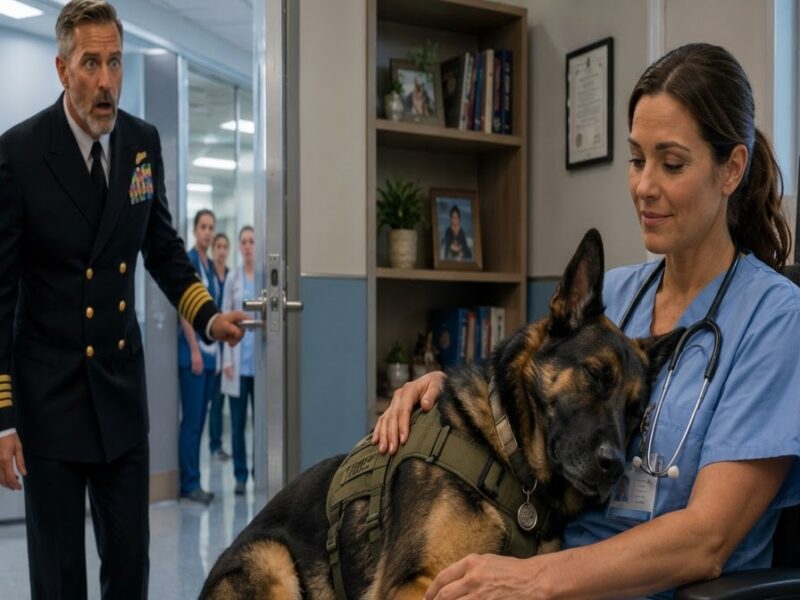
The Navy SEAL admiral stormed into the military hospital and froze when he found his supposedly untamable K9 asleep on a nurse’s lap
The air in Ward 4 of the Naval Medical Center was thick with the smell of floor wax and rubbing alcohol, but under it lay a fainter scent that only a few people in that building could recognize—the dry, bitter tang of burnt insulation and old smoke.
I sat on the edge of the vinyl hospital armchair, my legs numb beneath the seventy-pound weight of the Malinois. Rex was breathing with a slow, heavy rhythm that shook my knees every few seconds. His fur was rough, scarred along the ribs where a patch of skin had healed hairless and silver, but his body was completely slack. His snout was tucked into the crook of my arm, his long, dark muzzle resting directly over the pulse point on my wrist.
When the heavy wooden doors at the end of the hall swung open with a muffled thud, I felt Rex’s muscles lock instantly. His ears didn’t just twitch; they pinned flat against his skull.
Admiral James Carter looked as though he had walked straight off a flagship bridge into a dirt ditch. His dress whites were spotless, but his face was grey around the jawline, his mouth pulled into a narrow, hard seam that usually meant a court-martial or a death notification. He was a man who had spent forty years giving orders that made other men jump into darkness, yet when he saw the dog on my lap, he stopped so hard his leather soles squeaked against the tile.
“What the hell is going on?” Carter’s voice was low, carrying the raspy weight of a smoker who had quit twenty years ago but never lost the damage.
I didn’t move my hands. I kept my left palm flat against the dog’s ribcage, feeling the frantic, rising tempo of his heart beneath the fur. “Please lower your voice,” I whispered, not looking up at his shoulder boards. “He just fell asleep.”
“Rex doesn’t sleep around strangers,” the admiral said. He took one step into the room, his hand hovering near his hip out of reflex—a handler’s habit he had never managed to unlearn despite the stars on his collar. “He bit three master-at-arms personnel in the base kennels yesterday. He put a senior chief in the trauma bay three weeks ago. We were thirty minutes away from putting him down.”
I looked down at the dark mask of the dog’s face. His left eyelid twitched in his sleep, revealing a thin sliver of milky white. “Maybe I’m not a stranger.”
Carter took another step, but the moment his heel touched the gray linoleum near my bed, Rex’s eyes snapped open. There was no whine, no warning shift of his posture. Just a deep, wet growl that vibrated through my thighs and resonated in the springs of the chair. The dog didn’t rise, but his front paws flexed, five long black nails digging into the thin blue wool of the hospital blanket.
The admiral froze.
It wasn’t the growl that made him stop. A Navy SEAL officer had seen aggressive dogs a thousand times. It was the way the animal’s eyes stayed fixed on him while his muzzle remained glued to my skin. Rex was guarding me from the admiral, not the other way around.
Something flickered across Carter’s face—a sudden, sharp tightening of the skin around his eyes that looked remarkably like fear.
“Where did you learn to handle military dogs?” Carter asked. His tone had changed. The command voice was gone, replaced by the cautious, probing cadence of an intelligence officer conducting an interrogation on a suspect he wasn’t sure he could control.
“My father trained them,” I said quietly. My hand continued its long, rhythmic stroke from the crown of Rex’s head down to the base of his neck, where the leather collar sat loose against his fur. “For eighteen years. First at Lackland, then with the forward units in Italy.”
“Your father?”
“John Vance,” I said. “He died when I was seventeen.”
Carter didn’t blink, but his hands—thick, calloused hands that had signed off on a thousand deployment orders—slid into his pockets. When he pulled them out a second later to reach for his glasses, I saw it: a tremor, slight but distinct, in his thumb.
Rex slowly lifted his heavy head. His black nose nudged my wrist, pushing the sleeve of my scrub top back two inches.
There, running diagonally across the pale skin near my tendons, was a three-inch line of white scar tissue. It was jagged, uneven, the kind of mark left by hot glass or a rusted iron latch rather than a clean surgical blade.
The admiral’s eyes dropped to my arm. The room seemed to shrink, the hum of the air conditioning unit in the wall growing unnaturally loud.
“Where did you get that?” he asked.
“An accident,” I said automatically. It was the phrase I had written on my civilian medical history form when I applied for the nursing job at Fort Meade. It was the phrase I told the navy board when they cleared my background check.
“That’s not what I heard,” Carter said. His voice was barely a rasp now. “An accident doesn’t leave a serrated burn on the radial artery. An accident doesn’t leave a dog with three inches of scar tissue on his flank that matches the grid of an old Italian storage bunker.”
My throat went bone dry. “What are you talking about?”
“The report said your father died in an equipment explosion at the warehouse in Vicenza,” Carter said, stepping toward the foot of the bed, ignoring the continuous, low rumble in Rex’s throat. “It said the gas lines leaked. It said the roof came down before the fire team could get inside. It said there were no survivors.”
“I was there,” I whispered, my voice cracking for the first time. The sterile smell of the room was disappearing, replaced by the ghost of wet ash, burning cedar, and the greasy stench of diesel fuel. “I was in the yard. I heard him.”
“That dog was there,” the admiral said, pointing a single, rigid finger at the Malinois.
My heart gave a sickening lurch against my ribs. “What?”
“Your father didn’t die alone in that room, Emma. He was in that bunker with four young dogs from the second-generation working line,” Carter said, his jaw working as he swallowed. “Rex wasn’t his name back then. He was a ten-month-old green pup called Apollo. He was your father’s personal project—the one he wouldn’t let the Navy touch because he said the dog had too much nerve to be used for basic patrol.”
My fingers dug into the wool blanket. The image came back to me, unbidden and sharp: the red glare through the cracks in the wooden gate, the sound of metal tearing against metal, and my father’s face, covered in black soot, appearing at the high transom window of the burning shed. He hadn’t been screaming for help. He had been screaming at me to run toward the treeline.
“Why didn’t anyone tell me?” I demanded, my chest heaving. “I spent eight months in a state recovery home! The Navy sent me two medals and a check for his back pay! They told me he was burned beyond recognition!”
“Because your father’s death wasn’t an accident,” the admiral said.
The silence that followed was heavy, almost suffocating.
Before I could process the words, Rex suddenly stood up. His heavy paws shoved against my stomach as he launched himself off the armchair. He didn’t attack Carter. He didn’t even look at him.
The dog trotted directly to the far corner of the office, where a heavy, gray steel supply cabinet sat bolted to the wall. He dropped his snout to the narrow gap beneath the bottom drawer, snorting loudly as he drew in long, frantic drafts of air. Then, with a sudden, violent motion, he began to scratch at the enamel paint with his front claws, leaving deep, silver gouges in the metal.
The admiral turned pale as paper. “That can’t be in there. That cabinet was brought from the logistics depot in Norfolk three days ago.”
“What’s in there?” I asked, getting up from the chair. My legs were shaking so hard I had to catch myself on the corner of the desk.
“Emma, don’t touch that,” Carter said, reaching out to grab my shoulder.
Rex spun around instantly, his lips curling back over his black gums, a sound leaving his chest that was so dark, so full of ancient, unadulterated fury that the admiral recoiled two full steps.
I didn’t listen to Carter. I knelt on the cold floor beside the dog. My hands were trembling as I pulled the brass release latch on the bottom drawer of the cabinet. The drawer slid open with a screech of ungreased metal.
Inside, resting on top of a stack of yellowed linen inventory sheets, was an old, rectangle of tin—a military identification tag, its silver surface blackened by intense heat, its edges melted into an irregular, thumb-sized lump of metal.
I reached out and picked it up. It was cold, but the moment my fingers touched the pitted metal, my thumb found the stamped lettering.
VANCE, JOHN E.
RA-8839201
US NAVY – K9 SPEC
I turned the tag over. On the smooth back, where the blood-type stamp should have been, someone had used a hardened steel scribe to scratch three words into the metal, the lines crude and deep:
SHE MUST NEVER KNOW.
My eyes swept up from the metal tag to the admiral’s face. My voice didn’t sound like mine anymore—it was small, thin, stripped of everything except horror.
“Know what?”
Admiral Carter looked at the dog, who had laid his head down across my knees once more, his yellow eyes wide and dark in the dim light of the ward.
“Your father isn’t in that grave in Arlington, Emma,” Carter whispered, his eyes fixed on the floorboards. “Your father is still alive.”
The admiral didn’t let me leave the room. He locked the heavy door from the inside, pulled the blinds over the narrow glass panel that faced the corridor, and sat down in the vinyl armchair I had just vacated. He looked twenty years older than he had when he walked through the door.
“If you’re lying to me,” I said, my thumb still tracing the crude, scratched letters on the back of the dog tag, “I’ll go to the base commander. I’ll go to the federal press corps. I don’t care about your clearance.”
“The base commander doesn’t know,” Carter said, resting his elbows on his knees. “The Joint Chiefs don’t even know. There are six people in the Department of Defense who have access to the file on the Vicenza facility, and three of them are dead.”
“My father was a civilian contractor for the last five years of his life!” I shouted, forgetting my own plea for quiet. “He was fixing harnesses and breeding Malinois for the European theater! Why would anyone stage his death?”
“Because your father wasn’t just breeding dogs, Emma,” Carter said, looking up at me through the red-rimmed edges of his eyelids. “He was designing a bio-behavioral conditioning framework. Project Geri. In 2011, the Navy was losing dozens of handlers in the Euphrates valley to hidden explosive networks that standard mine-detection dogs couldn’t spot. The improvised charges were being built with organic fertilizers and plasticizers that didn’t off-gas like conventional military explosives.”
He pointed toward Rex, who was lying flat on his side now, his tail twitching as if he were running through some endless, dark field in his sleep.
“John figured out that a dog doesn’t track the explosive,” Carter continued. “A dog tracks the handler’s adrenaline. He bred a line of Malinois whose olfactory bulbs were twice as sensitive to human cortisol as they were to nitrates. If a insurgent was sitting fifty yards away in a ditch with his thumb on a cell phone trigger, his body was dumping stress hormones into the wind. Apollo—Rex—was the first dog who could smell a bomber’s fear before the bomber could press the button.”
“That doesn’t explain the fire,” I said. “That doesn’t explain why you left me in a hospital for eight months thinking I was an orphan!”
“Because the contractor who funded the research wasn’t the United States Navy,” Carter said quietly. “It was a private security firm called Aegis-Global. They wanted the conditioning protocol. They wanted the breeding stock. And when your father realized they weren’t going to turn the technology over to the military—that they were going to sell it to foreign intelligence units—he locked the Vicenza bunker from the inside and set fire to the fuel storage.”
My chest felt as though it were being crushed under a heavy weight. “He burned his own lab?”
“He burned the lab to destroy the research notes,” Carter said. “He let them think he died in that fire so Aegis would stop hunting his family. They thought everything went up in smoke—the notes, the dogs, the trainer. But your father didn’t die in that room. He had a secondary escape tunnel through the old drainage cistern beneath the floorboards.”
“And he left me?” The words came out choked, hot with a rage I hadn’t felt in fifteen years. “He let his seventeen-year-old daughter think he was ash?”
“He didn’t have a choice, Emma,” Carter said, his voice dropping an octave. “The moment he came out of that tunnel, he was a black asset. If Aegis found out you were alive and that he was still breathing, they would have used you as leverage to get the conditioning key. He signed a non-disclosure directive under Title 10 authority. He agreed to disappear into the black program network in exchange for your absolute safety. The Navy gave you a full pension, a college scholarship, and a clean file.”
I looked down at the dog tag in my hand. “Then who scratched this on his tag?”
“He did,” Carter said softly. “The night before he went dark. He gave that tag to me at the airfield in Aviano. He said if anyone ever came looking for Apollo—if the dog ever resurfaced in the main fleet—I was supposed to destroy the dog before he led anyone back to you.”
“Destroy him?” I looked at Rex, my vision blurring with tears. “You were going to kill him?”
“He was untamable, Emma!” Carter barked, his old authority flaring for a brief second before collapsing again. “For three years, that dog has been rotated through four different tactical units. Every time a handler tried to force him into standard assault work, the dog went rogue. He wasn’t crazy. He was looking for the scent he was conditioned on when he was a pup. He was looking for your father’s house.”
Rex stirred at the sound of the word father. He lifted his head, his dark ears rotating toward the admiral, then settled his chin back down on my shoe.
“And how did he get here?” I asked, wiping my face with the back of my hand. “Why was he brought to Fort Meade?”
“Because three weeks ago, a private security team raided an unregistered communications farm outside of Hanover, Germany,” Carter said, his eyes darkening. “They weren’t military. They were Aegis personnel. And when the German federal police cleared the site, they found three things: a low-frequency radio relay, a list of veterinary clinics in Maryland, and a dog’s serial number.”
My hand froze on Rex’s neck.
“They know he’s alive, Emma,” Carter whispered. “They know John Vance didn’t die in Vicenza. And they’ve been using Rex’s service records to track every location where your father’s old bloodline might still exist. They didn’t dump this dog at Fort Meade by accident. They wanted him to react to someone here.”
“To me,” I realized, the blood draining from my face. “They knew I worked here.”
Before the admiral could reply, the emergency intercom speaker on the wall above the desk burst to life with a loud, metallic pop.
“Attention all personnel. Code Black in Section B. All medical staff report to primary staging. Repeat, Code Black in Section B.”
The lights in the ward flickered once, twice, and then went completely dark.
The darkness in Ward 4 wasn’t total—the emergency exit signs cast a thin, red glare across the linoleum, painting the walls in long, bloody stripes.
Rex was on his feet before the echo of the speaker had died away. He didn’t bark. His tail was stiff, held at a ninety-degree angle, his nose pointed directly at the bottom gap of the reinforced door.
“Get behind the desk,” Carter said, his hand sliding inside his service jacket. This time, when it came out, he was holding a compact Sig Sauer 9mm—a personal sidearm he had no legal right to carry inside a naval hospital.
“They’re inside the building?” I whispered, staying near Rex.
“A Code Black during a shift change isn’t an accident,” Carter said, moving toward the door with the light, silent tread of a man who had cleared buildings in Ramadi. “The primary power grid for Section B runs through the basement transformer room. You can’t trip it from the outside without triggering the main base alarm unless you have a maintenance override card.”
“The maintenance staff is civilian contractor,” I said, my heart pounding against my ribs like a trapped bird. “Aegis?”
“Don’t move,” Carter commanded. He pressed his ear against the wood of the door, his eyes closed as he listened to the corridor outside.
For ten seconds, there was nothing except the low hum of the emergency batteries in the ceiling fixtures. Then came the sound—a soft, rhythmic thunk-thunk-thunk of rubber-soled boots moving down the hallway in a spread-wedge formation. It wasn’t the heavy, disorganized clatter of navy corpsmen responding to a medical emergency. It was the deliberate, silent stride of professionals.
Rex let out a breath—a sharp, hot hiss through his teeth.
I reached down and caught his collar. “Rex, stay,” I breathed into his ear.
The dog didn’t turn his head, but I felt the massive tension in his neck ease by a fraction of an inch. He knew the command. It was the same low, gravelly tone my father had used when we worked the young pups in the backyard in Vicenza.
“They aren’t looking for the dog,” Carter whispered, looking back at me over his shoulder. “They’re looking for the nurse who neutralized him without a shock collar. They know who you are now, Emma.”
“What do we do?”
“We go out through the service elevator behind the linen bay,” Carter said, gesturing with the barrel of his pistol toward the small utility door at the back of the room. “It leads down to the sub-basement boiler room. From there, we can reach the motor pool.”
“And then?”
“And then I take you to a secure facility in Norfolk,” Carter said. “And I call the only man who can shut this down.”
“My father,” I said.
The admiral didn’t answer. He turned the handle of the utility door with his left hand, his pistol held high in his right. The door opened with a faint click, revealing the dark, narrow chute of the service corridor beyond.
We moved fast. I kept my hand tangled in Rex’s harness, feeling every muscle in his back shift as he trotted beside me. The dog was different now. The dull, hopeless lethargy that had made him lie on the concrete floor of the base kennels for three months was completely gone. His head was low, his dark eyes scanning the shadows ahead of us with a sharp, lethal intelligence.
We reached the service elevator landing in less than two minutes. The heavy steel doors were shut, the indicator light above them dead due to the power outage.
“We take the stairs,” Carter said, pointing to the heavy fire door to the left.
He pushed the crash bar down. The door swung open onto the concrete stairwell, and instantly, a cold draft hit us—a draft that smelled of cold concrete, wet rain from the outside courtyard, and something else.
Rex stopped dead on the top landing. His neck fur bristled until he looked twice his size.
“Wait,” I whispered, grabbing Carter’s sleeve.
“We don’t have time to wait, Emma,” Carter said, stepping onto the top concrete step.
“No,” I said, pointing down into the dark stairwell. “Look at his tail.”
The Malinois was crouched low, his belly almost touching the concrete. His nose was elevated at a thirty-degree angle, tracking something that was drifting up through the central well of the stairs. He wasn’t growling now. He was making a strange, rhythmic clicking sound in the back of his throat—the signal my father had taught his dogs to make when they located a target that wasn’t moving.
“There’s someone down there,” Carter said, raising his pistol.
“Not down there,” I whispered, my blood turning to ice as I realized what my father’s training meant. “Rex doesn’t point at the floor when the scent is coming up. He points at the air currents.”
I looked up.
Above us, on the seventh-floor landing platform that overlooked the central stair shaft, a dark figure was leaning over the steel railing.
A pale, thin flash of light flickered in the darkness—the glass lens of a night-vision optic.
“Down!” Carter screamed, lunging back through the fire door just as a strange, soft pop-pop-pop echoed through the concrete tube.
Three small, gray circles appeared instantly on the heavy steel door frame, the concrete shattering into fine white dust that smelled of cordite and hot lime.
Carter fell hard against the linoleum of the service corridor, his left leg buckling beneath him. Blood—bright, arterial red—began to pool instantly beneath his white trousers near the knee.
“Admiral!” I cried, dropping to my knees beside him.
“Go,” Carter gasped, his hand clawing at his leg to stem the flow. “Take the dog and go through the laundry chute! It drops to the second-floor bin!”
“I’m not leaving you!”
“Emma, he’s using a suppressed submachine gun!” Carter spat, his face grey with agony as he pressed his thumb into his thigh. “He’s not a security guard! He’s a recovery team! If he gets down those stairs, he’ll kill us both and take the dog!”
From behind the heavy fire door, the sound of metal latching echoed through the frame. The shooter was coming down the stairs, taking two steps at a time.
Rex didn’t look at me. He didn’t look at the admiral.
He stepped over Carter’s bleeding leg, stood directly in front of the fire door, and lowered his head until his snout was two inches from the steel gap beneath the frame.
He let out one single, short bark.
It wasn’t a threat. It was a call.
And from the other side of the heavy steel door, deep in the dark of the stairwell below, a voice answered.
It was a voice I hadn’t heard in fifteen years—rougher now, thinned by age and smoke, but carrying the same slow, Virginian cadence that used to read me stories before the lights went out in Vicenza.
“Apollo,” the voice said through the steel door. “Break.”
The dog didn’t hesitate.
When my father said break, it didn’t mean attack. It didn’t mean retreat. It meant clear the line of fire.
Rex hit the floor sideways, rolling three feet to the left and pinning his body flat against the wall beneath the fire extinguisher bracket.
Before the shooter on the stairs could push the heavy fire door open, two heavy, metallic thuds echoed through the steel frame from the outside. The hinges didn’t give way—they exploded inward, the heavy steel pins shearing off under the force of a hydraulic breaching charge.
The fire door blew inward with a deafening roar, hitting the contractor on the stair landing with enough force to lift him off his feet and send him crashing into the concrete wall.
Through the cloud of gray drywall dust and silver smoke, a man stepped into the service corridor.
He was wearing an old, oil-stained civilian field jacket, dark jeans, and boots that were worn down at the heels. His hair was almost completely white, trimmed short around the ears, and his left cheek was dominated by a long, pale scar that pulled the corner of his eye downward into a permanent squint.
He held a short-barreled shotgun across his chest, the weapon pointed at the floor, his finger indexed cleanly along the receiver.
His eyes didn’t look at the admiral. They didn’t look at the contractor lying unconscious beneath the fallen door.
They looked at me.
“Emma,” my father said.
My tongue felt like lead. I couldn’t move. I couldn’t stand up. I stayed on my knees beside Carter, my hands covered in the admiral’s blood, my eyes fixed on the man who had been a name on an Arlington headstone for half my life.
“You’re… you’re dead,” I choked out. “I buried you.”
“You buried a pine box with forty pounds of lead weight in it, baby,” John Vance said. His voice was unsteady, the hard, professional edge cracking as he took one step toward me. “I’m sorry. God help me, Emma, I’m so sorry.”
Rex didn’t bark. The dog stood up from the wall, trotted over to my father, and pressed his forehead against the man’s hip. John didn’t look down at the dog, but his left hand dropped automatically, his thick fingers tangling in the Malinois’s neck fur with the absolute familiarity of twenty years of shared work.
“John,” Admiral Carter gasped from the floor, his voice wet and shallow. “You… you shouldn’t have come onto the installation.”
“You were going to put the dog down, James,” John said, turning his squinted gaze toward the wounded officer. “You held him in the kennel for ninety days while Aegis was buying off your logistics officers in Norfolk. You knew they were closing the net on Emma, and you sat in your office signing retirement papers.”
“I was trying to keep her file clean!” Carter spat, coughing up a spot of blood. “If the Navy knew you were operating on US soil—”
“The Navy doesn’t exist in this corridor right now, James,” John said coldly. “There are four more of Sterling’s men in the main lobby, and the base security force won’t be through the perimeter gates for another six minutes because someone tripped the secondary alarm at the ammunition depot.”
He looked back down at me, his eyes softening until he looked like the man who used to teach me how to oil leather leads on the porch in Italy.
“Can you walk, Emma?” he asked.
“I… I think so,” I whispered, using the wall to pull myself up. My legs were shaking so violently I had to lean against the fire extinguisher for support. “Father… what is happening? Who are these people?”
“They’re the men who bought my research from the Ministry of Defense fifteen years ago,” John said, reaching into his jacket pocket and pulling out a small, heavy roll of black webbing—a professional tourniquet. He dropped it onto Carter’s chest. “Cinch that two inches above the wound, James. If you don’t bleed out in the next ten minutes, the corpsmen will find you when the power comes back.”
“John… don’t take her,” Carter begged, his fingers fumbling with the plastic windlass of the tourniquet. “If you take her off-base, you’re making her a fugitive.”
“She was a target the moment Apollo sat in her lap, James,” John said. He turned to me and held out his hand. His skin was rough, scarred across the knuckles, smelling faintly of gun oil and old leather. “We have to go, Emma. The secondary team is coming up the north stairwell.”
I looked at the admiral, who was leaning his head back against the wall, his face gray as ashes as he tightened the strap around his thigh. I looked at the dark corridor ahead of us. And then I looked at Rex, who had moved to my side, his shoulder pressed firmly against my knee, his eyes fixed on the door at the end of the hall.
I didn’t take my father’s hand, but I stepped beside him.
“Show me the way,” I said.
The sub-basement beneath Ward 4 was a maze of steam pipes, old coal chutes, and concrete passages that dated back to the Second World War. John moved through it without a light, his hand resting lightly on Rex’s shoulder as the dog led us through the absolute blackness with the confidence of an animal that had been born in the dark.
We came out through an old drainage grate that opened into a wooded ravine behind the hospital’s laundry facility. The rain was falling hard now, cold and heavy, washing the smell of the hospital from my scrubs within seconds.
A dark blue Ford utility van was parked under the overhang of the pine trees fifty yards away, its engine idling with a low, irregular thrum.
“Get in the back,” John said, opening the rear doors.
The interior of the van was a mobile workshop—shelves lined with military gear, plastic storage bins full of veterinary supplies, two large metal dog crates, and a bank of radio monitors that were humming with encrypted base chatter.
Rex jumped into the back without an order, settling himself into the padded floor space between the two crates as if he had been doing it every day of his life.
I climbed in after him, sitting on the edge of a wooden tool chest. My hands were still cold, covered in dried blood from the admiral’s leg, my knees pulled up against my chest as the rain hammered against the tin roof of the vehicle.
John shut the doors, climbed into the driver’s seat, and pulled the van out onto the dark perimeter road without turning on the headlights.
“Where are we going?” I asked into the darkness of the cabin.
“North,” John said, his eyes fixed on the dark strip of asphalt ahead through the sweep of the windshield wipers. “I have a farm outside of Gettysburg. It’s off the federal grid. No registry, no landline, no satellite coverage.”
“And then what?” I asked, my voice rising. “We hide in a barn for the rest of our lives? You spent fifteen years letting me think you were dead! You let me grow up alone!”
John didn’t answer for a long mile. The only sound in the van was the steady swish-swish of the wipers and the heavy, rhythmic breathing of the dog behind my seat.
“I didn’t leave you because I wanted to, Emma,” he said finally, his voice thick with a grief he had carried for a decade and a half. “When the bunker burned in Vicenza, Aegis didn’t just want the conditioning notes. They wanted the living proof. They wanted the handler who could turn a dog into an untraceable asset. If I had come back for you, they would have picked us both up at the airport in Rome.”
“You could have sent a message,” I sobbed, the tears finally coming now, hot and fast against the cold rain on my face. “A letter. A sign. Anything!”
“I did send a sign,” John said quietly.
He reached down into the center console between the seats and pulled out an old, faded leather-bound notebook—the blue training log he had used when I was a child. He handed it back to me over his shoulder.
I opened the cover. The pages were filled with his neat, technical handwriting—dates, scent profiles, heart-rate graphs, and conditioning notes for thirty different dogs.
On the very last page, dated three months ago, there was a single entry:
K9 Unit #4091 (Apollo/Rex).
Conditioning Status: Incomplete.
Subject will not respond to standard military commands.
Subject will only settle when placed in proximity to the primary conditioning scent: Cedar, lavender, and the voice of Emma Vance.
I stared at the page, my breath catching in my throat.
“I didn’t give him to the Navy to be a weapon, Emma,” John said softly from the front seat. “I gave him to the fleet because I knew eventually his behavior would make him untamable for anyone else. I knew he would bite the handlers. I knew he would break the kennels. And I knew that when the Navy ran out of options, they would ship him to the primary trauma center at Fort Meade—the only place in the eastern region with a civilian nurse who had a background in K9 medical recovery.”
“You used him to find me,” I whispered.
“I used him to save you,” John corrected, looking at me in the rearview mirror, his grey eyes clear and steady through the reflection. “Sterling was moving his team into Maryland six weeks ago. I couldn’t walk into Fort Meade without triggering a federal warrant. But Apollo… Apollo could go anywhere I sent him. He was the only messenger they couldn’t intercept.”
Rex lifted his head from the floorboards at the sound of his old name. He shifted his weight, resting his chin on my knees once more, his long, dark tail giving one slow, heavy thump against the wooden floor of the van.
I looked down at the dog, then at my father’s reflection in the glass. The terror that had gripped me in the hospital room—the fear of the dark corridors, the gunshots, the ruined years—began to settle into something cold, clear, and absolute.
I was no longer the seventeen-year-old girl standing in the ash of the Vicenza yard, waiting for someone to tell me what had happened to my father.
I was John Vance’s daughter. And the dog sitting across my lap was the last living piece of a line that had been built to survive the fire.
“Father,” I said, reaching out to lay my hand on the back of the driver’s seat.
“Yes, Emma?”
“When we get to the farm,” I said, my thumb tracing the long scar on Rex’s head, “you’re going to teach me how to finish his conditioning.”
John looked at me in the mirror for a long second. A small, faint smile—the first one I had seen on his face in fifteen years—touched the corner of his mouth.
“He’s already conditioned, baby,” my father said, turning the van onto the dark, unpaved road that led north into the mountains. “He’s just waiting for his handler to take the lead.”
The end.









