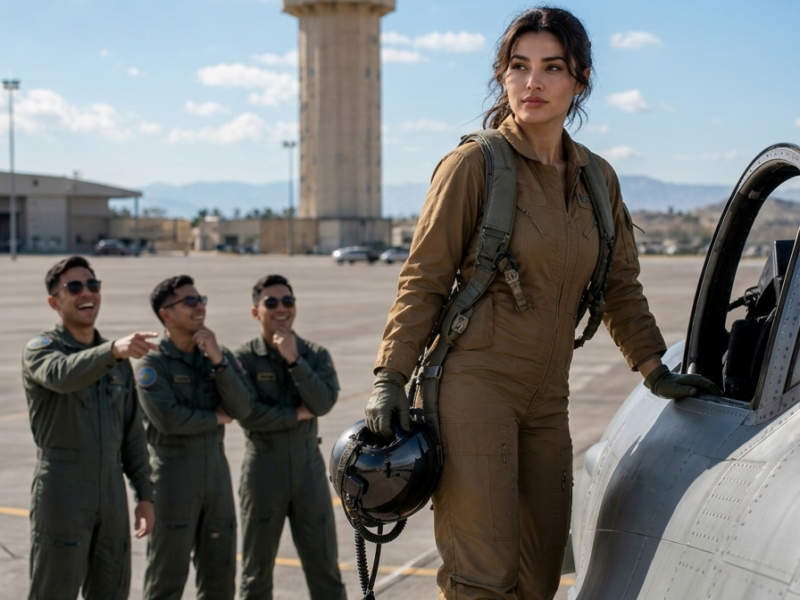
The Navy pilots burst out laughing when the quiet rookie walked into the ready room at Naval Air Station Oceana, but when the squadron commander saw the call sign painted beneath her F-18 cockpit
The Navy pilots burst out laughing when the quiet rookie walked into the ready room at Naval Air Station Oceana, but when the squadron commander saw the call sign painted beneath her F-18 cockpit, his face turned white because the name belonged to a pilot officially declared dead eleven years earlier.
I kept my eyes on the floor as the laughter rolled around me, pretending the jokes didn’t hurt while Captain Mason tossed my flight file onto the table like it was a mistake someone had made.
“You’re telling me this kid is joining our strike squadron?” he asked, looking at the other pilots, his arms crossed tightly over his chest. “Does she even know which end of the runway to use, or did flight school start accepting high school cadets?”
More laughter followed, ringing off the metal lockers and concrete walls of the ready room.
I was twenty-six, barely five-foot-six, and had spent the last three weeks listening to men twice my age explain why I didn’t belong in their sky. They saw a small, quiet woman who had transferred in from an obscure logistics squadron in the Pacific. They didn’t see the thousands of hours I had spent pushing jet engines to their absolute limit over open ocean, or the red-eye simulator sessions where I refined my reflexes until my instincts were sharper than a razor edge.
I didn’t argue.
My father had taught me that the loudest person in a room was rarely the one worth watching. The quietest pilot in the room was usually the one who survived the dogfight.
“What’s your call sign, Rookie?” Lieutenant Cole asked, leaning back in his swivel chair with a cocky grin, spinning a flight pen between his fingers.
“Ghost,” I answered, keeping my voice steady and low.
The room went strangely quiet for half a second before someone near the back snorted and cleared his throat.
“Ghost? What’d you do, disappear during your check ride? Or do you just freak out when the weather gets a little foggy?”
I let the joke pass, keeping my expression neutral, but my stomach tightened when Commander Hayes entered the room through the side door, carrying a sealed beige envelope stamped with high-security clearance seals.
He glanced at my open file on the briefing table, then looked up at me with an intensity that made the surrounding chatter fade away.
“Who assigned that call sign?” Hayes demanded, his tone lacking any of the jovial sarcasm Mason had been projecting.
“No one, sir,” I said, taking a step forward and standing at attention. “It was on my orders when I checked in from Fleet Forces Command.”
Hayes studied me longer than necessary, his dark eyes scanning my face as if searching for a phantom. He adjusted his collar, his fingers visibly rigid.
“Get your gear,” he snapped, breaking the silence. “We have a readiness evaluation in twenty minutes. I want to see if Fleet Forces wasted aviation fuel on you.”
The pilots filed toward the flight line, still making quiet jokes under their breath, and I followed them out into the salt-heavy Virginia air. The afternoon sun beat down on the tarmac, casting long, sharp shadows across the concrete aprons.
My F-18 Super Hornet waited beneath the morning sun, its gray fuselage scarred by years of carrier landings and harsh sea winds. It was an older airframe, assigned to me while the prime squadron aircraft underwent scheduled maintenance.
Then I saw it.
Beneath the canopy rail on the left side of the cockpit, right where the pilot’s call sign was traditionally stenciled, someone had freshly painted a small black symbol: a broken wing crossed by a single silver line.
My father’s personal symbol.
I stopped dead in my tracks, the heavy helmet bag sliding down my forearm.
Eleven years earlier, Commander Daniel Carter had vanished during a classified training mission over the deep waters of the Atlantic, leaving behind a grieving wife, a seven-year-old daughter, and an official naval investigation report that blamed pilot error and disorienting weather.
That daughter was me.
The Navy had given my mother a folded flag, a cold military funeral with an empty casket, and a sealed wooden box of his personal belongings.
But that box had contained something the military investigators never knew about: a tiny brass key wrapped in oilskin paper and a handwritten note tucked into the lining of his leather flight logbook.
If they ever call you Ghost, trust no one until you know why.
I had spent my entire adult life and my entire military career wondering what those words meant, wondering why my father had left a cryptic warning instead of a final goodbye.
Now I stood beside an aircraft bearing his private mark on a restricted naval air station five hundred miles from where he supposedly died.
“Problem, Rookie?” Mason called out from behind me, his boots crunching on the loose gravel of the flight line apron. He had his helmet tucked under his arm, watching me with a smug, expectant look.
I forced myself to turn around and adjust my survival vest. “No, sir. Just inspecting the airframe.”
“Good. Don’t embarrass us up there,” Mason said, walking past toward his own jet.
The evaluation began ten minutes later with a simulated air-to-air combat interception over the Atlantic training ranges. Mason watched from the radar control facility on the ground, fully expecting me to fail the high-G engagements and request an early return to base.
Instead, when two experienced aggressor aircraft dived out of the sun to trap me in a classic pincer maneuver, I didn’t panic. I pulled the stick back hard, putting the Super Hornet on its tail in a high-alpha maneuver that bled off airspeed instantly, forcing the first aggressor to overshoot my tail in a cloud of jet wash. I broke the engagement with a razor-sharp vector turn that made the ground controllers lean toward their monitors in disbelief.
Then, before the second fighter could adjust its turn circle, I anticipated its attack angle before its pilot even committed to his pull. I slipped effortlessly behind its defensive turn, lining up my targeting reticle and securing a simulated missile lock within three seconds.
The entire air combat maneuvering exercise ended in less than four minutes.
Nobody laughed when my tires touched the concrete runway at NAS Oceana and I taxied the jet back to the hanger apron.
As I stepped down the ladder, Commander Hayes approached me slowly through the heat haze rising off the tarmac. He was holding an old, yellowed photograph that looked older than the flight suit I wore.
It showed my father standing beside a dark, unmarked F-18 on an isolated flight line, one hand resting protectively on the shoulder of a young female pilot in full gear.
The woman in the photograph was undeniably me. But the flight suit she wore bore advanced unit patches I had never seen, and the date stamped on the corner of the film print was three years after my father’s official death.
“Where did you get that?” I whispered, my heart hammering against my ribs like a trapped bird.
Hayes lowered his voice, stepping closer so the ground crew couldn’t hear us over the turbine whine of neighboring aircraft.
“Your father wasn’t killed in a routine training accident eleven years ago, Claire,” Hayes said, his face pale in the bright sunlight.
My chest tightened until I could barely draw breath. “Then what happened to him? Where has he been?”
Before he could answer, the base emergency air-raid sirens erupted across the station, their piercing wails tearing through the afternoon air.
A panicked voice came over the flight line loudspeakers, echoing across the hangers: “All units, all units! Unidentified high-speed aircraft approaching restricted airspace from Sector Four! All duty squadrons, stand by for immediate launch!”
Hayes looked toward the northern runway, then turned his eyes back to me, his hands trembling slightly.
“Because eleven years ago, your father disappeared while investigating a rogue black-budget Navy program known only as Spectre,” Hayes whispered, thrusting the photograph into my hands.
On its back were six words written in my father’s unmistakable, precise handwriting:
GHOST IS THE ONLY ONE LEFT.
Then my radio headset, hanging around my neck, crackled to life on a secure tactical frequency that shouldn’t have been active.
A man’s voice—deep, gravelly, aged by stress and broken by heavy radio static—whispered a single sentence that made my knees weaken where I stood.
“Claire… if you’re hearing this… don’t let them launch you.”
I knew that voice. I had heard it in my childhood dreams, in old home videos, and in my nightmares for eleven long years.
“Dad?” I breathed into the small boom microphone.
Across the distant end of the runway, a sleek, jet-black aircraft with no military markings descended rapidly out of the cloud cover, turning its nose directly toward the air station base towers.
And painted beneath its cockpit glass was the exact same broken-wing symbol.
The black jet drifted down the glide slope like a shadow cutting through the bright afternoon sky. It didn’t flash landing lights, it didn’t respond to the control tower’s frantic radio queries, and its twin engines produced a low, haunting pulse that vibrated deep in the soles of my flight boots.
“Claire, get down!” Commander Hayes yelled, grabbing my shoulder and attempting to pull me toward the steel blast shelter of Hangar Three.
“No!” I yanked my arm free, staring up at the canopy of the descending aircraft.
Around us, the air station exploded into controlled chaos. Security vehicles with flashing red lights sped across the tarmac, sirens blaring, while armed guards took positions behind concrete barriers along the taxiways. Two F-18s from the alert facility roared down the main runway, their secondary afterburners scorching the pavement as they initiated an emergency scramble.
The black jet touched down softly on the center stripe of Runway 05, its tires smoking against the asphalt. It didn’t slow down to turn into a taxiway; instead, it cut its engines entirely, letting its momentum carry it to a stop directly in front of the primary command tower.
The canopy began to cycle open with a heavy pneumatic hiss.
“All personnel stay back! Do not approach the aircraft!” Captain Mason’s voice boomed through the tactical channel as he sprinted across the flight line, his sidearm drawn and pointed at the black fuselage.
I ignored Mason, stepping past Hayes and walking steadily toward the idling jet. Every instinct I had as a fighter pilot screamed at me that this was a trap, but the voice in my headset was still echoing in my ears, begging me to listen.
As I drew near, the figure in the cockpit unbuckled his helmet and pulled off his oxygen mask.
The man sitting in the cockpit was worn down by time and exhaustion. His hair was completely silver, his skin lined with deep scars across his jawline, but his piercing blue eyes were identical to the ones I looked at in the mirror every morning.
He was wearing an old, unpatched olive-drab flight suit—the same suit my father had worn the morning he kissed my mother and me goodbye eleven years ago.
“Dad?” my voice broke, trailing off into the cold wind blowing off the ocean.
He leaned over the side of the cockpit, looking down at me with a mixture of overwhelming relief and intense fear.
“Claire… you shouldn’t have come to Oceana,” he said, his voice raspy and dry. “They used your assignment orders to draw me out into the open.”
“Who used my orders?” I demanded, taking another step toward the boarding ladder. “The Navy told us you died in the ocean! Mom died three years ago thinking you were resting at the bottom of the Atlantic!”
A shadow of deep, crushing pain crossed his face at the mention of my mother, but before he could respond, three dark civilian SUVs slammed to a halt behind my jet, blocking off the hangar entry. Eight men clad in tactical body armor without agency patches stepped out, their automatic rifles held at low-ready positions.
At their head walked a tall man in a dark tailored suit, his hair neatly combed, his expression utterly void of emotion.
Commander Hayes stepped between the tactical team and my father’s jet, his hand resting on his service holster.
“Director Vance,” Hayes said, his tone icy. “You have no jurisdiction on an active naval flight line during an air defense emergency.”
The man named Vance didn’t even look at Hayes. He pulled a black leather wallet from his jacket, briefly displaying a clearance badge stamped with an emblem I had never seen before—a silver triangle surrounded by three black stars.
“Commander Hayes, this facility and all personnel on this flight line are now under Special Reconnaissance Directorate authority,” Vance said, his voice flat and authoritative. “The pilot in that aircraft is an escaped federal fugitive wanted for high treason, military espionage, and the theft of classified defense hardware.”
“He’s my father!” I shouted, stepping between Vance’s armed guards and the black jet.
Vance finally turned his cold, gray eyes toward me, studying my flight suit badge. “Ah. Captain Claire Carter. Or should I say, ‘Ghost’. You’ve grown up to look just like him, Captain. But I suggest you step aside. Your father has spent the last decade sabotaging state assets.”
“He’s telling you lies, Claire!” my father called out down from the cockpit, pulling a small silver memory drive from his flight pocket and throwing it toward me.
The drive bounced off the concrete, sliding to a stop right at my flight boots.
“Don’t touch that, Captain!” Vance warned, raising his hand toward his tactical team. His men immediately raised their rifles, aiming their red laser sights directly at my chest and my father in the cockpit.
“That drive contains the flight logs from Project Spectre,” my father yelled over the sound of idling turbines nearby. “It proves that Vance’s division has been running illegal uncrewed strike platforms over foreign airspace using stolen naval identities! They didn’t just hide me, Claire—they declared twelve active naval aviators dead over the past decade to build an untraceable black-ops air wing!”
My heart stopped. Twelve dead pilots.
I looked at Commander Hayes. His face was ghostly pale, his jaw clenched tight as he looked at Vance. Hayes knew. He had known parts of this all along.
“Commander…” I whispered, looking at Hayes. “Did you know my father was alive?”
“I knew they swept his crash site clear before the Navy search-and-rescue team ever reached the coordinates,” Hayes said softly, his voice trembling with hidden rage. “I was told to sign the official accident report or lose my command.”
“You sealed my family’s life away for a promotion?” I snapped, my fists clenching at my sides.
“I tried to protect you, Claire!” Hayes insisted, taking a step toward me. “If I had raised questions eleven years ago, Vance’s people would have erased you and your mother from the civil registry!”
“Enough of this nonsense,” Vance interrupted smoothly, pressing a button on his radio collar. “Team Alpha, secure the fugitive. Secure the drive. If the female officer interferes, use non-lethal force to neutralize her.”
The tactical team advanced, their boots clicking against the concrete in unison.
My father looked down at me from the cockpit, his eyes wide with urgency. “Claire! The brass key in your box! It fits the override port in your F-18’s secondary avionics bay! Get airborne! You’re the only one who can transmit that drive data to the Chief of Naval Operations before Vance shuts down the regional communication relays!”
Before Vance’s men could grab me, my father reached down into his cockpit, slammed his hand onto his jet’s emergency auxiliary engine starter, and shoved the throttles wide open.
The black jet’s massive engines erupted into a deafening, terrifying roar. A wall of superheated jet blast and thick black smoke blew backward across the flight line, knocking Vance’s tactical team off their feet, throwing equipment boxes across the tarmac, and blinding the guards in a swirling cloud of hot air and dust.
“Run, Claire! Run!” my father’s voice screamed through my headset over the deafening roar of the jet blast.
I didn’t think. I dropped to my knees, snatched the silver memory drive from the pavement, spun around, and sprinted with everything I had back toward my F-18 Super Hornet.
The heat from my father’s jet engine blast washed over me like an open furnace door, blinding my eyes with dust and stinging my skin as I threw myself up the aluminum boarding ladder of my F-18.
Below me, chaos had erupted on the tarmac. Vance’s tactical team was scrambling to regain their feet through the thick cloud of black smoke, their automatic weapons firing blindly into the air. Commander Hayes was screaming orders into his radio, attempting to mobilize base security forces against Vance’s rogue agency team, while Captain Mason drew his service weapon and stood guard at the foot of my boarding ladder.
“Get up there, Carter!” Mason roared over the deafening engine noise, his earlier arrogance entirely replaced by fierce naval discipline. “If Vance takes this flight line, nobody gets the truth out!”
I scrambled into the ejection seat, hauling my harness straps over my shoulders and jamming the metal buckles into the central lap lock with practiced, rapid movements. My fingers flew across the cockpit panels, flicking fuel pumps, generator switches, and flight computer controls in a sequence I had performed a thousand times in training.
The twin General Electric turbofan engines beneath my seat whined to life, spinning up to idle speed with a deep, familiar vibration that shook through my spine.
I pulled the tiny brass key—the one my father had left me eleven years ago—out from behind my dog tags.
Located beneath the main multi-function display on the left side of the instrument panel was an unmarked, recessed maintenance port that wasn’t listed in any standard Navy flight manual. I inserted the brass key into the narrow slot and turned it ninety degrees to the right.
The entire cockpit interface flickered brightly, shifting from its standard green tactical layout to a stark, deep blue display mode labeled: SPECTRE OVERRIDE: GHOST PROTOCOL ACTIVE.
A new data transmission window opened on the central screen, requesting an external encryption source. I jammed the silver memory drive my father had thrown me into the newly unlocked data port beside the key.
The screen flashed rapidly: DECRYPTING FLIGHT LOGS… 12 BLACK-WING AIRFRAMES IDENTIFIED… TRANSMISSION PATHWAY LOCKED TO FLEET COMMAND.
“Rookie! You’ve got company!” Mason shouted up at me, firing two warning shots into the pavement as three of Vance’s armed operatives emerged from the smoke, sprinted toward my jet, and brought their rifles up.
“Hold on, Mason!” I yelled, pulling the canopy closure lever down.
The heavy plexiglass canopy swung down, locking securely into place, sealing out the deafening roar of the tarmac and replacing it with the rhythmic, mechanical hiss of my cockpit oxygen supply.
I strapped my flight helmet on, pulled the oxygen mask over my nose and mouth, and unlocked the nosewheel steering. Without waiting for tower clearance, ground crew checks, or runway alignment, I shoved the twin throttles forward into full afterburner.
The F-18 surged forward like an unleashed predator, its heavy tires screaming against the concrete as it tore past Vance’s advancing SUVs. The force of the raw acceleration slammed me back into my seat as the runway markers blurred past my peripheral vision.
“Tower, this is Ghost,” I spoke into my mask, my voice surprisingly calm despite the adrenaline surging through my veins. “Initiating immediate tactical departure.”
I pulled back hard on the control stick.
The jet’s nose pitched up sharply, its twin afterburner flames scorching the runway threshold as the airframe broke ground, climbing vertically into the overcast cloud layer hanging over the Virginia coastline. Within six seconds, the base, the hangars, and the chaos on the tarmac vanished beneath a dense, blanket of gray storm clouds.
I leveled off at fifteen thousand feet, breaking into the bright, blinding sunlight above the cloud deck.
“Claire, do you copy?” my father’s voice came through my secure headset channel. He was flying his black jet five miles off my left wing, climbing rapidly to match my altitude.
“I copy, Dad,” I replied, my hands holding the control stick with a firm grip. “The drive is loaded into my avionics bay. It’s uploading to Fleet Command right now, but the file size is massive. The encrypted transfer is going to take at least eight minutes to complete.”
“We don’t have eight minutes,” my father answered, his voice grim. “Look at your long-range air-search radar.”
I flipped my radar screen to wide-area sweep mode.
Three high-speed radar contacts had just launched from a secret offshore facility thirty miles off the coast of Cape Henry, climbing through the clouds at Mach 1.5, vectoring directly toward our coordinates.
They weren’t Navy jets. Their radar signatures were small, erratic, and lacked standard military identification transponders.
“Uncrewed Spectre strike drones,” my father said, his voice cold with familiar dread. “They’re running on Vance’s automated attack algorithms. They don’t have human pilots, they don’t feel G-forces, and their only operational parameter is to destroy any aircraft carrying that data drive before the transmission finishes.”
I looked out my left canopy window. My father’s black jet surged ahead, taking a defensive position between my F-18 and the incoming threat vectors.
“Dad, what are you doing?” I asked, my heart dropping. “Your jet doesn’t have a full weapons loadout!”
“I’ve got two sidewinder missiles, an iron cannon, and eleven years of rage, Claire,” my father said, a faint, proud smile evident in his voice. “You keep that transmission active and stay on this vector. I’m going to buy you your eight minutes.”
“No! I just got you back!” I screamed into my mask, preparing to roll my jet into a hard left bank to join his formation. “We fight them together!”
“That’s an order, Captain Carter!” my father barked, using his full military authority for the first time in my life. “You are the carrier of the truth! If you die up here, Vance wins, those twelve dead pilots remain erased, and everything I fought for disappears! You fly the mission!”
Before I could answer, the cloud deck below us shattered into pieces as three sleek, carbon-black delta-wing drones erupted through the overcast, their red optical camera sensors glowing like burning coals against the bright sky.
The three uncrewed strike platforms cleared the cloud layer in a tight V-formation, turning toward my F-18 with inhuman speed and precision. They had no cockpits, no pilot canopies, and no drag-inducing physical structures—just sleek, razor-sharp lifting bodies built for absolute aerial dominance.
“Interrogating targets… no response,” I said through gritted teeth, watching my tactical display as the drones locked their radar arrays onto my airframe.
TRANSMISSION PROGRESS: 32%… TIME REMAINING: 5 MINUTES, 40 SECONDS.
“Break right, Claire! Now!” my father shouted over the tactical net.
I slammed the control stick to the right, stepping hard on the rudder pedal. My Super Hornet rolled onto its side, pulling seven Gs of force as a stream of heavy cannon fire from the lead drone stitched through the clear air where my jet had been a microsecond earlier.
My father’s black jet dived out of the high sun, his internal cannon roaring as he laced the lead drone with a devastating burst of armor-piercing rounds. The lead drone exploded into a brilliant ball of orange flame and shredded composite carbon, its wing sections tumbling down into the cloud layer below.
“One down!” my father called out, sweeping past the burning debris field. “Watch the second one! It’s cutting inside your turn circle!”
The second drone demonstrated the terrifying advantage of an uncrewed airframe. It initiated a ten-G cornering turn that would have rendered a human pilot instantly unconscious, slicing inside my trajectory and acquiring a infrared missile lock on my left engine nozzle.
A high-pitched warning tone screamed in my flight helmet: MISSILE LOCK! MISSILE LOCK!
I jammed my left thumb onto the dispenser button, dumping a cloud of burning flares and radar chaff behind my jet while pulling the aircraft into a vertical split-S maneuver.
The incoming missile bit on the burning flares, detonating fifty yards behind my tail section. The powerful shockwave rattled my airframe violently, tearing away a portion of my left vertical stabilizer and causing my control stick to fight against my hands.
“I’m hit, but still flying!” I yelled, fighting the hydraulic feedback as the jet groaned under the structural stress.
“Keep climbing, Claire! Don’t lose your altitude!” my father commanded. He had engaged the third drone in a tight, twisting dogfight two miles to the east, the two jets circling each other like predatory hawks over the sparkling blue surface of the Atlantic Ocean.
I checked my central multi-function display.
TRANSMISSION PROGRESS: 68%… TIME REMAINING: 2 MINUTES, 15 SECONDS.
Suddenly, my radar screen flashed a red warning. The second drone—the one I had evaded with flares—had recovered from its dive, looped around at supersonic speed, and was now coming up directly behind my damaged tail, its internal cannon bay doors sliding open.
I was out of flares. My left engine was surging dangerously due to structural damage, and my speed was bleeding off fast.
“Dad, I’ve got a bandit on my six, zero distance!” I shouted, trying to force the sluggish jet into a barrel roll to break his target tracking line.
“Hold your heading, Claire!” my father’s voice came through the radio, shockingly calm despite the chaos. “Trust your airframe. Trust your father.”
Out of the corner of my eye, I saw my father’s black jet break off his own dogfight, ignoring the third drone firing at his rear, and plunge into a suicidal dive straight toward the drone chasing me.
He didn’t fire a missile. He didn’t use his cannon.
He lined his aircraft up directly with the drone’s flight path, using his own airframe as a physical shield to protect my tail.
“Dad, no! Pull up!” I screamed into my mask, tears blinding my eyes inside my helmet visor.
My father’s jet clipped the second drone’s primary wing structure at four hundred knots.
A massive explosion lit up the sky behind my cockpit as both airframes disintegrated into a rain of twisting metal and fiery debris. The force of the mid-air collision threw my F-18 sideways, spinning my aircraft out of control toward the ocean below.
“Dad!” I sobbed, fighting the spinning cockpit displays as gravity pulled my jet into a violent flat spin. “Dad! Answer me!”
Static hissed through my headset. Nothing else.
I forced my hands back onto the flight controls, overriding the flight computer, stomping on the opposite rudder pedal, and jamming the throttles full forward to force air back over the wings.
The Super Hornet groaned in protest, its nose pitching down and snapping out of the flat spin at five thousand feet, just above the breaking ocean waves.
I leveled the wings, gasping for air, tears streaming down my cheeks, looking back up at the sky where the explosion had occurred.
There was no parachute in the air. Only thick columns of black smoke drifting over the water.
Then, a low, mechanical chime sounded from my central console:
TRANSMISSION COMPLETE. 100% OF ENCRYPTED DATA TRANSFERRID TO CHIEF OF NAVAL OPERATIONS COMMAND STAFF. ACKNOWLEDGEMENT CODE RECEIVED: ADMIRAL STEVENS AUTHORIZED.
I sat alone in the cockpit, the quiet hum of my damaged engine the only sound remaining, looking at the empty sky where my father had just sacrificed himself a second time to save me.
Then, my tactical display flickered once more.
The third drone—the last remaining strike platform—was swooping down from the upper atmosphere, lining its targeting laser up directly with my nose section for a final, execute strike.
I had no missiles left. My cannon was jammed. My left engine was dying.
I gripped the control stick tightly, aligned my damaged nose with the approaching drone, and unlocked my throttle safety guard.
“If I’m a ghost,” I whispered into the quiet cockpit, staring straight at the approaching death, “then I’m taking you to hell with me.”
I pushed the throttles all the way to the stops, forcing my single operating engine to give me every ounce of thrust it had left. My damaged Super Hornet accelerated across the ocean crests, pointing its nose straight into the path of the incoming drone.
The drone’s optical camera sensor flared bright red, its internal targeting computer attempting to calculate a collision vector for an aircraft that was refuse to turn away.
Five hundred yards. Four hundred yards. Three hundred yards.
I squeezed my eyes shut for a fraction of a second, preparing for the violent impact that would end my life.
Suddenly, two high-velocity AIM-120 AMRAAM missiles streaked out of the cloud deck above at Mach 4, passing over my canopy like bolts of white lightning.
They struck the drone simultaneously.
The strike platform detonated instantly, vaporizing into a cloud of white smoke and burning composite fragments that scattered harmlessly across the ocean waves beneath my wings.
I opened my eyes, pulling my stick back to clear the burning cloud of wreckage.
Thundering past my canopy on either side were four U.S. Navy F-18 Super Hornets bearing the official insignia of Fleet Forces Command, their multi-colored tail fins gleaming bright in the afternoon sun.
“Unknown F-18, this is Strike Group Alpha Leader,” a stern, authoritative voice boomed through my main radio channel. “Maintain your current heading and speed. Admiral Stevens has assumed direct personal command of this operational sector. You are under our protection, Captain Carter.”
I let out a long, shuddering breath, my hands trembling violently on the controls as the four fleet fighters formed an escort box around my damaged aircraft.
“Copy, Alpha Leader,” I rasped, my voice thick with emotion. “Data transfer was completed…”
“We know, Captain,” the flight leader replied gently. “The Admiral read the files three minutes ago. Federal marshals and naval military police have already raided the Special Reconnaissance Directorate headquarters in Washington, and Director Vance has been placed under arrest at NAS Oceana.”
I looked down through my canopy window at the dark, churning waters of the Atlantic ocean below, watching the oily black slick where my father’s aircraft had gone down.
“He saved me…” I whispered into the radio, not caring if the other pilots heard me. “He sacrificed himself again…”
“Captain Carter…” a new voice came over the tactical frequency—a voice I recognized from naval press conferences. It was Admiral Stevens himself, broadcasting directly from Fleet Command headquarters. “Claire, I want you to look at your long-range survival beacon receiver on your secondary display.”
I blinked away my tears, turning my attention to the lower right corner of my instrument panel.
A faint, steady emergency signal was pulsing on a military rescue frequency: BEEP… BEEP… BEEP…
“That’s a naval ejection seat emergency locator beacon,” Admiral Stevens said, his voice laced with profound respect. “Your father didn’t stay in that aircraft when it impacted the drone, Claire. He initiated his command ejection sequence three seconds before impact. Our naval search-and-rescue helicopter has just spotted his parachute floating in the water two miles off your stern, and he is alive and breathing.”
A sob tore from my throat—not of grief, but of overwhelming, unadulterated joy.
I pulled my control stick back, placing my damaged F-18 into a wide, sweeping turn, looking down through the cloud break.
There, floating on the bright blue surface of the Atlantic Ocean, was an orange emergency survival raft. A man was sitting inside it, waving a bright green dye marker flare up toward the sky, his eyes fixed on my jet as I circled overhead.
Three weeks later, the morning air at Naval Air Station Oceana was crisp, clear, and filled with the bright sunlight of early autumn.
The main hangar floor was packed with hundreds of naval aviators, officers, civil dignitaries, and national press personnel standing at quiet attention. Behind the main podium stood twelve uniformed pilots—the twelve men and women who had been listed as “deceased” by Vance’s covert division, now restored to active duty, wearing their full service dress blues.
Among them stood my father, his hair silver, his posture straight and proud, wearing the four gold stripes of a Navy Captain.
Admiral Stevens stood at the microphone, addressing the silent crowd.
“For eleven years, a grave injustice was committed under the dark cover of classified operations,” Admiral Stevens said, his voice echoing through the massive hangar space. “Names were erased, families were broken, and the truth was buried beneath a wall of national security lies. But the courage of two aviators brought that truth back into the light.”
The Admiral turned his head toward the side of the stage where I stood in my dress uniform.
“Captain Daniel Carter… and his daughter, Captain Claire Carter,” Stevens announced, his voice carrying immense pride. “Through their unwavering bravery, Project Spectre has been dismantled, those responsible face full military justice, and twelve honorable service members have finally come home.”
The entire hangar erupted into deafening, continuous applause. Hundreds of pilots—including Captain Mason, Lieutenant Cole, and the men who had laughed at me in the ready room three weeks earlier—stood on their feet, clapping furiously, their faces filled with unreserved respect.
After the ceremony ended and the crowds began to disperse, my father and I walked together down the quiet, sunlit length of the main flight line.
Standing on the tarmac in front of us was a brand-new F-18 Super Hornet, its dark gray skin pristine and unblemished by battle.
Painted neatly beneath the canopy rail on the driver’s side were gold letters reading:
CAPTAIN CLAIRE ‘GHOST’ CARTER
And right beside my name was the small, unmistakable symbol: a broken wing crossed by a single silver line, fully restored, intact, and shining brilliantly in the morning sun.
My father stopped walking, turning to look at me with tears in his eyes, placing a warm, heavy hand on my shoulder.
“You turned out to be a far better pilot than I ever was, Claire,” he said softly, his voice trembling with pride.
I looked up at the vast, open blue sky stretching out over the Atlantic Ocean—a sky that was no longer filled with shadows, lies, or buried secrets.
I turned to my father and smiled, adjusting my flight cap.
“I had the best instructor in the Navy, Dad,” I replied softly, taking his hand. “Now come on. Let’s go fly.”
The end,









