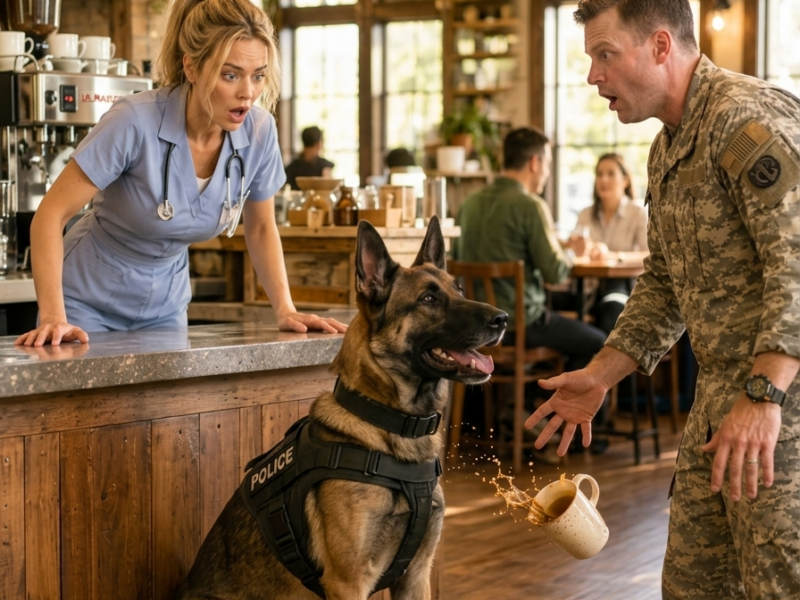
The Navy officers froze when the K9 found me collapsed behind an abandoned clinic in Norfolk, Virginia
I woke beneath a broken streetlamp with rain running down my face and a dog breathing against my neck.
For a few seconds, I didn’t know where I was. The icy Virginia air bit through my threadbare jacket, smelling of saltwater, wet pavement, and old rust. My body throbbed with an exhaustion that felt less like physical fatigue and more like a permanent stain on my bones.
Then I saw the Navy vehicles surrounding the narrow alley behind the abandoned clinic in Norfolk. High-intensity headlights pierced the midnight downpour, blinding me, cutting the rain into sharp, shimmering blades. Black boots slammed onto the wet asphalt, splashing muddy water into the gutters.
A man stepped forward slowly, his hand resting near his sidearm, though his eyes were wide with genuine shock. He wore the insignia of a Navy Master-at-Arms.
“Ma’am, we’re here to take you home.”
Home.
The word hurt more than the cold. It clawed at my throat like swallowed glass.
Nine years earlier, I had been Lieutenant Clara Vance, a Navy nurse assigned to an elite medical evacuation unit deployed overseas. One night, during a routine transfer of critical supplies and personnel across a rugged border route, our convoy disappeared from the radar. A catastrophic explosion, they said. Three charred bodies were eventually recovered from the twisted metal and ash.
I was declared dead. My family buried an empty casket. My belongings were packed into cardboard boxes and shipped away.
Except I wasn’t dead. I had survived the initial crash, bleeding and broken, only to realize that the burning wreckage was not an ambush by enemy combatants. It was an execution. Someone had made sure my name, my service record, and my life vanished entirely into thin air afterward.
For nine long years, I lived under another name—Maya, a ghost moving from town to town, working double shifts in dishpits, nocturnal laundromats, and low-rent diners, never staying in one place longer than six months, and never, ever trusting anyone wearing a uniform.
Then the dog found me.
He was a massive Belgian Malinois with scars running across his muzzle and a broad chest heaving in rhythmic pulses. The Navy officers had frozen in place when the K9 broke formation and charged into the dark alley, locating me collapsed against the damp brick wall behind the abandoned clinic. But instead of barking to signal a target, instead of letting them take me away, the dog pressed his heavy body against my chest and growled at every uniform in sight.
His low, vibration-heavy growl rolled through the tight corridor of the alley, a deep, menacing sound that kept five armed men rooted to the pavement.
“Easy, boy! Easy!” the K9 handler shouted, stepping forward with his lead extended. “Atlas, heel!”
Atlas didn’t budge. He leaned his entire weight into me, shielding my trembling frame with his own. The heat radiating off his fur was the only warmth I had felt in hours.
“Where did you get him?” I whispered, my voice cracked and dry from days of barely speaking.
The handler stopped, looking thoroughly confused as he fought to read the dog’s posture. “He was assigned to your unit years ago, ma’am. He’s a retired service animal brought back in for specialized tracking. He broke away from his handler the moment we set up the perimeter two blocks over.”
My hands started shaking violently. I reached up, my bruised fingers sinking deep into the dense, rain-soaked fur behind his ears.
I remembered Atlas as a young, energetic K9 who used to sleep beneath my desk whenever I worked overnight shifts at the forward operating base. I remembered scratching behind his ears before every risky medevac mission, whispering promises that we would all make it back to the barracks safely. I remembered his bright, intelligent eyes staring up at me while I sneaked him pieces of beef jerky from my rations.
I remembered the absolute terror of the last night I saw him, right before the flames swallowed everything.
Atlas turned his head and placed his heavy snout directly on my lap. He whined—a small, painfully human sound that shattered whatever walls I had built around my heart over nine years of isolation.
The handler took another cautious step, reaching out toward the leather harness. “I need to secure the dog, ma’am. Please, just step toward the squad car. We need to get you to Medical.”
Atlas immediately bared his teeth, the muscles along his spine locking tight as steel cables. A terrifying, guttural roar burst from his throat.
“No,” I whispered. “Don’t touch him.”
The Master-at-Arms raised his hands slightly, signaling his men to hold their positions. “Lieutenant Vance… or whoever you are now… you don’t understand. You’ve been listed as deceased on Navy rolls for nearly a decade. This whole block is secure. You’re safe.”
I looked into Atlas’s amber eyes. For the first time in nine years, a tiny spark of genuine safety flickered in my chest—not because of the armed men or the high-tech tactical vehicles, but because of the animal who refused to leave my side.
“She isn’t safe,” a low, gravelly voice echoed from the mouth of the alley.
A senior officer walked out from the shadows beyond the headlights, pulling his rain hood back. His face was weathered, mapped with deep lines of stress and years of command. He held a thick, yellowed manila folder tucked under his arm, and in his right hand, he carried a laminated black-and-white photograph.
He motioned for the Master-at-Arms to lower his weapon. “Stand down, team. Give her space.”
The senior officer slowly knelt on one knee about five feet away from us, carefully placing the photograph face-up on a dry patch of concrete near my boots.
“There’s something you need to know, Clara,” he said softly.
I stared down at the picture. It showed the charred wreckage of my convoy, taken hours after the crash under powerful floodlights. Firefighters and military investigators milled around the burned hull. But in the top left corner of the photo, standing near a black command sedan away from the main fire crew, stood a man whose face was etched into my worst nightmares.
Commander Richard Vance. My former commanding officer. The man who had signed my death certificate—and the man who happened to be my uncle.
The senior officer lowered his voice until it was barely audible over the patter of the rain. “We didn’t find you tonight because our intelligence network picked up your trail. We found you because an anonymous ping hit our internal servers two hours ago from a terminal inside the Pentagon.”
I looked up, my vision blurring. “I don’t understand.”
“We didn’t find you because you were hiding,” the officer said, his throat bobbing as he swallowed hard. “We found you because someone inside the Navy kept deleting every trace of you every time an automated search popped up over the last nine years. Someone was covering your tracks… until tonight.”
My heart sank into a dark, cold void. “If someone was covering my tracks… then why did the ping go out?”
“Because he stopped covering them,” the officer replied grimly. “Or because his access was revoked.”
Atlas suddenly snapped his head toward the street beyond the alley entrance. His ears pinned straight back, his teeth bared in an expression of pure, unadulterated hatred. His body vibrated with a rage so intense I could feel it through his ribcage.
Out on the street, beyond the blue and red flashing lights of the Navy barricade, a heavy black SUV pulled to a quiet stop. Its windows were heavily tinted. Its engine didn’t shut off; it just idle-hummed like a predator lurking in tall grass.
Nobody moved. Nobody spoke. The officers around us shifted their weight nervously, looking between the black vehicle and their commander.
Then Atlas began to growl—a sound far deeper and far more terrifying than the one he had directed at the patrol officers.
And in that horrifying moment, as the driver’s side door of the black SUV slowly opened into the rain, I realized the awful truth.
Atlas wasn’t protecting me from the Navy officers in front of me.
He was warning me that the man who erased my life nine years ago had finally come back to finish what he started.
The footstep that hit the pavement outside the alley was heavy, deliberate, and chillingly familiar.
“Clara,” a voice called out over the idling rumble of the SUV’s engine. It was smooth, commanding, and stripped of all warmth—the voice that used to orchestrate logistics for entire medical battalions.
Commander Richard Vance stepped into the glow of the streetlight. He wore a crisp, tailored overcoat over his uniform, entirely unfazed by the pouring rain. Behind him, two men in unmarked dark tactical gear stepped out of the black vehicle, their hands resting low beneath their coats.
“Commander Vance,” the senior Master-at-Arms said, his voice tightening as he took a half-step back. “This is an active recovery scene under district jurisdiction. You shouldn’t be here.”
Richard didn’t even look at the Master-at-Arms. His cold, gray eyes were fixed entirely on me, locking onto my face with the precision of a targeting scope.
“I have direct clearance from the Department of the Navy, Sergeant,” Richard said flatly, pulling an official document from his inner pocket and handing it to the officer. “Lieutenant Vance is a survivor of a classified black-budget operation. She is suffering from severe post-traumatic stress and extreme disorientation. My team is taking custody of her immediately for transport to a secure medical facility.”
“No,” I croaked, pushing myself harder against the brick wall. “No… don’t let him near me.”
Atlas lunged forward, the leather strap of his collar pulling taut as his front paws left the ground. He unleashed a furious tempest of barks, his eyes fixed squarely on my uncle’s throat. The handler desperately tried to secure the leash, but Atlas twisted, snapping back at the air to keep everyone away from my perimeter.
“Control that animal, Sergeant, or my men will put it down,” Richard said calmly, taking another step forward.
“Touch him and I’ll kill you,” I spat, the long-dormant rage finally bursting through my fear. The raw power of my own voice surprised me. Nine years of living like a stray dog, eating scraps, sleeping in cold alleys, and flinching at every passing shadow culminated in that single moment.
Richard paused, looking down at me with a mixture of annoyance and faint pity. “You look terrible, Clara. You always were too emotional for field command. If you had just stayed dead like you were supposed to, none of this mess would be happening right now.”
“You blew up our convoy,” I said, my voice shaking with a dangerous mixture of grief and fury. “There were four medical personnel in those trucks! We were carrying blood plasma and wounded soldiers! Why?”
“Because you weren’t carrying blood plasma, Clara,” Richard replied, his voice dropping low, sharp enough to cut through the heavy rain. “You were carrying three boxes of hard drives containing the entire financial trace of a defense contractor network that paid off half the Senate. You weren’t supposed to be on that transport. You took Lieutenant Miller’s shift at the last minute because you thought you were being nice.”
The truth landed like a physical blow. Nine years ago, Miller had asked me to swap duties so he could speak with his newborn daughter over satellite phone. I had smiled, taken his clipboard, and climbed into the back of the lead vehicle.
Miller died in my place. And I had survived only because the blast blew me clean out of the rear doors and into a deep ravine before the fire engulfed the truck.
“You killed them all to hide your money,” I whispered.
“I saved a system that keeps thousands of men employed,” Richard corrected smoothly. “And when I found out you had pulled yourself out of that ditch and crawled to a civilian hospital under an alias, I made a choice. I didn’t send a team to execute my own niece. I simply deleted your service record. I erased your identity. I left you to rot in the gutters of America, thinking you would eventually fade away quietly.”
He looked at his watch, completely unbothered by the rain soaking his gray hair. “Unfortunately, your old friend Atlas here got re-flagged in our database last week during a routine canine rotation. When I saw he was being transferred to Norfolk, I knew it was only a matter of time before his handler brought him through this district. Animals remember smells, Clara. Especially smells tied to trauma.”
“He remembers you,” I hissed.
“And that makes him a liability,” Richard said. He nodded to the two tactical operators behind him. “Take her. Neutralize the dog.”
“Hold on!” the Master-at-Arms shouted, unholstering his weapon and aiming it directly at Richard’s team. “Commander Vance, stand down! You do not have authority to order an execution on domestic soil!”
“I have total authority, Sergeant,” Richard said softly.
Before the Master-at-Arms could pull his trigger, one of the men in tactical gear raised a silenced pistol and fired two sharp shots. The Master-at-Arms dropped to his knees with a choked groan, hit clean in the shoulder and thigh. The other patrol officers scrambled for cover behind their squad cars as suppressed gunfire shattered the night air, blowing out the headlights and plunging the alley into violent, flashing shadows.
“Atlas, GO!” I screamed, grabbing the dog’s harness with all the strength I had left and shoving him sideways toward a narrow gap in the crumbling brick wall behind us.
Atlas didn’t run away—he grabbed the sleeve of my heavy jacket in his jaws and yanked with ferocious force, pulling me bodily off the wet ground and dragging me through the broken drywall of the abandoned clinic’s side entrance just as a hail of bullets tore through the brickwork where my head had been resting a second before.
We plunged into absolute darkness, the sound of rain immediately muffled by rotting timber and collapsing roof tiles.
“Secure the perimeter!” Richard’s voice echoed through the broken gap behind us. “Flush them out! I want her dead before sunrise!”
Inside the dark, rotting clinic, Atlas pressed his flank against mine, panting heavily. His coat was covered in mud and blood—not his own, but the blood of the shot officer. He looked up at me in the pitch black, his teeth gleaming, waiting for my command.
For nine years, I had been running away. I had sprinted across state lines, hidden behind fake names, and cowered in the shadows. But looking into the glowing eyes of the dog who had refused to abandon me, I knew that running was over.
“Okay, Atlas,” I whispered, reaching into my pocket and pulling out a rusty scalpel I had scavenged from the clinic debris days earlier. “Let’s hunting.”
The inside of the clinic smelled of damp drywall, mold, and long-abandoned antiseptics. Rain leaked steadily through cracks in the ceiling, creating a slow, rhythmic dripping that masked our movements as Atlas and I moved deeper into the pitch-black hallways.
I knew every inch of this ruined building. I had slept in its abandoned basement for three days prior to tonight, seeking shelter from the Virginia winter. I knew which floorboards creaked, which fire doors were rusted shut, and where the old medical supply shafts dropped down into the dark boiler room below.
Behind us, the heavy wooden back door was kicked open with a loud splintering crunch. Beam lights from military-grade flashlights cut through the dust-moted air, sweeping across the peeling wallpaper.
“Two targets inside,” a voice rasped through a tactical radio. “The girl and the animal. Proceed with lethal force. Commander Vance wants zero loose ends.”
“Copy that,” another voice replied from the far end of the corridor. “Taking the east hall.”
They were separating. A classic search pattern, designed to flush out a terrified civilian. But they didn’t realize that nine years ago, before I was a ghost, I was a Navy trauma nurse who had spent two tours in active warzones learning how men in tactical gear think, move, and bleed.
I leaned down to Atlas’s ear, feeling the heat radiating off his body. “Silent,” I breathed.
Atlas lowered his posture until he was practically crawling along the waterlogged linoleum. He didn’t make a sound. His nails didn’t even click on the floor. He moved like a shadow, his entire body attuned to my breathing.
We reached the entrance to the old triage room. I slipped behind a overturned metal gurney, my heart hammering against my ribs like a trapped bird. In my right hand, I gripped the rusty scalpel; in my left, I held a heavy glass intravenous bottle I had pulled from an open cabinet.
Footsteps approached. Slow. Measured. The beam of a flashlight swept across the room, illuminating rusted IV stands, shattered glass, and my own pale face reflected in a broken mirror hanging on the far wall.
The operative stepped over the threshold, his silenced rifle raised to his shoulder. He checked his corners with mechanical efficiency, but he failed to look up at the heavy ceiling beam where a loose air duct hung by a single rusted wire.
I didn’t throw the glass bottle at him. I threw it hard against the far window, smashing the remaining glass pane out into the alley.
The operative spun around, his rifle tracking the sound instantly.
“GO!” I snapped.
Atlas launched himself like a muscular missile. He didn’t bark. He didn’t warn. He crossed the ten feet of open floor in a fraction of a second, his powerful jaws locking around the operative’s right forearm with bone-crushing force.
The man let out a stifled scream as his rifle clattered to the floor. Before he could reach for his sidearm with his free hand, I lunged from behind the gurney, driving the heel of my boot into the back of his knee. He went down hard, his head striking the edge of the metal gurney with a sickening crack.
He crumpled to the floor, unconscious.
Atlas kept his grip on the man’s arm until I gently tapped his shoulder. “Release,” I whispered. He let go instantly, standing over the fallen soldier with his ears forward, watching the doorway.
I dropped to my knees, my hands moving with surgical speed. I stripped the operative of his tactical vest, his sidearm—a sleek, loaded 9mm pistol—and his radio earbud. I snatched his flashlight and two extra magazines, sliding the spare ammo into my jacket pocket.
“Team leader, status,” a voice crackled through the earbud I had just jammed into my ear. “Did you find them?”
I clicked the transmitter twice—the standard military signal for “stand by / engaged in search”—and didn’t say a word.
“Roger that, team leader. Moving to support your position in triage,” the voice replied.
I looked at Atlas. The dog was staring down the dark corridor toward the stairs that led to the upper administrative offices. He gave a tiny, almost imperceptible tail thump against my leg, as if to say one down.
“We need to get to the roof,” I whispered to him, checking the action on the stolen pistol. The cold metal felt terrifyingly familiar in my hands. “Richard will be watching the street exits. The only way out of this trap is over the adjacent rooftops.”
We moved quickly through the darkness, slipping into the stairwell just as the second operative entered the triage room behind us. A second later, a curse echoed up the concrete shaft as the man discovered his unconscious teammate.
“Ambush! Ambush! She’s armed! The dog is—”
I pushed open the heavy steel door at the top of the stairs, stepping out into the blinding rain on the building’s flat asphalt roof.
The cold air hit me like a slap, but I didn’t stop. Across a ten-foot alley gap sat the roof of a commercial warehouse, which led straight toward the civilian shipping docks and freedom.
“Clara!”
I froze.
Standing near the edge of the roof, illuminated by the distant city lights and holding a heavy black umbrella, was Commander Richard Vance. He wasn’t waiting in his car. He had taken the fire escape on the north side of the building, anticipating my escape route with the cold, calculating intelligence that had made him an admiral’s top advisor.
He held a revolver pointed directly at my chest.
“You always were predictable,” Richard said, his voice easily carrying over the storm. “You were always the good little soldier who looked for the high ground.”
Atlas stepped in front of me, his body locked, growling into the storm.
“Step aside, Clara,” Richard said, taking a slow step forward. “You’re tired. You’ve been a ghost for nine years. Let me give you the peace you should have had nine years ago.”
I raised the stolen pistol, aiming it straight between his eyes. “I’m not running anymore, Uncle Richard.”
He laughed—a dry, bitter sound. “With what? An empty gun? You didn’t check the magazine, did you?”
I paused, my heart dropping.
Richard smiled, pulling his finger back on the trigger of his revolver. “You were always a nurse, Clara. Not a soldier.”
The silence between us hung suspended, heavier than the rain beating against the tar paper of the roof.
I didn’t lower the gun. My arms stayed locked, my sight picture focused square on the bridge of Richard’s nose.
“You’re right,” I said softly, my voice cutting cleanly through the storm. “I am a nurse. And a good nurse always checks her equipment.”
I racked the slide of the pistol with a sharp, mechanical metallic snap. A live 9mm round chimed as it cleared the chamber, dropping onto the wet roof tiles, leaving a fresh, deadly round seated in the breach.
Richard’s smug expression dissolved in an instant. His eyes widened slightly as he realized I hadn’t fallen for his psychological game.
“You sold out your own blood,” I said, taking a step forward. Atlas moved with me, his shoulders aligned with my knees, a silent wall of muscle and bone. “You watched my mother weep over an empty coffin. You let her die of heartbreak three years later thinking her daughter was burnt ash in a foreign country. All for a offshore bank account and a promotion.”
“It wasn’t about money!” Richard snapped, his composure finally cracking, revealing the pathetic, desperate man beneath the expensive overcoat. “It was about survival! The people behind those accounts… they would have destroyed me, Clara! They would have destroyed our entire family!”
“You destroyed us yourself!” I shouted.
From behind me, the heavy steel fire door smashed open. The second tactical operative burst onto the roof, his rifle already coming up toward my back.
“Drop it!” the operative yelled.
“Atlas, TAKE HIM!” I roared.
Atlas didn’t hesitate. He spun on a dime, leaving my side and launching his heavy frame across the rain-slick roof. The operative fired off a wild shot that tore through the air inches from my ear, but Atlas was already on him. The dog slammed his entire weight into the man’s chest, knocking him backward down the flight of concrete stairs. The sound of tumbling boots and shattering gear echoed down the stairwell, followed by the heavy slam of the door shutting tight.
Richard took advantage of the split-second distraction. He raised his revolver and fired.
The bullet grazed my shoulder, tearing through my jacket and searing a burning track across my skin. The impact threw me off balance, slipping on the wet tar paper. I hit the ground hard, my pistol sliding away across the slippery surface, coming to a rest just inches from the roof edge.
Richard walked toward me, his umbrella discarded in the wind, his face twisted into an ugly, triumphant sneer. He stood over me, leveling his revolver directly at my forehead.
“It ends here, Clara,” he panted, his hand trembling slightly from adrenaline. “No more ghosts.”
I looked up at him, cold water filling my eyes, feeling the pain burning in my shoulder. But I didn’t feel fear anymore. The terror that had consumed my life for nine years had completely evaporated, replaced by a crystalline clarity.
“Look down, Richard,” I said quietly.
He blinked, momentarily confused by my lack of panic. He flicked his eyes down for less than half a second.
He was standing directly on the rusted, rotting iron hatch of the old building’s incinerator flue—a vertical shaft that dropped five stories down into the abandoned furnace room below.
Before he could react, I swept my leg with everything I had, kicking out the rusted support latch that held the ancient iron frame in place.
With a horrifying sound of rending metal, the iron doors gave way beneath his boots.
Richard let out a short, strangled cry as his footing vanished. His hands clawed wildly at the air, his revolver firing a useless shot into the dark clouds above as he plummeted backward into the pitch-black shaft.
A long, fading scream echoed down the vertical brick chimney, followed seconds later by a distant, heavy thud far below in the bowels of the earth.
Then, there was only the sound of the rain.
I lay on the cold roof for a long moment, staring up at the gray clouds whipping across the Norfolk sky. My breath came in ragged, painful gasps, my blood mixing with the rainwater pooling around my coat.
A wet snout pressed firmly against my cheek.
Atlas was standing over me, his flanks breathing heavily, his head lowered as he licked the cold rain from my face. He nudged my hand with his nose until I raised my trembling arm and wrapped it around his neck.
“We did it, boy,” I whispered, burying my face in his damp fur. “We did it.”
Below us, the faint wail of city police sirens began to rise over the sound of the storm, approaching from every direction. The gunshots on the roof had finally drawn the real authorities.
I pulled myself up, leaning heavily against Atlas as I stood on the edge of the roof. Down on the street, dozens of blue flashing lights were spilling into the alley, blockading the black SUV and swarming the perimeter.
I didn’t run. I didn’t jump to the next roof.
I took a deep breath, grabbed Atlas’s collar, and walked down the stairs to face the light.
The sunlight filtering through the high windows of the federal courthouse in Washington, D.C., was blindingly bright, sharp, and clean.
It was six months after that freezing night in Norfolk.
I sat at the defense table dressed in a clean, tailored dark suit—the first real clothes I had owned in nearly a decade. Beside me sat two federal attorneys appointed by the Department of Justice. And sitting quietly on the polished hardwood floor at my feet, his chin resting calmly on my leather shoes, was Atlas.
He wore a formal service vest emblazoned with his official Navy retirement seal. He had been officially decommissioned from military duty three weeks prior, his custody permanently transferred to me by an executive order.
The courtroom was packed to absolute capacity. Journalists, military brass, federal agents, and senators sat packed in the gallery rows, whispers rustling through the room like dry leaves.
On the high bench, the federal judge straightened her glasses and looked down at the thick stack of documents in front of her.
“In light of the extensive evidence recovered from the server nodes in Norfolk, as well as the corroborating testimony provided by surviving members of the 4th Logistics Battalion,” the judge declared, her voice echoing clearly off the high marble walls, “this court officially nullifies the 2017 death certificate of Lieutenant Clara Vance.”
A collective gasp swept through the gallery, followed by a wave of frantic note-taking by the reporters in the front row.
“Furthermore,” the judge continued, her expression softening as she looked down at me, “all military records regarding Lieutenant Vance are hereby restored with full honors. She is granted complete retroactive back pay, full medical disability retirement benefits, and a complete exoneration of all off-record movements during her time in hiding.”
I closed my eyes, letting out a breath I felt like I had been holding for nine long years. Beside me, Atlas lifted his head and let out a soft, low bark, as if confirming the verdict himself. A ripple of quiet laughter washed through the courtroom.
The judge struck her gavel. “Court is adjourned.”
As the room erupted into motion, people pushing forward toward the railings, my lead attorney turned to me with a wide smile, extending his hand. “Congratulations, Clara. You’re officially back among the living.”
“Thank you,” I said, shaking his hand, though my eyes were already drifting toward the heavy oak doors at the back of the room.
We walked out of the courthouse together, down the grand granite steps toward the sun-drenched plaza. Dozens of news cameras flashed, reporters shouting questions from behind the velvet ropes, but I didn’t stop to answer them. I didn’t need to explain myself to the world anymore. The truth was written into the federal record. The shadow network that my uncle had served was dismantled, dozens of corrupt officials facing trial, and the ghost named Maya was finally laid to rest.
When we reached the park across from the courthouse, away from the noise and the crowds, I sat down on a green wooden bench beneath a sprawling oak tree.
The spring air was warm, carrying the sweet scent of blooming cherry blossoms.
Atlas trotted over to a patch of bright green grass, sniffed it thoroughly, and then flopped down on his side, letting the warm sunlight soak into his scarred fur. He let out a long, contented sigh, his paws twitching slightly as he drifted into a peaceful nap.
I reached down, my fingers sinking into the thick fur behind his ears—the same gesture I had done in a dark alley in Norfolk, and in a dusty medical tent years before that.
For nine years, I had believed that home was a physical place—a house with a red door, a specific town, or a uniform that gave me a sense of belonging. I had thought that when my identity was erased, my home was destroyed along with it.
But looking at the dog sleeping peacefully at my feet, knowing we had survived the darkest night of our lives together, I finally understood the truth.
Home wasn’t a place on a map, nor was it a name typed onto a military roster.
Home was the loyalty that refused to forget you when the rest of the world turned its back. Home was the courage to stand your ground when the storm raged around you.
And for the first time in nine years, as I sat beneath the warm afternoon sun with my best friend beside me, I knew I was finally, truly home.
The end.









