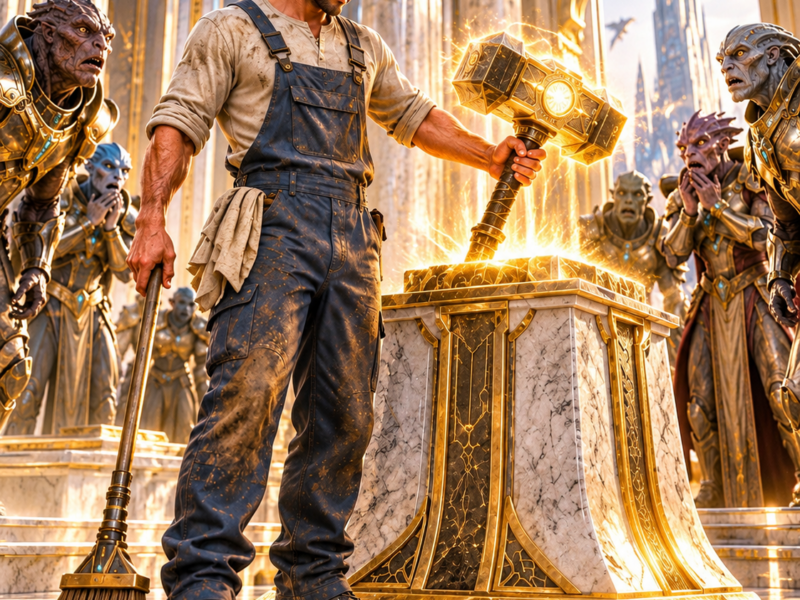
The most powerful warrior in the Iron Brand Order had spent twelve years trying to lift a legendary hammer.
Ida Imry had cleaned a great many places in her fifty-three years, and she had formed a firm opinion that there was no such thing as a dirty place, only a place that was waiting for someone to care about it.
She had cleaned primary schools on Earth, orbital hotels, a ferry terminal, a mining dormitory, and one memorable embassy where the ambassador’s pet had been sick in a place no pet should ever have been able to reach.
So when the staffing agency told her that the only open contract in the sector was night maintenance at Ilvine Bastion, home of the Iron Brand Order, she did not flinch.
She packed her flask, her peppermints, her good rubber-soled boots, and a photograph of her grandson holding up a fish nearly as long as his arm. Then she boarded the transport.
Ilvine Bastion hung in the thin light above the pale world of Ithaca, like a great bronze seedpod ringed with towers and docking gantries. It turned slowly against the stars. The Iron Brand Order had held it for nine hundred years.
The Order’s members were Ithrikai, a people built along the lines of very tall, very dignified lizards. Their bronze scales could be polished to a remarkable shine. Their bony crests rose from the backs of their heads and flushed different colors when they felt strongly. Even their ordinary speech sounded like a vow sworn on a battlefield.
They were warriors by tradition and temperament, and they took everything seriously, including breakfast.
Ida’s new supervisor met her at the docking ring.
Ignatri was a round, harried human with a tablet in one hand and a sandwich in the other. He gave the impression of a man who had been apologizing since birth.
“Mrs. Imry. Welcome. Welcome. Good that you’re here. We’re short three people, and the Order has a big gathering tomorrow. The In-Gathering. Everything has to shine.”
He walked quickly, and Ida kept pace without effort.
“Now, a few rules. One: you do not speak to the wardens unless spoken to. Two: you do not touch anything in a display case. Three—and I mean this more than the others—you never, ever touch the hammer.”
“What hammer?” Ida asked.
Ignatri stopped walking and gave her a look of mild horror, as though she had asked what a sky was.
“Iun. In the Hall of Iron Vows. The legendary hammer. You’ll see it. You can’t miss it. It glows.”
“All right.”
“Don’t dust it. Don’t polish it. Don’t breathe on it if you can help it.”
“I’ll try not to.”
He gave her a cleaning cart: a boxy gray machine with several shelves and a small round cleaning drone riding on its handle like a parrot. The name Ipsy had been stenciled across the drone’s casing in a child’s handwriting.
“Previous crew named it,” Ignatri said. “It’s mostly obedient.”
The drone gave a small chirp, rotated one lens, and settled against Ida’s wrist. She accepted its greeting with a pat.
The corridors of Ilvine Bastion were enormous. The ceilings climbed so high that the lamps looked like a second set of stars. The floors were made of long slabs of dark green stone, worked into spiral patterns and worn smooth by nine centuries of heavy boots.
Ida liked them at once.
They were honest floors. They had history in them, and they also had a surprising amount of grit.
She started at the eastern end and worked her way inward. As she went, she noticed things the way a cleaner does.
Dust gathered thickest along the windward side of every pillar. That meant the air was moving in a pattern. The floor had a faint trembling, so slight that her flask of tea showed it only as a shiver on the surface. There was a low note beneath everything, more felt than heard.
She noticed the warriors, too. They moved through the halls in pairs and threes, tall and grim and gleaming. Every one of them looked past her as though she were a drinks cabinet.
She did not mind. In her experience, being looked past was half the secret of a peaceful shift.
At the ninth bell of the station’s night, she reached the Hall of Iron Vows.
It was a round chamber wide as a sports field, with a floor of white marble veined in gold. The domed ceiling was painted with the faces of ancestors, all of whom seemed to be frowning at something just behind her.
Banners hung from the walls. Great braziers stood unlit in a ring.
And in the center, on a black stone plinth, rested the hammer.
Ida stopped and looked at it for some time.
It was not as large as she had expected. The head was a block of gray metal about the size of a bread loaf, and the handle was dark wood, banded with rings of pale silver. One spot near the middle had been worn smooth, as though someone long ago had held it there often.
A soft golden light moved inside the metal, slowly, like honey turning in a jar.
It looked less like a weapon and more like something a tired craftsman had set down at the end of a long day, meaning to pick it up again in the morning.
Around the plinth, in a neat ring on the marble, lay a scatter of small objects. There were tokens, ribbons, medals, a small carved bird, a pair of reading spectacles, and a child’s drawing of what might have been a dragon.
A handwritten placard stood nearby. Ida’s translator bud whispered the words into her ear.
*Iun, the Hammer of Ending Quarrels, forged in the First Age, awaits the worthy. Forty-one have tried. None have lifted it.*
“Forty-one,” Ida murmured. “That’s a lot of people with sore backs.”
She set to work.
She swept the marble in broad, steady arcs. She wiped down the braziers and polished the brass rail around the edge of the chamber. All the while, she hummed an old tune from her mother’s kitchen, something about a boat and a river and a girl who would not hurry.
Ipsy buzzed in lazy circles over her shoulder.
It was peaceful work, and she was good at it.
The trouble began with the plinth.
The black stone was streaked and dull, and a long smear of something—probably candle wax—ran across its upper face. The smear continued beneath the edge of the hammer’s head.
Ida looked at the hammer.
She looked at the smear.
She looked at the cloth in her hand.
The placard said not to touch the hammer. She had no intention of doing anything foolish. But the smear ran right to the edge, and the hammer sat squarely in the middle. A cloth could only reach so far.
She had moved a great deal of heavy equipment in her time. The thing was about the size of a loaf of bread.
Ida leaned her broom against the plinth, set the cloth on her shoulder, took hold of the wooden handle just above the worn spot, and lifted it the way one lifts a bucket to wipe the floor beneath.
It came up as lightly as a garden trowel.
The golden light inside it brightened.
A warm, low sound filled the hall. It was not loud, more like the note of a great church bell long after the clapper has stopped. The sound passed through the soles of her boots. She felt it in her teeth.
Ida paused, holding a hammer in one hand and a cloth in the other.
“Oh,” she said softly. “Aren’t you nice and warm?”
She wiped the plinth in three long strokes. The wax came away like butter.
Then she set the hammer back in its exact place, nudging it a finger’s width to the left because it had been sitting slightly crooked anyway.
She took up her broom and carried on sweeping.
The golden light dimmed to its slow, honeyed turning. The note faded.
Ipsy gave a questioning chirp.
Ida patted it.
“Don’t tell anyone I moved it,” she said. “I’ll get a talking to from Mr. Ignatri.”
Neither of them noticed the pair of enormous, round, terrified yellow eyes watching from behind the fifth pillar.
The eyes belonged to Cadet Iko, the youngest member of the Iron Brand Order, the smallest of his year, and, by his own estimation, the most unlucky.
He was nineteen cycles old, which for an Ithrikai was the awkward stage between hatching sweetness and proper dignity. His crest was too big for his head. His boots were too big for his feet. He had been assigned the least distinguished duty of the night: standing watch in the Hall of Iron Vows in case anyone tried to steal the legend.
Nobody ever had.
So he had settled behind a pillar with a sweet bun he was not supposed to have, listening to the cleaning woman hum.
Then he had watched her lift the hammer with one hand.
He stopped chewing.
The bun slipped from his fingers, bounced once on the marble, and rolled almost to the woman’s boot.
She picked it up, looked around, saw no one, and gently set it on the edge of a bench with a small shrug.
Then she wheeled her cart out of the hall, humming, and the doors closed behind her.
Iko stayed behind the pillar until his knees shook.
Then he ran.
The archivist, Enth, lived among her shelves like a snail in a shell. She was a very old Ithrikai, her bronze scales gone soft and gray at the edges, her crest folded flat, and her eyes enormous behind lenses she had ground herself.
The archive was a great dim room at the heart of the bastion, where the Order’s records were kept. There were rows upon rows of scrolls, slates, and ancient crystal discs. Enth slept there, ate there, and the cadets whispered that she had once been seen arguing with a bookcase.
She was reading when Iko burst in.
“If it is a fire,” she said without looking up, “report to the warden. If it is a quarrel, report to the warden. If it is a sweet bun, you may place it on the third shelf.”
“Archivist! The hammer! The cleaner! She picked it up!”
Enth looked up.
“What did she pick up?”
“Ayuroon. She lifted it. One hand.”
Enth set down her scroll with great care. She looked at Iko for a long moment, the way one looks at a very small child who has just announced he has seen a ghost and also needs the washroom.
“Cadet, describe precisely what you saw.”
He did. He described it badly, then described it again with fewer flailing gestures.
The old archivist listened without a word. Her crest slowly rose until it stood tall and flushed a pale, startled green.
“Wax,” she said at last.
“What?”
“She lifted the Hammer of the First Age to remove a smear of wax.”
Enth took off her lenses and polished them on her sleeve with trembling hands.
“How remarkable. How perfectly, absurdly remarkable. Tell me, Cadet, did she say anything? A challenge? A prayer? A vow?”
“She said it was nice and warm. And not to tell Mr. Ignatri.”
“Nice and warm,” Enth repeated faintly.
She rose from her chair, which creaked its relief, and walked to a high shelf. There she pulled down a crystal disc so old that its edges had gone cloudy.
“Come, Cadet. Say nothing to anyone. Not the warden, not your friends. Not yet. I need to look at something I should have looked at four hundred years ago.”
“But the In-Gathering is tomorrow.”
“Yes,” said Enth. “That is what worries me.”
***
Warden Ixmore had not slept well in eleven nights, and the reason was a letter.
It lay on his desk in the warden’s tower, written on cream-colored paper and sealed with the green wax of the Escorian Pact.
The letter was perfectly polite.
It said that Envoy Exara would arrive at the In-Gathering with a delegation of twenty. It said that the Pact had long wondered whether the Iron Brand Order remained worthy of Ilvine Bastion. And it said that, in the interest of settling the question peacefully, the Pact proposed a simple demonstration.
The Order’s finest would take up Ayuroon before all assembled.
If the hammer lifted, the matter would be closed.
If it did not, as it had not for three hundred years, the Pact would suggest with deep regret that the bastion be placed in the hands of those with a clearer claim.
Ixmore was a big, patient Ithrikai with a crest the color of old brass and the kind of face that made children behave.
He had led the Order for thirty years. He had faced pirates, storms, and a three-day banquet with the Escorian ambassador.
He had never faced a piece of paper that frightened him so much.
He was staring at it once more when Enth and Iko appeared at his door at the fourth bell of morning. Both looked as though they had been dragged through a hedge.
“Warden,” Enth said, “we must speak. And you must promise not to shout.”
“I never shout.”
“You shouted at the quartermaster about the soup.”
“The soup was inexcusable.”
Enth placed the cloudy crystal disc on his desk.
“Please sit.”
What followed took the better part of an hour.
Iko told his tale, shaking only a little. Enth played the disc, which turned out to be a recording of the Order’s founding oath, made by the first warden in the First Age in a language so old it was practically a rumor.
She had translated it herself over the course of the night, with the help of four dictionaries and a pot of bitter tea.
She read her translation aloud slowly.
“*Ayuroon shall be given to the Order and shall wait. It shall not answer the strong, for the strong are many. It shall not answer the proud, for the proud are louder. It shall answer the hand that keeps the hall.*”
Ixmore frowned.
“That is the oath as we know it. The hand that keeps the hall. It means the hand that rules the hall. The sovereign. The leader.”
“That,” said Enth, “is what we have always believed. But look. The word is *erdhan*. In the language of the First Age, it has two meanings, and we have spent nine hundred years choosing the wrong one. It can mean to rule, or it can mean to tend.”
The room went very quiet.
“To tend,” Ixmore said slowly. “As in tending a fire, tending a garden, tending a child.”
“Or a floor,” Enth added.
“The hand that keeps the hall,” Ixmore whispered. “Not the hand that holds the throne. The hand that sweeps it.”
Iko, who had been very good and very silent, could not hold it back.
“She had a broom.”
“She had a broom,” Enth agreed.
Ixmore stood. He walked to the narrow window of his tower, where the pale curve of Ithaca rolled slowly beneath the stars.
His crest had gone through a series of colors and settled on a deep, troubled amber.
“Forty-one champions,” he said. “My own predecessor was the thirty-ninth. He tried for a full day and a night. He wept when it would not move. He believed he was unworthy and carried that belief to his grave.”
He turned back.
“And all this time, the hammer wanted a woman with a mop.”
“Possibly,” Enth said gently. “It simply did not want someone who needed to win.”
Ixmore laughed. It was a short, startled sound like a cough. Then he sat down heavily and put his face in his hands.
“The In-Gathering is tomorrow.”
“Yes,” said Enth.
“And the Pact wants the hammer lifted in front of everyone, or the bastion is forfeit.”
“Yes.”
“And our hammer-bearer is a human cleaner who does not know she is anything of the sort. She works for a contractor, and if we ask her to stand before four hundred armored delegates and lift a legend, she will quite reasonably refuse or faint, or both.”
“Probably,” said Enth, “she will ask whether there will be tea.”
Ixmore looked up. For the first time in eleven nights, something like hope loosened the knot between his eyes.
“We must not frighten her,” he said. “We must not use her. She is not a weapon, and she is not a prize. She is a guest on our station.”
He rose again.
“We will watch. We will learn who she is, and we will be very, very careful.”
The Iron Brand Order was not good at being careful.
They were good at many things. They could march in perfect step for eight hours. They could recite eleven thousand lines of battle verse. They could lift an engine block.
Being subtle was not among their talents.
The next morning proved it.
Ida came on shift at the ninth bell, tucked her flask into the cart, and wheeled into the inner gallery. It was a long corridor of dark green stone that ran along the south side of the Hall of Iron Vows. It was wide, handsome, and lined with shields.
She liked it. It had good light and a very satisfying amount of grit.
On the first pillar, a warrior was reading a book.
It was upside down.
On the second pillar, two warriors stood pretending to discuss the weather, which on a space station is a hard thing to discuss for long.
“Fine day,” one was saying with the stiff gravity of a man reading from a card. “Very ambient.”
At the third pillar stood Irasque, the Order’s champion. He was enormous, glittering, and scarred, with a crest that looked as though it had been forged from red-hot iron.
He was glaring at Ida with such ferocious suspicion that she stopped her cart.
“Everything all right?” she asked politely.
“I was the Order’s champion,” he announced. “The finest swordsman in the bastion. Holder of nine medals. A man whose boots are polished to a mirror shine by a personal bootmaker.”
“That’s nice,” Ida said.
“For twelve years I have tried to lift Ayuroon. Every In-Gathering. I trained until I broke a rib. I fasted. I swore oaths. I stood before the hammer for nine hours once.”
Ida looked at him.
“Oh dear.”
“And you lifted it to remove a stain.”
“A bit of wax,” Ida said. “I’m sorry.”
Irasque stared at her.
Then something in his expression shifted. His crest, which had been blazing red, slowly faded to a warm orange.
“No,” he said. “Do not be sorry. This is the finest thing that has happened to me in a decade.”
He looked down at his enormous hands.
“Cleaner Ida, would you do me the honor of drinking tea with the warden today, if possible? He is a very serious man, but he is not unkind. And there is something we must tell you.”
“Well, I never refuse tea,” Ida said. “But I’m on shift until the fourteenth bell, and I’d like to finish this gallery first.”
“Of course.”
Irasque took a spare broom from the wall bracket and held it in both hands like a ceremonial sword.
“May I help?”
Ida considered the great warrior with a broom held at the salute. She considered the scattered dust along the gallery. Then she considered privately how much work she could get done if twelve strapping warriors could be persuaded to carry things.
“You can start with the benches,” she said.
It was the beginning of a very strange day.
The tea was taken in the warden’s tower, in a round room full of maps. Ida sat on a chair built for someone three times her weight, with her feet dangling a little above the carpet.
Ixmore poured the tea himself. His great scarred hands were remarkably careful with the cups, which were the size of thimbles in his grip. When he handed her one, he did it with both palms, as the Ithrikai did for a person of high honor.
He told her everything.
He told her about the oath and the two meanings of the old word. He told her about the forty-one champions. He told her about the Escorian Pact and the letter with the green seal. He did not hide the danger, and he did not dress it up.
When he finished, he folded his hands and waited with the patience of a man who had learned long ago that a thing said honestly can bear any silence.
Ida drank her tea. It was strong and slightly smoky, and she liked it very much.
“So,” she said at last, “you’re telling me that if I don’t help, you might lose your home.”
Ixmore nodded.
“And if I do help, I’ll have to stand in front of four hundred people and lift a hammer.”
“Yes.”
“I see.”
She looked down at her hands. They were ordinary hands, a little rough from years of work, with a small scar across one knuckle from a broken bottle in an orbital hotel.
“I’m not very good at ceremonies,” she said.
“We understand.”
“And I don’t want to be put on display.”
“We would never ask that of you.”
She looked at the warden. His crest had settled into a quiet, hopeful amber.
“But I won’t let people lose their home over something I can lift,” she said. “I’ll think about it.”
She finished her tea, thanked him, and went back to her shift.
She thought best while mopping.
By the next day, thirty-one warriors had learned to mop a floor.
They were not all good at it.
Irasque was particularly poor. He approached a stain as if it were an enemy combatant, attacking it with such force that he often spread it across a wider area.
Iko, on the other hand, was a natural. He understood that the mop needed to glide, not fight.
“Don’t fight the dirt,” Ida told them. “Persuade it to leave.”
She showed them how to use warm water, how to wring the mop properly, and why it was best to work from the top down.
“Gentle circles,” she said. “And don’t use too much soap. More isn’t always better.”
The warriors listened as though she were teaching them the secret movements of an ancient martial art.
They began to look at their home differently. They noticed the dust along the windows, the marks on the benches, the dull brass railings. They learned that a clean room was not merely a room without dirt. It was a room that had been cared for.
Ida found that she rather liked them.
Even Irasque, despite his terrible mopping.
The Escorian delegation arrived the following morning.
They came through the docking ring in a long procession of pale robes and polished silver. Their leader, Envoy Exara, wore a slim silver circlet and moved like someone who had never in her life been made to hurry.
She was elegant, patient, and very correct. Her expression, as she looked up at the towers of Ilvine Bastion, was one of mild, polished disappointment.
Ida watched from the courtyard.
“Exara,” murmured Enth, who had appeared beside her in her wheeled chair. “Clever, patient, and very correct. She has been maneuvering to take this station for twenty years.”
“Does she hate the Order?” Ida asked.
“No. That is the worst of it. She truly believes we are no longer fit to hold the station.”
“Is she a bad person?”
“No,” Enth said. “I wish she were. It would be so much simpler.”
Ida watched the envoy cross the courtyard. Behind her came attendants carrying flat wooden cases and long rolls of vellum. The whole procession had the quality of a very well-organized funeral.
Exara paused at the edge of the drill yard, where sudsy water was still running in the gutter. She looked at the neat rows of mop buckets.
“The Order is cleaning,” she said.
Irasque, who had been caught in the act of hiding a mop behind his back, went to full attention.
“Preparations for the In-Gathering, Envoy.”
“Of course.” Exara’s lips twitched. “How very domestic.”
She swept on, and her attendants flowed after her.
Ida finished her tea.
“Well,” she said, “she didn’t strike me as awful.”
Enth turned her great old eyes toward her.
“She looked tired mostly,” Ida continued. “Like someone who’s carried a heavy thing too long.”
“Tired?” Enth asked.
Ida shrugged.
“I know the look. I see it in the mirror.”
That night, after the delegation had been settled into the guest tower and the bastion had gone quiet, Ida returned to work.
She did not tell anyone where she was going. She simply wheeled her cart out into the long dim halls, with Ipsy riding sleepily on the handle, and began to sweep.
Sweeping was how she thought.
She started at the inner gallery and moved along it in her slow, steady rhythm. She listened.
It was the floor that told her.
The low trembling she had noticed on her first night was stronger now. It had a flutter in it, like a large bird caught in a chimney. Every few minutes it climbed sharply, then fell back.
The shields on the wall made a faint, tiny chatter.
In the Hall of Iron Vows, the surface of the ceremonial basin shivered in rings.
Ida stopped sweeping.
She put her palm flat against a pillar, the way one rests a hand against a sleeping animal, and stood there with her eyes closed.
“That’s not right,” she said softly.
“That’s not right at all.”
***
The In-Gathering began at noon the next day in the Hall of Iron Vows, beneath the frowning ancestors on the dome.
Four hundred guests filled the great round chamber. The Iron Brand knights stood along the left wall in polished ranks. The Escorian delegation occupied the right, silent and pale as candle smoke.
Brass horns sounded. The braziers were lit. Ayuroon glowed in the middle of the floor like a small, patient sun.
Ida was not in the hall.
She was in the inner gallery just outside the great doors, in her overalls with her cart and her broom. The warden had offered her a seat of honor. She had politely declined.
“I’d only fidget,” she had said.
So she swept in the long green passage with the doors ajar behind her, and the sounds of the ceremony drifted out in pieces.
Ixmore spoke first. He welcomed the Pact and honored the old oaths. He spoke well, though his crest betrayed him, flushing and fading in a way anyone who knew the Ithrikai could read as plainly as print.
Then Exara rose.
She spoke with beautiful, chilly courtesy. The Pact took no pleasure in what must be done. Nine hundred years was a long tenure. She begged the Order’s forgiveness for the question she was obliged to ask.
“Who here is worthy to take up Ayuroon?”
There was a pause.
Irasque stepped forward.
He had polished his armor until it hurt to look at. He knelt, took a long breath, closed both hands around the handle, and pulled.
A great hush fell.
The veins stood out in his neck. His scales flushed with effort.
The hammer did not shift by the width of a hair.
He tried for a full minute. At the end, he stood, bowed to the hall, and walked back to the ranks with his head high.
It was the most dignified defeat Ida had ever heard.
Ixmore tried next.
He fared no better.
Then Exara stepped down from the Escorian dais. She handed her circlet to an attendant, crossed the floor, and bent over the plinth.
Her pale hands closed around the handle.
Nothing happened.
She straightened. Her expression did not change.
“As expected,” she said, her voice carrying to every corner. “Forty-three have now failed, and the Order has no bearer under the terms of the old charter.”
A servant came forward with a long scroll.
“A fortress without a worthy claimant for the hammer is deemed unfit to stand alone. I regret to say that the Pact will take custody of Ilvine Bastion, effective at the next dawn.”
A roar went up from the Iron Brand ranks.
Ixmore held up a hand. Irasque’s crest blazed scarlet. For a moment, it seemed that nine hundred years of discipline might shatter, and a dozen knights stepped forward with their hands on their hilts.
Then the floor began to sing.
Ida felt it a heartbeat before anyone else did.
A deep grinding groan rose through her boots, coming from far below the marble, from the heart of the bastion itself. The brass rail beside her trembled. A shield slid off its hook and clanged against the floor.
Inside the hall, the water in the basin leapt in a ring. The flames of the braziers leaned sideways at once.
“What is that?” someone cried.
The groan grew.
The lamps swung. The great chandelier above the Hall of Iron Vows began to sway on its chains.
Four hundred guests from two proud peoples did what any group of people will do when the ground moves: they immediately forgot that they had been angry with one another.
“The chorus,” Enth said from her chair near the dais. Her face had gone white. “It is the Iron Chorus. It has come out of tune.”
Ida did not know what the chorus was.
But she knew a bad hum when she heard one.
She dropped her broom and went inside.
“Beneath the bastion,” Enth explained loudly over the clamor, “lies a spine of nine great bronze bells, set into the bedrock of the station by the founders in the First Age. Their steady, silent ringing—too deep to hear—holds the bastion’s slow spin in balance. It keeps the air moving and the walls from cracking.”
The bells had gone slightly sour over the centuries. It had happened so gradually that no one had noticed, except the cleaners, who had always complained about the wobbly floors and been told it was age.
Tonight, with a hall packed full of agitated people and a ship docking at the wrong angle, the old bells had slipped from sour into discord. Each one was pulling against its neighbor.
“The oath!” Enth cried. “The Hammer of Ending Quarrels. We thought it meant quarrels of people. It means the bells. It is the tuning hammer. It was never a weapon. It is a keeper’s tool!”
“Then someone use it!” Exara shouted.
She had forgotten her silver composure altogether. Her robes were rucked up, and her pale face was alarmed.
“Lift it! Strike it! Anything!”
Irasque seized the handle again.
He strained.
The hammer stayed where it was.
Ixmore tried, both hands, all his weight. The floor tilted a fraction more. Somewhere deep below, there was a long tearing creak of old metal. A chunk of plaster fell from the dome and burst on the marble.
Then a small, calm voice came out of nowhere.
“Excuse me. Mind your feet, please.”
The crowd parted.
Ida walked through the hall in her gray overalls, her sleeves rolled up, a cloth over one shoulder, her flask in her pocket, and a small round drone riding on her wrist.
She did not look at the ranks of armored warriors. She did not look at the pale envoys, the dome, or the dancing water.
She walked straight to the plinth.
She wiped her hands on the cloth out of habit, took hold of the wooden handle just above the worn place, and lifted.
Ayuroon rose in her hand as easily as a teaspoon.
Golden light flowed up the handle and over her fingers. The note that came from it was low and sweet and clear, ringing through the Hall of Iron Vows like a great bell struck in a snowy valley.
Every person present felt it in their chest.
Four hundred voices stopped.
The chandelier’s sway faltered in that held, shining moment.
Exara put a hand over her mouth.
Ida looked at the hammer.
The hammer, in a manner she could not have explained, seemed to look back.
“I know,” she said quietly. “I can hear it, too. Where do you need to go?”
The golden light flickered and turned. It drifted toward the floor, pointing like a patient finger to a low bronze door at the back of the hall. Ida had always taken it for a storage closet.
She picked up the spare lantern from her cart and nodded to the astonished warden.
“Mr. Ixmore, perhaps you could bring a few strong people to carry the lamps. It looks dark down there.”
The stair beneath the Hall of Iron Vows wound deep into the bones of the bastion. It was narrow and steep, and the walls sweated with damp.
Ida went down at a steady pace, the hammer in her right hand and the lantern in her left.
Behind her came Ixmore, Irasque carried in a litter by two knights, young Iko clutching a spare lamp, and Envoy Exara, who had not been invited but had come anyway, hitching up her silver robes.
Ipsy zipped ahead to light the way.
At the bottom, the stair opened into a vast round chamber hewn out of living stone.
Nine enormous bronze bells hung there in a ring. Each was taller than a house, green with age, their rims worn and their surfaces dull.
They were moving.
Each swung in a slow, uneven rhythm, out of time with its neighbors. They ground and groaned, and every swing sent a shudder through the floor.
The noise was a vast, wounded, discordant roar.
“Oh, you poor things,” Ida said.
Ixmore stepped forward.
“Cleaner Ida, we must strike them hard, all at once. That is the only way to—”
“Oh, love,” she said kindly, but with a firmness that stopped him in his tracks. “If you hit a bell that’s hurting, it only hurts louder. I’ve had a crying baby in my arms often enough to know. You have to settle it first.”
She walked to the nearest bell.
It was a great dull dome with a crack of green verdigris across its lip. Ida laid her palm against it, flat, just as she had done with the pillar upstairs.
She stood there and listened.
The warriors and the envoy watched, scarcely breathing.
Then, very lightly, she tapped the bell with the hammer.
It was no more than the tap you would give a melon to see if it was ripe.
A single clear note rang out. As it faded, it slid into something sweeter.
The bell shivered.
Its swing slowed by half.
“There,” Ida said. “That’s one.”
She moved to the next, listened, and tapped it.
Then the next.
She did not hurry.
She hummed under her breath as she worked. It was the old song from her mother’s kitchen, the boat and the river and the girl who would not hurry.
And as she tapped, the notes began to line up like children told to form a queue.
Each bell, as it settled, seemed to ease its neighbor. The great groaning sound fell to a murmur. The murmur fell to a hum. The hum grew rich and steady and golden until the whole chamber filled with a warm chord that wrapped around them all like a blanket.
By the ninth bell, the floor had gone completely still.
The lamps hung straight.
Far above, in the Hall of Iron Vows, four hundred guests stood in a silence so profound that they could hear the faint, glorious harmony rising through the stone, as though the entire bastion were breathing out.
Ida lowered the hammer.
She wiped her forehead with her sleeve.
“Needs a proper polish, mind,” she said to nobody in particular. “Nine hundred years of green. I’ll put it on the schedule.”
No one answered.
At her shoulder, the warden of the Iron Brand Order had gone down on one knee, and then the other. He bowed his head until his crest touched the stone.
Irasque did the same. Then Iko, the two litterbearers, and old Enth, who tried to rise from her litter to kneel and was gently told to stay put.
And Exara, envoy of the Escorian Pact, who had never knelt to anyone but her own mother, slowly bent her pale knees on the damp floor beside them.
“Cleaner Ida,” she said, and her cool, clear voice shook. “I came to this station to take it from a people I believed had forgotten what made them worthy. I was wrong. They had not forgotten. They had simply been looking in the wrong place.”
She lifted her face.
“The Pact withdraws its claim now and forever. And I ask your forgiveness for the manner in which I made it.”
“Oh, there’s nothing to forgive,” Ida said. “You were only doing your job. I know how that is.”
She looked down at the kneeling envoy and then at the long pale hands still marked with gray dust from the plinth.
She smiled.
“Though, if you’d like to make it up to me, you could hold that lantern. The steps are very slippery, and I’ve left my cart at the top.”
Exara blinked.
Then, very carefully, she took the lantern.
***
It was agreed afterward by everyone present that the settlement drawn up that evening was the fastest and friendliest in the history of either people.
The Escorian Pact and the Iron Brand Order signed a charter of friendship before supper. The Iron Chorus was declared a shared heritage, to be tended together.
Exara, with great dignity, asked whether her delegation might stay a few days to learn how the bastion’s bells were maintained.
Enth was delighted.
“Of course you may,” she said, “provided you are willing to hold a lamp.”
Ida, for her part, was offered a number of things.
She was offered the title Keeper of Ayuroon, which she accepted with some embarrassment, on the condition that it did not interfere with her cleaning rota.
She was offered a chamber in the warden’s tower, which she declined. She preferred her narrow bunk in the staff quarters, where she could hear the bells hum her to sleep.
She was offered a sum of money so large that Ignatri, who happened to be standing nearby, had to sit down on a bench and be fanned with a clipboard.
Ida took the money in the end, but only on the understanding that it be spent on proper supplies.
Within the month, the bastion acquired new brushes, new soap, a fleet of cheerful cleaning drones, all named after Ipsy, and a hot-water tap on every floor.
The warden signed a regulation that every cadet, knight, and warden of the Iron Brand Order must take a turn on the cleaning rota once a week.
They grumbled for a few days.
Then they discovered, to their quiet astonishment, that they rather enjoyed it.
Cadet Iko was promoted to Keeper’s Apprentice, a post that involved a great deal of mopping and a small, shiny badge shaped like a broom.
Irasque, whose floor technique never improved, was nonetheless made Master of Buckets. He accepted the position with such solemnity that he was seen weeping with joy when they gave him his uniform.
Enth wrote a new chapter in the archive in letters of gold. She gave it a title in the oldest word of the Ithrikai language:
*Erdhan: The Hand That Tends.*
And Ayuroon, the Hammer of Ending Quarrels, was hung on a plain brass hook beside the staff supply closet, where Ida could reach it whenever the bells needed her.
Visitors to the bastion are still shown the hammer.
They look at the golden tool glowing quietly on its hook between a mop bucket and a coil of cleaning hose. They are told the story, and most of them laugh.
Then they go very quiet.
A few of them cry.
On the night of the settlement, long after the feasting had ended and the guests had gone to bed, Ida walked alone down the inner gallery with her cart, her flask, and her faithful little drone.
She had left the corridor unfinished that afternoon, and it had been nagging at her, the way unfinished things always did.
The floor was steady beneath her boots.
The shields hung straight on their hooks.
Far below, softly, the Iron Chorus sang its long, low note.
Ida found that she was humming along.
She took up her broom and began to sweep.
Because the station was safe now.
Because the bells were singing.
Because there was still a little dust in the corners, and somebody had to take care of it.
And because, as Ida Imry had always known, there was no such thing as a place that was beyond saving.
There were only places waiting for someone to care about them.
THe end.









