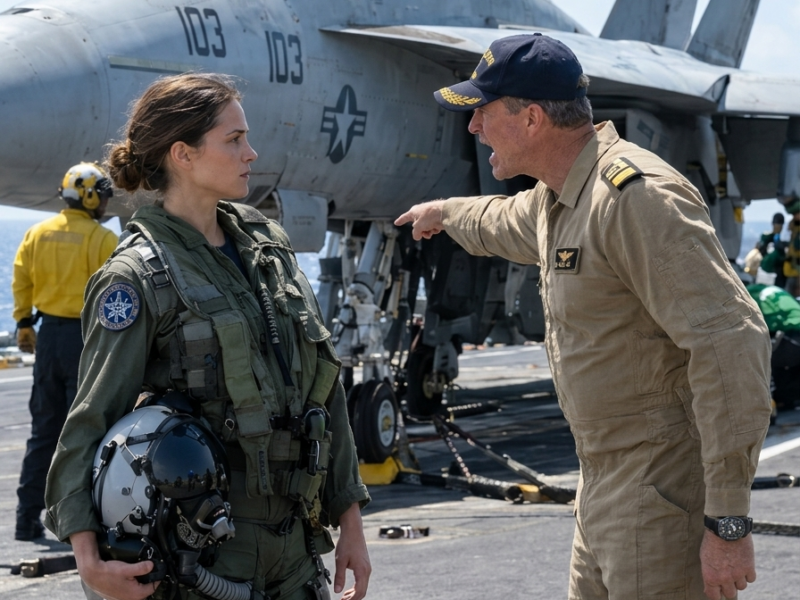
The morning my squadron commander mocked me in front of the entire crew aboard the USS Roosevelt, he called me a liability in a flight suit, never realizing the Navy had buried my old call sign for a reason
The morning mist off the coast of the Pacific felt like shattered glass against my skin. The flight deck of the USS Roosevelt hummed with the brutal, rhythmic violence of naval aviation—steam escaping from hydraulic catapults, jet fuel heavy in the sea air, and the deafening roar of F/A-18 Super Hornets being launched into a iron-gray sky.
I stood near the edge of the primary island superstructure, my helmet tucked tightly against my hip, my flight suit stiff and smelling of clean laundry. Dozens of sailors in yellow, green, and red jerseys moved around me, pretending to secure tie-down chains, but their eyes kept flicking in my direction. In the Navy, a new arrival on a carrier is always inspected, but a female aviator arriving mid-deployment under classified transfer orders is a spectacle.
Commander Marcus Blake stepped out of the primary flight control office. He was a broad-shouldered man with a face carved by twenty years of high-altitude turns and cheap cigars. He held my service record folder in one gloved hand, tossing it onto a metal staging table as if it were contaminated waste.
“So,” Blake said, his voice carrying over the dull thrum of the ship’s engines, easily reaching the ears of a dozen listening crewmen. “You’re the new replacement pilot?”
“Lieutenant Avery Vance, reporting as ordered, sir,” I replied, keeping my spine straight, my chin level.
Blake stepped closer, looking me over with a cold, deliberate contempt. He didn’t look at my face; he looked at my shoulders, as if measuring whether I was strong enough to handle a hard carrier landing in bad weather. “I read your transfer file, Vance. Three years of desk duty in naval intelligence, followed by a sudden requalification at NAS Fallon. No carrier landings logged in thirty-six months. You’re a liability in a flight suit, Lieutenant. Try not to damage anything expensive while you’re on my deck.”
A few junior officers near the hatchway chuckled softly.
I forced my mouth into a flat, professional line. I didn’t flinch. I had learned a long time ago that defending yourself against men like Blake only entertains them. They want anger; they want tears. They feed on the insecurity of anyone who doesn’t fit their narrow definition of a warrior.
“My orders were signed by the Commander of Naval Air Forces, sir,” I said evenly. “My qualifications are current.”
“Orders don’t make you good, Vance,” Blake snapped, turning his back on me to face the rest of the briefing group. “Experience does. Blood does. And you haven’t bled for this Navy.”
I said nothing. I kept my hand resting on the heavy titanium watch on my left wrist. Blake didn’t know about the Navy Cross locked inside a dark velvet box in my mother’s nightstand drawer back in San Diego. He didn’t know about the military funeral she had been forced to attend three years ago—a funeral with an empty casket, full military honors, and a folded flag presented by a two-star admiral whose eyes had refused to meet hers. And Blake certainly didn’t know why my previous squadron had scrubbed my original call sign from their official records, replacing it with administrative white noise.
By noon, the Pacific had turned vicious. A low-pressure front swept in from the north, swallowing the horizon in dark, bruised clouds. The Roosevelt pitched and rolled over twenty-foot swells, its massive steel hull groaning against the ocean. Rain began to slant across the deck, slicking the steel and reducing visibility to less than a mile.
Inside the Carrier Air Wing briefing room, the atmosphere was thick with tension. The radio consoles were crackling with static.
Suddenly, the primary emergency speaker burst into life. The sound was harsh, distorted, and laced with absolute panic.
“Mayday, Mayday, primary control! This is Navy Alpha-Zulu-4-2! I have a dual-engine oil pressure drop! Engine two is failing! I can’t hold altitude… I’m dropping through four thousand!”
The room froze. Blake immediately lunged for the tactical communications console, pulling the heavy headset over his ears. “Talk to me, flight four-two! This is CAG Blake. What is your position?”
“Seven miles out!” the pilot gasped over the static. Heavy, ragged breathing echoed through the speaker. “Clouds are solid down to two hundred feet! I’ve lost my primary navigation display! My horizon indicator is dead! I… I don’t think I’m making the trap!”
Blake’s jaw tightened. He turned to his landing signal officer. “Can we punch a rescue helicopter through this ceiling?”
“Negative, sir!” the officer shouted back. “Wind sheer is over forty knots near the wake. A chopper will get thrown right into the ocean!”
I stepped forward, moving past two senior lieutenants before Blake could wave me away. “Sir, let me take a radio relay on the secondary channel. If his primary displays are dead, he’s flying on spatial disorientation. I can guide him through the lower cloud break using visual landmarking from the stern radar.”
Blake turned on me, his eyes blazing with fury. “Are you insane? You’re the newest pilot on this deck! You don’t touch that radio!”
“His instruments are lying to him in this weather!” I stepped directly into his space, my voice dropping into a low, lethal calm. “He’s going to roll that aircraft upside down into the water in less than ninety seconds because his inner ear thinks he’s flying level! He needs someone who knows what it feels like when the artificial horizon dies!”
“You’ve made your point, Lieutenant! Stand down!” Blake barked.
Then, the pilot’s voice shattered across the room once more—a terrified, choked scream as the jet entered a high-speed dive. “I’m losing the stick! God, I can’t see the water! I can’t—”
The sound tore open something deep inside my chest that I had spent three long, agonizing years trying to bury under stacks of intelligence reports and quiet nights. For one horrible, vivid second, I wasn’t standing on the USS Roosevelt. I was back over the Hindu Kush mountains in eastern Afghanistan, listening to an emergency frequency as another aircraft went down, hearing a voice I loved more than life itself vanish into static while command ordered me to turn around and abandon the search.
Not again.
I reached over Blake’s shoulder and seized the main dispatch microphone.
“Unidentified flight, this is—”
Before I could finish, the Air Boss—a gray-haired Master Chief who had been quietly monitoring the administrative board behind us—leaned forward to look at the master flight roster to track the incoming plane’s wingman. His eye caught the classified clearance code listed beside my security clearance number—a series of red digits that had just been unsealed by the ship’s mainframe upon our entry into international waters.
The Air Boss’s face drained of all color. The pencil in his hand slipped from his fingers, clattering onto the deck.
He looked up at me, his eyes wide with disbelief, then looked back at the red text blinking on the monitor.
“No…” the Air Boss whispered. His voice was barely audible over the roaring wind outside.
Blake turned, irritated. “Master Chief, what the hell are you doing? Clear the line!”
The Air Boss ignored Blake entirely. With a hand that was visibly shaking, he took a secondary microphone linked directly to the external flight deck horn and the pilot’s emergency channel. He keyed the button.
“Ghost,” the old chief said, his voice echoing across the shipwide frequency and through every speaker on the bridge. “Ghost… do you copy?”
An absolute, heavy silence fell over the briefing room. The silence spread like a virus out onto the flight deck, where yellow-shirted directors stopped their hand signals and sailors stared up at the island structure.
Blake slowly turned back toward me, his arrogant expression collapsing into utter confusion.
Because Ghost wasn’t a tactical call sign assigned to new transfers. It was a legend—a ghost story whispered in the dark corners of naval aviator bars from Pensacola to Atsugi. It was the call sign of a rogue pilot who had officially been declared dead after an unauthorized, black-budget rescue mission three years ago in Afghanistan—a mission that had rescued six captured Special Forces operators and exposed an illegal, top-secret stand-down order that high-ranking officials in the Pentagon had spent millions trying to erase from military history.
I took the headset from the Air Boss’s trembling fingers. I pressed the transmitter against my lip.
“Ghost copies,” I said softly.
The Air Boss swallowed hard, his eyes locked onto mine. He leaned close, his breath brushing my ear, lowering his voice so that only I could hear his next words over the ambient hum of the equipment.
“Your brother’s name just appeared on the incoming pilot’s emergency file.”
My fingers tightened around the hard plastic of the microphone until my knuckles turned white. My heart stopped.
My brother, Captain Ethan Vance, had been buried three years ago in an empty grave in Arlington. I had watched the dirt fall onto the empty wooden box.
And the very last voice I had heard over a secure radio before my brother’s jet was shot down over the Afghan border had belonged to a high-ranking naval intelligence officer who had whispered a terrifying promise into my ear:
If you ever look for him, Lieutenant, he won’t be the only Vance who never comes home.
The air in the control room felt instantly thin, as if the oxygen had been drained out by the weight of a single sentence. I stood frozen, the heavy plastic of the microphone cold against my palm, my heart hammering against my ribs like a trapped bird.
“What did you just say?” my voice came out low, dangerous, stripped of all military deference.
The Air Boss didn’t look at Blake. He tapped the glowing green monitor in front of him with a trembling finger. “The emergency beacon on that incoming F/A-18 isn’t transmitting a standard squadron ID. It’s routing through an encrypted Department of Defense frequency—a legacy channel. The pilot’s medical transponder just pinged the ship’s receiver. Service ID: 884-90-Delta. Officer Ethan Vance.”
“That’s impossible!” Blake shouted, stepping between me and the console. “Ethan Vance died three years ago during Operation Dark Winter! His aircraft went down over the Kunar Province! It was verified by Central Command!”
“Then explain why his biometric key just unlocked our automated landing array, Commander!” the Air Boss snapped back, his voice rising in panic.
Outside, the storm howled with renewed fury. The rain crashed against the reinforced glass of the bridge windows in heavy, blinding sheets. Over the radio, the sound of the incoming jet’s dying engine was turning into a violent metallic screech.
“Ghost…” the voice came through the static again, weaker now, fighting against the heavy interference of the storm. “Ghost… if you’re out there… I have the package. They found out about the manifest… I couldn’t go back to the beach…”
My throat closed up. That wasn’t just a pilot using an old code. That was Ethan’s voice. Older, harsher, raspy from years of breathing bad air or living in the dark, but it was him. “The beach” was our childhood code word for home—the small coastal town in California where we used to surf before we both joined the Navy.
“Ethan!” I grabbed the console, leaning into the transmitter. “Ethan, listen to me! You’re four miles out from the Roosevelt! You are flying blind into a forty-knot crosswind! You need to pull your nose up three degrees and trust your flight path marker!”
“Avery?” The line crackled violently. “Avery… don’t let them… don’t let Blake take the flight recorder…”
I spun around to look at Commander Blake.
He hadn’t moved. But his face had changed. The arrogant, dismissive expression he had worn all morning was completely gone. In its place was a cold, terrifying stillness. His right hand had dropped casually toward the side of his tactical belt, hovering near the holster of his service sidearm.
“Cut the feed,” Blake said quietly.
“Sir?” the technician at the radio board looked up, confused.
“I said cut the damn feed!” Blake barked, stepping toward the main power switch for the tactical array. “That aircraft is compromised! It’s transmitting on an unverified, non-cleared frequency! It could be a hostile decoy or a hijacked bird!”
“He’s an American pilot flying an F/A-18 into our deck in a deadly storm!” I yelled, throwing myself in front of the master control switch, blocking Blake with my body. “If you cut that feed, he dies in the water!”
“He is already dead, Lieutenant!” Blake hissed, leaning in so close I could smell the stale coffee on his breath. “Ethan Vance died in Afghanistan because he refused a direct order! He was a traitor who stole classified intelligence from a forward operating base!”
“He was an officer who discovered that you and Admiral Vance—your own uncle—were routing unmanifested cargo through civilian airliners!” I spat back, the truth exploding out of me after three years of forced silence. “He didn’t steal intelligence, Blake! He saved evidence! And you shot him down to keep it hidden!”
The entire control room went dead silent. The technicians, the LSO officers, the Air Boss—everyone stopped moving. The accusation hung in the air like a unexploded bomb.
Blake’s eyes narrowed into slit-like lines. “You’re insane, Vance. Just like your brother. Master Chief, remove this officer from the bridge.”
“Don’t you dare touch her!” the Air Boss snapped, pulling a key from his neck lanyard and jamming it into the secondary override lock on the main landing console. “If that plane is Ethan Vance’s bird, he has the right of emergency approach under Naval Regulation 1012! I am landing that aircraft!”
“Override rejected!” Blake roared, reaching for the emergency shutdown lever on the wall—a lever designed to clear the flight deck by forcing incoming planes to ditch in the ocean if the deck became obstructed.
If he pulled that lever, the automated landing lights would go dark, the barrier nets would be locked down, and Ethan’s jet, running on zero fuel with dead instruments, would crash directly into the stern of the carrier at two hundred miles an hour.
I didn’t think. I reacted.
Three years of desk duty had not erased the hand-to-hand combat training from my years in special flight operations. As Blake’s hand swept toward the emergency lever, I grabbed his wrist, twisting it violently downward while driving my left palm straight into his chin.
Blake gasped, stumbling backward into the tactical table, scattering charts and electronic tablets across the steel deck.
“Secure the bridge!” Blake yelled, clutching his jaw, blood leaking from his lip. “Security team to Prifly! Lieutenant Vance is committing mutiny!”
“Air Boss, lock the hatches!” I screamed.
The old Master Chief didn’t hesitate. He slammed his fist onto the heavy hydraulic lock button. The heavy steel fire doors of the primary flight control room slammed shut with a deafening CLANG, the automatic deadbolts sliding into place just as heavy boots came pounding down the outer corridor.
“You’ve lost your mind, Avery,” Blake growled, pushing himself up from the floor, his eyes filled with absolute malice. “You think you’re saving him? Look at the radar!”
I turned my head toward the main display screen.
Beyond Ethan’s lone, sputtering radar blip, four miles out in the storm, two new targets had just appeared on the edge of the tactical display. They were high-speed aircraft, dropping fast out of the upper cloud layer, flying without secondary transponders.
They weren’t American jets. They were unmarked, painted matte black, flying a intercept vector directly behind Ethan’s dying F/A-18.
“Who are they?” the Air Boss gasped, his hands flying across the radar controls. “They aren’t on our air tasking order!”
“They’re the cleanup crew,” Blake said with a sickening smile, wiping the blood from his mouth. “The same people who made sure your brother stayed dead three years ago. Did you really think he made it out of Afghanistan alone? He’s been running for three years, Avery. And today, he brought them right to us.”
The radio crackled again, Ethan’s voice breaking through a wave of screeching static. “Avery! They’re on my tail! They’re locking on! I don’t have flares! I’m Winchester on countermeasures!”
My hands flew over the primary flight deck intercom. I grabbed the flight deck director’s headset and keyed the general quarter-deck horn.
“All personnel on the flight deck!” I screamed into the mic, my voice booming across the entire three-acre surface of the aircraft carrier. “Prepare for emergency launch! Fuel catapult one! I need a bird on the shuttle right now!”
“You can’t launch in this weather!” Blake yelled, lunging toward me again. “The deck is rolling twelve degrees! You’ll shoot yourself straight into the ocean!”
I grabbed my flight helmet from the table, slamming the tinted visor down over my eyes. I looked Blake dead in the eye through the dark glass.
“I’m not launching to fly a mission, Commander,” I said, my voice ice-cold. “I’m launching to kill whoever is trying to finish what you started in Afghanistan.”
I didn’t wait for permission. In the high-stakes world of naval aviation, permission is a luxury for peacetime; survival requires action.
I hit the emergency override release on the interior hatch, ducked under the heavy steel door before Blake could grab my harness, and sprinted down the narrow, red-lit ladderwells leading to the hangar deck. The sound of alarms blared through the ship’s passageways—a rhythmic, high-pitched screech warning of an incoming emergency landing and an unauthorized deck operation.
When I burst through the heavy rubber seals onto the flight deck, the full fury of the storm hit me like a physical punch.
Rain lashed across my helmet, blinding me for a fraction of a second until my thermal visor heater kicked in. The wind was howling at nearly fifty knots, whipping spray from the ocean waves high over the bow of the giant ship. The deck was tilted at an alarming angle, wet steel glistening under the dim floodlights.
“Lieutenant!” a deck crew chief in a bright yellow jersey screamed into my ear, grabbing my shoulder to keep me from being blown off my feet by the wind. “What the hell is going on? Prifly is ordering a total lockdown! They said you’re not cleared to fly!”
“The pilot incoming is Captain Ethan Vance!” I shouted back, grabbing his collar and pulling him down so he could hear me over the roar of the ocean. “He’s being hunted by hostile aircraft! If I don’t get a jet off catapult one in ninety seconds, he dies, and those jets will strike this carrier!”
The chief’s eyes went wide behind his safety goggles. Every sailor on the Roosevelt knew the story of Ethan Vance—he was a legend, a shadow from the past.
“Catapult one is loaded with an F/A-18 Block III,” the chief spat on the deck, his face setting into a grim line of resolve. “Fully fuelled, two AIM-120 AMRAAMs on the belly. But the launch bar isn’t locked!”
“Lock it!” I ordered. “Get me in that pit!”
Without waiting for a launch team, I scrambled up the ladder of the jet, sliding into the tight, cockpit cockpit of the Super Hornet. I pulled the heavy straps over my shoulders, clicking them into the ejection seat harness with trained, instinctual speed. My fingers flew across the control panel, toggling the dual engine starters.
The two massive General Electric turbofans behind me whined to life, building into a deafening, earth-shaking roar that vibrated through the composite frame of the jet. The glass displays in front of me flickered awake, flooding my face with green and digital cyan light.
Through the rain-streaked canopy, I saw movement near the bridge. Commander Blake had reached the secondary flight deck observation deck. He was pointing violently toward my jet, flanked by four armed Master-at-Arms security officers. They were running down the slippery deck toward my aircraft, guns drawn.
“Launch me!” I screamed into the radio to the chief on the deck. “LAUNCH ME NOW!”
The yellow-shirt chief didn’t look at Blake. He looked at me, gave a sharp, definitive hand salute, and slammed his hand onto the manual catapult trigger box built into the deck deck floor.
BOOM.
The steam catapult hit the nose gear like a sledgehammer. Thirty thousand pounds of thrust unleashed instantly.
My head was slammed back against the headrest as my body experienced four Gs of linear acceleration. The rain, the ship, Blake’s screaming face, and the security guards melted into a blur of grey and white. In less than two seconds, the jet went from zero to one hundred and sixty knots, leaping off the edge of the rising deck into the pitch-black void of the storm.
For a terrifying half-second, the jet sank toward the churning black ocean below. The stall warning horn blared inside my helmet: ALTITUDE! ALTITUDE!
I jammed the throttle forward into full afterburner. Twin pillars of blue and orange flame erupted from the rear of the aircraft, scorching the ocean spray. The jet caught the air, nose pitching up, screaming upward into the dense, dark cloud deck like a spear thrown into the sky.
“Ghost is airborne,” I breathed into my mask, pulling the landing gear lever up. “Ethan, do you copy? I am out of the deck, climbing through two thousand feet!”
“Avery!” Ethan’s voice was barely recognizable over the thick static, cut by the heavy gasping of a pilot fighting G-loc. “They’re… they’re on my six! One mile back! They’ve got a infrared lock on my bad engine!”
I threw the jet into a hard, bank-angle turn, pulling six Gs, slicing through the thick grey clouds until I broke out into a narrow layer of open air between two massive storm cells.
There, two miles ahead of me, was the sight that made my blood run cold.
Ethan’s F/A-18 was trailing a long tail of thick black smoke and bright orange sparks. His right engine was a ruined mass of metal, and his left wing was missing half of its composite flap. Flying right behind him—less than half a mile back—were two jet fighters painted entirely in matte black, with no national insignia, no tail numbers, and sleek, delta-wing profiles that didn’t match any known standard military inventory.
They weren’t foreign military. They were private military contractors—a black-ops unit equipped with unregistered, high-tech hardware.
One of the black jets pitched its nose up, its belly opening to reveal a hidden weapons bay. A red missile-launch tracking light flickered beneath its fuselage.
“Not today,” I growled through my teeth.
I flipped the weapon master switch to ARM. The radar display locked onto the trailing black jet with a sharp, high-pitched tone: BEEP-BEEP-BEEP-BEEP!
“Fox Three!” I screamed, slamming the firing button on my control stick.
A radar-guided AIM-120 missile detached from beneath my jet, its rocket motor igniting with a brilliant white flash that lit up the storm clouds. The missile streaked across the sky, leaving a white corkscrew trail of smoke through the rain.
The second black jet saw the incoming missile at the last second and broke hard to the right, dropping flares. But the primary target was too slow.
The missile slammed directly into the black jet’s wing root. A massive fireball erupted in the sky, shattering the aircraft into a hundred burning pieces that rained down into the dark ocean below.
“Target destroyed!” I yelled. “Ethan, break left! Break left now!”
The second black jet reversed its turn, rolling inverted, its nose swinging directly toward my aircraft. Its radar locked onto me instantly. A heavy metallic warning buzzed inside my helmet: THREAT LOCK! MISSILE APPROACHING!
“He’s fired!” Ethan screamed over the radio. “Avery, break!”
I pulled the stick back into my stomach, stomping on the left rudder pedal. My jet went into a vertical spiral, dropping chaff and flares into the grey darkness. The enemy missile roared past my canopy—so close I could see the glowing white nose cone of the weapon before it detonated harmlessly fifty yards behind me, the shockwave shaking my airframe violently.
I pulled out of the dive, bringing my nose back around, searching the sky through the thick rain.
The remaining black jet wasn’t pursuing me. Seeing that its wingman had been destroyed and the carrier was now fully alerted, it turned back toward the cloud cover, plunging into the dark storm at supersonic speed, disappearing off my radar screen within seconds.
“Hostile is disengaging,” I panted, my heart hammering against my ribs, sweat stinging my eyes inside my mask. “Ethan… Ethan, I’m on your wing. I’ve got you.”
I pulled my jet up beside his battered F/A-18.
Through the cracked canopy of his aircraft, I looked across fifty feet of rainy airspace. The pilot in the other cockpit turned his head toward me.
He raised a gloved hand to his helmet, giving me a slow, exhausted thumbs-up. Through his tinted visor, I could see his eyes—tired, hollowed by years of running, but undeniably the eyes of my brother.
“Good to see you, kiddo,” Ethan’s voice whispered in my headset, soft and broken. “Now… we have to land this thing before my wing falls off. And Avery… be careful when we touch down. The manifest… it’s not just about Afghanistan. It’s about the people on that ship.”
The approach back to the USS Roosevelt was a nightmare etched in grey, fire, and screaming steel.
Ethan’s jet was barely flying. His hydraulics were failing rapidly, causing his tail fins to flutter wildly in the turbulence. I flew formation tightly beside him, acting as his visual eyes, calling out his altitude, airspeed, and glideslope deck alignment every five seconds as we sank toward the pitching deck of the giant carrier.
“Keep your nose up, Ethan,” I instructed calmly, though my hands were shaking on the stick. “You’re five knots slow. Add a little power on that left throttle… easy… easy.”
“If I add power, the left engine will flame out,” Ethan rasped back. “I’m flying on fumes and prayer, Ave. Just get me to the deck.”
“Target deck in sight!” I shouted. “Three hundred feet! Two hundred! Call your call sign, brother!”
“Ghost one-one,” Ethan breathed. “Coming home.”
The battered F/A-18 dropped through the final cloud layer. The Roosevelt looked tiny from the air, a sliver of steel tossing violently in a sea of white foam. The yellow-shirted flight deck crew had deployed the emergency barricade net—a giant nylon web stretched across the landing area to catch a crippled jet that couldn’t use its tailhook.
Ethan’s jet hit the wet deck hard. BANG!
The main landing gear collapsed almost instantly under the crushing impact. Sparks erupted in a massive orange fountain as the belly of the jet skidded across the steel deck, slamming into the nylon barricade net at over a hundred miles an hour. The heavy steel cables groaned, absorbing the massive kinetic energy, stopping the jet just fifty feet short of the forward park area where dozens of loaded aircraft sat parked.
I didn’t waste a second. I flew past the carrier, pulled my jet into a tight pattern, dropped my gear and hook, and brought my own aircraft down onto the deck with a violent, perfectly executed three-wire trap.
The moment my jet ground to a halt, I unbuckled my harness, threw open the canopy, and vaulted over the side of the cockpit, dropping ten feet down to the wet steel deck.
“Fire crew! Move in!” the Air Boss was screaming over the flight deck speakers.
Emergency foam trucks were already surrounding Ethan’s steaming aircraft, spraying white fire-retardant foam over the glowing engine bay. Firefighters chopped through the warped canopy glass with heavy axes, pulling a limp figure from the cockpit.
I ran through the freezing rain, my boots splashing through sea water and chemical foam. “Ethan! ETHAN!”
The firefighters laid him on a stretcher on the deck. He was covered in soot, his flight suit torn, blood trickling from under his helmet padding. But his eyes were open, staring up into the rainy sky.
“Avery…” he coughed, clutching a small, heavily encrypted titanium hard drive against his chest—a drive sealed with a red wax security stamp bearing the crest of the Joint Chiefs of Staff. “Don’t… don’t let them take it…”
“Halt! Nobody move!” a loud, harsh voice cut through the sound of the wind.
Commander Blake marched out onto the flight deck, flanked by eight fully armed Master-at-Arms security officers carrying M4 rifles. Their weapons were raised, pointed directly at me, Ethan, and the medical crew kneeling on the deck.
“Step away from the suspect!” Blake ordered, his face dark with rage. “Captain Ethan Vance is under arrest for treason, desertion, and theft of classified military material! Hand over that drive, Lieutenant!”
“He’s a decorated officer who was shot down!” I shouted, standing up and stepping between the armed guards and my brother on the stretcher. “He needs immediate medical attention! Stand down, Commander!”
“He is a fugitive!” Blake spat, taking a step forward, raising his own sidearm and aiming it directly at my chest. “And you, Lieutenant Vance, are an accomplice to mutiny and destruction of naval property! Give me the drive, or I will order these men to open fire!”
The medical crew backed away, hands raised in terror. The firemen froze. The wind whipped rain between us, the atmosphere taut as a piano wire.
“You won’t shoot,” I said quietly, taking one step toward Blake’s gun barrel. “Because the moment you fire a bullet on this deck, every sailor on this ship will know you’re covering up what happened three years ago.”
“Try me, Vance,” Blake whispered, his finger tightening on the trigger. “You think anyone cares about a dead pilot’s story? The official record says Ethan died in Afghanistan. It will be very easy to write that his sister died in a flight accident today.”
Before Blake could squeeze the trigger, a deep, commanding voice boomed across the flight deck over the main horn system—a voice that carried the absolute, unquestionable authority of highest rank.
“LOWER YOUR WEAPONS, COMMANDER BLAKE!”
Everyone turned.
Walking down the flight deck island ramp, flanked by two senior marine guards and the ship’s Captain, was a tall man in a dress blue uniform covered in admiral’s stars. His silver hair was neatly trimmed, his face pale as marble.
Admiral Richard Vance—my uncle, Ethan’s uncle, and the Vice Chief of Naval Operations.
Blake froze, his hand trembling slightly on his gun. “Admiral… sir! The situation is under control! We have secured the fugitive and the stolen material—”
“I said lower your weapon, Marcus,” Admiral Vance said, his voice dropping into a terrifyingly quiet tone as he stopped ten feet away from us.
Blake slowly lowered his pistol, looking confused. “Sir… the drive… he brought the drive here. If the fleet command sees what’s on that file—”
“The fleet command already knows, Marcus,” Admiral Vance said coldly.
He didn’t look at Blake. He looked down at Ethan on the stretcher, then at me. His face was devoid of all family affection; it was the face of a man who viewed human lives as mere numbers on an operational ledger.
“You were always too persistent, Avery,” the Admiral said softly, his voice barely audible over the sea wind. “Just like your father. You never learned when to leave a dead story buried.”
The rain seemed to slow down, falling like heavy grey tears upon the foam-covered deck. I stood firm between my uncle and my bleeding brother, my hand secretly dropping behind my back to take the heavy titanium hard drive from Ethan’s cold fingers.
“You knew,” I whispered, the crushing realization hitting me like a physical blow. “You were the one who ordered the strike in Afghanistan. It wasn’t Blake acting alone. You were the officer who called my radio three years ago and told me to stop looking for him.”
Admiral Vance didn’t flinch. He adjusted the gold cuffs of his uniform jacket with calm, methodical precision.
“Three years ago, Avery, a covert operational fund worth over two hundred million dollars was established to finance black-budget intelligence operations across Eastern Europe and Asia,” the Admiral said, his voice completely devoid of emotion. “Your brother stumbled into an supply depot in Kandahar that wasn’t supposed to exist on any map. He took records that would have destroyed the careers of forty senior officers in Washington—and crippled our intelligence network in three continents.”
“It wasn’t intelligence money!” Ethan coughed violently from the stretcher, spit-blood spraying across his chin as he forced the words out. “It was… it was arms trafficking, Avery! They were selling decommissioned American hardware to private warlords in the Middle East… and routing the cash through untraceable shell corporations!”
The sailors and firefighters standing nearby gasps softly. The Master-at-Arms officers holding rifles began looking at each other, their hands wavering on their foregrips.
“Silence!” Blake barked, stepping forward again. “Admiral, give the order! We can secure them in the brig before this spreads!”
“It’s too late, Marcus,” Admiral Vance said with a cold, hollow sigh. He pulled a small, encrypted satellite phone from his pocket and looked at its dark screen. “When Captain Vance’s jet crossed into our defensive perimeter forty minutes ago, his aircraft wasn’t just transmitting an emergency transponder signal. He was using a automated satellite bridge.”
I looked down at Ethan. A faint, blood-stained smile was spread across my brother’s lips.
“The drive… isn’t local,” Ethan whispered into my ear as I leaned down. “The moment I got within five miles of the ship… the whole file started uploading directly to the Department of Justice, the Senate Armed Services Committee, and the Naval Inspector General. The hard drive in your hand… is just the decryption key.”
Admiral Vance’s phone began to vibrate violently in his hand. Then the ship’s primary communications horn blared again, a high-priority directive echoing across the entire vessel:
“ALL OFFICERS, THIS IS THE SHIP’S CAPTAIN. ADMIRAL RICHARD VANCE AND COMMANDER MARCUS BLAKE ARE TO BE DETAINED IMMEDIATELY BY NAVAL INVESTIGATIVE SERVICE PERSONNEL. REPEAT: DETAIN ADMIRAL VANCE AND COMMANDER BLAKE IMMEDIATELY.”
Blake’s eyes went wild with terror. “What? No! This is a mistake!”
He reached again for his gun, aiming it at the ship’s Captain, but two Marine guards stepped forward with ruthless speed. One slammed the butt of his rifle into Blake’s ribs, knocking him to his knees on the slick deck, while the second kicked the pistol far across the steel floor into the ocean below.
Blake screamed in pain as steel handcuffs clicked tightly around his wrists.
Admiral Vance didn’t fight. He didn’t run. He stood motionless as two NIS agents in black jackets walked up behind him, stepping over the wet deck. He looked at me, his blue eyes cold and empty.
“You think you’ve saved something today, Avery?” the Admiral said quietly as the agents secured his hands behind his back. “You think you’ve restored justice? You’ve just exposed a system that keeps this entire fleet running. The world isn’t clean, Lieutenant. It’s built on dark secrets.”
“The world might be dirty, Admiral,” I said, stepping right up to his face, my voice as hard as cold titanium. “But the sky above it belongs to people who still believe in honor. Take him away.”
The agents led my uncle and Blake down the deck toward the dark interior of the island structure, their figures disappearing into the grey shadow of the ship.
The medical crew rushed forward immediately, lifting Ethan’s stretcher and wheeling him toward the emergency surgical bay below deck. I walked beside him, holding his hand, feeling the warm, strong pulse in his wrist—a pulse I had thought was gone forever three long years ago.
“You made it home, Ghost,” I murmured, wiping the cold rain from his forehead.
Ethan looked up at me, his eyes tired but finally at peace. “We both did, Ghost. We both did.”
Two hours later, the storm began to break.
I stood alone on the stern edge of the flight deck, watching the heavy rain clouds drift away toward the east, revealing a narrow strip of golden sunlight breaking over the vast, blue expanse of the Pacific Ocean. The cold wind was still blowing, but it no longer felt like shattered glass; it felt clean, washing away the stench of fuel, lies, and old blood.
I pulled the old titanium dog tags from inside my flight suit—the tags bearing my brother’s name that I had worn around my neck every day for three years. I held them up toward the afternoon light, watching them glint against the golden sun.
My call sign was no longer a secret buried in a dark cabinet in Washington. It was no longer a memory of grief and defeat.
I was Lieutenant Avery Vance.
I was Ghost.
And for the first time in three years, the ghosts were finally at peace.
The end









