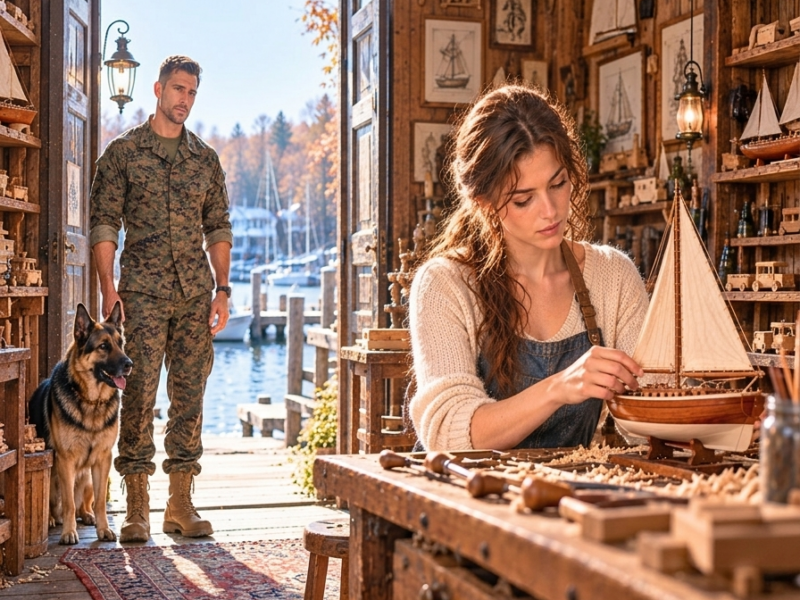
The morning a developer’s crew dumped a dumpster full of broken furniture outside my little wooden toy shop in downtown Charleston, South Carolina
The morning a developer’s crew dumped a dumpster full of broken furniture outside my little wooden toy shop in downtown Charleston, South Carolina, my own landlord stood on the sidewalk, smirking as he told me I had until sunset to disappear, unaware that the Marine watching from across the street carried a secret that could destroy everything he’d built.
I stood behind the shop window, staring at the splintered rocking horses and wooden soldiers scattered beneath the gray morning sky. My father had carved those toys by hand before cancer took him four years ago, and every scratch in the old oak counter reminded me of the man who had taught me that even broken things deserved another chance. His name was Arthur Vance, and to the historic district of Charleston, he was just a quiet, eccentric craftsman who smelled of cedar and linseed oil. To me, he was my entire world.
Now, a developer named Richard Hale wanted my shop demolished to make room for a luxury apartment complex, and he had spent months making sure I understood how little my memories mattered to him. Richard was a man who moved through life as if local laws and human lives were mere suggestions. He was impeccably dressed in a tailored navy overcoat, his silver hair neatly styled, his demeanor radiating cold, unchecked authority.
“You should have accepted my offer, Clara,” Richard said, stepping into the doorway, his voice dripping with condescension. “I offered you enough money to start over somewhere else. Somewhere far out of town. But you insisted on playing the loyal daughter. Now you get nothing.”
I looked down at the small wooden boat my father had carved for me when I was seven. Its hull was smooth, painted a deep evergreen, with my initials etched softly into the stern.
“You can’t buy everything, Mr. Hale,” I whispered, my knuckles white as I gripped the boat.
Richard laughed, a short, barking sound that held no humor, and turned toward his black SUV parked illegally by the curb. “Sunset, Clara. The bulldozers don’t care about sentimental trash.”
That was when the Marine crossed the street.
He was tall, broad-shouldered, and dressed in a faded canvas jacket that had seen years of rough weather. Walking beside him on a short leather leash was a massive German Shepherd with scars across his muzzle. The dog’s name tag read DUKE, and a silver military insignia hung from the Marine’s key ring, catching the pale morning light. The man moved with a deliberate, watchful grace—a man who scanned his surroundings not out of paranoia, but out of habit forged in dangerous places.
“Is this the shop that makes wooden boats?” the Marine asked, stopping at the threshold. His voice was deep, rough around the edges, but surprisingly gentle.
I nodded, confused, wiping a stray tear from my cheek before he could see it. “My father used to make them. I… I just manage what’s left.”
The Marine stared at the little boat in my hands, and something in his hard expression visibly broke. His jaw tightened, and his dark eyes softened with an overwhelming weight of recognition.
“May I come inside?” he asked.
“We’re technically closed,” I started, but something in his posture stopped me. “Yes. Come in.”
I unlocked the heavy glass door, and the bell above it chimed softly—a sound that usually brought me comfort, but today felt like a countdown. Duke stepped in, his paws clicking against the heart-pine floorboards. He sniffed the air, smelling the sawdust and age, then suddenly froze. The dog’s ears pricked up, and he pulled with surprising force toward a dusty, low cabinet beneath the back counter.
The Marine tightened his grip on the leash, his muscles tensing instantly. “Easy, boy. Heel.”
But Duke refused to move away. He whined low in his chest, scratched the cabinet door twice with a heavy paw, and then sat down, staring up at the Marine with an intensity that made the hair on my arms stand up.
“I’ve never seen him do that,” the Marine murmured, looking from the dog to me. “What’s in there?”
“Just old scrap wood and my father’s old blueprints,” I replied, my voice trembling. “Nothing valuable.”
I walked behind the counter, knelt on the floor, and opened the squeaky cabinet doors. Tucked deep in the back, behind a row of empty paint cans, lay an old wooden box wrapped in a faded American flag. It was a box I had seen a hundred times growing up, but my father had explicitly forbidden me to touch it until I was older—until I “understood why,” as he used to say.
My hands shook as I lifted the heavy mahogany box and placed it on the counter.
The Marine went completely still. The breath seemed to leave his lungs all at once. “Where did you get that?”
“It belonged to my father,” I said, looking at him closely now. “Who are you?”
He swallowed hard, his eyes glued to the flag. “What was his name?”
“Arthur Vance.”
For several long, agonizing seconds, the Marine couldn’t speak. He reached into his inner coat pocket and pulled out a worn leather wallet, sliding out a weathered photograph. He laid it flat on the wooden counter next to the box.
The photograph showed three young Marines in desert fatigues, standing shoulder-to-shoulder beside a military working dog in front of a concrete compound. The man on the left had a familiar, crooked smile. It was my father, decades younger, eyes bright and full of life.
The Marine pointed to the tall man standing beside my father in the photo. “That’s me, twenty years ago. Master Sergeant Ethan Vance—no relation, though we used to joke about it. And that,” he touched the dog in the photograph, “is Duke’s father, K-9 Rex.”
I stared at the picture, my chest tightening so fast I could barely breathe. “My dad never told me he served. He never spoke about the military. Ever.”
“He had to keep it quiet,” Ethan said, his voice dropping to a low, dangerous whisper. “Arthur wasn’t just a Marine, Clara. He was part of a specialized intelligence unit attached to Force Recon. And twenty years ago, during our final deployment in Iraq, he saved my life. He saved my partner’s life, too.”
Ethan looked out the front display window toward Richard’s black SUV, which had stopped at the end of the block rather than driving away. Richard was leaning against the driver’s door, talking urgently on a phone, his sharp gaze fixed on my store.
“Your father kept evidence that someone very powerful wanted buried forever,” Ethan continued, his eyes darting back to the box.
My stomach tightened into a hard knot. “What evidence? What are you talking about?”
Ethan stepped closer to the counter. He didn’t open the main latch of the box; instead, he ran his thumb beneath the base, feeling along the dark mahogany trim until he found a hidden seam. With a subtle click, a tiny side drawer popped open, revealing a tarnished brass key resting on velvet.
“Your father called me six months ago,” Ethan said softly. “He was sick, but he wasn’t just sick. He told me that if anything ever happened to him, I had to find his daughter, bring this key to a safe box in Atlanta, and protect you at all costs.”
Outside, the SUV door slammed. Richard Hale suddenly stepped away from his vehicle and marched back down the sidewalk toward the shop, his confident smile completely gone, replaced by a cold, murderous glare. He was staring directly through the glass, his eyes locked onto the brass key resting in Ethan’s hand.
Richard shoved the front door open, causing the chime to ring violently against the glass.
“That box was supposed to have burned with your father!” Richard shouted, his calm facade entirely shattered.
Ethan immediately shifted his body, stepping between Richard and me, his right hand resting casually near his belt line as Duke let out a deep, chest-vibrating growl.
The words hung in the air like poison. My mind scrambled to process what I had just heard. “What did you say?” I whispered, my voice breaking. “He had cancer…”
Ethan turned his head slightly toward me, his eyes filled with a terrible, dark realization. “Ma’am,” he whispered, “I don’t think your father died from cancer.”
Before I could process the horror of his words, Duke suddenly turned away from Richard, spun toward the dark hallway at the back of the shop, and lunged toward the basement door. A heavy thud echoed from below, followed by the unmistakably sharp sound of heavy boots ascending the wooden basement stairs.
Someone else was already inside my house.
The basement stairs creaked with terrifying rhythm. The door at the end of the dark hallway swung open, and two men dressed in dark tactical gear stepped out into the ambient light of the shop. They weren’t city workers, and they certainly weren’t moving like men who had gotten lost.
“Get behind me, Clara!” Ethan commanded, his voice changing instantly from quiet sympathy to the absolute authority of a combat veteran.
Richard Hale backed out of the front entrance, a cruel, cold expression settling over his features. “I tried to do this the easy way, Clara. I gave you a chance to take a check and walk away. But you Vance women never know when to give up.”
“Hale, step away from that door!” Ethan yelled, his hand disappearing under his jacket to draw a sleek, black sidearm.
The two men in tactical gear didn’t hesitate. One of them raised a suppressed handgun, but Ethan was already moving. He slammed his shoulder into the heavy oak counter, shoving the massive piece of furniture forward to create a temporary barrier.
“Duke, attack!” Ethan ordered.
The German Shepherd didn’t bark; he exploded into motion like a dark missile. He hit the first intruder with tremendous force, his jaws locking onto the man’s forearm. The intruder screamed, dropping his weapon as he fell backward against the hallway wall.
The second intruder aimed at Ethan, but Ethan fired two rapid shots into the man’s vest. The impact knocked the gunman off balance, sending him crashing into a display case of hand-carved wooden ships. Glass shattered across the floor, mixing with sawdust and cedar shavings.
“We have to go! Now!” Ethan shouted, grabbing my arm with a grip like steel.
“My father’s box!” I screamed, pulling back.
Ethan snatched the mahogany box and the brass key off the counter, shoving them into a heavy canvas duffel bag he carried over his shoulder. He grabbed my wrist and pulled me toward the side exit that led into a narrow, brick-lined alleyway behind the shop.
As we burst out into the chilly morning air, Duke leaped through the doorway behind us, blood dripping from his muzzle, but his eyes bright and alert. Ethan slammed the heavy steel exit door shut and threw a thick iron bar across the brackets—a security measure my father had installed years ago.
“This way!” Ethan barked, leading me down the wet cobblestone alley.
Rain began to fall, a light, cold Charleston drizzle that made the old bricks slick. My heart was pounding against my ribs like a trapped bird. Everything I had known about my life, my quiet existence, my father’s memory, was shattering around me in real-time.
“Where are we going?” I gasped, trying to keep up with Ethan’s long strides. “Who were those men? What did Richard mean about my father?”
“We don’t talk here,” Ethan said, his eyes constantly scanning the alleys and rooftops. “Hale has money, and in this city, money buys men with guns. We need to get out of the peninsula.”
We reached a secluded parking lot three blocks away, where a battered olive-green pickup truck was parked under the shade of a live oak tree. Ethan unlocked the passenger door and helped me inside before letting Duke jump into the back seat. He climbed into the driver’s seat, started the engine, and pulled out onto the street just as two black sedans sped past in the direction of my shop.
Ethan kept his eyes on the rearview mirror, turning down narrow backstreets until he was confident we weren’t being followed. Finally, he pulled into the shadowed parking space of an abandoned boat warehouse along the Ashley River.
He turned off the engine. The only sound was the steady patter of rain against the truck’s tin roof and the heavy breathing of the dog in the back.
“Talk to me,” I begged, my voice shaking so hard I could barely form the words. “Please. My father died in a hospital bed. He was sick. I was there, Ethan. I held his hand!”
Ethan turned to face me, his dark eyes filled with a profound sadness. He reached into his duffel bag and pulled out the mahogany box.
“Clara, your father didn’t die of natural causes,” Ethan said gently. “Three weeks before he entered that hospital, he called me. He told me that Richard Hale’s real estate firm was a front for a massive land-grab syndicate operating across the Southeast. They use arson, intimidation, and falsified tax liens to drive old families out of historical properties.”
“Why?” I asked. “Just for luxury apartments?”
“Not just apartments,” Ethan explained, setting the box between us. “It’s about money laundering on an international scale. But your father found out something worse. Twenty years ago, when we were overseas, Richard Hale was a civilian defense contractor. He stole millions in reconstruction funds and framed a young sergeant who tried to report him. That sergeant was your father’s best friend.”
I stared at the box, my mind reeling. “My father kept the proof?”
“Arthur spent twenty years building a dossier,” Ethan said. “He recorded every transaction, every payoff, every name. When Hale realized Arthur was collecting evidence against him here in Charleston, he tried to buy him out. When Arthur refused, your father suddenly got ‘sick.’ Fast-acting toxicity, Clara. Certain chemical compounds leave no trace in standard post-mortem blood panels. They mimic late-stage organ failure.”
Tears spilled over my eyelashes, burning my cheeks. “He poisoned him,” I choked out. “He murdered my dad…”
“And he thought the evidence died with him,” Ethan added. “Hale searched your dad’s house after he passed, but he couldn’t find the ledger or the key. That’s why he wanted your shop destroyed today. He was going to raze it to the ground and tear up the foundation to make sure whatever Arthur hid was obliterated.”
Ethan carefully lifted the tiny brass key from his pocket and held it up to the light.
“This key opens a safety deposit box at the Mercantile Bank in downtown Savannah,” Ethan said. “Arthur told me the complete ledger, along with hard drives containing Hale’s foreign bank accounts, is sitting in that box. If we get that evidence to the Federal prosecutor in Columbia, Hale goes away for the rest of his life.”
“Then let’s drive to Savannah right now,” I said, wiping my tears with the sleeve of my sweater, a sudden, cold fury replacing my fear.
“It’s not that simple,” Ethan warned, looking down at his phone. The screen flickered. “Hale knows I’m involved now. He’ll have men watching the highways out of town, and he likely has contacts within the local police department.”
Suddenly, Duke let out a sharp bark from the back seat.
Ethan’s head snapped up. He looked in the side mirror. Through the thick veil of rain, three vehicles were turning into the warehouse driveway, blocking the exit.
“They tracked us,” Ethan muttered, his face hardening.
“How?” I panicked, looking around. “We didn’t see anyone!”
Ethan looked down at his duffel bag, then reached inside and pulled out the faded American flag that had been wrapped around the wooden box. Tucked deep into the fringe of the fabric was a tiny, glowing red LED light—a cellular GPS tracker.
“They didn’t track the truck,” Ethan said grimly, looking toward the approaching dark sedans. “Hale put this tracker in your shop before his men broke in.”
Before Ethan could put the truck in reverse, a heavy SUV slammed into our front bumper, pinning us against the brick wall of the warehouse.
The impact shattered the pickup’s front headlights and sent a violent jolt through my spine. Glass rained down on the hood. Ethan instantly reached across me, shoving my head down toward the dashboard as the side windows of the truck blew inward from a hail of suppressed gunfire.
“Stay down!” Ethan roared.
He threw the truck door open, using it as a shield, and returned fire with precise, controlled shots. The sharp crack-crack-crack of his weapon echoed inside the cramped cab. Outside, shouts and screaming filled the rainy air.
Duke scrambled out behind Ethan, a blur of fur and teeth, diving into the rain to engage the attackers.
“Clara! Out the passenger side! Run inside the warehouse!” Ethan shouted, firing three more rounds into the engine block of the SUV that had rammed us.
I scrambled across the bench seat, kicked open the crumpled passenger door, and tumbled out onto the slick pavement. I grabbed the canvas duffel bag containing the wooden box and the key, holding it tightly against my chest.
Rain poured down, soaking through my clothing in seconds. I sprinted toward the rusted metal side door of the abandoned warehouse, my boots skidding on the wet concrete. Behind me, I heard Ethan shouting tactics to his dog, followed by the dull thuds of hand-to-hand combat.
I reached the metal door, shoved it open, and slipped into the cavernous, dark interior of the building. It smelled of rust, old river water, and rotting wood. Towering stacks of wooden shipping crates and abandoned machinery cast long, terrifying shadows across the floor.
Footsteps splashed through the puddles outside. A moment later, Ethan backed into the warehouse, his face smeared with grease and blood from a cut above his eyebrow. Duke followed close behind, limping slightly on his front left paw, but still fiercely alert.
Ethan pulled the heavy metal door shut and jammed a thick steel pipe through the handles, locking us inside.
“Are you hit?” he asked, leaning against the door, his breath coming in ragged gasps.
“No,” I breathed, my teeth chattering from cold and terror. “Are you? You’re bleeding!”
“Just a scratch,” he said, wiping the blood from his eye with the back of his hand. “They’re not trying to kill us yet. Hale wants that key. If we die before he gets it, he’ll never know if there are copies of the ledger somewhere else.”
He took the canvas bag from my hands, checked to ensure the brass key was still secure in the box’s hidden drawer, then looked up at the high ceiling of the warehouse.
“There’s an old coal loading dock at the back of this building,” Ethan whispered. “It connects to a wooden pier on the river. My backup boat is tied up there.”
“You planned for this?” I asked, amazed.
“Your father taught me to always have two exits, Clara,” Ethan said with a faint, tight smile. “He was a cautious man. He knew the kind of monsters that lurk behind expensive suits.”
We moved quickly through the dark warehouse, navigating the labyrinth of forgotten machinery. Duke walked right at my side, his shoulder pressing against my leg as if offering protection. I reached down and touched his damp fur, finding strength in the animal’s calm bravery.
Suddenly, a loud metallic screech rang out from the front doors. A blowtorch was spark-cutting through the steel pipe Ethan had used to bar the entrance. Bright yellow sparks rained down in the darkness like lethal fireworks.
“They’ll be inside in thirty seconds,” Ethan said. “Keep moving.”
We hurried toward the rear of the building. Ethan pushed open a small wooden door, and the cold breeze from the Ashley River hit us immediately. Outside, a long, wooden pier stretched out into the murky, rain-swept water. Tied to the end of the pier was a weathered fiberglass motorboat covered with a blue tarp.
“Get down the pier!” Ethan instructed, pushing me forward.
We ran down the slick wooden planks. Rain fell in sheets now, blurring the lights of downtown Charleston across the bay. Ethan pulled back the tarp, revealed the boat’s outboard motor, and began turning the ignition key. The engine sputtered, coughed, but failed to catch.
“Come on,” Ethan muttered, grinding the starter again.
From the warehouse doorway behind us, a voice boomed out through a megaphone, cold and chillingly calm.
“Clara! Ethan! There is nowhere to go!”
Richard Hale stepped out onto the pier, flanked by four armed men. He held a large black umbrella over his head, completely untouched by the storm, his posture elegant and utterly devoid of pity.
“You’re out of options, Sergeant Vance,” Hale called out, his voice carrying easily over the roar of the wind. “The river is high, the tide is turning, and my men have a clear line of sight. Hand over the key and the mahogany box, and I’ll let Clara walk away.”
I looked at Ethan. The engine was dead. We were trapped at the end of a sixty-foot wooden pier with thirty feet of freezing, churning water below us.
“Don’t listen to him, Ethan,” I whispered, tears mixing with the rain on my face. “He killed my father. He’ll kill us the second he gets what he wants.”
“I know,” Ethan said softly. He looked down at the brass key in his palm, then at the deep, dark water beneath the pier.
Richard took three steps forward, his heavy leather shoes clicking against the wood. “I built an empire in this city, Clara. Your father was a nobody—a simple carpenter who thought he could play hero. He suffered for his arrogance, and if you continue down this path, you will suffer the same fate.”
Ethan slowly stood up from the boat, raising his hands in a gesture of surrender. “Alright, Hale! You win! Just don’t shoot the girl!”
“Ethan, no!” I cried out, grabbing his sleeve.
Ethan ignored me. He reached into his canvas bag, pulled out the mahogany box, and held it up for Hale to see.
“The key is inside!” Ethan shouted over the storm. “Take it, and let us go!”
Hale smiled—a cruel, triumphant expression that made my blood run cold. “Bring it to me.”
Ethan took two steps toward Hale, holding the box out in his right hand. But as he took a third step, his foot deliberately caught the edge of a raised floorboard. Ethan feigned a stumble, throwing his arms wide for balance.
The mahogany box flew from his grip, sailing over the edge of the railing, and plunged into the black, rushing waters of the Ashley River below.
“No!” Hale screamed, his suave composure instantly vanishing into rage. “Kill them!”
Before the gunmen could raise their weapons, Ethan dropped to his knee, pulled a flare gun from his jacket pocket, and fired a brilliant, blinding magnesium flare directly into the center of the squad. The blinding red light exploded in their faces, illuminating the rain in violent scarlet and instantly blinding the gunmen.
“Jump, Clara!” Ethan yelled, grabbing my arm.
We leaped over the wooden railing together.
The icy water of the Ashley River hit me like a physical blow, knocking the air straight out of my lungs. Darkness consumed me as the cold current pulled me under. For a horrific moment, I lost my orientation, swirling in the black depth, surrounded by the deafening roar of water.
Then, a strong hand gripped the collar of my jacket, dragging me forcefully toward the surface.
I broke through the water, gasping frantically for air. Rain slammed into my face. Ethan was swimming beside me, holding me up with one powerful arm while Duke paddled strongly on our left, his head held high above the whitecap waves.
Above us, frantic gunfire erupted from the pier, bullets whistling through the rainy air and smacking harmlessly into the water yards away. But the fast-moving river current had already caught us, pulling us rapidly away from the pier and downstream into the gloom.
“Keep floating!” Ethan shouted over the roar of the storm. “Let the current take us to the marsh!”
We drifted for nearly ten agonizing minutes, fighting the freezing water and the dark tide, until the lights of the pier vanished into the storm behind us. Finally, our boots hit soft, muddy bottom. We dragged ourselves out of the river onto the tall marsh grass of a small, uninhabited island near the mouth of the harbor.
I collapsed onto the muddy bank, coughing up salt water, my entire body shaking violently from hypothermia and exhaustion. Ethan dragged himself up beside me, pulling Duke out of the reeds.
“Are you… alright?” Ethan wheezed, lying on his back, staring up at the stormy black sky.
“The box…” I gasped, my chest heaving. “The key… it’s gone. You threw it in the river!”
Ethan didn’t answer immediately. He slowly sat up, reached deep into his wet inner pocket, and pulled out a small, metallic object that glinted even in the pitch darkness.
It was the tiny brass key.
I stared at him, my jaw dropping. “You… you didn’t drop it?”
“The box was empty, Clara,” Ethan said, a faint, weary smile touching his lips. “I took the key out before we left the warehouse. What I threw into the river was just the wooden box filled with scrap iron to give it weight. Hale thinks his proof is resting at the bottom of the bay.”
A choked laugh escaped my throat—a mix of sheer relief and overwhelming emotional exhaustion. “You tricked him.”
“Your father taught me that too,” Ethan said, his smile fading as he looked down at the tiny piece of brass. “Never show your full hand until the enemy thinks he’s already won.”
He helped me stand up. We were shivering, soaked, and stranded on a marsh island in the middle of a storm, but for the first time since this nightmare began, I felt a spark of hope.
“Where are we?” I asked, looking through the dark mist.
“Sol Legare Island,” Ethan replied. “An old friend of your father lives half a mile up this bank. A former Navy medic named Marcus. He has a warm fire, dry clothes, and a secure phone line.”
We trudged through the thick mud and tall saltgrass, using Duke as our guide through the pitch-black terrain. After twenty minutes of exhausting walking, the dark outline of a small wooden cottage on stilts appeared through the trees.
Ethan knocked on the door in a specific, rhythmic pattern: three quick raps, a pause, then two more.
The door swung open instantly. An older Black man with silver hair and sharp, intelligent eyes stood in the doorway, holding a lantern. He took one look at Ethan’s bloodied face, my soaking clothes, and the dog, and his eyes widened.
“Ethan?” the man said, his voice deep and full of alarm. “What happened? And who…” He looked at me, and his breath caught. “Lord have mercy. You’re Arthur’s girl.”
“Marcus, we need help,” Ethan said quietly.
“Get inside, both of you! Quick!” Marcus insisted, pulling us into the warm, cedar-scented living room.
Within minutes, Marcus had wrapped us in heavy wool blankets, handed us mugs of steaming black coffee, and tended to the cut on Ethan’s forehead. Duke lay contentedly in front of a roaring woodstove, his damp fur steaming gently in the heat.
“I heard what happened downtown this morning,” Marcus said, sitting in an armchair opposite us. “Hale’s people are putting out news that an armed veteran took you hostage from your shop. The police are looking for Ethan’s truck right now.”
“Hale controls the narrative,” Ethan said, holding his hot mug with both hands. “He thinks he’s covered his tracks.”
“He doesn’t know we still have the key,” I added, my hands gripping the blanket around my shoulders.
Marcus looked at me sadly. “Clara… your father talked about you every single day. Before he went into that hospital, he came to see me. He knew Hale was coming for him.”
“Why didn’t he go to the police?” I asked, my voice trembling. “Why did he bear this burden all alone?”
“Because the police couldn’t protect you,” Marcus said gently. “Hale has judges, councilmen, and police captains in his pocket. If Arthur had gone to the authorities, the evidence would have vanished, and you would have been killed to close the loop. Arthur sacrificed his own life to buy enough time for Ethan to find you.”
I squeezed my eyes shut as fresh tears burned down my cheeks. All those years I thought my father was just an ordinary man making wooden toys, he was fighting a silent, deadly war to keep me safe from a monster.
Ethan stood up, his posture rigid and determined. “Marcus, I need your landline. It’s time to end this.”
“Who are you calling?” Marcus asked.
“The Federal Bureau of Investigation, Public Corruption Division in Washington,” Ethan said, pulling the brass key from his pocket and placing it on the table. “And then, I’m calling the one person in this state Richard Hale fears more than the law.”
“Who?” I asked.
Ethan looked down at me, his eyes dark and burning with an unbreakable oath. “Your father’s old commanding officer. He’s a United States Senator now.”
Twenty-four hours later, the sun rose over Charleston, casting a warm, golden light across the historic spires and cobblestone streets. The rainstorm had cleared, leaving the air crisp and clean.
At the corner of King Street, outside my father’s small wooden toy shop, three black luxury SUVs were parked along the curb. Richard Hale stood on the sidewalk, surrounded by four men in suits. A large yellow demolition excavator sat idling in the middle of the street, its diesel engine rumbling like a sleeping beast.
Richard looked at his watch, a triumphant, ruthless smile playing on his lips.
“It’s 8:00 AM,” Hale told the construction foreman. “Tear it down. Start with the roof. I want every plank of this dump reduced to toothpicks.”
“I wouldn’t touch that lever if I were you,” a voice called out from down the street.
Hale turned around, his smile instantly freezing.
Walking down the center of King Street was Ethan Vance, dressed in a sharp, crisp Marine Corps dress uniform, his chest decorated with ribbons and medals that caught the morning light. Beside him walked Duke, his head held high, his leather leash held loosely in Ethan’s hand.
And walking right next to Ethan was me. I carried my father’s hand-carved wooden boat tightly in my arms.
“You,” Hale spat, stepping forward, his eyes narrowing in shock and fury. “How are you still alive? My men checked the river!”
“Your men are incompetent, Hale,” Ethan said, stopping ten feet away. “Just like you.”
Hale sneered, motioning to his security detail. “It doesn’t matter. You’re trespassing on private property. The city issued the demolition permit an hour ago. You’re too late.”
“Check again, Mr. Hale,” I said, stepping forward, my voice firm, loud, and entirely devoid of fear.
Behind us, four unmarked black sedans pulled up to the curb, blocking the street from both sides. A dozen men and women in dark jackets with gold letters spelling FBI stepped out, their weapons drawn and pointed directly at Hale and his men.
Standing at the front of the federal agents was an elderly man with silver hair, wearing a dark suit with a lapel pin depicting a silver star.
Hale’s face drained of every drop of color. “Senator Vance… what is the meaning of this?”
“That’s General Vance to you, Richard,” the Senator said, his voice echoing with absolute authority across the quiet street. “And you are under federal arrest for public corruption, extortion, grand theft, and the state-side murder of Master Sergeant Arthur Vance.”
“Murder?” Hale stammered, stepping back, his confident composure completely disintegrating. “That’s absurd! Arthur Vance died of cancer! You have no proof!”
Ethan reached into his uniform jacket and pulled out a thick, sealed federal evidence bag. Inside was the complete physical ledger and three encrypted flash drives—retrieved just four hours ago from the safety deposit box in Savannah using the brass key.
“We have everything, Hale,” Ethan said coldly. “Your bank accounts in the Caymans, the wire transfers to local officials, and the chemical purchase receipts from the lab that synthesized the poison you gave Arthur. It’s over.”
Hale looked around wildly, his eyes darting from the FBI agents to the Senator, then to the heavy handcuffs being unholstered by a federal agent. The arrogance that had sustained him for decades evaporated in a single, pathetic instant. He collapsed back against the side of his luxury SUV as agents stepped forward, forced his arms behind his back, and slammed the steel cuffs around his wrists.
As Hale was pushed into the back of a federal vehicle, Senator Vance walked over to Ethan and me. He looked down at the hand-carved wooden boat in my arms, his eyes filling with quiet emotion.
“Your father was the bravest man I ever commanded, Clara,” the Senator said softly, placing a heavy, warm hand on my shoulder. “He spent twenty years making sure that when this day came, you would be safe, and his honor would be restored.”
“Thank you, Senator,” I whispered, tears of joy filling my eyes.
The Senator turned to Ethan, offering a sharp, crisp salute. Ethan snapped to attention and returned it with absolute precision.
“Outstanding work, Sergeant,” the Senator said. “Arthur would be proud.”
By noon, the street was quiet again. The excavator had been towed away, the yellow police tape removed. The sun shone brightly through the glass windows of my father’s toy shop, illuminating the dust motes dancing in the warm air.
Ethan, Duke, and I stood inside the shop. The counter was still scratched, the smell of cedar and linseed oil still lingered in the air, but the dark cloud that had hung over this place for years was finally gone forever.
“What will you do now?” Ethan asked, leaning against the counter, his dark eyes watching me gently.
I looked around at the wooden rocking horses, the soldiers, and the unfinished ships waiting on the workbench.
“I’m going to reopen,” I said, a genuine smile breaking across my face for the first time in four years. “I’m going to finish my father’s work. And I’m going to teach another generation how to fix broken things.”
Ethan smiled, reaching down to pat Duke’s head. “Sounds like a noble mission.”
I looked at him, feeling a deep, unshakeable connection that had been forged in fire, storm, and truth. “You don’t have to leave, Ethan. The shop could use a good woodworker. And Duke could use a permanent home.”
Ethan looked at the shop, then at Duke, and finally back at me. The hardness in his eyes was completely gone, replaced by a warm, peaceful light.
“I think,” Ethan said softly, “that’s exactly what Arthur had in mind.”
The end,









