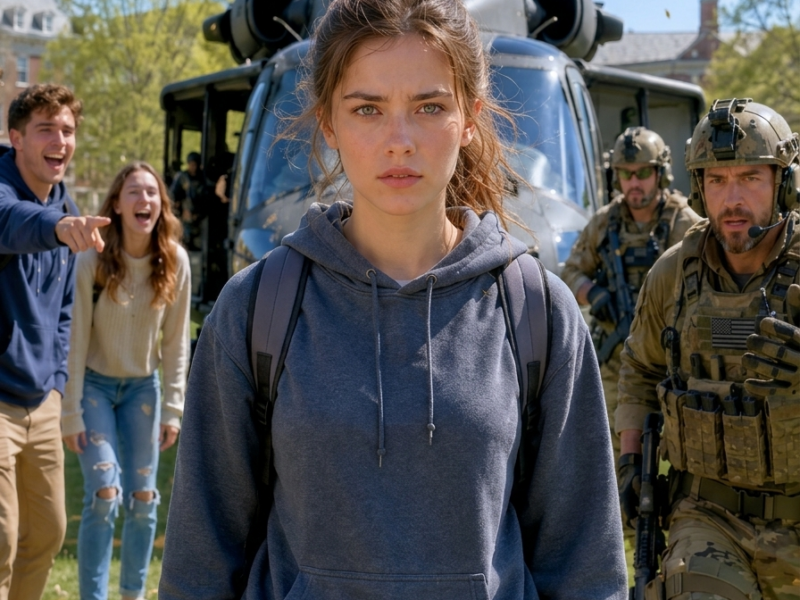
The moment three Black Hawk helicopters landed on my college football field, hundreds of students laughed as I stood frozen outside the freshman dorms
The moment three Black Hawk helicopters landed on my college football field, hundreds of students laughed as I stood frozen outside the freshman dorms, until a battle-hardened Navy SEAL stepped out, saluted me, and said, “Ma’am, 380 SEALs are trapped overseas, and you’re the only person who can bring them home.”
I was nineteen years old, halfway through my first semester at a university in Virginia, and the closest thing I had to military experience was growing up listening to my father’s stories about flying helicopters. At least, that was what everyone believed. My father had died when I was twelve, leaving behind a battered flight helmet, a folded American flag, and one sentence my mother refused to explain: “Some people will come looking for you one day.”
I had spent seven years assuming she meant relatives we had lost touch with. Then the helicopters arrived.
Their rotors tore across the football field, scattering notebooks, crushing the grass, and silencing the crowd that had been laughing at the spectacle moments earlier. A dozen soldiers rushed toward me, forming a perimeter that pushed back my bewildered classmates. The man leading them wore a weathered uniform, his face carved with deep lines of exhaustion, carrying a photograph so old its edges had turned yellow.
He looked at my face, then down at the photograph.
“Your father was Captain Michael Carter,” he said, his voice cutting through the roar of the idling turbines.
My throat tightened. “You knew him?”
The officer swallowed hard, his eyes glossing over with an ancient grief. “He saved my entire team seventeen years ago.” Before I could answer, he leaned in closer, lowering his voice into a gravelly whisper. “And now his daughter is the only person who can save mine.”
He explained that 380 American special operations personnel—a joint task force trapped across two mountain compounds inside a heavily fortified, hostile non-extradition zone in Eastern Europe—had been compromised after a covert extraction mission collapsed. Their communications were failing, their air cover had been turned away by diplomatic red tape, and heavy enemy armor was closing in from the north.
But the part that made my blood run cold was what came next.
Their mission had been planned around an experimental, low-observable stealth transport aircraft that officially no longer existed. The Ghosthawk Prototype Zero. My father’s aircraft.
I shook my head, stepping backward onto the concrete path. “I’m a freshman history major. I don’t understand what you want from me, Commander.”
The officer turned the old photograph around. Behind my father stood a stealth helicopter with a strange, stylized raven painted beneath its cockpit—a symbol I recognized instantly from the heavy metal pendant my father had worn around his neck every single day until the night he died.
“You inherited more than his name, Miss Carter,” the officer said, his tone urgent. “When your father was shot down in 2009, he didn’t destroy the flight control core. He encrypted it using a multi-factor biometric key linked to his direct bloodline and hid it. Our command structure believes you know where it is.”
My heart hammered against my ribs. I thought of the locked, military-grade steel footlocker stored beneath my childhood bed back home in Richmond—the box my mother had forbidden me to open or even touch until my twenty-first birthday. I had turned nineteen only three weeks earlier.
“Where’s my mother?” I whispered, a sudden spike of dread washing over me. “Does she know you’re here?”
The officer’s expression changed, hardening into something cold and deeply uncomfortable. “Your mother’s house was breached six hours ago, Miss Carter. She disappeared before our security detail could reach her.”
The football field suddenly felt impossibly large, the sky above spinning in gray clouds, and every face in the crowd watching me seemed to belong to a stranger.
Before I could collapse, a tactical comms soldier stepped forward and handed me a high-frequency satellite phone. A single text message waited on the dark screen.
IF THEY FOUND YOU, TRUST NO ONE IN UNIFORM.
Below it was my mother’s full legal name: ELIZABETH CARTER.
My fingers trembled violently as the screen flickered again. A second notification appeared, this time forcing open an encrypted live video feed.
My mother was sitting tied to a wooden chair inside a windowless, dimly lit room made of bare concrete. Her face was bruised, her lip split, but her eyes were burning with fierce defiance directly into the camera lens. Behind her stood a tall man clad in black tactical gear, his face obscured, wearing my father’s old, scuffed flight helmet—the exact one that was supposed to be sitting in a display case in our living room.
He stepped closer to the camera lens, adjusted the audio transmitter, and spoke five words that shattered everything I thought I knew about my life.
“Your father is still alive.”
The satellite phone screen went completely black.
I stood in the middle of the field, the icy wind ripping through my jacket, staring at the blank display while the heavy thump of helicopter rotors echoed off the brick walls of the library. Commander Marcus—the man who had saluted me moments ago—stared down at me, his eyes sharp and analytical. He had seen the shock register on my face, but he didn’t know what had just flashed across that screen.
Trust no one in uniform.
“Miss Carter?” Marcus asked, stepping closer, reaching a gloved hand toward my arm. “We need to move. Air space clearance for this extraction expires in six minutes. If we don’t get you to the command deck at Fort Meade, those men overseas die, and we lose the window to track your mother.”
“My father,” I choked out, pulling my arm away from his reach, keeping the phone gripped tight in my palm. “You told me he died in 2009. You said he saved your team.”
Marcus didn’t flinch, but a faint twitch near his jaw gave him away. “Captain Carter’s aircraft was hit by a surface-to-air missile over the border. We found the wreckage burned to ash. We recovered his dog tags and a body that matched his physical profile. As far as the United States military is concerned, he died a hero.”
“Then who is wearing his helmet?” I demanded, my voice cracking with emotion.
Marcus glanced back at his two second-in-command officers, a subtle signal passing between them. “I don’t know what you think you saw on that screen, Maya, but terror groups and black-market contractors have been using your father’s ghost identity for over a decade to sell classified aviation tech. That’s why we need that drive. If an rogue element has the prototype’s flight keys, they can override air defense grids across three continents.”
I looked down at the phone. My mother’s warning was clear. If I stepped onto that Black Hawk with Marcus, I would be walking straight into a military dark site where I would become nothing more than a living decryption key—used and discarded. But if I didn’t find that steel box, my mother was dead, 380 soldiers were doomed, and the truth about my father would be buried forever.
“The key isn’t at Fort Meade,” I lied, forcing my voice to stabilize, putting every ounce of conviction I could muster into my eyes. “It’s not in a government vault. My mother hid it inside our family’s cabin in the Blue Ridge Mountains. If you want it, you fly me there first.”
Marcus squinted at me, evaluating the risk. “We don’t have time for a side trip, Maya.”
“Then shoot me right here,” I said, stepping toward him, matching his military glare. “Because without my physical consent and my live biometric scan, that drive wipes itself the second you try to crack the encryption. My father made sure of that.”
A long, tense silence hung between us over the grass. Finally, Marcus turned to his crew chief. “Reroute Flight Alpha. Destination: Blue Ridge Sector 4. Ten-minute ground stop maximum.”
Twenty minutes later, the Black Hawk slammed through heavy mountain fog, dropping onto a rocky clearing behind our secluded cabin near Shenandoah. The rotors kicked up a hurricane of dry leaves and pine needles as the side doors slid open. Four armed SEALs jumped out first, forming a defensive perimeter around the perimeter of the cabin, their rifles pointed out into the dark timberline.
Marcus escorted me to the front door. The lock was untouched, but as soon as I stepped over the threshold into the dark, wooden living room, the smell of burnt copper and ozone hit my nose. Someone had already searched the house, but they hadn’t searched it right.
“Where is it?” Marcus asked, keeping his hand rested on his holstered sidearm.
“In the cellar,” I said, walking past the old brick fireplace toward the narrow wooden stairs.
I led him down into the cold subterranean room where my father used to store his aviation tools. I walked straight past the workbenches toward the far corner, where a heavy cast-iron safe sat against the stone wall.
“The code,” Marcus insisted, pulling an electronic forensic kit from his tactical vest.
“The safe is a decoy,” I whispered.
I dropped to my knees on the cold dirt floor, reaching under the edge of a stack of rotting cedar planks. My fingers found the hidden iron ring my father had showed me when I was six years old—the one he had made me promise never to mention to anyone, not even my mother. I pulled upward with all my strength.
A floorboard lifted, revealing a heavy steel footlocker sealed with a dual-biometric thumbprint scanner and a legacy digital keypad.
Marcus gasped, stepping forward, his eyes gleaming with a mixture of awe and dangerous greed. “The Ghosthawk Core… he really kept it.”
I placed my thumb on the glass pad. The device hummed to life, a soft green laser scanning my print.
BIOMETRIC MATCH: CARTER, M. (PRIMARY NEXT OF KIN)
STATUS: UNLOCKED
The heavy steel latches popped open with a loud pneumatic hiss. Inside lay a black hard-light flight helmet, a drive matrix glowing with faint blue fiber-optic light, and a handwritten notebook.
Marcus reached straight down for the drive matrix, but I slammed my hand over his wrist.
“Look at the screen on the lid,” I said, pointing a shaking finger at a small LCD monitor mounted inside the footlocker.
The monitor had powered up automatically upon opening. It wasn’t displaying military telemetry or flight coordinates. It was displaying a live GPS tracker feed broadcasted from a signal tower three miles away, along with an audio log recorded six hours prior.
My mother’s voice began to play from the box’s tiny speaker.
“Maya, if you are reading this with Commander Marcus standing behind you, kill the power immediately. Marcus wasn’t your father’s teammate. He was the man who sold his flight coordinates to Aegis Defense.”
The air inside the cellar went completely dead.
I didn’t think; I acted on pure instinct born of fear. I shoved my heel directly into the exposed wiring of the open footlocker’s battery pack. Sparks exploded in a flash of bright blue light, blinding Marcus for a fraction of a second as the smoke alarm on the ceiling erupted into an ear-splitting screech.
Marcus swore, drawing his pistol, but I grabbed the heavy black flight helmet from the box and swung it with all my weight, smashing the heavy composite visor directly into his jaw. He stumbled backward into a shelf of canned goods, crashing onto the dirt floor.
I snatched the glowing fiber-optic drive matrix from the box, scrambled up the cellar stairs, and slammed the heavy oak door shut behind me, shoving the rusted iron bolt into place just as Marcus slammed his body against the wood from the other side.
“Maya! Don’t do this!” Marcus roared through the thick timber, his voice echoing up through the floorboards. “You don’t understand the scale of what’s happening! If that drive isn’t plugged into the network at Sector 7, those 380 men will be executed on live television!”
“You betrayed my family!” I screamed back, grabbing a heavy kitchen chair and wedging it under the door handle.
I ran out the back door of the cabin, plunging straight into the dense pine forest just as the four SEALs outside noticed the disturbance and began shouting commands into their radios. Gunfire echoed through the trees behind me—suppressed tactical pops that tore through the bark of the pine trees above my head.
I sprinted down the steep mountain ridge, tears stinging my eyes, holding the ice-cold drive matrix tight against my chest like a newborn child. My breath came in ragged, burning gasps in the freezing air. I knew these woods better than anyone—my father had mapped every square inch of them with me when I was a little girl.
Half a mile down the ravine sat an old, abandoned forest service airfield—a overgrown gravel runway that hadn’t been listed on public maps since 1994.
As I broke through the treeline into the clearing, the roar of a low-frequency turbine vibrated through the ground beneath my sneakers.
Parked inside the decaying wooden hangar at the end of the gravel strip was an aircraft that defied every law of aviation design I had ever seen. It was matte-black, its edges sharp and angled like a jagged glass obsidian knife, its rotors shrouded inside advanced acoustic baffles that turned the roar of an engine into a faint, metallic whisper.
The Ghosthawk Prototype Zero.
The hangar doors were wide open, and standing beside the open side-hatch of the cockpit was the figure from the video feed. He had removed the flight helmet. His hair was gray, his face scarred by severe thermal burns along his jawline, but his eyes—clear, piercing, and blue—were undeniably the eyes that had looked down at me in my childhood bedroom every night before I went to sleep.
My feet froze in the mud. The drive matrix nearly slipped from my numb fingers.
“Dad?” I breathed, the word torn from my chest.
Michael Carter turned. For a second, the hardened tactical exterior of a ghost aviator shattered, and he looked at me with a raw, agonizing sorrow.
“Maya,” he said, his voice deep, raspy, damaged by fire. “You shouldn’t have come.”
“They have Mom!” I shouted, taking a step toward him, my voice breaking hysterically. “Marcus said you died! Mom said you were dead! Where have you been for seven years?!”
“Hiding you,” he said simply, stepping out from the shadow of the wing. “Hiding both of you. The men who took your mother aren’t military, Maya. They are private defense contractors who built this black budget project. When I realized they intended to use the Prototype’s stealth tech to execute unauthorized strikes against civilian infrastructure, I took the core flight control key and went off the grid. I let the world believe I died so they wouldn’t target my family.”
“Well, it failed!” I cried, pointing back toward the mountain where the sounds of Marcus’s squad were drawing closer. “Marcus found me! They captured Mom six hours ago! She’s locked in a dark room with a man wearing your gear!”
My father’s eyes narrowed into slits of ice. “That wasn’t a contractor, Maya. That was Colonel Vance—the CEO of Aegis Defense. And he doesn’t want to kill your mother. He used her as bait because he knew I would come out of the shadows if his men brought you to the key.”
He reached out his hand toward me. “Give me the drive matrix, Maya. We have three minutes before Marcus’s team flushes this valley.”
I looked down at the glowing core in my hands, then up into my father’s face. The man who had abandoned me for seven years to protect a secret.
“What about those 380 soldiers?” I asked, my voice deadly serious. “Are they real? Are they actually trapped overseas?”
My father hesitated, a heavy sigh escaping his lips. “Yes. Vance trapped them there on purpose to create a national defense crisis—a crisis that only the Ghosthawk can solve. If I launch this bird today, I can save those men, but Aegis will track our signal origin within seconds. There will be no coming back. We will be hunted by every intelligence agency on earth.”
“Good,” I said, slamming the fiber-optic drive directly into his hands. “Then let’s go get Mom.”
The Ghosthawk Prototype Zero didn’t take off like a normal helicopter; it lifted into the air like a phantom, its acoustic dampeners rendering the dual turbines virtually silent as we cleared the mountain canopy at three hundred knots.
I sat in the co-pilot’s seat, strapped into a heavy flight harness, staring at the complex array of holographic flight displays lighting up the cockpit in brilliant neon green and cyan. My father’s hands flew across the overhead panels with practiced, terrifying speed, bringing systems online that had been dark for over a decade.
DRIVE MATRIX INTEGRATED.
STEALTH MESH: 100% OPERATIONAL.
RADAR CROSS-SECTION: ZERO.
“Where are we going?” I asked through the comms headset, my heart racing as the ground below us blurred into a dark, mountainous carpet.
“Sector 7,” my father replied, his eyes fixed on the horizon. “An decommissioned subterranean missile silo in northern West Virginia. Vance bought the land through a shell corporation three years ago. That’s where he’s holding your mother, and that’s where the master comms relay is located—the relay jamming the signals of those 380 SEALs in Eastern Europe.”
“How are we going to breach a missile silo with just one aircraft?”
My father reached over and flipped a heavy safety guard off a red toggle switch mounted on the central throttle console. “Because this aircraft wasn’t designed just to hide, Maya. It was designed to break hardened bunkers.”
Twenty minutes later, the dark silhouette of the mountain ridge in West Virginia appeared on our forward infrared display. Nestled in a deep valley surrounded by concrete security walls and three automated perimeter gun turrets was the Sector 7 complex.
Suddenly, a red warning indicator flashed across my primary visor screen.
WARNING: INBOUND SURFACE-TO-AIR MISSILE LOCK.
“They know we’re here!” I yelled, gripping the edge of my seat.
“They know something is here, but they can’t lock our vector,” my father corrected calmly, banking the stealth helicopter sharply to the left, diving straight into the tree line. “Marcus alerted Vance’s ground team. They’re expecting a military assault team, not a ghost.”
Two surface-to-air missiles erupted from the hillside below, carving white hot trails through the night sky, but passing completely over our rotor blades, detonating harmlessly in the clouds above.
“Hold on!” my father barked.
He slammed the flight stick forward. The Ghosthawk nose-dived directly toward the heavy steel blast doors set into the mountain wall. At five hundred yards, he squeezed the tactical trigger on the control stick.
Two high-velocity kinetic penetrator missiles launched from the belly bays of the helicopter. They didn’t explode on impact; they punched straight through four feet of reinforced steel blast doors, detonating inside the subterranean staging area with a deafening underground roar.
A column of fire and black smoke billowed out from the shattered entrance.
My father flared the rotors, bringing the Ghosthawk to a hovering stop inside the burning, smoke-filled hangar bay of the underground bunker. The landing gear slammed onto the concrete floor with a heavy shock.
He unbuckled his harness, grabbed two tactical submachine guns from the storage rack behind his seat, and tossed one to me.
“You know how to use this?” he asked, looking at me intently.
“You taught me how to shoot when I was ten,” I said, racking the bolt with a metallic snap. “You told me it was for hunting deer.”
A faint, proud smile flickered across his scarred face. “I lied about that too. Come on. We have less than five minutes before the automatic fire suppression doors seal this level.”
We dropped out of the cockpit into the smoke. The underground base was in complete chaos. Alarms were blaring, red emergency strobes flashed against the concrete walls, and dozens of armed Aegis contractors were running toward the entrance, trying to make sense of the sudden breach.
My father moved like a shadow through the corridors, clearing corners with terrifying precision, dropping three guards before they even had time to raise their weapons. I covered his rear, my eyes scanning the catwalks above as the sound of alarms echoed off the steel walls.
We reached the central control bridge—a glass-walled room overlooking the main satellite array server.
Tied to a heavy steel pillar in the center of the room was my mother. Standing over her, holding a remote detonator wired to the server banks, was Colonel Vance.
“Stand down, Michael!” Vance yelled, his voice amplified by the room’s PA system as we kicked open the reinforced glass doors of the control bridge. “One step closer and I detonate the server room! The signal link will be destroyed, and those 380 men in Europe will be wiped out by artillery within ten minutes!”
My mother raised her head. Her face was bruised, but her eyes snapped to mine, her breath hitching in her throat. “Maya… no! Why did you bring her here?!”
“She brought herself, Elizabeth,” my father said, keeping his weapon trained directly on Vance’s chest. “Because she’s a Carter. And she doesn’t abandon people.”
Vance laughed—a cold, arrogant sound that echoed off the glass panels. “You think you’re heroes? You’re relics of a dead war! I built an empire out of your black budget trash, Michael! Aegis controls the defense contracts, we control the airspace, and once I wipe those SEALs off the map, Congress will grant us five hundred billion in emergency defense spending to replace the entire tactical fleet!”
“You’re not going to kill anyone else, Vance,” I said, stepping out from behind my father, holding my rifle firm, but keeping my left hand visible.
Vance looked at me, a condescending sneer on his lip. “And what are you going to do, little girl? Shoot me? If my thumb leaves this switch, the main relay blows.”
“It doesn’t matter if you blow the relay,” I said softly, my voice filled with a strange, calm certainty that surprised even myself. “Because we didn’t come here to steal your signal. We came to override it.”
Vance’s smile vanished. “What?”
I reached into my flight jacket and pulled out the small, secondary fiber-optic jumper cable I had detached from the Ghosthawk’s drive matrix before we left the cabin. While my father had been flying, I hadn’t just been sitting in the co-pilot seat—I had used my father’s field manual to write an automated broadcast loop using my father’s original administrative access codes.
“The Ghosthawk isn’t just an aircraft, Colonel,” I said, stepping toward the main console terminal on the wall. “It’s a mobile stratospheric satellite node. The moment my father landed inside this hangar, the aircraft’s internal antenna linked directly into your subterranean network bus.”
Vance looked down at his terminal screen in absolute panic. Lines of glowing green code were overwriting his security protocols at a rate of ten gigabytes per second.
OVERRIDE DETECTED: CARTER_PROTOCOL_01
EMERGENCY BROADCAST LIVE.
COMMUNICATIONS RESTORED TO TASK FORCE 88 (EUROPE).
TACTICAL AIR SUPPORT DISPATCHED.
“No!” Vance screamed, raising his sidearm toward me.
Before he could pull the trigger, my father moved with blinding speed. Two shots rang out through the glass room. Vance collapsed onto the steel floor, the detonator slipping from his hand, rolling uselessly across the tile.
My father didn’t wait for him to hit the ground. He rushed forward, pulling out a tactical combat knife, slicing through the heavy zip-ties securing my mother to the pillar.
“Elizabeth,” he whispered, his voice trembling as he pulled her into his arms.
My mother buried her face in his chest, sobbing violently, before pulling back and slapping him hard across the face. “You idiot,” she wept, throwing her arms around his neck again. “You absolute idiot.”
I stood by the terminal, watching the main tactical screen as the red threat icons surrounding the 380 SEALs in Eastern Europe suddenly turned bright blue. Over the tactical radio channel built into my headset, a clear, roaring voice broke through the static:
“This is Task Force 88 to Air Command—jamming is down! I repeat, jamming is down! We have full air support overhead! We are coming home!”
Suddenly, the heavy thud of military troop transports began to echo from the sky above the destroyed hangar doors. Federal law enforcement and loyal U.S. Army Special Forces units were dropping into the perimeter, securing the facility and arresting the remaining Aegis contractors.
Commander Marcus stepped into the shattered control room, accompanied by four military police officers. He had a heavy bandage wrapped around his jaw where I had struck him with the helmet, and his hands were already secured in heavy steel handcuffs.
He looked at my father, then at me, his eyes full of defeated disbelief. “How… how did a nineteen-year-old college student pull this off?”
I walked past him, stepping up beside my mother and father as the morning light began to bleed through the destroyed blast doors above us.
I looked Marcus in the eye, adjusted my father’s metal pendant around my neck, and smiled.
“Because my dad taught me how to fly,” I said. “And my mom taught me who to trust.”
The end.









