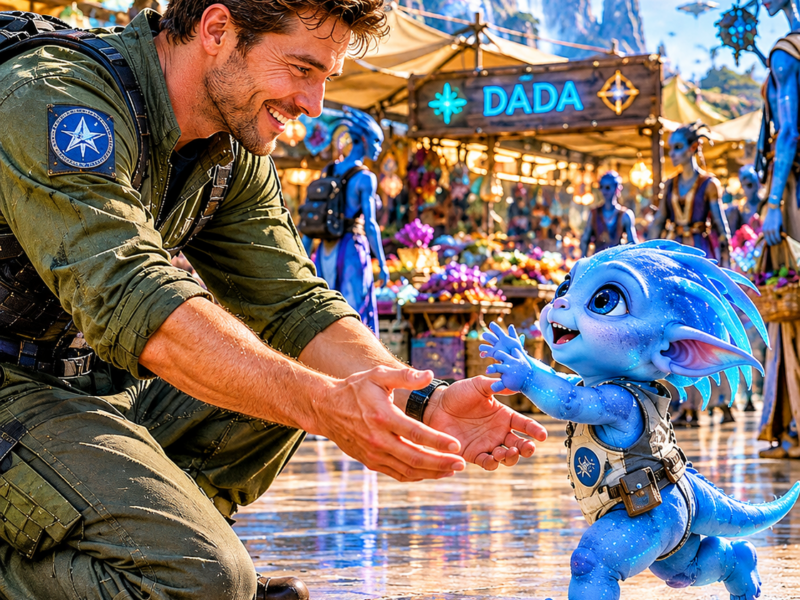
“The moment the Varashi ambassador’s daughter climbed into my lap during a diplomatic negotiation and called me ‘Dad,’ her mother’s glass shattered against the floor
The recording began with a soft electronic hum.
For the first few seconds, all I could see was Vess sitting in a small room, surrounded by three Varashi specialists. She looked smaller than she had in the negotiation chamber, her oversized robe folded around her knees, her hands resting motionless in her lap.
Then a voice came through the speakers.
It was Threlkai’s.
“Begin the assessment.”
I turned toward the ambassador.
She wasn’t looking at the recording. She was looking at the elderly adviser who had placed the device on the table.
The recording continued.
One specialist approached Vess and held out a small silver object. The child looked at it, then turned away.
Another specialist crouched in front of her and spoke gently.
Vess didn’t respond.
They tried a colorful toy, a musical instrument, and even a small animal-shaped machine that moved across the floor.
Nothing.
Then the recording changed.
A door opened, and a young Varashi man entered the room.
He held out his arms.
Vess immediately began crying.
The man stopped, looked toward the specialists, and lowered his hands.
“She still won’t accept anyone,” a voice explained.
I recognized it as Threlkai’s.
My stomach tightened.
The recording moved forward several minutes.
A specialist approached Vess with a device attached to a thin band. It looked similar to the translator collars worn by Varashi children.
The specialist activated it.
A series of words appeared above the recording.
The translation software identified them as emotional responses.
Fear.
Withdrawal.
Distress.
Then another word appeared.
“Searching.”
I leaned closer.
“What’s that supposed to mean?” I whispered.
Daniel didn’t answer.
The recording continued.
A specialist asked Vess a question, and her collar produced a strange sound. The specialist repeated the question.
This time, the translation appeared clearly.
“Where is the safe one?”
The chamber became so quiet I could hear the soft vibration of the projection device.
Threlkai closed her eyes.
I looked at her.
“Was she asking for someone?”
The ambassador nodded.
“For months,” she said quietly.
The elderly adviser stepped forward.
“This is precisely why the human must not be allowed to continue the attachment.”
I turned toward him.
“Why? What does the recording prove?”
He didn’t answer me directly.
Instead, he touched the device, and the image changed to a medical diagram.
I recognized Vess’s outline.
A small glowing region appeared near the base of her neck.
The adviser spoke slowly through his translator.
“Your species does not understand the Varashi bonding process. What you call affection is only the surface of a much deeper biological event.”
Daniel leaned toward me.
“Ethan, let him finish.”
The adviser continued.
“When a Varashi child forms a primary attachment, her nervous system begins synchronizing with the caregiver’s emotional patterns. This is not symbolic. It is measurable.”
He pointed at the glowing region.
“Vess has shown no measurable synchronization with any Varashi adult. Yet yesterday, after spending less than an hour with you, her readings changed.”
I stared at the projection.
“Changed how?”
The adviser hesitated.
Then he displayed two sets of readings.
One was from the previous day.
The other had been recorded during the negotiation.
The second set showed a dramatic shift.
The chamber erupted in quiet conversation.
I looked at Threlkai.
She finally spoke.
“She slept through the night for the first time in eleven months.”
I didn’t know what to say.
“That’s good, isn’t it?”
Her expression softened, but only for a moment.
“Yes. It is.”
Then she looked at the elderly adviser.
“And that is why I will not allow you to separate them.”
He struck the table with one hand.
“You are allowing a foreign species to influence the development of your child!”
Threlkai didn’t move.
“I am allowing my daughter to feel safe.”
Those words stayed with me.
For a few seconds, I forgot that I was sitting in a diplomatic chamber between two civilizations.
I only saw a mother who had spent more than a year watching her child struggle and had finally witnessed something she thought might never happen.
Then the adviser said something that changed the direction of the entire meeting.
“There is another part of the recording.”
He touched the device again.
The medical image disappeared.
A new video appeared.
This time, Vess was sitting alone.
A specialist was speaking from behind the camera.
“Vess, can you tell us what you want?”
The little girl looked down at her hands.
Then she raised her head.
“I want the man.”
The specialist paused.
“Which man?”
“The warm one.”
I felt the room turn toward me.
The recording continued.
“Can you tell us his name?”
Vess thought for a moment.
Then she said something in her own language.
The translator produced an English approximation.
“Ethan.”
My mouth went dry.
I had never met her before that morning.
I had never spoken to her privately.
I hadn’t even introduced myself.
The specialist asked another question.
“How do you know Ethan?”
Vess looked toward the camera.
“He waits.”
The specialist seemed confused.
“Waits for what?”
The child shrugged.
“For me to come.”
Nobody spoke.
The specialist tried again.
“Does Ethan make you happy?”
Vess nodded.
“He doesn’t pull.”
“Doesn’t pull what?”
“My hand.”
She looked down again.
“He lets me choose.”
I felt something tighten in my throat.
The recording ended.
For several seconds, nobody moved.
Then the elderly adviser turned toward me.
“Do you understand now?”
I shook my head.
“No. I understand that she likes being around me. I don’t understand why everyone is treating this like a political emergency.”
He studied me.
“Because our people believe a child’s first bond must remain within the family. It has always been that way.”
I looked at Threlkai.
“Is that what you believe?”
She took a long breath.
“I used to.”
Her answer surprised me.
She explained that Vess had been born healthy, but her early development had been difficult. The child rarely accepted physical comfort and often became distressed when someone approached too quickly.
At first, Threlkai believed it was simply a temporary phase.
Then months passed.
The specialists told her that Vess needed a stable primary bond.
Threlkai tried to become that person herself.
She spent nights beside her daughter’s bed, held her during medical examinations, and canceled official duties to remain close.
Sometimes Vess allowed her to sit nearby.
But whenever Threlkai reached for her, the child withdrew.
“I began to believe she did not want me,” the ambassador said.
Her voice was almost too quiet to hear.
I looked at the little girl beside her.
Vess was watching her mother.
Then, very slowly, she reached out and placed one small hand against Threlkai’s arm.
The ambassador looked down.
She didn’t grab her daughter.
She didn’t pull her closer.
She simply left her arm where it was.
Vess kept her hand there.
It was a small gesture, but I could see what it meant to Threlkai.
The elderly adviser noticed it too.
He looked away.
The meeting was suspended shortly afterward.
I expected to be sent back to Earth.
Instead, Daniel told me that the human delegation had received a formal request from Threlkai.
She wanted me to remain on the Varashi ship.
“For how long?” I asked.
“Until the negotiations are finished, at least.”
I stared at him.
“Daniel, I’m a translator. I’m not a child-development specialist.”
“I know.”
“Then why am I being asked to do this?”
He looked through the glass wall toward the corridor.
“Because the ambassador believes your presence may be helping her daughter. And because the Varashi delegation is divided over what to do next.”
I rubbed my forehead.
“That sounds like a terrible reason to put me in the middle of an international dispute.”
Daniel almost smiled.
“Welcome to diplomacy.”
The following days were unlike anything I had experienced.
I was given a small room near the Varashi family quarters and instructed to follow a strict schedule.
I wasn’t allowed to enter Vess’s private living area without permission.
I wasn’t allowed to touch her unless she initiated contact.
And I wasn’t allowed to make promises about visiting her that I couldn’t keep.
Those rules made sense to me.
In fact, I was grateful for them.
I didn’t want to become another adult who decided what Vess needed without listening to her.
The first afternoon, I found her sitting on the floor outside a large observation window.
She was arranging small glowing stones into a crooked circle.
I sat a few feet away.
“Building something?”
She looked at me.
Her translator collar flickered.
“House.”
I examined the stones.
“Looks nice.”
She moved one stone slightly.
“Not finished.”
“That’s okay. Houses take time.”
She considered that.
Then she pushed one of the stones toward me.
I picked it up and placed it near the edge of the circle.
She shook her head.
“Wrong.”
I laughed.
“Sorry. I’m not a very good architect.”
For the first time, I heard her laugh.
It was a tiny sound, almost swallowed by the ship’s ventilation system, but I heard it.
Over the next several days, we developed a routine.
Sometimes I read documents while she played nearby.
Sometimes she asked me questions about Earth.
She was particularly fascinated by rain.
The Varashi homeworld had very little rainfall, and she couldn’t understand why humans voluntarily walked outside when water fell from the sky.
I showed her a recording of a thunderstorm over my hometown in Colorado.
She watched it three times.
“Sky angry?”
“Not angry,” I told her. “Just making noise.”
“Why?”
“Sometimes the sky has a lot to say.”
She looked at me as though she was considering whether that was scientifically possible.
Then she laughed again.
Threlkai often watched us from the doorway.
At first, she looked uncertain.
Eventually, she began sitting with us.
She asked about human childhoods, family traditions, and why parents sometimes let children make mistakes instead of correcting them immediately.
I told her about my mother.
My mother had raised me alone after my father died when I was nine.
She worked two jobs, missed school events, and sometimes fell asleep at the kitchen table with bills spread in front of her.
But every evening, no matter how tired she was, she asked me one question.
“What was the best part of your day?”
Even when my answer was that nothing good had happened, she listened.
Threlkai seemed interested in that.
“She did not need to solve your problems?” she asked.
“Not always. Sometimes I just needed someone to listen.”
The ambassador looked toward Vess.
“I wish I had understood that sooner.”
I didn’t know how to answer.
There were things about being a parent that I couldn’t teach her.
But I could tell her what my mother had taught me.
A few days later, the negotiations reached their most difficult point.
The Varashi council demanded additional restrictions on human access to the jump corridor. Our delegation refused, arguing that the proposed restrictions would make the agreement commercially useless.
Both sides began threatening to withdraw.
Daniel spent most of the afternoon in closed meetings.
I remained with the translation team, trying to reconcile conflicting versions of the latest agreement.
Then my wrist alarm buzzed.
A message from Daniel appeared.
EMERGENCY SESSION. MAIN CHAMBER. IMMEDIATELY.
I hurried down the corridor.
When I arrived, the elderly adviser was already standing at the center of the room.
Threlkai sat opposite him.
Vess was nowhere to be seen.
The adviser looked directly at me.
“Human Ethan Cole, your presence has become a complication.”
I pulled out my chair.
“I was told to attend.”
“You have been told many things.”
Daniel gave me a warning look.
I decided not to respond.
The adviser activated a projection.
A document appeared, displaying several lines of Varashi writing.
The translation software identified it as a formal petition.
Threlkai stood.
“The council has requested that Vess be returned to the homeworld immediately.”
I looked at her.
“Why?”
“Because the council believes her attachment to you has become politically significant.”
I couldn’t help myself.
“She’s a child. She isn’t a diplomatic instrument.”
The elderly adviser narrowed his eyes.
“That is precisely the problem. You continue to see this as a matter of personal kindness.”
He touched the projection.
A new document appeared.
It contained the results of an investigation into the medical recordings.
“The council has discovered irregularities in the original assessments,” he said.
Threlkai turned sharply.
“What irregularities?”
The adviser looked uncomfortable.
“Several reports were incomplete.”
“That is not what I asked.”
He hesitated.
Then he said something that made Threlkai grip the edge of the table.
“Some of the specialists may have intentionally altered the bonding records.”
I looked from one to the other.
“Altered them how?”
The adviser didn’t answer.
Instead, he brought up a file from eleven months earlier.
It contained a medical report with a red authorization mark.
Threlkai moved closer to the projection.
I saw her face change as she read.
“Who signed this?”
The adviser lowered his head.
“It was authorized by the family medical council.”
“Who signed it?”
Her voice was sharper now.
He looked toward the human delegation.
Then back at her.
“Your husband.”
Threlkai went completely still.
I had heard very little about Vess’s father.
I knew he lived on the Varashi homeworld and that he was not part of the diplomatic delegation.
I also knew Threlkai had never spoken about him without changing the subject.
She stared at the document.
“That is impossible.”
The adviser shook his head.
“The signature has been verified.”
Threlkai looked at him.
“What did he authorize?”
The room fell silent.
The adviser seemed reluctant to speak.
Then he activated the final section of the report.
A line of translated text appeared.
PRIMARY BONDING SUPPRESSION PROTOCOL.
I read it twice.
“Suppression?” I asked.
Threlkai looked as though the floor had shifted beneath her.
The adviser explained that the protocol had been developed decades earlier to prevent dangerous bonding responses in children whose caregivers were considered unsuitable.
It was supposed to be used only in extraordinary medical circumstances.
But Vess’s records showed that the procedure had been administered repeatedly.
I looked at Threlkai.
“Did you know?”
She shook her head.
“No.”
Her voice was barely audible.
“Every specialist told me she was unable to bond. They said her nervous system was rejecting attachment.”
The adviser looked down.
“That is what the reports stated.”
I leaned toward the projection.
“Then why does this document say the procedure was repeated?”
Nobody answered.
I studied the dates.
The first treatment had been administered eleven months earlier.
The next one came three weeks later.
Then another.
And another.
There were twelve entries in total.
I looked at the final column.
The authorization notes were hidden behind a security restriction.
“Can you open that section?”
The adviser hesitated.
“It is restricted.”
“Then request access.”
Threlkai turned toward him.
“Open it.”
He didn’t move.
She stepped closer.
“I am her mother. Open it.”
After several seconds, he entered an authorization sequence.
The final column appeared.
I began reading the translated text.
The first few lines described the medical justification.
Then I reached the last entry.
It contained a note written by the specialist who had overseen the procedure.
The translation appeared slowly.
“Subject demonstrates repeated attempts to establish primary attachment outside designated family structure. Recommend continued suppression until approved caregiver is selected.”
I looked at the date.
It was eleven months old.
Then I saw the name of the designated caregiver.
Threlkai read it before I could.
Her face lost its color.
It wasn’t her husband’s name.
It wasn’t the name of a doctor.
It was the name of the elderly adviser standing across from us.
For several seconds, nobody spoke.
Then Threlkai turned toward him.
“You selected yourself?”
The adviser remained silent.
“Did you order this?”
He finally answered.
“I was protecting the family.”
“From what?”
“From a dangerous attachment.”
She pointed at the document.
“You suppressed my daughter’s ability to trust people, and you called it protection?”
His voice grew louder.
“Your husband believed she needed a controlled environment. I agreed with him.”
“Where is he now?”
The adviser looked away.
“He returned to the homeworld.”
Threlkai’s hands were trembling.
I wanted to say something, but I knew this wasn’t my conversation to control.
Then she asked the question that made everything worse.
“Did he know I was never told?”
The adviser didn’t answer.
He didn’t need to.
Threlkai turned away from him and walked toward the door.
I followed her into the corridor.
“Threlkai.”
She stopped.
For a moment, she looked as though she might tell me to leave.
Instead, she leaned against the wall and covered her face with both hands.
“I thought she didn’t want me,” she whispered.
I stood beside her.
“I know.”
“I thought there was something wrong with her.”
Her voice cracked.
“I thought perhaps I had failed her before she was even old enough to understand.”
I didn’t try to tell her everything would be fine.
I didn’t know that.
I only said, “You didn’t know what they were doing.”
She lowered her hands.
“But I should have known.”
“Maybe. But you’re here now.”
She looked through the corridor window.
Vess was sitting in the family room, arranging her glowing stones into a circle.
The ambassador watched her for a long time.
Then she asked me something I wasn’t prepared to hear.
“Will you help me bring her father here?”
I hesitated.
“Do you want him arrested?”
“I want him to explain what he did.”
She swallowed.
“And I want my daughter to hear the truth when she is old enough to understand it.”
I nodded.
“I’ll help you contact the human delegation. We can arrange a secure communication channel.”
Threlkai closed her eyes.
“Thank you.”
The next morning, the Varashi council convened an emergency hearing.
Vess’s father, whose name was Kaelor, appeared through a secure holographic connection from the homeworld.
He was older than Threlkai, with silver markings across his forehead and a formal robe that indicated high family status.
When he saw his wife, he didn’t look surprised.
He looked tired.
“Threlkai,” he said.
She stood across from the projection.
“Did you authorize the suppression protocol?”
Kaelor didn’t answer immediately.
Then he said, “Yes.”
A low murmur passed through the chamber.
Threlkai’s voice remained steady.
“Why?”
He looked toward the council members.
“Because the child was forming attachments that threatened the stability of her development.”
“She was a baby.”
“She was becoming unpredictable.”
“She was frightened.”
Kaelor shook his head.
“You don’t understand the consequences.”
“Then explain them.”
He looked at the elderly adviser.
The adviser lowered his eyes.
Kaelor finally spoke.
“The bonding process can be dangerous when it develops outside a recognized family structure. A child may become dependent on someone who cannot remain with her. If that person disappears, the consequences can be severe.”
I understood the fear behind his words.
It wasn’t entirely unreasonable.
He had been afraid that Vess would bond with someone who could never be part of her life.
But fear didn’t excuse what he had done.
Threlkai stepped closer to the projection.
“You made that decision without telling me.”
“I believed you would disagree.”
“Yes,” she said. “I would have.”
Kaelor looked down.
“I thought I was protecting her.”
“You were protecting your position.”
He raised his eyes.
“That isn’t fair.”
“Then tell me why the reports were falsified.”
He said nothing.
Threlkai continued.
“Why did you allow me to spend eleven months believing my daughter couldn’t love anyone?”
The room was silent.
Finally, Kaelor spoke.
“The council was concerned about the political consequences of an untreated attachment.”
I looked toward the elderly adviser.
He was staring at the floor.
Threlkai’s voice became quieter.
“You were both so afraid of losing control that you forgot she was a child.”
Kaelor looked as though he wanted to respond.
But no words came.
The hearing continued for several hours.
The council suspended the suppression protocol immediately and ordered an independent medical investigation.
The elderly adviser was removed from his position pending the results.
Kaelor was stripped of his authority over Vess’s medical decisions.
But the most important decision came from Threlkai.
She refused to let the council decide who her daughter was allowed to love.
She requested that Vess be given time, medical support, and the freedom to form relationships without political interference.
The council eventually agreed.
Still, the damage couldn’t be undone overnight.
Vess needed careful monitoring.
The specialists warned that her nervous system might take months to adjust after the repeated treatments.
I asked whether my presence would help.
The new medical director gave me a thoughtful look.
“Possibly. But we must be careful not to replace one imposed dependency with another.”
That made sense.
I didn’t want Vess to feel that she had to choose between me and her mother.
So I changed the way I spent time with her.
Instead of always being available, I began helping Threlkai establish small routines with her daughter.
We would sit together during breakfast.
Threlkai would ask Vess what she wanted to eat.
Sometimes the child answered immediately.
Sometimes she said nothing.
When that happened, Threlkai waited.
She learned not to reach for her daughter every time she wanted to comfort her.
She learned to sit nearby without demanding a response.
And slowly, Vess began reaching for her first.
The first time it happened, I wasn’t even in the room.
Threlkai told me about it that evening.
She had been reading a story in the family quarters when Vess climbed onto the seat beside her.
Then the little girl leaned against her mother’s shoulder.
Threlkai said she had continued reading as if nothing unusual had happened.
But she had to stop twice because her voice kept breaking.
I smiled.
“That’s wonderful.”
She nodded.
“I wanted to hold her so tightly.”
“But you didn’t.”
“No.”
She looked toward the window.
“I waited.”
The following week, the negotiations resumed.
This time, the Varashi delegation agreed to a more balanced shipping arrangement.
Human access to the Mars corridor would be granted under a joint monitoring system, and both civilizations would establish a permanent diplomatic office aboard the Varashi station.
The agreement wasn’t perfect.
It wasn’t the sweeping victory either side had initially wanted.
But it was fair.
And for the first time in six weeks, both delegations signed without threatening to walk away.
Daniel found me afterward.
“Well, Ethan, I suppose you managed to make yourself useful.”
I laughed.
“Is that your official assessment?”
“Don’t push it.”
He handed me a new assignment document.
I stared at it.
The human delegation wanted me to remain attached to the joint cultural and language team for the next six months.
I looked at him.
“Six months?”
“Unless you’d rather go back to reviewing shipping contracts.”
I glanced toward the other side of the chamber.
Vess was standing beside her mother, holding her hand.
I knew my answer.
Six months later, I was still aboard the Varashi diplomatic station.
My work had changed considerably.
I was no longer just translating documents. I was helping develop cultural training programs for both civilizations, particularly those involving families, education, and communication.
Threlkai had become one of my closest professional friends.
We still disagreed about plenty of things.
She thought human coffee tasted like burnt soil.
I thought Varashi breakfast was suspiciously similar to eating warm gelatin.
But we had learned to laugh about our differences.
Vess was doing well.
Her medical assessments showed steady improvement, and she had begun forming healthy relationships with several Varashi caregivers.
She still called me Dad.
The first time I asked whether she understood what the word meant, she looked at me as though I had asked whether the sky was blue.
“You are Ethan,” she said.
“Yes.”
“And you are Dad.”
I tried to explain that human families could be complicated.
She listened patiently.
Then she placed one hand on my arm.
“You stay when I ask.”
I smiled.
“Whenever I can.”
She seemed satisfied with that answer.
One afternoon, I found Threlkai standing alone near the observation window.
Earth was visible in the distance, a blue curve surrounded by darkness.
She held a small recording device in her hand.
“What are you watching?” I asked.
She looked down.
“A message from Kaelor.”
I wasn’t sure what to say.
“How is he?”
“He has requested permission to speak with Vess.”
“Will you allow it?”
She took a moment before answering.
“Eventually. If Vess wants to.”
She turned the device over in her hands.
“He sent an apology.”
I nodded.
“Do you believe him?”
“I believe he regrets what happened.”
She looked out at Earth.
“I don’t know whether he understands what happened.”
There was a difference.
I understood that.
“Do you think you’ll forgive him?” I asked.
Threlkai didn’t answer immediately.
“Perhaps one day. But forgiveness will not mean allowing him to make decisions for her again.”
She put the recording away.
“I spent so long believing that being a good mother meant preventing every possible hurt. I forgot that sometimes children need room to make their own choices.”
I thought about my own mother.
She hadn’t been able to prevent every difficult thing that happened to me.
But she had always made sure I knew I could come home.
A few minutes later, Vess appeared in the corridor.
She ran toward her mother, then stopped a few steps away.
Threlkai crouched.
“Would you like to come with me?”
Vess nodded.
Then she reached for her mother’s hand.
Threlkai looked at me.
There were tears in her eyes, but she was smiling.
“She asked me to walk with her today.”
I smiled back.
“Then I think you should go.”
Vess glanced over her shoulder.
“Dad, come too.”
I looked at Threlkai.
She laughed softly.
“Apparently, you are invited.”
We walked together toward the family quarters.
Vess held her mother’s hand with one hand and mine with the other.
For a while, none of us spoke.
Then she asked whether Earth really had storms that made the entire sky glow.
I told her about lightning.
She asked whether humans were afraid of it.
“Sometimes,” I said.
“Then why do you go outside?”
I thought about my mother standing on our old porch during summer storms, holding an umbrella while I ran through the rain.
“Because sometimes the people you love are waiting outside.”
Vess considered that answer.
Then she squeezed my hand.
I looked at Threlkai.
She was watching her daughter, not the stars, not the diplomatic station, and not the enormous Earth hanging beyond the glass.
Just her daughter.
I had come aboard that ship believing my job was to translate words between two civilizations.
Instead, I had learned that some of the most important things people need to understand cannot be translated by a machine.
Vess had called me Dad before she knew my name, before she understood my language, and before either civilization knew what to make of us.
But she had never needed me to replace her family.
She had only needed one person to show her that reaching out didn’t have to hurt.
And somewhere along the way, her mother had learned the same thing.
As we reached the family quarters, Vess let go of my hand and ran ahead.
Threlkai followed at her own pace.
I watched them disappear through the doorway, then glanced once more at the blue planet beyond the glass.
For the first time since the negotiations began, I wasn’t thinking about treaties, political alliances, or the future of humanity.
I was thinking about a little girl who had finally found a place where she could choose whom to trust.
And about a mother who had finally learned to let her.
The end.









