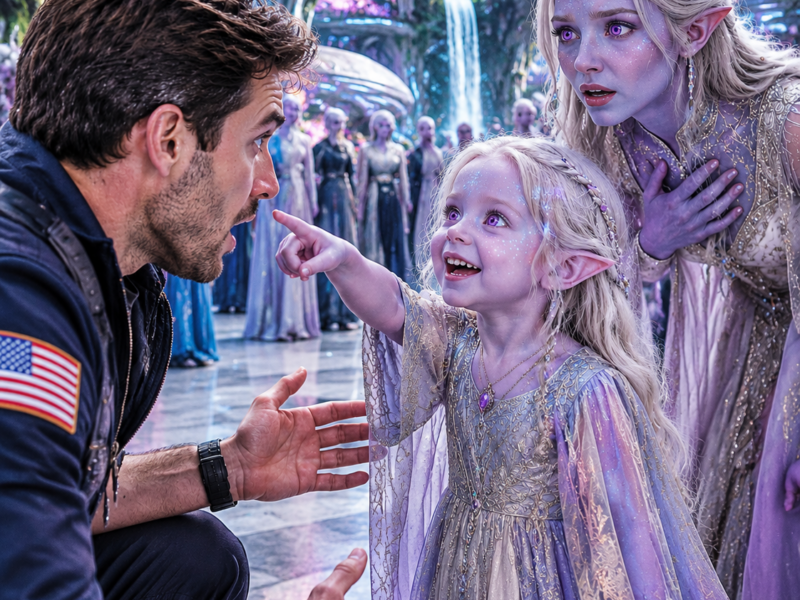
“The moment the little alien girl pointed at me inside the crowded intergalactic refugee station and whispered, “Dad,”
The emergency alarm grew louder.
Red lights swept across the terminal, turning the faces of hundreds of frightened passengers crimson.
A security officer shouted for everyone to move toward the nearest shelter.
But I couldn’t move.
I was staring at the photograph of a dead man while a little girl held the edge of my jacket.
“He’s coming back,” Lyra whispered again.
Serah pulled her close.
“Lyra, sweetheart, we need to go.”
“No, Mommy.”
The little girl shook her head.
“Papa said Daniel would keep us safe.”
I looked at Serah.
“Get her behind the security doors. Now.”
She didn’t argue.
Something in my voice must have reminded her of the person I used to be.
I handed my coffee to a passing station attendant and followed them toward the emergency corridor.
My communicator was already ringing.
“Commander Carter, report to operations immediately,” said Lieutenant Harris.
“I’m with a civilian mother and child. We have a possible connection to an old rescue mission.”
“That can wait. We have an unidentified vessel approaching without clearance.”
“Does it have weapons?”
A pause.
“That’s the problem. Our scanners can’t identify the ship.”
I glanced at the main display.
The vessel was moving toward the station at an unusual speed.
It was enormous, almost three times the size of a standard human transport, with a dark hull that reflected almost none of the station lights.
No identification codes.
No communication response.
And according to the station’s sensors, it carried no detectable life signs.
“Keep the civilian shelters sealed,” I said. “I’m coming.”
Serah grabbed my sleeve.
“Daniel.”
I turned.
“That ship was there when my husband disappeared.”
The words landed harder than the alarm.
I looked back at the display.
“You’re certain?”
She nodded.
“I saw it in the last transmission he sent me. He said something had followed his transport through the jump corridor.”
“Why didn’t you tell the authorities?”
“I did.”
Her voice cracked.
“They told me the recording was damaged. They said grief had made me see things that weren’t there.”
I studied her face.
Three years of unanswered questions.
Three years of raising a child alone.
And now she was standing in front of the man whose name had been left inside her husband’s final message.
“Come with me,” I said.
We reached the operations center twelve minutes later.
The station commander, Admiral Reeves, stood before the central holographic display.
He was a broad-shouldered man in his late fifties with silver hair and the permanent expression of someone who had spent too many years correcting other people’s mistakes.
When he saw me enter with Serah and Lyra, his eyebrows tightened.
“Commander Carter, I asked for you alone.”
“I believe these civilians may be connected to the approaching vessel.”
He glanced at Serah.
“Explain.”
Before she could speak, Lyra pointed at the hologram.
“That’s Papa’s ship.”
Everyone turned toward her.
The little girl had gone very still.
She walked closer to the display and touched the image with one finger.
“Papa drew it for me.”
Serah knelt beside her.
“Where, sweetheart?”
“In my dreams.”
The admiral exchanged a look with the station’s intelligence officer.
“Children often reproduce images they’ve seen without understanding them.”
Serah’s expression hardened.
“She has never seen that ship.”
I stepped between them.
“Sir, I need the archived records from the Vesta-9 evacuation.”
At the name of the mission, Admiral Reeves stopped moving.
It was only for a second.
But I noticed.
“Why?”
“Because the message identifies me as part of the incident.”
He looked toward the intelligence officer.
“Pull the file.”
The hologram changed.
A familiar image appeared.
Three years earlier, the civilian transport Vesta-9 had been caught in a Kethari attack near the border.
Our rescue vessel, the Resolute, had arrived after receiving a distress signal.
I had been the senior medic aboard.
We found the transport burning, its outer hull torn open, its emergency compartments venting atmosphere.
The mission report stated that all civilian passengers had been evacuated except for one crew member.
Dr. Elias Venn.
Serah’s husband.
I remembered him clearly.
He had been a civilian xenobiologist, assigned to study medical adaptations among several allied species.
He’d helped me carry injured passengers into the rescue shuttle.
Then the rear compartment exploded.
I remembered reaching for him.
I remembered his hand slipping from mine.
I remembered the blast throwing me against the corridor wall.
And I remembered waking up in a medical ward with burns across my shoulder.
The official report said Elias had died in the explosion.
I had believed it.
For three years, I’d believed it.
“Show me the final sensor record,” I said.
The intelligence officer hesitated.
Admiral Reeves folded his arms.
“Commander, the mission is classified.”
“Then unclassify the section relevant to this vessel.”
“That’s not your authority.”
I stared at him.
“Then give me someone who has it.”
For a moment, nobody spoke.
Then a voice came from behind us.
“Perhaps we should hear what the child has to say.”
It belonged to Lieutenant Harris, who had just entered the room.
He had worked with me for almost four years and knew better than to interrupt an admiral without a reason.
He approached Lyra and crouched.
“Can you tell us what your father showed you?”
Lyra looked at Serah.
Her mother nodded.
The girl touched the pendant around her neck.
“He said the bad people wanted to take the little lights.”
“The little lights?” Harris asked.
Lyra nodded.
“Inside the people.”
I felt the blood drain from my face.
Elias had used that expression during the rescue mission.
He had been studying a treatment for a rare neurological disease that affected several alien species.
He called the microscopic cellular structures involved in the process little lights.
His research had been controversial because it relied on an unusual biological discovery.
A group of alien refugees possessed a rare regenerative adaptation.
Their cells could repair damage to certain neural pathways.
Elias believed the mechanism could save millions.
But somebody else had wanted to weaponize it.
I looked at the admiral.
“Where is the research?”
He didn’t answer.
“Sir.”
His jaw tightened.
“That research was destroyed.”
“By whom?”
“Commander, you are out of line.”
The station shuddered.
A heavy impact reverberated through the outer docking ring.
The intelligence officer looked at his console.
“Unidentified vessel has transmitted a docking request.”
“Denied,” Reeves said.
The officer swallowed.
“Sir, it’s not requesting docking.”
“Then what is it doing?”
The holographic display changed.
A message appeared in the center of the room.
**RETURN THE CHILD.**
Nobody moved.
Serah pulled Lyra against her.
My hand instinctively went to the sidearm beneath my jacket.
Then another line appeared.
**RETURN THE KEY.**
Lyra began crying.
I crouched beside her.
“Sweetheart, what key?”
She pointed to her pendant.
“Papa said I should never give it to the bad people.”
Serah removed the pendant carefully.
For the first time, I noticed that the metal surface wasn’t smooth.
A thin seam ran around its edge.
I recognized the design.
It was an old human medical data capsule, the kind used by field researchers who needed to carry encrypted information without connecting to a network.
I looked at Serah.
“May I?”
She studied me for a moment before placing it in my hand.
I pressed the small release catch.
The pendant opened.
Inside was a translucent memory crystal no bigger than a grain of rice.
The operations officer immediately scanned it.
His console flashed.
Then every screen in the room went black.
A moment later, a message appeared.
**AUTHENTICATION REQUIRED.**
Below it was a list of names.
Elias Venn.
Serah Venn.
Lyra Venn.
Daniel Carter.
I stared at my own name.
“Why am I on this?”
Serah’s eyes filled with tears.
“Because Elias told me that if anything happened to him, I had to find you.”
“Why?”
She shook her head.
“I don’t know. He never explained.”
The station commander approached the console.
“Can you access the file?”
The intelligence officer shook his head.
“It requires a biological verification.”
“Whose?”
The officer looked at the screen.
“Daniel Carter.”
I stepped forward.
The scanner extended a narrow arm.
A small needle touched my fingertip.
The screen flashed green.
**IDENTITY CONFIRMED.**
Then a recording opened.
Elias appeared.
He looked thinner than I remembered.
There was a bandage around his forehead, and a dark room behind him.
He was speaking directly into the camera.
“If Daniel is watching this, then the extraction failed.”
My hands tightened.
Elias continued.
“Daniel, I owe you an explanation. The explosion on Vesta-9 wasn’t an accident.”
The recording flickered.
“I discovered that the Dominion had been experimenting on refugee children. They wanted to isolate the regenerative ability in their cells and reproduce it artificially.”
Serah covered her mouth.
“They believed they could create soldiers who would recover from almost any injury. But the process was killing the children.”
Elias looked away from the camera.
For a moment, he seemed unable to continue.
“Lyra was born with the same adaptation. I didn’t know until the medical tests.”
I looked at the little girl.
She was holding Serah’s hand so tightly that her tiny fingers had turned pale.
“Why would they want her?” I whispered.
Elias answered from the recording.
“Because she carries the most stable form of the adaptation we’ve ever found.”
The room fell silent.
“But she is not a weapon,” he said firmly. “She’s a child. I spent months developing a way to protect her biological information and prevent the Dominion from using her as a template.”
He touched the pendant.
“The crystal contains the research, along with evidence of the experiments. I split the encryption between three biological signatures because no single person could be trusted with the whole truth.”
I looked at the names on the screen.
Elias.
Serah.
Lyra.
Daniel.
My throat tightened.
“Why me?”
The recording seemed to answer before I could ask again.
“Because you saved my life once, Daniel. And because I know you won’t sacrifice a child to win a war.”
The image distorted.
Then Elias leaned closer.
“If you’re hearing this, they have probably found Lyra. Don’t let them take her to the Dominion.”
His voice dropped.
“And don’t trust the people wearing our insignia.”
The recording ended.
Every person in the room stared at Admiral Reeves.
He didn’t move.
Then he slowly reached for his sidearm.
Lieutenant Harris reacted first.
“Sir, step away from the console.”
Reeves drew his weapon.
Two security officers raised theirs.
For one terrible second, I couldn’t understand what I was seeing.
The admiral had commanded this station for six years.
He had attended memorial ceremonies for the Vesta-9 casualties.
He had personally signed the report declaring Elias dead.
And now he was pointing a gun at a five-year-old girl.
“Give me the crystal,” he said.
I stepped in front of Lyra.
“No.”
His expression was almost sad.
“You don’t understand what you’re interfering with.”
“Then explain it.”
“The Dominion has offered peace in exchange for the research.”
Serah stared at him.
“You sold children?”
Reeves looked at her.
“I prevented a war.”
“By handing over my daughter?”
“By making a necessary sacrifice.”
The words were so calm that I almost wished he had shouted.
I understood then.
He didn’t think he was evil.
He thought he was the only adult in the room willing to make a difficult decision.
I had met men like him before.
They always called the people they sacrificed necessary.
“Lieutenant,” I said quietly.
Harris kept his weapon trained on the admiral.
“Yes, sir?”
“Get the civilians to the evacuation shelter.”
Reeves laughed bitterly.
“There’s nowhere to go. The ship has already disabled our external communications.”
The lights flickered.
A warning appeared on the wall.
**DOCKING RING BREACH IN 90 SECONDS.**
Then Reeves moved.
He shoved the nearest officer aside and fired.
The shot struck the operations console.
Sparks burst across the room.
I grabbed Serah and pulled her behind the central table.
Harris fired once.
The admiral’s weapon flew from his hand.
But Reeves reached the emergency control panel and slammed his palm against it.
The station doors began sealing.
“He’s locking down the command center!” Harris shouted.
I pulled Serah toward the side corridor.
“Come on!”
Lyra stumbled.
I lifted her into my arms.
Behind us, Reeves was shouting into his communicator.
“Secure the child! The crystal must remain intact!”
A security drone dropped from the ceiling.
Its targeting light swept across the room.
Harris fired at it, but the first shot only damaged its outer casing.
I turned and threw a metal equipment tray.
It struck the drone’s sensor housing.
The machine crashed into the wall.
“Move!” I shouted.
We reached the maintenance corridor just as the docking ring began to rupture.
A deep metallic groan traveled through the station.
Then the entire structure shook.
Serah stumbled against me.
I caught her elbow.
“Are you hurt?”
She shook her head.
Lyra was crying against my shoulder.
I could feel her small hands gripping the back of my jacket.
“Don’t let them take me.”
I looked down at her.
“I won’t.”
I didn’t know whether I could keep that promise.
But I knew I would try.
We reached a service elevator.
Harris was waiting beside the control panel.
“Commander, I’ve got a route to the civilian hangar.”
“Can we get a shuttle out?”
“Not with the communications grid down.”
“Then we’ll fly without it.”
He gave me a grim smile.
“That’s what I was hoping you’d say.”
The elevator descended.
Through its narrow window, I saw the unfamiliar vessel attached to the station.
A section of its hull opened.
Something moved inside.
Not soldiers.
Not machines.
People.
Hundreds of them.
Small figures pressed against the transparent walls of the docking chamber.
Children.
Some were human.
Others belonged to species I recognized from the refugee manifests.
Their faces were pale and exhausted.
A few were reaching toward the glass.
Serah saw them too.
“Those are the children from the research program,” she whispered.
Lyra lifted her head.
“Papa said there were more.”
I looked at her.
“More what?”
“Little lights.”
The elevator stopped.
The doors opened into the civilian hangar.
A dozen families were already boarding emergency transports.
A medic waved us toward the nearest shuttle.
Then a voice came through the hangar speakers.
It was weak.
Distorted.
But unmistakably human.
“Daniel Carter.”
I stopped.
Serah looked at me.
The voice continued.
“If you’re there, please don’t leave.”
My communicator crackled.
I pulled it from my jacket.
“Who is this?”
A pause.
Then a breath.
“Daniel?”
I knew that voice.
I had heard it in the recording.
I had heard it in nightmares after the Vesta-9 mission.
“Elias?”
The answer came slowly.
“Yes.”
Serah made a sound I will never forget.
It was half a sob and half a gasp.
She grabbed the communicator with both hands.
“Elias?”
Silence.
Then the voice broke.
“Serah.”
She covered her mouth.
For three years, she had carried his memory like a wound that never closed.
Now the man she had buried was speaking to her.
“Where are you?” I asked.
“Inside the vessel.”
“Can you get out?”
“No.”
A metallic crash sounded behind him.
“They’re holding the children in the lower medical chamber. Reeves was supposed to deliver Lyra, but you stopped him.”
I glanced at the shuttle.
“We’re getting you out.”
“Daniel, listen. You have to destroy the research crystal.”
I looked at the pendant.
“That’s the only evidence.”
“The crystal contains the biological map. If the Dominion gets it, they can reproduce Lyra’s adaptation.”
“Then we’ll send it to the Terran government.”
“No.”
His voice sharpened.
“They’ve already infiltrated your government. That’s how Reeves got access to the original files.”
I felt cold.
“How do we stop them?”
“The crystal has a second function. It can release a counter-signal that disables the extraction equipment and destroys the stored biological templates.”
“Can it save the children?”
“Yes. But once activated, it will erase everything.”
I looked at Serah.
She was still holding the communicator.
“Elias, we can get you out. Just tell us where you are.”
There was a long silence.
Then he answered.
“I’m not coming home.”
She shook her head.
“No. Don’t say that.”
“Serah…”
“Don’t.”
His breathing became uneven.
“The Dominion’s commander knows who I am. They won’t let me leave while I can identify the people responsible.”
“Then we’ll come get you.”
“Please.”
The word was barely audible.
“Don’t make Lyra watch another person die.”
The communication broke.
Serah lowered the communicator.
She didn’t cry.
Not immediately.
She just stood there, staring at the small black screen.
Then Lyra reached for her mother’s face.
“Mommy?”
Serah knelt.
“Yes, sweetheart?”
“Papa is scared.”
Serah closed her eyes and pressed her forehead against her daughter’s.
“I know.”
I looked toward the shuttle.
We had perhaps twenty minutes before the docking ring became completely inaccessible.
Harris stepped beside me.
“Commander, we need to leave.”
I looked at the vessel.
Then at the crystal.
Then at the families boarding the emergency transports.
I had spent three years believing Vesta-9 was a tragedy I couldn’t undo.
Now I knew there were still people trapped inside that tragedy.
And one of them was a father who had waited three years to hear his daughter’s voice.
“Lieutenant, take the civilians and launch.”
Harris stared at me.
“What?”
“Get everyone to the outer evacuation platform.”
“Sir, you’re not seriously considering boarding that ship.”
“I’m considering bringing those children home.”
“That’s not an order I can follow.”
I looked at him.
“Then consider it a request.”
He glanced at Serah.
She was watching me.
“You’re going after him,” she said.
I nodded.
She took the pendant from my hand.
For a moment, I thought she would keep it.
Instead, she placed it back in my palm.
“Elias trusted you for a reason.”
I looked down at Lyra.
She reached up and touched my cheek.
“Bring Papa home.”
I swallowed.
“I’ll do everything I can.”
Harris exhaled.
“Fine. But I’m coming.”
We entered the emergency shuttle.
The vessel’s outer docking door was partially open, allowing us to slip through the damaged section of its hull.
Our shuttle’s navigation system failed almost immediately.
Harris switched to manual controls.
“Whoever designed this ship hates pilots.”
“Keep complaining. It might make the controls feel better.”
He gave a short laugh.
It was the first time either of us had smiled since the alarm began.
We landed inside a dimly lit hangar.
The air smelled of antiseptic and burnt wiring.
A series of red lights illuminated a narrow corridor.
I checked my weapon.
Harris checked his.
Then we moved.
The first two guards appeared near the medical wing.
They wore black armor without insignia.
Harris distracted the first while I pushed the second into the wall.
We disarmed them and continued.
At the end of the corridor, we found the children.
There were twenty-three of them.
Some were sitting on medical beds.
Others were curled beneath thin blankets.
A young human boy clutched a stuffed animal with one missing eye.
A small reptilian girl was crying silently.
And behind a transparent medical barrier stood Elias.
He looked older.
Much older.
His hair had turned almost completely gray, and a long scar crossed his left cheek.
But he was alive.
When he saw me, he placed one trembling hand against the barrier.
“Daniel.”
I stepped closer.
“You’re a difficult man to find.”
He laughed.
It sounded painful.
Then his eyes moved past me.
“Where’s Serah?”
“Safe. With Lyra.”
His knees almost gave way.
I caught him when the barrier opened.
For several seconds, neither of us spoke.
Then he grabbed my shoulders.
“You kept your promise.”
“I haven’t finished yet.”
He looked at the children.
“Neither have I.”
Harris moved toward the control console.
“How do we release them?”
Elias pointed to the central server.
“The extraction equipment is connected to the biological archive. If we activate the crystal, the system will shut down.”
“Then let’s do it.”
Elias shook his head.
“There’s a problem.”
Of course there was.
“The archive is linked to the ship’s life-support network. The counter-signal will destroy the templates, but it will also trigger an emergency purge.”
“Meaning?”
“The medical chambers will lose power. The doors will lock. We have six minutes to get everyone out.”
Harris looked at the twenty-three children.
“Can we move them all?”
“Not through the main corridor,” Elias said. “The guards will be waiting.”
I studied the layout.
A maintenance passage connected the medical wing to the hangar, but it was narrow.
We could move the smaller children through first.
The others would have to follow.
“How many guards?”
“At least twelve.”
Harris checked his ammunition.
“That’s inconvenient.”
I almost smiled.
Then the first alarm sounded.
The ship had detected us.
A voice echoed through the corridor.
“Unauthorized access. Security lockdown initiated.”
Elias looked at the crystal.
“Daniel, once you activate it, there’s no reversing it.”
I thought about the people who had died on Vesta-9.
I thought about Serah waiting in the evacuation hangar.
And I thought about Lyra’s small voice asking me to bring her father home.
“Do it.”
I placed the crystal into the central console.
A circle of blue light expanded across the surface.
The system recognized the four biological signatures.
Daniel Carter.
Elias Venn.
Serah Venn.
Lyra Venn.
Then a fifth line appeared.
**PROTECTED SUBJECTS: 23.**
The screen asked for final confirmation.
I pressed my palm against it.
The ship went dark.
For one second, there was nothing.
Then every medical chamber opened.
The children’s restraints released.
The extraction machines shut down.
A piercing alarm began counting down.
**PURGE INITIATED. SIX MINUTES REMAINING.**
“Move!” I shouted.
Harris took the two smallest children.
Elias helped a wounded teenager stand.
I lifted the human boy with the stuffed animal.
The boy looked at me.
“Are you going to leave us here?”
“No.”
“Promise?”
I looked at him.
“I promise.”
We entered the maintenance passage.
The first guards appeared behind us.
Harris fired a warning shot into the ceiling.
“Keep moving!”
A blast struck the wall.
Dust filled the corridor.
Elias stumbled.
I caught him.
“Can you walk?”
He nodded through clenched teeth.
“Don’t waste time on me.”
“Not happening.”
We reached the hangar with less than two minutes remaining.
The shuttle was still there.
Harris loaded the children while I helped Elias inside.
Then the ship’s commander appeared at the far end of the hangar.
He was a Kethari, tall and heavily armored, with dark scales and a metal breathing apparatus.
He raised his weapon.
“Give me the human researcher.”
I stepped in front of Elias.
“You’ll have to come through me.”
The commander tilted his head.
“You humans are remarkably stubborn.”
“Been told that.”
He fired.
The shot struck the shuttle’s open door.
Harris returned fire.
The commander ducked behind a support beam.
I pulled Elias into the shuttle and climbed aboard.
Harris slammed the controls.
The engines roared.
The shuttle lifted just as the vessel’s emergency purge began.
A white flash consumed the medical wing.
Then the entire ship shuddered.
The biological archive was gone.
So was the research that had been used to torture those children.
But the evidence survived.
The memory crystal had transmitted one final encrypted package to the shuttle before it burned out.
A complete record of the experiments.
Names.
Dates.
Orders.
Payment records.
And the signatures of everyone involved.
Including Admiral Reeves.
We escaped through the damaged docking ring seconds before the vessel’s internal systems collapsed.
Behind us, the black ship drifted away from the station.
Its lights went out one by one.
For a moment, nobody spoke.
Then the boy with the stuffed animal asked,
“Are we going home?”
Harris glanced at me.
I looked toward the station.
“Yes,” I said. “You’re going home.”
When we returned to the evacuation platform, Serah was waiting.
She stood near the medical entrance with Lyra in her arms.
The moment she saw the shuttle, she ran.
The doors opened.
Elias stepped out.
Serah stopped.
For a long time, neither of them moved.
He looked at her as though he was afraid the slightest movement might make her disappear.
She lowered Lyra to the floor.
The little girl stared at him.
Then her face changed.
“Papa?”
Elias dropped to his knees.
“Hello, little star.”
Lyra ran into his arms.
He held her as if he were trying to remember every detail at once.
Her hair.
Her tiny hands.
The warmth of her cheek against his neck.
Serah covered her mouth.
Then she walked toward them.
Elias looked up.
“I’m sorry.”
She shook her head.
“You don’t get to apologize and expect everything to be fixed.”
“I know.”
“You missed her first word.”
His eyes filled.
“I know.”
“Her first steps.”
“I know.”
“Three birthdays.”
He lowered his head.
“I know.”
Serah knelt beside them.
For a moment, I thought she might strike him.
Instead, she placed one hand against his face.
“You should have come home.”
Elias closed his eyes.
“I tried.”
She kissed his forehead.
“I know.”
Then she pulled him into her arms.
It wasn’t a perfect reunion.
There were too many years between them.
Too many unanswered questions.
Too much pain that couldn’t disappear simply because he was alive.
But it was a beginning.
And sometimes, that was all a family could ask for.
The investigation that followed lasted months.
Admiral Reeves was arrested before he could leave the station.
The evidence from the crystal exposed a network of officials, military contractors, and Dominion agents who had been trafficking refugee children for experimental research.
Several senior officers were removed from their positions.
The Dominion publicly denied involvement, but the records were too detailed to dismiss.
The rescued children received medical care and protection.
Their identities were kept confidential.
And the research that had once been intended to turn them into weapons became the foundation for a new humanitarian medical program.
Elias testified before the Terran Assembly.
Serah testified beside him.
I testified last.
When the committee asked why I had risked my life for a child who wasn’t mine, I gave them the simplest answer I could.
“Because she asked me not to let them take her.”
The hearing room went quiet.
A senator leaned forward.
“Commander Carter, you understand that your actions violated several direct security orders?”
“Yes, sir.”
“And you would do the same thing again?”
I looked toward the back of the room.
Serah and Lyra were sitting together.
Elias stood behind them, one hand resting on his daughter’s shoulder.
“Without hesitation.”
Six months later, I visited them on Earth.
They had settled in a quiet town outside Portland, Oregon.
Elias was still recovering.
He walked with a slight limp and sometimes woke from nightmares.
Serah had returned to medical research, though she now worked only on projects involving voluntary patients.
Lyra had become fascinated with Earth.
She liked rain.
She liked strawberries.
And she had developed an extraordinary talent for convincing adults to buy her ice cream.
I arrived on a Saturday afternoon carrying a small wooden box.
Lyra opened the front door.
“Daniel!”
She ran toward me and wrapped both arms around my waist.
I laughed.
“Hey, troublemaker.”
She looked at the box.
“What’s that?”
“Something I thought you might like.”
Inside was a small silver pendant.
Not the original.
That one had been destroyed with the research crystal.
This pendant was plain, with no hidden data and no secret codes.
Just a tiny engraved star.
Lyra held it up to the sunlight.
“It’s pretty.”
“Your dad helped me choose it.”
She looked toward the kitchen.
Elias was standing there with Serah.
He smiled.
“She told me you needed something that didn’t beep every five minutes.”
I laughed.
“She’s not wrong.”
Serah handed me a cup of coffee.
Real coffee.
Not the terrible station stuff.
We sat outside as the afternoon rain began tapping against the porch roof.
Lyra climbed into the chair beside me.
After a while, she asked a question.
“Daniel?”
“Yeah, sweetheart?”
“Are you my dad too?”
I looked at Elias.
Then at Serah.
They didn’t rush to answer for me.
I thought about the little girl hiding behind a vending machine.
The first time she had pointed at me.
The way she had said Dad with absolute certainty.
“I think,” I said carefully, “there are different ways to be someone’s family.”
Lyra considered that.
Then she nodded.
“Then you’re my Earth dad.”
I laughed.
“That’s a pretty important job.”
She leaned against my arm.
“You’re good at it.”
Across the porch, Elias looked down at his hands.
Serah reached over and took one of them.
I realized then that the little girl had never really been confused about who her father was.
She had recognized something in me that I hadn’t recognized in myself.
Not a replacement for Elias.
Not a stranger wearing a familiar face.
Just another person who had once refused to leave her father behind.
A person she could trust.
A person who had come back.
Years later, when Lyra was old enough to understand the story, she asked why her father had chosen me as the final key to protecting her.
Elias told her the truth.
“Because Daniel was the only person I knew who would put a child’s life ahead of his own orders.”
She thought about that for a long time.
Then she asked,
“Is that what makes humans special?”
Elias smiled.
“No, little star. Humans aren’t special because they’re fearless or because they’re stronger than everyone else.”
He glanced at me.
“Sometimes they’re special because, even when the universe gives them a hundred reasons to walk away, they still choose to stay.”
I never forgot those words.
I had spent most of my life thinking that being a hero meant saving someone in the middle of an explosion, carrying them through gunfire, or standing between them and a weapon.
But Lyra taught me something quieter.
Sometimes being a hero means showing up the next morning.
And the morning after that.
It means remembering birthdays, fixing broken toys, sitting through nightmares, and keeping promises long after the danger has passed.
On the day Lyra turned ten, she ran into the backyard wearing a paper crown.
She had invited every child from the rescue program.
Some were human.
Some were alien.
Some still carried scars from the experiments.
All of them were laughing.
Elias stood beside me near the garden fence.
Serah was taking photographs.
Lyra ran back toward us, holding a slice of birthday cake in each hand.
She gave one to her father.
Then she gave the other to me.
“Happy birthday to my family,” she announced.
Elias looked at me.
I looked at him.
Neither of us needed to say anything.
The little girl who had once pointed at a stranger in a crowded station now had a home filled with people who loved her.
And when she reached for my hand that afternoon, I took it without hesitation.
Because she had called me Dad before I understood why.
And somehow, over the years, she had taught me what that word really meant.
The end.









