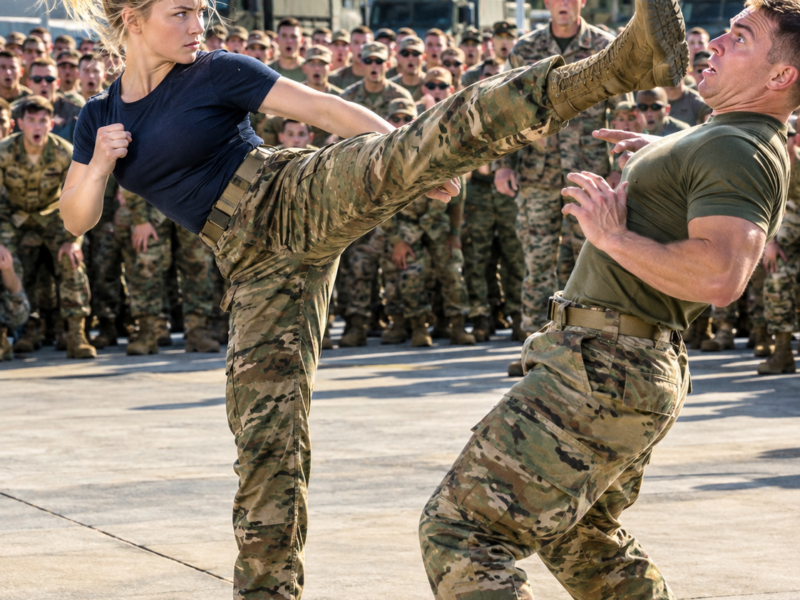
“The moment my husband shouted, ‘Remember, I’m a Navy SEAL!’ before striking me in front of 1,040 service members at a military ceremony in San Diego
The envelope felt heavier than paper should have felt.
I held it between my fingers while Commander James Whitaker stood beside the reviewing platform, his expression unreadable beneath the California sun. Behind him, 1,040 service members remained in formation, their uniforms crisp, their faces turned toward the disturbance that had just shattered the ceremony.
My husband was still on one knee.
Lieutenant Commander Ryan Bennett had spent twelve years building a reputation as a disciplined officer, a decorated Navy SEAL, and a man who could keep his head when everyone else lost theirs. At least, that was the man the Navy knew.
The man I knew had just slapped his wife in front of more than a thousand witnesses because she had refused to apologize for something she hadn’t done.
And when he tried to use his rank and reputation to frighten me into silence, I had put him on the ground.
I had not wanted that moment. I had not planned it. I had spent years learning how to avoid confrontations that could be turned against me. But when his hand came toward my face a second time, my body reacted before my mind could negotiate with the consequences.
One movement. One fall. Then silence.
Now every eye seemed fixed on the envelope.
“Ma’am,” Commander Whitaker said quietly, “you told me this document concerns an investigation I’ve been conducting. Is that correct?”
“Yes, sir.”
“Does it contain evidence?”
“It contains a statement and supporting records. The original records are secured elsewhere.”
He glanced at Ryan, then back at me.
“Why bring it here?”
“Because I was told that if I waited any longer, the evidence might disappear.”
A murmur traveled through the formation. Whitaker raised one hand, and the sound died.
Ryan finally stood. His face had turned red, not from pain, but from humiliation. Two senior enlisted sailors had moved closer, positioning themselves between him and me without touching either of us.
“Commander, this is a private marital dispute,” Ryan said. “My wife has been under a tremendous amount of stress. She has a history of making things sound worse than they are.”
The words landed with familiar precision.
A history.
That was how he described every time I disagreed with him. Every time I asked where he had been. Every time I questioned an explanation that changed depending on who was listening.
I looked at Whitaker.
“Sir, I understand that what happened here will have consequences. I will cooperate with any inquiry into my actions. But I won’t let what he did become an excuse to ignore what’s in that envelope.”
Whitaker studied me for a moment, then nodded to the master-at-arms.
“Secure the area. No one leaves until we’ve documented the incident and spoken to the relevant witnesses. Lieutenant Commander Bennett, surrender your sidearm and remain with the senior officer assigned to you.”
Ryan’s eyes widened.
“You cannot be serious.”
“I’m entirely serious.”
“Sir, I’ve served this country for twelve years.”
“And today,” Whitaker replied, “you struck a civilian in front of a formation of sailors. Your service record will be considered. So will your conduct.”
Ryan turned toward me. His expression changed, shedding the polished confidence he wore in public.
“You have no idea what you’re doing.”
For years, that sentence had made me feel small.
This time, it only made me tired.
“I know exactly what I’m doing,” I said.
Then I handed Commander Whitaker the envelope.
He did not open it in front of the formation. He gave it to an investigator who had arrived from the command building, and the two of them walked toward a nearby administrative office.
The ceremony was suspended. The troops were dismissed in sections, each group escorted away from the reviewing area while officers took statements. Several people approached me, then stopped, uncertain whether they should speak.
A young petty officer finally stepped forward.
“Ma’am, are you hurt?”
My cheek was burning. My hands had started shaking now that the immediate danger had passed.
“I’ll be all right.”
He looked toward the building where Ryan had been taken.
“I’m sorry that happened.”
“Thank you.”
He hesitated. “For what it’s worth, I saw it. So did a lot of us.”
I swallowed.
That was the first time all morning I felt close to crying.
Not because someone had hit me. I had survived worse than a slap, though not from the person who had promised to protect me.
I almost cried because a stranger had offered the one thing Ryan had spent years taking away from me: the simple assurance that I did not have to prove what I had seen.
An hour later, I sat in a small conference room with a paper cup of water between my hands. A medical corpsman had examined my face and documented the swelling. An investigator had photographed the marks and taken my initial statement. Commander Whitaker had returned from the administrative building carrying a folder.
He closed the door.
“Mrs. Bennett, I want to be clear about something. The envelope does not excuse or determine what happened in the ceremony area. The incident involving your husband will be handled separately.”
“I understand.”
“And the material you provided is serious.”
I looked at the folder.
“How serious?”
“Serious enough that I have referred it to the appropriate investigative authority. I can’t discuss every detail yet, but your statement appears consistent with information we’ve been trying to verify for several months.”
I felt my stomach tighten.
“What happens now?”
“Investigators will authenticate the records, interview the people named, and determine whether regulations or laws were violated. You may be asked to provide additional information. You may also be asked to testify.”
“I will.”
He leaned back slightly.
“Before we continue, I need to ask about your background. Your response to the physical assault was controlled and immediate. And the insignia I saw in your bag—”
I reached for the bag at my feet.
Inside was a small black case. I opened it and placed a silver insignia on the table.
Whitaker looked at it without touching it.
“Where did you earn this?”
“Naval Special Warfare support training and subsequent operational assignments,” I said. “I served in a classified support role attached to a special operations element before I was medically separated.”
His eyes returned to mine.
“You were in the teams?”
“I was attached to them. I wasn’t a SEAL, sir. I won’t claim a title I didn’t earn.”
It was a distinction I had learned to make carefully. My service had included demanding training, operational planning, intelligence coordination, and deployments that I could not discuss in detail. I had trained to recognize threats, protect people, and make decisions under pressure. But I had never worn the Trident Ryan liked to mention whenever it suited him.
He had once called my work “administrative support.”
He knew better.
He had been there when I returned from my last deployment, thinner, quieter, and carrying a diagnosis that made ordinary life feel like an unfamiliar country. He had promised that we would rebuild together.
At first, he meant it.
Then my recovery became an inconvenience. My questions became disrespect. My boundaries became insults. And the more I tried to explain what was happening between us, the more he told people I was unstable.
Whitaker folded his hands.
“Why did you leave that career?”
“An injury. I was cleared to leave the program, and I decided not to return to operational work.”
“Did your husband ever use your service history against you?”
“Yes.”
“In what way?”
“He told people I was exaggerating my experience when he wanted to discredit me. Then he would invoke his own service whenever he wanted people to trust him without asking questions.”
Whitaker’s expression tightened.
“Did he know you were bringing us these records?”
“No.”
“Did he know you had them?”
“He knew I had copies of some material. He didn’t know where the originals were.”
“Were you afraid he might destroy them?”
I stared at the paper cup.
“I was afraid he might make it impossible for anyone to believe me.”
Whitaker did not rush to fill the silence.
Finally, he said, “That concern is understandable. It is also why we rely on documented evidence, not simply on a person’s reputation.”
For the first time in months, I felt as though I could breathe without preparing to defend every breath.
The investigation had begun six months earlier, though not in the way Ryan imagined.
It began with a phone call from Petty Officer First Class Daniel Ruiz, a former colleague who had worked with Ryan on a joint training exercise. Ruiz had asked whether I still had access to old correspondence from a deployment planning office. He said a report had been altered after an incident that injured two sailors.
At first, I thought he had the wrong person.
I had left active duty years before. My records were boxed in a storage unit, my old contacts scattered across different commands, and most of my work had been classified or compartmentalized. But Ruiz remembered a project I had helped coordinate. He remembered that I kept meticulous copies of approved communications because the planning process had required strict accountability.
“I don’t want to accuse anyone,” he told me. “I just need to know whether the version in the archive is the same version you saw.”
I searched the files I still possessed.
It wasn’t.
The original schedule showed a safety restriction that had been removed from the final version. A message chain showed that the restriction had been discussed before the exercise. Another document indicated that an officer had approved a change after the deadline, even though the official report claimed the change had been made earlier.
The discrepancies didn’t prove criminal conduct on their own. They did, however, justify questions.
I gave Ruiz the information I could lawfully share and directed him to the proper reporting channels. I expected the matter to be resolved through routine review.
Instead, the pressure began.
A former colleague warned me that people were asking who had contacted me. An anonymous message arrived telling me to stop digging into “old operational issues.” A week later, Ryan found a printed email on our kitchen counter and asked why I was communicating with people from my previous unit.
I told him the truth.
He stared at me for a long moment, then smiled without warmth.
“You don’t understand the damage you could cause.”
“If the records are correct, there shouldn’t be damage.”
“You think the world works that way?”
“No. I think records should match what happened.”
That night, he accused me of trying to sabotage his career. He told me that people would believe him over me because he was still serving and I was not. He said I had become obsessed with my past because I had nothing meaningful in my present.
I packed a bag and stayed with a friend for three nights.
When I returned, Ryan apologized. He said he had been under pressure. He promised we would get counseling. He asked me to give him time.
I wanted to believe him.
I had loved the man he was before his ambition became a wall between us. I remembered the husband who had sat beside my hospital bed and held my hand when pain made it difficult to speak. I remembered the way he used to listen when I talked about my work, even when I couldn’t explain the details.
I kept hoping that man would return.
But the apology never changed the pattern. His anger grew whenever the inquiry moved forward. He began checking my phone and asking where I had been. He told mutual friends that my injury had left me emotionally unpredictable.
And then I learned that he had contacted someone involved in the review.
I did not know exactly what he had said, but a message from Ruiz confirmed that a witness had suddenly withdrawn a statement. Ruiz urged me to preserve every document and make a formal submission through an independent channel.
That was why I had prepared the envelope.
It contained a signed statement, copies of the original planning records, the altered versions I had been given, and a timeline of the communications. I had sent the originals to an attorney who specialized in military matters, with instructions to release them to the proper authorities if I was threatened or if the records were at risk.
I had not brought the envelope to the ceremony to embarrass Ryan.
I had brought it because the review was approaching a deadline, and I had received a credible warning that the last remaining copy of a key record might be destroyed.
I had intended to give the envelope to Whitaker privately after the ceremony.
Then Ryan slapped me.
And everything changed.
Two days later, the Navy placed Ryan on administrative leave while the assault investigation proceeded. His access to certain duties was suspended pending review. I was advised not to contact him directly, and he was ordered not to contact me except through approved channels.
He sent messages anyway.
The first was an apology that lasted two sentences.
I’m sorry I lost control. You know I would never intentionally hurt you.
The second blamed the ceremony.
You humiliated me in front of my command. You could have walked away.
The third was a warning disguised as concern.
You don’t understand what this investigation will do to everyone involved.
I saved every message and sent them to the investigator.
Then I blocked his personal number.
I stayed with my older sister, Natalie, in a small house outside San Diego. She had never liked Ryan, though she had tried to respect my choices. When I arrived with a swollen cheek and a suitcase, she opened the door, looked at me, and pulled me into her arms without asking a single question.
I cried against her shoulder until my knees felt weak.
“I should have left sooner,” I whispered.
Natalie held me tighter.
“You left when you were ready. That’s enough.”
I wanted to argue that I should have known better. I had been trained to recognize patterns, assess risk, and act decisively. How could I have missed what was happening inside my own home?
But Natalie shook her head as though she could hear the question.
“Being trained to handle danger doesn’t mean you can always recognize it when it comes from someone you love.”
I carried those words with me into the following weeks.
The inquiry moved slowly, as serious investigations often do. Investigators authenticated the documents, compared the original records with archived copies, and interviewed people who had been involved in the exercise. Some confirmed the discrepancies. Others claimed they had no memory of the decisions in question.
A technical review established that the final report had been altered after the fact. The investigators did not rely on my statement alone; they compared metadata, distribution logs, and archived messages. A separate review examined whether anyone had pressured witnesses or interfered with the process.
Ryan’s role remained under examination.
I learned that he had not created every discrepancy. The records showed a chain of decisions involving several people, and investigators were careful not to attribute every action to one officer simply because he was the most visible figure in the case. But messages placed Ryan in conversations about the revised report, and two witnesses said he had urged them to accept the official timeline even when it conflicted with what they remembered.
One of them was Ruiz.
When he finally agreed to give a formal statement, he called me afterward.
“I should have spoken sooner,” he said.
“Yes,” I answered.
There was a pause.
“I was afraid.”
“So was I.”
“I thought if I kept my head down, it would pass.”
“Did it?”
“No.”
Neither of us pretended that saying the truth made the consequences disappear.
Months passed. I attended interviews, answered questions, and reviewed records when investigators asked me to clarify what I had seen. Some nights I slept well. Others, I woke at the sound of a car door outside and lay rigid in the dark until I could remind myself where I was.
I started seeing a counselor who worked with veterans and military families. At first, I thought the sessions would be about Ryan. They were, in part, but the counselor kept returning to a question I found harder to answer.
“What do you want your life to look like if you stop organizing it around his reactions?”
I had no answer.
For years, I had measured every decision by whether it might provoke him, embarrass him, or give him another reason to accuse me of disloyalty. I had stopped calling old friends because Ryan disliked hearing stories about my service. I had abandoned a volunteer program because he said it made me look as though I needed attention. I had learned to keep my opinions quiet in rooms where he wanted to be the smartest person.
I had called it compromise.
Now I was beginning to understand how much of myself I had traded away to maintain the illusion of peace.
The divorce process began that spring. It was not dramatic. There were no public arguments, no grand speeches, no final confession in which Ryan admitted everything. There were forms, legal appointments, financial disclosures, and the slow separation of two lives that had become difficult to untangle.
Ryan’s attorney requested that the ceremony incident be treated as an isolated lapse in judgment.
My attorney responded with the witness statements, medical documentation, and the messages he had sent afterward.
I did not ask for revenge. I asked for safety, a fair division of our shared property, and no direct contact.
The court issued a protective order while the case proceeded.
Ryan’s professional future remained uncertain. The Navy’s review and the inquiry into the altered records continued on separate tracks. I heard through official notices that he had been removed from leadership responsibilities pending the outcome. I did not celebrate that news.
I had once imagined that watching him lose his career would make me feel vindicated.
Instead, I felt grief.
Not grief for the rank he might lose, but for the life I had believed we were building. For the man who had held my hand in the hospital. For the mornings when we drank coffee on the back porch and talked about the future as though it belonged to us equally.
I could acknowledge those memories without using them to excuse what he had done.
That distinction became one of the hardest things I learned.
Almost eight months after the ceremony, Commander Whitaker asked me to attend a formal meeting with the investigative team. I sat at a conference table across from two investigators and a legal officer. A recorder was placed in front of us. The room smelled faintly of coffee and printer toner.
Whitaker opened the meeting by explaining that the investigation had reached a significant stage.
“The evidence supports a finding that the official report was altered after the relevant events,” he said. “Several individuals are being referred for further administrative or legal action. We are still determining the extent of each person’s responsibility.”
He paused.
“Your documentation was important. It was not the only evidence, but it helped establish the timeline and direct investigators to the records that ultimately corroborated it.”
I let out a breath I hadn’t realized I was holding.
“Will the truth be made public?”
“Some findings will be released through the appropriate channels. Other details may remain protected for legitimate operational reasons. I cannot promise that every question will be answered publicly.”
I nodded. It was not the perfect resolution I had once imagined, but it was an honest one.
Then Whitaker turned to the other matter.
“The review of the assault at the ceremony is also progressing. The witnesses’ accounts are consistent, and the medical documentation supports your statement. Your husband will have the opportunity to respond through the proper process.”
I looked down at my hands.
“I didn’t want to hurt him.”
“I understand.”
“I also didn’t want to stand there and let him hit me again.”
“You were entitled to protect yourself from an imminent assault,” he said carefully. “The investigators will assess the facts. No one is asking you to pretend you had no right to defend yourself.”
That was the first time an officer had said it to me so plainly.
I had spent months replaying the moment in my head. I wondered whether I should have stepped back, whether I could have avoided the fall, whether everyone would have been better off if I had simply accepted the slap and waited until we were alone.
But the truth was simple: I had tried to step away. Ryan had followed me. He had struck me. When he moved toward me again, I protected myself.
The consequences belonged to the choices we had both made, not to a fantasy in which I could control every movement of another person.
When the meeting ended, Whitaker walked with me to the door.
“You know,” he said, “a lot of people in this building will remember the ceremony.”
“I know.”
“Some will remember that you put an officer on the ground.”
“I expect so.”
“I hope more of them remember that you brought evidence forward when it would have been easier to stay quiet.”
I thought about the 1,040 troops standing in formation that day. Many of them had never met me. Most would never know the details of the inquiry. Some might remember the slap, the fall, the sudden silence.
I could not control what they remembered.
I could only control what I did next.
The final decisions came months later. The review found that the records had been improperly altered and that multiple officers had failed to follow required reporting procedures. Some faced administrative penalties; others were referred for further proceedings. Ryan received formal disciplinary consequences for his part in the matter, and his future in the Navy was no longer the one he had expected.
The assault case was handled separately. The military investigation documented the witnesses’ accounts and the medical evidence. Ryan’s command took action under the applicable regulations, and my protective order remained in place during the separation.
I was not given every detail of his personnel file, and I did not need to be. I knew that the institution had examined what happened rather than dismissing it because of his reputation.
The divorce was finalized shortly afterward.
On the day I signed the final papers, I sat in my car outside the courthouse for nearly twenty minutes. The sky was bright, the air smelled of dry grass, and a group of people crossed the parking lot laughing about something that had nothing to do with me.
I expected to feel triumphant.
Instead, I felt still.
The marriage was over. The investigation had reached its formal conclusions. The documents were preserved. I had a safe place to live and people I could call when the nights grew difficult.
There was no applause.
No formation of troops.
No commander standing nearby to confirm that I had done the right thing.
There was only me, sitting in a car, deciding where to go for lunch.
For the first time in years, that ordinary choice felt like a gift.
I returned to work gradually, taking a position with a nonprofit that helped veterans navigate benefits and transition services. I did not talk about the ceremony unless someone asked. When people recognized my name from the video, I corrected the rumors as briefly as I could.
“No, I didn’t knock him out with one punch,” I told one man who insisted on describing it that way. “I defended myself when he attacked me.”
“But you were trained, right?”
“Yes.”
“So he picked the wrong woman.”
I considered that.
“He picked the wrong moment to believe he could hurt someone without consequences,” I said. “That’s different.”
The video had traveled farther than I ever wanted. Some people called me a hero. Others said I had embarrassed a decorated officer. A few accused me of exploiting the moment for attention, despite the fact that I had given no interviews and had asked no one to share the footage.
I stopped reading the comments.
A person could spend a lifetime trying to win an argument with strangers who knew nothing about her. I had already spent too many years doing that with someone who claimed to love me.
One afternoon, a letter arrived at my sister’s house. It had no return address, but I recognized Ryan’s handwriting.
I sat with it for a long time before opening it.
He wrote that he had lost friends, status, and the career he had built. He said he had been angry and ashamed. He admitted that he had treated me as though my loyalty belonged to him and that he had mistaken my patience for permission.
Then he wrote the sentence I had once wanted more than anything to hear.
“I was wrong to hit you. There is no excuse for it.”
I read the line twice.
He did not ask me to come back. He did not ask me to withdraw a statement or help repair his reputation. Whether that was because he had finally understood, or because he had learned that such requests would be useless, I could not know.
For a moment, I felt the old pull to answer him. I imagined writing a long letter about every night I had cried, every promise he had broken, every time he had made me doubt my own memory.
Then I realized I no longer needed him to agree with my account for it to be true.
I placed the letter in a folder with the legal documents and returned it to the drawer.
I did not write back.
That was not punishment. It was a boundary.
A year after the ceremony, I returned to the base for a veterans’ support event. The invitation came through the nonprofit, and I almost declined. I could already picture the faces turning toward me, the whispers, the inevitable question about the video.
But my counselor asked me something that stayed with me.
“Would you be going because you’re afraid of being seen, or because you want to be there?”
I thought about the people I had helped during the previous year. A former corpsman who needed assistance with housing. A young veteran who had been too embarrassed to ask for help with paperwork. A military spouse who had spent months convincing herself that constant fear was just part of marriage.
“I want to be there,” I said.
So I went.
The event was held in a modest hall near the base’s family support center. There were folding chairs, coffee urns, paper plates, and a long table covered with donated books. No reviewing platform. No formal ranks. Just people trying to help other people.
Commander Whitaker attended for part of the program. He greeted me with a firm handshake and asked how I was doing.
“Better,” I told him. “Not every day. But better.”
“That’s good to hear.”
A young sailor approached while we were speaking. He looked barely old enough to shave and kept adjusting the sleeve of his uniform.
“Ma’am, can I ask you something?”
“Of course.”
“I was at the ceremony last year.”
I waited.
“I remember what happened. I remember what you did afterward, too.”
I glanced toward the table of donated books.
“Which part?”
“The part where you gave the commander the envelope. Everyone was talking about the fight, but I heard you say you had evidence. I didn’t understand what that meant at the time.”
He swallowed.
“My supervisor has been asking me to sign off on something I know isn’t accurate. I’ve been afraid to challenge him. I keep thinking about what happened to you.”
My chest tightened, not with fear, but with the weight of his trust.
“I can’t tell you what to do without knowing the details,” I said. “But don’t change a record you believe is false just because someone outranks you. Write down what you know, preserve what you’re allowed to preserve, and seek advice through the proper channels. Don’t go looking for a confrontation. Make sure you understand the reporting process, and get support.”
He nodded slowly.
“What if it hurts my career?”
“It might make things harder for a while. I won’t lie to you about that. But if you sign something you know is false, you may carry that decision for the rest of your life.”
He looked down, thinking.
“Thank you, ma’am.”
After he left, I remained beside the table for a moment.
I had spent so much time thinking about the consequences of speaking up that I had forgotten there could be consequences to silence, too.
Later that afternoon, I stepped outside for air. The California sun was warm on my face. Across the road, a formation of sailors crossed the parade ground, their steps measured and even.
For a second, I was back at the ceremony. I could hear Ryan’s voice, sharp with contempt.
“Remember, I’m a Navy SEAL!”
I could see the shock on the faces around us when he hit me. I could feel the split second in which I decided not to let him hit me again.
The memory was still there. It might always be.
But it no longer controlled the story I told myself.
Ryan had wanted his rank to settle every argument. He had wanted his reputation to make people doubt what they saw. He had wanted me to believe that my past, my injury, and my love for him made me incapable of judging what was happening.
He had been wrong.
Not because I was stronger than every man in the room. Not because I had once trained beside people who could do extraordinary things. Not because I had knocked him down in front of 1,040 troops.
He had been wrong because no rank makes cruelty acceptable, and no marriage requires a person to surrender the right to be safe.
I thought about the insignia I had carried in my bag that day. It was a reminder of a chapter in my life, but it was not the source of my worth. I had spent years believing that if people understood my training, they would finally understand me.
Now I knew that my worth had never depended on whether anyone recognized my service.
I could be a veteran, a wife no longer married, a woman rebuilding her life, a person who still sometimes woke from nightmares. I could be strong and uncertain on the same day. I could miss someone and still refuse to return to him. I could acknowledge the good memories without allowing them to erase the harm.
And I could walk onto a military base without needing to prove anything to anyone.
As I turned toward the hall, I noticed a young woman sitting alone on a bench near the entrance. She wore civilian clothes and held a folded sheet of paper in both hands. Her eyes were fixed on the ground.
I slowed.
“Are you all right?”
She looked up quickly, then shook her head.
“I don’t know,” she whispered.
I sat at the other end of the bench, leaving space between us.
“You don’t have to explain everything right now.”
For a while, neither of us spoke. Then she told me that her partner had begun frightening her whenever she questioned his decisions. He had never hit her in public, she said. He was careful about that. He always apologized afterward, and he always found a way to make her feel responsible.
I listened without interrupting.
When she finished, I did not tell her what she had to do. I did not promise that everything would be easy if she left. I simply told her that fear was not proof of love, that she deserved to be safe, and that there were people who could help her make a plan.
She began to cry.
I stayed beside her until she was ready to stand.
It was a small moment, nothing that would ever become a viral video. No formation watched us. No officer issued an order. No one cheered.
But as we walked toward the support center together, I understood that the most important part of my story had never been the moment Ryan fell.
It was what came afterward.
The envelope. The records. The truth that survived the pressure to bury it. The people who finally spoke. The life I began building when I stopped confusing loyalty with silence.
And the woman I was becoming—not because I had defeated my husband in front of 1,040 troops, but because I had finally stopped letting his voice decide who I was.
I still remember the sound of that slap. I probably always will.
But when I think of that day now, I no longer picture Ryan on the ground or the shocked faces in the formation.
I picture myself standing beneath the California sun, holding an envelope with trembling hands, and choosing to tell the truth.
I had thought courage meant never being afraid.
I know better now.
Sometimes courage is a steady voice in a room full of people who expect you to be quiet. Sometimes it is a record you refuse to falsify. Sometimes it is leaving a person you still love because staying has begun to cost you yourself.
And sometimes, it is simply deciding that what happened to you matters—even if the person who hurt you insists that it doesn’t.
THE END.









