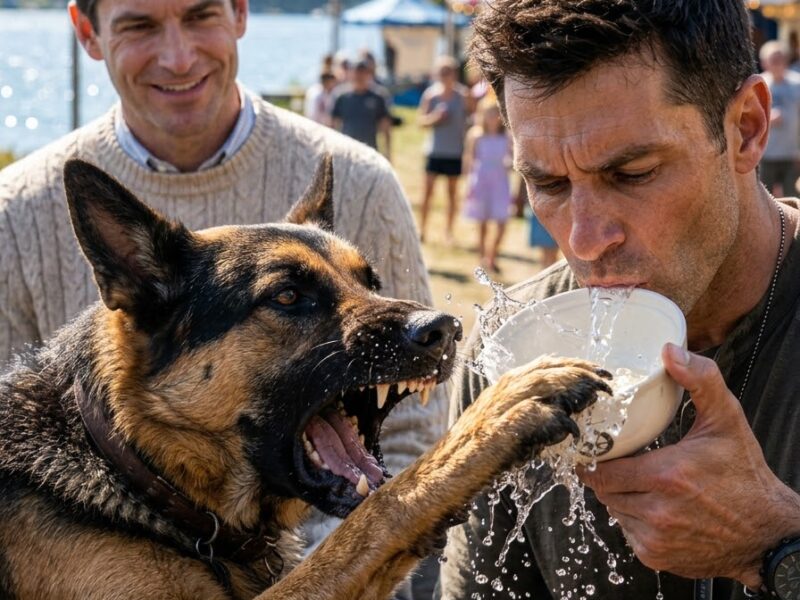
The moment my German Shepherd knocked over his water bowl at my cabin in Montana, I laughed—until he refused to drink, growled at the untouched water
The heavy wooden floorboards of my Montana cabin were cold under my bare feet, but the real chill came from inside my chest. The morning had started like any other in the Bitterroot Valley: crisp air, the scent of pine bleeding through the cracked bedroom window, and the low, steady hum of the wind sweeping down from the granite peaks. I was a man who craved routine. After two tours in the Arghandab Valley, routine wasn’t just comfort—it was a survival mechanism, the anchor that kept the lingering echoes of artillery fire from dragging me under.
My German Shepherd, Bear, was usually my shadow during these early hours. At ninety pounds of lean muscle and black-and-tan fur, he was a retired military working dog I’d adopted after we both got drummed out of service—me with a shattered knee and a chest full of bad memories, him with a scarred flank from a shrapnel burst near Kandahar. We understood each other’s silence.
I walked into the kitchen, the heavy iron kettle already whistling on the wood-burning stove. Bear was standing by his stainless-steel bowl near the stone fireplace. But he wasn’t drinking.
He was standing entirely rigid, his hocks locked, his tail held low and stiff. A low, vibrating growl rolled through his chest—a sound so deep I felt it through the soles of my boots.
“What is it, boy?” I muttered, lowering my mug.
I walked over and knelt beside him. The water in the bowl was fresh, poured straight from the tap just fifteen minutes earlier when I’d filled my coffee pot. Or so I had thought. Bear sniffed the rim, recoiled violently, and let out a sharp, frantic bark, snapping his head toward me.
“Take it easy,” I said, reaching out to tilt the bowl toward the light to check for debris.
Before my fingers could touch the metal rim, Bear’s jaws clamped down on the thick fabric of my flannel sleeve. He didn’t break skin, but the sheer urgency of his grip pulled my hand back a full foot. He pulled hard, leaning his entire body weight backward, dragging me away from the bowl.
My heart did a sudden, familiar spike in rate—the old combat reflex kicking in before my brain could process why. I looked closely at the water. Floating near the bottom was an almost imperceptible, iridescent sheen, like a drop of motor oil washed away in rain, accompanied by a faint scent that hit the back of my throat—sweet, slightly metallic, like crushed almonds mixed with damp copper.
Heavy footsteps crunched on the frozen gravel outside.
Bear immediately placed himself between me and the front door, his top lip curling back to reveal rows of white teeth. A loud, friendly knock echoed through the heavy timber.
“Michael? You up, buddy?”
It was Carl. He lived half a mile down the ridge in a log home he’d built thirty years ago. Carl was the local fixture—a retired land surveyor with silver hair, denim overalls, and a soft, grandfatherly demeanor. When I moved here three years ago, struggling to adjust to civilian life, Carl was the one who brought over snow chains, helped me stack four cords of fire-cured larch, and brought fresh bread his wife had supposedly baked before she passed away. He was the nearest thing to family I had in this valley.
I unbolted the heavy door, keeping Bear pinned behind my left leg with a firm command. “Down, Bear. Stay.”
Carl stood on the porch, wrapped in a heavy canvas coat, holding a brown paper bag that emitted the warm, yeast-rich scent of fresh sourdough. He was smiling, his blue eyes crinkling at the corners against the sharp morning light.
“Morning, soldier,” Carl said cheerfully, stepping just inside the threshold to escape the wind. “Saw your chimney smoking. Thought you might want a hot loaf for breakfast. You looked a little pulled-apart when I saw you at the post office yesterday.”
“Thanks, Carl,” I said, taking the bag. My tone was flat, my mind still locked on the strange reaction Bear had just had. “Appreciate it.”
Carl’s eyes drifted past me, landing on the dog, who was emitting a continuous, silent tremor of aggression. Then Carl’s gaze flicked down to the floor—specifically, to the water bowl by the fireplace. His eyes hovered there for a fraction of a second too long.
“Dog seems awful jumpy today,” Carl observed, his voice dripping with casual concern. He took a half-step closer. “Still having those episodes from the war, huh? The hyper-vigilance?”
A sudden, freezing drop of adrenaline hit my stomach. It wasn’t just what he said; it was the precision of it. Carl had never used the term hyper-vigilance before. He had always called it “the jitters” or “war nerves.”
“He’s just alert,” I said, keeping my hand flat against Bear’s chest. I could feel the dog’s heart hammering like a machine gun. “He smells something he doesn’t like.”
Carl’s smile didn’t fade, but his eyes flattened, losing their warmth entirely. “Well… snow’s coming down heavy by afternoon. Make sure you drink plenty of fluids, Michael. You look pale. Take your medicine and rest up.”
He turned and walked down the steps, his boots leaving deep prints in the fresh powder. I locked the deadbolt behind him, my pulse thumping violently in my ears.
Carl knew I took medication for nerve pain in my knee. But I had never told him when I took it, or where I kept it.
I grabbed a clean mason jar from the cupboard, carefully poured the contents of Bear’s water bowl into it, and sealed the lid tightly. I didn’t touch the liquid with my skin.
Thirty minutes later, I was leaning over the counter at the county veterinary clinic ten miles down in town. Dr. Sarah Lin, a woman who had treated Bear for his shrapnel scars twice before, held the glass jar up to the fluorescent light. She uncapped it slightly, wafted the air above it toward her nose with a gloved hand, and immediately snapped the lid shut. Her face drained of color.
“Michael,” she said, her voice dropping to an urgent whisper as she backed away from the counter. “Where did you get this?”
“My dog refused to drink it this morning. What is it, Sarah?”
“I can’t give you a definitive toxicology report without sending it to the state lab in Helena,” she said, her hands visibly trembling as she placed the jar inside a biohazard container. “But this smells like a high-concentration synthetic organophosphate—a restricted agricultural nerve toxin. A few drops in a water supply will shut down a mammal’s nervous system in under ten minutes. It causes sudden cardiac arrest, looking almost identical to a natural heart attack.”
The room seemed to tilt. The sounds of traffic outside muted into a dull, distant roar.
“Don’t touch your face, Michael,” Sarah commanded, grabbing my wrist. “Did you ingest any of this?”
“No,” I breathed, staring at the plastic box. “Bear stopped me.”
“Call the sheriff. Right now. Do not go back to your cabin alone.”
I didn’t wait for the local authorities to meet me at the clinic. I drove back up the mountain trail, the tires of my truck spitting gravel against the wheel wells, my hand white-knuckled on the steering wheel. The pieces were shifting in my head, forming a terrifying picture I couldn’t yet fully comprehend.
When Sheriff Miller and two deputies pulled up to my property an hour later, the sky had turned a bruising shade of purple-grey. Snowflakes were beginning to drift down through the tall pines.
Sheriff Miller, a veteran lawman with thirty years in the county, stepped into my kitchen. He examined the empty water bowl, took my statement, and watched as his deputies dusted the door handles for latent prints.
“Carl’s lived on this mountain for decades, Michael,” Miller said, rubbing the back of his neck as he leaned against my kitchen counter. “He’s a pillar of the community. What reason would he have to drop poison in your dog’s dish?”
“I don’t know!” I snapped, my voice cracking under the pressure. “Look at the jar Sarah took! Someone came onto my porch while I was asleep, lifted the latch on the dog door, and dumped nerve poison into his bowl! Carl came over this morning specifically to check if I was dead!”
Before Miller could reply, a sharp, violent scratching sounded from the back porch.
Bear was at the kitchen door, whining frantically, his nose pressed against the glass. He wasn’t barking at the woods; he was looking down at the snow packed against the cabin’s foundation.
“Hold on,” Miller said, drawing his sidearm as I yanked the back door open.
Bear bolted into the yard, ignoring the falling snow, and plunged his snout directly into a thick drift beside my stacked firewood. He began digging aggressively, sending clods of frozen dirt and snow flying between his hind legs.
“Bear, heel!” I shouted.
He ignored me, biting down on something hard buried beneath eight inches of ice. He pulled his head back, dropping a heavy, dark green plastic pelican case onto the snow.
Deputy Vance stepped forward, using the toe of his boot to turn the waterproof case over. It was latched tight, sealed with electrical tape around the seams.
“Don’t touch it,” Miller ordered, motioning Vance back. Miller pulled out a pair of thick rubber gloves, knelt in the snow, and used a pocket knife to slice through the tape. He popped the plastic latches.
Inside lay a small radio receiver, a secondary vial of clear liquid, and a folded sheet of waterproof butcher paper.
Miller picked up the paper with tweezers from his kit and unfolded it on the tailgate of his cruiser.
I leaned over his shoulder. Written across the top in precise, block lettering was my full name, social security number, and my former military unit designation. Below it was a grid of four other names—three of them crossed out with thick red ink. Beside each crossed-out name was a cause of death: Massive Coronary, Acute Respiratory Failure, Car Crash/Embankment.
My name was at the very bottom of the list. It was uncrossed.
Underneath my name was a timestamp: OCTOBER 14 – 06:00 HOURS.
That was tomorrow morning.
“My God,” Miller whispered, his eyes widening as he recognized one of the crossed-out names. “Mayor Higgins… he died of a heart attack six months ago in his sleep. We thought it was natural.”
My blood ran cold. The mountain wasn’t just quiet; it was a hunting ground. And I was the final target on an execution list.
“What is this, Miller?” I demanded, my hands shaking so violently I had to jam them into my coat pockets. “Who is Carl?”
Miller looked up, his face grim, the blood entirely gone from his cheeks. “Carl isn’t a land surveyor, Michael. His real name is Karl Vance… former contractor for a private defense firm that went under investigation ten years ago for liquidating military assets.”
Before I could ask another question, the heavy silence of the snowy yard was shattered by the sharp chime of my phone inside my coat pocket.
I pulled it out. The caller ID displayed a local number I knew by heart.
Carl.
Miller nodded sharply at me, signaling his deputy to track the signal. “Answer it. Keep him talking.”
I slid my thumb across the glass and pressed the phone to my ear. I didn’t say a word. I just listened to the sound of my own ragged breathing in the freezing air.
A long beat of silence stretched across the line. Then, a voice came through—soft, calm, completely devoid of the friendly neighbor persona he had worn for three years.
“Your dog was always smarter than you, Michael,” Carl said smoothly.
“Carl—”
“You should have drunk the water, son. It would have been peaceful. Now… things are going to get messy.”
Click.
The line went dead.
At that exact moment, fifty yards out in the tree line beyond my woodshed, a dark figure stepped out from behind a snow-draped fir tree. Bear whipped around, his teeth bared, and let out a roar of absolute rage as the power grid to my cabin suddenly cut out, plunging the house into complete blackness.
The sudden darkness felt like a physical blow. The only light remaining came from the faint red glow of the deputies’ cruiser tail lights and the dim, twilight reflection of the falling snow.
“Get down!” Sheriff Miller yelled, drawing his Glock and stepping in front of me.
A sharp crack echoed from the tree line—not the loud bang of a standard rifle, but the metallic thwack of a suppressed high-caliber round. The rear windshield of the police cruiser imploded in a shower of safety glass. Deputy Vance fell backward into the snow with a choked scream, clutching his shoulder where blood was already blooming black against his tan uniform.
“Officer down! Officer down!” Miller screamed into his shoulder mic, but his radio returned only a harsh, static hiss. Jammed.
“Inside! Move!” I roared, grabbing Vance by the collar of his tactical vest and dragging his 200-pound frame backward over the snow toward the cabin porch. Bear provided rear guard, barking furiously at the treeline, his body low to the ground as snow began to fall heavier, turning the world into a wall of white noise.
We slammed the heavy oak door shut, and I threw both deadbolts into place. Miller dragged Vance into the hallway, using his belt as an improvised tourniquet around the deputy’s upper arm.
“They jammed the frequencies,” Miller panted, his eyes wild. “We can’t call for backup from the valley. How many guys does Carl have out there?”
“He doesn’t need a platoon,” I said, my combat training taking over, suppressing the panic that threatened to paralyze me. “He just needs to cut us off and wait for us to bleed out or freeze. He cut the main power line at the transformer box down the drive.”
I moved through the dark house with practiced memory, pulling down heavy wool blankets to tack over the windows, blocking line-of-sight from the perimeter. Bear stayed glued to my heel, his ears rotating toward the exterior walls like radar dishes. Every few seconds, he would whine softly, pointing his snout toward a different section of the cabin.
“He’s circling us,” I whispered, kneeling by the gun safe hidden beneath the stairwell. I punched in the combination by touch—five digits, sharp and precise. The heavy steel door clicked open.
Inside sat my civilian arsenal: a Remington 700 bolt-action hunting rifle with a 12x scope, a 12-gauge Remington 870 shotgun, and my old service SIG Sauer P226. I tossed the shotgun to Miller.
“Can you shoot with that shoulder bruised?” I asked.
“I can pull a trigger,” Miller growled, loading buckshot into the tube with trembling hands. “Michael… that list in the snow. Why you? What do you have that ties you to a dead mayor and two retired defense contractors?”
I paused, holding the cold steel of the rifle. The memory flashed back—2018, Kandahar Province. My squad had been tasked with securing a perimeter around a downed supply transport. The cargo hadn’t been food or ammunition; it had been crates of unmarked, military-grade hardware stamped with a corporate logo I didn’t recognize at the time. Carl’s former company. I had signed the manifest lock-box intake form before the entire site was swept clean by a secondary black-ops team. I thought it was routine logistics.
“I signed the intake clearance for his illegal shipments eight years ago,” I realized aloud, the sickening truth finally locking into place. “I was the last loose end. The others were the money trail—the mayor signed off on the local land permits for his storage facilities here in the valley. Carl isn’t just a neighbor. He’s a cleaner. He’s liquidating everyone who could tie him to those weapons before he leaves the country.”
A heavy thud echoed from the roof directly above the kitchen.
Bear barked once—a sharp, violent burst—and bolted toward the back of the house.
“They’re on the roof!” I yelled.
Glass shattered in the master bedroom upstairs. Wood splinters rained down as someone breached the upper window.
“Stay with Vance!” I told Miller, grabbing my SIG Sauer and unclipping Bear’s leash. “Search and destroy, Bear. Go!”
The dog exploded up the wooden staircase like a streak of fur and teeth. I followed two steps behind, my firearm raised, low to the step to minimize my profile against the faint light coming from the landing.
A man dressed in full white winter camouflage was dropping down from the ceiling hatch in the upper hallway. He carried a compact submachine gun fitted with a long suppressor.
He never got the chance to raise it.
Bear hit him mid-air.
Ninety pounds of trained assault dog slammed into the intruder’s chest, knocking him hard back against the drywall. The shooter screamed as Bear’s jaws locked onto his forearm, the sound of crunching tactical gear filling the corridor. The submachine gun clattered to the floorboards.
“Freeze!” I roared, coming around the corner with my pistol level at his head.
The attacker, his face concealed behind a black balaclava, didn’t stop. He pulled a long tactical knife from his vest with his free hand and lunged toward Bear’s throat.
Pop. Pop.
Two rounds from my P226 struck him square in the chest plate. The man went limp, tumbling down the short flight of stairs landing at the foot of the bathroom door.
I grabbed Bear’s harness, pulling him back. “Clear! Good boy, hold!”
Bear was panting heavy, his muzzle flecked with red, but he was unhurt. I searched the tactical vest of the downed intruder. No dog tags. No patches. But tucked into the side pocket of his rig was a handheld GPS unit showing four distinct red blips surrounding my cabin property.
Carl wasn’t alone. He had brought three professional mercenaries with him to finish the job.
Downstairs, a violent explosion rocked the front wall of the cabin.
The front door splinters blew inward, driven by a breaching charge. Dust and dry-wall smoke filled the lower floor instantly. I heard Miller opening fire with the shotgun—BOOM… BOOM… BOOM—the heavy blasts shaking the floorboards beneath my feet, followed by the deep, guttural yell of an advancing shooter.
“Miller!” I shouted, sprinting back to the balcony overlooking the living room.
Through the thick haze of grey smoke, I saw Miller flat on his back near the overturned dining table, his shotgun lying out of reach. Standing over him in the destroyed doorway was a massive figure wearing a white parka, carrying a heavy assault rifle.
It was Carl.
He didn’t look like the kindly old neighbor anymore. His face was cold, hard, set like granite. He leveled the barrel of his rifle directly at Miller’s chest.
“You shouldn’t have gotten involved, Sheriff,” Carl said, his voice entirely steady over the sound of the wind howling through the shattered entrance. “This was a private matter.”
“Carl!” I screamed from the top of the stairs, aiming down through the smoke.
Carl didn’t panic. He pulled the trigger.
TAK-TAK-TAK.
Miller groaned, rolling into the shadows behind the couch as rounds chewed through the floorboards beside him. Carl swung his barrel upward toward the balcony, firing a burst that forced me to dive behind the heavy oak banister as wooden splinters rained down on my back like shrapnel.
“You can’t win this, Michael!” Carl’s voice boomed through the ruined house, echoing off the stone chimney. “The snowstorm is blowing in at forty knots! No one is coming up this road for twelve hours! You’re pinned, your deputy is bleeding out, and you’re running out of room!”
I squeezed myself low against the wall, checking my magazine. Four rounds left in the hand-gun. Eight rounds in the hunting rifle back downstairs.
I looked at Bear. The dog was crouched low, his eyes fixed on me, waiting for a command. He was terrified of the gunshots—his ears were pinned flat—but his loyalty was absolute.
“We go down through the laundry chute,” I whispered to the dog, pointing toward the small utility access at the end of the hall. “We flank them from the cellar.”
Suddenly, the smell of liquid fuel hit my nostrils.
Carl wasn’t trying to clear the house room by room anymore. He was pouring accelerant onto the wooden porch steps.
A bright, orange light flared outside the broken window, followed by the terrifying WHOOSH of gasoline igniting. Smoke—thick, black, and suffocating—began to pour into the living room from below.
“If you won’t come out, Michael,” Carl shouted from outside the burning threshold, “I’ll just bake you inside!”
The heat rose with terrifying speed. Within seconds, the lower level of the cabin was transformed into a roaring furnace of yellow flame and blinding black smoke. The dry pine logs, preserved for decades against the Montana winters, caught fire like paper.
“Miller!” I choked out, crawling through the blinding smoke toward the edge of the stairwell. “Miller, can you hear me?”
A weak cough came from below the smoke line near the kitchen hallway. “I’m… I’m here… under the table. Vance is unconscious… I can’t move him, Michael!”
I couldn’t abandon them. The military code drilled into my bone marrow wouldn’t allow it, but logic dictated that if I went down the main stairs into the open living room, Carl’s men would pick me off the moment my silhouette crossed the flames.
“Bear, stay low!”
I grabbed a wet wool blanket from the linen closet, threw it over my shoulders, and kicked open the floor hatch that led to the crawlspace underneath the house. Cold, sub-zero air rushed up from the earth, cutting through the stifling heat for a brief second.
“Go, Bear! Down!”
The dog didn’t hesitate. He dropped down the four-foot ladder into the dirt crawlspace beneath the foundation. I dropped down after him, pulling the wooden hatch shut above us to seal out the fire.
We were under the house now, surrounded by stone pillars, dirt, and exposed copper pipes. Above us, the floorboards were creaking violently as the fire spread, orange light leaking through the gaps in the wood.
I crawled on my elbows through the frozen dirt toward the north side of the crawlspace, where an iron ventilation grate led out into the snow behind the woodshed. Bear crawled beside me, his belly scraping the frozen soil, keeping his head down like he’d been trained to do in the valley of Arghandab.
I reached the metal grate, shoved my boots against the iron frame, and kicked outward with all the force left in my bad knee.
CRACK.
The rusted frame gave way, popping open into a heavy snowbank outside.
I slithered out into the blinding white storm. The wind was howling now, a full blizzard sweeping down off the mountain, dropping visibility to less than ten feet. The rear of the cabin was already engulfed in flames, thick plumes of black smoke being whipped sideways by the gale.
Across the yard, two dark figures were positioned near my truck, watching the front exit with assault rifles raised. They were waiting for us to run out the front door to escape the flames.
They didn’t expect us to come out of the ground behind them.
“Bear,” I breathed into the dog’s ear, pointing through the swirling snow at the mercenary standing nearest to the woodshed. “Pheel. Quiet.”
The dog understood. He moved like a ghost through the deep powder, his dark coat blending seamlessly into the storm. I chambered a round in my SIG Sauer, keeping low behind the stack of larch logs.
The guard near the woodshed turned his head to check his rear flank, but the blowing snow obscured his vision.
Bear hit him from the left.
The dog didn’t bark. He launched himself through the drift, taking the man down by the back of the knee. The guard went down with a muffled shout, his rifle discharging harmlessly into the sky—TAK-TAK-TAK—before Bear locked onto his tactical vest collar, thrashing him against the icy ground.
I sprinted forward through the knee-deep snow, closed the distance, and brought the heavy butt of my pistol down across the man’s helmet visor, cracking the composite plastic and knocking him unconscious into the drift.
I dragged his body behind the woodpile and stripped him of his belt—taking three fresh magazines and a pair of night-vision goggles.
One guard left on the perimeter. Plus Carl.
I pulled the night-vision goggles over my eyes. The white-out world transformed into a sharp, phosphor-green landscape.
Fifty feet away, the second mercenary was advancing cautiously toward the burning front porch of the cabin, holding a suppressed carbine. He saw the flames licking through the roof and assumed we were trapped inside.
I brought up my pistol, compensated for the thirty-knot crosswind, and fired twice.
The rounds caught him in the thigh and side. He dropped into the snow with a sharp cry, dropping his weapon.
“Carl!” I screamed over the roar of the fire and the wind. “It’s over!”
Out of the bright orange inferno of the front door, a shape emerged.
Carl stepped off the burning porch, unaffected by the heat, wrapped in his heavy winter gear. In his left hand, he held a remote detonator with a flashing red LED. In his right, he held a heavy revolver.
He didn’t look at his downed men. He looked directly toward the woodpile where I was concealed.
“You always were a tough bastard to kill, Michael!” Carl shouted, his voice carrying over the storm. “Just like your commander in Afghanistan! He wouldn’t take the payout either!”
My heart stopped. “What did you say?”
“You think it was an IED that took out your convoy in 2018?” Carl laughed—a dark, ragged sound that was swallowed by the wind. “Your captain found the manifest discrepancies. He was going to turn us into the Inspector General. So I sold your route coordinates to the local insurgents for fifty grand! You survived by accident, Michael! But you were never supposed to come home!”
The ground beneath my feet felt like it opened up. The nightmare that had haunted my sleep for eight years—the fireball that destroyed my unit, the loss of my brothers—hadn’t been a random act of war. It had been orchestrated by the man who had spent the last three years bringing me home-cooked meals and helping me clear my driveway.
“You monster,” I whispered.
“I’m a businessman who cleans up his loose ends!” Carl yelled back. He lifted the remote detonator. “I planted three charges around your propane storage tank behind the cabin. In thirty seconds, this whole side of the mountain is going to be a crater. You, the Sheriff, and your damn dog are going to be vaporized, and the state police will assume your wood stove exploded in the blizzard!”
He raised his thumb over the red button on the detonator.
There was no time to aim. No time to shoot. He was behind the reinforced frame of my pickup truck, offering no clean line of sight for my handgun.
I looked at Bear. The dog was staring at the red flashing light in Carl’s hand, his muscles coiled like steel springs.
“Bear,” I said, my voice dropping to a low, deathly calm. “Take!”
Bear didn’t sprint—he flew.
He carved through the three-foot snowdrifts like a torpedo, his powerful hind legs kicking up clouds of white powder behind him. He didn’t make a sound. No bark, no growl. Just pure, unadulterated kinetic energy directed at the man who had destroyed our lives.
Carl saw the black shape charging through the green-tinted haze of the storm and swung his revolver toward the dog.
BANG.
The heavy bullet tore through the snow inches from Bear’s flank, kicking up ice.
Bear didn’t flinch. He leapt from five feet out, his ninety-pound frame hitting Carl square in the chest just as Carl’s thumb pressed down on the detonator button.
The impact sent both of them crashing hard into the frozen gravel of the driveway. The remote control flew from Carl’s hand, tumbling through the air and landing twenty feet away in a deep snowdrift.
Carl screamed as Bear’s jaws clamped down on his wrist, preventing him from raising the revolver. The two fought violently in the snow—the old mercenary punching frantically at the dog’s ribs with his free hand, Bear refusing to release his grip, tearing through layers of heavy canvas and skin.
“Get off me! Get off!” Carl shrieked.
I sprinted across the open yard, ignoring the blinding pain in my shattered knee, and dove into the snowdrift where the detonator had landed. My fingers scrambled through the freezing ice, hunting for the plastic casing.
My hand closed around the small box. The LED light was blinking rapidly—a five-second countdown timer had been initiated by the impact of the fall.
3… 2…
I jammed my thumb under the battery cover panel, ripping the lithium power cell out of the circuit board just as the timer hit one.
The green LED went dark. The propane tank behind the burning cabin remained silent, its heavy steel hull reflecting the orange flames that were now consuming the roof rafters.
I let out a ragged breath, turned, and drew my pistol.
Carl had managed to pull a tactical knife from his boot sheath with his left hand. He was raising it, preparing to drive the six-inch blade into Bear’s neck.
“BEAR, OUT!” I screamed the release command.
The dog instantly disengaged, rolling backward into the snow away from the knife blade, his chest heaving, his mouth bloody.
Carl scrambled to his feet, bleeding heavily from his arm, his face twisted in rage and desperation. He held the knife in a defensive stance, his eyes wild as he stared at me through the driving snow. The burning cabin behind him cast long, terrifying shadows across his face.
“Shoot me then, soldier,” Carl spat, blood flecking his lips. “Go ahead! Put a bullet in me! You’re still a killer under that civilian coat! Shoot me and spend the rest of your life in a state prison trying to prove it was self-defense!”
I stepped forward, keeping the SIG Sauer pointed directly between his eyes. The wind roared around us, carrying the crackle of burning timber and the bitter smell of pine and copper.
“I’m not going to shoot you, Carl,” I said, my voice cold and hollow as ice.
He blinked, a flicker of confusion crossing his face. “What?”
“I don’t need to,” I said.
From down the mountain trail, through the thick curtain of the whiteout, came the sound of heavy diesel engines, screaming sirens, and the rhythmic thump-thump-thump of a tactical helicopter breaking through the low cloud deck.
The radio jammer on the first downed mercenary had failed when I knocked him out. Sheriff Miller’s secondary distress beacon—the automatic emergency responder built into his cruiser’s dash—had triggered the moment the vehicle took heavy fire.
The Montana State Police Tactical Response Team was sweeping up the ridge road.
Carl’s eyes widened in sheer panic. He turned his head toward the tree line, realizing his escape route was completely cut off by the deep snow and the approaching convoy of law enforcement.
He looked back at me, raised the knife, and took a desperate step forward.
I didn’t pull the trigger.
I stepped side-on, swept his leading leg with my heavy boot, and drove my elbow directly into his collarbone. Carl went down hard onto the frozen ice, the breath exploding from his lungs in a thick cloud of vapor. The knife clattered harmlessly into the drift.
Before he could push himself up, I had his arm pinned behind his back, my knee pressed firmly into the spine of his shoulder blade. I pulled a pair of heavy flex-cuffs from the downed mercenary’s rig nearby and ziptied Carl’s wrists together until the plastic bit deep into his skin.
“Karl Vance,” I growled into his ear as he struggled against the snow. “You’re under arrest for the murder of Mayor Higgins, the attempted murder of three officers, and treason.”
The fire from the cabin roared into the sky, illuminating the snow with brilliant shades of orange and red, as state police cruisers burst into the clearing, their red and blue strobes painting the forest in flashing light.
By sunrise, the storm had finally broken.
The sky over the Bitterroot Valley was a clear, brilliant shade of crystalline blue. The air was bone-chillingly cold, minus fifteen degrees, making every breath feel like breathing shattered glass.
My cabin was gone. In its place stood a smoking skeleton of charred logs, black beams, and twisted metal, surrounded by deep yellow crime scene tape that fluttered violently in the morning breeze. State forensic teams in white Tyvek suits were sifting through the ash, collecting evidence from the breached crawlspace and the clearing.
Sheriff Miller sat on the lowered tailgate of an ambulance near the driveway, a thick wool blanket wrapped around his shoulders. His shoulder was bandaged, his face pale, but he was alive. Deputy Vance was already being transported to the regional trauma unit in Missoula—the paramedics had stabilized him, and the doctors said he would make a full recovery.
Carl and his surviving mercenaries had been hauled away in armored state transport vans two hours ago, bound for a federal detention facility in Helena. The paper list found in the snow, along with the contents of Carl’s safe-house down the ridge, had already yielded enough evidence to reopen four unsolved homicides and trigger a massive federal investigation into his former contractor syndicate.
I sat on a wooden crate near the woodshed, holding a paper cup of black coffee that had already gone lukewarm in the freezing air.
Bear lay beside my boots. The vet had checked him over thirty minutes ago—no broken bones, no internal injuries, just a few deep bruises and a lot of exhaustion. He had his massive head rested on my thigh, his dark eyes watching the investigators move around the property.
Federal Agent Marcus Vance—no relation to the deputy—walked over, pulling off his heavy leather gloves. He looked down at the smoking ruins of my home, then at me.
“The state lab confirmed the chemical analysis on that water bowl, Michael,” Agent Vance said softly. “It was concentrated Fluorosilicic Acid mixed with an unlisted organophosphate. Half a cup would have taken out an entire squad. If your dog hadn’t knocked that bowl over…”
He let the sentence hang in the frigid air.
“He saved my life,” I said, my voice raspy from smoke inhalation. “Again.”
“The federal prosecutor’s office is taking over the case,” Vance continued, leaning against the side of my snow-covered truck. “Carl’s syndicate is done. The paper trail he kept to blackmail his former associates is entirely intact. You won’t ever have to look over your shoulder again, son. It’s over.”
I didn’t answer right away. I looked at the blackened foundation of the place I had spent three years building—the home where I thought I could hide from the world and lock my nightmares away behind solid timber walls.
“What will you do now?” Vance asked, looking around at the desolate, snow-covered mountain. “You lost everything in the fire.”
I dropped my gaze to Bear. The dog lifted his head, nudging my gloved hand with his cold black nose, letting out a soft, contented sigh that steamed in the sunlight.
I reached down and stroked the dense fur behind his ears, feeling the steady, powerful rhythm of his heartbeat beneath my fingers. The cabin was gone, the wood was ash, and the memories of the war were still there—but the shadow that had hung over my life for eight years had finally been dragged into the light.
“I didn’t lose everything,” I said, standing up and pulling my collar up against the morning wind.
I snapped the leash onto Bear’s collar. He stood up instantly, alert, his body aligned with mine, ready for whatever lay down the road.
“Come on, boy,” I whispered. “Let’s go home.”
We walked down the long, snowy driveway together, leaving the ashes behind us, heading toward the valley below as the morning sun broke over the snow-capped peaks of Montana.
The end.









