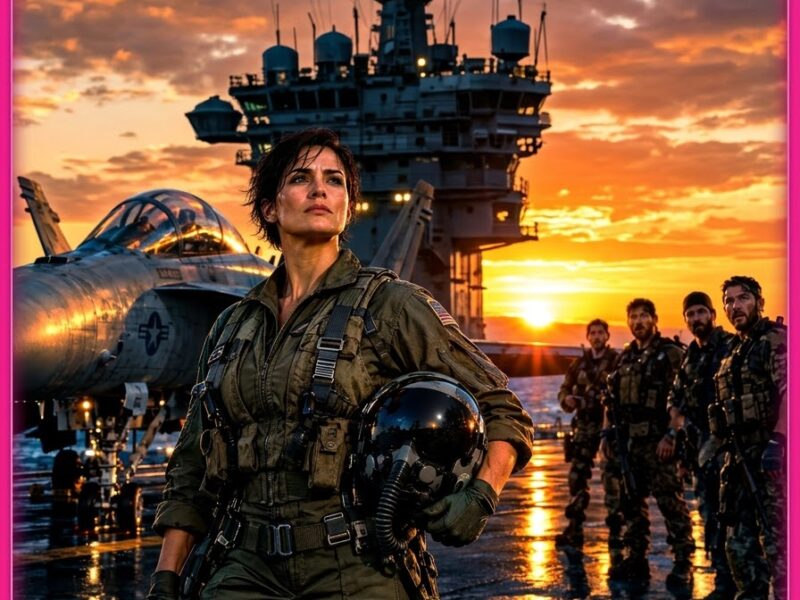
The moment my battered F-18 touched down beside a Navy SEAL staging area in Virginia, several operators laughed at its scarred wings
The relentless downpour over the Tidewater region of Virginia did nothing to dull the metallic sheen of the coastal air. Rain hammered against the canopy of my F-18 Hornet, drumming a steady, violent rhythm that mirrored the pulse in my throat. The aircraft was a relic—scarred by years of hard carrier landings, its radar nose cone discolored by high-speed bird strikes, and its gray paint peeling at the panel edges like dry skin.
I taxied the jet past a row of pristine MH-60 Black Hawks lining the apron of the naval auxiliary landing field. The ground crew, clad in heavy yellow foul-weather gear, waved their wands with hurried precision, directing me toward a secluded, high-security staging area near the edge of the tree line.
I brought the throttle back, bringing the twin General Electric engines to a whining halt. The moment the canopy hissed upward, letting in the smell of ozone, burning jet fuel, and wet pine, I unclipped my helmet. My dark hair was soaked with sweat, clinging to my forehead.
A squad of Navy SEALs was gathered under the overhang of a nearby corrugated steel shelter. They wore full tactical kit—crye precision uniforms, plate carriers, and suppressed rifles slung across their chests. As I unbuckled my harness and climbed down the narrow ladder built into the fuselage, several of them stepped out into the rain, eyeing my battered aircraft with open amusement.
“Hey, Navy!” one operator called out over the sound of the squall, a smirk breaking across his camouflage-painted face. “Did you drag that thing out of a junkyard in Pensacola? I didn’t think those old C-models could still lift off the ground without dropping their engines!”
A couple of the men chuckled, shaking their heads as they watched me drag my flight bag from the ladder. I stepped off the bottom rung, my flight boots splashing into a deep puddle on the cracked tarmac. I ignored them completely, keeping my eyes fixed straight ahead.
“Check out the wings,” another SEAL remarked, pointing at the long, jagged scratch running along the starboard airfoil. “Looks like she traded paint with a phone pole.”
“Enough,” a sharp, gravelly voice cut through the rain.
The laughter died instantly. A tall, broad-shouldered officer stepped forward from the shadows of the shelter. He wore the insignia of a Commander, his face lined with deep, weather-worn grooves, and his eyes cold, grey, and entirely devoid of humor. He walked toward me, his heavy combat boots crunching on the wet gravel.
He stopped three feet away, staring down at me, taking in the grease stains on my flight suit and the calm, unblinking glare I returned.
“Call sign?” he asked, his voice low and raspy, barely carrying over the storm.
I hesitated for a fraction of a second, feeling the sudden, cold weight of a ghost settling on my shoulders.
“Ghost Six,” I said clearly.
The Commander stopped cold. The subtle air of detachment he wore snapped like glass. His grey eyes widened slightly, his jaw clenching so hard a muscle twitched in his cheek. The remaining operators behind him shuffled, picking up on the sudden shift in atmospheric pressure between us.
He stared at my face, searching my features as if looking at a dead man returned from the depths of the Atlantic.
“Ghost Six…” he repeated softly, the words coming out as a heavy exhalation of cold air. He turned his head abruptly toward his team. “Everyone inside. Now. Lock the perimeter.”
The SEALs didn’t ask questions. The humor was gone, replaced by disciplined speed as they turned and filed into the briefing facility.
I followed the Commander through a set of heavy steel double doors into a dimly lit, high-security operations room. A massive, floor-to-ceiling map of the Mid-Atlantic coastline covered the entire back wall, crisscrossed with glowing red tactical overlays, satellite imagery, and encrypted signal feeds.
“I’m Commander Miller,” the man said, turning to face me the moment the heavy doors clicked shut. “Two days ago, a covert coastal extraction went sideways forty miles off the coast of Virginia. A squad from DEVGRU—six men—went black during a heavy weather insert. Their helicopter’s distress beacon vanished twelve miles offshore. Primary Command logged it as a structural failure in heavy seas. No survivors. Case closed.”
He stepped toward a tactical console and flipped a switch. A speaker on the desk crackled to life with static—a harsh, rhythmic hiss that cut through the room.
Then, through the wall of white noise, a voice emerged. It was distorted, synthetic, and carried a precise, ancient cadence.
“Ghost Six… respond.”
The sound of those three words sent a violent chill cascading down my spine. My hands clenched into tight fists at my sides. I hadn’t heard that call sign uttered across a military frequency in eleven long years.
“My father was Ghost Six,” I whispered, my voice tight, my chest heaving as memories I had spent a decade burying flooded back into my mind. “Captain Thomas Vance. He was an elite strike pilot attached to a black-budget naval intelligence unit. He vanished during a classified night intercept over international waters when I was seventeen. The Navy gave my mother a folded flag and a closed casket. They told us he went into the ocean at Mach 2.”
Commander Miller looked at me, his gaze unyielding. “Your father didn’t just fly for the Navy, Lieutenant. He trained the initial maritime insertion tactics for this very unit. He was a shadow. A man who knew every blind spot in our radar grid, every classified emergency protocol, every deep-water shelf along the eastern seaboard.”
“Then why are you calling me?” I demanded, stepping up to the tactical table. “My father is dead.”
Miller pointed a thick finger at a pulsating red marker blinking on the wall map, floating isolated in a sector marked RESTRICTED AREA – DANGER ZONE.
“Because whoever took our six men just used your father’s personal, hand-coded emergency frequency,” Miller said quietly. “A frequency that was scrubbed from the Pentagon’s master database twenty years ago. A frequency that only two people on this planet should know.”
My heart hammered against my ribs like a trapped bird. “He’s dead, Miller. The Navy conducted a six-month investigation—”
“The Navy buried it,” Miller interrupted, leaning over the table, his face inches from mine. “Because three hours before your father disappeared, forty million dollars in classified surveillance architecture went dark, and three foreign intelligence operatives vanished from a safe house in Norfolk. The Navy didn’t bury his death, Vance. They buried his treason.”
“That’s a lie,” I hissed through gritted teeth.
“Is it?” Miller countered smoothly. “Then you fly out there and prove it. The storm has grounded our rotary aircraft. The weather is too rough for surface vessels. Your old F-18 is the only bird on this line equipped with a manual terrain-following radar system capable of punching through that electrical wall out there.”
He reached into his pocket and placed a small, silver encrypted drive on the desk. “Ten minutes to launch, Lieutenant. If those six men are breathing, you bring back their coordinates. If it’s a trap…” He paused, his eyes darkening. “You blow whatever is out there to the bottom of the sea.”
Ten minutes later, I was back in the cockpit.
The twin engines roared, throwing vast plumes of spray behind me as the F-18 blasted off the waterlogged runway and sliced into the pitch-black sky. Within ninety seconds, the lights of the Virginia coastline were completely swallowed by the wall of the storm.
The ocean below was an abyss—a churning, invisible mass of forty-foot swells. The rain slammed against my windshield in sheets, creating an impenetrable grey wall. I relied entirely on my instruments, my hands holding the control stick with white-knuckled intensity.
Suddenly, my tactical display flared violently.
WARNING: RADAR LOCK – BAND X.
A high-pitched, steady tone screamed through my helmet speakers. Something was tracking me from the dark.
“Contact, contact!” I shouted into my mask, slamming the stick hard to the left and dumping a cloud of chaff and flares into the night sky.
A split second later, a brilliant white streak of fire rocketed past my canopy, missing my port wingtip by less than twenty feet. The concussive shockwave of the surface-to-air missile rattled the airframe, sending a shudder through the controls.
I inverted the jet, pulling a violent 7-G dive toward the ocean surface, breaking the missile’s radar lock in the heavy wave clutter. As I leveled out barely two hundred feet above the raging water, my forward sensors picked up a faint, flickering signal tucked deep inside an uncharted rocky shoals cluster.
Through the rain-streaked glass, I saw it—a jagged spire of black rock jutting out of the ocean, topped by the rotting silhouette of an abandoned nineteenth-century lighthouse.
At the top of the stone tower, a faint light was flashing through the tempest.
FLASH… FLASH… FLASH…
PAUSE.
FLASH… FLASH… FLASH…
My breath hitched. It was the old naval distress code my father had taught me on a flashlight in our backyard when I was a little girl. A code he swore was our family’s private signal.
I brought the Hornet into a tight, low-altitude orbit, dropped my arrestor hook, and set the aircraft down on a narrow, cracked concrete supply pier extending from the base of the island—a landing so violent it nearly snapped the landing gear in two.
I unbuckled, grabbed my sidearm from the cockpit holster, and dropped down onto the slippery, wave-battered rocks. The storm howled like a dying beast around me as I kicked open the rusted iron door at the base of the lighthouse and moved inside, weapon raised.
The air inside smelled of salt, rot, and old copper.
I cleared the spiraling stone stairs, my boots echoing off the damp walls, until I reached a heavy steel maintenance hatch near the basement foundation. I threw the latch back and shoved the door open.
Inside, chained to heavy iron pipes along the wall, were six men in torn flight suits. They were bruised, bloodied, but breathing.
The SEAL Team Commander from the mission—a sergeant with a broken jaw and blood matting his hair—looked up through the dim, flickering light of a single hanging bulb. His eyes widened in disbelief as he saw my naval flight suit.
“How… how did you find us?” he rasped out, his voice raw from dehydration.
I lowered my weapon slightly, my chest heaving. “My father taught me that signal.”
The wounded operator stared at me, his face turning ghostly pale beneath the dirt and grime. He didn’t look relieved. He looked terrified.
“Your father…” the man whispered, his lips trembling as he leaned forward into the light. “Your father is the one who put us here.”
The air left my lungs as if I had been struck in the chest with a sledgehammer. “What?”
Before he could answer, heavy, deliberate footsteps echoed from the iron staircase above us.
THUD. THUD. THUD.
A tall silhouette stepped out of the shadows at the top of the stairs, framing a man holding a silenced pistol. He wore a heavy wool coat, his hair silvered by age, but his posture was unmistakable.
He stepped into the dim light of the hanging bulb.
“Hello, Emily,” my father said.
The silence that followed his voice was heavier than the storm crashing against the stone walls outside.
I stood frozen in the middle of the damp basement, my hands trembling violently as I kept my Sig Sauer 9mm pointed directly at my father’s chest. The weapon felt like a block of ice in my grip.
“Put the gun down, Emily,” my father said softly. His voice was identical to the recordings my mother used to play on quiet evenings—calm, measured, carrying the steady authority of a man who had spent his life controlling violent machines in high-stress environments.
“Stay back!” I screamed, my voice cracking, echoing off the wet granite walls. “Stay right where you are! You’re dead! You died eleven years ago off the coast of Cape Hatteras!”
A faint, bitter smile touched the corner of his lips. He slowly lowered his weapon, clicking the manual safety into place before sliding it into his coat pocket. He stepped down the final iron rung of the staircase, his dark boots splashing into the shallow water pooling on the concrete floor.
“The Navy needed a dead hero, Emily,” Thomas Vance said quietly, looking at me with those cold blue eyes I had inherited. “And I needed to disappear before the people running the Pentagon decided to put a bullet in the back of my head.”
“You took these men!” I motioned wildly with my pistol toward the six chained SEALs behind me. “You attacked my aircraft! You sent an emergency transmission on a classified military band just to draw me out here!”
“I sent that signal because it was the only way to get you here before Miller’s strike team turned this island into a crater,” Thomas said, his tone sharpening. He took another step forward. “Do you really think Commander Miller sent you on a rescue mission, Emily? Look at your aircraft’s telemetry storage. Look at the mission orders stamped on your flight knee-board!”
“Shut up!” the wounded SEAL sergeant spat from the floor, his chains rattling furiously against the rusted iron pipe. “Don’t listen to him, Lieutenant! He’s a traitor! He sold our tactical movement schedules to a foreign syndicate! He ambushed our bird twelve miles out!”
Thomas didn’t even look at the sergeant. His eyes remained locked on mine. “Three days ago, those six men were dispatched by Commander Miller to recover a sunken intelligence module from a black-budget drone that crashed in international waters. They weren’t meant to survive that mission, Emily. Miller staged their helicopter crash to cover up the fact that the module contained the master authorization keys for the U.S. Navy’s automated coastal defense grid.”
“You’re lying,” I stammered, though a cold knot of dread began to tighten in my stomach.
“Why do you think Miller put you in that F-18 tonight?” Thomas asked, stepping closer, his hands held open at his waist. “Because your plane’s flight recorder is hard-wired into the base’s central command hub. The moment you touched down on that supply pier outside, your jet automatically transmitted this island’s precise GPS coordinates to Miller’s tactical desk. He didn’t use you as a pilot, Emily. He used you as a targeting laser.”
Suddenly, a deep, rhythmic thrumming sound began to vibrate through the concrete foundation beneath our feet. It wasn’t the sound of thunder. It was the low-frequency chop of heavy rotor blades approaching fast through the tempest.
THRUP-THRUP-THRUP-THRUP.
“They’re here,” Thomas said, his face hardening instantly. “Miller’s clean-up crew.”
Above us, the high-pitched whistle of a incoming air-to-ground missile cut through the howling wind.
“GET DOWN!” Thomas roared, lunging forward and tackling me to the stone floor.
BOOM!
The top two floors of the historic lighthouse exploded into a cascading cloud of shattered brick, flaming timber, and blinding dust. The shockwave slammed through the basement, throwing heavy debris across the room and shattering the single hanging light bulb, plunging us into total, suffocating darkness.
Coughing through the thick smoke that filled my lungs, I pushed myself up onto my hands and knees. My ears were ringing violently, a high-pitched whine drowning out the sound of the storm. Emergency red emergency lights from my flight vest flickered to life, casting eerie, blood-colored shadows across the ruined room.
Beside me, my father was already on his feet, pulling an iron crowbar from an old maintenance rack against the wall. With terrifying speed and mechanical precision, he wedged the steel bar beneath the rusted chains securing the six SEALs, leveraging his entire body weight until the old bolts sheared out of the masonry with a loud SNAP.
“Get up!” Thomas barked at the injured operators, kicking away the broken chains. “If you want to live to tell your Admiral what Miller did to you, move your asses now!”
The SEAL sergeant looked at my father with a mix of shock and confusion, but the instinct to survive took over. He grabbed two of his injured teammates, hauling them to their feet as secondary explosions rocked the upper levels of the structure.
“The pier is blown!” I yelled over the deafening roar of falling masonry, pointing toward the collapsed staircase. “My F-18 is destroyed! How do we get off this rock?!”
“Your plane isn’t the only bird on this island, Emily,” Thomas said, turning toward a heavy steel blast door at the far end of the basement that had been concealed behind a stack of old wooden crates. He pulled a heavy brass key from around his neck and jammed it into the keyhole. “Follow me!”
We ran through the blast door just as the main ceiling of the lighthouse collapsed into the basement, burying the iron staircase in a mountain of rubble.
We emerged into a massive, cavernous sea cave carved into the base of the island’s granite cliffs. The ocean surged violently into the mouth of the cavern, forty-foot waves crashing against a concrete dock built inside the subterranean bunker.
Moored to the dock was an aircraft unlike anything I had ever seen in Navy inventories. It was a twin-engine, stealth-coated amphibian strike craft—sleek, painted in a light-absorbing matte black, its swept wings folded upward like a hunting hawk.
“What is that?” I gasped, staring at the machine.
“The Ghost-8,” Thomas said, hauling the wounded SEAL sergeant up the entry ramp into the aircraft’s cargo bay. “A prototype designed thirty years ago for low-observable insertion in heavy maritime environments. The program was canceled on paper… but I kept the prototype operational.”
“You’ve been living out here… for eleven years?” I asked, looking at my father in absolute disbelief.
Thomas turned back to look at me, his eyes filled with an unbearable, heavy sorrow. “I couldn’t come home, Emily. If I came back, Miller and his financial backers would have used you and your mother to force my hand. I had to stay dead until I had enough evidence to bring their entire network down.”
Outside the cavern, searchlights cut through the rain. Two heavily armed MH-60 Black Hawks hovered over the churning waters of the island, their side-mounted mini-guns spinning up with a terrifying, mechanical whine.
“Hold on!” Thomas yelled, leaping into the cockpit pilot’s seat and hitting the master ignition switch.
The twin turbine engines of the Ghost-8 erupted into life with a high-pitched, terrifying roar that echoed violently within the enclosed rock walls of the sea cave. Blue fire leaped from the rear vectoring nozzles, illuminating the dark, swirling ocean water beneath the concrete dock.
“Emily, take the co-pilot’s seat!” my father shouted over the engine noise, his hands flying across the glass-cockpit panels with a speed born of a lifetime of military flying. “You’re flying right seat!”
I threw myself into the co-pilot’s chair, slamming the five-point harness into place as the heavy composite canopy sealed shut above us, cutting off the deafening roar of the storm outside. Behind us in the small cargo cabin, the six rescued SEALs secured themselves into troop seats, their faces pale under the tactical red cabin lights.
“The cavern exit is thirty feet wide!” I yelled, staring out the front canopy at the churning ocean waves crashing into the narrow rock mouth of the cave. “We don’t have enough distance to reach takeoff speed on water!”
“We aren’t taking off on water,” Thomas said coldly. He grabbed a heavy lever labeled HYDRO-THRUST. “We’re using the surge.”
Outside, the first MH-60 Black Hawk descended toward the mouth of the cavern. Its side mini-gun opened fire, sending a deadly stream of tracer rounds ripping across the concrete dock and tearing through the outer skin of our port wing.
TRRRRRRRRRRRRRRRRRRRRRR!
Sparks erupted across the metal hull.
“Hold on!” Thomas roared, slamming the throttles into full afterburner.
The Ghost-8 leaped forward off the concrete ramp like an arrow shot from a bow. Instead of steering away from the massive thirty-foot wave roaring into the cavern, my father drove the sharp, reinforced nose of the amphibious aircraft straight into the crest of the incoming surge.
The hydraulic hydro-ski beneath the hull caught the wall of water. The sheer force of the wave lifted the multi-ton aircraft upward, pitching our nose up at a sixty-degree angle just as we burst through the narrow stone opening of the cave into the open night sky.
The Black Hawk hovering outside tried to swing its nose to track us, but the sudden, violent trajectory of our climb threw their gunner off balance. We cleared the helicopter’s rotor blades by less than ten feet, the concussive force of our afterburners rattling the heavy chopper like a rag doll in the wind.
“Airborne!” I shouted, watching the altimeter climb rapidly through five hundred, one thousand, two thousand feet.
“We aren’t clear yet,” Thomas gritted out, pulling the stick hard into a banking turn.
On our primary radar screen, two high-speed tactical signatures separated from the storm clouds five miles above us. F-35 Lightning IIs—the Navy’s elite fifth-generation stealth fighters, flying under Commander Miller’s direct tactical command.
“They’re painting us with APG-81 radar!” I warned, my flight training instantly taking over despite the insanity of the situation. “Fox Three track incoming!”
“Drop chaff!” Thomas commanded. “Emily, override the lower thrust-vectoring flaps! Give me ninety percent pitch authority!”
I reached out, my fingers finding the manual flight flap override switches without looking—a muscle memory burned into my mind from the hundreds of hours my father had forced me to practice in our home simulator when I was a teenager.
The Ghost-8 reacted instantly. As a radar-guided missile shot out of the cloud deck above us, my father pulled a maneuver that defied standard aerodynamic physics. He kicked the left rudder, reversed the thrust vectoring on the starboard engine, and threw the aircraft into a flat, horizontal spin.
The missile streaked past our nose, missing us by inches, before detonating harmlessly in the clouds above.
“Where did you learn that maneuver?” the SEAL sergeant shouted from the back, his hands white-knuckled as he held onto the troop frame.
“He taught me,” I answered, glaring across the cockpit at my father. “When I was twelve years old.”
“Save the family reunion for later,” Thomas said, his face dripping with sweat as he fought the heavy control stick against the turbulence of the storm. “Miller isn’t trying to shoot us down anymore. Look at their flight path.”
I zoomed in on the tactical display. The two F-35s weren’t pursuing us into the storm. They had turned around, heading at maximum supersonic speed back toward the Virginia coastline.
My heart sank. “They’re going back to the base.”
“No,” Thomas said, his voice dropping into a terrifyingly quiet register. “They’re going to scrub the evidence. Commander Miller is going to wipe the main server banks at the naval air station, framing you for the destruction of the lighthouse, the theft of this aircraft, and the murder of those six men back there.”
“He can’t do that,” I said, my blood turning to liquid ice. “My flight log… my comms recording…”
“He owns the base network, Emily,” Thomas said. “By morning, the Department of Defense will have your face on every television screen in America as a rogue officer who committed high treason. They will hunt you to the ends of the earth.”
I stared at the glowing radar screen, watching the two jet signatures disappear into the coastal radar grid. Eleven years ago, my father had walked away, allowing himself to be labeled a dead traitor to protect the truth. He had lived in the shadows, isolated on a frozen rock in the middle of the Atlantic, watching his life pass by while the men who betrayed him walked the halls of power in Washington.
I looked at my reflection in the dark canopy glass. I saw my father’s eyes looking back at me.
“No,” I said firmly, reaching out and slamming my hand down on the primary communications frequency dial, locking it into the fleet-wide emergency broadcast array. “I’m not running. We’re going back.”
Thomas turned his head, staring at me with a look of sudden, profound surprise. “Emily, if we land at that base, Miller will have fifty armed guards waiting on the tarmac.”
“Then we don’t land on the tarmac,” I said, a cold, ruthless smile breaking across my face for the first time all night. “You spent eleven years hiding from these people, Dad. It’s time you taught them why they should have been afraid of Ghost Six.”
The rain had eased into a miserable, freezing drizzle by the time we breached the coastal airspace of Naval Auxiliary Landing Field Fentress. The sky was a bruised shade of violet as the first light of dawn struggled to break through the heavy storm deck.
The Ghost-8 drifted through the lowest layer of fog, its matte-black composite skin absorbing the base’s ground-search radar sweeps like a sponge. Below us, the long concrete runways were lined with flashing red and blue emergency lights. Dozens of naval security humvees were parked near the primary operations hangar, their tactical lights cutting through the lingering mist.
“Base command is locked down,” I said, analyzing the encrypted radio traffic echoing through my headset. “Miller has declared a Condition Red security breach. He’s claiming an unauthorized armed entry.”
“Look at the main apron,” Thomas pointed through the front canopy.
Parked in front of the central intelligence facility was Commander Miller’s command transport—a heavy, armored C-130 Hercules, its rear cargo ramp lowered, while technicians frantically loaded stacks of black server drives and locked transport cases into the belly of the plane.
“He’s burning the evidence,” the SEAL sergeant said from the rear cabin, leaning forward between our seats, his jaw set in a hard, dangerous line. “Those server drives contain the raw telemetry logs from our helicopter crash. If those drives get on that C-130, Miller flies to an undisclosed location in South America, and we become ghost casualties on an official casualty report.”
“He isn’t taking off,” I said, pulling the flight stick back slightly to adjust our glide slope. “Dad, can this bird pull an unpowered short-field assault landing on a taxiway?”
Thomas looked at me, a sudden spark of fierce pride flashing in his grey eyes. “This bird was built for short-field assaults, sweet pea. But we only get one shot. If we miss the stopping line, we go straight into the munitions storage bunker at eighty knots.”
“Then don’t miss,” I said flatly.
Thomas slammed the hydraulic airbrakes. The Ghost-8 dropped out of the fog bank like a stone, its engines cut to complete flight idle, silent as a falling shadow.
The technicians loading the C-130 didn’t even hear us coming.
The Ghost-8 touched down on the narrow parallel taxiway with a sharp, heavy thud, its hydro-skis and modified landing gear grinding against the wet asphalt in a shower of brilliant orange sparks. My father slammed the reverse-thrust levers forward the second the wheels hit the ground. The twin vectoring nozzles flared open, blasting forty thousand pounds of reverse pressure against the momentum of the aircraft.
The black prototype skidded sideways across the rain-slicked concrete, spinning one hundred and eighty degrees before coming to a dead halt less than thirty feet from the open ramp of Miller’s C-130, blocking the transport plane’s escape route entirely.
“GO! GO! GO!” the SEAL sergeant roared.
The rear cargo ramp of the Ghost-8 slammed open before the tires had even stopped smoking. The six rescued DEVGRU operators—despite their injuries, despite their broken bones—flooded out of the aircraft like a wave of black armor. They didn’t need orders. They had been betrayed by their own commander, and the hunger for justice burned hotter than their physical pain.
They stormed the C-130’s cargo ramp, overpowering the private security contractors loading the server drives before a single shot could be fired.
My father and I stepped out of the cockpit, drawing our sidearms as we walked side by side down the ramp onto the blood-wet tarmac.
Commander Miller was standing near the foot of the C-130’s entry stairs, holding a heavy tactical briefcase tightly in his left hand. Two armed security officers stood beside him, but their weapons were lowered, their faces pale as they looked at the six missing SEALs returning from the dead.
Miller stared at my father. The briefcase slipped from his numb fingers, crashing onto the wet pavement.
“Thomas…” Miller whispered, his voice trembling violently as if he were looking at a specter from the deepest depths of hell. “You… you were dead…”
“You should have made sure, Robert,” Thomas said, his voice cold, hollow, and absolute as he stopped ten feet away, his pistol pointed directly at Miller’s chest. “You should have come out to that ocean yourself twenty years ago instead of sending young men to do your dirty work.”
“You don’t understand!” Miller stammered, backing away until his spine hit the fuselage of the C-130. “The defense network was failing! The Pentagon was going to scrap the entire coastal monitoring initiative! I had to create a threat! I had to secure the funding!”
“You left six of your own men to drown in a metal box, Miller,” I said, stepping up beside my father, my weapon leveled straight at Miller’s head. “You framed my family. You stole eleven years of my father’s life.”
“Emily… please,” Miller begged, looking at my flight suit badge, his eyes filled with sheer, unadulterated terror. “Think of your career! You’re an officer in the United States Navy! If you shoot me here, you ruin everything you’ve worked for!”
I looked down at the silver flight wings pinned to my chest—the wings I had worn proudly through hundreds of hours of dangerous, thankless flight time, thinking I was serving a system of absolute honor.
Then I looked at my father, whose entire life had been erased by the corruption of a single man standing in front of me.
“My career didn’t start in the Navy, Commander,” I said softly, my finger taking up the trigger slack on my 9mm. “It started on a flashlight in a backyard in Virginia.”
The sound of sirens filled the cold morning air as a convoy of United States Marine Corps Security Forces vehicles roared across the airfield, their heavy armored doors slamming open as dozens of heavily armed Marines surrounded the apron.
At the head of the convoy was Rear Admiral Vance—no relation to my family, but the senior commanding officer of Naval Air Force Atlantic. He stepped out of his command vehicle, flanked by federal agents from the Naval Criminal Investigative Service.
“Hold your fire! Everyone stand down!” the Admiral boomed over a bullhorn, his authoritative voice echoing across the tarmac.
The six rescued SEALs stood in a protective perimeter around my father and me, their weapons resting at low ready, shielding us from the surrounding Marines. The sergeant stepped forward, tossing the recovery drive containing Miller’s encrypted server logs onto the hood of the Admiral’s vehicle.
“Sir!” the sergeant called out, his voice strong and unwavering despite his broken jaw. “Commander Miller compromised an operational detachment, committed treason, and attempted to murder six members of this unit! Lieutenant Vance and Captain Thomas Vance secured the evidence and brought us home!”
The Admiral picked up the drive. He looked at the bruised, bloodied faces of the six men standing before him, then at Commander Miller, who was currently slumped against the tire of the C-130, his face buried in his hands as NCIS agents moved in to snap heavy steel handcuffs around his wrists.
The Admiral walked slowly over to where my father and I stood beside the idling Ghost-8. He looked at the sleek, matte-black stealth aircraft, then at the silvered hair and weathered face of my father.
“Captain Thomas Vance,” the Admiral said quietly, his eyes filled with a mixture of profound shock and deep respect. “The Department of the Navy logged you as killed in action eleven years ago.”
Thomas stood tall, snapping a sharp, flawless military salute. “Reporting for duty, Admiral. My mission is complete.”
The Admiral held the salute for three long seconds before lowering his hand. “There is going to be a massive investigation, Thomas. Washington is going to tear this base apart. The political fallout from what Miller did is going to shake the entire Department of Defense.”
“Let it shake,” Thomas said quietly. “It’s time the dust got cleared out of the dark corners.”
The Admiral turned his attention to me. He looked at my grease-stained flight suit, my scarred boots, and the calm, unyielding glare I maintained.
“Lieutenant Emily Vance,” the Admiral said. “You disobeyed a direct tactical vector, landed on a restricted civilian installation, and engaged in an unauthorized black-ops recovery.” He paused, a subtle, proud smirk touching his lips. “And you just saved six of the Navy’s finest operators and uncovered the largest intelligence breach in a decade. What do you have to say for yourself?”
I looked at my father, who was watching me with a look of unconditional love and pride that I had missed for over a decade.
“I was just following my call sign, sir,” I said steadily.
Three weeks later, the rain had finally cleared over the mountains of western Virginia.
The late afternoon sun cast a warm, golden glow across the small, grass-strip airfield tucked away in a quiet valley miles away from any military base. The air smelled of wild clover, damp earth, and aviation fuel.
I stood near the door of a small wooden hangar, holding two cold bottles of root beer.
Out on the grass runway, an old 1947 Piper Cub was rolling to a gentle stop. The propeller flickered in the golden light before sputtering into silence.
The door of the Cub opened, and my father climbed out. He wore a faded leather jacket, his sleeves rolled up, his calloused hands covered in light engine grease. He looked lighter, as if the heavy weight of eleven years spent in the cold dark had finally melted off his shoulders.
The Navy had officially cleared my father’s name, restoring his rank, his pension, and his honor in a private ceremony at the Pentagon. Commander Miller and his associates were facing life sentences in a federal military penitentiary. The Ghost-8 program was officially integrated into a new, highly classified maritime defense division.
And as for me… I had been offered a promotion to Lieutenant Commander and a permanent seat in the Navy’s elite strike testing squadron.
Thomas walked across the grass, taking one of the cold bottles from my hand with a quiet nod of thanks. We leaned back against the hangar wall, looking out at the calm, endless blue sky stretching over the mountains.
“They gave me my orders today, Dad,” I said softly, taking a sip. “I report to Pax River next month to head up the tactical flight trials.”
Thomas smiled, staring out at the horizon where the wind was softly bending the tops of the pine trees. “You’re going to be better than I ever was, Emily. You fly with your heart, not just your head.”
“I had a good instructor,” I said, nudging his shoulder with mine.
He reached into his pocket and pulled out an old, worn brass compass—the same compass he had carried in his flight suit during his cold-war intercepts thirty years ago. He held it out to me.
“Take it,” he said softly. “So you always know your way back home, no matter how thick the storm gets.”
I took the compass, feeling the warm, solid weight of the brass in my palm.
“Where are you going to go, Dad?” I asked.
Thomas looked up at the sky, his eyes reflecting the deep, infinite blue above us.
“Nowhere far, sweet pea,” he smiled, his voice filled with a peace I had never heard in him before. “I think I’ve had enough of the shadows. I think I’m just going to stay right here… and watch you fly.”
The end.









