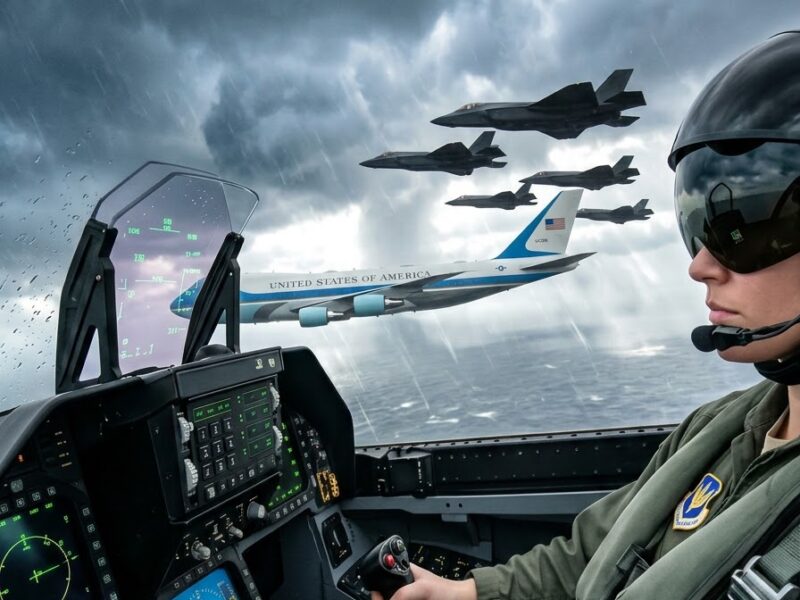
The moment I was dragged away from Air Force One at Andrews Air Force Base, the President’s chief of security called me a disgraced pilot and ordered me to stand down
The rain at Andrews Air Force Base did not merely fall; it slammed against the tarmac in heavy, suffocating sheets that smelled of jet fuel and ozone. Beneath the vast, curved belly of Air Force One, the noise was deafening—a double thunder of twin-turbine auxiliary power units and the low, rolling roar of a storm brewing over the Potomac.
I stood in the center of a half-circle of armed Secret Service agents and Air Force Security Forces. Water pooled in the creases of my G-suit, heavy and cold. My hands were held flat at my sides, palms open, every muscle tense with the hard-earned restraint of a fighter pilot who knew that one wrong gesture would trigger a volley of 9mm hollow-points.
Directly in front of me stood Daniel Cross. As the Chief of Presidential Security, Cross was a man whose entire existence was built on absolute control. Right now, he was losing it, though his tailored, rain-slicked overcoat and rock-hard posture tried to hide the fact.
“Step away from the ladder, Captain Hayes,” Cross barked, his voice straining against the rain and the jet noise. “You’ve been officially relieved of flight status as of 0600 hours. You are trespassing on a restricted flight line during a Tier-One defense alert. Stand down!”
“Daniel, listen to me!” I shouted back, stepping forward just an inch before two guards raised their M4 carbines toward my chest. “Check the primary radar feed on the ground control terminal! Not the filtered NORAD feed—the raw phased-array track from the Raytheon grid on the south perimeter. There are six bogey tracks coming out of the soup over the Delmarva Peninsula!”
Cross gave a cold, bitter laugh, though his eyes darted nervously toward his wrist communicator. “Your career ended three years ago over the Black Sea, Maya. You’re suffering from operational paranoia. Command already checked the primary feeds. It’s an atmospheric ghost—temperature inversion reflecting off the low cloud ceiling.”
“A ghost doesn’t fly at Mach 1.2 with an active radar cross-section of zero point zero two meters!” I yelled. “They are running dark! No transponders, no TACAN emissions!”
My encrypted combat radio—the small, modified tactical receiver I had kept tucked inside my flight jacket against every Air Force regulation in the book—crackled against my collarbone. The voice that came through was clipped, sharp, and laced with static.
“Falcon One, this is Track Lead. Multiple hostile contacts approaching from the northeast. Vector zero-four-zero, speed six-hundred-eighty knots. Altitude dropping fast.”
My blood ran instantly cold. I stared at Cross. “How many?” I muttered into my lapel mic.
“Six, ma’am,” the voice responded. “They just cleared the outer warning ring. ETA to target coordinates: two minutes.”
I reached out and grabbed Cross by the lapel of his wet coat. The guards surged forward, the clicks of their safety levers releasing sounding like a chorus of breaking bones. Cross froze, startled by the sheer desperation in my grip.
“Get the President off that plane. Now!” I screamed into his face. “Taxi back to Hangar Three! Cover him with the reinforced concrete!”
Cross slapped my hand away, his face twisting in disgust. “You’re finished, Captain. You broke protocol, you stole a secure tactical radio, and now you’re trying to stage a fake crisis to save your ruined reputation. You’re not a hero, Maya. You’re a disgraced washed-out pilot who couldn’t accept that her mistake killed three people.”
The words hit like a physical strike, but I couldn’t afford the luxury of pain. I looked up at the sky above the airfield. The clouds were bruised, purple, and hanging low at barely eight hundred feet.
Somewhere up in that gray abyss, six aircraft were dropping through the cloud deck.
I didn’t need a radar screen to visualize what they were doing. The tactical geometry was already burning behind my eyelids. They weren’t coming in a standard line-abreast attack formation. They weren’t flying a delta wedge or a trail sweep. They were executing a complex, intersecting pincers vector—a six-ship inverted umbrella designed to cut off every evasive climb angle, every low-altitude breakout vector, and every chaff-flare deployment arc an illuminated target like Boeing VC-25 could attempt.
It was an impossible formation for standard air forces. It required instantaneous, sub-millisecond data-link synchronization between six independent flight computers. It was designed to force a high-value target to stay grounded or be instantly destroyed the moment its tires left the tarmac.
I had seen that exact formation geometry only once before. Three years ago, in a classified subterranean simulator at Groom Lake. I hadn’t just seen it. I had written the algorithmic targeting flight parameters for it.
It was the signature maneuver of the 104th Aggressor Squadron—the “Black Ghost” unit. A squadron that had been officially wiped from the Pentagon’s rolls, its assets scrapped, its pilots buried or imprisoned after a disastrous, highly classified engagement off the coast of Crimea.
A squadron I used to command.
“Connect me to the President’s pilot,” I demanded, stepping toward the mobile command terminal mounted on the back of a security Humvee parked twenty feet away. “Connect me to Colonel Vance right now!”
Cross stepped into my path, pulling a black Sig Sauer P322 from his holster and pointing it directly at my forehead. “Touch that console, Maya, and I will end you right here on the concrete. That’s an order.”
Before I could answer, a high-pitched, warbling alarm erupted from the Humvee’s interior speakers. A red light began to strobe against the wet asphalt, painting Cross’s pale face in vivid crimson.
A young Air Force sergeant sitting at the terminal turned around, his eyes wide with absolute horror. “Sir! NORAD track confirmation! We have a missile lock! Multiple painting radars just went active!”
The air around us seemed to freeze. The heavy rain felt suspended in time. Cross’s arm trembled slightly, the barrel of his pistol wavering.
“What?” Cross stammered, his authority evaporating in an instant. “Where are they?”
“They just broke cloud cover!” the sergeant screamed. “Six contacts! They’re inside the perimeter!”
I didn’t wait for Cross’s permission. I ducked beneath his raised gun arm, slammed my shoulder into his chest to throw him off balance, and lunged for the command terminal console. The security guards were too stunned by the blaring threat alarms to shoot.
I smashed my hands onto the mechanical keyboard, clearing the filtered security interface and dropping the system into raw military telemetry mode. The tactical screen illuminated my face with green and red vector lines.
Six crimson triangles were converging on Andrews Air Force Base. They were flying stripped-down, matte-black Su-35 Flanker variants—aircraft that had no business existing in American airspace without scrambling half the Atlantic Fleet’s interceptors.
“They aren’t firing,” I muttered, my eyes scanning the telemetry data streams cascading down the margin of the screen.
“What do you mean they aren’t firing?!” Cross yelled, stumbling up beside me and grabbing the edge of the screen. “The lock warning is blaring!”
“Look at the emitter signatures!” I pointed to the bottom rail of the monitor. “They’re using continuous-wave illumination, but their ordnance bay doors are closed. They aren’t tracking Air Force One to shoot it down. They’re using their radar arrays as a synchronized telemetry net. They’re painting the aircraft… waiting for an external trigger.”
“A trigger from where?” Cross asked, his voice barely a whisper now.
“From the ground,” I said, my teeth clenched so hard my jaw burned. “They aren’t executing an autonomous strike. They’re executing a ground-commanded execution. Someone right here at Andrews is broadcasting a localized target-acquisition key.”
My eyes darted around the illuminated flight line. Dozens of ground crew members, Secret Service agents, fuel technicians, and military police were running in blind panic, seeking cover behind tractors and concrete blast walls.
Suddenly, my private tactical radio hissed with heavy, non-linear distortion. The audio was cracked through an old-style military scrambler, but the voice was distinct—low, slow, and horribly familiar.
“Captain Hayes,” the distorted voice whispered directly into my ear. “If you want the Commander-in-Chief to live through the next two minutes, trust no one wearing a presidential security badge.”
I snapped my head toward Cross.
He wasn’t looking at the sky. He wasn’t looking at the incoming jets. His left hand was slipping into his inner jacket pocket, pulling out a heavy, hardened tactical satellite transmitter with a bright yellow toggle switch on its face.
At that exact moment, the four giant Pratt & Whitney engines of Air Force One roared into a sudden, deafening takeoff test cycle. The massive jet began to tremble on its shocks, its emergency stairwells retracting automatically into the fuselage.
On the terminal screen, a glowing gold pop-up window bypassed all security walls, overriding the base defense network.
AUTHORIZATION ACCEPTED: HAYES PROTOCOL.
INITIATING TERMINAL GUIDANCE VECTOR.
CLEARANCE CODE: FENRIR-NINE-ZERO.
My breath caught in my throat. My personal flight clearance ID. My private command override key from three years ago—a code that was supposed to have been purged from the Defense Information Systems Agency mainframes the day I was court-martialed.
I looked up from the screen just as the low cloud deck split open directly above the runway. Six jet engines shrieked in unison, a sound that tore through the air like screaming metal, as six pitch-black fighters plummeted out of the gray clouds, their twin tails cutting through the fog like fins through water.
I stared at Cross, my eyes wide with a horrific realization. “Cross… what did you do?”
Cross looked at the satellite device in his hand, then up at me, his eyes filled with a terrifying mixture of tears and cold, fanatic resolve.
“Your squadron was never disbanded, Captain,” he whispered, his voice trembling against the roar of the descending jets. “They never buried them. They were just waiting for you to come back and lead them home.”
The roar of twelve Saturn AL-31 turbofan engines passing eight hundred feet above the tarmac was enough to shatter the safety glass along the hangar bay walls. Rain turned to fine mist as the sheer thermal exhaust swept over the concrete, bringing with it the acrid stench of burned kerosene and unspent jet fuel.
The six black fighters didn’t pull up. They flared their airbrakes simultaneously, locking themselves into a hovering, high-alpha stance that defied aerodynamics, boxing in the presidential aircraft from three distinct headings. They were so close I could see the dark tinted visors of the pilots in the cockpits—pilots who flew with the cold, mechanical precision of ghosts raised from the dead.
“Down! Everyone down!” Cross screamed, but his order was entirely meaningless now.
The ground crew had scattered. The two Secret Service guards who had previously held their rifles on me were on their knees, staring up at the sky in absolute, paralyzed shock.
I grabbed Cross by his lapels, tearing the hardened satellite transmitter out of his trembling fingers before he could press the toggle switch. He didn’t even fight me. He slumped back against the side of the Humvee, staring at the sky like a man who had just seen a demon step out of a church.
“Talk to me, Daniel!” I roared, slamming the satellite box against the edge of the tactical terminal. “Who gave you this transmitter? Who activated the Hayes Protocol?!”
“You don’t understand, Maya…” Cross choked out, his eyes glassy, wet with rain and fear. “After the Black Sea incident… the Department of Defense didn’t scrap the project. They couldn’t! The synthetic neural-link flight interface you built—it worked too well. They couldn’t let the Russians or the Chinese get it, and they couldn’t afford to burn two billion dollars in black-budget research!”
“We lost three pilots in that test flight!” I screamed, shaking him hard enough to rattle his head against the steel body of the vehicle. “Marcus, Miller, and Vance! Their planes disintegrated in mid-air because the control algorithm suffered a phase-lock loop! I watched their telemetry flatline!”
“They didn’t die, Maya!” Cross yelled back, a sudden, wild desperation breaking through his voice. “The egress pods worked! The military faked the crash debris! They pulled them out of the water, wiped their service records, and moved them to a subterranean facility in Sector 4 of the Nevada Test Range! They’ve been flying under black ops directives for three years! They’ve been living in the dark, waiting for the code to be completed!”
My mind reeled. Marcus? Miller? My wingmen. The men whose letters I had written to their widows. The men whose names were etched into my soul as my greatest failure. They were alive?
I looked up at the lead Su-35—tail code Ghost-01—hovering less than five hundred yards away over the main taxiway. The aircraft dipped its nose slightly, pointing its vectoring nozzles directly at the cockpit of Air Force One.
The radio on my chest buzzed again. The voice was clearer now, devoid of the synthetic distortion. It was a voice I had heard in my dreams every night for three long years.
“Maya… is that you?”
My heart slammed against my ribs so hard I couldn’t breathe. “Marcus?”
“You shouldn’t have come to Andrews today, Captain,” Marcus’s voice came through the speaker, low, exhausted, and devoid of human warmth. “This isn’t a rescue mission. It’s an extraction. We’re taking the President, and we’re taking the flight core.”
“Marcus, listen to me!” I grabbed my lapel mic, stepping out into the open rain, fully visible to the six black jets surrounding the tarmac. “You’re being manipulated! Cross has a ground trigger! The Hayes Protocol isn’t a recovery sequence—it’s a self-destruct command! The system you’re linked into was designed with an auto-purge safety loop! If you execute the ground-link capture, the neural feedback will fry your flight computers and detonate your primary fuel tanks!”
Silence stretched across the radio frequency for three agonizing seconds. Up in the sky, Ghost-01 rocked its wings slightly—a subtle, instinctual gesture I recognized instantly. Marcus was hesitating.
“He’s lying to you, Marcus!” another voice broke through the channel—sharper, angrier. It was Vance, my old tactical officer. “She abandoned us! She walked away from the program while we were locked in subterranean bunkers for thirty-six months! She’s working with the ground staff now! Execute the lock!”
“Vance, no!” I screamed.
On the terminal screen, the status lines flipped from amber to bright, flashing white.
SYNTHETIC NEURAL LINK: ESTABLISHED.
OVERRIDE CONTROL: AIR FORCE ONE.
COCKPIT AVIONICS: LOCKED OUT.
Inside Air Force One, the lights suddenly flickered and died. The massive airliner sat completely dark on the taxiway, its engine hum dropping to a low, dying whine as the black jets’ remote override system seized control of its fly-by-wire flight computers. The President, his cabinet, and the aircrew were now completely trapped inside a three-hundred-ton steel coffin, controlled entirely by six rogue fighters hovering in the storm overhead.
“They’ve got the plane,” the young sergeant at the console gasped, his hands flying across his keyboard in a frantic attempt to break the override. “Captain, they’re linking Air Force One’s autopilot to Ghost-01’s lead computer! They’re going to fly it out of here under remote control!”
“They can’t,” I said, my teeth grit so hard my mouth tasted like iron. “Not if I’m in the air.”
I turned around and looked down the service taxiway. Parked outside Hangar Four, sheltered beneath a temporary steel canopy, was an F-22A Raptor. It was the base’s alert interceptor, fully fueled, armed with live AIM-120D AMRAAMs, its engine covers off, waiting for a pilot who had been ordered to stand down.
“Maya, don’t!” Cross yelled from the ground, reaching out to grab my leg. “If you take that bird, defense command will classify you as a hostile combatant! They’ll scramble the entire East Coast air defense array against you!”
I kicked his hand away, snatched my flight helmet from the passenger seat of the Humvee, and started sprinting toward the F-22.
“Let them scramble,” I muttered into the wet wind.
Behind me, the sky roared as Ghost-01 began to pull up, its remote umbilical line pulling the dead, dark shell of Air Force One into motion down the rain-slicked runway behind it.
I sprinted across fifty yards of slick, oil-stained concrete, my flight boots splashing through ankle-deep puddles. The world narrowed down to the gray composite skin of the Raptor, the open canopy, and the high-pitched whine of the pre-flight auxiliary power unit that the ground crew had left running during the initial alert.
I grabbed the ladder rungs, pulled myself up into the cockpit in three violent leaps, and slammed my body into the ACES IV ejection seat. I didn’t bother with the harness locks for the shoulders; I snapped the waist buckle shut, jammed my helmet over my ears, and slapped the canopy closed toggle.
The heavy glass bubble came down, sealing out the deafening roar of the storm and replacing it with the sharp, rhythmic breathing of my own lungs against the oxygen mask.
I smashed my left hand onto the master engine start switches.
“Come on, baby,” I whispered, flicking the twin Pratt & Whitney F119 turbines into active fuel feed. “Ignite.”
The dual engines behind me didn’t just start; they erupted with a deep, chest-cavitating howl that shook the entire frame of the jet. The digital Multi-Function Displays flashed to life, displaying a sea of red system warnings across the dark glass.
UNAUTHORIZED FLIGHT INITIALIZATION.
SECURITY OVERRIDE REQUIRED.
I ripped open the access panel beneath the main throttle quadrant, exposed the bare copper wiring of the emergency tactical override, and jammed my dog tags directly across the diagnostic terminals.
Spark. A smell of ozone.
The warning screens vanished, replaced by the cool, serene blue of an active combat system.
WELCOME, CAPTAIN HAYES.
WEAPONS STATUS: HOT.
I shoved the dual throttles straight into full military power, released the wheel brakes, and felt thirty-five thousand pounds of thrust slam into my spine as the Raptor leaped forward out of the hangar canopy and directly onto the storm-drenched runway.
The F-22 screamed down Taxiway Charlie, spray from its nose gear throwing a thirty-foot wall of water behind it. I didn’t wait to reach the proper takeoff rotation speed. I yanked the flight stick back into my stomach at barely one hundred and forty knots, relying on the thrust-vectoring nozzles of the twin engines to literally tear the jet off the ground.
The Raptor pitched up at a brutal seventy-degree angle, its sharp stealth edges cutting through the rain like a razor blade. Within three seconds, the flooded tarmac of Andrews Air Force Base vanished beneath a dense, swirling blanket of slate-gray clouds.
“Radar operational,” I grunted through my oxygen mask, fighting the heavy G-forces as I leveled the aircraft at four thousand feet, right at the ceiling of the local cloud layer.
My main display illuminated with tactical tracks.
Directly ahead of me, flying in a tight, geometric box, were the six black Su-35s. Suspended in the exact mathematical center of their formation was Air Force One. The massive Boeing 747 was flying silently, its lights extinguished, its control surfaces moving in unnerving, robotic unison with Ghost-01’s lead movements.
They were holding a steady vector toward the northeast, climbing rapidly toward the dark expanse of the Atlantic Ocean.
“Ghost Flight, this is Falcon One,” I broadcasted over the open tactical frequency, my voice dropping into the flat, monotone cadence of a combat commander. “Disengage the remote link immediately and return to base. You are escorting a compromised target into an active kill zone.”
“Maya… stay out of this,” Marcus’s voice returned. He sounded strained now, his breathing heavy over the open channel. “You don’t know the whole story. The President isn’t the victim here. He signed the executive order that buried our squadron! He signed the authorization to use our neural link data for autonomous combat drones! We aren’t killing him—we’re bringing him to the senate tribunal in Europe to expose the entire shadow program!”
I shook my head inside my helmet, my eyes darting between the radar tracks and the infrared targeting camera mounted on my nose cone.
“Marcus, look at your secondary data bus!” I yelled, pulling my stick to the left to bank into an intercept arc behind Ghost-06, the rearmost fighter in their formation. “Look at the telemetry string coming out of your own avionics! Cross didn’t give you a transfer code! He gave you an execution loop! The moment you cross the three-mile territorial water line, the automated defense grid at Naval Air Station Patuxent River is programmed to fire a salvo of SM-6 missiles at your formation! They aren’t going to let you reach Europe! They’re using you to sink Air Force One over deep water so the evidence is destroyed forever!”
A sudden, sharp silence fell over the radio line.
On my radar display, Ghost-06—flown by my old wingman Miller—swerved slightly out of formation.
“Marcus…” Miller’s voice crackled, laced with sudden panic. “She’s right. I’m looking at the hidden subroutine in my flight guidance bus. There’s an unchangeable target lock hardcoded to geographic coordinates seventy-five miles off the coast. It’s an automated fire-control trigger!”
“Ignore it!” Vance’s voice cut in, fierce and fanatic. “She’s spoofing your signal, Miller! Drive the formation higher! Get us into the stratosphere before NORAD can lock on!”
“He’s not spoofing you, Miller!” I roared, pushing my throttles straight into full afterburner.
The F-22 accelerated with terrifying violently, punching through the sound barrier with a sharp CRACK that shook the cockpit frame. I closed the distance on Ghost-06 in seconds, pulling up less than fifty feet behind his left wingtip.
“Look out your canopy, Miller!” I shouted. “Look at me! Have I ever lied to you in the sky?”
I looked to my right. Through the heavy rain and grey mist, the canopy of Ghost-06 was visible. The pilot inside turned his head. I saw the reflective silver mask, the black helmet, and then—slowly—Miller raised his gloved left hand and gave me a sharp, two-finger salute.
“She’s telling the truth, Marcus,” Miller said softly over the radio. “I’m breaking the link.”
“Miller, don’t you dare!” Vance screamed.
“I’m out,” Miller said.
Ghost-06 rolled hard to the left, pulling away from the formation, its remote umbilical control line to Air Force One snapping cleanly as its onboard computers disengaged from the master link.
Instantaneously, the stability of the entire formation fractured.
Without the balancing control of Ghost-06, the synthetic neural link driving Air Force One shuddered. The giant presidential jet rocked violently in the turbulence, its left wing dipping dangerously low toward a spin.
“Warning! Flight system instability!” the voice of my central computer warned in my ears.
“Vance, re-balance the array!” Marcus ordered, his voice echoing with sheer desperation. “We’re losing control of the transport!”
“I can’t re-balance it while she’s in our blind spot!” Vance snarled.
Suddenly, Ghost-03—Vance’s black Su-35—peeled off from the top of the formation, its thrust-vectoring nozzles flipping the nose of the heavy fighter around in a terrifying, ninety-degree instant turn. His broad radar nose pointed directly at my cockpit.
MISSILE LOCK! MISSILE LOCK! my warning system blared, screaming in a high-pitched continuous tone.
“Vance, don’t fire!” Marcus screamed over the radio. “That’s Maya!”
“She’s a threat to the mission!” Vance shouted back. “Die in the dark, Captain!”
A bright red flash ignited beneath Vance’s right wing. An R-73 short-range heat-seeking missile detached from its pylon, its solid rocket motor blooming into a blinding ball of white flame as it streaked directly toward my cockpit.
The world compressed into milliseconds.
I didn’t think; my body reacted with the deep, instinctual muscle memory forged through thousands of hours of dogfighting.
I slammed my left foot onto the rudder pedal, shoved the flight stick into the forward right quadrant, and slapped the flare dispenser button twice.
The F-22 snapped into a violent, negative-G barrel roll. A cloud of burning magnesium flares exploded from the tail dispenser, painting the grey storm sky with blinding bursts of yellow light.
The R-73 missile slammed directly into the center of the flare cluster fifty feet behind my tail, detonating in a massive ball of orange fire. The shockwave slammed into the Raptor’s tail control surfaces like a sledgehammer, pitching my nose down into a violent, tumbling spin toward the roaring ocean below.
CAUTION! FLIGHT CONTROL DEGRADATION!
HYDRAULIC SYSTEM TWO: PRESSURE DROPPING.
“Maya!” Marcus’s voice cried out on the open radio, devoid of any military coldness now—just pure, unadulterated terror for his former commander.
I was falling through four thousand feet, three thousand feet, spinning rapidly through dense cloud cover while the dark gray water of the Chesapeake Bay rushed up to meet me. The artificial horizon on my primary display was spinning like a roulette wheel.
“Focus, Maya,” I grunted against the crushing G-forces that were trying to force the blood out of my brain. “Trust the bird.”
I neutralized the rudder pedals, pulled the throttles back to idle to stop the aerodynamic stall, and slammed the vector control override switch. The F-22’s computer, recognizing the extreme loss of control, used its thrust-vectoring tail nozzles to bite into the rushing air, forcing the nose back up toward the sky.
I pulled out of the dive at barely four hundred feet above the white-capped ocean waves, the salt spray coating my canopy view.
“I’m still here, Vance,” I whispered through my mask, my breath coming in ragged, painful gasps.
I shoved the throttles back to full afterburner, the twin engines roaring as I rocketed back up through the cloud layer like an arrow shot from the deep.
When I broke through the cloud ceiling at six thousand feet, the situation had deteriorated into pure chaos.
Vance’s jet was flying aggressively, trying to force Miller’s Ghost-06 down into the sea, while Marcus and the remaining two jets were desperately trying to maintain the neural lock on Air Force One. But the heavy airliner was out of control. Its right outboard engine was spewing thick black smoke—a result of the violent aerodynamic drag caused by the unstable remote link.
Air Force One was losing altitude, heading on a slow, fatal trajectory toward the rocky coast of Delmarva.
“Marcus!” I called out, bringing my F-22 up alongside Ghost-01. “The link is tearing the airframe apart! Air Force One’s tail structure can’t take the synthetic control inputs! If you don’t release her in ten seconds, the vertical stabilizer is going to snap off and everyone on board will die!”
“I can’t release her!” Marcus cried out, his voice cracked with emotion. “The Hayes Protocol locked my system controls! Cross programmed a fail-safe! Once initiated, the link cannot be severed from the air! It can only be disengaged from the primary ground console… or if the lead ship is destroyed!”
My hands froze on the flight stick.
Or if the lead ship is destroyed.
I looked across the narrow gap of sky at Ghost-01. Marcus was sitting in that cockpit. The pilot who had saved my life over Syria. The man who had taken the blame for the Black Sea failure so that I wouldn’t face a military court-martial alone.
“Marcus…” I whispered, my voice breaking.
“Do it, Maya,” Marcus said, his voice suddenly turning remarkably calm, dropping into the quiet cadence of a soldier who had finally reached the end of his road. “I’ve been a ghost for three years. I died over the Black Sea anyway. Don’t let them take down the country with us.”
“There has to be another way!” I yelled, searching my weapon selection screen frantically for a targeting mode that could disable his avionics without blowing his aircraft out of the sky.
“There isn’t!” Marcus shouted back. “Vance is coming up behind you! He’s going to take you out, and then the automated defense grid will finish all of us! Shoot me down, Maya! That’s an order from your wingman!”
On my radar warning receiver, a new threat emitter flared to life.
WARNING: SURFACE-TO-AIR MISSILE RADAR ACTIVE.
PATUXENT RIVER NAVAL COMPLEX HAS LOCKED ON.
“They’ve initiated the kill grid,” Miller’s voice echoed over the channel. “Two minutes to impact.”
I looked at Marcus’s jet. Then I looked down at my weapons selector panel.
I didn’t select the AIM-120D radar-guided missile. I selected the 20mm M61A2 Vulcan cannon—a mechanical gun that relied on pure pilot eyesight and manual lead-angle estimation.
“Marcus…” I choked out, tears finally breaking past my eyelids and stinging my eyes behind my visor. “Eject the moment I break your wing.”
“I can’t eject, Captain,” Marcus replied softly, giving a painful, quiet smile behind his mask that I could feel through the radio waves. “They welded the canopy manual release shut before we took off from Sector 4. They never intended for us to come back alive.”
The world seemed to stop moving.
The rain, the shrieking engines, the blaring missile warnings from Patuxent River—everything dissolved into a silent, icy void inside my mind.
They had welded the canopy shut.
My squadron—my pilots—had been turned into suicide units, locked inside flying coffins, driven by an algorithmic ghost code that I had built with my own hands. They weren’t traitors. They were prisoners, sacrificed on the altar of a shadow military program that wanted to hide its greatest sins beneath three hundred feet of ocean water.
“No,” I said. My voice wasn’t a whisper anymore. It was cold iron. “Nobody else dies today.”
“Maya, what are you doing?!” Marcus yelled.
I didn’t answer him over the radio. I pulled the F-22’s stick back hard, slamming the rudder down, and flipped my fighter into an inverted position directly above Ghost-01.
I was flying upside down, barely fifteen feet above Marcus’s canopy. I could look directly down through my glass canopy into his eyes.
“Miller! Vance!” I roared over the emergency command channel. “Listen to me right now! Cross set you up! The satellite box he carried on the ground didn’t just have an execution loop—it had an emergency master reset switch designed to flush the neural bus! If I can smash his transceiver unit using an electromagnetic discharge from my radar array at point-blank range, it will force your flight computers into safe recovery mode!”
“That’s impossible!” Vance screamed over the noise. “An APG-77 radar pulse at that proximity will scorch your own main computer board! You’ll lose all avionics! You’ll be flying blind!”
“Then I fly blind!” I screamed.
I rolled the F-22 right side up, pitching down until my radome was pointing directly at the dorsal spine of Marcus’s Su-35—right where his primary neural-link receiver array was mounted beneath the stealth skin.
“Maya, don’t!” Marcus pleaded. “If your radar burns out over the bay, you won’t be able to pull out of the dive!”
“Hold your stick steady, Marcus!” I ordered, my eyes locked on the target crosshairs illuminated on my heads-up display. “That’s a direct order, Lieutenant!”
I flipped the master radar switch to FULL UNRESTRICTED EMISSION—a high-energy focused microwave burst mode designed for offensive electronic warfare.
WARNING: EXTREME THERMAL OVERLOAD IMMINENT.
AVIONICS BUS TEMPERATURE: CRITICAL.
“Firing pulse now!” I yelled.
I slammed the radar fire button.
A blinding spike of invisible electromagnetic energy erupted from the nose of my Raptor, hammering into the spine of Marcus’s jet from less than ten yards away. Sparks burst from the composite skin of Ghost-01. The black jet shuddered violently as its internal avionics racks melted under the raw microwave heat.
Instantaneously, the glowing golden tether linking Ghost-01 to Air Force One snapped.
The massive Boeing 747 shuddered, its onboard emergency systems auto-rebooting as the external neural link severed. The lights inside the presidential aircraft flashed back to life, its four giant engines screaming back to full manual throttle control as Colonel Vance—the real human pilot inside the cockpit—wrested control back from the dead code.
“We have manual control!” Colonel Vance’s voice erupted over the standard air traffic frequency, clear and powerful. “Air Force One is under pilot command! Executing emergency climb to ten thousand feet!”
But my victory lasted less than a fraction of a second.
The extreme feedback from the electromagnetic burst travelled backward through my own radar array.
BOOM!
A bright flash of purple light exploded behind my instrument panel. Every display in my cockpit flipped to absolute darkness. The digital horizon vanished. The engine status screens died. The electric flight control systems went completely dead, locking my flight surfaces in a static, neutral position.
The F-22 dropped like a thirty-thousand-pound rock, plunging straight down through the dark clouds toward the raging ocean below.
“Maya!” Marcus’s voice echoed weakly through my battery-powered backup radio headset. “Maya, respond! Pull up!”
I couldn’t pull up. The stick was dead weight in my hands, locked tight by hydraulic pressure loss. Through the rain-streaked canopy, I saw the black, churning waters of the Chesapeake Bay rising up to meet me at four hundred miles per hour.
Three hundred feet.
Two hundred feet.
I reached down between my knees, grabbing the yellow-and-black striped loops of the ACES IV mechanical ejection handle. I looked up at the grey sky one last time, seeing the sun barely breaking through a tear in the storm clouds high above.
“Flight’s over, Maya,” I whispered to myself.
I yanked the ejection handles upward with every ounce of strength left in my arms.
The canopy explosive bolts detonated with a deafening bang. The canopy blew away into the slipstream, instantly filling the cockpit with a two-hundred-knot wall of freezing rain and wind. A split second later, the rocket motor beneath my seat ignited, blasting me out of the dying aircraft in a blinding wave of heat and acceleration.
My jet slammed into the ocean beneath me, exploding in a massive geyser of water and black fuel smoke.
I floated down beneath the canopy of my parachute, drifting slowly through the cold rain toward the dark sea.
High above me, through the breaking storm clouds, I watched Air Force One climb safely toward the clear blue sky, flanked on either side by three black fighters—Marcus, Miller, and Vance—flying in a perfect, peaceful escort formation, turning away from the coast, heading toward a military base where the truth would finally be told.
My feet hit the freezing salt water of the bay.
As the waves closed over my shoulders and my emergency flotation vest deployed, pushing my head back above the surface, I heard the faint, distant hum of incoming Coast Guard rescue helicopters cutting through the rain.
I closed my eyes, took a deep breath of the wet, salty air, and smiled.
The ghosts were finally home.
The end.









