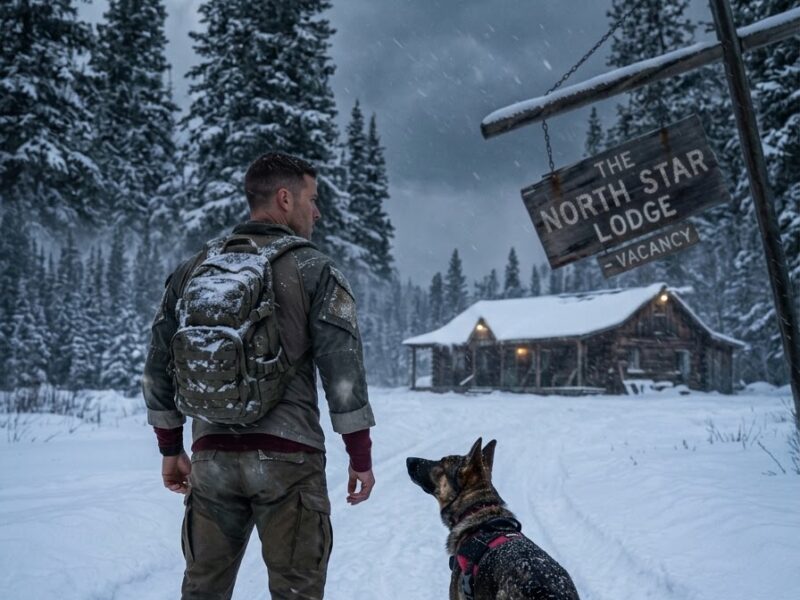
The moment I stood outside a ruined lodge in Montana while the bank manager laughed and called me a washed-up Navy SEAL
The winter wind howling down through the Bitterroot Valley felt remarkably similar to the icy gales I’d survived during high-altitude operations in the Hindu Kush. It was brutal, indifferent, and carried the quiet promise of death if you stopped moving for too long. I pulled the collar of my worn canvas jacket up around my ears, resting my palm on the solid, warm flank of Ranger. My five-year-old German Shepherd didn’t flinch against the cold. He was a retired multi-purpose canine from my old team, bearing the same psychological and physical scars of four combat deployments that I did. Together, we were a pair of broken veterans looking for a place where the noise of the world couldn’t reach us.
Before us stood the Blackwood Lodge. Or what was left of it.
The structure sat on thirty acres of dense pine forest six miles outside a small Montana town that didn’t even bother putting its population on the highway sign. Eight years ago, a catastrophic fire had gutted the east wing, leaving behind a charred skeleton of heavy timber. The main hall’s roof sagged like a broken spine, its windows shattered, and the grand stone porch had collapsed into a mess of rotten wood and overgrown briars. It smelled of damp ash, wet pine, and long-abandoned memories.
“It’s a real masterpiece, isn’t it, Commander?”
The voice belonged to Arthur Vance, the senior loan officer from Bitterroot Commercial Bank. He was leaning against the side of his pristine, climate-controlled luxury SUV, wearing a tailored wool coat that cost more than my monthly disability check. He pulled a heavy ring of brass keys from his pocket and tossed them at me. I caught them out of instinct.
“You dropped the absolute last dime of your Navy pension and savings into a pile of burnt driftwood, Vance,” the banker laughed, a high, mocking sound that rattled through the empty trees. “I told you at the desk, and I’ll tell you out here: you’re a washed-up SEAL who thinks hard work can fix anything. The bank was glad to dump this tax liability on a naive veteran. You’ll be broke, frozen, or bankrupt by first snowfall. You’re going to lose everything.”
I didn’t answer him. In the Special Warfare Community, you quickly learn that people who talk the loudest usually have the least to say. I didn’t care about Vance, his condescension, or the bank’s opinion. I just wanted peace. I wanted a perimeter I could defend and a project that didn’t involve clearing rooms or counting body bags.
Vance shook his head, pulled his coat tighter, and climbed back into his vehicle. The heavy tires kicked up gravel as he sped back toward the highway, leaving Ranger and me in the heavy, suffocating silence of the forest.
“Just you and me, boy,” I murmured, rubbing the gray fur around Ranger’s muzzle.
Instead of exploring the front entrance, Ranger suddenly pulled against his leash. His nostrils flared, picking up a scent that made his entire body lock in absolute operational focus. His ears pinned forward, and his tail went straight. He bolted toward the collapsed section of the front porch—a dangerous lattice of cracked stone and rotten pine beam.
“Ranger, heel!” I commanded.
He ignored me—something he only did when he detected an explosive hazard or an immediate threat during our service years. He dropped to his chest and began violently tearing at the damp dirt and pulverized wood beneath the collapsed overhang. Whining with intense urgency, his heavy paws threw dirt behind him in dark, violent clouds.
“Ranger! Stop!”
I rushed over, crouching beside him in the mud. He wasn’t chasing a rodent. He was digging with a calculated, desperate rhythm. I used my tactical knife to pry away two heavy, charred joists, clearing room for him. His claws struck something solid with a dull metallic clack.
I pulled the dog back and reached into the hole. My fingers wrapped around a cold, heavy object wrapped in oil-soaked canvas. I yanked it out. It was a heavy steel ammunition box, locked tight with a rusty padlocked clasp. The metal was pitted with age, but the waterproof rubber seal had kept the interior completely dry.
Using the flat head of a heavy crowbar from my truck, I snapped the degraded padlock. Inside lay three items: a faded black-and-white photograph of a young woman standing in front of the lodge, a heavy brass key with intricate grooves, and a small, leather-bound notebook with mold growing along its spine.
I opened the notebook. The first page contained a single line of handwritten text, scrawled in black ink with frantic, heavy pressure:
Don’t let them sell the lodge. If they dig beneath the foundation, they will find what we hid. Trust the man who comes with the dog.
My heart took a slow, heavy drop in my chest. The handwriting belonged to Thomas Reed.
According to the county property records I had reviewed before buying the land, Thomas Reed was a decorated Vietnam veteran who built the Blackwood Lodge in the late 1970s. Eight years ago—the exact same night the eastern wing caught fire—Reed had disappeared without a trace. Local authorities had ruled it a voluntary abandonment, claiming the old man had suffered a mental breakdown, set fire to his own property, and walked into the wilderness to die. The bank had seized the land shortly after.
Standing there in the bitter Montana chill, holding a box buried deep beneath a burned structural support, I knew the official police report was a complete lie. You don’t bury a warning in a sealed ammo box if you’re planning on walking into the woods to die.
I spent the next three hours securing the perimeter. I boarded up the ground-floor window frames with heavy plywood and used a portable generator to power up three high-lumen halogen floodlights inside the main hall. The interior of the lodge was terrifyingly vast. High vaulted ceilings supported by blackened cedar trunks stretched up into the shadow. Water dripped rhythmically from the sagging ceiling into rusted buckets I’d set out.
Ranger moved with a slow, tactical sweep through every room. He checked the Corners, sniffed the baseboards, and kept his head low. When we reached the stone fireplace at the center of the great room—a massive structure built from local river rock—Ranger stopped dead in his tracks.
He dropped his head to the hearth, his nose pressed against a crack in the mortar where the stone met the oak floorboards. He let out a low, vibrating growl from deep within his chest.
“Find something else, boy?”
I knelt beside him. The stonework looked solid, but when I pressed my thumb hard against a decorative iron plate mounted into the chimney mantel, I felt a mechanical give. A soft, metallic click echoed from within the wall.
A section of the floorboards three feet to the left dropped two inches and slid silently backward, revealing a narrow, dark opening beneath the stone foundation. Cold, stagnant air poured out of the hole, smelling faintly of old paper, engine oil, and iron.
I pulled my tactical flashlight from my belt, clicked the high-beam on, and unholstered my sidearm. “Stay close, Ranger.”
We descended a set of steep, rough-hewn wooden steps that led far deeper beneath the lodge than any standard basement would go. The beam of my light sliced through dense cobwebs, revealing a hidden subterranean bunker constructed from reinforced concrete walls and steel support pillars.
This wasn’t a root cellar. It was a command center.
Desks lined the far wall, covered in dusty computer monitors from the early 2000s, landline wiretapping gear, and stack upon stack of manila folders labeled with property plot numbers, county tax registry codes, and the names of local politicians. On the central table lay a cassette recorder connected to a heavy reel-to-reel tape system.
I approached the table, my boots kicking up thick dust. Beside the recorder sat a fresh cassette tape with a handwritten label: PLAY ME FIRST.
I reached out, pressed the heavy mechanical play button, and waited. The machine hummed to life, static hissed from a small speaker, and then a raspy, tired voice filled the cold concrete room.
“If you are listening to this,” Thomas Reed’s recorded voice whispered through the static, “then I am either dead or hiding deep in the mountains where they can never find me. They burned my home because I refused to sign over the mineral rights and the valley access routes. Vance and the county syndicate think they bought my silence. They don’t know I kept the original survey maps. They don’t know about the bodies buried under the north timber lot. If you are the man with the dog… God help you. Because the moment you turned on the lights in this lodge, they knew you were here.”
Before the recording could finish, Ranger spun around toward the stairs, his upper lip pulling back to reveal his teeth in a deadly, silent snarl.
Above us, through the thick wooden floorboards of the main hall, I heard the crunch of heavy footsteps stepping onto broken glass.
I didn’t need to give Ranger a command. He knew the drill. He moved into the shadow beneath the basement stairs, his body coiled like a steel spring, completely silent. I clicked off my flashlight, plunged the bunker into total darkness, and pressed my back against the cold concrete wall beside the stairwell.
The sounds from above were deliberate, tactical, and disciplined. These weren’t local teenagers looking for a place to drink, nor was it a bank inspector coming to check up on property damage. The footfalls moved in a mutually supportive two-man element. Soft, measured steps that avoided the creaking floorboards.
“Clear the main hall,” a low, gravelly voice ordered from above. “Check the perimeter. The banker said the veteran’s truck is out front. Find him and make it look like an accidental fall through the weak floorboards.”
“Understood,” a second voice replied. “What about the dog?”
“Kill it on sight.”
A cold, familiar calm settled over my chest. The hyper-vigilance that had defined my decade in the SEAL teams came flooding back, drowning out the ache in my joints and the fatigue in my mind. These men were professionals, sent here to clean up a mistake. They thought they were hunting a broken veteran who was easy prey. They didn’t know they were walking into a prepared kill zone.
I drew my combat knife with my left hand, keeping my sidearm low in my right.
The heavy footsteps moved closer to the fireplace. A beam of bright LED light swept across the upper room, shining down through the open trapdoor. The light cut through the dust, reflecting off the steel walls of the bunker.
“Hey,” the second man called out, standing directly above the hidden stairs. “The hearth is open. There’s a hatch down here.”
“Cover the opening,” the leader commanded. “I’m coming over.”
The shadow of the first man appeared at the top of the stairs. He held a suppressed pistol, extended in a high-ready position. As his lead foot touched the second step, I moved.
I grabbed his forward tactical vest, pulling him violently down the steep stairs with all my weight. He lost his balance, tumbling headfirst down the wooden steps into the darkness. Before he hit the concrete floor, Ranger hit him like a freight train, locking his jaws around the man’s arm and disabling his weapon hand in a second. The man gasped in shock, but before he could scream, I brought the butt of my heavy tactical flashlight down onto his temple, rendering him instantly unconscious.
“Frank?” the voice from above called out, sudden tension bleeding into his tone. “Frank, report!”
I didn’t give him time to process. I seized the fallen man’s suppressed pistol, stepped around the base of the stairs, and fired three fast rounds through the thin wooden steps where I calculated the second man was standing.
A grunt of pain echoed from above, followed by the heavy sound of a body hitting the hardwood floor. I rushed up the stairs, Ranger right on my heels.
The second intruder was down on his knees, clutching his shoulder where a round had shattered his collarbone. His flashlight had fallen onto the floor, illuminating his face. He was wearing tactical gear with no insignia, no identifying patches—a classic private military contractor setup.
I kicked his weapon away, pressing the barrel of my gun firmly against the center of his forehead.
“Who sent you?” I asked, my voice flat, devoid of any anger or heat.
The contractor stared at me, his eyes wide with shock and pain. He recognized the coldness in my eyes—it was the look of a man who had asked questions in far worse places than a ruined house in Montana.
“Vance…” he gasped, struggling for air. “It was Arthur Vance. He said… he said you were just a homeless veteran. He said you were going to discover the vault.”
“What vault?”
“The survey records… in the basement,” the contractor coughed, blood staining his lip. “The bank doesn’t own this land. They forged the deed after Reed disappeared. If the county finds out the real deed is registered under the federal trust… Vance goes to federal prison for thirty years. They’re liquidating the entire valley next week.”
“Where is Thomas Reed?” I demanded, pressing the barrel harder against his skull.
The man swallowed hard, his breath ragged. “He’s not dead. But if you don’t leave this valley by sunrise… you will be.”
I didn’t waste time. I bound both men with heavy-duty zip ties from my tactical pack, gagged them with duct tape, and dragged them down into the bunker, locking the steel hatch behind them. They weren’t going anywhere, and nobody was coming to rescue them until morning.
I went back down to the command desk, pulled out the leather-bound notebook from the ammo box, and began reading through the pages with relentless focus.
Thomas Reed had laid out everything with surgical precision.
In the late 1990s, Reed had discovered that a massive, untouched aquifer ran beneath the Bitterroot Valley—a water source worth hundreds of millions of dollars to industrial developers and private utility firms. Vance, operating through a shell corporation backed by foreign investors, had systematically forced local ranchers off their land using predatory loans, poisoned livestock, and mysterious fires.
Reed had fought back. He had gathered court-admissible evidence—wiretaps, bank transaction ledgers, forged title transfers—and hid them inside the lodge. When Vance realized Reed couldn’t be bought, he sent an arson crew to burn the lodge down with Reed inside it.
But Reed was a veteran. He had anticipated the attack. He had escaped through an underground emergency tunnel that led half a mile into the wilderness, leaving behind the decoy body of a nameless corpse he’d acquired from a local morgue to cover his escape.
On the last page of the journal, dated eight years prior, Reed had drawn a rough topographical map of the surrounding mountains, marking a remote cabin deep within the Selway-Bitterroot Wilderness.
Beneath the map, he had written:
If you are reading this, the lodge has been passed to a new keeper. Take the key. Go to the cabin on Signal Ridge. The final piece of the puzzle is there.
I looked down at Ranger, who was watching me with calm, steady eyes.
“Looks like we aren’t done fighting yet, boy,” I said softly.
I packed a heavy ruck with cold-weather gear, ammunition, medical kits, and the leather journal. I left the floodlights running inside the main hall to make it appear from the road as though I were still working on repairs. Then, under the cover of a blinding midnight snowfall, Ranger and I slipped out through the rear exit and vanished into the black timber of the Montana mountains.
The blizzard struck with merciless velocity as we climbed into the high country.
The Selway-Bitterroot Wilderness is some of the most unforgiving terrain in North America. Vertical granite walls, dense old-growth pine forests, and temperatures that drop far below zero without warning. Every step was an exercise in pure survival. My knee, holding a piece of shrapnel from a mortar strike in Helmand, throbbed with a rhythmic, dull agony, but I pushed the pain down into the quiet corner of my mind where I kept all my operational discomfort.
Ranger moved ahead of me like a shadow, his dark fur dusted with snow, his paws picking paths through the deep drifts with instinctive precision.
We marched for four straight hours, navigating by compass and the crude map drawn in Reed’s journal. The trail was long gone, buried beneath six inches of fresh snow. I kept my head down against the biting wind, my eyes constantly scanning the tree line for movement. Vance wasn’t going to rely solely on two contractors. When those men failed to report back, he would mobilize whatever resources his money could buy.
At roughly 0400 hours, Ranger stopped atop a high ridge overlooking a narrow canyon. He raised his snout, tasting the frozen wind.
I crouched beside him, pulling my night-vision monocular from my chest rig and placing it over my eye. The forest bloomed into a bright green landscape of trees, rocks, and falling snow.
Three miles behind us, moving along our backtrail, were four infrared heat signatures.
A heavy tracking team. They had night-vision technology, thermal optics, and were moving at a fast, efficient pace. They had likely brought in professional trackers from out of state.
“They’re relentless,” I muttered, feeling the cold steel of my rifle beneath my glove. “They think this is their mountain.”
I knew I couldn’t outrun them forever in this weather. My body was damaged, and Ranger was tiring under the weight of his own harness. I needed to turn the environment into my weapon.
I led Ranger off the main ridge line, descending into a steep, narrow ravine known as Deadman’s Couloir. The terrain here was a nightmare of fallen logs, loose shale, and unstable snow shelves—a perfect place for an ambush.
I found a dense thicket of spruce trees near a choke point in the canyon. I pulled a spool of high-tensile tripwire from my pack and set two non-lethal distraction traps using flare charges I’d taken from the lodge’s emergency kit. I wasn’t here to execute people if I could avoid it; I was here to secure the truth. But if they forced my hand, I would end them without hesitation.
We waited in the freezing darkness. My breath came in slow, measured plumes of ice.
Twenty minutes later, the tracking team entered the mouth of the couloir.
Through my optics, I saw four men dressed in high-end cold-weather tactical gear. They were strung out in an tactical column, weapons raised, scanning the trees.
The lead tracker paused, stopping just ten feet from my tripwire. He dropped to one knee, looking closely at the disturbed snow where I had deliberately left a heavy footprint as a lure.
“He went this way,” the tracker whispered, his voice picking up through my directional microphone. “He’s getting tired. The stride is uneven. His left leg is dragging.”
“Finish him quickly,” the team leader replied over the radio. “Vance wants the journal destroyed before the county court opens at nine in the morning.”
As the leader stepped forward to join the tracker, his boot caught the hidden tripwire.
BANG!
A blinding white magnesium flare erupted in the tight canyon, turning the dark forest into day and completely blinding their night-vision goggles. Screams of agony echoed through the narrow ravine as the contractors snatched at their helmets, temporary flash-blindness stripping away their situational awareness.
Ranger barked once—a deep, booming war cry—and I opened fire with precise, rapid shots, striking the weapons out of their hands and targeting the rock wall directly above their heads. A cascading shower of heavy stone and snow buried their equipment, pinned two of them beneath a heavy snowslide, and sent the other two scrambling back toward the mouth of the canyon in total panic.
“Move!” I shouted to Ranger.
We didn’t stay to check their condition. We turned and charged up the steep, frozen slope of Signal Ridge, utilizing the chaos to break contact entirely.
By 0630, the sky began to turn a pale, bruised purple as dawn struggled to break through the heavy storm clouds. The wind finally died down, leaving behind a dead, frozen world covered in fresh white powder.
Near the summit of Signal Ridge, hidden beneath the thick boughs of a massive, ancient Douglas fir tree, sat a small, rough-hewn log cabin. It had no electricity, no road access, and no smoke rising from its stone chimney. It looked entirely abandoned, seamlessly blending into the mountain landscape.
I approached the heavy oak door with caution, my rifle raised.
Beside the door frame was a heavy iron lock mechanism with a brass keyhole that matched the key I had recovered from the ammo box beneath the lodge porch eight hours earlier.
I inserted the brass key into the lock. It turned smoothly with a heavy, satisfying mechanical click.
I pushed the door open. The cabin was warm.
Standing in the center of the room, holding a lever-action Winchester rifle aimed directly at my chest, was a man with long gray hair, a weathered face lined with deep scars, and piercing blue eyes that held the unmistakable look of a warrior who had never surrendered.
Beside him sat an aged, blind German Shepherd that raised its head and sniffed the air, letting out a soft whine.
The old man lowered his rifle slowly, his hand trembling slightly as he looked from my face down to Ranger.
“You brought the dog,” Thomas Reed said, his voice like gravel scraping against iron. “I’ve been waiting eight years for you, Commander.”
The inside of Thomas Reed’s cabin was an operational masterpiece.
What appeared from the outside as an abandoned hunter’s shack was, in reality, a high-tech off-grid command post powered by hidden solar panels and a micro-hydro turbine set into a nearby mountain stream. Bank after bank of satellite communication receivers, encrypted hard drives, and legal dossier files covered the walls. Reed had spent eight long years living like a ghost in these mountains, waging a silent, invisible war against the corruption that had stolen his home and ruined his valley.
“Sit down, son,” Reed said, motioning to a heavy wooden table. He walked over to a small cast-iron stove and poured two metal mugs of dark, strong coffee. “Your name is Jack Vance—no relation to that viper Arthur Vance, I hope?”
“Jack Miller,” I corrected, accepting the hot mug. The warmth spread through my frozen fingers like a lifeline. “Former Navy SEAL, Master Chief. Ranger and I bought your property at a county foreclosure auction three weeks ago.”
Reed smiled faintly, a tired, humorless expression. “You didn’t buy a house, Master Chief. You bought a front-line trench. I knew the moment Arthur Vance put that property up for sale, only a man with a military background would be foolish or brave enough to stay after seeing the state of it.”
“Why didn’t you go to the FBI eight years ago, Thomas?” I asked, setting my rifle on the table. “You had enough evidence down in that basement to put Vance and half the county commission in prison for life.”
Reed stood by the window, peering out through a pair of heavy binoculars into the snow-covered valley below.
“Because Vance isn’t the top of the pyramid,” Reed said grimly. “He’s just the local bagman. The syndicate behind the land grabs in Montana extends all the way to a private equity firm in Chicago that specializes in buying up critical water infrastructure across the Western United States. If I had gone to the local authorities back then, the evidence would have vanished from the evidence locker before I made it back to my truck, and I would have ended up with a bullet in the back of my head.”
He walked over to a heavy wall safe, dialed a complex combination, and pulled out an encrypted solid-state hard drive wrapped in a lead-lined pouch.
“This drive contains the complete financial trail,” Reed explained, placing it on the table between us. “It shows every bribe paid to county judges, every forged property line, and the offshore accounts where the syndicate holds fifty million dollars in stolen assets. But it requires two digital key codes to unlock. I have the first one. The second code was hidden inside the master registry at the county courthouse.”
“Which Vance controls,” I noted.
“Which Vance thinks he controls,” Reed corrected, a dark glint returning to his old eyes. “Today is the official public auction where Vance’s company plans to finalize the seizure of thirty thousand acres of Bitterroot farmland—including the Blackwood Lodge. Once that land transfer is signed by the county judge at nine o’clock this morning, the deal becomes legally binding under state law, and the water rights are lost forever.”
I looked at my watch. It was 0745. We had one hour and fifteen minutes to get down the mountain, reach the county courthouse, and expose a multi-million-dollar criminal enterprise before the ink dried on the contracts.
“The snow is clearing,” I said, rising to my feet. My fatigue had vanished, replaced by the razor-sharp focus of an operation with a hard time deadline. “We can make the valley floor in forty minutes if we use the old logging roads.”
“They’ll be waiting for you at the courthouse, Jack,” Reed warned, pulling a heavy tactical jacket over his shoulders and loading his Winchester rifle. “Vance has the local sheriff in his pocket. The moment you step into that building, they will arrest you or kill you.”
“They can try,” I said softly. “Ranger, gear up.”
The old dog stood instantly, his tail giving a single, firm wag. Beside him, Reed’s aged dog let out a quiet bark of encouragement.
We locked down the cabin, activated the self-destruct mechanism on the local servers to protect the data, and plunged back out into the freezing morning air. The sun was finally breaking through the storm clouds, casting long, gold rays across the pristine white peaks of the Bitterroot Range.
We descended the mountain like men driven by a single purpose. Reed knew every trail, every shortcut, and every hidden gully. We moved with terrifying speed, cutting through deep snow drifts, sliding down rocky embankments, and pushing our bodies to the absolute limit.
As we reached my truck parked in the hidden alley behind the burned lodge at 0830, I saw three black SUVs speeding past on the main highway toward the town center.
“Vance’s security detail,” I said, starting the heavy diesel engine of my truck. The motor roared to life, shaking the ice off the windshield. “They think they’ve trapped us on the mountain.”
“Let’s go show them what happens when you corner two old soldiers,” Reed said, racking a round into the chamber of his rifle.
I slammed the truck into gear, pulled out onto the icy asphalt, and accelerated toward town.
The Bitterroot County Courthouse was a grand, three-story stone building built at the turn of the century, sitting squarely in the middle of the town square. By 0855, the parking lot was packed with black luxury sedans, local news vehicles, and a crowd of anxious local ranchers who had been forced out of their family lands over the past decade.
Inside the main ceremonial courtroom on the second floor, Arthur Vance stood at the podium beside a wealthy, sleek man in an Italian suit—the representative from the Chicago private equity firm. At the front of the room, Judge Harold Miller sat behind the high bench, his wooden gavel resting in his palm.
“We are here to finalize the tax lien foreclosure and land transfer for Parcel 404 through 512,” Judge Miller announced, his voice echoing through the crowded room. “Including the property known as the Blackwood Lodge. Is there any final legal objection before I sign the deed transfer?”
Arthur Vance smiled, a triumphant, arrogant grin spreading across his face. He adjusted his silk tie and leaned into the microphone. “No objections, Your Honor. The previous buyer, Mr. Jack Miller, has defaulted on his property maintenance obligations and has abandoned the premises.”
“That’s a lie!” a voice shouted from the back of the room.
The heavy double doors of the courtroom were kicked open with violent force, crashing against the oak walls.
The room erupted into collective gasps and shouts.
I walked into the courtroom, dressed in my tactical gear, muddy combat boots, and covered in snow. Ranger walked beside my left heel, his ears forward, his eyes scanning the room with calm lethality. Right beside me was Thomas Reed, holding a thick leather briefcase, his eyes fixed entirely on Arthur Vance.
Vance’s face went completely white, as if he were looking at a pair of ghosts rising straight out of the grave.
“Security!” Vance shrieked, his polished composure shattering in a single second. “Sheriff, arrest these men! They are armed and dangerous! Shoot them!”
Two armed sheriff’s deputies drew their sidearms, but before they could raise their barrels, I stepped forward, my voice booming through the high-vaulted room with the authority of a military command.
“Stand down, Deputies!” I roared. “Federal Officers are currently executing a search warrant on Arthur Vance’s home and bank records as we speak! You draw those weapons, and you become accomplices to federal treason and fraud!”
The deputies hesitated, looking nervously between the Sheriff, the Judge, and the undeniable authority in my stance.
Thomas Reed stepped up to the central aisle, opening his briefcase and pulling out a thick stack of certified legal documents and a heavy tablet connected to the courtroom’s digital display system.
“Judge Miller,” Reed said, his voice ringing clear and steady through the silent room. “My name is Thomas Reed. Eight years ago, Arthur Vance tried to murder me and burned my home to steal this valley. For eight years, I have documented every single dollar, every bribe, and every forged signature he used to steal land from thirty families sitting in this room today.”
Reed tapped the tablet screen. Instantly, the large video monitors mounted on the courtroom walls flickered to life, displaying bank account numbers, encrypted wire transfers, and audio recordings of Vance orchestrating the arson attack on the Blackwood Lodge.
The courtroom descended into absolute chaos. Ranchers stood on their chairs, shouting in anger, while local reporters rushed forward with cameras flashing.
“This is absurd! These are fabrications!” Vance screamed, backing away toward the side exit. “Judge, sign the papers!”
Judge Miller stared at the screens, his hand trembling as he read the undeniable evidence of his own name listed on several bribe ledgers. He dropped his gavel onto the bench, his face drained of all color. “Court… court is adjourned. Sheriff, secure Mr. Vance immediately!”
Vance realized the game was over. In a panic, he pulled a small snub-nosed revolver from his inner jacket pocket and aimed it directly at Thomas Reed.
“I won’t let you ruin me!” Vance shrieked.
Before he could pull the trigger, I reacted with pure muscle memory. I closed the distance in two explosive strides, grabbed Vance’s wrist, and twisted it violently upward. The gun discharged harmlessly into the plaster ceiling. Ranger lunged forward, grabbing Vance’s coat sleeve and dragging the screaming banker to the polished marble floor.
I placed my knee firmly on Vance’s back, twisting his arm behind him and snapping a pair of heavy steel handcuffs onto his wrists.
“You said I was going to lose everything, Vance,” I whispered into his ear as he sobbed against the floor. “Looks like you were talking about yourself.”
Three months later, the sun was shining brightly over the Bitterroot Valley.
The snow had melted, giving way to lush green grass and bright wildflowers that covered the hillsides. The federal investigation sparked by Thomas Reed’s evidence had dismantled the entire corrupt syndicate, sending Arthur Vance, Judge Miller, and fourteen corporate executives to federal prison. Every acre of stolen land had been legally restored to the original ranching families.
At the base of the mountains, the Blackwood Lodge looked completely transformed.
The burnt timber had been replaced with beautiful, handcrafted cedar logs. New glass windows reflected the bright blue Montana sky, and the massive stone porch had been rebuilt strong enough to last a hundred years. Above the front entrance hung a hand-carved wooden sign: THE BITTERROOT VETERANS & RESCUE SANCTUARY.
The lodge was now a place of healing—a safe haven where combat veterans struggling with the transition to civilian life could live, work, and help train service dogs for disabled former soldiers.
I stood on the porch, leaning against the sturdy wooden railing, holding a hot cup of coffee.
A vintage pickup truck pulled up the gravel driveway, stopping beside the porch. Thomas Reed stepped out, wearing a clean canvas jacket and a broad smile. From the passenger side stepped his daughter, Sarah, who had returned to the valley after years of hiding under federal protection.
Ranger trotted down the porch steps, his tail wagging as he greeted Thomas and his old dog, who was happily sniffing the fresh valley air.
“Looks like a real home now, Jack,” Thomas said, walking up the steps and shaking my hand with a firm, strong grip. “You did a hell of a job.”
“We did it together, Thomas,” I replied, looking out over the peaceful valley where dozens of veterans were working alongside rescue dogs in the training yards below.
For the first time in ten years, the heavy, suffocating noise in my mind was gone. The nightmares of war had finally been replaced by the quiet beauty of a mission accomplished. I hadn’t just bought a ruined house in Montana; I had found a purpose, a community, and a place to finally lay down my armor.
I looked down at Ranger, who sat beside my boots, looking out over the land we had fought so hard to save.
“We’re finally home, boy,” I murmured.
Ranger looked up at me, let out a soft, contented sigh, and rested his head gently against my knee.
The end.









