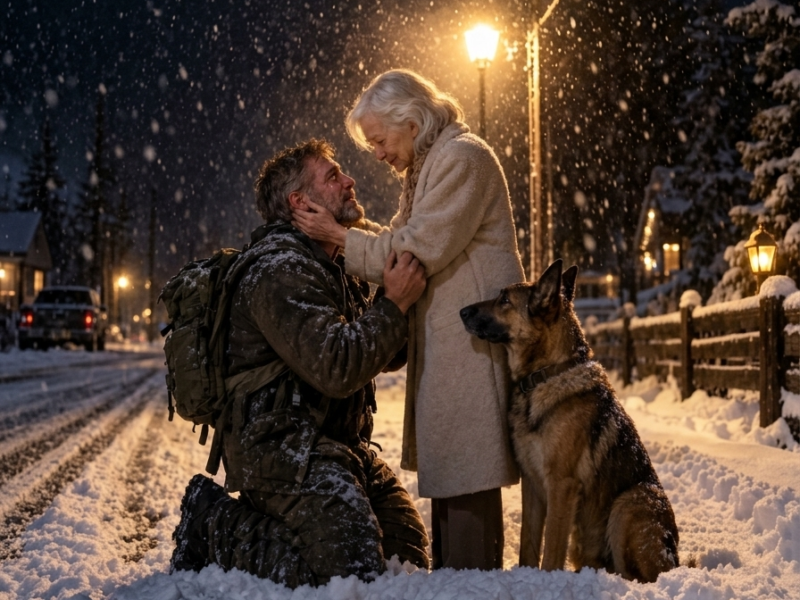
The moment I stepped onto my mother’s porch in Virginia, her retired K9 lunged at me with a terrifying growl, while she stood behind the door whispering, “Don’t come any closer,”
The drive up Oak Ridge Road had always felt like a return to certainty. The towering Virginia pines leaned over the narrow asphalt, casting long, familiar shadows that I had memorized long before I ever wore a uniform. But that afternoon, as the dust settled around my mud-splattered truck, the air felt heavy, carrying the sharp, metallic tang of an approaching storm. Eleven months of deployment in dust-choked compounds across the globe were supposed to end here, on the wrap-around porch where my mother used to sit every evening with a mug of chamomile tea. I killed the engine, the sudden silence inside the cab ringing louder than the hum of the tires.
When my boots hit the gravel, the porch door didn’t swing open with the usual warm, creaking welcome. Instead, the heavy oak front door opened just an inch. Through the narrow gap, the dark muzzle of Ranger, my mother’s retired police K9, thrust forward. Before I could even call his name, a low, gut-wrenching growl vibrated through the screen. His ears were flattened, his lips pulled back to reveal sharp, gleaming canines. He slammed his ninety-pound frame against the metal mesh with a violence that shook the door frame.
I froze on the bottom step, my hands automatically raising to chest height in a universal gesture of non-threat. “Ranger? Easy, boy. It’s me.”
The dog didn’t back down. His dark eyes weren’t filled with the chaotic energy of a territorial animal; they were cold, sharp, and focused on my throat. Ranger had slept at the foot of my bed from the day he retired from the state police search-and-rescue unit. He had pulled me out of a frozen creek when I was seventeen. He knew my scent better than he knew his own. Yet here he was, hair raised along his spine, looking at me like I was a nightmare brought to life.
“Mom?” I called out, my voice tight. “Mom, hold him! It’s Ethan!”
A pale, thin face appeared in the dark recess behind the screen door. My mother, Sarah, looked as though she had aged a decade in the eleven months I had been gone. Her knuckles were stark white where she gripped the doorframe, her graying hair pulled back into a messy, rushed knot. But it wasn’t her appearance that made my blood run cold—it was the profound, terrifying distance in her eyes. She looked at me not with the relief of a mother seeing her deployed son return alive, but with the raw, paralyzing dread of a woman facing her executioner.
“Don’t come any closer,” she whispered. Her voice was barely audible above the rising wind in the pine trees, but the sharp edge of terror in it stopped me dead in my tracks.
“Mom, what are you talking about?” I took a small, cautious half-step forward. “I just got off the transport at Andrews. I drove straight here. It’s Ethan.”
“Please…” Her voice cracked, degenerating into a pathetic, desperate sob. She didn’t open the door. She didn’t reach out. “Please, Ethan… just go away. Just leave us alone.”
As I stood there, confused and hurt, Ranger did something that completely severed my anchor to reality. He didn’t lung forward at me. He slowly backed up, placing his massive body directly between the screen door and my mother’s legs. He pressed his flank against her shins, leaning his weight into her while keeping his teeth bare and his eyes locked entirely on me. He wasn’t guarding the house from an intruder. He was guarding her from me.
That was when the sun shifted through the branches above, casting a stark ray of light across her right arm. Her sleeve was pushed up slightly, exposing her wrist. Encircling the fair skin were deep, yellowish-purple bruises—the unmistakable shape of a heavy hand gripping with cruel, merciless force.
“What happened to your arm?” I demanded, my military instincts taking over, surging past the shock. “Who did that to you?”
“Nothing,” she stammered, pulling the sleeve down with a violent jerk. “It was an accident. I fell in the garden.”
“You don’t get finger-shaped bruises from a fall, Mom! Let me in!”
“No!” she screamed, a sound so shrill it set Ranger off into a frantic frenzy of barking. “You need to leave! If you ever loved me, Ethan, you’ll get in your truck and drive away right now!”
She slammed the heavy oak door. The deadbolt clicked into place with a sound as loud as a rifle shot.
I stood on that porch for what felt like an eternity, the rain beginning to fall in fat, heavy drops, pattering against the roof. Every instinct I possessed screamed at me to kick the door down, to clear the house, to find whoever had hurt her. But the absolute horror in her eyes kept my foot glued to the wood. She wasn’t lying about being afraid. She was terrified of me.
Unable to force my way in without causing her further trauma, I retreated to my truck. I didn’t drive back to the base, nor did I check into a hotel in town. I drove three miles down the road to the Pines Motel, a dingy, six-room dive tucked away behind a rusted gas station. I checked into Room 4, paid in cash, and sat on the edge of the spring-worn mattress with my service pistol resting on the nightstand beside me.
The night stretched on into a suffocating silence. I sat in the dark, watching the headlights of occasional semi-trucks sweep across the peeling wallpaper. My mind looped through every interaction, every phone call over the past year. Satellite calls from Iraq had been brief, filled with static, but she had always sounded like herself—worried, loving, asking if I was eating enough. How had everything collapsed into this madness in the span of forty-eight hours?
At precisely 2:13 a.m., the screen of my phone lit up. The ringtone shattered the darkness. The caller ID read: MOM.
I grabbed the phone instantly, pressing it to my ear. “Mom? Mom, are you okay? I’m at the motel down the road. I can be there in three minutes.”
Silence.
Only the ragged, shallow sound of breathing came through the speaker. It was fast, panicked, accompanied by a faint, rhythmic scratching sound—like fingernails scraping against dry plaster.
“Mom, talk to me,” I pleaded, standing up and grabbing my keys from the table. “Are you alone?”
The breathing suddenly stopped. A voice came through the line. It wasn’t my mother’s soft, Appalachian tone. It was a low, raspy, deliberate whisper—cold, completely devoid of emotion, and chillingly familiar.
“You should’ve stayed gone, Ethan.”
The line went dead.
A surge of adrenaline hit my system like an electric shock. I didn’t lock the motel door. I sprinted to the truck, threw it into drive, and tore down the rain-slicked highway, the tires screaming around every curve of Oak Ridge Road.
When I pulled up to the property, the front door of the house was standing wide open, swinging gently in the damp night breeze. The porch light was off, leaving the doorway looking like an open mouth gaping into a dark abyss.
I unholstered my pistol, stepping onto the porch without making a sound. “Mom?” I called out quietly, keeping my back to the wall as I cleared the entryway.
There was no answer. But sitting right in the center of the dark hallway was Ranger. He wasn’t barking. He wasn’t growling. He sat perfectly still, his ears erect, watching me with an eerie, unblinking intensity. As soon as our eyes met, the dog stood up, turned his body, and walked slowly toward the back of the hallway. He stopped at the head of the basement door, turned his head to look back at me once, and then disappeared down the dark, wooden stairs.
I followed, my weapon raised, stepping softly on the treads to avoid squeaking. The basement smelled of damp earth, old cardboard, and something sharp and metallic—rust, or maybe old iron.
At the bottom of the stairs, a single bare lightbulb hung from a pull chain, swaying slightly and casting long, dancing shadows across the concrete floor. Beneath the light sat an old, canvas military duffel bag—my duffel bag from my first tour six years ago. It had been pulled into the center of the floor.
I kept my eye on the dark corners of the room as I knelt beside the bag. The zipper was partially open. Inside lay a thick, manila envelope. I pulled it out and spilled its contents onto the cold floor.
Dozens of photographs scattered across the concrete.
I picked one up, my breathing stopping in my throat. It was a high-resolution photo of me. I was standing in my mother’s garden, holding a pair of shears, smiling toward the camera. Another showed me sitting at the kitchen table, reading a newspaper. A third showed me walking out of the local hardware store in town.
They were all taken over the last six months.
During the exact six months I had been stationed at a forward operating base three thousand miles away, completely cut off from civilian life.
My hands shook violently as I shuffled through the stack. The clothes in the photos were mine—jacket, boots, even the silver watch my father had left me. The posture, the hair, the slight scar across the left eyebrow—everything was identical. It was me. But it couldn’t be me.
Then I reached the last photograph at the bottom of the pile.
This photo was different. It wasn’t taken from a distance; it was a clear, flash-lit portrait taken right inside this basement. It showed the man who looked like me standing shoulder-to-shoulder with another man—a tall, broad-shouldered individual whose face was completely blacked out with a heavy permanent marker. The duplicate of me wasn’t smiling. His eyes were empty, cold, staring directly into the lens.
I turned the photograph over. Written on the back in precise, block handwriting were two words:
He knows.
A soft sound echoed from the top of the stairs. A floorboard creaking.
I spun around, bringing my pistol up, targeting the top of the stairwell.
My mother was standing there, wrapped in a faded robe, clutching the doorframe. Tears were streaming down her hollow cheeks, reflecting the dim glow of the hanging lightbulb.
“I wanted to tell you,” she whispered, her voice barely a thread. “I tried to hide it…”
“Tell me what, Mom?!” I lowered the weapon slightly, my voice crackling with raw desperation. “What is this? Who took these pictures? Who was living in this house?!”
She looked down at the photograph trembling in my left hand. She swallowed hard, her whole body shaking as if an arctic wind were blowing through the basement.
“That man…” she sobbed, burying her face in her bruised hands. “That man came here three months before you came home. He had your key. He knew your childhood memories. He knew where the spare money was hidden in the attic. He lived in your bedroom, Ethan. He ate at my table.”
She looked up at me, her eyes filled with an agonizing, impossible truth.
“He looked… he looked exactly like you.”
Before I could process the sheer absurdity of her words, Ranger, who had been lying silently near the laundry sink, suddenly let out a low, terrifying snarling sound. He turned his head away from us, staring up toward the ceiling—toward the floorboards directly above our heads.
From upstairs, in the dark house, came the distinct, heavy sound of a lock turning.
Click.
Then came the slow, deliberate rhythm of heavy boots walking across the hardwood floor of the living room, heading directly toward the basement door.
The footsteps above were measured, unhurried, carrying a chilling confidence that echoed down through the wooden rafters. Every strike of the boot heel matched the heavy, militaristic cadence I had practiced for years.
“Mom, get behind me,” I hissed, pushing her gently toward the dark storage alcove behind the water heater.
Ranger was at the foot of the stairs, his tail stiff, his throat emitting a continuous, dangerous rumble. He wasn’t confused anymore. He knew the threat was coming from above, but he kept glancing back at me, his ears twitching as if trying to reconcile two identical sensory inputs. My scent was in the room, but the scent of the man upstairs was already drifting down the stairwell—a mixture of cold rain, gun oil, and a bitter, chemical soap I had never used in my life.
“Ethan…” my mother whimpered, her hands clutching the back of my tactical vest. “He told me if I ever called the police… if I ever told anyone… he’d make sure you never came back from overseas.”
“He lied,” I whispered, raising my 9mm service weapon and aligning the tritium night sights with the top of the dark stairwell. “I’m right here.”
The heavy oak door at the top of the stairs creaked open.
A tall figure framed itself against the faint light of the kitchen corridor. The silhouette was undeniable: broad shoulders, slightly slouched left side from an old shoulder injury I had sustained in basic training, tactical posture.
“You shouldn’t have dug up the bag, Ethan,” a voice called down.
My heart slammed against my ribs so hard it felt like it would break them. The voice coming down those stairs wasn’t just similar to mine—it was my voice. The same pitch, the same subtle Virginia drawl on the vowels, the same gravelly undertone from years of smoke inhalation and loud command orders. Hearing your own voice speak words you didn’t formulate is a special kind of madness that paralyzes the brain.
“Step into the light where I can see your hands!” I commanded, straining to keep my gun rock-steady. “Now!”
A low, dry laugh echoed off the concrete walls. “Always following protocol. Always the good soldier. Do you really think you’re the one in control here? You’ve been gone for eleven months, brother. In eleven months, a lot of things can be rewritten.”
“I don’t have a brother!”
“No,” the voice replied calmly. “You didn’t. Not on paper.”
The figure took one step down the wooden stairs. The dim hanging bulb illuminated his face, and for a fraction of a second, my finger almost went slack on the trigger.
It was like looking into an evil, distorted mirror.
He had my sharp jawline, my cropped dark hair, the thin scar running vertically through my left eyebrow. But where my face bore the stress and fatigue of recent deployment, his skin had a pale, unnatural smoothness—like a portrait painted by someone who had memorized my feature set from high-resolution satellite imagery but had never seen me bleed. His eyes were the worst part. They were flat, milky blue, devoid of the human spark that reacts to light and emotion.
Ranger let out a fierce, lunging bark, stepping onto the first tread.
The imposter didn’t even flinch. He reached into his dark rain jacket, pulled out a small, metallic cylinder, and tossed it down the stairs. It bounced down the wooden steps with a loud clack-clack-clack and landed at my feet.
Instinct took over before my brain could register what it was. “Flashbang! Down!” I roared, throwing my body over my mother and slamming her down into the alcove.
BANG!
A blinding flash of white light exploded in the tight concrete basement, accompanied by a deafening, high-pitched screech that shattered the glass of the single hanging lightbulb. Darkness plummeted over us, instantly replaced by the searing, persistent ringing in my ears. My vision was reduced to a swirling mass of green and purple spots.
Through the disorientation, I heard the heavy thump of boots hitting the concrete floor. Ranger was barking wildly, the sound muffled as if underwater. A sound of a struggle rang out—a sharp grunt, a heavy thud, and then the agonizing whine of a dog thrown violently against the metal furnace.
“Ranger!” I yelled, firing two blind shots toward the direction of the sound. The muzzle flashes illuminated the dark basement for micro-seconds, showing empty concrete.
A heavy boot slammed into my wrist, knocking my pistol from my hand. It skidded across the floor, disappearing into the dark.
Before I could recover, a iron-like grip clamped around my throat, lifting me off my knees and slamming my back against the cold stone foundation wall. Pain flared through my spine. I reached up, grabbing his wrists, trying to use a standard wrist-lock to break the chokehold, but his grip was like a hydraulic press. It was unnatural strength, unyielding and mechanical.
Our faces were inches apart in the shadows. I could smell the cold rain on his jacket.
“You were supposed to die in Syria,” the imposter whispered, his cold breath brushing against my cheek. “The ambuscades at Al-Tanf… you were supposed to be in that lead vehicle. Your convoy was tagged. Someone miscalculated the timing.”
“Who… sent you?” I managed to choke out, digging my thumbs into his wrists, trying to find a nerve center.
“The same people who paid for your college,” he replied, a chilling smile spreading across his face. “The same people who made sure your mother’s medical bills were paid when her cancer came back four years ago. You thought you were just a sergeant in the Infantry, Ethan? You were an investment. An asset with a duplicate.”
He pulled back his right arm, a heavy tactical knife gleaming in the dim moonlight filtering through the basement window.
“And when an asset comes home unexpectedly,” he murmured, raising the blade, “it creates a terrifying clerical error.”
“Ethan, watch out!”
From behind him, my mother rushed out of the dark, holding a heavy iron wrench she had grabbed from the workbench. With a scream born of pure motherly desperation, she swung it with all her strength, striking him across the side of his knee.
The knee gave a sickening crack. The imposter grunted, his grip on my throat loosening just enough for me to drop to the floor. He stumbled sideways, his cold blue eyes flashing with a sudden, vicious rage as he turned toward her.
“Don’t touch her!” I roared.
I lunged forward, tackling him around the waist. We crashed into the wooden storage shelves, bringing down boxes of old Christmas decorations, tools, and glass jars. The impact broke his balance. I drove my elbow into his nose, feeling the cartilage yield under the force, but he didn’t bleed like a normal man—a thin, dark, almost black fluid oozed from his nostril.
He struck me in the ribs with a force that cracked two of my ribs, throwing me off him. Despite his shattered knee, he scrambled back toward the stairs with terrifying speed, dragging his broken leg behind him without uttering a single sound of pain.
“Ethan… the bag…” my mother gasped, pointing toward the duffel bag that had been knocked open during the fight.
The imposter reached the top of the stairs, turned back to look down at us through the darkness, his face smeared with dark fluid.
“It doesn’t matter what you find down here,” he rasped, his voice glitching slightly, dropping an octave into an eerie, mechanical drone. “The paper trail is already complete. Look at the news tomorrow, Sergeant. You’re already dead.”
He slammed the basement door, and the sound of a heavy metal bar sliding across the top frame echoed down the stairwell.
We were locked in.
The air in the basement felt thicker, heavy with the smell of dust, ozone, and the iron scent of blood. Ranger was limping toward me, letting out a soft, whimpering sound. I knelt, my chest burning from the cracked ribs, and ran my hands over his ribs and legs. Nothing seemed broken, though he was shaken and bruised.
“Good boy,” I choked out, pulling his broad head against my chest. “Good boy, Ranger.”
My mother was sitting on the bottom stair, her head in her hands, her shoulders shaking hysterically. “What is happening, Ethan? What was that… that thing?”
“I don’t know,” I said, forcing myself to stand up despite the agony in my side. “But he said the paper trail is complete. We need to get out of here right now.”
The basement door was solid wood, reinforced with an external deadbolt and a steel security bar that my father had installed twenty years ago to protect his gun safe. Kicking it open from the inside was impossible.
I looked toward the back of the basement. Near the ceiling was a narrow hopper window used for coal deliveries decades ago. It was rusted shut, covered in cobwebs and years of grime. I grabbed the heavy iron wrench my mother had used, climbed onto an old wooden crate, and smashed the glass. The cold rain poured inside, hitting my face like a cold wake-up call. I used the wrench to pry the rusted metal frame away from the foundation until the opening was wide enough for a person to squeeze through.
“Mom, you first,” I said, helping her climb onto the crate.
It took five agonizing minutes of pushing and pulling, but I managed to hoist my mother through the tiny window into the muddy flowerbed outside. Next, I lifted Ranger, pushing his back end until he scrambled through the frame. Finally, I dragged myself through, the sharp glass tearing into my tactical pants, my cracked ribs screaming in protest as I tumbled out into the pouring rain.
The house was completely dark. The front door was wide open, swaying in the wind, but the driveway was empty. His vehicle—whatever he had arrived in—was gone.
“We can’t stay here,” I said, grabbing my mother’s arm. “We need to get to my truck.”
We ran through the mud, staying low behind the tree line, until we reached my truck parked down the shoulder of Oak Ridge Road. I got my mother and Ranger into the cab, threw the vehicle into gear, and drove away from the house without turning on the headlights until we were two miles clear of the property.
My head was spinning. What he had said in the basement kept echoing in my brain: Look at the news tomorrow, Sergeant. You’re already dead.
I pulled into a secluded rest stop off Route 29, surrounded by towering semi-trucks with their engines idling. The dashboard clock read 4:15 a.m. I pulled out my phone, connected it to the truck’s satellite receiver, and opened a secure, encrypted military communications portal—a system I still had access to as an active duty sergeant waiting for reassignment.
I typed in my Service Identification Number: US-8894-ET.
The screen loaded for several seconds, the small buffering wheel spinning endlessly. Then, a stark red notice filled the screen:
RECORD TERMINATED / INVALID ACCESS CODE
STATUS: DECEASED
LOCATION OF CASUALTY: AL-TANF PROVINCE, SYRIA
DATE OF DEATH: THREE MONTHS PRIOR
My breath hitched in my throat. I stared at the screen, my eyes scanning the text again and again. According to the United States Department of Defense, Sergeant Ethan Vance had been killed in action ninety days ago when an Improvised Explosive Device struck a two-vehicle convoy outside a remote outpost.
There was an official casualty report, a death certificate signed by a military medical examiner, and a record of a closed-casket funeral held at Arlington National Cemetery six weeks ago.
“Mom…” I whispered, turning the phone toward her. “Look at this.”
She looked at the screen, tears swelling in her eyes once again. “He… he brought a letter,” she whispered, her voice trembling. “Three months ago, two men in dress uniforms came to the house. They gave me a flag. They told me you were killed in an explosion. They told me your body couldn’t be recovered completely…”
“And then?”
“And then, three days after the funeral, you walked through the front door,” she sobbed. “You were wearing civilian clothes. You had your duffel bag. You smiled at me and said the military made a mistake, that it was a classified operation and you couldn’t talk about it. I was so heartbroken, Ethan… I wanted to believe it so badly that I didn’t question it. I held you… I made you dinner…”
“When did you realize it wasn’t me?”
She looked down at Ranger, who was resting his head on her lap. “Ranger knew the first night. He wouldn’t go near him. Whenever that man walked into the room, Ranger would hide under the bed and growl. And then… a month ago… I saw him in the bathroom. He was sitting in front of the mirror with a scalpel. He was… he was making small cuts along his jawline, pulling his skin back, and inserting thin metal wires underneath.”
She grabbed my jacket, her nails digging into the fabric. “He didn’t bleed red, Ethan. It was dark… like motor oil. When he saw me looking at him in the mirror, he didn’t panic. He just turned around, locked the door, and told me that if I ever breathed a word to anyone, he would find you wherever you were hiding and finish the job.”
A cold realization washed over me. I wasn’t just facing a rogue operative or an identity thief. I was caught in the middle of a black-budget military program—a secret so deep that they were willing to replace dead soldiers with biological replicas to maintain control over specific assets, operations, or land.
I reached for the duffel bag I had dragged out of the basement. I unzipped the side compartment and pulled out a small, black leather notebook that had been tucked away at the bottom.
It wasn’t my handwriting inside. The pages were filled with names, dates, coordinates, and monetary amounts totaling millions of dollars. The coordinates pointed to sites all across the eastern seaboard—storage facilities, private airstrips, and chemical processing plants.
On the last page, written in bold red ink, was a list of five names.
The first four names had line drawn through them, with the word “REPLACED” stamped beside them.
The fifth name at the bottom of the list was mine: ETHAN VANCE.
Beside my name was a date—today’s date—and a single word written in capital letters:
CLEANUP.
Suddenly, the truck’s radio slammed on by itself, emitting a loud blast of static. The digital display glitched, the station numbers cycling wildly before settling on a single frequency.
Through the static, a voice came through the speakers—the same mechanical, cold voice from the basement.
“You’re very hard to kill, Sergeant,” the voice said calmly. “But you’re running out of roads. Look out your side mirror.”
I snapped my head toward the side mirror. Through the pouring rain, two black SUVs with dark tinted windows and no license plates were slow-rolling into the rest stop, blocking both exits.
“Hold on!” I screamed, slamming my foot onto the accelerator.
The truck’s engine roared to life, the tires spinning on the wet asphalt before catching traction. I jerked the steering wheel to the left, mounting the concrete curb and plunging the truck straight through the grassy median toward the highway.
Behind us, the two black SUVs surged forward, their high beams flashing like predatory eyes through the dark deluge. One of them sped up, attempting to pit-maneuver my rear bumper, but I slammed on the brakes, letting him slide past on the slick pavement, before ramming my front bull-bar into his rear quarter panel. The SUV spun wildly out of control, crashing sideways into a highway guardrail in a violent spray of sparks and twisted metal.
“Ethan!” my mother screamed, clinging to the dashboard as the truck bounced violently over the drainage ditch and slammed back onto Route 29.
“Stay down!” I ordered, keeping one hand on the wheel and using the other to check the glovebox. I pulled out my father’s old .357 Magnum revolver—a weapon I kept locked away for emergencies—and handed it to her. “If anyone opens your door who isn’t me, pull the trigger.”
The second SUV was right on our tail, closing the distance rapidly. In the side mirror, I saw the passenger side window roll down. A man dressed in black tactical gear leaned out, raising a suppressed automatic rifle.
Pfft-pfft-pfft-pfft!
Rounds punched through the fiberglass bed of my truck, shattering the back windshield into a web of spiderwebbed safety glass. Rain and glass shards sprayed into the cabin. Ranger barked wildly, shielding my mother with his body.
“We can’t outrun them on the open highway!” I yelled, looking at the GPS map on my dashboard. A mile ahead was the old limestone quarry—an abandoned industrial site with narrow dirt roads, blind turns, and steep drops that I knew like the back of my hand from my teenage years.
I jerked the wheel, veering off the highway onto a unpaved logging road that snaked up into the mountains toward the quarry. The truck bounced violently over rocks and exposed roots, mud splashing up against the windshield as the wipers struggled to keep up with the torrential downpour.
The SUV followed, its heavy four-wheel drive allowing it to maintain speed on the treacherous terrain.
As we broke through the tree line into the open clearing of the upper quarry, I pulled the handbrake, sending the truck into a deliberate 180-degree slide. We came to a halt right at the edge of a hundred-foot cliff overlooking the flooded gravel pit below.
“Get out! Into the old sorting shed!” I yelled, throwing my door open.
My mother, holding Ranger by his collar, scrambled out of the passenger side and sprinted toward the rusted corrugated metal shed fifty yards away. I grabbed my father’s revolver and took cover behind the truck’s engine block just as the black SUV roared into the clearing, coming to a sudden halt thirty feet away.
Four men in unmarked black tactical gear stepped out of the vehicle. Their movements were terrifyingly synchronized—perfect, mechanical efficiency. No commands were shouted, no hand signals were given. They moved with a collective hive-mind awareness that made my skin crawl.
Among them was the imposter. His shattered knee was bound with a thick steel brace, allowing him to walk with a mechanical, limping gait. His face was pale, his eyes completely lifeless.
“Give it up, Ethan!” the imposter called out, his voice carrying over the sound of the rain and the wind. “You’re a ghost fighting against an army that doesn’t exist on any map. There is nowhere for you to go.”
“Who controls you?!” I shouted back, aiming the Magnum through the gap between my truck’s tire and chassis. “Who paid for this program?!”
The imposter took a step forward, raising his sidearm. “The same men who run the country from the shadows. The men who realized that real human soldiers are weak. They break under stress. They have families. They have consciences. You were a defective prototype, Ethan. Your genetics were good, but your loyalty to your mother was a flaw.”
“A flaw?” I growled.
“A vulnerability,” he corrected coldly. “One that is about to be eliminated.”
He signaled to the three operatives beside him. “Clear the shed. Kill the woman and the dog. Bring me the notebook.”
The three operatives raised their weapons and began advancing toward the shed where my mother was hiding.
“No!” I yelled.
I popped up from behind the truck engine and fired three rounds from the .357 Magnum. The heavy hollow-point rounds slammed into the chest of the lead operative. He stumbled back, but he didn’t fall—the armor under his uniform absorbed the impact. However, the kinetic force was enough to buy me three seconds.
I didn’t run toward them. I ran toward the massive, diesel-powered industrial crane that sat at the edge of the quarry pit—a piece of rust-covered machinery left behind when the quarry closed in the nineties.
The imposter fired at me, the bullets kicking up dirt around my boots. I lunged into the cab of the crane, slamming the heavy iron door shut just as a hail of bullets shattered the cab’s glass windows.
I ducked beneath the dashboard, reaching for the master battery switch. I had spent three summers working for the local gravel company in my youth; I knew these old machines inside and out. I flipped the heavy copper breakers and pulled the mechanical ignition lever.
The massive V12 diesel engine groaned, belching a thick cloud of black exhaust into the rainy night sky, before roaring to life with a deafening, metallic thrum.
I grabbed the hydraulic controls, swinging the massive steel boom—carrying a four-ton iron wrecking ball—across the gravel yard.
The three operatives advancing on the shed didn’t hear the swinging ball until it was too late. The heavy steel sphere swept through the rain like a pendulum of death, slamming into the side of the black SUV and catapulting the two-ton vehicle straight into two of the operatives, crushing them beneath its weight before plunging over the edge of the hundred-foot cliff into the flooded pit below.
The third operative fired blindly at the crane’s cab, but I brought the heavy bucket arm down, slamming the hydraulic shovel onto the gravel beside him, the shockwave knocking him off his feet and burying him beneath a mountain of crushed limestone.
The engine of the crane sputtered and died, the fuel lines severed by gunfire.
Silence fell over the quarry once again, broken only by the sound of the falling rain and the heavy idling of the remaining operative—my duplicate.
I pulled myself out of the shattered cab of the crane, blood dripping from a cut on my forehead. I held the .357 Magnum in my right hand. There was only one bullet left in the cylinder.
The imposter stood twenty feet away, his weapon gone, his dark fluid dripping onto the muddy ground from a tear in his tactical vest. Despite the devastation around him, his face remained completely emotionless.
“You can’t stop what’s coming, Ethan,” he rasped, taking a slow, mechanical step toward me, his steel knee brace creaking under the strain. “There are dozens of us. In every department. In every agency. We are already you.”
“Maybe,” I said, raising the heavy revolver and aiming it directly between his milky blue eyes. “But you’re not me tonight.”
I pulled the trigger.
The heavy bullet struck him dead center in the forehead. His head snapped back, his eyes flashing with a sudden burst of static electricity, and he collapsed onto the mud like a puppet whose strings had been cut.
I stood there for a long time, my breathing heavy, watching his body. It didn’t twitch. It didn’t bleed red. A thin plume of acrid smoke rose from the wound in his skull.
“Ethan!”
My mother emerged from the shed, holding Ranger’s collar. She ran across the muddy yard, throwing her arms around me, sobbing hysterically into my chest. Ranger pressed his nose against my hand, letting out a soft, reassuring whine, finally licking the blood from my knuckles.
“It’s over,” she wept. “Oh God, Ethan, it’s over.”
I looked down at the dead thing lying in the mud, then turned my gaze toward the black notebook sitting on the passenger seat of my truck.
I knew she was wrong. This wasn’t the end. It was just the beginning.
Three days later, the sun broke through the clouds over Washington D.C., casting a brilliant, golden light across the marble facades of the federal buildings along the National Mall. To the millions of tourists walking the streets, it was a beautiful, peaceful autumn afternoon in the nation’s capital.
They had no idea that a war was being fought in the shadows right beneath their feet.
I sat in a small, unpretentious diner three blocks from the Department of Veterans Affairs. I was dressed in a tailored suit, a dark trench coat covering the bandages wrapped around my cracked ribs. My mother and Ranger were safe—currently residing in a secure, off-grid safe house in the mountains of West Virginia, guarded by three former squad mates from my deployment who owed me their lives.
On the table in front ofRich leather booth sat a thick, manila envelope and the black leather notebook I had taken from the basement.
Sitting across from me was a man in his late fifties, dressed in a crisp, three-piece navy suit. His hair was silver, his eyes sharp and analytical. His name was General Richard Vance—my father’s estranged brother, and the Deputy Director of the Defense Intelligence Agency.
He stared at the black notebook resting between us, his fingers trembling slightly as he reached out to touch the leather cover.
“I thought you were dead, Ethan,” General Vance said softly, his voice low and raspy. “I attended your memorial service at Arlington. I stood beside your mother.”
“You stood beside a woman who was being terrorized by a monster your agency built,” I replied, my voice cold and unyielding. “Look at the records, Uncle Richard. Page forty-two.”
The General opened the notebook, his eyes scanning the handwritten entries, coordinates, and financial ledger accounts. As he read, the color slowly drained from his face.
“Project Janus…” he whispered, leaning back against the leather cushion as if he had been struck. “This… this was supposed to be a theoretical research study on bio-synthetic replication for deep-cover reconnaissance. It was canceled by the Senate Select Committee five years ago.”
“It wasn’t canceled,” I said, leaning forward, resting my elbows on the table. “It went dark. Someone within your department privatized it. They’ve been targeting active-duty military personnel during overseas deployments—officers and non-commissioned officers with specific security clearances, clean family backgrounds, and access to critical infrastructure.”
“They orchestrate a false casualty report,” General Vance murmured, connecting the dots in his head. “They declare the soldier dead, bring a replica into their home and workplace, and use their identity to move money, weapons, and intelligence without triggering a single red flag.”
“And when the real soldier survives the ambush?” I asked, staring directly into his eyes. “They send the replica to clean up the mess.”
The General swallowed hard, closing the notebook with a heavy snap. “Ethan, if this gets out… if the public finds out that the military has been replacing American citizens with bio-synthetic operatives… it will tear the entire government apart. The panic, the loss of trust… it would destroy everything.”
“I don’t care about the government’s reputation,” I said, my voice dropping an octave, carrying a dangerous, razor-sharp promise. “I care about the four other soldiers on that list. The ones who were marked as ‘REPLACED’.”
I pulled four smaller envelopes from my trench coat and laid them on the table in a neat row.
“These are the names and current assignments of the four replicas currently operating inside the Department of Defense,” I continued. “One is a Logistics Officer at Fort Bragg. One is a Communications Specialist at NORAD. One is a Security Force Commander at Naval Base Kitsap. And the fourth…”
I paused, looking at the General’s pale face.
“The fourth is sitting in the Pentagon right now, serving as the Senior Military Assistant to the Secretary of Defense.”
General Vance stared at the envelopes, a cold sweat breaking out on his forehead. “My God… they’re positioning themselves at every critical node of our national command structure.”
“You have twenty-four hours, Uncle Richard,” I said, sliding the notebook and the envelopes across the table to him. “You use your authority to arrest these four targets quietly. You expose the private corporation behind Project Janus. You wipe my casualty record from the Department of Defense databases, and you restore my active-duty status with a full security clearance.”
The General looked up at me, his eyes filled with a mix of shock and sudden realization. “And if I can’t do it in twenty-four hours?”
“Then I won’t just release this notebook to the press,” I said, standing up from the booth and buttoning my trench coat. “I will hunt down every single one of those replicas myself. And I won’t stop until the people who created them are standing in front of a firing squad.”
I turned and began walking toward the diner’s exit.
“Ethan, wait!” General Vance called out, turning in his seat. “Where are you going?”
I stopped at the glass door, looking back over my shoulder. The reflection in the rain-streaked window showed my face—tired, battle-scarred, but indisputably real.
“I’m going home,” I said quietly. “To rebuild my mother’s porch.”
I stepped out into the crisp autumn air, pulling my collar up against the wind. As I walked down the bustling sidewalk, mingling with the crowd of government workers, military personnel, and tourists, I reached into my pocket and pulled out my phone.
A new message had just arrived from an unknown, encrypted number.
I opened the text. It contained a single high-resolution photograph.
The photo was taken from across the street, capturing me standing right outside the diner.
Below the photograph was a short text message that sent a chill through my soul, proving that the shadows were far deeper than even I had imagined:
Nice suit, Ethan. But you forgot one thing… how do you know you’re the original?
The end.









