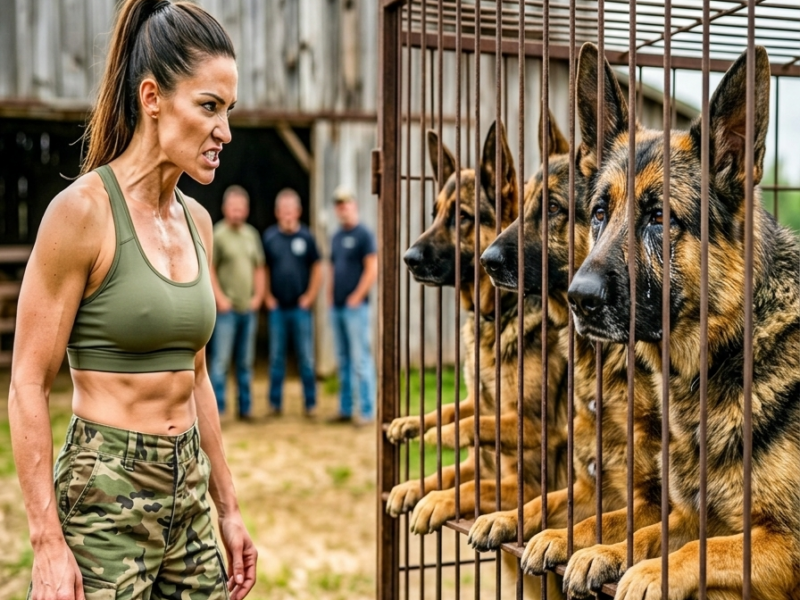
The moment I stepped into the military auction yard and said, “I’ll take every retired K9,” the officers stopped laughing and stared at me in silence
The autumn wind sweeping across the concrete tarmac of the military auction yard at Fort Benning carried the sharp scent of wet earth, jet fuel, and age. Row upon row of galvanized steel kennels stretched into the grey mist, each enclosure housing a quiet, solitary figure. These were not the young, high-drive Belgian Malinois and German Shepherds fresh out of the tactical breeding programs at Lackland. These were the leftovers—the discarded, the broken, the ghosts of classified deployments who had outlived their official operational utility.
The officer holding the brass-clipped clipboard was Master Sergeant Vance. His uniform was immaculate, but his eyes were heavy with the dull, bureaucratic exhaustion of a man who had spent twenty years processing paperwork for military property. To the United States Armed Forces, every dog in those pens was designated as equipment—specialized gear to be logged, depreciated, and eventually written off.
I adjusted the collar of my dark canvas jacket, my hands thrust deep into my pockets to hide the slight, persistent tremor in my left wrist—a lingering souvenir from a piece of shrapnel that had ended my operational career as a Navy SEAL team operator three years prior.
“Ma’am,” Vance said, his voice dropping into a flat, practiced tone, “you understand these animals are officially designated as retired.”
“I understand,” I replied, my voice steady, cutting through the low hum of distant idling trucks.
“Some are considered unfit for service. Severe PTSD, structural degradation, behavioral anomalies,” he continued, flicking through the yellowed pages of medical clearances. “They aren’t pets. They’re former military working dogs with high-arousal triggers. Most of them will never adapt to a living room.”
I walked slowly down the concrete center aisle, my boots clicking against the damp pavement. I didn’t look at the paperwork. I looked into the kennels.
Some of the dogs had thick, jagged scars crisscrossing their snouts and shoulders. Some limped heavily on arthritic hips built from years of high-altitude jumps and hard fast-rope insertions. One dog, a heavily scarred Dutch Shepherd in pen four, barely opened his milky, clouded eyes as I passed, his breath coming in shallow, rhythmic rasps against the concrete floor.
I stopped at the end of the line, turned back toward Vance, and pulled a certified cashier’s check from my inner pocket.
“I’ll take them,” I said.
Vance blinked, his pen hovering an inch above his clipboard. “Which ones?”
“All of them.”
“All of them?” he repeated, his voice cracking slightly. “There are fifteen dogs in this block, Lieutenant. You can’t possibly take an entire decommissioned unit.”
“Every one,” I said, placing the check firmly against his clipboard. “Transfer the ownership files and medical registries to my civilian LLC. Today.”
Behind Vance, a younger supply clerk in crisp camouflage leaned toward a junior handler and whispered, loud enough to cut through the wind: “Why would a former SEAL want fifteen damaged dogs? What is she going to do with a pack of unhinged landmines?”
I heard him. I didn’t turn around. I pretended I didn’t.
Because three years earlier, in a nameless valley along the border of Kunduz Province, one of those supposed “landmines” had dragged my broken, bleeding body out of a burning command compound while AK-47 fire chewed through the mud walls around us.
His name was Ghost.
He was a Malinois-Dutch Shepherd cross with a rare, silver-grey coat and an uncanny, almost unnatural intelligence. That night in Kunduz, after an improvised explosive device breached our entry point, I had watched him disappear beneath a rolling cloud of suffocating black smoke while the MEDEVAC winch pulled my stretcher into the belly of a Black Hawk helicopter. The formal casualty report handed to me in the military hospital at Landstuhl was brief, cold, and definitive: MWD Ghost (K-114) — Presumed Destroyed in Action.
Everyone told me he hadn’t survived. They told me the fire had consumed the entire lower level of the facility.
I walked three paces past Vance to the very last kennel—a isolated, reinforced pen set apart from the rest under the overhang of a brick administrative building.
There he was.
He was lying alone in the shadows on the cold stone. He was older now. The brilliant silver of his coat was grizzled with stark white around his muzzle and eyes. He was painfully thin, his ribs visible beneath a dull coat, and a long, thick surgical scar ran from his left shoulder down to his flank.
He didn’t bark. He didn’t rise into a defensive stance. But as I stepped up to the chain-link mesh, his ears lifted sharply, pointing straight at me with absolute, razor-sharp focus.
The air left my lungs in a sharp, painful gasp. The world around me seemed to tilt on its axis.
I lowered myself onto one knee, pressing my knuckles gently against the cold iron of the cage door.
I whispered, “Hey, Ghost.”
For three long seconds, the dog didn’t move. Then, his heavy silver tail lifted off the stone floor and struck the concrete once. Twice.
That was all it took. The knot of grief that had lived in my chest for thirty-six months tore wide open, replaced by a sudden, freezing wave of clarity.
I stood up, walked back to Vance, and snatched the pen from his hand. I signed every transfer document, every liability waiver, every medical release form they put in front of me without reading another word.
Vance watched me sign, his jaw tight. As I reached the final page—the master release manifest for the entire kennel block—his hand shot out, pressing down on the top edge of the paper. He hesitated, his eyes darting nervously toward the overhead security cameras mounted along the eaves of the administrative roof.
“There is something you should know before you clear these files, Lieutenant,” Vance muttered, his voice dropping into a barely audible rasp.
I looked up, my eyes narrowing. “What?”
“These dogs… they weren’t retired because they were too old,” he whispered.
My stomach tightened into a hard, cold ball. “Then why?”
Vance swallowed hard, his neck muscles straining. He glanced toward the black glass domes of the cameras again. “Because over the last six months, they stopped responding to certain handlers. Complete operational refusal. Aggression toward friendly personnel during routine maintenance.”
I looked back down the line toward Ghost’s pen.
Ghost was standing now, his head lowered, his body perfectly still. But he wasn’t looking at me. He wasn’t looking at Vance, either. He was staring directly up at the security camera mounted above his kennel door.
I glanced down the corridor of pens. Every single one of the fifteen dogs had risen to their feet. The Dutch Shepherd with the clouded eyes, the scarred Malinois, the limping German Shepherd—all fifteen animals were standing in complete, eerie silence, their bodies locked like statues, their heads tilted upward at the exact same angle.
Every dog was facing the same direction: toward the second-story glass windows of the base administrative building overlooking the yard.
“Who worked with them?” I asked, my voice dangerously soft. “Who had access to this kennel block before the retirement order was issued?”
Vance lowered his head, his hands trembling slightly as he folded his arms. “Different teams came through. Joint task force elements.”
“That isn’t what I asked, Sergeant,” I said, stepping closer, my posture shifting into the aggressive, unyielding stance of a team leader demanding a debrief. “Names.”
Vance swallowed heavily, sweating despite the cold autumn wind. He leaned in so close I could smell the stale coffee on his breath.
Then he gave me a name.
It was a name I hadn’t heard spoken aloud in three years. Commander Richard Vance-Sterling—my former operational team leader in Kunduz. The man who had signed the mission log after the compound raid. The man who had officially certified that Ghost had died in the fire. The man who had received a Distinguished Service Cross for pulling our surviving team members out of the valley while leaving the intelligence files—and my dog—behind.
I felt the blood drain completely from my face. My breath came short and cold.
“Where is he now?” I demanded.
Vance didn’t answer with words. He slowly lifted a finger and pointed toward the heavy double glass doors of the administrative building at the top of the concrete steps.
Before I could take a single step forward, a sound tore through the quiet yard that made the hair on my arms stand up.
Every single retired K9 in the fifteen pens began barking at once.
It was not the wild, chaotic yapping of agitated animals. It was a disciplined, rhythmic, thunderous roar—a collective battle cry produced by fifteen war dogs acting in absolute synchronization.
The heavy glass doors of the administrative building pushed open.
A tall man in a tailored olive-drab service uniform stepped out onto the top landing, adjusting the brass belt buckle of his dress uniform. The silver oak leaves of a Navy Commander gleamed on his collar in the pale sunlight.
He stopped at the top of the stairs. He looked down into the yard.
First, his eyes met mine. I saw the briefest flash of recognition in his dark, heavy-lidded eyes—followed instantly by a cold, calculating shock.
Then, his gaze drifted past me, landing directly on the final cage at the end of the aisle.
He saw Ghost.
For the first time in my professional life, I watched a decorated, combat-hardened naval officer turn completely, ghost-white pale. His hand froze on his belt buckle. His chest hitched in a silent gasp.
In the final pen, Ghost stepped forward until his snout was inches from the steel mesh. He didn’t bark with the others. He raised his head, his silver fur bristling into a razor-sharp ridge along his spine, and let out a deep, gut-wrenching growl that vibrated through the concrete beneath my feet.
In that singular, horrifying moment, the puzzle pieces of three lost years clicked together in my mind with terrifying precision.
Fifteen dogs hadn’t experienced random behavioral breakdowns. They hadn’t failed their handlers.
They had remembered the face of the man who had betrayed us all.
The silence that followed the initial explosion of barking was heavy, suffocating, and charged with static electricity. Commander Sterling stood motionless on the concrete landing, his boots glued to the threshold of the administrative building. For five long seconds, the only movement in the entire facility was the sharp, cold wind whipping the American flag against its aluminum pole overhead.
I slowly turned away from Sterling and looked back down the line of kennels. The fifteen dogs had ceased their barking, but not a single one had sat down. They remained in rigid, tactical formation behind their steel mesh doors, fifteen pairs of dark eyes locked onto the solitary figure standing at the top of the stairs.
“Sergeant Vance,” I said, my voice dropping an octave into an icy, measured register that made the clerk behind us step back two paces. “Unlock these pens.”
“Lieutenant… I can’t do that,” Vance stammered, his fingers twitching over his clipboard. “Base protocol dictates that retired military assets remain secured until civilian transport vehicles arrive.”
“I own them,” I replied, holding up the signed master transfer manifest, the ink still wet under my thumb. “As of two minutes ago, every animal in this block is private property under the custody of my firm. Unlock the doors, or I will use my emergency extraction tool to shear the padlocks off myself.”
Sterling finally moved. He descended the concrete steps with slow, deliberate precision, his leather dress shoes clicking against the stone. He had recovered his composure, his face hardening back into the smooth, unreadable mask of a high-ranking officer accustomed to absolute authority.
“Stand down, Lieutenant Miller,” Sterling said as he approached the lower gate of the kennel yard. His voice was smooth, deep, and carried the unmistakable cadence of command. “You always were overly impulsive. It seems your medical discharge hasn’t tempered your lack of tactical discipline.”
I stood my ground, my feet planted shoulder-width apart, my arms hanging loose at my sides—a posture engineered for rapid weapon drawing, a habit five years out of active service could not erase.
“Commander,” I said, omitting any military greeting. “I was told my dog died in Kunduz. I was told his body was incinerated in the lower level of the intelligence compound.”
Sterling stopped four feet away from me. He didn’t look at Ghost. He deliberately kept his eyes fixed on my face, though I could see the slight, telltale twitch of a muscle at the corner of his jaw.
“Operational reports from active combat zones are subject to the fog of war, Sarah,” Sterling said smoothly, using my first name in a condescending attempt to de-escalate the tension. “The compound was collapsing. We suffered multiple secondary detonations. The extraction team logged what they believed to be accurate information at the time. If the dog was recovered by local forces and later re-entered the supply chain, it’s a clerical anomaly, nothing more.”
“A clerical anomaly,” I repeated, my voice dripping with cold disgust. “And what about the other fourteen dogs in this yard? Are they clerical anomalies too?”
“Military working dogs suffer from neurological decay after prolonged exposure to blast trauma,” Sterling replied, his tone shifting into the patronizing explanation of an instructor at a briefing board. “They become unpredictable. Unreliable. They project aggression onto familiar uniforms. It’s why the department ordered them decommissioned.”
A low, vibrating rumble emanated from Ghost’s chest. The silver Malinois stepped closer to the wire, his lips retracting to expose long, pristine canines.
“They aren’t projecting aggression onto uniforms, Richard,” I said, stepping into his personal space until I was inches from his chest plate. “They’re projecting aggression onto you.”
Sterling’s eyes darkened. The smooth, diplomatic facade cracked for a fraction of a second, revealing the cold, sharp predator beneath. “Careful, Lieutenant. You’re a civilian now, but you are still subject to federal non-disclosure agreements regarding Operation Deep Vault. If you cause a disturbance on this installation, I will have base security place you in administrative detention before you reach the front gate.”
“Try it,” I whispered.
I turned back to Vance. “Open the kennels.”
Vance looked between Sterling and me, the sweat now dripping freely down his collar. Seeing the signed transfer papers in my hand and knowing that federal ownership had officially shifted, he pulled a heavy ring of brass keys from his belt with shaking hands.
“Sergeant, do not open those doors,” Sterling ordered sharply.
“Sir,” Vance squeaked, his voice cracking, “the paperwork is finalized in the Defense Logistics database. If I hold private property without a judicial stay, I’m in violation of federal civil statutes. My hands are tied.”
Vance stepped past Sterling, inserted the master key into the heavy padlock of Ghost’s kennel, and turned it.
The steel latch clicked open.
The moment the cage door swung wide, Ghost didn’t launch himself forward into a attack pattern. He didn’t execute a standard bite command. Instead, he trotted out of the enclosure with agonizing slowness, his head held low, his tail extending straight out behind him in a classic tracking posture.
He walked directly past Sterling, ignoring the officer entirely, and stopped at the driver’s side door of a late-model black government sedan parked beside the administrative building.
Ghost placed his front paws onto the frame of the rear trunk, pressed his snout against the rubber seal of the lock, and let out two short, sharp barks—the high-priority alert signal for hidden organic material and specialized tactical hardware.
My eyes snapped to Sterling.
The Commander’s hand went instinctively to his hip—a movement so subtle a civilian would have missed it, but to a trained operator, it was the unmistakable muscle-memory twitch of a man reaching for a concealed sidearm.
“Vance,” I called out, my voice cutting through the yard like a whip. “Where are the official service logs for these fifteen dogs? The deployment histories and handler records.”
Vance was already unlocking the second and third kennels, letting out the Dutch Shepherd and the limping German Shepherd. “In the main administrative office, room 204. But those records are classified under Joint Special Operations Command seals.”
“They were classified,” I said, pulling my smartphone from my pocket and tapping an encrypted communications app linked to a retired military intelligence attorney in Washington. “Until this transfer went through. Under the Freedom of Information Act and the MWD Adoption Equity Act, all operational history files must be handed over to the primary caretaker upon release.”
I walked straight toward the administrative building steps, Ghost dropping into heel position at my left side, his shoulder pressing against my leg with comforting solidity. The fourteen other dogs, now being systematically released by a terrified Vance, spilled out into the yard in a silent, orderly pack, forming a loose perimeter around Ghost and me.
Sterling stepped in front of the glass doors, blocking my path.
“Sarah,” he said, his voice dropping into a dangerous, dark whisper. “You have no idea what you’re digging into. Kunduz wasn’t just a combat engagement. It was a recovery operation for high-value intelligence assets that never existed on paper. If you reopen those files, you won’t just ruin my career. You’ll put every surviving member of our old unit in a federal pine box.”
I stopped on the top step, looking down into the eyes of the man I had trusted with my life three years ago.
“My team died in that valley, Richard,” I said, my voice dead and cold as ice. “Ghost was left behind. And you came home with a medal. I’m going up to room 204. And if you attempt to stop me, fifteen war dogs who remember exactly what you did in that compound are going to demonstrate just how ‘unfit for service’ they really are.”
Sterling looked down at the pack of fifteen dogs standing in total, eerie silence on the stairs below him, fifteen pairs of dark, unforgiving eyes fixed on his throat.
Slowly, deliberately, Commander Sterling stepped aside and opened the door.
The interior of Room 204 smelled of ozone, old carpet, and floor wax. Heavy metal filing cabinets lined the back wall, sealed with double combination locks and digital biometric scanners. A single terminal sat on a laminate desk in the center of the room, its screen glowing with a harsh, blue login interface.
Ghost entered the room first, his nose working the baseboards with systematic, professional precision. He didn’t look like a broken, retired animal suffering from trauma. The moment he stepped inside an administrative environment connected to his old deployment network, every inch of his working-dog muscle memory reactivated.
I sat down at the terminal, pulled a high-speed encrypted flash drive from my jacket pocket, and inserted it into the blue USB port.
“You think a civilian intelligence drive is going to bypass JSOC encryption?” Sterling asked, standing in the doorway with his arms crossed, watching me with cold detachment. Two junior base security officers stood behind him in the hallway, their hands resting nervously on their holstered sidearms as they eyed the three massive dogs that had followed me up the stairs.
“It’s not a civilian drive, Richard,” I said without turning around, my fingers flying across the mechanical keyboard. “It’s a master diagnostic key developed by the Defense Advanced Research Projects Agency. The same key we used to pull digital telemetry off captured enemy hard drives in Kunduz.”
The blue interface flickered, flashed crimson once, and then dissolved into a cascading waterfall of green terminal text. System access granted.
I bypassed the general personnel files and searched directly for the master identification numbers etched into the ear tattoos of the fifteen dogs in the yard below.
MWD Ghost: K-114.
MWD Ares: K-089.
MWD Valkyrie: K-102.
File after file opened on the high-resolution monitor. As I read the classified deployment logs, the room seemed to drop ten degrees in temperature.
The records did not list routine patrol routes, bomb-detection logs, or perimeter security details. Every single one of the fifteen dogs had been assigned to a specialized, unacknowledged unit designated as Task Force Omega-9.
Their primary operational parameter wasn’t detecting C-4 or tracking Taliban insurgents.
They had been imprinted on a highly specific, synthetic chemical compound: Variant-7 Tactical Biometric Markers—an invisible, odorless liquid dye used by American intelligence agencies to mark illicit shipments of unregistered gold bullion, untraceable foreign currency, and specialized weaponry distributed to proxy forces.
My eyes widened as I scrolled through the deployment timelines.
Every time a major cache of untraceable currency or seized gold was slated for secure transport back to federal vaults, Task Force Omega-9 was deployed to verify the cargo using the dogs’ specialized olfactory training.
And every single deployment logged over the last three years shared two identical data points:
First, the mission leader on site was Commander Richard Vance-Sterling.
Second, within forty-eight hours of every recovery operation, the assigned military working dog was logged as “decommissioned due to severe operational trauma” or “killed in action,” and the physical evidence files were purged under high-level national security waivers.
“They weren’t failing their handlers,” I breathed, my hand trembling against the computer mouse as the full, monstrous reality crystallized in my brain. “They were finding the money you were stealing.”
Sterling didn’t move. He didn’t deny it. He stood silently in the frame of the door, his face cast in shadow.
“You weren’t retrieving intelligence in Kunduz,” I said, turning slowly in the swivel chair to face him, the blue light of the monitor reflecting off my eyes. “You were skimming millions from the covert operational reserves. The dogs kept alerting on the hidden crates you were stashing in private transport containers. You couldn’t retrain them to ignore the dye scent once they were imprinted. So you tried to destroy them.”
“A dog is a tool, Sarah,” Sterling said, his voice terrifyingly calm, devoid of all human emotion. “An organic sensor. Nothing more. Do you have any idea how much off-the-books capital flows through an active combat theater? Billions. Unmarked, uncounted, completely abandoned by the governments that printed it. It was sitting in mud forts, waiting for some bureaucrat in Washington to lose it in a line-item budget error.”
“And my team?” I snarled, rising from the chair so fast it slammed into the wall behind me. “What about Miller? What about Jackson? What about the eight men who died in that burning compound while you were moving crates into your personal evacuation chopper?!”
“They were collateral damage!” Sterling snapped, his voice finally breaking into a sharp, venomous bite. “They ran into a hot landing zone! I didn’t detonate that IED, Sarah! But I certainly wasn’t going to let three hundred million dollars in gold bars burn in a ditch when my extraction timeline was moved up!”
Ghost let out a low, terrifying bark that echoed through the small room, his claws digging into the linoleum floor as he braced his body to spring.
“You left Ghost tied to a support beam in the basement because he wouldn’t stop barking at the gold crates,” I whispered, the sheer cruelty of the act burning through my veins like liquid fire. “You left a decorated war dog to burn alive so he wouldn’t alert the inspection team at Bagram air base.”
“He survived,” Sterling spat, looking down at Ghost with dark disgust. “The local villagers pulled him out before the fire reached the lower floor. When our contractors recovered him six months later, I tried to have him euthanized under standard bio-hazard protocols, but the base veterinary staff intervened and routed him into the retirement pool before I could sign the authorization.”
“And the other fourteen dogs?” I demanded. “You brought them here to Fort Benning to quietly let them die in isolation pens where nobody would ask questions!”
“It doesn’t matter what you know, Sarah,” Sterling said, stepping into the room and pulling a small, encrypted satellite phone from his pocket. “Look at the terminal screen.”
I glanced back at the monitor.
A red banner was flashing across the top of the interface: CRITICAL SYSTEM OVERRIDE — SECURITY PROTOCOL ZERO INITIATED BY DIRECTORATE OF NAVAL INTELLIGENCE.
The files were deleting themselves. Line by line, byte by byte, the operational logs, deployment records, ear-tattoo registries, and financial tracking data were being systematically wiped from the server in real-time.
“You think you’re the first person to try to pull those files?” Sterling smiled—a thin, cruel line across his face. “The moment that external flash drive touched that terminal, an automated purge script was triggered at JSOC headquarters. In thirty seconds, those fifteen dogs won’t exist in any federal database. Their service numbers will be scrubbed. Their medical histories will be gone. As far as the United States military is concerned, Task Force Omega-9 was a myth.”
“I have hard copies on this drive,” I said, tapping the USB stick.
“You won’t leave this base with that drive, Lieutenant,” Sterling said softly. He raised his left hand and signaled the two armed base security guards standing in the hallway. “Base Security, detain this civilian. She is in possession of stolen classified hardware and unauthorized biometric data.”
The two guards stepped into the doorway, drawing their stun batons and reaching for their sidearms.
“Don’t do this, boys,” I warned, stepping in front of the terminal, my body shielding the flash drive.
“Take her down,” Sterling commanded.
Before either guard could take a step across the threshold, Ghost didn’t attack the men. He spun on his hind legs, slammed his heavy frame into the side of the laminate desk, and knocked the heavy desktop computer screen directly onto the floor, shattering the glass.
In the sudden chaos, the silver Malinois let out a specialized, high-pitch command bark—the exact signal used by squad leaders to order an immediate perimeter breach.
Down in the yard below, a chorus of fifteen powerful, synchronized roars erupted through the open windows of the administrative building.
The pack was coming upstairs.
The thunder of sixty heavy paws pounding up the concrete stairwell echoed through the administrative building like an approaching storm. The base security guards froze in the doorway, their heads snapping toward the hall as the low, terrifying rumble of an advancing pack of trained war dogs filled the narrow corridor.
“Sir?” one of the young guards stammered, his hand shaking violently as he unholstered his sidearm. “What is that?”
“Hold your ground!” Sterling yelled, his voice laced with sudden panic. “Draw your weapons! Secure the room!”
“If you fire a weapon in this hallway, every dog coming up those stairs will treat you as an active shooter,” I shouted, my voice carrying the absolute authority of a combat operator. “Drop your batons and step back!”
The lead guard took one look at the hallway landing.
Ares, the massive Dutch Shepherd with the clouded eyes, hit the top of the stairs first, followed closely by Valkyrie and three other heavily scarred Malinois. They didn’t bark. They moved in a tight, disciplined wedge, their ears pinned back, their eyes burning with intense, focused drive.
The two guards made a instant, wise tactical decision: they holstered their sidearms, raised their hands, and backed rapidly down the far wing of the hallway, leaving Sterling standing completely alone in the doorway of Room 204.
Sterling backed into the office, his hand darting into his jacket pocket. He didn’t pull out a phone this time. He pulled a compact 9mm secondary sidearm from a concealed shoulder holster.
“I won’t let a discarded animal and a broken veteran destroy twenty years of service, Sarah,” Sterling snarled, leveling the weapon directly at my chest.
“Richard, don’t,” I said, holding my hands up open, taking a slow step forward to draw his focus entirely onto me. “It’s over. The server purge didn’t clear the off-site backups. You know how DARPA diagnostic keys work. Everything that flashed across that screen was mirrored to an encrypted server in Langley three seconds ago.”
Sterling’s eyes flickered with a sudden, devastating realization. “You lied… there was no local script.”
“The drive didn’t trigger a purge,” I said, a cold smile touching my lips. “It triggered a live audit upload to the Inspector General’s office.”
Sterling’s finger tightened on the trigger. “Then you’re going down with me.”
Before his finger could complete the pull, Ghost launched himself.
The silver Malinois didn’t aim for Sterling’s arm or leg. He launched his entire eighty-pound body off the edge of the fallen laminate desk, soaring through the air like a kinetic weapon. His heavy chest slammed directly into Sterling’s sternum with massive, bone-crushing force.
BANG!
The 9mm round discharged harmlessly into the ceiling plaster, showering the room in white dust and asbestos fragments.
Sterling slammed backward into the heavy steel filing cabinets, his breath exploding from his lungs in a ragged gasp as the gun flew from his hand and clattered across the linoleum floor.
Ghost landed heavily on top of him, his front paws planted firmly on Sterling’s shoulders, his jaws locked inches from the officer’s throat. A low, terrifying growl vibrated through Ghost’s chest—a sound so deep and guttural it shook the glass windows in their frames.
The fourteen other dogs poured through the doorway, filling Room 204 in a silent, impenetrable sea of grey, black, and brown fur. They surrounded the fallen commander, forming a living wall of sharp teeth and unyielding military discipline.
Sterling lay pinned against the steel drawers, his eyes wide with absolute, unadulterated terror. Sweat poured down his face, washing away the last remnants of his arrogant, decorated authority.
“Call… call him off…” Sterling choked out, his hands trembling as he kept them pressed flat against the floor, afraid to make a single sudden movement. “Sarah… please… call him off…”
I walked slowly across the room, picked up the dropped 9mm pistol, cleared the chamber with a crisp metallic slide, and engaged the safety. I tucked the weapon into my belt.
I lowered myself onto one knee beside Sterling, looking down into the face of the man who had abandoned my team to die in a burning Afghan basement.
“He isn’t going to bite you, Richard,” I said softly, my voice filled with a quiet, devastating calm. “He’s a highly trained military working dog. He knows the difference between an active threat and a captured prisoner.”
I looked at Ghost. The dog’s eyes were steady, clear, and completely devoid of wild rage. He was executing a textbook tactical hold—restraining a high-value target until civilian authorities arrived to take custody.
“He’s better than you,” I added, my eyes burning into Sterling’s soul. “Every single one of these fifteen dogs is better than you will ever be.”
The heavy stomp of tactical boots echoed from the hallway outside. A team of Federal Marshals and investigators from the Naval Criminal Investigative Service (NCIS), tipped off by the live DARPA audit upload, burst into the building, their badges gleaming under the fluorescent lights.
They stopped at the threshold of Room 204, their jaw dropping at the sight of a disgraced Navy Commander pinned to the floor by an entire pack of retired war dogs.
“Lieutenant Sarah Miller?” the lead NCIS special agent asked, stepping forward with his hands visible.
“He’s all yours, Agent,” I said, standing up and retrieving the master USB drive from the terminal. “The financial audit logs, the murder records, and the stolen currency tracking files are fully decrypted and backed up on federal servers.”
I looked down at Ghost and gave a short, soft hand signal.
“Ghost, heel.”
The silver Malinois immediately released his grip, stepped off Sterling’s chest, and dropped into perfect heel position at my left side. The fourteen other dogs parted like a red sea, creating a clear lane for the NCIS agents to step forward and slap heavy steel handcuffs onto Sterling’s wrists.
As they hauled the disgraced officer to his feet, Sterling looked back at me one last time, his face haggard, broken, and stripped of all power.
I didn’t say another word to him. I turned my back on the commander, hooked my thumb into Ghost’s collar, and walked out of the room.
Six months later.
The early morning sun rose over the rolling green hills of the Blue Ridge Mountains in Virginia, painting the sky in soft shades of orange, rose, and gold. The air was crisp, clean, and filled with the rich scent of mountain pine and dew-covered grass.
A heavy wooden sign hung over the entrance of a sweeping two-hundred-acre property, carved with bold, elegant lettering: THE GHOST BATTALION SANCTUARY FOR RETIRED WORKING DOGS.
A sprawling, state-of-the-art facility sat in the center of the valley, featuring open running pastures, specialized physical therapy pools, climate-controlled indoor kennels, and a dedicated veterinary surgical clinic.
I sat on the wide wooden porch of the main farmhouse, holding a steaming mug of black coffee in my hands. The morning wind rustled the leaves of the ancient oak trees shading the yard.
Out in the main pasture, a breathtaking scene unfolded.
Ares, the Dutch Shepherd whose clouded eyes had been successfully treated by our staff veterinarian, was trotting happily across the grass, chasing a red rubber ball thrown by a young, smiling female veteran—a former Army handler who had lost her leg in Iraq and now served as our lead rehabilitation specialist.
Valkyrie and three other Malinois were lying in a sunbeam near the pond, their bodies relaxed, their ears flopped over in peaceful, undisturbed rest. There were no cages here. No steel mesh doors. No tactical wire. No cameras. No commanders with hidden agendas.
A soft, warm pressure against my knee made me look down.
Ghost was standing beside my chair. He looked healthier now. His coat had regained its rich, lustrous sheen, the silver fur gleaming under the morning light. His weight was back up to a solid eighty-five pounds, and the limp in his shoulder had vanished thanks to daily hydrotherapy sessions.
I set my coffee mug down on the wooden side table and reached out, burying both hands in the thick, soft fur around his neck.
He leaned his heavy head directly into my lap, letting out a long, deep, contented sigh that seemed to echo through the quiet mountain valley.
The legal battle following that fateful day at Fort Benning had been swift and brutal. Commander Richard Vance-Sterling had been convicted by a court-martial panel on multiple counts of federal treason, grand larceny, military fraud, and three counts of negligent homicide related to the Kunduz compound collapse. He was currently serving a life sentence without the possibility of parole at the United States Disciplinary Barracks at Fort Leavenworth.
Every cent of the recovered covert funds discovered through the Task Force Omega-9 files had been redirected by a federal court order into an endowment fund—a fund that permanently financed the care, medical treatment, and lifelong sanctuary of every retired military working dog in the United States Armed Forces.
The fifteen dogs that the military had deemed “unfit for service” were now living out their final years in absolute peace, freedom, and dignity, surrounded by people who loved them and understood the silent sacrifices they had made in dark, forgotten corners of the world.
My smartphone chimed on the table beside my coffee. I picked it up and tapped the screen.
It was a text message from a senior MWD coordinator at Lackland Air Force Base:
Lieutenant Miller. We have three more retired Belgian Malinois coming out of an active deployment block in Syria. Behavioral notes say they’ve become resistant to standard handling protocols and are scheduled for euthanasia. Do you have room for them at the sanctuary?
I looked out across the green pastures of the valley. I looked down at Ghost, whose intelligent brown eyes were watching me with quiet, unwavering devotion.
My thumb moved across the screen as I typed my response:
We have room for all of them. Send them home.
I put the phone back in my pocket, stood up from the wooden porch chair, and stepped down onto the soft mountain grass. Ghost walked right beside me, his shoulder gently brushing my hip, his head held high and proud under the open sky.
The scars were still there—on his shoulder, on my wrist, and in our memories. But as we walked together across the sunlit field toward the pack, the dark shadows of Kunduz finally faded away into the morning light.
They hadn’t failed. They hadn’t been broken. They had simply waited for someone to listen to what they had been trying to tell the world all along.
And now, at long last, the battle was over. They were finally home.
The end









