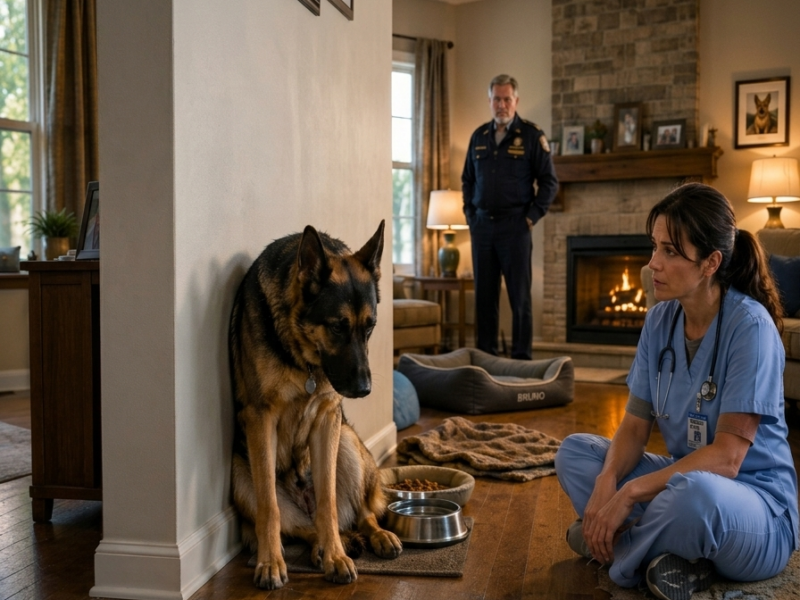
The moment I stepped into a private military hospital in Norfolk, Virginia, a Navy admiral ordered me to treat his supposedly dying K9 and warned me not to ask questions
The moment I stepped into a private military hospital in Norfolk, Virginia, a Navy admiral ordered me to treat his supposedly dying K9 and warned me not to ask questions, but the German Shepherd wasn’t staring at the wall because he was sick—he was watching something everyone else had been paid to ignore.
I had been a veterinary nurse for eleven years, and I had never seen a dog look so terrified of an empty corner.
The German Shepherd lay on a gray blanket beside the admiral’s bed, his powerful body trembling despite the warm, temperature-controlled room. His black-and-tan coat was dull from stress, his ribs visible beneath a tactical harness that looked far too heavy for a dog in his condition.
His name was Ranger.
Admiral Thomas Whitmore stood near the tall window overlooking the foggy harbor, his uniform immaculate, his brass buttons catching the dim morning light, his expression carved from stone. He was a man accustomed to having his commands executed without a second thought.
“He stopped eating three days ago,” Whitmore said, his voice deep and gravelly. “The military doctors say his organs are shutting down due to old age and combat trauma. I want a second opinion.”
I knelt beside Ranger on the cold linoleum floor and held out my hand, palm up, speaking in a low, gentle voice.
He didn’t sniff it. He didn’t even acknowledge my presence.
His dark eyes remained fixed on the same patch of pale green plaster wall near the baseboard, his breathing shallow and rapid. When I moved a few inches closer, his lips curled back to reveal sharp white teeth, releasing a low, warning growl that vibrated through the floorboards.
Not toward me. Toward the wall.
“Has he always done this?” I asked, keeping my body language relaxed.
The admiral’s jaw tightened, a tiny muscle twitching near his ear. “Treat the dog, Nurse Parker, and leave the rest to people who understand what they’re doing.”
I swallowed my questions, reaching into my canvas medical kit to pull out a stethoscope and a thermal scanner. I began checking Ranger’s pulse, temperature, and breathing, but something felt fundamentally wrong. His temperature was normal, and his muscle tone was firm, yet his heart was pounding at an alarming rate—over one hundred and eighty beats per minute.
I noticed a strange pattern. His heart raced whenever I shifted my weight toward the corner near the wall. When I stepped away, his pulse slowed noticeably.
I stood up slowly, walked over to the section of plaster Ranger was watching, and pressed my bare palm against it.
It felt strangely cold—far colder than the surrounding drywall, as if a thick layer of ice or a hollow subterranean draft lay directly behind the stone structure.
Before I could process the sensation, Ranger suddenly leaped from his blanket, caught the fabric of my left sleeve between his teeth, pulled me backward with incredible force, and whined with a guttural desperation that made my stomach twist into a knot.
“Easy, boy,” I whispered, dropping to my knees beside him.
He released my sleeve immediately, refusing to bite down, then sat on his haunches and stared back at the plaster again, his ears pinned flat against his skull.
That was when I noticed the faint, dark scratches near the wooden baseboard. They weren’t random dog marks. They were precise, deliberate incisions carved into the wall—three short vertical lines, repeated over and over in identical clusters of three, as if someone had been trying to mark the exact same spot in total darkness.
I looked back toward the admiral. For the first time since I had entered the room, the stoic officer looked genuine fear reflecting in his eyes.
“Please,” Whitmore said quietly, his hands trembling slightly as he folded them behind his back. “Just give him something to calm him down.”
His voice had completely changed. It no longer sounded like an official military order. It sounded like a desperate plea.
I felt a cold wave of realization wash over me. I had lost my younger brother, Caleb, a Navy corpsman, two years earlier during a classified counter-terrorism operation in the Middle East. His death had been scrubbed from official records, and the only thing returned to our family was a tightly folded American flag, a silver watch with a broken face, and a cold form letter thanking us for his ultimate sacrifice.
I had learned over those two painful years to stop asking military officials questions, because every answer I sought seemed to lead to another locked door, another sealed file, or a warning from federal agents to let the past stay buried.
But Ranger was looking at that wall the same way my brother Caleb used to stare at our bedroom door when violent nightmares woke him as a terrified child.
I turned back to the trembling German Shepherd and gently brushed aside his thick fur, noticing a faded, tarnished silver identification tag hidden beneath his tactical leather collar. Most of the original military engraving had worn away from years of dirt and hard weather.
Only one line remained clearly visible, stamped deep into the metal plate:
M. PARKER.
My surname.
My hands went completely numb. The room seemed to tilt beneath my feet.
The admiral took one step toward me, opening his mouth to speak, but stopped abruptly when Ranger rose to his feet for the first time all morning. The dog placed his powerful body directly between Whitmore and me, his hackles raised, his chest emitting a deep, continuous rumble.
“Where did you get this dog?” I whispered, my voice shaking violently as I looked up at the admiral.
Whitmore closed his eyes, letting out a long, heavy sigh that seemed to age him ten years in a single second.
“Your brother saved him,” Whitmore said softly. “During an unsanctioned raid in Sector Seven. And before Caleb died… he made me swear an oath to make sure you never came to this facility.”
A terrible, suffocating silence filled the room, punctuated only by the hum of the air filtration units and the dog’s heavy breathing.
I stared at the scratched plaster, the trembling dog standing guard over me, and the high-ranking officer who had spent the entire morning pretending this was nothing more than an ordinary house call for a sick pet.
“What’s behind that wall, Admiral?” I asked, my voice hardening into steel.
He didn’t answer.
Instead, Ranger suddenly barked three times—a sharp, piercing signal—and pressed his right front paw firmly against a loose, darkened section of the lower plaster trim.
A soft, pneumatic mechanical click echoed from inside the wall cavity.
The admiral went ghostly pale, taking a step backward until his spine hit the glass window.
Because whatever had been sealed inside that hidden room for two long years had just recognized the one person my brother had trusted to find it.
A thin seam in the plaster split open, releasing a blast of ice-cold air into the room, and from the darkness beyond the hidden door, an audio transmitter flickered to life, broadcasting a recorded voice I had buried with my brother two years ago softly whispering my name:
“Maya… if you’re listening to this… they lied about everything.”
The voice coming through the concealed speaker sent a wave of electric shock straight down my spine. It was Caleb’s voice—unmistakable, slightly raspy, carrying the familiar southern cadence of our childhood home.
Ranger didn’t bark again. He sat down at the edge of the opening, his body relaxing for the first time since I had stepped into the room, his long tail sweeping across the floorboards in a slow, rhythmic motion.
“Admiral Whitmore,” I said, turning slowly to face the officer, my hands clenched into tight fists at my sides. “You have five seconds to tell me what is happening here, or I walk out that door and bring every local news crew in Norfolk to this hospital.”
Whitmore reached into his uniform jacket. For a split second, I thought he was reaching for a weapon, but he pulled out a small electronic jammer, switched it on, and placed it on the bedside table. A low blue light began to pulse on the device, cutting off all external cellular and radio signals.
“If you walk out that door, Maya, neither you nor I will live to see the sunset,” Whitmore said, his tone devoid of any military posturing. “That jammer buys us ten minutes before security sweeps detect an anomaly in this room.”
“My brother died two years ago!” I shouted, tears finally breaking through my composure. “I buried him in Arlington!”
“You buried an empty casket filled with seventy pounds of sand,” Whitmore revealed, his voice dropping to an urgent whisper. “Caleb was never killed in the Middle East. He was part of Project Deep Water—a black-budget medical and intelligence unit operating out of this very facility.”
I looked at the open seam in the plaster wall. Darkness stretched beyond the opening, revealing a narrow, concrete staircase descending into the bedrock beneath the hospital foundations.
“Why did he leave this dog with you?” I demanded. “Why did he stamp my name on his tag?”
“Because Ranger wasn’t just a military working dog,” Whitmore explained, walking toward the door to lock the heavy deadbolt. “Ranger was trained to recognize human DNA profiles. Caleb programmed Ranger’s biological tracking parameters with your genetic markers before he vanished. The dog wasn’t sick, Maya. He was waiting for you. His body was shutting down because I had to keep him sedated to prevent him from tearing this room apart trying to open that door.”
My mind whirled with horror and confusion. “Where is Caleb?”
“Down there,” Whitmore said, pointing down the dark staircase. “Or at least, what’s left of his research.”
“I’m going down,” I said, pulling a heavy tactical flashlight from my medical kit.
“Maya, listen to me!” Whitmore grabbed my shoulder with a firm grip. “The men who funded this facility—the contractors behind Sector Seven—they think Caleb destroyed the master files before he was captured. If they find out that Ranger successfully guided you to the local server vault, they will erase this entire wing of the hospital.”
“Captured?” My breath hitched in my throat. “You said he vanished! Is he alive?”
“I don’t know,” Whitmore admitted, his eyes filled with profound guilt. “Eighteen months ago, a rogue paramilitary group intercepted Caleb’s transport off the coast of North Carolina. I was ordered to declare him dead and close the file. I kept Ranger in my private quarters here under the guise of an officer’s personal pet to protect him from being euthanized by the agency.”
Ranger nudged my hand with his cold nose, then stepped through the open plaster seam, nudging the concrete door wider with his snout. He looked back over his shoulder at me, whining softly, inviting me into the dark.
I didn’t hesitate. I stepped past the threshold, switching on my flashlight.
The air in the shaft was freezing, smelling heavily of damp concrete, copper, and old paper. The beam of my light cut through the gloom, illuminating a line of rusty steel handrails leading down into a vaulted underground bunker.
Whitmore followed close behind me, pulling a suppressed pistol from a hidden holster inside his coat.
“If security comes down those stairs, stay behind me,” the admiral warned.
We descended forty feet beneath the hospital foundation, our footsteps muffled by the thick layer of dust covering the stairs. At the bottom of the flight lay a heavy steel blast door, its electronic keypad smashed to pieces, its emergency locking bars thrown wide open.
Ranger trotted ahead, his paws clicking on the floor as he guided us into a vast, abandoned laboratory space.
Dust-covered computer monitors, shattered glass vials, and surgical tables sat untouched in the dark. Rows of empty cages lined the left wall—cages designed for large animals, equipped with complex biometric monitoring sensors identical to the ones used in human intensive care units.
“What were they doing down here?” I asked, sweeping my light across a shattered glass partition marked with biohazard symbols.
“They were testing neural bridging protocols,” Whitmore answered grimly. “Using advanced synthetic interface implants to link military handlers directly to their working animals in high-threat combat environments. Caleb was the lead medical officer assigned to monitor the biological toll on the subjects.”
I stopped in front of a primary workstation console in the center of the room. The terminal was dead, but sitting on top of the keyboard was an old leather-bound journal—the exact same style of notebook my brother used to keep during his time in veterinary corps training.
I reached out with a trembling hand and opened the cover.
Inside, written in Caleb’s neat, precise handwriting, were hundreds of pages of medical notes, diagnostic charts, and personal entries.
I turned to the final page, dated two years ago—the night before he officially disappeared.
If you are reading this, Maya, it means Ranger brought you home. Don’t trust Whitmore. Don’t trust the Navy. The program wasn’t designed to save dogs. It was designed to replace human soldiers with remote-controlled weapons. I hid the core drive inside Ranger’s secondary tracking capsule. Forgive me for leaving you in the dark.
I dropped the journal, turning around rapidly to look at the dog.
Ranger was standing beside a steel surgical table, looking up at me with calm, intelligent eyes.
And behind me, I heard the heavy blast door at the top of the stairs slam shut with a thunderous, definitive boom.
Whitmore raised his weapon, pointing it directly at the back of my head.
“I’m sorry, Maya,” Whitmore whispered, his voice cold and devoid of his earlier desperation. “I really wished Caleb had taken that drive with him when he died.”
The silence in the concrete bunker was absolute, broken only by the low, mechanical hum of the emergency ventilation shafts high above our heads.
I kept my back turned to Whitmore, staring down at my brother’s journal on the steel table. My heart slammed against my ribs like a trapped bird, but the shock of his betrayal was quickly replaced by a sharp, icy clarity.
“You never cared about the dog,” I said quietly, keeping my hands visible near my waist. “You brought me here because you knew Ranger wouldn’t unlock the vault for you.”
“Ranger’s biometric interface was hardcoded to Caleb’s immediate family,” Whitmore admitted behind me, the barrel of his suppressed pistol remaining completely still. “I spent eighteen months trying to force this animal to open the secondary server array. He almost tore my throat out twice. But I knew if I brought his sister into the room, his behavioral programming would override his aggressive instincts.”
“Caleb warned me about you in his diary,” I said, turning around slowly to face the admiral.
Whitmore looked different under the harsh beam of my flashlight. The refined military commander had vanished, replaced by a cold, calculating contractor who had spent years operating in the shadows of black-budget defense programs.
“Caleb was an idealist, Maya,” Whitmore spat, stepping forward. “He thought he was saving lives. He didn’t understand that in modern warfare, human beings are the most expensive, inefficient liability on the battlefield. The synthetic neural link your brother helped create allows a single operator to command a squad of biological assets with pinpoint accuracy.”
“They’re living creatures!” I snapped, glancing down at Ranger, who was quietly crouching beside my boots, his muscles coiled tight, waiting for my signal. “You turned noble, loyal animals into suicide bombs!”
“I built a multi-billion-dollar defense platform!” Whitmore corrected, his eyes flashing with anger. “And your brother stole the master encryption key before my buyers could finalize the contract. Now, hand over the tracking capsule from Ranger’s collar, and I’ll make sure your death is listed as a tragic medical accident.”
I reached down toward Ranger’s collar, my fingers brushing against the faded metal identification tag stamped with my surname.
“Caleb didn’t hide the drive in his tag, Whitmore,” I lied smoothly, keeping my voice steady while watching the admiral’s eyes. “He hid it beneath the dog’s subcutaneous tracking chip behind his shoulder blade. You need a veterinary surgeon to remove it without destroying the neural flash memory inside.”
Whitmore hesitated for a fraction of a second, his eyes darting toward Ranger’s shoulder.
“You’re lying,” Whitmore warned, raising the pistol higher.
“Try shooting us and see what happens to the drive,” I challenged, taking a step closer to the surgical table. “These neural capsules are lined with volatile lithium micro-cells. One kinetic impact from a bullet, or one improper incision from an amateur, and the entire master file incinerates itself.”
That was the turning point. Whitmore was a military officer, not a veterinarian. He didn’t know the exact physical construction of the experimental implants. His greed override his caution.
“Step over to the surgical table,” Whitmore ordered, gesturing with his gun. “Remove it now. If you try anything clever, I shoot the dog first.”
I walked toward the stainless steel table, setting my canvas medical bag down on the metal surface. Ranger followed me in complete silence, leaping onto the low examination platform without needing a command.
I opened my medical kit, pulling out a pair of surgical gloves, a bottle of antiseptic, and a stainless steel scalpels.
“I need you to hold his restraint harness while I make the incision,” I told Whitmore, keeping my tone professional and detached. “If he twitches during the extraction, the chip will short-circuit.”
Whitmore gritted his teeth, stepped closer to the table, and lowered his weapon slightly as he reached out with his left hand to grip Ranger’s leather tactical harness.
“Make it fast,” Whitmore growled, leaning his face over the dog’s shoulder.
I didn’t reach for the scalpel.
I reached for the high-concentration bottle of medical ammonia spray I used for reviving unconscious animals in field emergencies.
In one fluid motion, I spun around and sprayed the concentrated chemical directly into Whitmore’s eyes.
The admiral screamed in agonizing pain, dropping his weapon as the blinding chemical burned his retinas. He stumbled backward, firing two wild shots into the concrete ceiling that echoed like thunderclaps through the enclosed room.
“Ranger! Take him down!” I yelled.
Ranger didn’t hesitate. The German Shepherd launched himself off the table like a missile, his powerful jaws locking around Whitmore’s gun arm, driving the six-foot-two officer violently to the concrete floor.
Whitmore’s pistol clattered across the floorboards, sliding under a row of heavy metal filing cabinets.
“Maya! Get to the control room!” a voice suddenly boomed through the laboratory’s emergency intercom system.
It wasn’t a recording this time. It was live.
I whirled around toward the far glass partition of the lab. A red emergency light was flashing inside the secondary control booth, and standing behind the bulletproof glass, holding a manual override terminal, was a man in a torn military uniform.
His face was covered in scars, his left arm supported by a carbon-fiber brace, but his eyes were instantly recognizable.
It was my brother Caleb.
My knees nearly gave out beneath me. I gripped the edge of the steel surgical table to keep from collapsing, staring through the thick glass partition at the ghost who had haunted my dreams for two years.
“Caleb?” I screamed over the sound of the alarm sirens echoing through the bunker.
“Maya! Lock Whitmore in the holding cell!” Caleb’s voice came crackling through the intercom speaker above. “The security team upstairs just breached the jammer! We have less than three minutes before the automated defense systems purge this sub-level!”
On the floor, Whitmore was groaning in pain, clutching his bleeding arm while Ranger stood over him, his jaws dripping with saliva, his deep growl keeping the admiral pinned to the floor.
I grabbed Whitmore’s fallen tactical belt, unhooking his heavy steel handcuffs. I dragged the blinded officer into a nearby reinforced isolation cage—one of the very cages he had used to house experimental animals—and slammed the heavy iron bar shut, turning the mechanical key in the lock.
Whitmore slammed his fists against the iron bars, blood running down his sleeve. “You don’t know what you’re doing, Parker! If those files leak, half the Joint Chiefs will go to prison!”
“Good,” I spat, throwing the key into the dark corner of the room.
I ran toward the side door of the control booth, Ranger trailing right at my heels. I slammed my shoulder against the emergency bar, breaking into the brightly lit observation room.
Caleb turned away from the main terminal screen. Up close, he looked frail, his skin pale from years without sunlight, his hands trembling as he typed rapidly into a command line interface.
Before he could say another word, I threw my arms around his neck, hugging him so tightly I could feel the mechanical frame beneath his jacket. Tears burned my eyes, wetting his torn uniform collar.
“You’re alive…” I sobbed, holding his face in my hands. “You’re really alive…”
“I’m sorry, Maya,” Caleb whispered, his voice cracking with emotion as he held me close. “I’m so sorry I let you think I was dead. It was the only way to keep Vance’s people from coming after you.”
“Whitmore said you were captured eighteen months ago!”
“I was,” Caleb admitted, looking down at Ranger, who was resting his head against my brother’s knee, whining softly. “They kept me in a medical holding facility in Maryland, trying to force me to give up the primary encryption codes. Three days ago, Ranger managed to escape Whitmore’s quarters and triggered an internal security alert that gave me the window I needed to break out.”
“How did you get down here without being seen?” I asked.
“I’ve been hiding in the service tunnels beneath this hospital for forty-eight hours,” Caleb explained, gesturing to the complex wiring harnesses hooked into the terminal. “I knew Whitmore would eventually bring you into this room once he realized Ranger wouldn’t cooperate with anyone else. I used the ventilation controls to guide the dog toward that wall.”
Suddenly, the green terminal screen flashed a bright crimson warning display:
SECURITY BREACH DETECTED: LEVEL 4 PURGE PROTOCOL INITIATED BY EXECUTIVE AUTHORITY. THERMITE OVERLOAD IN 180 SECONDS.
“They’re blowing the facility,” Caleb said, his face hardening as he inserted a small silver thumb drive into the console. “They’re activating thermite charges built into the structural pillars to collapse this entire wing of the hospital and burn every hard drive in the building.”
“Can you stop the timer?” I asked, looking at the countdown ticking rapidly down from 2:45… 2:44…
“No,” Caleb said, pulling the silver thumb drive from the slot as a green confirmation bar lit up. “The purge code was hardcoded into the facility’s master safety protocols. But I just uploaded the entire Project Deep Water archive—every name, every contract, every illegal medical record—directly to federal prosecutors and three major international news networks.”
A deep, violent explosion shook the subterranean bunker, sending thick clouds of white concrete dust showering down from the ceiling. The glass partition in the lab shattered into thousands of tiny pieces.
“The main stairs are blocked!” I yelled, looking at the monitoring screens, which showed the upper stairwell engulfed in roaring orange flames.
“We aren’t going up,” Caleb said, grabbing his tactical bag and slinging it over his shoulder. He reached down and unhooked a heavy iron maintenance grate in the floor of the control booth. “This drainage tunnel leads directly into the Norfolk storm sewer system. It empties out into the Elizabeth River half a mile south of the naval station.”
“Can you make it with your leg?” I asked, looking at his heavy carbon brace.
Caleb looked at me, then down at Ranger, a grim smile touching his lips. “I’ve spent two years waiting to walk in the sunshine again, Maya. I’m not stopping now.”
A second explosion ripped through the outer laboratory wall. Steel support beams groaned under thousands of tons of shifting concrete as the ceiling began to cave in over Whitmore’s cage.
“Caleb! What about Whitmore?” I shouted over the deafening roar of falling debris.
Caleb glanced through the shattered window at the trapped admiral, who was screaming for help as dust engulfed his iron cage.
Caleb picked up a heavy fire axe from the wall frame, sprinted out into the lab, and swung the heavy blade against the cage lock mechanism with incredible force. The iron latch shattered, dropping the cage door open.
“Run, Whitmore!” Caleb shouted over the chaos. “The service elevator in Sector B still has power! Get out before the roof drops!”
Without waiting for the admiral’s response, Caleb sprinted back into the control booth, grabbed my hand, and pointed down into the dark drainage pipe.
“Ranger, lead the way!” Caleb commanded.
The German Shepherd barked once, diving headfirst into the dark concrete tunnel, his powerful body moving with incredible speed through the narrow pipe.
I slid down into the darkness right behind him, feeling the cool rush of flowing river air against my face, while behind us, the hidden subterranean laboratory of Sector Seven collapsed into a mountain of fire and twisted steel.
The rushing water in the drainage pipe was freezing cold, reaching up to my knees as we staggered through the pitch-black tunnel. The sound of exploding thermite charges beneath the hospital faded behind us, replaced by the hollow echo of our splashing footsteps and Ranger’s steady, reassuring breathing ahead.
Caleb held my wrist tightly, his mechanical leg brace making a rhythmic clicking sound with every step he took through the dark water.
After ten agonizing minutes of navigating the slippery concrete conduit, a circle of bright, blinding daylight appeared at the far end of the tunnel.
Ranger broke into a fast trot, bursting through the rusty iron outlet grate and splashing into the shallow mud flat along the bank of the Elizabeth River.
I stumbled out into the warm afternoon sunshine, collapsing onto the grassy riverbank, my lungs gasping for fresh air that didn’t smell like sulfur, copper, or burnt concrete.
Caleb dropped down beside me, unbuckling his heavy tactical vest and throwing it onto the mud. He leaned his head back against the grassy embankment, closing his eyes, letting the warm autumn sun wash over his scarred, weathered face.
Ranger immediately trotted over, shaking river water from his thick coat before laying his heavy head directly across Caleb’s lap.
Overhead, the deep blue Virginia sky was clear and vast, free of storm clouds. In the distance, across the bay, the sirens of Norfolk emergency vehicles were wailing, responding to the massive structural collapse in the abandoned sub-basement of the military hospital.
“Is it over?” I asked, wiping dried mud and sweat from my forehead as I looked at my brother.
Caleb reached into his pocket, pulled out the silver master drive containing the decrypted files, and held it up into the sunlight.
“It’s over, Maya,” Caleb said softly, his voice trembling with relief. “The moment those files hit the public servers, the federal court issued emergency arrest warrants for every officer and defense contractor involved in Project Deep Water. Whitmore’s program is dead.”
“What about us?” I asked, reaching out to stroke Ranger’s soft ears. “The agency… Vance’s contractors… they know who we are.”
“They don’t have an agency anymore,” Caleb said, looking at me with clear, bright eyes. “Federal marshals secured the primary command node twenty minutes ago based on the automated transmission I sent from the lab terminal. We’re being taken into federal witness protection under direct authority from the Department of Justice.”
A high-speed civilian boat swept around the bend of the river, its hull painted white with official federal agency markings. Standing on the forward deck were four armed federal marshals, waving a white signal flag to indicate they were the extraction team Caleb had arranged.
The boat eased up to the muddy bank, its engines idling smoothly in the quiet river current.
The lead marshal, a tall woman with graying hair and a silver badge pinned to her coat, stepped down onto the muddy shore and looked at Caleb, then at me, and finally at the dirty German Shepherd sitting beside us.
“Dr. Caleb Parker?” the marshal asked, her voice firm but respectful.
“Yes, ma’am,” Caleb replied, pushing himself up from the grass with my help.
“I’m Special Agent Miller, Department of Justice,” she said, offering her hand to my brother. “We received your data package. The Attorney General has already unsealed the indictments. You and your family are under full federal protection.”
She looked down at Ranger, who stood at attention beside my boots, his ears perked up, his dark eyes scanning the riverbank with calm alertness.
“Is this the dog who held the encryption key?” Agent Miller asked, a small smile breaking through her stern expression.
“This is Ranger,” I said, resting my hand on his head, feeling the powerful, steady beat of his heart against my palm—no longer racing, no longer terrified. “He’s a decorated veteran.”
“Well, Officer Ranger,” Agent Miller said, stepping aside to invite us onto the boat. “Your service is officially complete. Let’s get you all home.”
Caleb and I walked up the gangway onto the vessel, with Ranger stepping proudly right between us, his long tail waving in the wind.
As the boat pulled away from the shore, heading down the sparkling river toward the open bay, I looked back one last time at the distant skyline of the Norfolk naval facility.
The dark shadows of the past two years were fading behind us in the wake of the boat’s propellers, dissolving into the clear, open water.
I put my arm around my brother’s shoulders, feeling the warmth of the sun on my face, and leaned down to whisper into Ranger’s ear:
“Good boy, Ranger. You brought us home.”
The end









