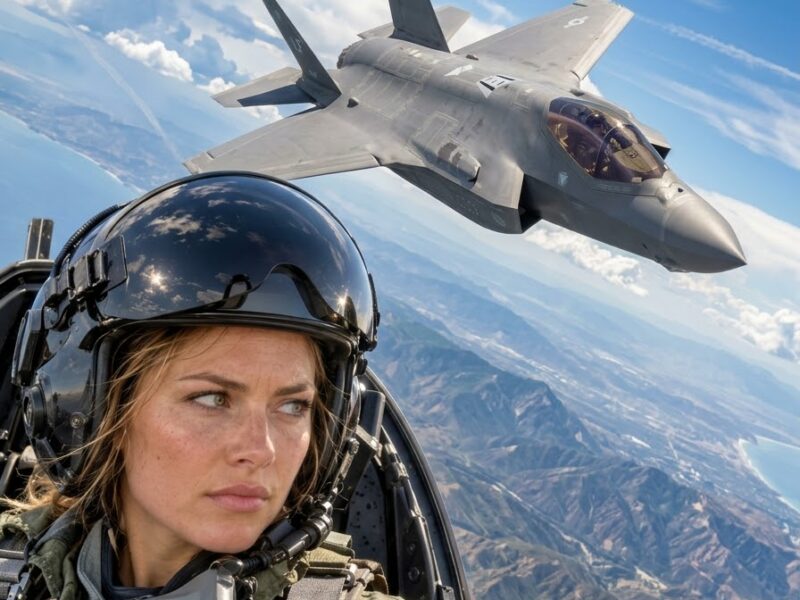
The moment I rolled my battered pickup onto the Naval Air Station Fallon flight line, the Top Gun instructors laughed when they saw my muddy boots
The dust of the Nevada desert did not care about military protocol. It coated the worn chrome of my 1998 Ford F-150 just as heavily as it did the sleek, radar-absorbent paint of the multimillion-dollar stealth jets lined up along the tarmac of Naval Air Station Fallon. I killed the engine, the rusty V8 shuddering to a final halt outside the secondary hanger of the Strike Fighter Tactics Instructor program—better known to the world as Top Gun.
When I stepped out, my work boots made a heavy, dull thump against the heat-baked concrete. The leather was scuffed raw at the toes, darkened by years of Montana soil, tractor grease, and the engine oil of a 1946 Piper Cub crop-duster.
A group of aviators in crisp, tailored flight suits stood near the flight line, helmets resting against their hips. As I walked toward them carrying a battered canvas duffel bag, a few of them nudged each other. Soft chuckles floated across the shimmering heat waves of the tarmac.
“Hey, mechanic’s entrance is around back,” one of them called out, his voice dripping with relaxed arrogance.
I didn’t answer. I kept my head high, shielding my eyes from the blinding noon sun. I was Maya Vance. To them, I was an anomaly—a civilian farm girl from Big Sky Country who had somehow bypassed years of Naval Aviation Schools Command through a hush-hush, experimental civilian integration initiative called Project Apex. The Navy wanted to see if non-military pilots with unconventional flight hours could adapt to fifth-generation fighter systems. To these men, I was a political stunt waiting to crash.
Standing at the center of the group was Lieutenant Mason Reed. His callsign was “Viper,” but everyone just called him the Golden Boy. Tall, broad-shouldered, with aviator glasses reflecting the scorched desert landscape, Mason was Fallon’s premier instructor. He had more simulated air-to-air kills than anyone in his squad.
Mason stepped forward, looking down at my mud-crusted boots, then up to my face. The smirk on his lips was effortless. “You Vance?”
“I am,” I said, keeping my tone flat, steady.
“I’ve seen some strange things come through Fallon, Vance, but usually they wear a uniform,” Mason said, folding his arms. He glanced back at his fellow instructors, who grinned on cue. “You spent five thousand hours flying over cornfields at eighty knots. Today, you’re stepping into an F-35 Lightning II. It flies at Mach 1.6, processes two million lines of code a second, and punishes mistakes with high-speed impact. Try not to embarrass yourself up there.”
I looked him dead in the eye. The memory of my father’s quiet, calloused hands on the wooden throttle of our family duster flashed through my mind.
“Try to keep up,” I said softly.
The smirk faltered from Mason’s face, just for a fraction of a second, replaced by a sudden, sharp coldness. “Flight suits are inside. Briefing in ten.”
Inside the briefing room, the atmosphere was sterile and quiet. The mission was simple: an unscripted 1-v-1 basic fighter maneuver exercise over the Dixie Valley airspace. Mason would play the aggressor; I was the defender. The goal was air dominance.
Thirty minutes later, I was strapped into the cockpit of the F-35. The carbon-fiber helmet settled heavy on my head, the synthetic aperture system feeding a three-hundred-and-sixty-degree digital view of the world straight to my visor. The jet felt alive around me, a hum of sheer power vibrating through the ejection seat. Yet, despite the modern electronics, as the canopy sealed shut with a pneumatic hiss, the claustrophobic silence felt familiar.
It felt like the cockpit of the old duster late at night, when my father would let me take the controls over the Absaroka Mountains.
“The instruments tell you what the plane is doing, Maya,” my father’s voice echoed in my head, as clear as if he were sitting behind me. “But the wind tells you what the plane is going to do. Feel the air before it hits the wing.”
“Apex One, you are clear for departure, Runway 13 Left,” the tower crackled in my headset.
I shoved the throttle forward. The Pratt & Whitney F135 engine roared to life, generating forty thousand pounds of thrust. The jet shot down the runway and leaped into the cloudless Nevada sky.
Below me, the earth shrank instantly. The mountains looked like jagged spine bones sticking out of the sand. Within three minutes, we reached the designated airspace over the desert floor.
“Apex One, this is Aggressor,” Mason’s voice came through the comms, cold and deliberate. “Fight’s on.”
Immediately, my tactical display flared. Mason hadn’t hesitated. Using the F-35’s advanced AN/APG-81 radar, he had locked onto me from twenty miles out, diving out of the blinding glare of the sun to close the distance before I could establish a baseline tracking profile. In a standard dogfight, a civilian pilot’s brain would freeze, overwhelmed by the visual clutter of the helmet overlay.
I took a slow, deep breath. I turned off my reliance on the digital flight path indicator. I didn’t look at the screen; I looked out at the jagged peaks of the Stillwater Range below.
The heat rising from the desert floor created massive thermal updrafts, squeezing violently through the narrow mountain canyons. Mason was flying by the textbook—maintaining energy management, staying high, preparing to drop behind me for a gun-kill simulation. He expected me to pull up into a standard high-yo-yo to conserve airspeed.
Instead, I pushed the stick forward and dumped the nose straight down toward the canyon floor.
“What the hell are you doing, Apex One?” the range controller’s voice cut in, laced with sudden panic. “You are below minimum safe altitude!”
Mason’s jet flashed past above me, his sensor array losing lock as my aircraft dipped below his radar horizon, masked by the heavy ground clutter of the canyon walls.
“Where did she go?” Mason’s voice crackled, no longer smooth, no longer arrogant. It had a sharp, nervous edge.
I didn’t answer. Down in the canyon, the turbulent desert air slammed against my wings, threatening to tear the controls from my grip. Standard doctrine said to fight the turbulence with computer-assisted roll inputs. But I didn’t fight it. I let the updraft catch my left wing, riding the wind curve just like I used to ride the mountain waves back in Montana.
I pulled a violent, high-G bank, slicing through a gap in the ridge that no military manual would ever recommend. The F-35 roared, its thrust-vectoring capabilities blending with the natural aerodynamic pressure of the canyon.
I emerged from the shadows of the valley directly behind Mason’s tail. He was still searching the horizon above.
I pressed the red weapons engagement button on the stick.
“Tone,” the automated voice sang in my ears. “Fox Two.”
A simulated missile track locked onto the tailpipe of Mason’s jet.
The range control room went dead silent. For five agonizing seconds, no one spoke over the frequency.
Then, the controller cleared his throat, his voice trembling slightly. “Aggressor… Apex One has simulated kill on you. Exercise paused.”
“Check your sensors!” Mason barked, his voice cracking violently across the channel. “That was a glitch! She drifted off the boundary grid! Reset the push! Reset!”
“Negative, Aggressor,” the controller replied. “Kill confirmed.”
“Run it back!” Mason demanded, his breathing heavy over the mic. “Run it back right now!”
We reset. Second run.
This time, Mason tried to out-climb me, taking advantage of his engine thrust to pull me into a high-altitude stall fight. I let him climb, trailing behind him just enough to make him think he had the positional advantage. Then, as my airspeed bled out to near zero, I kicked the rudder, dropped the flaps, and allowed the tail to slide sideways in a controlled slip—a maneuver used by old-school crop-dusters to dump altitude instantly without losing nose control.
The F-35 rotated on its center of gravity. My nose pointed directly at him as he slid past.
BEEP-BEEP-BEEP.
“Kill two confirmed,” the controller announced quietly.
Third run. Mason attempted a low-altitude sweep. I caught him in a vertical scissor, reading the wind shear off the northern ridge three seconds before he felt it. The draft threw his alignment off by a fraction of a degree. It was all I needed.
“Kill three confirmed,” the controller said. “Apex One, Aggressor, RTB. Return to base.”
When I taxied the F-35 back onto the apron and shut down the engine, the tarmac felt different. The laughter was gone. The instructors standing near the hangar doors weren’t nudging each other anymore. They were staring at my aircraft in absolute, stunned silence.
I popped the canopy, climbed down the ladder, and unclipped my helmet. Sweat soaked my hair, sticking it to my forehead.
Mason was already out of his cockpit, walking toward me. His face was pale, his jaw clenched tightly. He stopped five feet away, staring at me as if he were looking at a ghost. He didn’t say a word. He couldn’t.
Before I could grab my canvas bag, an older man stepped out from the shadows of the hangar. He wore a Commander’s uniform, his temples graying, his chest covered in operational ribbons. He carried a thick, faded brown manila folder under his arm.
He walked past Mason without looking at him and stopped right in front of me.
“I’m Commander Miller, Chief of Tactics here,” the man said, his voice low, gravelly, and entirely unreadable. He looked down at my muddy work boots, then up into my eyes. “Where did you learn that tail-slip transition in the canyon, Vance?”
“My father,” I said simple, wiping the sweat from my eyes. “He taught me how to fly the air, not the metal.”
Commander Miller didn’t smile. He slowly opened the manila folder. Inside was not my application, nor my civilian pilot logbooks.
It was a black-and-white military photograph from twenty years ago.
In the photo, a sleek, classified experimental prototype aircraft stood in an unmarked hangar. Standing in front of the jet, wearing a dark green flight suit with an unmarked patch, was a young man with familiar, piercing blue eyes and a quiet, crooked smile.
My breathing stopped. The desert heat seemed to freeze around me.
“That’s… that’s my dad,” I whispered, my voice trembling for the first time all day. “That’s impossible. He was a crop-duster in Bozeman. He spent his whole life fixing tractors and flying fifty feet above alfalfa fields.”
Commander Miller looked at me with deep, solemn eyes. “Your father wasn’t a crop-duster, Maya.”
“What are you talking about?”
“He was ‘Ghost-Zero.’ He was the lead test pilot for the Defense Advanced Research Projects Agency,” Miller said, lowering his voice so only I could hear. “He was the man who personally designed and flight-tested the low-altitude fluid-dynamics maneuvers for the fifth-generation stealth program. The very maneuver you just used to destroy my best instructor.”
My mind spun. Memories of my childhood—the late nights my father spent staring out at the stars, the absolute secrecy surrounding his old metal locker in the barn, the precise, military discipline masked beneath a farmer’s worn denim—shattered into a thousand pieces.
Commander Miller turned the photograph over.
Written on the back in dark, faded black ink was my father’s handwriting. I would recognize those sharp, angled letters anywhere. Below a handwritten set of flight coordinate vectors was a single sentence:
Teach her when she’s finally ready.
“He died three months ago,” I stammered, tears suddenly stinging the corners of my eyes. “Cancer. He never said a word…”
“He couldn’t,” Miller said softly. “Not until you proved you had his hands on the stick. The Navy didn’t pick your application out of a random stack, Maya. Your father set this protocol in motion fifteen years ago. And what you did up there today… that wasn’t just a test.”
Miller reached into the folder and pulled out a key with a small steel brass tag stamped with a six-digit number.
“What is this?” I asked.
“That’s the key to Hangar 7,” Miller replied, pointing toward an isolated, unmarked concrete bunker at the far edge of the base, surrounded by double-layer chain-link fencing and armed guards. “What your father built out in Montana was only half the story. The rest of his work is waiting for you inside.”
The key felt icy cold against my palm despite the sweltering Nevada heat. I stared across the shimmering concrete toward Hangar 7. It sat isolated from the main flight line, shrouded behind reinforced blast doors and razor-wire fencing. Two heavily armed Security Forces guards stood at the gate, their eyes tracking my every movement as I walked toward them beside Commander Miller.
“Commander, what is in there?” I asked, my voice barely louder than a whisper over the distant whine of jet turbines.
“Answers, Maya,” Miller said without looking at me. “And a legacy your father spent twenty years hiding from the wrong people.”
Behind us, I heard fast, heavy footsteps on the tarmac. Mason Reed was catching up, his flight helmet slung violently over his shoulder. His face was flushed with a mixture of wounded pride and desperate confusion.
“Sir!” Mason called out, stopping short of the guard perimeter. “With all due respect, what the hell just happened out there? She breached low-altitude safety thresholds, broke formation, and used non-standard tactical inputs! I demand a formal debriefing!”
Miller stopped and turned around slowly. The authority in his posture made Mason instantly stiffen.
“Lieutenant Reed,” Miller said coldly. “You were beaten today because you fly according to a computer manual written by engineers sitting in an air-conditioned office in Maryland. She flies according to the physics of the sky. Go back to the ready room, evaluate your telemetry, and figure out why a girl in mud-stained boots just put three virtual missiles through your tailpipe.”
Mason’s jaw worked silently. He shot a look at me—no longer arrogant, but filled with a dangerous, sharp curiosity. He looked at the brown folder in Miller’s hand, then at the key in my fist.
“This isn’t over, Vance,” Mason said under his breath before turning on his heel and marching back toward the squadron building.
“Ignore him,” Miller said, turning back to the gate. “Reed is a good pilot, but he’s blind to what lies beyond the system limits. Your father saw it thirty years ago.”
Miller swiped a high-clearance security card at the gate keypad, and the guards stepped aside, saluting briskly. We walked up to the heavy steel door of Hangar 7. I inserted the key into the mechanical lock beneath an electronic fingerprint scanner. Miller pressed his thumb against the glass panel.
With a deep, mechanical thud, the heavy iron bolts disengaged. The blast doors slowly slid open with a screeching groan of heavy machinery, revealing a pitch-black interior.
As we stepped inside, the lights flickered on one by one, overhead halogen lamps buzzing to life in a cascading line down the length of the massive hangar.
I gasped.
In the center of the vast, hollow space sat an aircraft unlike anything I had ever seen. It was roughly the size of an F-35, but its silhouette was fluid, sweeping, almost organic. It possessed no sharp vertical stabilizers; its wings blended seamlessly into a matte-black hull that seemed to absorb the light around it. It looked less like a machine built on an assembly line and more like a predator sculpted by high-speed wind itself.
“The X-99 Ghosthawk,” Miller said, his voice echoing in the vast room. “This was your father’s ultimate project. A prototype designed to bypass all known radar, heat, and optical tracking systems by integrating passive aerodynamic control—flying with the atmosphere instead of fighting against it.”
I walked slowly toward the jet, my hand reaching out timidly. My fingertips brushed against the dark composite skin of the fuselage. It wasn’t cold like aluminum; it was warm, rough, almost like the texture of sharkskin.
“He built this?” I whispered.
“He designed its control architecture,” Miller corrected. “Twenty years ago, during the height of the black-budget stealth trials, your father—Captain Thomas Vance—realized that modern fly-by-wire computers were reaching an operational ceiling. He believed that human instinct, combined with fluid control surfaces, could pull maneuvers no computer algorithm could predict. But during the final test phase, the program was compromised.”
I spun around to face Miller. “Compromised how?”
“A private defense contractor called Apex Defense Solutions tried to seize the flight control algorithms,” Miller said, his face darkening. “They wanted to turn it into an autonomous, unmanned killer drone line. They didn’t want human pilots. They wanted cold, automated lethality sold to the highest international bidder. Your father refused to give them the final primary source code—the core control matrix.”
“What did he do?”
“He erased the central database, stole the test flight logs, and walked away from the Navy under an assumed civilian identity,” Miller revealed. “The military protected him by placing him in deep cover in Montana. Apex thought he was dead. But Thomas wasn’t hiding. He was waiting. He knew that one day, Apex’s political influence would force the Navy into a corner.”
Miller walked over to a steel workbench sitting near the rear of the aircraft. On top of it sat an old leather-bound journal and a heavy, reinforced steel briefcase with a digital keypad.
“Two weeks ago, a private faction within the Pentagon pushed through a mandate,” Miller continued. “Next week, the Navy is slated to sign a multi-billion-dollar contract with Apex Defense Solutions to fully automate our fighter fleet. The final demonstration takes place right here at Fallon during Exercise Northern Shield. If Apex wins, human tactical aviation is finished. But more importantly… control of the sky will belong to a corporation that answers to no nation.”
“Why am I here, Commander?” I asked, my heart pounding against my ribs like a trapped bird.
“Because the primary control matrix isn’t written on a computer drive,” Miller said, pointing to the journal. “Your father encoded it into a neural-flight interface inside that jet. But the system was calibrated specifically to his personal biometrics… and to his biological line. Yours, Maya.”
I stared at the leather journal. I stepped over and opened it. The pages were filled with my father’s precise handwriting—diagrams of wing cant angles, weather patterns, wind shear calculations over the Absaroka Range, and personal notes written to me.
I turned to the last page. The date was written just one month before he died.
Maya,
If you are reading this, it means Miller brought you to the box. I am sorry I lied to you all those years. I couldn’t let you carry the weight of my past until you were strong enough to bear it. The farm was never just a farm, sweet pea. The duster was never just an old plane. Every bank, every dive through the canyons, every time I made you fly blind in the fog—I was training you.
They think machines can replace the soul of a pilot. Show them they are wrong.
Love,
Dad.
A teardrop fell from my cheek, splashing onto the faded ink of my father’s signature. All those quiet evenings on the porch, all those brutal sunrise flight drills when my hands were numb from the cold, all the times I thought he was just a tough, hard-headed Montana farmer… he was preparing me for this exact moment.
Suddenly, a loud siren blared throughout Hangar 7. Red emergency lights began flashing against the cold concrete walls.
“Commander!” a voice barked over Miller’s radio. “We have a security breach at Gate 3! An unauthorized black-ops tactical team bearing civilian defense credentials has just entered the perimeter!”
Miller’s face went white. He grabbed his sidearm from his holster. “Apex,” he muttered through gritted teeth. “They found out you were brought to Fallon.”
The heavy steel blast doors at the front of the hangar suddenly jerked, then ground to a halt as power to the primary bay doors was remotely severed.
Outside, the sound of heavy footsteps and tactical orders echoed closer.
“Maya, listen to me,” Miller said urgently, grabbing my shoulders. “They aren’t here to talk. They want that jet, and they want the interface locked inside your mind. Get into the cockpit. Now!”
“What about you?” I shouted over the blaring siren.
“I’m a Navy Commander on a United States military installation!” Miller shouted back, drawing his pistol. “They won’t kill me, but they will take you! Get in that jet, initiate the initialization sequence with your father’s journal, and do not let them take the controls!”
Before I could answer, the side personnel door of the hangar was blown off its hinges with a deafening EXPLOSION. Smoke and flashbang blinding light poured into the room.
The concussive shockwave from the explosion knocked me backward against the smooth composite belly of the X-99 Ghosthawk. Coughing through the acrid black smoke that filled the hangar, I saw shadows moving rapidly through the haze—men clad in unmarked black tactical gear, carrying suppressed carbines.
“Secure the aircraft!” a harsh, synthetic voice commanded through a tactical helmet comm system. “Target the girl! Do not fire lethal rounds on the pilot—corporate wants her alive!”
Commander Miller fired two sharp shots into the smoke, forcing the lead contractor to dive behind a heavy equipment cart. “Go, Maya! Get up the ladder!” Miller roared, returning fire as he backed toward the main breaker panel.
I didn’t hesitate. I threw my canvas bag into the open cockpit, scrambled up the steel ladder, and threw myself into the seat of the X-99.
The cockpit was unlike any standard aircraft. There were almost no mechanical switches or traditional multi-function displays. In their place were smooth, dark glass panels and a strange, glove-like control yoke sculpted from a carbon-mesh material.
I slammed the canopy control switch. The heavy acrylic hood began to slide down, sealing me off from the gunfire echoing inside the hangar.
Through the glass, I saw Commander Miller take a hard hit to the shoulder. He collapsed against the wall, his pistol clattering away across the polished concrete. Two black-clad mercenaries immediately pinned him down while three others rushed toward the ladder of my aircraft.
“Initialization!” I screamed out loud, my hands frantically searching the dark panel. “How do I turn this thing on?!”
I grabbed my father’s leather journal from my bag. The last page had a handwritten sequence circled in red ink: [THETA-7-WIND-ALPHA].
I typed the sequence into the sole active touchscreen panel near the throttle.
Instantly, the dark cockpit exploded with light.
A soft blue luminescent aura pulsed through the entire interior of the frame. The synthetic canopy display didn’t just project data; it transformed into a fluid, biological-looking overlay that seemed to interface directly with my vision. A soft, synthesized voice echoed gently through the helmet speakers—a voice that made my breath catch in my throat.
It was a digitized render of my father’s voice.
“Biometric match confirmed. Welcome back, Vance pilot. System operational.”
“Dad…” I whispered, tears filling my eyes.
“Threat detected on exterior airframe,” the system announced calmly. “Initiating auxiliary emergency power back-feed.”
Outside, two mercenaries had reached the top of the ladder. One of them produced a high-frequency plasma cutter, aiming to slice through the canopy latch.
“Hold on,” I gritted through my teeth.
I slammed the engine start sequence. The X-99’s twin adaptive-cycle engines didn’t whine like standard jet turbines; they erupted with a deep, subsonic hum that vibrated through the floorboards of the entire base. The raw thrust pressure unleashed from the rear vectoring nozzles blew the equipment carts, ladders, and tactical gear backward like a hurricane.
The mercenaries on the ladder were tossed into the air, crashing hard onto the concrete floor below.
“Power low,” the console warned. “Hangar bay doors locked.”
Through the front canopy, I could see the massive, multi-ton steel blast doors blocking the hangar exit. They were locked down electronically by the Apex intruders. I had no runway. I had no clearance.
Outside, a heavily armored tactical vehicle pulled into the narrow gap of the side doors, its mounted heavy machine gun turning toward my cockpit glass.
“If I stay here, we die,” I muttered.
I grabbed the carbon-mesh control yoke. The moment my fingers wrapped around the grips, small sensory pins subtlely pressed into the skin of my palms. Instantly, the aircraft’s sensor suite connected to my neurological reaction times. I didn’t just feel the controls; I felt the air pressure outside the hull, the weight of the fuel, the precise angle of the thrust nozzles.
“Manual override engaged,” my father’s voice chimed. “Fly the wind, Maya.”
I slammed the throttle into full military afterburner inside the closed hangar.
The blue fire from the twin engines roared with forty-five thousand pounds of thrust. The X-99 shot forward like a bullet down a barrel. I didn’t head for the small side entrance. I aimed the sharp, reinforced nose of the stealth aircraft straight at the center of the solid steel blast doors.
“Hold on, Dad!” I screamed.
CRASH!
The composite nose cone, reinforced with a classified titanium-carbide weave designed by my father, slammed into the steel doors at over eighty miles per hour. The reinforced locks sheared apart under the catastrophic impact. Light blinded my eyes as the X-99 burst through the twisting metal gates, tearing through the chain-link security fence and skidding across the sun-drenched tarmac outside in a cloud of sparks and fire.
Tires screamed as security humvees scrambled toward me across the airfield. Sirens wailed across NAS Fallon.
I pulled back hard on the yoke. The X-99’s nose pitched up violently. The vectoring nozzles angled downward, and the jet leaped into the sky like a rocket, leaving the chaos of the airfield below in a blinding flash of silver and black.
Within ten seconds, I broke through the cloud cover at fifteen thousand feet.
My chest heaved as I fought for air. Below me, Fallon looked like a tiny toy set. But my temporary escape was cut short when a loud red warning square flashed across my visor.
WARNING: MULTIPLE RADAR LOCKS DETECTED.
I looked at my tactical radar display. Three aircraft were rising fast from the desert floor, closing in on my position at supersonic speeds.
I zoomed the visual tracking camera onto the lead aircraft. It was an F-35 Lightning II. Tail code: Viper 01.
Mason Reed.
“Unidentified aircraft, this is Lieutenant Mason Reed!” Mason’s voice thundered over the emergency military frequency, laced with fury and confusion. “You have breached restricted airspace and damaged base property! Land immediately or I am cleared to engage with lethal force!”
“Mason, listen to me!” I shouted into the comms. “Apex has compromised the base! Commander Miller is injured inside Hangar 7! They tried to steal this plane!”
A brief pause echoed over the radio. Then, a dark, unfamiliar voice cut through the channel, overriding Mason’s comms.
“Lieutenant Reed, this is Apex Strategic Command,” the cold voice boomed. “The pilot of that stolen prototype is a civilian insurgent who has committed treason against the United States government. She has compromised a classified defense asset. You are ordered to splash that aircraft immediately. Repeat: Shoot to kill.”
I looked out the canopy. Behind Mason’s jet were two unmarked, matte-black unmanned drones—sleek, wing-shaped aircraft flying in perfect, mathematical synchronization. Apex’s automated fighters.
“Mason, don’t do this!” I pleaded. “Look at who is flying beside you! Those aren’t Navy jets!”
“Mason!” the Apex commander barked. “Execute order now, or you will be court-martialed for treason!”
In my visor, I saw Mason’s F-35 tilt its wings. His missile bay doors slowly began to slide open.
The silence in the air between my aircraft and Mason’s F-35 was more deafening than the roar of the afterburners. I could see the sunlight glinting off his gold-tinted visor two miles away.
“Mason,” I spoke again, my voice steady, stripped of fear. “You spent your whole life becoming the best pilot in the Navy. Are you really going to let a computer program give you orders to murder an American citizen?”
For five long seconds, Mason didn’t fire.
“Viper 01, you are disobeying a direct order!” the Apex operative screamed through the secure channel. “Engage target or we will override your flight systems remotely!”
Suddenly, the two black Apex automated drones on Mason’s wings broke formation. Their optical turrets swiveled—not just toward me, but toward Mason’s jet as well.
“What the hell?” Mason’s voice crackled over the open frequency, panic breaking through his military discipline. “My primary flight controls just locked up! I’ve lost manual stick authority! They’re hijacking my control bus!”
“They don’t need you anymore, Mason!” I called out. “Once they prove their autonomous system can take down this prototype, you and every human pilot in the Navy become obsolete!”
The two Apex drones opened fire. Red tracer rounds from thirty-millimeter cannons chewed through the sky, slicing between Mason’s jet and mine. The lead drone executed a lightning-fast, high-G turn that no human pilot could survive, instantly locking a sidewinder missile onto Mason’s helpless aircraft.
“I can’t eject!” Mason yelled, his voice strained as his jet entered a hard dive toward the jagged peaks of the Ruby Mountains. “System override is complete! They’ve locked my seat!”
“Not today,” I gritted.
I slammed the X-99’s throttle forward into full combat power. The biological flight interface responded to my pulse, reading my intent before my hands even completed the motion. The black jet inverted, diving straight through the stream of enemy fire.
I sliced between Mason’s tail and the pursuing Apex drone.
“Initiating vortex dynamic control,” my father’s automated voice spoke softly into my helmet.
I pulled the control yoke back hard, executing the same low-altitude canyon maneuver my father had taught me on the farm—the maneuver Mason had scoffed at during our morning debrief. The X-99 caught the violent thermals rising off the mountain slopes, spinning on its axis like a falling leaf while maintaining forward momentum.
The maneuver created a massive, chaotic aerodynamic turbulence wave directly in front of the lead drone’s optical sensors. The drone’s automated processor, unable to calculate the unpredictable fluid dynamics of the air, glitched for two seconds—a fatal error.
I pulled the trigger on my carbon yoke.
A streak of high-density kinetic rounds erupted from the X-99’s hidden gun bay, shattering the lead drone’s wing root. The machine exploded into a ball of orange fire, its debris scattering across the rocky peaks below.
“One down!” I yelled.
“Apex Two closing on your six!” Mason shouted over the radio, his voice filled with newfound respect and absolute adrenaline. “Maya, it’s locked onto your thermal signature!”
The second drone was smarter. It climbed into the sun, using the blinding glare to mask its approach while launching an all-aspect radar-guided missile straight at my belly.
“Warning: Missile incoming. Distance: two miles,” the synthetic voice warned.
I had no flares left in the prototype’s defensive bays.
“Maya, break left!” Mason screamed. “Break left!”
“No,” I whispered, staring down at the narrow, razor-thin granite canyon of the Devil’s Gate below us. “If I break, the missile tracks. I have to drag it down.”
I slammed the nose down, plummeting straight into the narrowest abyss of the mountain range. The walls of granite squeezed in around my wings, separated by less than fifty feet on either side.
Behind me, the Apex missile followed, locked onto my tailpipe heat. Close behind the missile came the second Apex drone, its computerized brain executing flawless terrain-following algorithms.
“She’s crazy…” Mason muttered over the comms, watching from three thousand feet above as his system slowly recovered manual control. “She’s going to paint the walls with that jet!”
Down in the dark shadow of the canyon, the wind screamed against the carbon skin of the X-99. It slammed against my wings like concrete, trying to throw the jet into the rock walls. My physical body was pulling 8.5 Gs; my vision began to narrow into a dark tunnel, grey edges swallowing my sight.
“Don’t fight the wall, Maya,” my father’s voice echoed in my memory, blending seamlessly with the jet’s audio interface. “Let the wall push the air back to you.”
I relaxed my grip on the yoke just a fraction. I let the high-pressure shockwave bouncing off the right canyon wall lift my right wing, pushing the jet into a sideways roll through a gap no wider than a barn door.
The incoming missile, flying on rigid mathematical trajectories, couldn’t adapt to the sudden change in local air density. It slammed headfirst into the sheer granite face of the canyon, exploding in a mountain-shaking shockwave of flame and rock dust.
The pursuing Apex drone shot through the fireball, its optical sensors blinded by the smoke.
I pulled the nose up into a vertical climb, executing a total reverse loop within the narrow confines of the gorge. As the drone emerged from the smoke below me, my target reticle sat directly over its central processor.
“This is for my father,” I said softly.
I pulled the trigger.
A stream of fire tore through the second drone, detonating its fuel core. The unmanned craft disintegrated into a shower of burning metal that rained down into the silent desert valley below.
I leveled the X-99 out at ten thousand feet, the sky around me suddenly returning to a calm, infinite blue.
“Apex One… Apex Two… down,” I breathed, my lungs burning for oxygen.
Silence filled the radio waves.
Then, Mason’s voice came through. It was quiet, humbled, and deeply respectful. “Target destroyed. That… that was the most incredible flying I have ever seen in my life, Vance.”
“Thanks, Mason,” I managed a faint smile beneath my mask. “Now let’s go take back our base.”
Twenty minutes later, the high-pitched hum of the X-99’s engines echoed across the airspace above NAS Fallon. But this time, I wasn’t alone. Mason flew on my left wing, his F-35 acting as an official escort. Behind us, two additional Navy F-18 Hornets—scrambled by loyal military command once the communications jamming was cleared—formed a defensive shield around us.
“Fallon Tower, this is Viper 01,” Mason announced over the base-wide tactical frequency. “We have secured the airspace. The threat assets have been neutralized. Clear the main runway for Apex One.”
“Viper 01, this is Fallon Base Command,” a firm, official voice responded—the voice of the Regional Fleet Admiral. “Commander Miller has been secured and is receiving medical care. Apex Defense mercenaries have been disarmed and taken into federal custody. Land the aircraft. The Admiral is waiting for you on the apron.”
I reduced the throttle, bringing the sleek, matte-black X-99 down through the desert heat shimmer. The tires touched the concrete runway with a soft squeal, and the prototype rolled smoothly to a stop right in front of the main installation headquarters.
Dozens of instructors, mechanics, ground crew, and high-ranking naval officers stood along the tarmac. As the engine spun down to a quiet whistle, no one moved. Everyone stared in awed silence at the lethal, graceful black machine resting on their runway.
I slid the canopy up. The fresh, dry desert air filled my lungs.
I unclipped my oxygen mask, grabbed my father’s leather journal, and climbed down the steel ladder.
Standing at the front of the gathered crowd was a short, severe-looking man in a expensive tailored suit, his hands bound in heavy steel handcuffs, flanked by two armed Navy Shore Patrol officers. It was Marcus Thorne—the Chief Executive Officer of Apex Defense Solutions.
Thorne glared at me with cold, bitter hatred as I walked past him. “You think you won something today, girl?” Thorne spat, his voice filled with venom. “You destroyed two prototypes. We have billions of dollars, political backing in Washington, and hundreds more on the assembly line. You’re just a farmer’s daughter playing soldier.”
I stopped in front of him. I looked him dead in the eye, just as my father had taught me to look at storm clouds brewing over the mountains.
“You can build a thousand machines, Mr. Thorne,” I said, my voice carrying clearly across the quiet flight line. “You can buy all the politicians you want. But you can’t code the human spirit into an algorithm. You can’t program a computer to love the sky.”
Commander Miller stepped out from the crowd, his arm wrapped in a tight white sling, a proud, tight smile resting on his weathered face. Beside him stood the Fleet Admiral.
“Mr. Thorne,” the Admiral spoke with heavy authority. “Apex Defense Solutions’ contracts with the United States Armed Forces are terminated immediately. You and your board members are under arrest for treason, illegal black-ops deployment, and attempted murder of military personnel.”
As the military police dragged Thorne away, the Admiral turned to face me. He looked at the X-99, then down at my worn, mud-stained work boots, and finally into my eyes. He rendered a slow, sharp, formal salute.
Around us, every instructor, mechanic, and pilot on the flight line snapped to attention, saluting in unison.
Mason stepped forward from the crowd, holding his flight helmet under his arm. He looked at me, his former arrogance completely gone, replaced by genuine warmth.
“I guess I owe you an apology, Vance,” Mason said, extending his hand. “And maybe a pair of new boots.”
I shook his hand firmly. “The boots stay, Reed. They remind me where I came from.”
“So what happens now, Vance?” Mason asked, nodding toward the prototype jet. “That aircraft needs a test pilot. Someone who actually knows how to talk to it.”
I looked over at Commander Miller. He handed me an official naval commission folder stamped with the gold eagle seal of the United States Navy.
“Your father left the jet to the country, Maya,” Miller said softly. “But he left the flight program to you. The Navy is establishing a new tactical flight division right here at Fallon—a division dedicated to training human pilots to push beyond the limits of technology. We want you to lead it as Chief Test Pilot.”
I took the folder. I looked down at the faded black-and-white photograph tucked inside my father’s journal—the photo of young Thomas Vance standing proudly in front of his secret prototype twenty years ago.
I looked out toward the distant, majestic peaks of the Nevada mountains, where the desert wind whispered through the canyons, wild and untamed.
I could almost hear my father’s laugh riding on the breeze.
“Well, Commander,” I said, stepping back toward the X-99 Ghosthawk and looking at the gathering of Top Gun instructors. “We better get started. We’ve got a lot of flying to do.”
The end.









