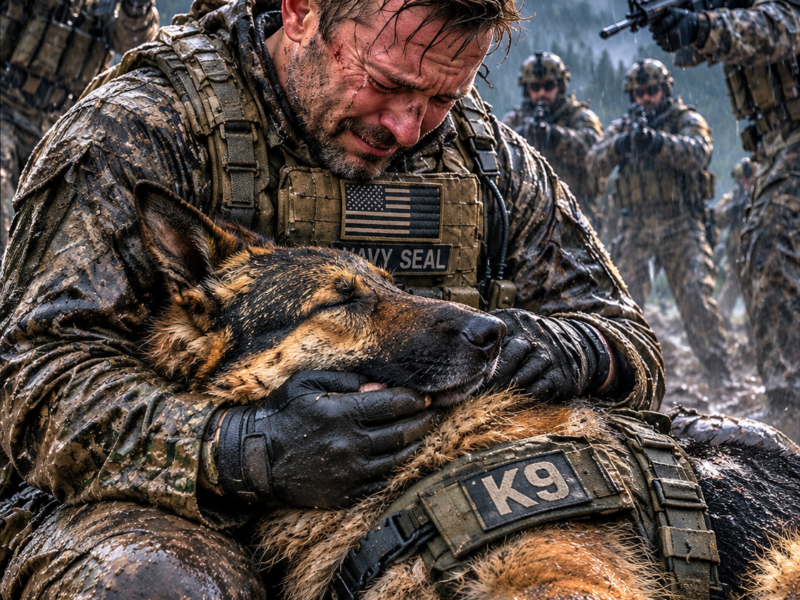
“The moment I ordered my K9 partner to take a different route through the mountains of Afghanistan, I heard the explosion behind us
I didn’t sleep that night.
I sat at my kitchen table until sunrise, the photograph of Rex lying in front of me, turning it over every few minutes as if a different answer might appear on the back.
The man on the phone had given me one name.
Captain Daniel Hayes.
My former commanding officer.
The man who had stood beside me after the mission, looked me in the eyes, and told me Rex was gone.
For four years, I had believed him.
At 6:17 a.m., I called the number that had contacted me.
It rang twice before a woman answered.
“Mr. Carter?”
“Who is this?”
“My name is Laura Bennett. I work for a private security company in Virginia. I believe you received a photograph last night.”
My fingers tightened around the phone.
“Where did you get it?”
“I didn’t send it.”
“Then how do you know about it?”
There was a pause.
“Because the person who did is missing.”
I stood up so quickly that my chair scraped across the kitchen floor.
“Who is missing?”
“An employee named Daniel Price. He worked at a facility outside Richmond. He was responsible for maintaining records on several retired military working dogs.”
My throat went dry.
“Was Rex one of them?”
“He was listed under a different identification number.”
I stared at the photograph.
“Where is this facility?”
“I can give you the address, but I need you to understand something first. Mr. Carter, you shouldn’t go there alone.”
“Why?”
“Because someone has been watching the facility for the last three days. And yesterday, Daniel disappeared after asking for your name.”
I closed my eyes.
Four years of silence.
Four years of visiting a memorial with a red collar in my hands.
And suddenly, people were disappearing because someone had mentioned my dog.
“Send me the address,” I said.
“Please wait for—”
I ended the call.
Twenty minutes later, I was driving south.
The facility sat behind an old industrial complex, surrounded by high fencing and security cameras.
There was no sign at the entrance.
Only a small metal plaque beside the gate bearing the name of a government contractor I didn’t recognize.
I parked across the road and watched the entrance.
A delivery truck came through.
Two employees walked out carrying coffee.
A security guard checked his phone.
Everything looked ordinary.
That was what bothered me.
I had spent twelve years in the Navy learning that the most dangerous places rarely announced themselves.
I called Laura again.
“You said Daniel Price maintained the records.”
“Yes.”
“Did he work with military dogs?”
“He was a veterinary technician before joining us.”
“Was Rex being treated there?”
“I can’t confirm that over the phone.”
“Then tell me who can.”
Another pause.
“Captain Hayes.”
I laughed once, without humor.
“Of course.”
I drove away from the facility and headed toward the address she sent me.
Hayes had retired two years earlier.
According to the records I found, he lived in a quiet neighborhood outside Fredericksburg.
His house was a modest brick home with a white garage door and a flag hanging beside the front porch.
I parked at the curb.
For several minutes, I couldn’t make myself get out.
I remembered him standing in the dust after the explosion.
I remembered his hand on my shoulder.
I remembered the way he had refused to let me return to the ridge.
And I remembered his exact words.
“Sometimes, Carter, you have to accept that not everyone comes home.”
I crossed the lawn and knocked.
The door opened almost immediately.
Hayes looked older.
His hair had turned almost completely gray, and he leaned slightly on a wooden cane.
But his eyes were the same.
For one second, neither of us spoke.
Then he looked at the photograph in my hand.
His face changed.
“Michael,” he whispered.
I held it up.
“Where is my dog?”
He looked over my shoulder toward the street.
“Come inside.”
“Not until you answer me.”
“Someone could be watching.”
“Then you should have thought about that four years ago.”
His jaw tightened.
He stepped aside.
I entered.
The house smelled of coffee and old books.
A framed photograph of Hayes with his wife stood on a side table.
Beside it was a smaller picture of our convoy in Afghanistan.
I recognized the location immediately.
The valley.
The place where Rex had disappeared.
Hayes noticed me looking.
“Sit down.”
“I’ve spent four years sitting with this.”
I placed the photograph on his coffee table.
“Tell me what happened.”
He lowered himself into an armchair.
For a long moment, he stared at the picture.
Then he said something I had never expected to hear.
“Rex saved more than your convoy that morning.”
“What does that mean?”
“The route you chose wasn’t just a way around the main road. It took us past a temporary communications post that wasn’t on our approved maps.”
I frowned.
“What communications post?”
“An abandoned compound. At least, that’s what our briefing said.”
He rubbed his forehead.
“Farid had been passing information to someone. We suspected he was working with a local network that had access to our movements.”
I felt my stomach tighten.
“Farid was our interpreter.”
“I know.”
“He helped us.”
“He also gave us a map with our route marked on it.”
“Because he found out the original road was compromised.”
Hayes looked at me.
“That’s what we believed at first.”
The room seemed to grow smaller.
“Are you saying Farid set us up?”
“I’m saying we never knew whose information he was carrying.”
I stepped closer.
“Stop talking around it. What happened to Rex?”
Hayes looked down at his hands.
“When the second explosion hit, the recovery team found you unconscious near the ridge. They found the harness, but they didn’t find Rex.”
“I know. I was there.”
“No, Michael. You weren’t there for what happened afterward.”
I felt a coldness spread through my chest.
“What happened afterward?”
“A local medical team reached the ridge before our recovery unit could secure the area. They found a wounded dog.”
I couldn’t breathe.
“Rex?”
Hayes nodded once.
“He was alive.”
For four years, I had imagined every possible ending.
None of them had prepared me for that sentence.
“Where did they take him?”
“The first report said he was transferred to a veterinary station. Later, we learned that station had been compromised.”
“By whom?”
“We never established that.”
“Then how did you know he was alive?”
Hayes looked toward the window.
“Because I saw him.”
The words landed harder than the explosion ever had.
“You saw him?”
“Three days after the mission. He was being moved in a covered transport vehicle. I recognized the scar on his muzzle and the bent ear.”
I gripped the back of a chair.
“You saw my dog, and you didn’t tell me?”
“I was ordered not to.”
“By who?”
“An intelligence officer attached to the operation.”
I stared at him.
“Who?”
“Colonel Richard Voss.”
I knew the name.
Voss had been part of the regional command structure, a senior officer who rarely appeared in the field but had authority over intelligence operations.
“What did he want with Rex?”
“He believed Rex had detected something that morning. Something beyond the explosives.”
I shook my head.
“Rex detected a bomb. That’s what he did.”
“He detected a bomb on the approved route, but the second alert came near the compound. The intelligence team later found equipment there that wasn’t supposed to exist.”
“What equipment?”
“An encrypted transmitter. Several storage devices. Documents.”
I thought of Farid’s map.
The note.
The marked route.
The gunfire.
“Was Farid involved?”
“We don’t know. He disappeared during the evacuation.”
I looked at Hayes.
“And you let them take Rex.”
“I tried to stop them.”
“That’s supposed to make me feel better?”
“No.”
His voice broke slightly.
“I’ve regretted it every day.”
I paced across the room.
“So what was the plan? Keep him hidden until everybody forgot?”
“Rex was moved to a secure veterinary facility in Germany. Then he was transferred to another site in the United States.”
“Why?”
“Because Voss believed someone was trying to locate the dog.”
“Someone?”
Hayes met my eyes.
“People who knew what Rex had found.”
I felt anger rising, hot and uncontrollable.
“You’re telling me my dog was used as evidence in some intelligence operation?”
“He was never supposed to be used.”
“But he was.”
Hayes didn’t answer.
I picked up the photograph.
“Where is he now?”
“I don’t know exactly.”
I stared at him.
“You have one chance to tell me the truth.”
“I believe he’s at the Richmond facility.”
“The one Laura Bennett told me about?”
His expression confirmed it.
“Why did you say you didn’t know?”
“Because the facility changed its records. Daniel Price was the only person there who knew the original identity files.”
“And now he’s missing.”
Hayes slowly stood.
“Michael, listen to me. If you go there, you may not find what you’re looking for.”
“I’ve already spent four years not finding him.”
“You don’t understand. Voss is still involved.”
“Then I’ll ask him.”
Hayes reached for my arm.
“Don’t.”
I pulled away.
“Don’t touch me.”
He let his hand fall.
“I know what I did to you,” he said quietly. “I know you buried a dog who wasn’t dead. I know you went home believing you had failed him.”
My anger faltered for half a second.
Then he continued.
“But if you go after Rex, you need to understand that someone may try to take him again.”
I looked at the photograph.
“Then they’ll have to get through me first.”
Before I could leave, Hayes gave me a small envelope.
Inside was an old printed document, stained at one corner.
It contained a transfer record dated three days after the mission.
The animal’s name had been blacked out.
But beneath the redaction, I could still see the last three digits of Rex’s military identification number.
At the bottom was a signature.
Richard Voss.
Hayes watched me read it.
“There’s one more thing,” he said.
“What?”
“Rex wasn’t the only one who was moved.”
I looked up.
“Who else?”
“Farid.”
I froze.
“You told me he disappeared.”
“He did. But two years ago, I received a message from an address I couldn’t trace. It contained one sentence.”
Hayes swallowed.
“Farid wrote, ‘The dog remembers the man who opened the gate.’”
I looked down at the document.
“What gate?”
Hayes shook his head.
“I don’t know.”
I left his house with the transfer record in my pocket and a question that had followed me across four years.
Who had opened the gate?
By the time I reached Richmond, the sky had turned dark.
I parked several blocks from the facility and walked the rest of the way.
The security lights were on.
A side entrance stood near the loading area, partly hidden behind a row of storage containers.
I watched it for twenty minutes.
At 9:43 p.m., a woman came out carrying a small cardboard box.
Laura Bennett.
She looked around before walking toward a silver sedan.
I stepped out from the shadows.
“Laura.”
She spun around.
Her hand went straight to her coat pocket.
“Michael?”
“Where’s Daniel Price?”
She glanced toward the building.
“I don’t know.”
“Try again.”
“He’s inside.”
“Is Rex inside?”
Her expression answered before her mouth did.
“I can take you to him.”
My heart began pounding.
“Then why are we standing here?”
“Because the security system logs every entrance. If I bring you through the main gate, someone will know.”
“Who?”
“People who don’t want you to see him.”
She led me to a maintenance door behind the storage containers.
Inside, the building smelled of disinfectant and damp concrete.
A distant bark echoed through the corridor.
I stopped.
It was only one bark.
But I knew that voice.
I had heard it through dust, gunfire, helicopter noise, and the quiet nights between missions.
“Rex,” I whispered.
Laura put a finger to her lips.
We moved down the corridor.
Behind a glass window, I saw rows of kennels.
Several dogs lifted their heads as we passed.
Then I saw him.
He was lying near the back wall, his body thinner than I remembered.
His muzzle had turned gray around the edges.
A pale scar crossed his nose, and his left ear still bent slightly forward.
But his eyes were unmistakable.
Rex.
For a moment, I couldn’t move.
Four years of grief had taught me how to imagine his face.
Seeing him alive made every imagined goodbye collapse at once.
I approached the kennel.
“Hey, buddy.”
His head lifted.
His ears moved.
Then he stood.
He took one step toward the gate and stopped.
I crouched, my hands trembling.
“It’s me, Rex.”
He sniffed the air.
His tail moved once.
Then he made a sound I had never heard from him before.
A small, broken whine.
I pressed my forehead against the bars.
“I’m here.”
Rex pushed his nose between them.
I reached through and touched the scar on his muzzle.
He leaned into my hand.
Then he sat down, just as he had done every time I returned from a mission.
The same quiet patience.
The same trust.
I started crying before I could stop myself.
Laura stood several feet behind me.
“I thought he might not recognize you,” she said.
I didn’t look away from Rex.
“He remembers.”
I knew it wasn’t only recognition.
It was the way he pressed his forehead against my wrist.
The way he waited for my hand to move before settling.
He remembered the person who had once promised to bring him home.
And I had failed to do it.
I stayed beside the kennel for several minutes.
Then I noticed the metal identification plate attached to the door.
It didn’t say Rex.
It said K-17.
I looked at Laura.
“Why is he listed under another number?”
“Because his original file was sealed.”
“Who ordered that?”
“Colonel Voss.”
“Where is Daniel?”
Laura looked down the corridor.
“Come with me.”
She took me to a small records room.
A man sat at a desk with a bandage around his forehead.
He looked exhausted.
“Daniel Price?”
He nodded.
“Are you Michael Carter?”
“Yes.”
Daniel opened a drawer and removed a thick folder.
“I’ve been trying to get this information out for months.”
“Why?”
“Because Rex wasn’t being held here only because of the intelligence operation.”
He turned the folder toward me.
Inside were medical reports, transfer records, and handwritten notes.
The first report described severe injuries, dehydration, and a damaged rear leg.
The second documented his recovery.
The third contained a note from a veterinary specialist.
The animal displays persistent attachment behavior toward an unidentified handler. Responds to the name Rex.
I had to stop reading.
Daniel continued.
“After he recovered, they tried to reassign him. He refused to work with anyone else. He wouldn’t enter unfamiliar vehicles. He wouldn’t sleep unless he could see the kennel door.”
I looked through the glass toward the corridor.
“He was waiting.”
Daniel nodded.
“I think so.”
“Why didn’t anyone tell me?”
“Because Voss believed the dog was a security risk. He thought the people who had planted the explosives might try to recover whatever Rex had detected.”
“And what had he detected?”
Daniel opened another section of the folder.
It contained a photograph of a small black device, partly buried beneath the rubble near the abandoned compound.
“An encrypted recording unit,” he said. “It had been placed near the convoy route. The intelligence team believed it was collecting communications from military vehicles.”
I studied the image.
“Rex found it?”
“He found the device’s power source. His alert led the recovery team to the rest.”
“Then why hide him?”
“Because the recording unit contained evidence that someone inside the operation had been sharing convoy information.”
I looked at the folder again.
A list of names appeared on the next page.
Some were unfamiliar.
One wasn’t.
Captain Daniel Hayes.
I felt my stomach drop.
“Hayes?”
Daniel nodded.
“His name appeared in the original investigation.”
I stepped back.
“No. He told me he tried to stop them.”
“He may have.”
“Then why is he on this list?”
“Because he approved the route briefing that morning. His signature was on the document that sent the convoy toward the compromised road.”
I remembered Hayes telling me that the route had been approved.
I remembered his face when I asked about Rex.
“Was he involved?”
“We don’t know. The investigation never reached a conclusion.”
I closed the folder.
“Who was the man who opened the gate?”
Daniel hesitated.
“Farid.”
The room seemed to tilt.
“Farid opened the gate?”
“He was the one who helped the intelligence team recover the recording unit. He knew where it was hidden.”
“But Hayes said he disappeared.”
“He was taken into protective custody after the mission. His identity was changed because he had information about the network responsible for the attack.”
“Is he alive?”
Daniel looked at Laura.
She nodded slowly.
“He’s alive,” she said. “And he contacted us last week.”
My pulse quickened.
“Where is he?”
Before she could answer, an alarm sounded.
Red lights flashed in the corridor.
Laura rushed to the door.
“They’re here.”
Daniel closed the folder.
“Voss must have found out.”
I looked through the glass.
Two men in dark jackets were entering the kennel area.
One carried a clipboard.
The other was holding a leash.
“Are they taking Rex?”
Laura grabbed my sleeve.
“They have authorization to transfer him.”
“Not anymore.”
I moved toward the corridor.
“Michael, wait,” Daniel called.
But I was already running.
The first man opened Rex’s kennel.
Rex backed away.
His body lowered.
He didn’t growl.
He simply looked toward me.
“Rex!”
His head snapped around.
I reached the kennel as the man pulled the leash toward him.
“Step away from the dog,” I said.
The man turned.
“Sir, this is a restricted facility.”
“I know.”
“Then you know you can’t interfere with an authorized transfer.”
I held up the photograph.
“This dog has a handler.”
The man looked at it.
Then at me.
“Not according to our records.”
I reached for Rex’s collar.
He moved forward and pressed against my leg.
The man tightened his grip on the leash.
Rex turned his head and stared at him.
A low warning rumble came from his chest.
“Easy, buddy,” I whispered.
The second man approached.
“Mr. Carter, you need to leave.”
“Show me the transfer order.”
He handed me a document.
I scanned the page.
The authorization was signed by Richard Voss.
But the date was from the previous week.
And the destination was listed as an undisclosed location.
I looked at Laura.
“Call the police.”
The first man reached for the leash again.
Rex stepped between us.
He wasn’t the young dog who had sprinted across the Afghan mountains.
His back leg was stiff, and his movements were slower.
But he still knew how to protect the person standing beside him.
I put a hand on his neck.
“It’s okay.”
Then a voice came from the entrance.
“Let him go.”
Everyone turned.
An older man stood beneath the red emergency light.
He wore a dark coat and held a folder under one arm.
Colonel Richard Voss.
He looked at me without surprise.
“Carter.”
“Voss.”
“You’ve made this more complicated than it needed to be.”
I pointed toward Rex.
“You kept him from me for four years.”
“I kept him alive.”
“You kept him hidden.”
“Those are not always different things.”
I stepped closer.
“Why?”
Voss looked at the dog.
“Because that morning, your partner found evidence that could have exposed an intelligence network operating inside our own command structure.”
“And you decided the dog belonged to you?”
“I decided that if the people responsible learned he had survived, they would come for him.”
“Then you should have protected him and told me.”
“You were not cleared to know.”
I almost laughed.
“He was my partner.”
“He was a military asset.”
“No,” I said. “He was family.”
For the first time, Voss looked uncomfortable.
He opened his folder and removed a photograph.
It showed Farid standing beside a small building.
Behind him was a metal gate.
The same gate from the old compound.
“Farid opened this gate before the convoy arrived,” Voss said. “He had discovered that the network was using the building to monitor our movements.”
I stared at the photograph.
“Then why was the convoy sent down the original route?”
“Because the information never reached the right people.”
“Whose fault was that?”
Voss didn’t answer.
I thought of Hayes.
His signature.
His guilt.
His silence.
“Was Hayes part of it?”
“No,” Voss said. “He was investigating the same network. But he made a mistake. He trusted a source he shouldn’t have trusted.”
“And you punished him by making him lie to me?”
“I ordered him to protect the investigation.”
“You ordered him to let me mourn a living dog.”
Voss looked away.
The alarm continued to flash.
Behind me, Rex leaned against my leg.
Voss lowered his voice.
“The men responsible for the attack were never all identified. Some of them are still out there. If Rex’s survival becomes public, it could expose people who have spent years staying hidden.”
I looked at the dog.
“He doesn’t owe you another day of his life.”
Voss studied me for a long moment.
Then he closed the folder.
“Take him.”
The words were so unexpected that I didn’t move.
“What?”
“You heard me. The transfer is canceled.”
The two men released the leash.
I unclipped it from their hands and attached Rex’s old collar, which I had kept in a drawer for four years.
It was worn and faded.
The metal tag still carried his name.
Rex sniffed it.
Then he looked up at me.
“Home?” I whispered.
His tail moved.
Voss stepped aside.
But before I left, he spoke again.
“Carter.”
I turned.
“Hayes has been trying to get the truth released for years. He sent the photograph.”
I felt my throat tighten.
“The note?”
“His handwriting.”
I looked down at the message on the back.
You changed the route. They didn’t forget.
It wasn’t a threat.
It was a warning.
And perhaps an apology.
I took Rex outside.
The night air touched his face, and he paused beneath the security lights.
For four years, I had imagined this moment.
I had imagined him running toward me, barking, jumping, and knocking me to the ground.
Instead, he stood quietly beside me, leaning his weight against my leg.
I opened the passenger door.
He climbed in slowly.
Before I closed it, I placed my hand on his head.
“I’m sorry I took so long.”
He rested his chin on the seat.
And for the first time in four years, I drove away with my partner beside me.
The following months were not easy.
Rex needed surgery on his rear leg and regular treatment for the damage caused by years of poor mobility.
He had trouble sleeping at first.
Some nights, he woke suddenly and paced around the house.
Other nights, he sat by the front door until sunrise.
I never forced him to do anything.
I let him choose where to sleep.
I let him decide when to eat.
And every morning, I took him for a slow walk around the neighborhood.
People asked where I had found him.
I told them the truth.
I had lost him in a war.
And someone had kept him alive long enough for me to find him again.
The investigation into the convoy attack eventually reopened.
Farid gave a formal statement, and several names from the original recording were confirmed.
Hayes testified.
He admitted that he had followed orders when he should have questioned them.
He also admitted that he had allowed me to believe Rex was dead.
He never asked me to forgive him.
I never promised that I would.
But one afternoon, he came to my house.
He stood at the gate, leaning on his cane.
Rex was lying on the porch.
When he saw Hayes, his ears lifted.
Hayes stopped walking.
“Hello, old soldier.”
Rex stood and approached him.
He sniffed Hayes’s hand.
Then he sat down.
Hayes looked at me.
“I don’t deserve that.”
“No,” I said. “You don’t.”
He nodded.
“I know.”
For a while, we stood in silence.
Then Hayes placed a small package on the porch.
Inside was Rex’s original military service record, along with the photograph from the day our convoy returned to base.
Rex was sitting beside me in the picture.
His tongue was out.
His tail was blurred from wagging.
On the back, Hayes had written:
He never stopped looking for you.
I looked at Rex.
He was older now.
His muzzle was gray.
His movements were slower.
But when I reached for the old red collar, he lifted his head and came to sit beside me.
That evening, I placed the collar beneath the photograph.
Not beneath a name carved into stone.
Not at a memorial.
But on a shelf in a home where Rex could sleep without wondering whether the door would open again.
A year later, I took him to the coast.
We walked slowly along the beach, his paws leaving uneven tracks in the wet sand.
He stopped whenever he needed to rest.
I stopped with him.
At one point, he turned toward me and pressed his shoulder against my knee.
I scratched behind his bent ear.
“Still with me, buddy?”
His tail moved once.
That was enough.
I used to believe bringing a soldier home meant making sure he survived the mission.
I was wrong.
Sometimes it means refusing to let the world decide that someone you love is already gone.
Rex had spent four years waiting for the sound of my voice.
And I had spent four years believing I had lost him.
In the end, neither of us had stopped listening.
The war had taken many things from me.
But it hadn’t taken the one thing that mattered most.
When I looked down at Rex walking beside me, I finally understood that some promises don’t end when the mission is over.
They end when the last one comes home.
THE end.









