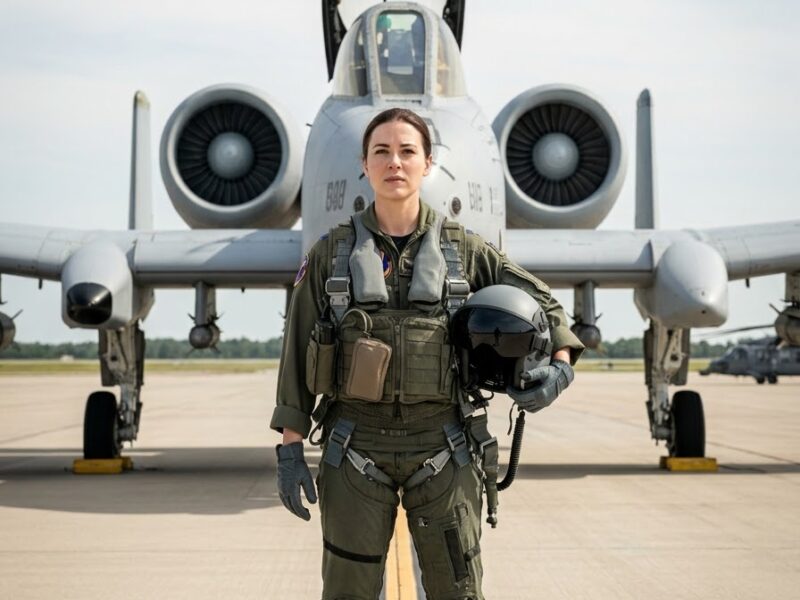
The moment I landed my A-10 on a frozen stretch of highway in northern Alaska, 124 Navy SEALs were staring at me through the snow
The wind in northern Alaska did not merely blow; it carved. It stripped the paint from metal, froze fuel lines into brittle veins of slush, and tore through flight suits like paper. I had sat inside the narrow cockpit of my A-10 Thunderbolt II for four straight hours, watching the gray blur of the Arctic tundra merge seamlessly into the low, bruised belly of the clouds. Routine border patrol over Sector 4. Cold, tedious, and safe. That was the flight plan logged at Eielson Air Force Base before dawn.
Then came the static.
It ripped across the secure tactical channel not as a steady carrier wave, but as a violent burst of broken white noise, sounding like tearing sheet metal.
“Mayday, mayday, we are trapped. Sector 7-Echo, kilometer marker eighty-four. Pressure falling. We have injured…”
The transmission cut out with the sharp, hollow snap of an severed cable.
I pressed the transmit toggle on my throttle, my thumb stiff inside my heavy winter flight gloves. “Station calling, this is Boar Two-One. Identify. I have broken audio. Say again coordinates.”
Silence hung over the radio. Only the steady, rhythmic whine of my two twin General Electric turbofans answered.
I immediately brought up the operations console and patched directly into Eielson Regional Flight Control. “Control, Boar Two-One. Picked up an emergency distress call on tactical frequency four-niner. Origin Sector 7-Echo. Request confirmation on active ground units in that quadrant.”
A long pause stretched between us. The channel hummed with distant relays before the voice of the watch officer, Major Nathan Hayes, crackled back into my ears. His voice was too steady, too polished for an emergency report.
“Boar Two-One, be advised, Sector 7-Echo is vacant. No active deployments, no ground teams, no exercise personnel. You are tracking stray interference or atmospheric bounce from commercial freight corridors. Disregard, maintain your assigned patrol route, and return to base at scheduled bingo fuel. Acknowledge.”
“Control, that was military encryption,” I countered, checking the digital readout on my heads-up display. “The waveform carried a dual-tone burst signature. That is standard naval tactical gear. The operator sounded injured.”
“Captain Walker,” Hayes said, his tone dropping from routine coordination to cold, uncompromising authority. “You are ordered to stay out of that airspace. You have no authorization to divert north of the 68th parallel. Turn south. Now.”
The line went dead.
A cold stone settled into the pit of my stomach. Pilots learn early in their careers to distinguish between protocol and panic, but this sounded like neither. It sounded like an erasure.
I switched off the autopilot and leaned over the secondary avionics panel. I pulled up an archived topographical survey map loaded onto an older, standalone flash drive that had not been synchronized with the latest regional updates. I zoomed in on the grid Hayes had called vacant.
The coordinates did not point to open wilderness. They aligned directly with a decommissioned military artery: Route Iron-Nine, a two-lane supply highway carved through the Brooks Range during the Cold War. Officially, it had been shuttered and struck from flight charts six months ago following a structural bridge failure.
Yet the terrain mapping revealed something else. Just beyond the collapsed pass lay an abandoned emergency staging outpost, designated Station Blackwood. Someone had scrubbed the installation from the primary navigation logs, but the physical concrete and the dead highway remained.
I looked at my fuel gauge. I had enough fuel to make the run, burn twenty minutes on-station, and limp home on fumes. If Hayes pulled my flight recorder, I would face an immediate court-martial, the loss of my wings, and a cell at Fort Leavenworth. But the sound of that man’s voice, suffocating in the snow, refused to let me turn south.
I banked hard left. The heavy armored nose of the A-10 pitched downward through the thick cloud layer.
The weather deteriorated within minutes. A blizzard had rolled off the Arctic Ocean, slamming against the mountains and turning the world into a howling sheet of white. My heads-up display flickered as the terrain-avoidance radar struggled to pierce the dense, frozen mist. I flew low, skimming barely four hundred feet above the jagged mountain spines, trusting the mechanical gauges when my eyes saw nothing but blank void.
Then, breaking through the bottom of the cloud deck at two hundred feet, I saw them: three orange thermal flares burning in the deep snow, sputtering against the wind.
Directly behind the flares, crushed under thousands of tons of packed snow and shattered pine trees, sat a convoy. Armored transport carriers, smashed together like toys under a collapsed ridge. Figures in white winter camouflage moved frantically around the twisted metal, digging with bare hands and entrenching tools.
There was no airfield, no strip, no cleared ground. Just the long, narrow, ice-slicked line of Route Iron-Nine, bordered on both sides by steep drop-offs and snowbanks taller than my aircraft.
I reduced throttle, deployed full flaps, and fought the rudder as crosswinds hammered the tail. The landing gear screamed as the heavy tires hit the frozen tarmac, sliding violently before the anti-skid brakes caught. The A-10 fishtailed along the centerline, throwing up twin walls of powdered snow fifty feet into the air, finally halting less than twenty yards from the lead transport vehicle.
I popped the canopy. The sub-zero Alaskan air rushed into my lungs like shattered glass.
I scrambled down the ladder onto the frozen asphalt, my service sidearm strapped tight against my chest. All around me, men were stepping out of the shadows of the crushed vehicles. There were dozens of them. Their faces were blackened with grease and soot, their uniforms stripped of standard insignia, bearing only the sterile, subdued patches of Navy special warfare operators.
A tall officer with ice frozen into his thick beard strode toward me. His rifle was slung across his chest, his eyes burning with intense fury.
“Who authorized this?” he demanded, his voice cutting through the wind. “You were ordered to stay out of this airspace!”
“Nobody authorized it,” I shouted back, stepping forward. “I heard your mayday. I have medical kits and an emergency relay. I came to get you out.”
The commander stopped three paces from me. His jaw clenched so hard the muscles jumped against his weathered skin.
“We never sent a distress call,” he said.
The wind suddenly sounded deafening.
“What?” I asked, my voice dropping. “I heard a distress call on four-niner. Specific coordinates. Marker eighty-four.”
The commander reached into his tactical vest, pulled out a shattered, battery-drained radio unit, and held it out. Its internal circuits were melted into slag.
“Our transmitters were knocked out when the ridge came down two hours ago,” he said, his voice deadly quiet. “We haven’t transmitted anything. The frequency you heard was encrypted from within your own base network. Someone used our relay codes to lure you here.”
Before I could process the words, a younger operator crawled out from the crushed cab of the command carrier, dragging a heavy, rubberized case.
“Commander Sterling!” the operator yelled. “You need to see this. We found it in the rear lockbox.”
Sterling waved me over. Together, we knelt in the snow as the operator popped the heavy seals of the case.
Inside were three satellite uplinks, sets of forged civil defense identification cards, stacks of untraceable currency, and a thick, laminated manifest.
Sterling picked up the document. His eyes flicked down the list of names. “This is our deployment roster,” he muttered. “Every operator on this mission. Classified under deep black access.”
He turned the page, and his eyes froze.
He looked up from the paper and stared straight into my eyes. The coldness in his gaze was no longer anger; it was grim realization.
“What is it?” I asked, reaching for the paper.
Sterling turned the sheet toward me. At the bottom of the column, below the names of one hundred and twenty-four Navy SEALs, a final line had been printed in fresh, dark ink:
Walker, Nathan E. – Captain, USAF – Air Asset / Asset Disposal.
“Why is my name on that list?” I whispered, my heart thudding violently against my ribs.
Sterling closed the case with a heavy latch. “Because whoever buried us here knew exactly who was on patrol today. They knew your habits. They knew you wouldn’t turn around.”
A low, mechanical rumble reverberated through the frozen bedrock beneath our boots. It was not the sound of moving snow. It was the synchronized roar of heavy military turbine engines approaching from the south, hidden behind the blinding curtain of the storm.
My A-10’s proximity alarms, left running in the idling cockpit, began to shriek through the open canopy.
Sterling grabbed the collar of my flight suit, his grip like iron. “Captain, whatever you do, don’t trust the people who sent you here.”
Suddenly, the portable tactical radio hooked to my survival vest hissed to life. A crisp, familiar voice cut through the static, free of panic, free of urgency, filled only with cold finality.
It was Major Nathan Hayes, speaking from the command bunker at Eielson.
“Captain Walker,” Hayes said quietly. “You should have followed your orders. You were never supposed to find them.”
The transmission ended with a single click. The silence that followed was broken only by the shriek of the A-10’s radar warning receiver echoing off the rock walls of the canyon.
“Scatter!” Sterling roared, his voice cutting through the wind like a siren. “Take cover under the treeline! Move! Move!”
The one hundred and twenty-four operators moved without hesitation. Despite their exhaustion, despite hours spent digging through packed ice, they vanished into the tree line with practiced, terrifying speed. They dragged their wounded into the deep shadows beneath the snow-laden pines, abandoning the crushed transports along the centerline of Route Iron-Nine.
I turned toward my aircraft, my boots skidding on the glazed tarmac. “I can get the A-10 airborne! I can provide close air support!”
Sterling caught my shoulder and slammed me down behind the engine block of a half-buried transport. “You won’t make the end of the strip! Look up!”
Tearing through the snowstorm at five hundred feet came two unmarked, matte-black helicopters. They were modified MH-60 Blackhawks, stripped of national insignia, their forward-looking infrared pods glowing like dull red eyes in the blizzard. Their side-mounted Miniguns were already spinning.
“Down!” Sterling shouted.
The world erupted into fire and noise.
A continuous stream of 7.62mm tracer rounds tore into the highway, pulverizing the asphalt and sending razor-sharp fragments of stone and ice flying through the air. The fire walked straight up the fuselage of my A-10. The canopy shattered into a thousand glittering pieces; the twin engines took direct hits, vomiting smoke and oil before seizing with a sickening metallic shriek. The titanium bathtub around the cockpit held, but the aircraft was dead, ruined on the frozen highway.
“Who are they?” I gasped, pressing my face into the snow as hot brass from Sterling’s rifle rained down on my back. “That is American hardware!”
“Special Activities Division,” Sterling replied between short, controlled bursts from his weapon. “Or private contractors operating under a black budget ledger. They aren’t here to capture anyone, Captain. Look at the approach angles. They’re boxing us into the kill zone.”
The second helicopter swung wide, banking over the frozen riverbed to flank our position. A crewman leaned out of the open cabin door, hoisting an anti-tank guided missile launcher to his shoulder.
“RPG! Right flank!” an operator screamed from forty yards away.
The missile streaked forward on a pencil-thin trail of white smoke. It struck the lead transport vehicle twenty feet from where Sterling and I crouched. The explosion lifted the multi-ton vehicle off its suspension, tossing it onto its side in a roaring ball of orange flame and black diesel smoke. The shockwave slammed into my chest, knocking the breath from my lungs and sending me sliding across the icy road.
My ears rang with a high, deafening tone. Snow fell like ash all around me. Through the blur of smoke, I saw two operators sprint into the open, ignoring the hail of gunfire to grab my arms and drag me behind the concrete embankment of an old drainage culvert.
Sterling was already there, his face streaked with soot and blood where shrapnel had grazed his temple. He slammed a fresh magazine into his rifle and leaned close to my ear.
“Walker! Focus! Did you log this flight plan anywhere besides Hayes’s desk?”
“No,” I choked out, coughing from the thick fumes of burning jet fuel. “Hayes was the sole controller for the Arctic sweep. He had primary clearance on all route modifications. If he flagged the flight, it stayed on his console.”
“Then we’re officially dead,” Sterling said grimly. “As far as the Pentagon knows, my unit perished in an avalanche during an unsanctioned cold-weather drill, and your plane suffered a catastrophic engine failure over the Beaufort Sea. No wreckage to find. No survivors to question.”
“Why?” I demanded, grabbing his arm as another burst of minigun fire chewed through the concrete above our heads. “What was this deployment? Why would they wipe out an entire team?”
Sterling looked toward the burning wreckage of the convoy. “Operation Northern Veil. We weren’t training out here, Captain. We were sent to extract something from Station Blackwood. An unmonitored listening post built in the 1960s.”
“Extract what?”
“A physical data archive,” Sterling said. “Hard drives containing thirty years of back-channel financial transfers between defense procurement officials, private energy corporations, and foreign intelligence cutouts. The kind of money that builds shadow fleets and funds unacknowledged wars. Someone in the Pentagon realized the archive was being audited by an independent inspector general. They couldn’t wipe the station remotely—it’s an air-gapped system. So they sent us to retrieve it, and then arranged for the mountain to come down on us.”
The roar of the helicopters shifted. The lead Blackhawk was hovering directly over the remains of my A-10, its searchlight bathing the highway in a harsh, clinical glare. Ropes dropped from the cabin doors. Heavily armed assault troops in sterile gray tactical gear began fast-roping down onto the asphalt.
“They’re deploying sweepers,” one of the SEALs, a squad leader named Miller, reported from the edge of the culvert. “Twelve boots on the ground. Heavies with body armor and thermal optics. They’re moving systematically to clear the wreckage.”
“We can’t fight them here,” Sterling said, making a swift calculation. “They have air superiority, thermal sensors, and unlimited ammunition. We have small arms, freezing temperatures, and twenty wounded men who can’t walk.”
“Where do we go?” I asked, looking around at the sheer, vertical rock faces flanking the pass. “We’re trapped in this gorge.”
Sterling pointed through the blizzard toward a dark, jagged shadow cut into the base of the mountain, two hundred yards past the burning trucks.
“The drainage tunnel,” he said. “It feeds into the lower utility corridors of Station Blackwood. The entrance is buried under three feet of snow, but the heavy blast doors inside are built into the bedrock. If we can get inside, their air support won’t mean a damn thing.”
“They’ll cut us to pieces before we make fifty yards,” Miller warned. “That searchlight sweeps the entire gap every six seconds.”
I looked at the burning carcass of my A-10. The left fuel tank had breached, but the right wing was intact, resting tilted against the concrete guardrail. The fuel emergency dump valve was located on the underside of that wing, accessible via an external manual release lever.
“I can give you cover,” I said, looking at Sterling.
“How? Your plane is junk.”
“The thirty-millimeter rounds haven’t cooked off yet,” I said. “And the right wing is holding three thousand pounds of high-octane JP-8 jet fuel. If I can reach the manual release, I can flood the highway between here and the sweepers. All you need is one tracer round to light it.”
Sterling stared at me for a split second, measuring the odds. “It’s suicide. The sweepers have the lane covered.”
“If we stay here, we’re dead in five minutes anyway,” I said, checking the slide of my 9mm service pistol. “Get your men moving toward that tunnel. When the fire starts, you run.”
Without waiting for his answer, I dropped onto my belly and began crawling through the snow toward the rear of the shattered aircraft.
The cold was excruciating. It seeped through my flight suit, numbing my elbows and knees as I dragged myself forward through the slush. Gunfire cracked steadily overhead as the SEALs opened up with coordinated suppression fire, drawing the attention of the sweepers away from the center of the road.
I reached the underside of the right wing. The smell of leaking aviation fluid was overwhelming. My fingers found the cold steel latch of the emergency release valve. It was frozen shut, sealed by a thick crust of rime ice.
Behind me, the sound of boots crunched on the gravel.
“Target sighted by the wing!” a voice shouted in flat, professional cadence.
I glanced back. A gray-clad assault soldier was advancing through the smoke, his rifle raised directly at my head, his finger tightening on the trigger.
I didn’t reach for my sidearm. Instead, I grabbed the heavy steel wrench hanging from the emergency tool bracket beneath the landing gear strut and slammed it with all my strength against the frozen release latch.
The metal cracked. The latch sheared open.
A torrential wave of pressurized jet fuel gushed from the tank, hitting the soldier square in the chest and pooling instantly across the icy highway, flowing downward toward the enemy sweepers.
“Fire!” I screamed into the dark.
From the tree line, a single red tracer round flashed through the blizzard.
The world vanished into a wall of blinding, roaring orange.
The shock of the ignition threw me backward into the snowbank. A towering sheet of fire rose thirty feet into the frozen night, creating an impassable barrier of heat and thick, black smoke across Route Iron-Nine. The sweepers caught in the initial blast stumbled back, their synthetic uniforms singed, their night-vision optics whited out by the sudden, blinding glare.
“Move! Go!” Sterling’s roar cut through the crackle of the flames.
I scrambled to my feet, my eyebrows singed by the blast, and joined the retreat. The SEALs moved with surgical discipline, carrying their wounded on improvised stretchers made from cargo straps and vehicle panels. We plunged into the waist-deep snow at the base of the mountain cliff, heading straight for the dark slit of the drainage culvert.
Miller was already at the opening, using a tactical pry bar to wrench apart an iron grate choked with decades of ice. He heaved with all his weight, the metal screaming in protest before popping free with a hollow clang.
“Inside! Hurry!” Miller urged, waving the team through.
One by one, the men slipped into the black maw of the concrete pipe. I turned back for a fraction of a second. Beyond the curtain of burning fuel, the two black helicopters were banking hard, their searchlights desperately probing the smoke. Mini-gun fire began chewing through the forest edge again, but the rounds were blind, tearing harmlessly through pine branches fifty yards behind us.
Sterling pushed me into the opening, then crawled in behind me, hauling the damaged iron grate back into position to mask the entrance.
We dropped into a subterranean utility corridor that smelled of rust, stale ozone, and wet concrete. The temperature here was marginally warmer than the surface—above freezing, but damp enough to chill a man to the bone within an hour. The only illumination came from the tactical red lights mounted on the operators’ weapons.
“Count off,” Sterling commanded in a low, hollow whisper.
“All accounted for, sir,” Miller reported quietly from the darkness. “We lost two when the initial missile hit the convoy. Seven wounded, three critical. We need a sterile environment to treat them, or they’ll be dead from shock before sunrise.”
“We move down the trunk line,” Sterling ordered. “Station Blackwood’s central operations hub is four hundred yards ahead. The facility was designed to survive a direct nuclear strike on Fairbanks. If the blast doors are intact, Hayes’s people won’t be able to dig us out without heavy engineering equipment.”
We advanced through the decaying arteries of the Cold War facility. Pipes wrapped in crumbling insulation lined the low ceilings; dead electrical conduits hung like vines from cracked concrete bulkheads. My flight boots, never designed for tactical marches, clicked sharply against the steel floor gratings. Every step sent a sharp pain through my bruised ribs, reminding me of the transport that had flipped just yards from where I stood.
We reached the primary blast door—a four-ton slab of solid steel set deep into the living granite of the mountain. Beside it sat a mechanical locking wheel covered in peeling yellow paint.
“Help me with this,” Sterling said, gesturing to two operators.
The three men threw their weight against the wheel. The gears inside the wall groaned, spitting flakes of red rust, before finally turning. With a heavy, pneumatic hiss that sounded like an ancient tomb unsealing, the blast door cracked open three inches.
Using a hydraulic jack from an operator’s assault pack, they forced the door wide enough for the men to slip through sideways.
Inside lay Station Blackwood.
It was a ghost ship carved into stone. Vast, cavernous rooms stretched into the gloom, filled with rows of green-enameled computing consoles, dead cathode-ray tubes, and massive tape-reel drives dating back to the late 1960s. But mixed among the vintage equipment were unmistakable signs of recent life: modern computer terminals tied into portable satellite arrays, heavy lithium battery packs humming faintly in a corner, and fresh ration wrappers scattered over a metal briefing table.
“Look at this,” an operator murmured, sweeping his light over the floor. “Boot prints. Modern issue. Someone was operating out of this facility within the last forty-eight hours.”
“Clear the perimeter!” Sterling barked quietly. “Check every room, every maintenance shaft. If there’s a hostile element inside this bunker, I want them found before we tend to the wounded.”
I walked toward the central console. A bank of modern flat-screen monitors sat amidst the dusty Cold War dials, connected to a running server stack that pulsed with steady blue LED indicators. The system was live, running on an auxiliary geothermal power tap that had kept the facility operational off the grid for decades.
I brushed away a layer of dust on the main desk and looked at the screen. A live surveillance feed was displayed, split into four quadrants.
My breath hitched in my throat.
One camera was angled downward from the exterior communication mast above the mountain pass. It showed Route Iron-Nine. The fire from my A-10 was dying down, reduced to smoldering heaps of black metal. Surrounding the wreckage were not just the two unmarked helicopters, but a third aircraft—a heavy-lift transport that had landed directly on the highway.
Dozens of armed contractors were unloading heavy industrial cutting torches and seismic imaging sensors.
“Sterling,” I called out, my voice trembling slightly. “Take a look at this.”
The commander stepped up beside me, his eyes narrowing as he watched the monitor. “They’re not just sweeping for bodies. They’re bringing in ground-penetrating radar. They know about the access shafts.”
“Look at camera three,” I pointed to the lower left panel.
The third feed was an interior shot of a secure communications relay station located inside Eielson Air Force Base—the very bunker where Major Nathan Hayes had sat when he ordered me to abandon these men.
On the screen, Hayes was not alone.
Standing behind him was a man in civilian clothes—a dark charcoal suit, heavy winter overcoat draped over a chair, holding a secure satellite phone to his ear. Even through the low-resolution feed, the face was immediately recognizable to anyone who read military intelligence briefs: Richard Vance, the Undersecretary of Defense for Special Programs.
“Vance,” Sterling spat, the name dripping with venom. “He personally signed our deployment orders. He told us we were securing a lost weapon system.”
“Why would Hayes work with him?” I asked, my mind racing. “Hayes is Air Force operations. He’s got twenty-eight years of spotless service.”
“Because Vance controls the promotions, the black budgets, and the private defense contracts that wait for officers after retirement,” Sterling said bitterly. “Look at the terminal status, Walker. What is that system processing?”
I leaned closer to the monitor, tapping the keyboard. The terminal was locked behind a high-level military encryption gate, but the file directory was visible on the secondary screen.
Rows of encrypted documents scrolled automatically as an automated data transfer progressed.
Operation Northern Veil: Phase IV.
Target: 1st Special Warfare Task Element.
Status: Containment Protocol Initiated.
Ancillary: Intercepted Flight Log – A-10C Tail #4088 (Walker, N.).
Below that was a subfolder labeled: Digital Archive – Project Chimera.
“Chimera,” I whispered. “What is Chimera?”
Sterling stood motionless, staring at the screen as if looking at a ghost. “It’s not an archive of financial crimes, Walker. Vance lied to me from the start.”
Before he could explain, a loud, synthetic chime echoed from the console speakers. The automated data transfer had reached one hundred percent.
A dialogue box popped up on the center screen, flashing in bold, amber text:
BROADCAST READY: GLOBAL DATA BURST PENDING AUTHORIZATION.
ENCRYPTION KEY ACCEPTED: SOURCE – EIELSON COMMAND NODE.
TIME TO TRANSMISSION: 14:59… 14:58…
From the far end of the bunker, a sharp metallic clatter broke the silence.
Every SEAL turned their rifle toward the dark hallway leading to the deep ventilation shafts.
“Who’s there?” Miller yelled, raising his weapon.
A figure stumbled out of the shadows, hands raised, clutching a bloody rag against his side. He wore an Air Force maintenance uniform, stained with hydraulic oil and dirt.
“Don’t shoot!” the man cried, his voice breaking with sheer terror. “Please! I didn’t know what they were doing! I just maintained the generators!”
I recognized him immediately. It was Airman First Class Jenkins, one of the junior avionics specialists from my own squadron at Eielson.
“Jenkins?” I stepped forward, lowering my sidearm in utter disbelief. “What are you doing fifty miles north of your post?”
Jenkins looked at me, his eyes wide, pupils dilated with pure panic. “Captain Walker? Oh God… they told us you crashed. They told us you were dead an hour ago.”
“Who told you that, son?” Sterling asked, his voice low and dangerous as he stepped between me and the boy.
“Major Hayes,” Jenkins sobbed. “He brought six of us up here three days ago to wire this room into the national defense satellite network. But when we finished an hour ago… his men took the others outside into the snow. I heard the shots. I crawled into the duct before they could find me.”
Jenkins pointed a shaking finger at the flashing countdown on the main terminal.
“You have to stop that broadcast,” Jenkins whispered, his teeth chattering uncontrollably. “It’s not an archive of the past. It’s a kill switch. It’s a forged Russian military cyber-payload. The moment that countdown hits zero, it transmits into our early warning defense network. It makes it look like an active, unprovoked strategic strike from the Arctic.”
The blood drained from my face. “A false flag. They want a war.”
“No,” Sterling said, his voice dropping to a terrifying whisper. “They want the defense contracts that come with one. And they’re going to sacrifice an entire task force and an Air Force pilot to prove the attack was real.”
Suddenly, the steel walls of the bunker shuddered violently. A deafening boom echoed through the concrete floor, followed by the screech of metal tearing apart at the main blast door.
The sweepers had found the entrance. And they were using thermite charges.
The blast blew the hydraulic jack into pieces and sent a spray of molten metal across the threshold of the bunker. The heavy steel door hung crookedly on its hinges, black smoke billowing through the jagged opening.
“Defensive positions!” Sterling bellowed. “Miller, take the right flank! Use the server racks for cover! Conserve your ammunition—make every single round count!”
The SEALs took up positions behind the heavy steel desks and concrete pillars. Despite their wounds, their movements were fluid, cold, and entirely focused on survival. They set up two light machine guns on tripods, covering the entrance corridor with overlapping fields of fire.
“Walker!” Sterling turned to me, his face illuminated by the flickering amber warning on the console screen. “You know these Air Force network protocols better than any of us. Can you stop that transmission?”
I dropped into the operator’s chair, my fingers flying across the mechanical keyboard. “It’s protected by a twenty-four-character rotating authorization cipher generated from the command bunker at Eielson. Hayes holds the physical master token. If I try to brute-force the password, the system will instantly lock, initiate an emergency dump, and transmit the payload immediately to prevent tampering.”
“How much time do we have?”
I glanced at the red numbers ticking down on the secondary monitor. “Ten minutes. Ten minutes until that data packet hits the defense satellite constellation.”
“Then we have to cut the power,” Sterling said, looking around the room.
“It won’t work,” Jenkins interjected, clutching his wounded side as he leaned against a filing cabinet. “The system has an internal battery reserve housed inside a sealed vault beneath the floor. Once the countdown starts, pulling the external breakers just triggers an automated fail-safe that runs the program faster.”
“There is another way,” I said, looking closely at the hardware schematic displayed on the diagnostics panel. “The transmission doesn’t originate from this console. This terminal is just the controller. The actual data broadcast has to go through the high-frequency microwave transmission array mounted on top of the exterior radar tower.”
Sterling looked up toward the ceiling. “On the mountain peak. Outside.”
“Yes,” I said. “If someone climbs that tower and severs the main waveguide cable, the signal will broadcast into empty air. It will never reach the satellite relay.”
“Look outside, Captain,” Miller shouted over the growing din of gunfire echoing down the entrance tunnel. “The mountain is crawling with their sweepers! The moment you step onto that access ladder, you’ll be silhouetted against the snow like a neon sign!”
“Then I guess you’d better make a lot of noise down here,” I said, unzipping my flight jacket and pulling out my sidearm. “Sterling, give me an assault rifle and two magazines. I’m going up.”
Sterling stared at me for a heartbeat. In his eyes, I saw the profound weight of a commander who had sent too many good people to die, but he also knew there was no other choice. He unslung an M4 carbine from his shoulder, slapped a fresh thirty-round magazine into the well, and handed it to me.
“The emergency maintenance hatch is in the back of the ventilation bay,” Sterling said. “It leads to an enclosed vertical shaft that opens sixty feet below the summit. From there, you have to climb the exterior ladder to the microwave dish.”
He placed a heavy hand on my shoulder. “Walker. Don’t come back down until that cable is cut.”
“Count on it,” I said.
“Jenkins, go with him and show him the hatch,” Sterling ordered. “The rest of you—open fire!”
The entrance corridor exploded into deafening violence as the enemy sweepers pushed through the shattered blast door. The SEALs unleashed a wall of disciplined, devastating fire. The narrow concrete hallway became a slaughterhouse of ricocheting bullets, flashing muzzle blasts, and the thunderous roar of fragmentation grenades.
Jenkins led me down a dark, narrow corridor away from the firefight. The air grew colder with every step, until we reached a round steel hatch set into the ceiling, with a vertical iron ladder vanishing into absolute blackness.
“This is it,” Jenkins gasped, his face pale from blood loss. “The ladder goes straight up to the antenna platform. There’s a manual service panel at the base of the dish. You have to sever the thick copper conduit.”
“You stay here, Jenkins,” I told him, checking the action on the M4. “Find a place to hide. If we don’t stop this, none of it matters anyway.”
I grabbed the frozen rungs of the ladder and began to climb.
The shaft was a chimney of ice. The freezing wind screamed down from above, howling through the narrow steel tube like an enraged animal. My hands, protected only by thin flight gloves, went numb within seconds. Every breath tasted like dry, frozen dust, burning my lungs as I hauled myself up rung by rung.
Below me, the muffled concussions of grenade blasts and automatic gunfire shook the concrete shaft. The SEALs were holding the line, but they were running out of ammunition, surrounded by an enemy with infinite resources.
After fifty feet of agonizing climbing, my head struck the iron latch of the upper hatch. I braced my back against the wall of the shaft, wedged my shoulder under the metal cover, and heaved upward.
The hatch flew open with a shower of powdered snow, and the full fury of the Arctic blizzard struck me in the face.
I pulled myself out onto the summit ridge. The wind nearly blew me off my feet. Route Iron-Nine lay hundreds of feet below, hidden beneath the swirling cloud of snow, visible only by the dim orange flicker of burning vehicles. Above me, towering forty feet into the storm, stood the steel lattice of the radar tower, crowned by a massive, twenty-foot microwave transmission dish.
The tower was covered in an inch of solid rime ice.
I checked my watch.
03:42. Three minutes and forty-two seconds until transmission.
I slung the rifle over my back and lunged for the base of the tower ladder. The wind hit me with hurricane force, threatening to tear my grip from the slick metal rungs. Step by step, slipping on the ice, I hauled myself toward the antenna platform.
Suddenly, a bright, blinding light pinned me against the steel lattice.
Fifty yards away, hovering in the blinding snow at eye level with the tower, was the second unmarked Blackhawk. Its searchlight illuminated me with theatrical clarity. Through the open cabin door, I saw the door gunner racking the bolt of his minigun, pointing the six rotating barrels straight at my chest.
I was trapped on the open ladder, sixty feet above the rocky peak, with nowhere to run.
The minigun began to spin.
Before it could fire, a sharp crack echoed from the snowy ridge below the tower. A single, high-caliber sniper round shattered the helicopter’s cockpit glass. The aircraft jerked violently to the left as the pilot instinctively banked away to avoid the fire.
I looked down. Standing on a narrow ledge near the maintenance hatch was Miller, leaning heavily against a boulder, an abandoned enemy sniper rifle pressed against his shoulder. He had dragged himself up the shaft despite his wounds to cover my back.
“Climb, Walker!” his voice was lost in the wind, but his silhouette waved frantically.
The Blackhawk swung around, its minigun opening fire on the ridge, chewing the rock around Miller into powder.
I scrambled up the remaining rungs and hauled myself onto the antenna platform. The wind here was terrifying, screaming across the metal grating. In the center of the platform sat the transmission housing—a heavy, weather-sealed aluminum box connected to the dish by a thick, insulated waveguide conduit wrapped in armored steel braiding.
I checked my watch.
01:15.
I pulled my combat knife, but the steel blade bounced uselessly off the armored braiding.
“Damn it!” I yelled into the storm.
I unslung the M4 carbine, set the selector switch to full automatic, and jammed the muzzle directly against the thickest junction of the conduit where it entered the dish housing.
I squeezed the trigger.
The rifle bucked in my hands, vomiting thirty rounds of 5.56mm armor-piercing ammunition into the cable at point-blank range. Sparks, shredded copper, and pulverized insulation sprayed into the blizzard. The heavy conduit severed under the barrage, snapping free from the mount and whipping violently through the air like a dying snake, spewing a burst of brilliant electrical arcs into the dark.
Below me, inside the bunker, the connection died. The timer was rendered irrelevant. The false flag was killed in the cradle.
A bullet slammed into the steel platform six inches from my boot.
I turned around.
The Blackhawk had returned, hovering barely twenty yards away. The side door was open. Standing on the skid, holding a suppressed assault rifle aimed directly at my head, was a man in an Air Force flight jacket.
He raised his visor.
It was Major Nathan Hayes.
“You really are the most stubborn pilot I’ve ever had the displeasure of commanding, Nathan,” Hayes’s voice crackled through my survival radio, his tone dripping with cold, clinical disappointment.
“It’s over, Hayes!” I shouted against the wind, raising my empty rifle. “The cable is cut! The broadcast is dead!”
Hayes looked at the severed conduit, then back at me. A thin, joyless smile touched his lips.
“The broadcast was only Plan A, Walker,” Hayes said calmly over the radio. “Plan B is much simpler. We drop four tons of precision-guided ordnance on this mountain and bury all of you so deep that nobody will ever find the truth.”
He raised his weapon to pull the trigger.
The shot never came.
From the swirling whiteout behind Hayes’s helicopter, a massive shape materialized like a ghost emerging from an ocean of clouds. It was an Air Force HH-60 Pave Hawk search-and-rescue helicopter, fully armed, bearing the unmistakable yellow markings of the 210th Rescue Squadron out of Anchorage.
Its nose-mounted forward-firing machine guns opened up with terrifying precision, raking the tail rotor of Hayes’s unmarked Blackhawk.
The black helicopter spun out of control, its tail boom severed by the barrage. Hayes dropped his rifle and grabbed the cabin frame as the aircraft began a violent, sickening death spiral, plunging off the edge of the mountain ridge and vanishing into the canyon below. Seconds later, a dull, muffled explosion rolled up the cliffs, followed by a brief flash of orange through the snow.
The Pave Hawk banked hard and settled into a steady hover ten feet above the radar platform. The side door slid open, and a crewman in Arctic survival gear lowered a steel rescue hoist directly to my feet.
“Air Force Captain Nathan Walker?” a voice boomed through an external loudspeaker.
I hooked the carabiner of the hoist harness securely into my chest rig, tugged the line twice, and gave a thumbs-up. “That’s me!”
The winch whined, lifting me off the frozen steel platform and pulling me into the warm, illuminated belly of the helicopter. The crewman hauled me inside, slammed the door shut against the blizzard, and immediately wrapped a heavy thermal blanket around my shoulders.
Sitting in the jump seat across from me was Colonel Marcus Vance—not the corrupt Undersecretary of Defense, but his estranged brother, the commander of the 11th Air Force Inspection Division.
“You look like hell, Captain,” Colonel Vance said, his face grave as he handed me a thermos of black coffee.
“The SEALs,” I rasped, the coffee burning my frozen throat. “Station Blackwood. There are over a hundred men trapped in the bunker. The sweepers have them pinned down.”
“Sit back, Walker,” the Colonel said calmly, tapping his pilot on the shoulder. “We brought friends.”
The Pave Hawk banked, and through the cabin window, I saw two more combat helicopters and a heavy Marine assault gunship descending into the gorge. They swept over Route Iron-Nine with devastating force, saturating the ground around the entrance tunnel with suppressive fire, scattering the remaining mercenary sweepers into the wilderness.
Within twenty minutes, the area was locked down.
Federal tactical teams secured the entrance to Station Blackwood, evacuating the wounded operators and taking the surviving contractor sweepers into custody. Commander Sterling walked out of the tunnel under his own power, his uniform torn, his face blackened by soot, but his eyes steady and unyielding.
When he saw me standing by the medical transport, he walked over, stopped two paces away, and held out his hand.
“You cut the wire,” he said.
I shook his hand, my grip firm despite the trembling in my fingers. “You held the door.”
“We’re not out of the woods yet,” Sterling said, lowering his voice as he looked at the federal agents securing the perimeter. “My brother, Undersecretary Vance, has allies in every department in Washington. The moment we land at Eielson, the cover-up begins. Evidence will vanish, witnesses will be reassigned, and this entire night will be reclassified under executive privilege.”
“Not this time,” a voice said behind us.
Colonel Marcus Vance stepped forward, holding the black case that Sterling’s men had recovered from the convoy, along with a secondary flash drive pulled from the terminal inside Station Blackwood.
“My brother made one fatal mistake,” the Colonel said, looking at the drive in his hand. “He assumed Hayes had total control over the server routing. But Captain Walker’s A-10 didn’t just carry weapons; its avionics suite was recording every encrypted military transmission on frequency four-niner from the moment he diverted north. That data was automatically backed up to a secure, air-gapped flight recorder in the tail assembly.”
I looked toward the highway, where the smoldering, broken carcass of my A-10 sat surrounded by support vehicles.
“The tail is intact,” I realized.
“The black box survived,” the Colonel nodded. “And it contains Hayes’s unedited voice commands, the unauthorized orbital satellite patch, and the direct digital signature linking Undersecretary Vance’s office to the deployment of those unmarked helicopters. It is incontrovertible proof of treason.”
Twelve hours later, a C-17 Globemaster took off from Eielson Air Force Base, heading directly for Andrews Air Force Base outside Washington, D.C.
Inside the cargo hold sat one hundred and twenty-two surviving Navy SEALs, guarded by federal marshals who reported directly to the Joint Chiefs of Staff. In the rear passenger compartment, I sat beside Sterling, watching the endless white plains of the Arctic disappear beneath the clouds.
The news broke while we were still over Canadian airspace.
The emergency broadcast flashed across every major news network: Undersecretary of Defense Richard Vance had been taken into federal custody at his Pentagon office by military police, charged with conspiracy, treason, and the attempted murder of American service personnel. Major Nathan Hayes, who had miraculously survived the helicopter crash with broken limbs, had already signed a full confession in exchange for avoiding a military tribunal.
The story was hailed as an unprecedented victory against internal corruption, a triumph of military oversight.
But as the transport plane leveled out at thirty thousand feet, Sterling leaned back against the bulkhead, his arms crossed over his chest, his eyes fixed on the gray floor.
“You’re thinking about the list,” I said quietly.
Sterling looked up at me. “My name was on it. Your name was on it. But there was a third page in that case, Walker. A page Colonel Vance didn’t take to the press.”
I felt the hairs on the back of my neck stand up. “What was on the third page?”
Sterling reached inside his tactical jacket and pulled out a small, folded piece of water-resistant paper that he had slipped from the folder before the federal agents arrived. He unfolded it and handed it to me.
It wasn’t a list of operators.
It was an operational timeline.
Step 1: Deployment of Task Force to Sector 7-Echo.
Step 2: Elimination of ground unit via localized avalanche.
Step 3: Interception and destruction of responding air asset (A-10).
Step 4: Transmission of Project Chimera cyber-payload.
Step 5: Public arrest of Undersecretary Vance to satisfy congressional oversight.
Step 6: Initiation of Phase V – Shadow Fleet Protocol.
I stared at the paper, the ink swimming before my eyes.
“Vance wasn’t the mastermind,” I whispered, the cold air of the high altitude feeling suddenly like the chill of Station Blackwood. “He was a scapegoat. The whole thing… the arrest, the exposure… it was planned.”
“Someone wanted Vance out of the way,” Sterling said, his voice barely audible over the drone of the four massive turbofans. “Someone who needed an even bigger distraction to move something far worse into place. Hayes and Vance were just pawns on the board.”
“Then who wrote this timeline?” I asked.
Sterling took the paper from my hands, held his lighter beneath the corner, and watched the flame slowly consume the names and the dates, turning them into delicate, curling black ash.
He let the ashes fall to the steel deck and ground them beneath the heel of his combat boot.
“The people who are going to welcome us home with medals at the White House tomorrow morning,” Sterling said.
He closed his eyes and leaned back against the metal seat, leaving me to stare out the small oval window into the darkening sky, knowing that the war we had just survived was only the opening salvo of a battle we had not yet begun to understand.
The end.









