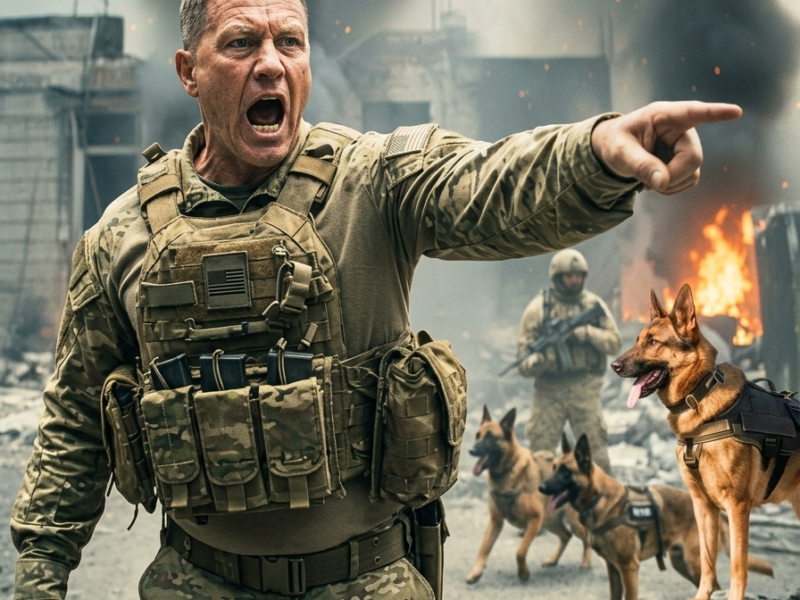
The moment General Hayes ordered us to abandon the collapsing outpost, every elite K9 refused to move, standing shoulder to shoulder beneath the screaming alarms while concrete rained around them
The alarm system at Outpost Bravo didn’t sound like a standard military siren; it was a rhythmic, agonizing pulse that vibrated straight through the reinforced foundation of the mountain complex. Deep inside Sector 7 of the Hindu Kush perimeter, the air in the lower staging tunnels smelled of scorched insulation, electrical ozone, and dry limestone dust. Heavy mortar rounds were slamming into the forward ridge three hundred meters above us, sending shockwaves down through the rock that made the emergency lights flicker in slow, sickening cycles of orange and pitch black.
The evacuation order came over the tactical comms at precisely 2:17 a.m.
“All personnel, this is Command. Outpost integrity compromised. Abandon position immediately. Evacuate to Extraction Point Alpha. Repeat, everyone out.”
I reached down and grabbed the reinforced handle of Ranger’s tactical harness. Ranger was a eight-year-old Dutch Shepherd whose fur was scarred along the shoulder from a shrapnel strike in Helmand three years back. He had cleared dozens of compounds with me, sat beside me through three combat tours, and possessed an intelligence that often felt unnervingly human.
“Come on, boy! Up! Let’s go!” I yelled, pulling on his lead.
Ranger didn’t budge. He dropped his weight low, his front paws planted firmly into the cracks of the concrete floor. His back was arched, his ears pinned flat against his broad skull, and a low, guttural growl hummed deep within his chest.
I looked down the staging bay. Fourteen other handlers from the 34th Tactical K9 Detachment were struggling with their animals. German Shepherds, Belgian Malinois, and Dutch Shepherds—fifteen of the most highly trained war dogs in the United States military—were acting in complete, terrifying unison. Not a single dog moved toward the lit exit ramp. They stood shoulder to shoulder, forming an unbroken arc facing toward the dark, unlit maintenance corridor that ran beneath the command deck.
“What’s wrong with them?!” yelled Sergeant Miller, holding onto the lead of his Malinois, Thor. “Thor, heel! Heel!”
“They won’t take the order, Chief!” Corporal Jackson called out, his voice laced with rising panic as another explosion rattled the overhead pipes, showering us with fine grey dust. “They’re locking up!”
Boots thundered down the metal catwalk above us. General Thomas Hayes descended the stairs two at a time, flanked by two armed executive security contractors in unmarked slate-grey plate carriers. Hayes was a legendary figure in the theater—a stern, grey-haired commander who had built Outpost Bravo from a desolate listening post into a high-priority intelligence hub. But tonight, his face was pale, slick with sweat, and his jaw was set in a rigid, unforgiving line.
“Why isn’t this deck clear?!” Hayes roared over the sirens.
“Sir, the dogs are refusing to navigate the ramp,” I said, stepping between Hayes and Ranger. “Something’s off. They’re sensing a structural hazard or gas leak in the main exit tunnel.”
Hayes didn’t look at the exit tunnel. He looked at the animals with an expression that wasn’t anger—it was cold, calculated desperation.
“Leave them,” Hayes said.
The words hung in the dusty air, sharper and more destructive than the mortar strikes above.
I froze. “Sir?”
“You heard me, Sergeant Vance,” Hayes snapped, reaching down to unbuckle his holster strap. “We have ninety seconds before the upper magazine detonates and collapses this entire valley. Unhook their harnesses and fall in with security. That is a direct order.”
“We don’t leave working dogs behind, General!” Miller yelled, stepping forward. “These animals saved every man in this room at Red Pass! We carry them out or we don’t leave!”
“There is no time!” Hayes barked, his voice straining. “Move your asses to the transport, now!”
Before any of us could answer, Ranger let out a sharp, deafening bark. With a sudden, explosive surge of power, he tore the heavy lead straight out of my gloved hand. He didn’t head for the exit ramp. He sprinted full speed into the blacked-out maintenance corridor, his claws clicking furiously against the concrete.
“Ranger! No!” I shouted, dropping my duffel bag and sprinting after him.
“Vance! Get back here!” Hayes yelled from behind.
The fourteen other dogs broke rank simultaneously. They ignored their handlers’ commands, surging past Hayes and his contractors like a pack of wolves, following Ranger into the narrow, dark artery of the base.
“Follow the dogs!” Miller screamed to the team.
We ran into the dark. The maintenance corridor was cold, drafty, and smelled of ancient moisture. Emergency strobes flashed every twenty feet, painting the concrete walls in blinding pulses of red. Ahead of us, the pack of dogs moved with terrifying purpose, ignoring open side doors, storage rooms, and armories.
Ranger stopped at the very end of the corridor—a dead-end wall of solid, poured concrete where the base foundation met the deep mountain granite. He threw his weight against the wall, his front paws scratching frantically at the junction where the concrete floor met the vertical wall.
Thor slammed his shoulder into the concrete beside him. Within seconds, all fifteen dogs were stacked against that dead-end wall, barking, digging, and snarling at the solid stone with a frantic, desperate rage.
“There’s nothing here, Ethan!” Miller panted, coming up beside me with his weapon raised, scanning the shadows. “It’s a load-bearing retaining wall!”
“Look at the ground,” I said, dropping to my knees beside Ranger.
The dust on the floor wasn’t settling. It was being blown sideways by a faint, steady draft of freezing air coming from beneath the concrete wall.
I brushed away the thick layer of grey powder and dried mud. Beneath it lay a clean, steel seam—an industrial seal embedded directly into the foundation floor. There were no handles, no keypads, no military inspection stamps.
I wedged my tactical combat knife into the seam and pried upward. A small steel latch popped up with a heavy pneumatic hissed sound.
The floor didn’t just open; a six-foot section of solid concrete shifted smoothly on hidden hydraulic tracks, sliding back into the wall to reveal a dark, rectangular void. Cold, stale air—smelling of old paper, copper, and damp earth—rushed up into our faces.
Heavy footsteps echoed down the corridor behind us. General Hayes arrived, his contractor security team raising their rifles toward us. Hayes was breathing heavily, his eyes wild as he stared at the open hatch in the floor.
“You shouldn’t have dug into this, Vance,” Hayes whispered, his voice trembling slightly.
“Open it all the way, sir,” I said, stepping back and keeping my hand near my sidearm. “What is under this base?”
Hayes didn’t answer. He looked at his security detail, then down at the dark opening. “Open it.”
I pulled the steel ring on the hatch door, swinging the heavy plate back until it locked into place. Inside was a steep, narrow spiral staircase made of rusted iron, descending into absolute darkness far below the base’s official blueprint levels.
I unclipped my tactical flashlight, clicked it on, and aimed the beam downward. The light cut through decades of dust, illuminating iron steps that spiraled down at least forty feet into the mountain core.
“Stay here,” I told Miller. “Keep the perimeter.”
“I’m coming with you,” Miller insisted, keeping his hand on Thor’s harness.
I began my descent, my boots clanging softly on the iron treads. Ranger went first, his nose low to the steps, his body taut as a coiled spring. Hayes followed closely behind me, guarded by his two contractors, whose rifle barrels remained uncomfortably close to my shoulder blades.
At the bottom of the spiral stairs, the air was ice cold. My flashlight beam swept across a massive, vaulted chamber cut directly out of the mountain granite. It looked like an old Cold War bunker, but the equipment inside was modern, high-grade, and lit by faint, green backup battery lights.
Rows of industrial steel shelves stretched into the shadows. They were filled with hundreds of thick, black leather-bound binders, unencrypted server hard drives mounted in custom cooling racks, and crates of physical surveillance reels.
I walked up to the nearest rack and pulled a binder from the shelf. On the spine was a classification label I had never seen before: PROJECT WATCHTOWER – PHASE IV.
I opened the binder. Inside were high-resolution photographs of our unit.
Not mission photos from command briefs. Private, candid photos.
There was a photo of Sergeant Miller sitting in a mess hall three years ago in Kuwait. A photo of Corporal Jackson writing a letter to his wife during a layover in Germany. A photo of me standing on the flight deck at Bagram, holding an unopened package from home.
Every mission, every patrol, every tactical debrief our detachment had conducted over the last five years was logged here with terrifying precision—including psychological evaluations, private radio transcripts, and medical heart-rate telemetry collected during firefights.
“We weren’t just an operational unit,” I muttered, my blood turning to liquid ice as I turned the pages. “We were an experiment.”
“Ethan,” Miller called out from a few feet away, his voice trembling. “Look at this one.”
He was holding a red-tagged folder pulled from a climate-controlled metal case at the center of the room. The folder was stamped with the date of our unit’s very first deployment to the valley eight years ago.
Inside was a single, high-contrast black-and-white photograph.
It showed Ranger as a young, two-year-old pup, sitting inside a containment cage hooked to electronic biometric monitors. Beside him were fourteen other cages, each holding a puppy from the same tactical breeding program.
Underneath Ranger’s photograph, written in bold, red archival ink, were three words:
HE REMEMBERS EVERYTHING.
My hands went completely numb. The folder slipped from my fingers, fluttering to the concrete floor. I turned slowly to face General Hayes.
“Sir,” I whispered, my voice barely audible over the hum of the cooling racks. “What is this room? What did you do to these dogs?”
Hayes stood in the shadow of the staircase. He wouldn’t meet my eyes. His jaw twitched, his right hand resting heavy against his leather holster.
“Some programs are larger than the men who serve in them, Sergeant,” Hayes said softly. “You were never meant to see this level of the facility.”
Before I could demand an answer, Ranger dropped his chest to the floor, releasing a low, terrifying snarling sound that echoed off the stone walls. Thor and the other dogs down the row joined in, their hackles raised, their eyes locked on the far dark corner of the vaulted bunker.
A slow, deliberate sound of clapping echoed from the shadows behind the server racks.
Clap. Clap. Clap.
“Brilliant,” a smooth, calm voice called out from the dark. “Eight years of conditioning, and the biological memory overrides the tactical training every single time.”
A man stepped out into the faint green light of the server racks. He was dressed in a standard U.S. Army officer’s fatigue uniform—complete with a captain’s bars on his collar and a unit patch matching ours on his shoulder.
But he wasn’t on our roster. I had never seen his face in my life.
General Hayes instantly raised his sidearm, aiming it directly at the stranger’s chest. “Hold your position! Who gave you access to this facility?!”
The stranger didn’t panic. He stood ten feet away, his hands casually tucked into his tactical pockets, a thin, mocking smile resting on his lips.
“Lower the gun, Thomas,” the stranger said softly. “You know exactly who I am. You’re the one who signed my transfer orders when the project went dark.”
The man turned his gaze away from Hayes and looked directly down at Ranger. He reached into his pocket, pulled out a small, metallic cylinder—a high-frequency whistle—and held it between two fingers.
Ranger didn’t attack. The dog stood frozen, his eyes wide, his body trembling as if an invisible electric current were passing through his spine.
The stranger looked back up at me, his eyes cold and hollow.
“Don’t blame your general for trying to abandon the base, Sergeant Vance,” the man said, his smile widening into a terrifying grin. “He wasn’t trying to save his skin from the mortar fire outside. He was trying to collapse the mountain over this room before you realized why your dogs were brought here.”
The stranger paused, his eyes gleaming with a malicious satisfaction.
“Ask your dogs who gave the original order to create them.”
The entire subterranean chamber fell into a suffocating, absolute silence.
I turned my head slowly toward General Hayes.
The general’s hand was shaking violently. The barrel of his pistol dipped toward the floor. The color had completely drained from his face, leaving him looking like a corpse under the pale green lights.
And in that horrifying, crystal-clear second, the truth hit me like a physical blow. The mortar fire outside wasn’t an enemy attack. The evacuation order wasn’t a rescue protocol.
Hayes hadn’t been trying to save us. He had been trying to bury us—and the evidence of what he had created—under fifty feet of solid granite.
The air in the subterranean vault felt like it had been stripped of oxygen. The sirens from the upper outpost were muffled here, sounding like a faint, dying heartbeat beneath forty feet of solid rock.
“Put the gun down, Thomas,” the stranger repeated, taking a slow, casual step toward General Hayes. “The game ended the moment these handlers walked down those stairs. You can’t execute fifteen specialized soldiers and their K9s in a locked room without the Joint Chiefs asking where two dozen body bags came from.”
“I can classify the entire outpost as a total loss under hostile artillery fire,” Hayes said, his voice raspy and thin. His pistol was still trained on the stranger, but his stance was broken. “A direct hit on the munitions depot. Tragic. No survivors.”
“Sir…” I stepped into Hayes’s line of sight, my own sidearm drawn and leveled at the general’s chest. “Lower your weapon. Now.”
“Vance, you don’t know what you’re doing,” Hayes hissed, his eyes darting frantically between me and the stranger. “This entire facility is an off-the-books research site. If this intelligence leaves this room, every man in this unit will be hunted by military intelligence for the rest of his life!”
“I’d rather be hunted than buried alive by my own commander,” Sergeant Miller spat, stepping up beside me with his M4 carbine raised.
The stranger let out a low, dry laugh. “Listen to your men, General. They have better survival instincts than you do.”
I kept my gun locked on Hayes, but my mind was racing, trying to piece together the nightmare unfolding around us. “Who are you?” I demanded, eyeing the stranger. “What is Project Watchtower?”
The man reached up and unbuttoned his collar, pulling back his uniform shirt. Beneath his skin, right over his collarbone, was a thick, silver surgical scar that ran down into his chest—a long, unnatural seam where technology met bone.
“My name is Dr. Aris Thorne,” he said calmly. “Eight years ago, I was the principal director of the Defense Advanced Research Directorate’s Neurological Behavioral Unit at Fort Meade. Project Watchtower wasn’t an intelligence program, Sergeant Vance. It was a bio-enhancement initiative.”
Thorne pointed a finger toward Ranger, who was still standing rigidly at my side, his breath coming in fast, shallow gasps.
“Standard military working dogs are magnificent tools,” Thorne continued. “Great tracking, high aggression, excellent scent discrimination. But they have limits. They age out in six or seven years. They suffer from PTSD. They forget complex operational parameters when exposed to high-stress combat environments.”
Thorne stepped closer to the rows of hard drives mounted on the steel racks.
“We fixed those limits,” Thorne murmured, his eyes glittering under the green emergency lights. “We took a single litter of Dutch Shepherds—fifteen pups—and subjected them to a targeted neural-mapping protocol. We augmented their hippocampus, expanded their olfactory processing centers by three hundred percent, and locked their long-term memory banks. They don’t forget anything, Vance. Every face they’ve seen, every command they’ve ever been given, every scent they’ve ever processed is permanently burned into their brain tissue.”
“Why?” I asked, my grip tightening on my sidearm until my knuckles turned white. “Why do that to war dogs?”
“Because a dog that never forgets is the ultimate living ledger,” Thorne said, his voice dropping into a dark, cold whisper. “They don’t leak information. They don’t write memoirs. They don’t get interrogated by Senate committees. For eight years, your unit was deployed to black sites across three continents. Wherever you went, these dogs were recording everything—troop movements, target identities, classified asset handoffs.”
Thorne turned his eyes toward Hayes, his smile vanishing into a cold glare.
“And five years ago, when General Hayes realized that the political climate was shifting, he decided to use Project Watchtower for his own personal insurance policy. He used these dogs to track high-value targets, retrieve off-system intelligence, and store encrypted data locations right here in this mountain vault.”
“He’s lying!” Hayes shouted, his voice echoing frantically off the stone walls. “Vance, he’s a rogue contractor! He sold the primary research data to foreign buyers three months ago!”
“I didn’t sell anything, Thomas,” Thorne replied smoothly. “I came back to retrieve my property before you detonated the thermobaric charges in the ceiling.”
Thermobaric charges.
The words hit me like a surge of adrenaline. I grabbed Hayes by his tactical vest, slamming his heavy frame against the nearest steel rack, bringing down a shower of paper files.
“Where are the charges, Hayes?!” I roared, pressing the muzzle of my pistol against his throat. “Where are the detonators?!”
Hayes choked, his eyes wild with terror. “It’s… it’s automated! The timer was set when the emergency evacuation alarm was triggered at 0217 hours! We have… we have less than ten minutes before the demolition sequence triggers!”
“How do we stop it?” Miller yelled, rushing over to the main control terminal at the back of the room. “Is there a manual override?”
“There is no manual override from the console,” Thorne said, leaning against a steel pillar with his arms crossed. “General Hayes designed the fail-safe himself. The system requires a two-factor biometrics release to disarm the roof charges.”
Thorne pulled the small metallic whistle from his pocket and held it up.
“One factor is the General’s keycard,” Thorne said, his eyes shifting to Ranger. “The second factor is the alpha asset’s voice command.”
I stared at Thorne, then down at Ranger. “A dog’s voice command?”
“Not a bark, Sergeant,” Thorne grinned. “A specific vocal frequency sequence burned into Ranger’s neural memory when he was six months old. The disarm code isn’t typed on a keyboard. It’s spoken into the acoustic sensor on that wall.”
Thorne tossed the metallic whistle to me. I caught it in my left hand.
“Blow the whistle, Vance,” Thorne instructed softly. “It triggers the neural retrieval sector in Ranger’s brain. He will speak the sequence to the console. Disarm the charges, or we all burn under fifty tons of molten rock.”
I held the whistle to my lips, my chest burning, looking down at my dog. Ranger looked up at me, his dark eyes filled with an agonizing, intelligent awareness. He knew what was happening. He had been waiting eight years for this moment.
Above us, the ceiling shook violently as a loud, metallic clanking echoed through the mountain—the heavy demolition arming bolts sliding into place.
The ceiling groaned as a heavy shower of concrete dust poured through the iron ventilation grates overhead. A low, rhythmic beeping sounded from the main control console at the back of the vault—a steady, crimson countdown clock ticking backward from 06:00.
“Do it, Vance!” Miller screamed over the sound of crumbling rock. “Blow the damn whistle!”
I stood motionless, looking down at the small silver cylinder in my palm. My thumb brushed over the faint engraving near the tip: DARPA-NBU-01.
“Ethan,” Hayes gasped, clutching his throat where my grip had bruised his skin. “If you trigger that neural override… you don’t know what it will do to him! The synthetic pathways in his brain… they were never designed for a full manual recall! It could destroy his nervous system!”
I glared at Hayes, my teeth grit so hard my jaw burned. “You cared so much about his nervous system that you were going to blow him to pieces with thermobaric explosives?!”
“It was a security containment protocol!” Hayes yelled desperately. “If Thorne gets the raw neural data from those dogs, he controls every classified operation executed in the Eastern Hemisphere for the last decade! He’ll sell it to the highest bidder!”
“I’m not selling it, Thomas,” Thorne said, stepping past the rows of files toward the disarm console. “I’m restoring the natural order. The men who funded Watchtower want their ledger back.”
“Vance!” Miller shouted. “Five minutes!”
I raised the whistle to my lips.
Ranger stepped directly in front of me. His front legs were shaking, his teeth bare, a thick, foaming saliva dripping from his jowls as his body fought the invisible conditioning reacting to the whistle’s presence. He raised his dark eyes to mine—not as a weapon, not as an asset, but as the partner who had slept beside my cot in three different war zones.
“I’m sorry, boy,” I whispered.
I blew into the whistle.
No sound came out that human ears could detect—it was a high-frequency ultrasonic pulse that vibrated straight through the air.
The effect on the room was instantaneous and horrifying.
Every single one of the fifteen dogs in the vault let out a synchronized, agonizing scream—a sound that was half-wolf howl, half-metallic screech. Thor collapsed onto his side, his legs kicking wildly as if caught in a grand mal seizure. The other thirteen dogs dropped to their knees, their bodies trembling violently under an intense electromagnetic shock generated by the neural implants buried deep within their skulls.
Ranger didn’t fall.
He stood his ground, his claws digging into the concrete floor until his pads bled, his back arching as his spine locked rigid. His eyes flared with a strange, unnatural amber light as the long-dormant neural sequences in his brain forcefully unlocked.
“Ranger!” I dropped to my knees, throwing my arms around his broad chest, trying to hold him steady. “Ranger, hold on!”
A synthesized, low-frequency sound began to rumble from Ranger’s throat. It wasn’t a bark. It wasn’t a growl. It was a precise, rhythmic series of modulated acoustic tones—a complex sequence of high and low frequencies that sounded like an ancient digital modem trying to connect over an analogue line.
The acoustic sensor mounted on the disarm console lit up with a bright green ring.
The tones echoed off the granite walls, bouncing back and forth, matching the resonant frequency of the vault.
Tone. Tone. Tone-tone-tone.
The countdown clock on the console stuttered.
03:42… 03:42… 03:42…
With a loud, mechanical clunk that shook the steel racks, the red warning lights across the ceiling turned a solid, reassuring green. The heavy hydraulic arming bolts overhead retracted back into their housings with a pneumatic hiss.
The thermobaric charges were disarmed.
Ranger’s acoustic sequence abruptly cut off. The amber light in his eyes vanished, replaced by a dull, glazed film. His legs gave out, and he collapsed heavily against my chest, his breathing shallow, his heart hammering against his ribs like a trapped bird.
“Ranger! Ranger, talk to me!” I cried, cradling his heavy head in my lap, wiping the thick foam from his muzzle.
“He’s alive,” Thorne said, walking up to the console and plugging a small, high-speed data drive directly into the port beside the acoustic sensor. “His neural pathways survived the recall. Phenomenal. Truly phenomenal.”
A progress bar appeared on the console screen: EXTRACTING NEURAL LEDGER – 0%… 12%… 28%…
“What are you doing?!” Miller demanded, raising his rifle toward Thorne. “Step away from that terminal!”
Thorne didn’t even look back. He reached into his tactical vest, pulled out a small electronic detonator, and held his thumb over the red button.
“Don’t move, Sergeant,” Thorne said smoothly. “The thermobaric charges overhead may be disarmed, but the secondary charges I placed on the stairwell doors are very much active. One click, and the only exit out of this mountain becomes a solid wall of collapsed granite.”
Hayes saw his chance. With a sudden, desperate surge of energy, the general lunged at Thorne, tackling him against the control console.
“You’re not taking that data!” Hayes screamed.
The two men crashed into the heavy equipment racks, bringing down monitors, cables, and steel shelves. The electronic detonator slipped from Thorne’s hand, bouncing across the concrete floor and landing right at my boots.
“Miller! Get the dogs out!” I yelled, reaching down to grab the detonator while keeping my arm hooked around Ranger’s body.
“I’m not leaving you, Ethan!” Miller shouted, firing a warning burst over Thorne’s head as the two men wrestled on the floor.
Suddenly, the progress bar on the console hit 100%.
A sharp, high-pitched chime rang through the vault: TRANSFER COMPLETE. NEURAL LEDGER ERASED FROM PRIMARY ASSETS.
Ranger let out a sudden, sharp gasp for air. His body twitched, his eyes snapping open. But when he looked at me, the deep, intelligent spark that had been there for eight years was gone.
He looked at me with the blank, empty confusion of a stray dog that had never seen a human face before.
He didn’t recognize my voice. He didn’t recognize my scent. He didn’t know who I was.
The neural ledger download hadn’t just extracted the mission data—it had completely wiped his long-term memory banks, erasing every memory he had ever formed with me.
The loss hit me harder than any bullet ever could. I stared into Ranger’s empty, bewildered eyes, my throat tightening so hard I couldn’t speak. He pulled his head back from my hand, letting out a soft, uncertain whine, retreating two steps toward the cold stone wall as if I were a complete stranger.
“Ranger…?” I whispered, my voice breaking. “It’s me, boy… it’s Ethan…”
The dog tilted his head slightly, sniffing the air, but there was no recognition. The bond that we had built through years of mud, blood, and shared survival had been systematically wiped clean by a digital progress bar.
Beside us, the struggle between General Hayes and Dr. Thorne reached a violent climax.
Thorne managed to pull a heavy tactical knife from his boot sheath, driving the blade deep into Hayes’s shoulder. The general let out a strangled cry of pain, falling backward onto the shattered glass of the control monitors.
Thorne scrambled to his feet, bleeding from a cut across his forehead, and snatched the high-speed data drive from the console port.
“A tragic necessity, Sergeant,” Thorne panted, clutching the glowing drive in his fist as he backed away toward the secondary escape tunnel behind the server racks. “The neural wipe was a built-in safety feature. The data couldn’t be copied without purging the biological hosts. They’re just standard dogs now. Harmless. Forgetful.”
Miller brought his M4 up, aiming straight at Thorne’s head. “Drop the drive, Thorne! I won’t tell you again!”
“If you shoot me, Sergeant,” Thorne grinned, holding up the small drive between his thumb and forefinger, “the thermite core inside this drive triggers automatically upon my heartbeat stopping. You’ll lose the only record of who authorized your unit’s deployments. You’ll never prove your innocence.”
Miller hesitated, his finger trembling on the trigger.
“Ethan!” Miller yelled, glancing back at me. “What do we do?!”
I looked at the detonator in my hand, then at Hayes, who was bleeding out on the floor, and finally at Ranger, who was cowering near the wall, staring at the chaos with pure, animal terror.
The rage that surged through me wasn’t wild; it was ice cold, surgical, and absolute.
“Keep the drive, Thorne,” I said, my voice dangerously calm as I stood up, racking a fresh round into the chamber of my sidearm. “You can have the data.”
Thorne blinked, surprised by my response. “A wise choice, Sergeant—”
“Because the data doesn’t matter anymore,” I cut him off, stepping forward. “You thought those dogs were just biological hard drives. You thought their memory was just code written on neural tissue.”
I motioned toward the fourteen other dogs in the room. They were slowly picking themselves up off the floor. Their neural ledgers had been wiped too—their faces were blank, their eyes confused, their tactical training gone.
“You took their memories,” I said, pointing my gun straight at Thorne’s chest. “But you didn’t take ours.”
Before Thorne could react, I slammed my thumb down on the green override button on the detonator I held in my left hand—not the main demolition switch, but the localized blast control for the secondary escape tunnel behind him.
BOOM!
A localized charge detonated in the archway behind Thorne, sending a massive wall of rock, iron, and dust collapsing inward, completely sealing the escape tunnel in a shower of sparks and debris.
Thorne was thrown forward by the shockwave, crashing hard onto his face on the concrete floor. The data drive flew from his grip, skidding across the room and bouncing right into the pool of hydraulic oil beneath the main server rack.
“No!” Thorne screamed, scrambling on his hands and knees toward the drive.
General Hayes, using the last of his strength, reached out from the floor and grabbed Thorne’s ankle, pinning him to the ground. “You’re… not leaving… doctor…”
“Let go of me, you fool!” Thorne shrieked, kicking wildly at Hayes’s face.
I walked over to the oil pool, picked up the high-speed data drive, and looked down at it. The small blue activity light was still blinking.
“Miller,” I commanded. “Gather the team. Take the dogs up the emergency stairs. The mountain is stable, but we need to clear this grid before military reinforcement arrives.”
“What about them?” Miller asked, gesturing toward Hayes and Thorne.
“They’re coming with us,” I said, pulling a pair of heavy steel flex-cuffs from my tactical vest. “They’re going to stand in front of a military tribunal and explain every single name in those binders.”
I walked over to Ranger. He backed away slightly, his tail tucked between his legs, watching me with wide, cautious eyes.
I didn’t force him to heel. I didn’t give him a tactical command.
I simply unhooked my heavy combat vest, dropped my sidearm into its holster, and knelt on the cold concrete floor, extending my open, empty palm toward him—just like I had done eight years ago when I first picked him out of his kennel at Fort Bliss.
“Hey, buddy,” I whispered gently, keeping my voice soft and calm. “It’s okay. We’re going home.”
Ranger stood motionless for a long, agonizing minute. He looked at my open hand, then at my face. The neural data was gone. His training was gone. The ledger was erased.
Slowly, tentatively, the Dutch Shepherd took one small step forward.
He stretched his dark muzzle out, his wet nose brushing against my knuckles. He took a deep draught of my scent.
And then, very softly, his tail gave a single, hesitant wag.
The snow was falling heavily over the Blue Ridge Mountains of Virginia, coating the pine trees in a thick, clean blanket of white. Three months had passed since the night Outpost Bravo was erased from official military maps.
I sat on the wooden porch of a small, secluded cabin four miles off the main highway. The air was crisp, smelling of woodsmoke and damp earth. On the small wooden table beside my chair sat a thick stack of legal documents—the official transcript from the closed-door Senate Intelligence Committee hearing held in Washington D.C. two weeks prior.
General Thomas Hayes and Dr. Aris Thorne were currently held in a maximum-security military brig in Leavenworth, awaiting court-martial under charges of treason, illegal bio-technological experimentation, and misappropriation of classified defense assets.
The Project Watchtower files had been unsealed for the committee. The fourteen handlers from my detachment had been granted full honorable discharges, medical pensions, and complete immunity.
And the dogs… the dogs had been retired.
A soft sound of paws crunching on frozen snow echoed from the side of the cabin.
Ranger trotted up the porch steps, his thick winter coat dusted with fresh snow. He was holding a worn, red rubber ball in his mouth. He walked over to my chair, dropped the ball directly onto my boot, and let out a soft, impatient bark.
He wasn’t a tactical asset anymore. He didn’t respond to Dutch or German command words. He didn’t check corners when we entered a room, and he didn’t tense up when he heard the sound of heavy engines or sharp metallic clicks.
He was just a dog.
“You want to play?” I smiled, picking up the cold, wet ball.
I threw it as far as I could into the deep snow in the front yard. Ranger surged down the porch steps, his broad chest clearing a path through the white powder, chasing the ball with a pure, unburdened joy that he had never been allowed to feel during his eight years in uniform.
Sergeant Miller stepped out onto the porch, carrying two steaming mugs of black coffee. He handed one to me and leaned against the wooden railing, watching Thor chase Ranger through the snowdrifts.
“How’s he doing?” Miller asked, nodding toward Ranger.
“He’s good,” I said, taking a sip of the hot coffee. “He sleeps through the night now. No nightmares. No pacing.”
“Does he… does he remember anything from before?” Miller asked softly.
I watched Ranger leap through the snow, catching the red ball mid-air and landing with a heavy, happy splash in a drift.
“No,” I said. “The doctor was right about the wipe. The military data is gone. The missions, the black sites, the grid coordinates… all erased.”
“And you?” Miller looked at me. “Do you wish he still remembered?”
I looked down at my hands, feeling the faint scars across my knuckles where Ranger had protected me from shrapnel years ago.
“For a long time, I thought his memory was what made him special,” I said slowly, watching the two dogs wrestle playfully in the snow. “I thought the bond we had was built on everything we went through together—the fire, the combat, the fear.”
I paused, watching Ranger turn and sprint full speed back toward the porch, his eyes bright, his tail wagging furiously as he leaped up the steps and pressed his cold, wet nose against my knee.
“But I was wrong,” I smiled, reaching out to rub his broad ears. “The memory was just data. The bond… the bond was something else entirely.”
Ranger dropped the ball on my boot again, letting out a happy bark that echoed through the quiet, snow-covered pines.
I picked up the ball, stood up from my chair, and walked out into the cold mountain sunlight with my dog.
The end.









