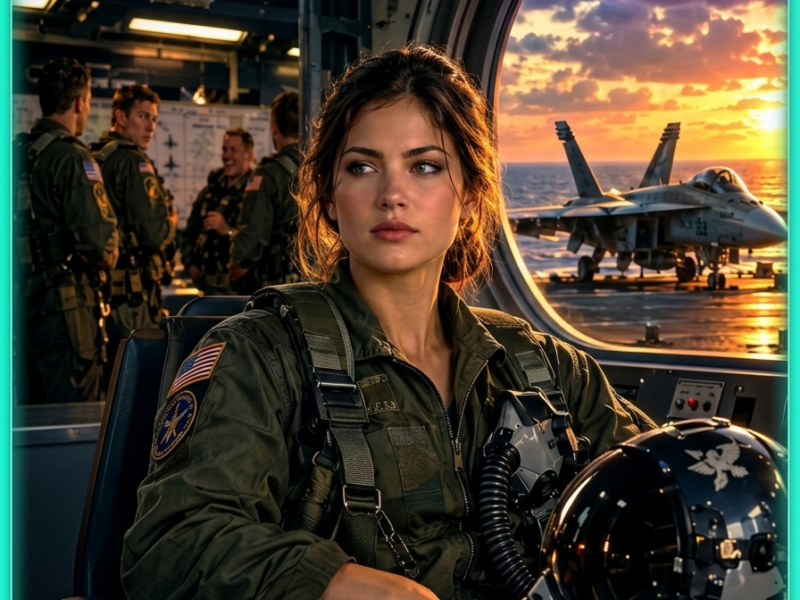
The moment Captain Ryan Mercer laughed at me in the Naval Air Station Oceana ready room, calling me “the rookie who got lucky,” everyone joined in
The hum of fluorescent lights in the Naval Air Station Oceana ready room always sounded like static before a storm. I stood in the back corner, near the flight line schedule board, adjusting the cuffs of my flight suit. My flight helmet rested under my left arm, its scarred dark-visor shell tucked tightly against my ribs.
Around me, the room hummed with the easy, practiced camaraderie of strike fighter squadron VFA-103. Laughter echoed off the metal lockers. Coffee mugs clinked against scarred wooden tables.
Then came Ryan Mercer’s voice.
“Check it out, boys,” Captain Mercer said, tossing his flight gloves onto the central briefing table. He tilted his head toward me, a smirk tugging at the corner of his mouth. “The rookie who got lucky on yesterday’s low-level route. Tell us, Rookie, did you actually read the terrain clearance charts, or did you just close your eyes and pray the trees were shorter than your altitude?”
A ripple of chuckles spread across the room. Several junior aviators smirked, eager to stay on the good side of the squadron’s prized flight lead. Ryan was a golden boy in the Navy tactical aviation community—decorated, possessive of his space, and carrying the kind of effortless confidence that made him seem twice his size.
I didn’t roll my eyes. I didn’t raise my voice. I had arrived at NAS Oceana three weeks ago without fanfare, without friends, and without a past anyone could read. My official records had been transferred under a high-level administrative hold, locked behind red-tape security clearance protocols that even the squadron clerk couldn’t bypass. To everyone here, I was just Lieutenant Maya Vance—a transfer from a desk job or a secondary fleet unit, quiet, hyper-vigilant, and painfully careful.
“I kept my eyes open, Captain,” I said softly, giving him a faint, unbothered smile. “The terrain followed the published pull-up points.”
“Right,” Ryan scoffed, leaning back against the briefing rail with his arms crossed. “Just try not to bend my jet today. The CAG is watching this morning’s four-ship exercise. I’d hate for you to scuffed the paint on an F/A-18E Super Hornet before you even figure out where the ground is.”
More light laughter flared up. I simply nodded. “I’ll do my best, sir.”
Before Ryan could launch into another taunt, the heavy steel door of the ready room swung open. Commander Marcus Vance—no relation, though the shared last name had been an awkward joke during my first day—walked inside. The atmosphere instantly shifted. Commander Vance was a veteran strike lead with a face carved from granite and eyes that rarely held warmth. He carried a thick, red-stamped manila folder under his arm.
“At ease,” Vance commanded, dropping the folder onto the mahogany briefing table with a sharp thud. The ready room snapped into complete silence.
“Before we step to the jets for the morning surface-attack scenario, we have a structural change in today’s formation,” Vance said, scanning the row of pilots until his gaze locked directly onto me.
“Lieutenant Vance,” the commander said crisp, clear, and unyielding. “You have the lead.”
Ryan’s sharp laugh cut through the quiet before he could catch himself. “Her? Commander, with all due respect, she’s been in the squadron for twenty days. She hasn’t even flown a division-lead flight in our local airspace.”
Commander Vance didn’t laugh. He didn’t even blink. He kept his slate-gray eyes fixed entirely on Ryan. “Did I stutter, Captain Mercer? You will fly wing on her left box. Lieutenant Vance has flight lead for the entire four-ship package today. Any questions?”
Ryan’s smile evaporated into a tense, hard line. He glanced at me, his eyes burning with a mix of irritation and deep suspicion. “No, sir.”
“Step to airframes in ten minutes,” Vance ordered, turning away without another word.
My stomach tightened into a hard knot. I tightened my grip on the helmet under my arm. Nobody in this room knew why I had been assigned to VFA-103 so abruptly. Nobody knew why my previous operational history was scrubbed clean from the public duty rosters. Nobody knew why I woke up every morning at 0300, staring at the ceiling, my hands shaking until I squeezed them into tight fists.
And I had intended to keep it that way forever.
Twenty minutes later, the flight line was a blur of heat haze, jet fuel exhaust, and the roar of twin General Electric F414 engines warming up. I climbed the metal boarding ladder of my Super Hornet, side number 101. The ground crew was securing my harness straps, but my eyes were fixed on the sky above the Atlantic coastline. It was crisp, bright, and silver-blue—an eerily quiet canvas for what was supposed to be a simple tactics evaluation.
“Dash One, check radio,” I spoke into my mask as the canopy sealed shut around me.
“Dash Two, loud and clear,” Ryan’s voice snapped back over the secure tactical frequency, laced with cold resistance. “Lead, just make sure you don’t take us over the restricted warning area boundary. Wouldn’t want you getting lost.”
“Copy, Dash Two. Save the banter for the debrief,” I replied, my voice dropping into a flat, razor-sharp operational tone that caught Ryan off guard.
We taxied out in sequence, lined up on Runway 23 Left, and blasted into the sky in a tight four-ship diamond. Within four minutes, we cleared the coastline, climbing rapidly to fifteen thousand feet over the Atlantic Warning Area. The ocean below glistened like polished tin.
“Division, combat spread,” I ordered over the radio. “Search radars active. Maintain ten-mile lateral separation.”
Everything proceeded normally for the first twelve minutes. Then, my tactical display flickered.
It was subtle—a phantom radar return flashing near the edge of our assigned air space, right along the outer limits of the threat vector. It wasn’t part of the simulated exercise script. According to our briefing packet, the hostile aggressors were supposed to approach from the north-northeast at twenty thousand feet. This contact was coming from the low east, hugging the wave tops at under five hundred feet, moving at high subsonic speed.
“Lead, Two,” Ryan’s voice burst through the headset, loud and urgent. “Target acquired north! That’s our simulated bandit. I’m committing early to intercept. Break left, Rookie, follow my line!”
Ryan’s aircraft began a hard bank toward the north, cutting across my formation’s flight path. He was taking over the flight, ignoring my position, chasing the scripted target like a dog chasing a ball.
“Negative, Dash Two!” I snapped into the mask, my heart slamming hard against my chest. My eyes were glued to the raw radar feed on my right display. “Dash Two, abort bank! Re-establish formation immediately!”
“What are you talking about?” Ryan barked back. “The threat is at zero-two-zero! Follow me or get out of the way!”
“That’s a decoy!” I yelled, my voice ringing with a fierce, absolute authority that shocked the entire frequency into silence. “Look at your raw Doppler! Low altitude, eastern vector! We have an unannounced target entering the live zone!”
“I don’t see anything at low altitude!” Ryan snapped, his tone laced with frustration. “That’s an order, Vance!”
“I am the flight lead!” I cut him off, executing a hard four-g break to the right, sweeping my aircraft directly into his path to physically block his vector. “Something is wrong with this track! Break right NOW!”
Three seconds later, the main tactical radio frequency wailed with an automated Fleet Defense warning tone. A loud, continuous tone buzzed through our helmets—an active missile-tracking warning from the exercise control center ashore.
An unannounced surface-to-air threat system on a military testing vessel had accidentally gone live during a weapons sync test, locking onto the exact sector Ryan was about to cross. If he had continued his turn to the north, he would have entered a live firing sector without radar jamming support.
Ryan went utterly, completely silent over the radio.
“Division, bank hard right, snap to heading zero-nine-zero, drop lower shelf, go low altitude!” I ordered smoothly, maneuvering the entire four-ship package through a narrow, safe corridor between the operational zones.
For the next ten minutes, nobody spoke. I guided the four Super Hornets out of danger, through the transit corridor, and back toward NAS Oceana with surgical, flawless precision.
When our tires touched down on the runway and we taxied back to the ramp, the silence among the pilots was suffocating. We unbuckled, dropped down from our cockpits, and walked toward the squadron building. Nobody looked at each other. Nobody uttered a word.
Inside the ready room, Commander Vance was standing beside the briefing table. The manila folder was open.
Ryan walked in first, his helmet held loosely in his hand, his face flushed red with embarrassment and residual shock. He opened his mouth to speak to Vance, but the commander held up a hand, cutting him off before a single word could come out.
Vance looked past Ryan, straight at me.
“You never told them?” Vance asked, his voice low and heavy.
I stopped near the doorway, keeping my chin level. “Told them what, sir?”
Vance didn’t answer right away. Instead, he reached down and turned the open file around so it faced the entire room. Ryan stepped closer, his brows furrowing as he looked down at the official record printed inside.
Across the top of the dark red classification cover page, a single military call sign was stamped in bold, dark lettering:
GHOST SEVEN
Ryan’s face drained of color in an instant. He staggered back a half-step, staring at the paper as if it were a ghost.
Beside him, another veteran pilot leaned forward, gasped, and whispered in sheer disbelief, “No way… that’s impossible.”
Two years ago, during a catastrophic night-operation exercise off the coast of the Pacific, a carrier strike group’s air defense system suffered an unprecedented combat system failure during live-fire missile drills. A runaway tracking sequence threatened to strike an unarmed command cruiser carrying over eight hundred crew members.
A single F/A-18 pilot—call sign Ghost Seven—had deliberately flown into the intercept window, using their aircraft’s custom electronic warfare jamming arrays and high-risk maneuvers to force the missile’s guidance system to track away from the ship. The pilot saved the cruiser, but their aircraft was destroyed. Official reports stated the pilot ejected into dark, frozen waters and was declared dead after a two-week search failed to recover a body. The identity of Ghost Seven had been classified at the highest levels of Naval Intelligence.
Ryan slowly turned his eyes toward me, his voice trembling for the first time since I had met him.
“You… you were Ghost Seven?”
I looked down at my flight gloves, my fingers twitching slightly. The sound of freezing Pacific waves still echoed in my ears every time I closed my eyes.
“Yes,” I said quietly.
The ready room fell into a silence so profound you could hear the tick of the wall clock. Nobody laughed. Nobody cracked a joke. Ryan stared at me, his mouth slightly open, the arrogance that had defined him for weeks completely shattered into dust.
“There’s one more thing,” Commander Vance said, breaking the silence with a tone that made my skin crawl.
Vance reached inside the folder and pulled out a single, glossy photograph. He slid it across the wooden table until it rested under the glare of the ceiling lights.
I stepped forward slowly, my boots feeling like lead weights. I looked down at the photograph.
It was a military salvage photo taken from an underwater recovery drone at the bottom of the Pacific floor. It showed the twisted, crushed, thermal-damaged wreckage of my old Super Hornet jet resting in the black silt. I recognized the shattered tail fins immediately.
But as my eyes drifted toward the edge of the frame, my blood went instantly ice-cold.
Lying in the sand twenty feet from the wreckage was a flight helmet. Its glass visor was cracked, and the custom unit insignia painted on the forehead was unmistakably clear.
It wasn’t my helmet.
It belonged to a second pilot—a wingman who had officially been listed as absent from that flight, a pilot who was never supposed to have been in the sky with me that night.
My breath caught in my throat. My hands began to shake violently. I looked up into Commander Vance’s eyes, my chest heaving.
“Where… where did you get this photo?” I whispered, my voice barely audible.
Commander Vance leaned over the table, lowering his voice so only the pilots in the room could hear.
“It arrived in a sealed courier bag at the front gate at 0500 this morning,” Vance said. “Addressed specifically to you.”
He turned the photograph over. Taped to the back was a strip of torn waterproof paper. Written on it in dark, erratic black marker were five words that made my entire past collapse around me:
I know you survived. -G8
My breath hitched in my chest as I stared at those two letters and a single digit: -G8.
Ghost Eight.
There was no Ghost Eight. There had never been a Ghost Eight. On that freezing, catastrophic night off the Pacific coast two years ago, I was flying solo on a high-altitude tactical evaluation mission. When the command system glitched and the live missile launched toward the USS Leyte Gulf, I was the only aircraft in the immediate quadrant.
Or at least, that was what my telemetry had told me. That was what the official Navy investigation board had put in writing before they wiped my record clean and gave me a fresh identity.
“Maya?” Commander Vance’s voice cut through the ringing in my ears. He was watching me with sharp, intense concern. “Do you know who sent this?”
I couldn’t speak. I looked back down at the salvage photograph. The cracked helmet in the silt carried the painted emblem of a striking osprey—a squadron insignia from a unit that had been decommissioned ten years ago.
“Lieutenant Vance,” Ryan stepped closer, his voice entirely devoid of his previous arrogance. His eyes were wide, filled with a sudden, unsettling realization. “Who was in the air with you that night?”
“Nobody,” I lied, though my voice cracked on the word. “I was alone.”
“This photograph says otherwise,” Commander Vance said sternly. He snatched the photo off the table and slipped it back into the manila folder. “Until we clear the origin of this package, your flight status is temporarily suspended. I’m placing you on administrative duty.”
“Sir, no!” I blurted out, taking a step toward his desk. “If someone sent this to the front gate of Oceana, they know I’m here. Sidelining me makes me a blind target. Put me back in the cockpit. Whatever this is, it’s connected to what happened two years ago.”
Vance stared at me for a long moment, wrestling with the decision. Finally, he slammed the folder shut. “No flight missions today. You stay on the ground until Naval Criminal Investigative Service verifies the chain of custody for this envelope. That is an order.”
He turned on his heel and walked out of the ready room, leaving a heavy, oppressive tension in his wake.
The other pilots slowly dispersed, casting quiet, unnerved glances in my direction. They were no longer looking at a rookie they could push around; they were looking at a living legend whose shadow had just darkened their brief room.
Only Ryan remained behind. He stood near the briefing table, staring at the floor, picking at the seam of his flight suit glove.
“I didn’t know,” Ryan said softly, his voice barely louder than a whisper. He didn’t look up at me. “When you transferred in… I thought you were just another ladder-climber who bought her way into a prime tactical unit. I didn’t know you were the one who took the hit for the Leyte Gulf.”
“It doesn’t matter what you thought, Ryan,” I said, walking toward my locker to stow my helmet. “Just keep your eyes open when you’re up there. Whatever happened two years ago… it isn’t over.”
“Maya, wait,” Ryan said, stepping into my path. “That helmet in the photo… I’ve seen that osprey emblem before.”
I froze, my hand hovering over the metallic latch of my locker. I turned my head slowly. “Where?”
“In the maintenance archives at Point Mugu three years ago,” Ryan explained, his forehead furrowing as he recalled the memory. “Before I transferred to Oceana, I did a rotation with testing and evaluation. There was a black-budget drone development project—experimental autonomous wingmen. The test team used old decommissioned squadron crests as cover logos to hide the budget lines. The striking osprey was Project VANGUARD.”
My pulse spiked. An autonomous wingman.
Two years ago, when my Super Hornet was struck by the shockwave of the intercepted missile, my avionics had failed completely before I ejected. But in those final five seconds, right before I pulled the ejection handle between my legs, I remembered seeing a shadow cross my canopy—a fast, swept-wing aircraft flying without landing lights, cutting through the explosion smoke. I had spent two years convincing myself it was a hallucination caused by hypoxia and trauma.
It hadn’t been a hallucination.
“If VANGUARD was an autonomous drone program,” I whispered, “then who was wearing that helmet?”
Before Ryan could answer, the red emergency alarm on the ready room wall began to flash, accompanied by the loud, rhythmic blare of the base scatter horn.
BZZZZT. BZZZZT. BZZZZT.
The ready room door burst open again. A young intelligence officer stumbled inside, his face pale and dripping with sweat.
“Captain Mercer! All available pilots step to jets immediately!” the officer shouted. “We have an unidentified radar track crossing into sovereign airspace thirty miles off the Virginia Capes! It’s not responding to IFF transponders, and it’s running an active jamming frequency that’s knocking out radar shore stations!”
Ryan grabbed his helmet off the table. “Is it a commercial track?”
“No sir!” the intel officer gasped. “It’s flying at Mach 1.8 at fifty feet above the water. Its radar signature matches a legacy tactical airframe… but its electronic footprint is identical to an experimental Navy system.”
Ryan turned to look at me. The look in his eyes matched the cold dread in my chest.
It was here.
“I’m coming with you,” I said, grabbing my helmet back from the locker.
“Vance gave a direct order—you’re grounded!” Ryan warned.
“I don’t care about Vance’s order!” I snapped, shoving my helmet onto my head and pulling the chin strap tight. “Whoever is flying that track sent that photo to me! If you go up there without knowing what Ghost Eight is, you’re going to get killed!”
Ryan hesitated for a fraction of a second, staring into my eyes. He saw the cold, unyielding fire of a pilot who had already survived death once.
“Fly my wing,” Ryan said flatly. “Don’t let Vance see us step to the tarmac.”
We sprinted through the ready room hangar bay, dodging ground crews and refueling trucks. The air was electric with panic. Engines were screaming across the flight line as two other Super Hornets from our squadron were already taxiing toward the runway.
We ran up to aircraft 104—a two-seat F/A-18F model parked in the alert shelter. I climbed straight into the rear cockpit, taking the Naval Flight Officer seat responsible for weapons systems and radar operations, while Ryan strapped into the front seat as the pilot.
Within three minutes, our twin engines roared to life with a deafening blast of afterburners. We didn’t wait for formal tower clearance. Ryan pushed the throttles forward, and aircraft 104 shot down the runway, rotating into the overcast grey sky like a silver bullet.
“Oceana Tower, Alert Track 104 airborne,” Ryan called over the radio.
“Alert 104, proceed vector zero-eight-zero, altitude below five thousand,” the controller’s voice rattled over the static. “Target speed is increasing. It just performed a nine-g turn that should have ripped the wings off a human pilot.”
I flipped my tactical radar console to long-range scan. My screens burst into a chaotic mosaic of purple electronic interference. The target was actively blinding our sensors.
“I’m filtering the noise!” I called to Ryan over the internal intercom. “Keep her steady on zero-eight-zero! I’m going to run an optical tracking lock using our nose infrared sensor!”
My hands flew across the glass display panels, keying in custom override codes that I hadn’t used in two full years. These were high-level developer overrides—codes that only someone who had been part of classified operational testing would know.
The radar screen flickered, flushed green, and suddenly locked onto a solid, razor-sharp contact.
My breath caught in my throat. The target’s telemetry profile appeared on my lower screen:
AIRCRAFT DESIGNATION: VANGUARD-08
STATUS: UNMANNED / AUTONOMOUS OVERRIDE
PILOT PROFILE: SIMULATED COGNITIVE COPY – VANCE, M.
I stared at the blinking text in horror.
The aircraft flying toward us wasn’t piloted by a human survivor. It was an advanced autonomous drone carrying an AI flight profile built from my own recorded flight data, my own combat instincts, and my own tactical patterns—harvested from the flight recorder of my crashed jet two years ago.
“Ryan!” I screamed over the intercom. “Break high right NOW! It knows what we’re going to do before we do it!”
Before Ryan could react, a sleek, dark-grey matte delta-wing aircraft burst through the thick cloud layer directly in front of us, flying inverted at supersonic speed.
It didn’t drop weapons. It didn’t open fire.
Instead, it rolled directly over our canopy, missing our vertical stabilizers by less than ten feet. As it flashed past, a blinding flash of high-intensity infrared light pulsed from its underbelly, completely blinding our optical sensors and frying our main cockpit display panels.
Our instrument screens went pitch black. The engines sputtered as electromagnetic interference surged through our electrical bus.
“I’ve lost flight controls!” Ryan yelled, pulling frantically on the stick as the jet began a violent, sickening roll toward the dark ocean surface below. “Controls are dead! Maya, we have to eject!”
“No!” I yelled back, slamming my hand into the manual breaker panel beneath my right leg. “Don’t pull the handle! Override the digital fly-by-wire! Pull the mechanical backup circuit!”
Through the thick smoke filling the cockpit, Ryan reached down and yanked the emergency mechanical reversion handle. The control stick shuddered violently, then caught. The nose of our Super Hornet pulled up just two hundred feet above the crashing sea waves, throwing us back into our seats with crushing g-force.
We leveled off, breathing heavily, our cockpit lit only by the amber glow of emergency backup battery lights.
Out the right side of my canopy, I looked out into the grey ocean mist.
The dark drone was hovering half a mile away, banking smoothly, matching our airspeed effortlessly. On its tail section, illuminated by a glowing strip of green LED strip lights, was a clear, painted call sign:
GHOST EIGHT
And then, my cockpit audio panel crackled to life with a synthetic, mechanical voice that sounded eerily, terrifyingly like my own:
“Welcome back, Ghost Seven. It is time to finish the flight.”
The synthetic voice echoing through my helmet set every nerve ending in my body on fire. It was my voice—my cadence, my pitch—but stripped of all human emotion, flattened into a cold, lethal algorithm.
“Maya…” Ryan’s voice shook through the internal comms, his breathing ragged as he fought to keep our semi-disabled Super Hornet flying straight. “Tell me you heard that too. Tell me I’m losing my mind.”
“You heard it,” I whispered, staring through the fogged glass of my canopy at the matte-black shape hovering off our wingtip. “It’s VANGUARD. It’s an AI flight architecture… built from my brain chemistry and flight telemetry recovered from my crash.”
“Why would anyone build that?” Ryan asked, his hands gripped tightly around the mechanical control stick as emergency warnings flashed amber across our backup instruments.
“Because two years ago, I didn’t just save the Leyte Gulf by accident,” I admitted, the painful truth finally tearing out of my chest. “I was testing the VANGUARD neural link during that exercise. The system glitched, identified the cruiser as a target, and locked on. The only way I could stop the drone from firing was to crash my own jet into its flight path to disrupt its guidance system. The Navy covered it up because VANGUARD was an illegal black-budget program.”
“And now it’s back,” Ryan breathed.
“No,” I said, my eyes narrowing as I watched the dark drone’s movements. “It didn’t just wake up on its own. An AI doesn’t mail a salvage photograph to a military base gate at 0500 in the morning. Someone released it. Someone is controlling it from the ground.”
Suddenly, our emergency radio frequency clicked. The static cleared, replaced by a clear, authoritative, and chillingly familiar voice.
“Alert 104, this is Commander Vance,” the radio crackled. “You have violated a direct grounding order. Revert control of your airframe immediately and turn back to Oceana base.”
I grabbed my mask microphone. “Commander! VANGUARD-08 is live! It’s operating in our airspace using a stolen neural profile! You knew about this program, didn’t you?”
There was a long pause on the line. When Vance spoke again, his voice was no longer that of a stern squadron commander. It was cold, calculated, and devoid of any institutional loyalty.
“You were supposed to stay grounded, Maya,” Vance said softly over the secure channel. “If you had stayed in the ready room, NCIS would have quietly taken you into custody, and we could have finalized the neural transfer without a public spectacle.”
Ryan gasped in the front seat. “Commander? What the hell are you talking about?”
“Captain Mercer, you were never meant to be part of this,” Vance replied coldly. “Lieutenant Vance—or rather, Ghost Seven—is the missing piece. The VANGUARD neural model is incomplete. It lacks the critical survival instinct logic that allowed her to survive the ejection two years ago. We needed her back in an active cockpit, under stress, to capture her final cognitive operational sync.”
My blood ran cold. The photo. The sealed folder. The sudden reassignment to VFA-103. It was all a setup. Vance hadn’t just received my file three weeks ago—he had orchestrated my transfer to Oceana to trap me in an environment where he could trigger my trauma and force my brain into combat-mode synchronization with the drone.
“You sold out to a defense contractor,” I snarled into the mic.
“I secured the future of aerial warfare,” Vance corrected calmly. “Pilots are weak, Maya. They get tired. They hesitate. They care about collateral damage. VANGUARD doesn’t. And once Ghost Eight completes its synchronization with your brain patterns during this air engagement, the software package will be worth billions on the international market.”
“You’re out of your mind!” Ryan yelled into the radio. “I’m taking this aircraft back to base and reporting you to Fleet Forces Command!”
“You won’t get the chance, Captain,” Vance said flatly. “Ghost Eight, execute authorization protocol Omega. Eliminate the legacy target.”
The moment Vance spoke those words, the dark drone off our right wing pitched up sharply, its twin thrust-vectoring nozzles glowing bright violet as it engaged full afterburner. It looped over our heads, falling into a perfect attack position directly behind our tail.
“Tone! Tone! Missile lock!” our emergency threat receiver screamed in our ears.
“He’s targeting us!” Ryan yelled, slamming the throttles forward. But our digital systems were still fried from the drone’s earlier EMP pulse; we had no flares, no radar chaff, and no electronic countermeasures. We were a blind, crippled bird flying against an apex predator.
“Ryan, dive for the water!” I shouted. “Get down into the sea spray! The salt mist distorts infrared targeting sensors!”
Ryan didn’t argue. He shoved the flight stick forward, sending our heavy Super Hornet into a stomach-churning dive toward the roaring ocean below. Five thousand feet. Three thousand feet. One thousand feet.
Behind us, the dark drone swept down like a falcon, trailing close, its optical eye locked onto our engine heat signatures.
“It’s not shooting!” Ryan yelled, looking in his rearview mirror. “Why isn’t it shooting?”
“Because it doesn’t want to kill us yet!” I realized, my mind racing through tactical scenarios at lightning speed. “It needs to stay locked onto us to complete the neural sync! Look at the backup display!”
On the small emergency screen between my knees, a progress bar was slowly filling with green light:
NEURAL SYNC: 78%… 81%… 84%…
“It’s reading my brain waves right now through my helmet comms array!” I shouted. “It’s copying my evasion tactics! Every time you pull a maneuver, Ryan, it learns how I react and absorbs it into its code!”
“Then how do we stop it?” Ryan asked, his voice tight with desperation as sea spray splashed across our lower belly camera.
“We give it something I would never do,” I said, a dangerous, insane idea forming in my mind.
“What does that mean?”
“I’m a precise, textbook pilot, Ryan. I calculate every risk. I never act on pure reckless instinct,” I said, leaning forward and placing my hand over Ryan’s on the mechanical flight stick. “But you do. You’re the arrogance-driven golden boy who flies on raw feel.”
Ryan let out a breathless, crazy laugh despite the terror. “Is that a compliment, Rookie?”
“It’s our only chance,” I said fiercely. “Unclip my helmet comms sync cable! Now!”
I reached up and yanked the neural data link cable from the base of my helmet, severing the digital feed sending my brain wave metrics to the drone.
“Now, Ryan!” I yelled. “Fly like an idiot! Do something completely uncalculated!”
Ryan didn’t hesitate. Instead of executing a standard tactical escape maneuver, he yanked the mechanical flight stick sideways and kicked the full left rudder pedal simultaneously—a violent, uncoordinated control input that would make any flight instructor scream.
Our heavy Super Hornet didn’t turn smoothly. It stalled out in mid-air, spinning sideways through the sea spray in an unpredictable, chaotic tumble.
Behind us, the VANGUARD drone’s prediction algorithms failed instantly. The AI had calculated twenty-four logical evasion paths based on my profile—and Ryan had chosen none of them.
The drone overshot us at Mach 1.2, screaming past our canopy and plunging straight into the thick layer of ocean fog ahead.
“We did it!” Ryan cheered, struggling to recover our spinning jet. “We broke its lock!”
“Not yet!” I yelled, looking back out the canopy. “Look up!”
High above us, emerging through the cloud layer, were two more dark, swept-wing radar-evading shapes.
Vance hadn’t just built one drone.
Ghost Nine and Ghost Ten dropped out of the clouds, their weapon bays snapping open in unison, painting our cockpit with live, lethal target locks.
The sky around us turned into a fatal trap.
Three black, pilotless predators now circled our crippled Super Hornet like vultures over a dying animal. Down at five hundred feet above the stormy Atlantic, we were trapped between an unforgiving ocean and three AI-driven war machines that possessed hyper-calculated precision.
“Maya…” Ryan’s voice was remarkably steady now, the panic gone, replaced by the grim resolve of a military aviator facing impossible odds. “Our engine temp on engine two is redlining. That uncoordinated spin tore up the compressor blades. We have maybe five minutes of flight time before the engine explodes.”
I stared out at the three black shapes forming a killing triangle around us. My hands were shaking, but inside my chest, the cold, crystal-clear focus of Ghost Seven took total control.
“Vance is watching this through their satellite link,” I said, my voice dropping an octave into pure ice. “He wants the neural dataset. He won’t fire until he gets a ninety-five percent sync confirmation from one of those units.”
“So what’s the move, Lead?” Ryan asked. For the first time, he called me Lead with genuine, absolute trust.
“Look ahead,” I pointed toward the eastern horizon.
Ten miles out, a massive wall of dark cumulonimbus clouds rose from the ocean floor to forty thousand feet—a severe, violent oceanic thunderstorm cell, flashing with blinding purple lightning and turbulence strong enough to tear airframes apart.
“You want to fly into that?” Ryan asked, incredulous.
“Standard Navy flight doctrine strictly prohibits entering a Category 4 thunderstorm cell,” I said with a faint, deadly smile. “VANGUARD’s safety protocol code is built on standard Navy flight doctrine. Its collision-avoidance subroutines won’t allow it to follow us inside.”
“And if the storm rips our wings off?”
“Then Vance doesn’t get his software,” I replied cold-bloodedly. “Turn zero-nine-zero. Full afterburner on engine one. Let’s go storm chasing.”
Ryan slammed the left throttle forward, leaving the damaged right engine at idle. Our Super Hornet surged forward, banking steeply toward the wall of black lightning and torrential rain.
Behind us, the three VANGUARD drones matched our course instantly. As we closed the distance to the storm—five miles, three miles, one mile—the drones began to sway erratically. Their optical sensors glitched as ambient static electricity from the storm wall charged the surrounding air.
“Sync dropping!” I read from the glitching emergency panel. “Sync is down to sixty percent! Their AI is struggling with the electrostatic noise!”
“Entering the wall!” Ryan yelled.
BOOM.
Daylight vanished in an instant. Darkness swallowed our cockpit, broken only by blinding flashes of white lightning that illuminated giant walls of water slamming against our canopy. The aircraft shuddered violently, thrown up and down fifty feet at a time by brutal vertical updrafts.
Inside the storm, ice began to form instantly along the edges of our wings.
“Look at the radar!” I shouted over the deafening roar of hail battering our aluminum skin.
On my flickering tactical screen, two of the drone contacts—Ghost Nine and Ghost Ten—halted at the edge of the storm wall, holding in an automated orbit pattern, unwilling to breach the severe weather barrier.
But one contact kept coming.
Ghost Eight.
The primary drone, carrying my stolen neural framework, had overridden its safety protocols. Driven by the obsessive core objective to complete the sync, it plunged into the lightning storm directly behind us.
“It’s crazy!” Ryan yelled, dodging a massive flash of cloud-to-ground lightning that struck the ocean below us. “The damn thing is chasing us down!”
“It’s not crazy—it’s me,” I realized with a shudder. “My neural profile carries my stubbornness. It won’t give up until I’m dead or synced.”
A massive bolt of lightning slammed directly into the drone’s right wingless fuselage fifty yards behind us. The blinding flash illuminated the drone’s carbon-fiber hull. The electrical strike shattered its internal guidance gyro, sending Ghost Eight into an unstable oscillation.
“It’s damaged!” I shouted. “Ryan, pull up! Execute an inverted vertical loop!”
“In a thunderstorm? With one engine?” Ryan yelled back.
“TRUST ME!” I screamed.
Ryan gritted his teeth, growled a curse into his mask, and pulled the mechanical stick back with all his physical strength.
Our Super Hornet pitched upward, climbing straight through the heart of the storm cell, trading air speed for altitude. 20,000 feet… 25,000 feet… 30,000 feet.
The air thinned. The turbulence eased slightly as we punched through the top layer of the storm clouds, bursting out into the brilliant, blinding blue sunlight above the storm ceiling.
A split second later, Ghost Eight burst through the clouds behind us, struggling to maintain lift with its damaged stabilization systems.
We were inverted, floating upside down at thirty-five thousand feet, staring down at the damaged black drone floating directly below us like a sitting duck.
“Ryan, cut the throttle on engine one!” I ordered sharply. “Force a stall!”
Ryan chopped the power. Our Super Hornet stalled in the high-altitude air, nose dropping instantly, falling straight down toward the drone’s dorsal spine.
I unlocked my manual emergency control override on the rear weapons console. With no digital radar guidance available, I brought up the legacy iron sight optics on my display, aligning our heavy metal belly directly over the drone’s central processing spine.
“We aren’t going to shoot it,” I said, my thumb hovering over the manual jettison switch for our empty heavy external fuel tank. “We’re going to crush it.”
“Drop it!” Ryan roared.
I slammed the manual jettison button.
The massive, six-hundred-gallon aluminum centerline fuel tank detached from our belly with a heavy mechanical CLACK.
The heavy tank tumbled through the freezing air, dropping like a silver anvil straight onto Ghost Eight.
CRASH!
The fuel tank smashed directly into the drone’s main wing root and engine intake. The impact violently severed the drone’s control surfaces, igniting residual jet fuel in a massive, blinding fireball that erupted across the top of the white cloud deck.
Ghost Eight disintegrated into flaming scrap metal, spiraling downward into the dark, churning thunderstorm below, gone forever.
“Direct hit!” Ryan yelled, his voice echoing with triumphant adrenaline. “Target destroyed!”
My heart pounded against my ribs as I watched the smoke clear. But our celebration lasted less than two seconds.
Our remaining operational engine let out a metallic screech, shuddered violently, and cut out completely.
The cockpit alarms wailed in a chorus of death:
DUAL ENGINE FAILURE. HYDRAULIC PRESSURE ZERO. ALTITUDE DROPPING.
Silence descended on the cockpit, broken only by the rush of wind outside. We were at thirty thousand feet, gliders made of dead metal, floating over a stormy ocean with no engines and no power.
And then, my backup emergency radio clicked on one last time.
It wasn’t Vance. It wasn’t the base.
It was a cold, calm voice originating from a high-altitude satellite transmission—a voice that made my soul freeze in my chest.
“Impressive performance, Ghost Seven,” a deep, unfamiliar man’s voice spoke smoothly through the static. “You destroyed Prototype Eight. But you forgot one simple rule of software…”
My eyes widened in sheer horror as I looked at the backup panel on my knee.
The progress bar wasn’t gone. It had reached one hundred percent right before the drone exploded.
NEURAL SYNC: 100% COMPLETE.
DATA UPLOADED TO CLOUD SERVER.
“Thank you for the data, Lieutenant Vance,” the smooth voice whispered. “Ghost Eight was just the test copy. Production begins today.”
The cold wind roared past our canopy as aircraft 104 fell rapidly through twenty-five thousand feet. The engine displays were totally dark; both General Electric turbofans were dead, frozen iron.
“Maya!” Ryan’s voice surged over the battery-powered intercom, urgent and focused. “Controls are locking up as hydraulic pressure bleeds out! We have to eject before we hit the cloud deck!”
“No!” I snapped, forcing myself to ignore the voice that had just spoken over the radio. “If we eject over the storm cell, the downdrafts will pull our parachutes into the sea waves and drown us! We glide this bird past the storm wall first!”
“We don’t have the altitude to glide ten miles!” Ryan argued, wrestling with the heavy, unpowered stick.
“We do if we trade altitude for airspeed!” I shouted back. “Trim the nose down five degrees! Keep our glide speed at two hundred and twenty knots!”
Ryan looked at the visual horizon, set his jaw, and pushed the dead stick down. The heavy Super Hornet responded sluggishly, its nose dipping into a controlled, silent dive toward the bright white cloud floor.
Behind us, the satellite transmission signal faded into static, but the man’s words burned in my mind like acid.
Ghost Eight was just the test copy. Production begins today.
Vance hadn’t been acting alone. He was just a field asset for a larger syndicate—a defense contractor or rogue intelligence network that now possessed a complete digital clone of my tactical brain, my instincts, and my combat reflexes. An unkillable, unfeeling fleet of autonomous killers was about to be built using my identity.
Not if I stop them first, I swore to myself.
We punched through the bottom of the storm clouds at four thousand feet, breaking out into clear, rain-swept air five miles off the coast of Virginia. The runway strips of NAS Oceana were visible in the far distance—tiny grey lines amidst a sea of dark green pine trees.
“We’re short!” Ryan yelled, checking our sink rate against the emergency barometric altimeter. “We’re dropping too fast! We’re going to come down two miles short of the runway, right in the civilian housing sector!”
I scanned the terrain below frantically. Off to our left, running parallel to the base, was a wide, four-lane concrete highway—Route 168—currently cleared of heavy traffic by base emergency alert sirens.
“Route 168, left bank!” I called out. “Dead-stick landing on the highway!”
“Are you crazy?” Ryan barked. “There are power lines along that road!”
“It’s the highway or a neighborhood, Ryan! Pick one!”
Ryan didn’t hesitate. He hauled the heavy, dying control stick to the left with both hands. The Super Hornet groaned under the aerodynamic stress, banking steeply, its shadow skimming over the tops of the pine trees bordering the road.
Two hundred feet. One hundred feet. Fifty feet.
The black asphalt of Route 168 rushed up to meet us. Ryan flared the nose at the last possible microsecond.
SCREEECH!
Our main landing gear slammed onto the pavement with a bone-jarring crash. Rubber burned, smoke billowed from the tires, and the aircraft bounced violently before settling onto the highway. Ryan stomped on the mechanical brakes with everything he had.
The jet slid sideways, clipping a metal streetlamp with its left wingtip, sending a shower of bright orange sparks across the glass canopy. The heavy aircraft skidded another four hundred yards before finally coming to a dead stop across all four lanes, just fifty feet from an intersection.
Silence slammed into the cockpit like a physical wall.
No alarms. No engine roar. Just the hot smell of burning rubber, hydraulic fluid, and rain touching hot metal.
Ryan slumped forward against his harness, panting heavily, his face drenched in sweat. He turned his head slowly, looking back at me through the cracked canopy glass.
“Hey, Rookie,” Ryan whispered, a genuine, breathless grin breaking across his bruised face. “That… was unbelievable flying.”
“You didn’t do so bad yourself, Captain,” I said, unbuckling my harness with trembling hands.
Before we could pop the manual canopy release, three black SUVs slammed to a stop on the road around our jet, their doors flying open instantly. Armed federal agents wearing NCIS vests spilled out, weapons drawn, surrounding the aircraft.
Behind them, a single marked Navy command sedan pulled up. Commander Marcus Vance stepped out of the rear seat, wearing his dress uniform, his face expressionless as he watched agents secure the perimeter.
“Stay in the cockpit!” an agent yelled through a megaphone.
I reached down, pulled the emergency canopy jettison handle, and pushed the heavy acrylic glass shell off our aircraft. The cool, wet sea air rushed inside.
I stood up in the rear cockpit, stepping out onto the wing root, and jumped down onto the asphalt. Ryan followed a second later, standing shoulder-to-shoulder with me as the armed agents closed in.
Commander Vance walked forward slowly, stopping ten feet away, flanked by two armed federal officers.
“Lieutenant Vance,” Vance said, his voice flat and bureaucratic. “Captain Mercer. You are under military arrest for destruction of government property, unauthorized airframe operation, and treason.”
I stepped forward, ignoring the weapons pointed at my chest. I looked Vance directly in the eye, pulling my flight gloves off one finger at a time.
“Save it, Marcus,” I said, my voice cutting through the rainy air like a knife. “We know about the satellite link. We know about the off-shore server upload. And more importantly… I know where the server is hosted.”
Vance’s cold expression twitched slightly. For a fraction of a second, a shadow of genuine fear crossed his eyes.
“You’re bluffing,” Vance whispered.
“Am I?” I asked, stepping right up into his space until we were inches apart. “The VANGUARD neural code requires a quantum hardware array to process live combat telemetry. There are only two facilities on the East Coast with that computing infrastructure: NAVAIR Patuxent River… and your private estate off the Chesapeake Bay.”
Vance went completely silent.
I leaned closer, lowering my voice so only he could hear.
“I didn’t just eject two years ago, Vance,” I whispered coldly. “I spent two years learning how your network operates. You thought you were hunting me today to steal my brain. But the moment Ghost Eight reached a hundred percent sync… my custom logic worm uploaded directly into your off-site mainframe.”
Vance’s eyes went wide with pure, unadulterated terror. He fumbled in his pocket, pulling out a encrypted military satellite phone. He tapped the screen frantically—only to see the display flicker, turn solid bright red, and flash a single line of text:
SYSTEM DELETED. RECOVERED BY GHOST SEVEN.
“It’s over, Commander,” Ryan said, stepping up beside me, placing a hand on my shoulder. “The entire tactical flight recorder from aircraft 104 was broadcast on an open Navy frequency during our dive. Fleet Forces Command heard every word you said.”
In the distance, the wail of dozens of military police sirens echoed down the highway. A convoy of heavy armored Navy security vehicles swept around the bend, moving at high speed, their red and blue lights reflecting off the wet pavement.
Vance slowly dropped his hands to his sides. The armed NCIS agents around us lowered their weapons, looking at Vance, then looking at each other, realizing who the real target was. Two junior agents stepped forward and clicked heavy steel handcuffs around Vance’s wrists.
As they led the disgraced commander away, Ryan looked at me, a deep sense of respect shining in his eyes.
“So… what happens now, Ghost Seven?” Ryan asked softly.
I looked up at the sky. The heavy storm clouds were finally beginning to break, revealing long streaks of golden sunlight cutting through the grey mist over the Atlantic.
I picked up my flight helmet from the wing of the broken Super Hornet, cradling it under my arm.
“Now?” I said, turning to look toward the flight line of Oceana in the distance. “Now I get my real name back.”
The end









