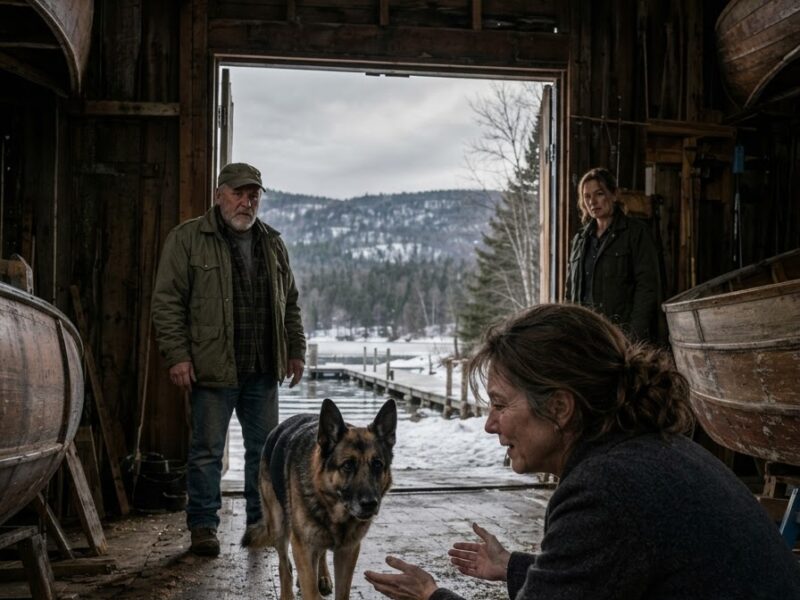
The moment a woman at a crowded Seattle ferry terminal called my Navy SEAL service dog “Milo,” I froze as he abandoned my side and walked straight toward her
The salt air off Elliott Bay always carried a bite in late October, the kind of sharp, icy mist that settled into old joint injuries and forced a man to remember every place he had ever bled.
I stood near the railing of the Bainbridge Island ferry terminal, surrounded by the late-afternoon rush of commuters. Car engines idled in long lanes behind us, their exhaust mixing with the thick grey fog rolling off the Puget Sound. Beside me, sitting perfectly upright on the cold concrete, was my nine-year-old Belgian Malinois-German Shepherd mix.
His official military working dog tag read Ranger.
I had spent five years in the Navy SEALs and another three trying to unlearn the habits of a war zone. Ranger was my tether to the real world. He wasn’t just a service dog; he was a highly trained tactical asset retired from active duty due to blast trauma—the same blast trauma that left me with a scarred leg and a mind full of bad memories. Ranger was disciplined, hyper-vigilant, and completely indifferent to strangers. He had been trained to ignore ambient noise, sudden movements, and raised voices.
He stayed on my left heel. Always.
“Ranger, easy,” I muttered, resting my hand on his tactical harness as a group of tourists laughed nearby.
His ears flicked, but he remained still, his amber eyes scanning the crowd with the same steady, calculating gaze he had used when sweeping compounds in the Helmand Province of Afghanistan.
Then, across the crowded concourse, a woman stepped off the ramp from the lower deck. She was wearing a faded tan trench coat, her hair pinned up loosely against the damp wind. She looked tired, carried down by the sort of heavy, silent grief that you can spot from a hundred yards away if you’ve carried it yourself.
She stopped ten feet from us to adjust her scarf. As she did, her eyes fell upon my dog.
She froze. The color drained completely from her face. Her canvas travel bag slipped from her shoulder, hitting the concrete with a dull thud.
“Milo?” she whispered.
Her voice wasn’t loud. It was barely a breath above the sound of the ferry’s idling diesel engines. But the moment that single word cut through the air, Ranger’s entire body went rigid.
His head snapped toward her. His tail didn’t wag; it dropped low and trembled. His ears pinned back—not in aggression, but in a strange, agonizing posture of recognition I had never seen from him in six years of ownership.
“Milo…” she repeated, her voice cracking as she dropped to her knees right there in the middle of the crowded walkway, completely oblivious to the commuters swerving around her. “Oh god… Milo…”
Ranger broke heel.
It was a small thing to an outsider, but to me, it felt like the earth had cracked open beneath my feet. A military working dog trained for high-stress combat environments does not break command. He does not abandon his handler.
“Ranger, heel!” I called out, my voice taking on the sharp, authoritative bark of an instructor.
He ignored me entirely. He didn’t rush or bark; he walked slowly, almost reverently, toward the kneeling woman.
I reached for his leash, but my fingers caught only air. My stomach twisted into a tight, hard knot.
The woman extended two trembling hands. Ranger closed the final distance, lowered his large snout into the crook of her neck, and let out a long, shuddering sigh. He pressed the full weight of his front torso against her chest, wrapping his head over her shoulder—a specific, deep-pressure calming maneuver he had never once performed on anyone but me.
“Ma’am,” I said, stepping forward quickly, my hands held open, my eyes darting across the concourse out of old tactical habit. “Ma’am, please don’t move suddenly. He’s a retired military working animal.”
She lifted her head. Her eyes were red, brimmed with tears that ran freely down her pale cheeks.
“No,” she whispered, looking up at me. “I… I’m sorry. I thought…”
“Do you know this dog?” I demanded, my tone sharper than I intended.
“No,” she said softly, though her hands were buried deep in the thick fur around Ranger’s neck, clutching him as if he were an anchor in a storm. “I don’t know your dog. But he looks… he moves just like…”
Ranger whined—a high, delicate sound that sounded entirely wrong coming from a dog that had faced down gunfire without blinking.
I looked closer at the woman. Beneath the tired lines around her eyes, there was a faint, haunting familiarity I couldn’t quite place. The ache in my chest—the deep, dull phantom pain that usually flared up when the weather turned cold—began to throb.
Eight years ago, in a sun-baked, dust-choked valley in Khost Province, my team had been ambushed during an extraction operation. Lieutenant Daniel Brooks, my spotter, my teammate, and the best man at a wedding that never ended up happening, had taken a heavy caliber round to the chest while holding off enemy fire so the rest of us could reach the chopper.
Before the dust cleared and the medevac took him, Daniel had grabbed my vest with bloody fingers.
Find Emma, he had choked out through the red foam on his lips. She’s in Seattle. The baby… find her, Mike. Promise me.
I had made that promise. But when I was finally discharged from the hospital at Walter Reed nine months later, the military records were a mess. I went to the apartment address Daniel had given me in Bremerton. The landlord told me she had moved out weeks after receiving the official Department of Defense telegram. The phone number was disconnected. Social media was a ghost town. After two years of hiring private investigators and knocking on dead-end doors, the trail went completely cold.
I had spent eight years carrying the guilt of a broken promise.
“What did you call him?” I asked, my voice barely audible over the sea gulls screaming above the bay.
“Milo,” she said, wiping her cheek with the back of her sleeve. “It was the name my husband gave his pup before he left for his final tour.”
My breath caught in my throat. My knees felt weak.
The woman reached into the inner pocket of her trench coat with shaking fingers. She pulled out a small, worn leather wallet, unbuckled the clasp, and slid out a faded, 4×6 photograph wrapped in clear protective plastic.
She held it up toward me.
The photograph showed a younger Daniel, wearing his navy dress whites, his arm wrapped around the shoulder of this very woman. And sitting in the grass between them was an eight-week-old Malinois puppy with a distinct black smudge across his left ear.
The exact same mark Ranger carried today.
“Where did you get that picture?” I whispered, the world around us blurring into insignificance.
“Daniel took it three days before his deployment,” she replied, her voice shaking violently. “He left Milo with his brother’s family in Oregon because I was high-risk with the pregnancy. But two months later, the family told me the pup got out of the yard and was hit by a truck. They said he was dead.”
“He wasn’t hit by a truck,” I rasped, staring at the puppy in the picture, then down at the full-grown dog resting his head against her knee. “Daniel had the pup shipped to our base as a mascot through a private transport contractor right before our unit deployed. The command let us keep him on base. When our transport vehicle was hit eight years ago… Ranger—Milo—was in the back crate. He was the only living thing we pulled out of the wreckage near Daniel’s final position.”
The woman gasped, covering her mouth with both hands. “You… you were with him?”
“I’m Michael,” I said. “Michael Miller. Special Warfare Operator.”
Her eyes went wide. “Michael…”
“My God,” I murmured. “Emma.”
The massive horn of the incoming ferry sounded across the harbor, a long, low vibration that shook the wooden piers. The crowd began to surge toward the turnstiles, pushing past us like water around a stone.
“Why didn’t you find me?” I asked, the voice of the broken friend finally leaking through my soldier’s exterior. “I searched for two years, Emma. I went to the Bremerton house. I called everyone.”
Emma lowered her head, fresh tears spilling onto her coat. “Because three weeks after Daniel died, a man from his division came to my house. He told me that the entire squad had been wiped out. He said you were dead, Michael. He told me to pack my things, take the settlement money from the military, and leave Washington State because it wasn’t safe.”
My blood ran cold. “What man?”
Before she could answer, Emma reached into her leather travel bag and pulled out a thick, heavy yellow envelope. The paper was creased and weathered, sealed with aged clear tape. Across the front, written in dark black marker, was a single word in a jagged, hurried handwriting I would recognize anywhere:
MICHAEL.
It was Daniel’s handwriting.
“He left this with a lawyer in Tacoma six days before he was killed,” Emma whispered, her eyes darting nervously toward the terminal crowd. “The lawyer was instructed to hold it until I returned to Washington. I only picked it up two hours ago.”
My hands shook as I took the envelope from her. I tore open the side. Inside was a single, folded sheet of lined notebook paper and a smaller photograph.
The note contained only eight words:
Trust Ranger. He knows who saved me. Don’t go home.
“Saved him?” I stammered, my brain refusing to process the words. “Daniel died in the valley. I saw the body bag—”
“Michael,” Emma interrupted, her voice dropping into a terrified, razor-thin whisper.
She reached out and gripped my forearm with surprising strength. She wasn’t looking at me anymore. Her eyes were locked on the glass doors of the terminal entrance thirty yards away.
“What is it?” I asked, sliding my hand instinctively toward the concealed holster beneath my heavy jacket.
“He’s been following me since I left the lawyer’s office,” she whispered. “The man in the dark coat standing by the coffee kiosk.”
I didn’t turn my head immediately. I used the reflection in the dark glass of the terminal window beside us.
Standing near the automated ticket counters was a tall, broad-shouldered man wearing a black wool overcoat and a dark baseball cap pulled low over his eyes. His right hand was tucked deep into his coat pocket, his posture rigid, his gaze fixed straight on Emma and me.
As if sensing the sudden spike of adrenaline in my system, Ranger stood up. The low, deep rumble started in his chest—a sound he only made when an active threat crossed the threshold. His lips pulled back slightly, revealing clean, lethal white fangs.
He wasn’t looking at a stranger. He was staring directly at the man in the black coat.
The man saw Ranger growling. He didn’t look surprised. He slowly lifted his head just enough for me to see the lower half of his face. Across his jawline was a distinct, silver-white surgical scar—a scar I had seen on a chief petty officer during my second deployment.
The man turned on his heel and walked calmly through the heavy glass doors into the fog of the parking lot.
Emma looked up at me, her face pale as snow. “Michael… who was that?”
I looked down at the note in my hand, then at the photograph that had fallen out of the envelope onto the concrete. The picture showed Daniel, severely burnt and bearded, sitting inside a dark, windowless room, holding up a newspaper dated three years after his official death.
My heart pounded against my ribs like a sledgehammer.
“We need to get off this dock,” I said quietly, pulling my phone from my pocket and slipping Ranger’s leash back into my grip. “Right now.”
We didn’t take the ferry.
I guided Emma and Ranger out of the terminal through a side exit used by port maintenance workers, avoiding the main parking garage where the man in the black coat had disappeared. My truck was parked four blocks away in a secured pay lot off Western Avenue.
Every ten paces, I checked our six. My military training, buried beneath years of quiet suburban living, roared back to life with terrifying clarity. The line between paranoia and survival had evaporated the moment I saw that photograph of Daniel.
“In the truck,” I said, unlocking the doors of my grey Ford F-150. “Ranger, up.”
The dog leaped into the back seat, his head wedged firmly between the front headrests, his eyes still darting out the tinted windows. Emma slid into the passenger seat, clutching her canvas bag against her knees like a shield.
I climbed into the driver’s seat, locked all the doors, and kept the engine idling while I checked the rearview mirrors. Nothing suspicious on the street.
“Take a deep breath,” I told her, handing her an unopened bottle of water from the center console. “You’re safe right now. Tell me everything that happened after Daniel’s memorial.”
Emma took the bottle, her hands still trembling so hard she could barely unscrew the cap.
“Two weeks after the service,” she began, her voice hoarse, “a man claiming to be from the Naval Criminal Investigative Service came to my home in Bremerton. He showed me a badge. He said… he said Daniel hadn’t just died in an accident. He said Daniel was involved in an illegal weapons trafficking ring inside his squad.”
“That’s a lie,” I growled, my knuckles turning white against the steering wheel. “Daniel was the cleanest operator in the team. He reported irregularities in the supply manifests twice during our last rotation.”
“I knew that!” Emma said, her eyes flashing with a sudden, desperate fire. “I told the agent he was wrong. But then he showed me documents—bank transfers with Daniel’s signature, photos of equipment crates. He told me that if I stayed in Washington or started asking questions, the military would freeze Daniel’s pension, seize our house, and launch a public court-martial that would ruin his name forever. He said… he said for the sake of my baby, I needed to disappear.”
“So you left.”
“I took my maiden name,” she whispered. “I moved to a small town outside of Boise. I raised my son, Leo, by myself. I never touched the military benefits. I worked two jobs to pay for his school because I was terrified that if I used Daniel’s name, they would find us.”
“Who was the agent?” I asked. “Did he have a name?”
“He called himself Officer Vance,” she said. “He had a silver scar across his jaw.”
My blood ran cold. Vance.
Master Chief Thomas Vance had been our logistics officer at the forward operating base in Afghanistan. He was the man responsible for signing off on arms crates, supply choppers, and local security contracts. Two days after Daniel’s death, Vance had been suddenly reassigned to a shore-duty billet in San Diego and retired from active duty six months later.
“Vance wasn’t NCIS,” I said, the pieces of a grotesque puzzle assembling in my mind. “He was the guy running the black-market supply lines out of the valley. Daniel didn’t stumble into an ambush, Emma. He found out what Vance was doing.”
I picked up the worn photograph from the dashboard—the picture of Daniel holding a newspaper dated three years after his supposed death.
“Look at the date on this paper,” I said, pointing to the faded print near his thumb. “October 14, 2021. Daniel didn’t die in that valley in 2018. Someone took him.”
Emma let out a ragged sob, pressing her forehead against the glass of the window. “Is he still alive, Michael? Please… tell me the truth. Is my husband alive?”
“I don’t know,” I admitted honestly. “If he was alive three years ago, Vance was holding him somewhere. But why? Why keep a captive SEAL alive for five years instead of killing him?”
Ranger let out a low, persistent whine from the back seat, nudging his nose against my shoulder. I reached back and patted his head, feeling the hard ridges of his leather collar.
“Wait,” I said, freezing.
I turned around in my seat and grabbed Ranger’s collar. It was an old, heavy-duty military-spec nylon collar I had taken off his transport crate the day I officially adopted him from the working dog kennel. I had never taken it off.
I unbuckled the collar. The brass buckle was rusted, the nylon frayed. Tucked beneath the inner lining of the nylon, right against the dog’s neck, was a small, flat seam that had been restitched with thick black fishing line.
“Got a pocket knife?” I asked Emma.
She quickly reached into her purse and handed me a small silver utility knife. I carefully sliced through the black thread and peeled back the inner strap of the collar.
Nested inside a carved recess of the thick nylon was a small, silver micro-SD card, wrapped in clear plastic to protect it from moisture.
I stared at the tiny piece of plastic in my palm.
“Daniel didn’t just give you a dog,” I whispered, looking up at Emma. “He hid the evidence on him before he left for that last mission. He knew if anything happened to him, Ranger was the only thing Vance’s men wouldn’t search.”
I pulled my laptop out from the lockbox beneath the rear passenger seat, booted it up, and inserted the micro-SD card into the reader slot.
The drive contained three encrypted video files and a single text document labeled READ_FIRST.txt.
I double-clicked the text file. The screen flickered, revealing lines of text typed in raw, unedited prose:
Mike,
If you’re reading this, Vance thinks I’m dead, and you’ve finally found Emma. I don’t have much time. Vance isn’t working alone. The smuggling operation goes all the way up to the regional logistics command in Joint Base Lewis-McChord. They aren’t just selling surplus gear—they’re shipping un-registered weapons caches to private militias in the Pacific Northwest.
I hid the master manifest files on this drive. It has names, dates, and GPS coordinates for their main storage facility in the Cascade Mountains.
If they come for you, look for the place where the river turns red. Vance has a safehouse there. That’s where they keep the ghosts.
Protect my family, brother.
— Dan.
Before I could open the video files, a loud, metallic THUD echoed from the roof of my truck.
The driver’s side window exploded inward in a shower of reinforced safety glass.
A heavy, gloved hand reached through the shattered window, grabbing me by the collar of my jacket and hauling me violently against the door frame.
“Out of the truck! Now!” a voice barked.
It was Vance.
Behind him, two men dressed in black tactical gear were already trying to wrench open the passenger door where Emma sat screaming.
Ranger didn’t wait for a command. He launched himself over the center console like a seventy-pound missile of muscle and teeth. His jaws clamped down hard onto Vance’s forearm, the puncture teeth tearing through the heavy wool of his black coat.
Vance roared in pain, dropping his grip on my collar as Ranger dragged him half-way into the broken window, thrashing his head with lethal, trained force.
“Gah! Shoot the damn dog!” Vance screamed to his men.
“Ranger, OUT!” I bellowed, throwing my weight into the driver’s door, slamming it outward into Vance’s chest.
The door struck Vance hard, breaking his grip and knocking him backward onto the wet asphalt of the parking lot. I reached down, grabbed my 10mm sidearm from its holster beneath the steering column, and leveled it through the broken window frame.
“GET BACK!” I roared.
The two tactical guards froze, their hands hovering over their holstered sidearms. In a busy downtown Seattle parking lot at four in the afternoon, firing automatic weapons was a risk even rogue operators couldn’t take without drawing immediate federal attention.
“Michael, drive!” Emma screamed, pulling her door shut and locking it as one of the guards reached for the handle.
I jammed the truck into reverse, stomping on the accelerator. The tires shrieked against the wet pavement as the F-150 slammed backward out of the parking space, clipping a concrete pillar and spraying sparks across the dark garage.
Vance scrambled to his feet, blood pouring from his arm where Ranger had torn through his coat. “You won’t make it out of the state, Miller!” he shouted, his voice echoing over the screech of my tires. “We have the roads covered!”
I threw the truck into drive, smashed through the wooden parking gate arm, and burst out onto Western Avenue into the heavy Seattle rain.
For six blocks, I drove erratically—taking sharp lefts, cutting through alleyways, and constantly checking the mirrors. No headlights followed us out of the garage. Vance was smart; he wouldn’t engage in a high-speed chase in downtown traffic. He would use his local network to box us in.
“Are you hit?” I asked, my heart hammering against my ribs, blood dripping from a small cut on my forehead where glass had grazed me.
“I’m… I’m okay,” Emma gasped, holding her bag tight. Ranger was panting heavily in the back seat, his mouth wet with Vance’s blood, his eyes locked on me.
“Good boy, Ranger,” I rasped, reaching back to touch his snout. “Good boy.”
I pulled into a covered gas station three miles north of the city, staying under the canopy to hide the vehicle from potential overhead cameras. I turned off the engine and looked at the laptop screen resting on the console. The micro-SD card was still inserted.
“Where is Leo?” I asked, turning to Emma. “Your son.”
“He’s at a summer camp near Mount Rainier,” she said, her voice trembling. “With my sister. They don’t know anything about this.”
“Keep it that way,” I said. “Call your sister. Tell her to take Leo to a public place—a mall, a crowded restaurant—and stay there until I give you the all-clear. Do not use Daniel’s name over the phone.”
While she made the quick, frantic call, I analyzed the note again on my screen.
Look for the place where the river turns red. Vance has a safehouse there. That’s where they keep the ghosts.
“Do you know what that means?” I asked Emma when she hung up. “The place where the river turns red?”
Emma wiped her nose with a tissue, staring blankly at the dash before her eyes suddenly widened. “The Red Cabin,” she murmured. “Daniel’s grandfather owned an old mining claim up near Skykomish, along the South Fork of the Skykomish River. In the autumn, the clay beds upstream wash into the water and turn the river a deep, rusty red. Daniel used to take me up there when we were dating.”
“Is it still in the family?”
“No,” she said. “The county seized it for back taxes ten years ago. It was sold at a private auction.”
“To a shell company,” I finished the thought. “That’s where Vance is holding him. Or where he was holding him.”
“Michael, if Vance has men everywhere, we should go to the FBI,” Emma pleaded, reaching out to touch my arm. “We have the SD card. We have the files. Let the federal authorities handle this!”
“Look at the files, Emma,” I said, opening one of the text documents on the drive. I pointed to a list of names and titles. “Deputy Directors. Federal Marshals. State Patrol Commanders. Vance’s network isn’t just a couple of rogue soldiers. It’s an entire infrastructure built over fifteen years of black-market operations. If we walk into a field office in Seattle, we won’t know if the agent taking our statement is working for the government or working for Vance.”
She looked at the names on the screen, the reality of our isolation settling into her features.
“We have to go to Skykomish,” I said, putting the truck in gear. “If Daniel is still alive up in those mountains, Vance knows we have the location now. He’ll move to burn the evidence—and that means killing anyone left inside that cabin.”
“I’m coming with you,” she said firmly.
I looked at her. Eight years of grief had turned the soft young woman from Daniel’s old photographs into someone hardened by survival.
“It’s going to get dangerous, Emma,” I warned.
“He’s my husband,” she said simply. “And Leo deserves to know his father.”
I looked back at Ranger in the rear seat. The dog let out a sharp, single bark, his eyes focused forward on the highway leading toward the dark, jagged peaks of the Cascade Mountains.
“Alright,” I said, stepping on the gas. “Let’s go get our boy back.”
The storm picked up as we climbed into the foothills of the Cascades.
Rain turned into a sleet-like slush that coated the windshield of the F-150. Highway 2 was nearly deserted, the massive Douglas firs towering on either side of the asphalt like dark sentinels. By the time we turned off onto an unmarked logging road four miles east of Skykomish, night had fallen completely.
I cut the truck’s headlights half a mile from the coordinates Emma had given me, navigating by the dim moonlight filtering through the storm clouds.
“We go on foot from here,” I whispered, pulling two tactical flashlights, a spare magazine, and my heavy winter coat from the back.
I handed Emma a light fleece jacket and a small canister of military-grade pepper spray. “Stay ten paces behind me. If anything happens to me, you take Ranger and run back to the highway. Do you understand?”
“I’m not leaving you, Michael,” she said.
“It’s tactical protocol, Emma,” I said sharply. “If I drop, you survive. For Leo.”
She swallowed hard and nodded. “Understood.”
I unlatched Ranger’s harness and attached a silent tactical lead. “Ranger, search mode. Quiet.”
The dog moved into a low, creeping gait, his nose hovering an inch above the frozen mud of the logging trail. He was back in his element. The anxiety he had displayed at the ferry dock was gone, replaced by the lethal, silent focus of a military working dog executing a breach-and-clear operation.
We navigated through a dense thicket of Western Red Cedar, the sound of the roaring South Fork River growing louder with every step. The air smelled of wet pine, ozone, and fresh mud.
After twenty minutes of silent movement, Ranger stopped behind a massive granite boulder. He lowered his body into the brush and lifted his left paw—the classic signal for an occupied structure ahead.
I crept up beside him, peeking over the top of the rock.
Nestled in a small clearing fifty yards below us, right at the edge of the swollen, clay-red river, sat an old log cabin. The windows were boarded up with heavy plywood from the inside, but thin wisps of smoke rose from a rusted iron chimney on the roof.
Parked in the gravel driveway were two black SUVs—the same vehicles Vance’s men had used in Seattle.
Two armed guards in thermal ponchos were pacing the perimeter, carrying short-barreled carbines. Through the heavy timber walls of the cabin, I could hear the faint, muffled sound of a raised voice.
Vance was already inside.
“How many men?” Emma whispered, crawling up to my right.
“At least four,” I said, scanning the clearing with my night-vision monocular. “Two on the perimeter, two inside. They’re setting up something. Look at the back of the SUV.”
Through the lens, I could see crates of commercial-grade explosive charges stacked near the open tailgate of the rear vehicle.
“They’re going to demolish the cabin,” I realized, a cold sweat breaking out on my neck. “They’re wiping the site clean. Burning the evidence and everything in it.”
“Daniel…” Emma gasped, reaching for the boulder.
I caught her wrist. “Wait. We can’t just charge in. They have thermal scopes and heavy firepower. We use the environment.”
I turned to Ranger. I reached down, unclipped his lead, and touched his neck right behind the ear—the command cue for an aggressive distraction sequence.
“Ranger… fetch,” I whispered, pointing toward the far side of the clearing, away from the cabin doors.
The Malinois shot through the underbrush like a shadow, completely silent, disappearing into the dark forest surrounding the driveway.
Ten seconds later, a loud, violent thrashing noise erupted from the brush fifty yards to the left of the guards, accompanied by the ferocious, echoed barking of a pack of wild dogs—a sound Ranger was trained to emulate by striking metal trash cans or wooden crates left in target zones.
“What the hell was that?” one of the perimeter guards yelled, raising his rifle and pointing his flashlight toward the noise. “Bear?”
“Check it out,” the second guard ordered. “Vance wants the perimeter clear before we set the charges.”
The first guard stepped away from the cabin porch, taking six steps into the dark treeline.
That was all the window I needed.
I moved out from behind the boulder, sprinting silently down the mud slope. I closed the distance to the second guard before he even turned his head. I slammed the butt of my 10mm pistol into the side of his neck. He went down without a sound, his rifle splashing into a puddle.
Before the first guard in the treeline could realize his partner was down, Ranger hit him from behind, taking him to the ground in a tangle of limbs and mud.
“Clear,” I grunted, waving Emma down the slope.
We reached the rotting front porch of the cabin. The heavy oak door was locked with a padlocked chain on the outside.
I pulled a pair of heavy bolt cutters from my tactical pack, snapped the chain link, and kicked the heavy door inward.
The hinges shrieked as the door flew open.
Inside, lit only by the red glow of a kerosene lantern hanging from a ceiling beam, was a scene straight out of a nightmare.
The cabin was stripped to the bare stone. Chains hung from the heavy log rafters. Standing near a rusted iron stove in the corner was Vance, holding a flare gun in one hand and a remote detonator in the other.
And chained to a heavy steel post in the center of the room, his clothes tattered, his beard long and grey, his body covered in decades of scars, was a man.
He lifted his head slowly. His amber eyes—the exact same eyes as the young SEAL in the photograph—blinks against the dim light.
“Mike…?” the man rasped, his voice a broken, dusty whisper.
“Daniel,” I breathed.
“Get back, Michael!” Daniel screamed, his voice raw from years of disuse, his heavy chains rattling against the iron post. “It’s a trap!”
Vance turned toward the doorway, a twisted, maniacal smile breaking across his scarred face. He held up the remote detonator in his left hand, his thumb resting over the red arming switch.
“You really are a loyal bastard, Miller,” Vance sneered, his arm wrapped in thick blood-stained bandages from Ranger’s bite earlier. “I knew you couldn’t resist playing the hero one last time.”
“Drop the detonator, Vance,” I said, stepping into the room, my sidearm raised and locked onto the center of his chest. “It’s over. The files are already on a secure server. If I don’t check in with the regional DOJ in thirty minutes, the entire manifest goes public.”
Vance laughed—a dry, rattling sound that turned into a wet cough. “You think I care about the DOJ, Miller? This operation made fifty million dollars over twelve years. The people above me aren’t going to let any of us stand trial. The moment you crossed that river, my handlers scrubbed my credentials. I’m dead either way. But I’m not going alone.”
“Michael!” Emma cried out as she stepped through the door behind me.
Daniel’s eyes locked onto her. The wild, broken look in his face vanished, replaced by an expression of pure, unadulterated shock.
“Emma…?” Daniel whispered, his knees buckling beneath him as he sagged against his chains. “Oh god… Emma…”
“Daniel!” She rushed past me, completely ignoring the danger, throwing her arms around his neck, weeping uncontrollably as the cold iron chains pressed between them. “You’re alive… you’re alive…”
“I told you to stay away…” Daniel sobbed into her shoulder, his scarred hands reaching up to touch her hair. “I tried to keep you safe…”
“Enough emotional bullshit!” Vance barked, stepping toward the window. “I set the timer on the exterior charges for two minutes. You want him back, Miller? You have two minutes to find the key to these chains before this entire cabin gets blown into the Skykomish River.”
Vance raised the flare gun toward the ceiling, intending to fire it into the exposed insulation to start a blaze before escaping through the rear hatch.
“Ranger, ATTACK!” I screamed.
The Malinois didn’t hesitate. He launched himself across the room, clearing the central table in a single bound.
Vance fired the flare gun, but the sudden impact of seventy pounds of muscular shepherd threw his aim off completely. The white-hot magnesium flare slammed into the log wall, showering the room in blinding red sparks.
Ranger drove Vance hard against the rear window. The glass shattered, and both the man and the dog tumbled out into the mud of the backyard.
“Mike! The key!” Daniel yelled, pointing toward a heavy brass ring hanging from Vance’s belt hook on the floor where he had dropped it during the struggle.
I dove across the floor, grabbed the brass key, and jammed it into the heavy padlock securing Daniel’s wrist chains. The lock clicked open. I swung the iron bar back, releasing his wrists.
“Can you walk?” I demanded, hauling my best friend to his feet.
Daniel collapsed into my arms, his legs withered from years of confinement, but the old fire in his eyes was blazing. “I can run if I have to, brother.”
“Out! Everyone out!” I shouted, grabbing Emma with one arm and supporting Daniel with the other.
We burst through the front door of the cabin just as a high-pitched electronic beep began to sound from the exterior SUV—the count-down timer reaching its final seconds.
“Ranger! COME!” I bellowed toward the rear yard.
The dog leaped out from the broken rear window, covered in mud and snow, sprinting toward us as fast as his nine-year-old legs could carry him.
Behind him, Vance was scrambling toward the driver’s side of the second SUV, trying frantically to disarm the charge he had set too quickly.
“RUN!” Daniel yelled.
We threw ourselves over the crest of the mud embankment fifty yards away just as the first commercial charge detonated.
The explosion was deafening. A blinding flash of orange light tore through the dark Cascades, followed by a shockwave that knocked us flat into the wet snow. The log cabin collapsed inward like a house of cards, sending a massive fireball skyward that lit up the red waters of the river below.
The SUV exploded a second later, a secondary blast that swallowed the driveway and Vance’s desperate screams in a pillar of flame.
Then, silence returned to the canyon, save for the crackle of burning timber and the steady rush of the river.
I lay in the snow, gasping for air, the heat of the fire washing over my back.
Beside me, Daniel was lying on his side, his arm wrapped tightly around Emma. She was kissing his forehead, his cheeks, his hands, tears washing away the soot on his skin.
Ranger trotted up to us, his tongue hanging out, panting heavily. He dropped down beside Daniel, resting his massive head directly on my friend’s chest.
Daniel lifted his scarred, shaking hand and laid it over the dog’s head, scratching him behind the left ear where the smudge of black fur remained.
“Hey, Milo,” Daniel whispered, his voice cracking with emotion. “You kept them safe. Good boy.”
Ranger let out a long, quiet sigh and closed his eyes.
Six months later.
The morning sun broke over the rolling green hills of a small horse ranch in Sequim, Washington. The sky was clear, blue, and free of fog.
I sat on the wooden porch of the ranch house, holding a warm cup of coffee, watching the fence line.
Down in the pasture, seven-year-old Leo was running through the tall grass, laughing as he kicked a soccer ball. Chasing right behind him, his tail wagging with energetic joy, was Ranger. The dog had retired for good this time—no more searches, no more threats, just endless green fields and a boy who adored him.
Sitting on the porch steps below me were Daniel and Emma. Daniel’s hair was cut short again, his face clean-shaved, though the deep scars remained as badges of honor. His legal identity had been restored by the Department of Justice, the military corruption network Vance led had been completely dismantled by federal prosecutors, and the record had been set straight.
Daniel wasn’t a traitor. He was a hero who had survived the impossible.
Daniel looked up from his mug, catching my eye. He smiled—a real, genuine smile that reached all the way to his eyes.
“What are you thinking about, Mike?” he asked.
I took a sip of my coffee, looking out over the mountains in the distance where the sun was shining bright and clear.
“I’m thinking that I spent eight years carrying a broken promise,” I said softly. “And it turns out, all I needed to do was follow the dog.”
Daniel chuckled, leaning back against Emma’s knees as she ran her fingers through his hair.
“He always was the smartest officer in the unit,” Daniel said.
Down in the field, Leo kicked the soccer ball into the wooden goalpost, and Ranger let out a loud, victorious bark that echoed across the quiet valley, completely free of echoes from the past.
The End.









