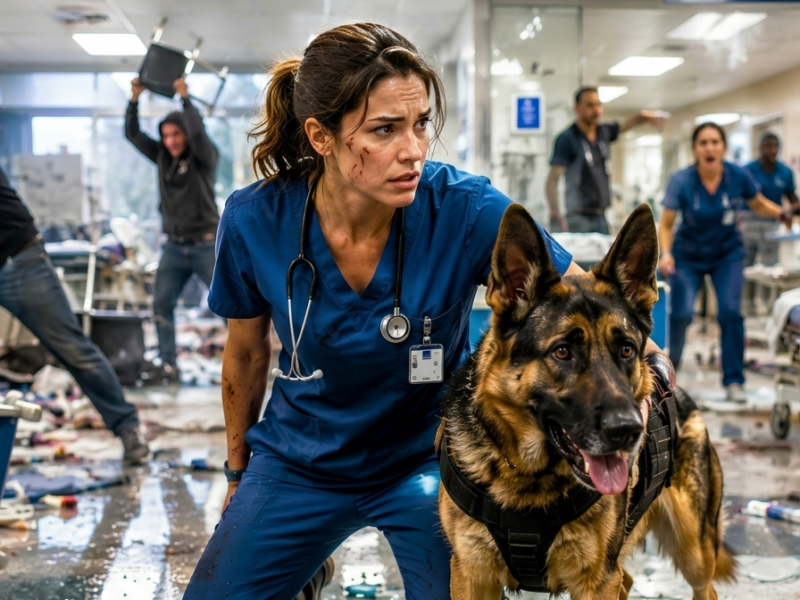
The moment a wealthy surgeon ordered security to drag me out of the emergency room in front of twenty terrified patients, he laughed at my battered uniform and called my K9 partner a useless dog
The emergency room at Mercy General in Chicago looked like a war zone that night. Rain lashed against the high glass windows of the ambulance bay, mixing with the harsh amber glare of emergency floodlights outside. Inside, the floor was covered in a chaotic mosaic of shattered glass, discarded IV tubing, and smeared crimson trails. Frightened patients, nurses, and elderly visitors were pressed against the cold ceramic walls, staring in mute horror at three masked men who were violently tearing through the locked medication cabinets near the triage desk.
I had been off duty for less than an hour when the urgent tones of the emergency broadcast crackled over my radio. I hadn’t even had time to change out of my faded, navy-blue uniform scrubs. Running alongside me, his nails clicking sharply against the polished concrete, was Duke—my retired military working dog. Duke was a ten-year-old German Shepherd whose ears bore the scars of two tours in Afghanistan. Though officially retired due to an old shrapnel injury in his left hip, his senses remained sharper than those of any human I had ever known.
As I burst through the double automatic doors, the hospital’s security chief, a thick-necked man named Miller, immediately stepped out from behind the reception counter to block my path.
“You’re off the clock, Emily! You’re not authorized to be in this sector!” Miller snapped, extending a heavy arm to physically bar my entrance.
Behind him, standing in the center of the panicked crowd like a tyrant surveying a crumbling empire, was Dr. Richard Hayes. Hayes was Mercy General’s chief orthopedic surgeon and a prominent hospital board member. He looked impeccably composed despite the chaos. His tailored surgical coat was unwrinkled, and he was casually adjusting the leather strap of his custom gold watch. Nearby, a young pediatric nurse was practically on her knees, crying and begging him to unlock the pediatric trauma bay to retrieve a portable ventilator for a five-year-old boy struggling to breathe in the corner.
Hayes didn’t even look at her. His cold gray eyes locked onto mine, flickering with pure disgust as he took in my faded uniform and the scarred dog at my heel.
“Get her and that animal out of my hospital immediately,” Hayes ordered Miller, his voice booming over the sound of screaming sirens and crying children. He gestured at Duke with a sneer. “We are handling a high-stakes containment. We don’t need a broken-down cop playing hero with a useless hound.”
I stared at him, stunned by the sheer depth of his indifference. A child was choking on his own fluids ten feet away, armed intruders were smashing equipment, and Hayes was worried about hospital protocol and hierarchy.
Then Duke growled.
It wasn’t his standard defensive rumble aimed at the masked men who were currently ripping steel doors off the pharmacy cabinets. It was a deep, guttural, venomous vibration that rattled through his leash straight into my palm.
He wasn’t looking at the thieves. Duke’s dark, intelligent eyes were locked intently on Dr. Richard Hayes.
The surgeon’s face changed for half a second. The calm, arrogant mask slipped, revealing a flash of absolute, blinding terror before he quickly regained his composure. That tiny reaction frightened me far more than the armed men thirty feet away.
“Duke, stay,” I whispered, tightening my grip on his leather lead.
But Duke ignored the command—something he had never done in six years of service. He lunged forward, ignoring the armed men entirely, and darted toward an overturned medication cart resting beside the heavy double doors of Operating Room 4. He lowered his snout to the floor, sniffing intensely along the metal baseboards, before scratching furiously at a hidden, locked supply panel built into the wall beneath the surgical monitors.
One of the masked men turned sharply, raising a black semi-automatic pistol. “Get that damn dog away from there!”
“Put the weapon down!” I shouted, unholstering my service sidearm and stepping directly between the shooter and my partner. My heart pounded against my ribs like a sledgehammer, drowning out the blaring overhead fire alarms.
The gunman let out a cold laugh, but before he could squeeze the trigger, Duke lunged again—not at the shooter, but at the loose metal panel beneath the shelves. With a violent jerk of his jaw, he ripped the stainless-steel cover away.
Something small and metallic clattered onto the linoleum floor, rolling to a stop right at my boots.
It was a heavy, military-grade black flash drive, stamped with an encrypted brass crest.
Dr. Hayes went deathly white. All the color drained from his face, leaving him looking like a corpse in a expensive suit.
Instantly, the three masked men stopped smashing the pharmacy cabinets. They didn’t grab the narcotics. They didn’t grab the cash box. They turned as one unified unit and charged directly toward me and Duke.
In that terrifying instant, the truth hit me like a physical blow. This wasn’t a random robbery for prescription drugs. They hadn’t come for medicine at all. They had come to retrieve that drive. They had come to erase something.
I dropped to one knee, scooped up the flash drive, and shoved it deep into my tactical pocket. Duke immediately shifted his heavy weight, placing his body squarely between me and the three approaching men. His front paws planted firmly, his coat bristling with the same fierce, unwavering determination I had seen seven years ago in the dusty valleys of Kandahar—years before a devastating roadside explosion took the life of my younger brother, Michael, and nearly ended my own career in law enforcement.
A sharp, deafening gunshot shattered the air.
The muzzle flash illuminated the dark room. Duke let out a agonizing yelp, his front legs buckling instantly. He collapsed onto his side, his heavy head hit the floor with a dull, horrifying thud.
“No!” I screamed, a raw sound that ripped straight from the depths of my lungs. I collapsed onto the floor beside him, completely ignoring the armed men who were now closing in around us.
I pressed both of my hands over the dark red wound blossoming on Duke’s ribcage. His chest heaved erratically, hot blood flowing freely between my fingers. The world around me dimmed into a surreal blur; the screaming patients, the flashing emergency lights, the blaring alarms all dissolved into complete silence as I looked down at my partner.
Duke’s dark, expressive eyes slowly rolled up to meet mine. He let out a faint, shallow whine. Then, his heavy tail thudded against the floor once. Just once. A final gesture of loyalty from a soldier who had spent his entire life protecting others.
“Stay with me, boy! Please, Duke, stay with me!” I sobbed, pressing my shoulder into his side to staunch the bleeding while keeping my weapon pointed blindly into the shadows ahead.
Footsteps echoed softly against the blood-stained tile. I looked up through a veil of furious tears. The three masked men had formed a perimeter, but they weren’t moving to shoot me. They were waiting for Dr. Richard Hayes, who stepped slowly out of the shadows. The cold, polished demeanor was gone, replaced by a dark, sinister malice that turned his aristocratic features ghastly.
“You should have stayed outside, Emily,” Hayes whispered, his voice dangerously low, stripped of all humanity. “You have no idea what you’ve just stolen.”
I gritted my teeth, wiping blood from my cheek with the back of my hand, my firearm locked squarely onto the center of his chest. “Then explain it to me, Doctor. Explain why you’re willing to murder a dog and let a room full of people die for a piece of plastic.”
Hayes didn’t flinch at the sight of my gun. Instead, he slowly turned his head to look through the thick observation window of Operating Room 4. Inside, under the pale blue glow of surgical lights, a ten-year-old girl lay motionless on an operating table, hooked up to a silent heart monitor.
“That drive doesn’t contain patient charts or billing codes,” Hayes said quietly, his voice chillingly matter-of-fact. “It contains the encrypted operational log of Sector 7—a private military research initiative funded by government contractors. It holds the complete records of every individual we were ordered to let die under the guise of medical trauma… and every soldier brought here for ‘specialized containment’.”
He paused, letting the silence stretch between us until it felt like a physical weight crush my chest.
“And your brother’s name is at the top of that list,” Hayes added smoothly.
My breath caught in my throat. The room seemed to tilt violently on its axis. “You’re lying,” I whispered, my voice trembling despite my best efforts to hold it steady. “Michael died seven years ago in Helmand Province. His unit was hit by an IED. I buried his empty casket myself.”
“You buried a box filled with sand and military honors,” Hayes corrected, taking a slow step toward me. “Your brother didn’t die in Afghanistan, Emily. He survived the blast. But he saw something his commanders couldn’t allow him to report. So they shipped him here, under top-secret clearance, to be processed in our subterranean trauma unit. Mercy General isn’t just a hospital, my dear. It’s a vault.”
Before I could process the monstrous weight of his words, the overhead fluorescent lights suddenly flickered, buzzed violently, and went completely dark.
The emergency generators failed to kick in. Instead, every computer screen, patient monitor, and wall display across the entire emergency department simultaneously flared to life, casting a brilliant, eerie neon-green glow across the darkened room.
A bold, crimson line of text began flashing repeatedly across every screen:
CRITICAL SYSTEM OVERRIDE: PATIENT FILE UNLOCKED — CARTER, MICHAEL J.
SUBJECT STATUS: ACTIVE / CONFINED IN LOWER LEVEL 3
A sharp, static crackle echoed over the hospital’s master public address system. The speaker above my head hummed, and then a distorted, raspy human voice echoed through the dark corridors—a voice I had dreamed of hearing every single night for seven agonizing years.
“Emily…” the voice rasped, struggling for air through what sounded like an oxygen mask. “If you’re hearing this… don’t let them take the drive. I’m still here.”
I froze, tears spilling down my face as the sound of my dead brother’s voice vibrated through the foundation of the building.
Down at my side, Duke let out a deep breath. His eyes snapped wide open, his body shuddering as if jolted by an electric shock. He pushed his front legs against the wet floor, miraculously struggling back to his feet despite the dark blood staining his coat. He raised his snout toward the back wall of the emergency room.
From somewhere deep behind the reinforced steel doors of Operating Room 4—down inside a hidden concrete shaft that wasn’t marked on any hospital blueprint—came three distinct, rhythmic metallic thuds.
Someone was knocking from inside a vault that had been sealed from the outside for seven long years.
The heavy metallic thuds echoed through the dark, green-lit emergency room like a rhythmic heartbeat from the grave. Thump. Thump. Thump.
Dr. Hayes lost every trace of his sinister composure. “Kill her!” he screamed at the masked men, his voice cracking with desperation. “Get that drive and lock down Level 3! Now!”
The closest gunman raised his rifle, but Duke was faster. Propelled by an impossible surge of adrenaline, the scarred Shepherd launched himself off his hind legs, slamming his sixty-pound frame directly into the man’s chest. The gunman crashed backward into a heavy stainless-steel tray, his rifle discharging harmlessly into the ceiling tile.
“Duke, move!” I roared, grabbing the fallen officer’s heavy tactical flashlight from the floor while firing three rapid shots from my duty weapon at the second intruder. My shots hit the mercenary’s chest plate, throwing him off balance long enough for me to grab Duke by his tactical harness and drag him through the swinging double doors of Operating Room 4.
I slammed the heavy emergency door shut behind us and jammed a metal surgical cart beneath the crash bar. Outside, heavy boots pounded against the door, accompanied by the muffled curses of Hayes’s men as they began hammering against the reinforced glass.
Operating Room 4 was dead silent compared to the madness outside. The young girl on the table was asleep under sedation, her breathing calm and steady. But in the back corner of the surgical suite, behind a row of hanging linen drapes, stood a heavy steel door marked with a high-voltage hazard symbol. Duke stumbled directly toward it, leaving a trail of blood on the white tile, and pressed his snout against the seam of the frame.
I ran to him, kneeling to inspect his wound. The bullet had grazed his chest rib cage, tearing through skin and muscle, but had miraculously missed his heart and lungs. I pulled a roll of sterile surgical gauze from a nearby tray and wrapped it tightly around his torso, knotting it with trembling hands.
“You’re a tough old soldier, Duke,” I whispered, pressing my forehead against his wet nose. “Hold on a little longer. Just a little longer.”
He licked my hand once, his tail giving a low, steady wag.
I turned my attention to the steel door. There was no keyhole, no handle, and no standard electronic keycard reader. Instead, embedded into the center of the frame, was a narrow drive slot framed by a pulsing blue LED ring.
I pulled the encrypted flash drive out of my pocket. The military emblem stamped into its casing matched the brass border of the door’s reader. I didn’t hesitate. I shoved the drive firmly into the slot.
The blue ring instantly turned a brilliant, solid white. A heavy pneumatic seal hissed open, releasing a cloud of freezing, chemical-scented air that smelled of ozone and industrial bleach. The massive steel door swung inward, revealing a steep, concrete stairwell spiraling downward into pitch-black shadow.
From the dark depths below, the rhythmic knocking sounded again. Thump. Thump. Thump.
“Emily…” the faint voice whispered through the stairwell’s intercom system. “Hurry. They’re initiating the thermal purge.”
I drew my weapon, clicked on the heavy tactical flashlight, and began guiding Duke down the freezing concrete steps.
With every step down into Level 3, the modern appearance of Mercy General faded away. The clean, painted walls gave way to raw, unpainted concrete and heavy steel conduits running along the ceiling. This wasn’t a medical facility; it was an underground black site built beneath the city under the guise of an emergency fallout shelter.
At the bottom of the stairs, we stepped into a vast, cavernous corridor lined with floor-to-ceiling glass observation cells. Most of the cells were dark and empty, filled with rusted medical gurneys and discarded monitoring equipment. But at the far end of the hallway, a single room was illuminated by a solitary overhead spotlight.
Inside that cell, sitting on the edge of a narrow iron cot, was a man wearing a ragged military undershirt. His back was turned to us, covered in deep, jagged scars that mirrored the blast injuries Duke carried on his side. His left arm was reinforced with a crude metal brace, and his dark hair was streaked with gray.
“Michael?” my voice broke, echoing softly down the hollow concrete corridor.
The man froze. He slowly stood up, turning around to face the reinforced glass.
My heart stopped beating. The jawline was the same. The sharp, piercing blue eyes were the same. But the young, smiling twenty-two-year-old brother I had hugged goodbye at O’Hare airport seven years ago was gone. In his place stood a hardened, hollowed-out survivor whose eyes burned with a mixture of profound relief and terrifying knowledge.
“Emily,” Michael said, his voice coming through a tiny mesh speaker beside the glass frame. He pressed his trembling palm against the heavy glass. “You shouldn’t have come.”
I rushed to the glass wall, pressing my palm directly opposite his. Tears flowed freely down my face, hot against the ice-cold air of the underground bunker. Duke trotted to my side, pressing his heavy head against the base of the cell, letting out a low, emotional whine that made Michael’s eyes well with tears.
“Duke,” Michael whispered, a small, painful smile touching his cracked lips. “You brought the old boy with you.”
“Michael… oh my god, Michael,” I sobbed, my fingers scratching uselessly at the unbreakable bulletproof glass. “They told me you were dead. They brought home an empty flag-draped box. Why? How could this happen?”
Michael took a deep, shaky breath, glancing nervously at a red digital clock ticking down on the wall above his head. The timer showed 04:12… 04:11… 04:10…
“The roadside bomb in Helmand wasn’t an insurgent attack, Emily,” Michael said quickly, his voice urgent. “Our unit intercepted an unmarked convoy transport in the desert. We found out that high-ranking officials within our command, working directly with private pharmaceutical executives like Hayes, were smuggling advanced biological research under military clearance. When my team refused to stay quiet, our own command called in an airstrike on our position to eliminate us.”
He pressed his hand harder against the glass. “I survived the strike, but I was badly wounded. Hayes had me secretly transported here to his private facility. For seven years, they’ve kept me locked in Level 3, using my blood to test synthetic trauma-recovery drugs designed for defense contractors. I wasn’t the only one, Emily. Dozens of soldiers listed as ‘Missing in Action’ passed through these rooms.”
“Why didn’t you try to get a message out?” I asked, my blood boiling with a mixture of intense rage and sorrow.
“I tried every single day,” Michael replied, gesturing toward a panel of raw copper wiring he had exposed beneath his iron cot. “It took me four years to steal enough wire and radio components from the maintenance workers to splice into the hospital’s main PA system. Tonight, when I felt the power grid fluctuate during the lockdown, I knew it was my only chance to fire the signal.”
Suddenly, the red digital clock on the wall let out a loud, high-pitched screech.
02:30… 02:29… 02:28…
“What is that timer?” I demanded, shining my tactical flashlight on the ceiling overhead. Heavy yellow pipes were beginning to hiss, venting thick clouds of pressurized white gas into the corridor.
“It’s the thermal purge system,” Michael said, his voice turning dead serious. “Hayes knows the flash drive was taken. The system is programmed to incinerate everything on Level 3 to eliminate all biological evidence before law enforcement can execute a search warrant. In two minutes, this entire floor will be engulfed in high-intensity thermite flames.”
“No!” I yelled, pulling my weapon and firing three heavy rounds directly into the glass cell door. The bullets struck with loud cracks, but only left faint white spiderwebs on the reinforced surface.
“It’s bulletproof, Emily! You can’t break it from the outside!” Michael shouted over the blaring siren. “The master override control is located inside the central monitoring room at the end of the hall!”
I turned toward the deep shadows at the end of the corridor. “I’ll get it. Stay right there!”
“Emily, wait!” Michael called out.
I didn’t stop. With Duke limping faithfully beside me, I sprinted down the corridor toward the central monitoring room. The air was growing hot, filled with the sharp, suffocating stench of burning chemical fuel. Heavy metal blast doors began creeping down from the ceiling, slowly sealing off the exit routes one by one.
I threw open the door to the central monitoring room. Inside, a wall of vintage computer monitors displayed live feeds of every corner of the hospital. In the middle of the room stood Dr. Richard Hayes, holding a heavy chrome revolver, his hand trembling with insane fury.
“You really are as persistent as your brother,” Hayes spat, pointing the revolver straight at my head. “But it ends here, Emily. In ninety seconds, this entire level becomes ash. And no one will ever know the truth.”
“It’s over, Hayes!” I screamed, keeping my gun leveled at his head as the room around us grew intensely hot. The ambient temperature was rising rapidly, making the air burn inside my throat with every breath. “The broadcast went through! The entire emergency room heard Michael’s voice! The police are already outside!”
“The police work for people who pay my salary!” Hayes shrieked, his eyes wide and bloodshot. “A few dead patients and a crazy woman’s story won’t survive the night! Hand over the drive, or I’ll put a bullet through your forehead right now!”
“You forgot one thing, Doctor,” I said softly, stepping sideways to draw his attention away from the door frame behind him.
“And what is that?” Hayes sneered, taking a step toward me, his finger tightening on his trigger.
“You called him a useless dog.”
Behind Hayes, a streak of gray and tan fur erupted through the smoky haze.
Despite his bleeding torso and years of old war injuries, Duke launched his heavy body through the air with terrifying force. He hit Hayes from behind, his powerful jaws locking onto the surgeon’s right wrist.
Hayes screamed in agony as the chrome revolver flew from his hand, clattering uselessly across the metal floor. The surgeon crashed backward onto the main control console, smashing a bank of delicate glass monitors.
“Get him off me! Get him off!” Hayes shrieked, flailing wildly as Duke pinned him to the floor, his deep, commanding growls shaking the room.
I rushed forward, kicking the fallen revolver into the dark corner, and smashed my heavy flashlight down onto the master override control console. I shoved the encrypted flash drive into the primary diagnostic port and slammed my palm onto the flashing red manual release button.
Across the room, a loud mechanical klaxon roared, followed by the deep, heavy sound of hydraulic locks disengaging across the entire subterranean sector.
“SYSTEM OVERRIDE ACCEPTED,” a calm computer voice announced over the speakers. “THERMAL PURGE CANCELED. CELL DOORS UNLOCKED.”
Down the hallway, the heavy glass door of Cell 7 swung open with a heavy metallic hiss.
I looked down at Hayes, who was pinned beneath Duke, crying and hyperventilating in sheer terror. “Duke, release,” I commanded firmly.
Duke instantly released his grip, stepping back and standing at strict military attention, his ears perked, his chest heaving as he kept his dark eyes locked on the defeated surgeon.
Heavy footsteps echoed down the corridor. Michael burst into the control room, his movement awkward from years of confinement, but his eyes burning with intense life. He looked at Hayes, then looked at me, a profound look of silent understanding passing between us.
“Is it over?” Michael asked quietly.
“Not yet,” I replied, pulling a pair of heavy steel handcuffs from my tactical belt and roughly ratcheting them around Dr. Hayes’s wrists. “We still have to introduce him to the federal prosecutors.”
Ten minutes later, the heavy blast doors of Operating Room 4 were forced open from the inside.
As Michael, Duke, and I emerged from the darkened surgical wing into the main emergency room, the scene was entirely transformed. A dozen armed Federal Marshals and Chicago Police officers had secured the building, having breached the facility after receiving the automated distress broadcast fired from Michael’s spliced transmitter.
The three masked mercenaries were already in zip-ties on the floor, guarded by heavily armed tactical officers.
When Dr. Richard Hayes was led out of the back doors in hand-cuffs, blinking against the flashing blue lights of thirty police cruisers, a heavy silence fell over the crowded room. The frightened patients, the nurses, and the hospital staff watched in utter shock as the prestigious chief surgeon was marched toward the back of a police transport van.
A young team of military paramedics rushed forward with a gurney for Michael, wrapping him in a warm emergency blanket. He refused to lie down until he looked at me and wrapped his arms around my shoulders in a bone-deep, long-overdue embrace.
“I thought I lost you forever, Mike,” I whispered into his shoulder, holding onto him with everything I had.
“You never gave up on me, Em,” Michael said, tears running down his weathered face. “Neither of you did.”
He reached down, gently placing his hand on Duke’s head. The old German Shepherd leaned heavily against Michael’s legs, letting out a soft, contented sigh as the rain outside slowly began to clear.
The encrypted flash drive sitting safely inside my pocket contained enough evidence to dismantle a decade of corruption, expose high-level military co-conspirators, and bring justice to dozens of families who had been lied to for years.
Duke looked up at me, his brown eyes clear, calm, and victorious. He was no longer just a retired military hound or an injured stray in a broken ER. He was a protector, a savior, and the hero who had brought my brother back from the dead.
The end









