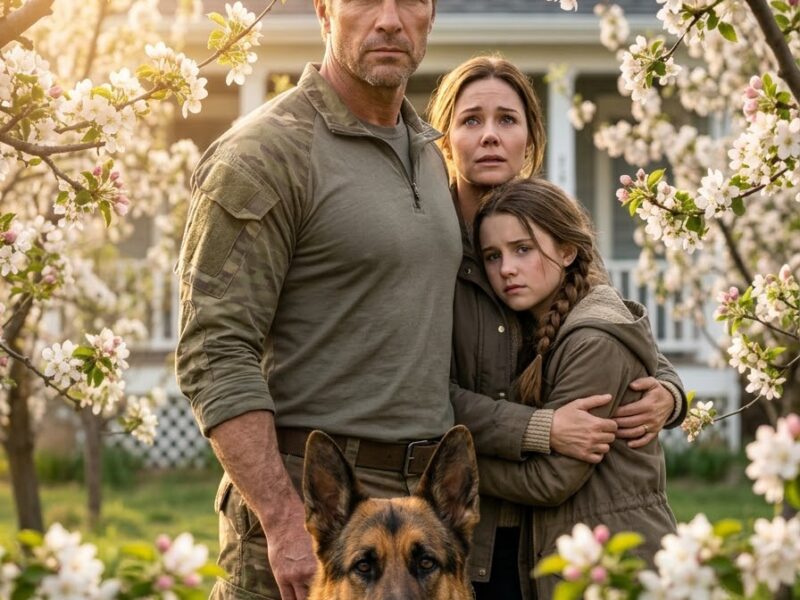
The moment a stranger shoved a Gold Star widow against a memorial wall at Arlington National Cemetery, I stepped between them
The damp cold of an early September rain in Northern Virginia seemed to soak straight through my canvas field jacket into the old metal in my left shoulder. Arlington National Cemetery was shrouded in a heavy, knee-high fog that rolled up from the Potomac, blanketing the endless white headstones like a wool shroud. It was the kind of morning that invited quiet, but the silence in my head was already deafening.
I had come for Daniel. Six years had passed since the afternoon the DOD casualty officer stood on my porch, dressed in full dress blues, telling me Lieutenant Daniel Hayes had been killed in action during a night raid in the Korengal Valley. Six years since I brought his dog tags back to his mother, bearing the heavy, crushing guilt of a man who had survived the blast that took his best friend.
Beside me, my retired Belgian Malinois, Bear, walked with the slow, deliberate tread of a veteran who knew where he was. His dark face was graying at the muzzle, his flank scarred by the same shrapnel that had shattered my collarbone in the Hindu Kush. He was my shadow, my anchor, and the only living creature that understood why I couldn’t sleep without a light on.
We were standing near the section reserved for the fallen of Operation Enduring Freedom when a sharp, muffled cry broke the heavy stillness.
Bear’s ears immediately pinned back. I turned toward the marble pathway fifty yards away. A tall man wearing a dark waterproof jacket had backed a woman against a low stone memorial wall. His fingers were clamped hard around her wrist, twisting it down toward her waist while she tried desperately to pull away.
“Leave her alone,” I said, my voice carrying the flat, gravelly weight of a man used to giving orders in chaotic places.
The man froze, then slowly turned his head. He was younger than me, mid-thirties, with a military-style high-and-tight haircut, a pale face, and eyes as dead and grey as wet slate.
“Mind your business, old man,” he snapped, his voice sharp and low.
Bear stepped in front of me, his body locking into a low, predatory crouch. A vibrating growl began deep in his chest—a sound I hadn’t heard him make since we cleared compounds in Helmand Province.
I looked closer at the woman. She was shivering, clutching a faded brown leather handbag against her ribs with her free arm. pinned to her coat lapel was a small, golden star set within a purple background.
A Gold Star widow.
The sight stirred something fierce and cold in my chest. I closed the distance between us in three long strides, positioning my six-foot-two frame directly between the stranger and the woman.
“I said let her go,” I repeated, dropping my hand to Bear’s harness. “Now.”
The man looked at my combat boots, the scarred muzzle of the tactical K9 beside me, and the look in my eyes. He released her wrist with a sudden, violent flick of his hand, but he didn’t back down. Instead, he stepped into my space, leaning close enough that I could smell the stale tobacco and damp rain on his coat.
“You’re making a mistake, Sergeant,” he whispered. “This isn’t over.”
He spun on his heel and melted into the foggy path, his dark coat swallowed by the grey mist within seconds.
The woman collapsed back against the cold marble wall, gasping for air. I turned to her, keeping my hands open and non-threatening. “Are you hurt, ma’am?”
She shook her head, her face pale as a sheet, but her grip on that worn leather handbag never loosened. “No… no, I’m okay. Thank you.”
Bear didn’t relax. He didn’t look toward the path where the stranger had fled. Instead, his snout dropped toward the woman’s handbag. He took two slow steps forward, his nose twitching violently as he sniffed the leather seams, and let out a second, lower growl that made the hair on my arms stand up. Bear was a dual-certified MWD—trained for both combat protection and explosive/contraband detection. He wasn’t growling out of aggression; he was alerting.
“What’s inside the bag?” I asked softly, keeping my tone gentle.
She looked down at the leather, her knuckles white. Her lips trembled as she looked up into my eyes. “Something my husband left behind. Something I wasn’t supposed to find.”
“Who was your husband?”
She wiped a tear from her cheek with her sleeve, her voice dropping to a whisper. “Daniel Hayes.”
The world seemed to lose its sound. The distant rumble of traffic over the Key Bridge, the rustle of rain on the oak trees—everything vanished.
“Daniel?” I repeated, my lungs suddenly refusing to draw air. “Lieutenant Daniel Hayes?”
“Yes,” she breathed. “I’m Clara. He… he spoke about you all the time.”
She reached into the side pocket of the handbag and pulled out a small, yellowed piece of paper folded into a tight square. The paper was weathered, stained with salt and grease, but as she unfolded it, I recognized the sharp, slanting handwriting instantly. It was the same handwriting that had filled a hundred letter-bound notebooks during our long nights at Firebase Anaconda.
I took the paper with trembling fingers. Across the center, written in dark ink, was a single sentence:
If anything happens to me, trust Michael.
“My name is Michael,” I whispered, staring at the paper. “Michael Vance.”
Clara nodded slowly, tears welling in her green eyes. “I know. He told me if I ever felt unsafe, if anyone ever came looking for his footlocker, I had to find you. I came here today because… because I didn’t know where else to go on the anniversary.”
“Who was that man?” I asked, my blood beginning to run cold.
“He’s been following me for three weeks,” she said, looking terrified. “He showed up at my apartment in Richmond. He searched my car. He wants the package Daniel sent home before his final mission.”
Before I could ask what was in the package, Bear suddenly lunged toward a green wooden bench sitting beneath a weeping willow ten feet away. He dropped his nose to the gravel, barking twice—a sharp, insistent alert.
I walked over, pulling my small tactical flashlight from my pocket. Underneath the bench, partially buried in the mud and wet leaves, was a small metallic object. I knelt, wiping away the grimy silt with my thumb.
It was an American military identification tag. Daniel’s name, blood type, and service number were stamped into the stainless steel. But my hand went totally numb when my thumb cleared the line at the very bottom.
In standard military issue, the bottom line reads USMC or USA, followed by religious preference. But this tag was stamped with a date: 14 OCT 2022.
Daniel had been officially listed as Killed in Action on 12 SEP 2020.
The tag was stamped two full years after I had watched his sealed coffin lower into the earth.
My heart began hammering against my ribs like a trapped bird. “Where did you get this, Clara?”
“I didn’t,” she gasped, stepping back. “I’ve never seen that before!”
Bear whipped his head around, snapping his jaws at the air as he faced the main gate parking lot. Down through the foggy trees, a black Chevy Tahoe was idling near the wrought-iron fence. Standing beside the driver’s side door, holding a pair of binoculars, was the same man in the dark jacket.
Suddenly, the heavy vibration of my cell phone rattled in my pocket. I pulled it out.
An unknown caller ID from an unlisted satellite trunk.
My thumb slid across the glass. “Vance.”
Silence filled the line for three long, agonizing seconds—just the heavy, rhythmic static of a scrambler circuit. Then, a voice came through the speaker. It was quiet, raspy, damaged by what sounded like throat trauma, but the cadence, the accent, the subtle drawl were impossible to mistake.
“Michael,” the voice whispered, sending a shockwave of cold horror straight down my spine. “Don’t trust the widow.”
The line went dead with a loud click.
I stood frozen in the cold rain, the cell phone pressed so hard against my ear my knuckles turned blue. The sound of that voice echoed in my head, tearing through six years of grief and acceptance like a jagged blade.
Michael, don’t trust the widow.
It was Daniel. It was impossible, insane, a cruel trick—but I had spent four years listening to that man give orders, joke over cold rations, and yell over the roar of helicopter rotors. I knew his voice better than my own brother’s.
“Michael?” Clara’s voice broke through my trance. She was watching me, her eyes wide with mounting terror, her hand clutching the strap of her bag so tightly the leather creaked. “Who was that? What’s wrong?”
I slowly lowered the phone, staring at her. The rain was picking up, splashing off the marble wall behind her, turning her hair into slick dark strands against her cheeks. She looked frail, terrified, a victim of circumstance—but the voice on the phone still rang in my ears.
“We need to move,” I said, my voice dropping an octave into my operational register. “Now.”
Bear was already moving, placing his body between Clara and the treeline where the black SUV was idling. I grabbed Clara by the elbow—not hard enough to hurt her, but firm enough to command her momentum—and pulled her toward the pedestrian exit near the Women in Military Service Memorial.
“Where are we going?” she gasped, stumbling slightly over the slick cobblestones.
“My truck is parked off Eisenhower Avenue,” I said, scanning the foggy paths every two seconds. “If that guy in the SUV has a team, they’re moving to block the main gates. We stay off the primary roads.”
“Michael, you’re scaring me!”
“The man on the phone just used my name, Clara,” I snapped, turning my head to glare at her as we moved through a section of headstones. “He knew who I was. He knew who you were.”
Her face went entirely drained of color. “Who was it?”
“I’ll tell you when we’re in the truck.”
We cut through a cluster of ancient white oaks, Bear leading the way twenty feet ahead, his nose low, scanning for movement. The dog was on high alert, his coat bristling against the wind. As we cleared the cemetery perimeter wall near the metro station, I spotted the black Tahoe pulling slowly along the outer fence line, its dark tinted windows hiding whoever was inside.
They weren’t calling the police. They weren’t making a scene inside Arlington. They were hunting.
We made it to my ten-year-old Ford F-150 parked in the overflow lot. I unlocked the doors, shoved Bear into the crew cab backseat, and forced Clara into the passenger side before sliding behind the wheel and slamming the engine into gear. The V8 roared to life, and I pulled out onto the road just as the black SUV whipped around the corner, its headlights flashing in my rearview mirror.
“Hold on,” I grunted, stomping the accelerator.
I took three rapid, erratic turns through the industrial side streets of Alexandria, using the narrow alleyways and warehouse corridors I knew from my years living in Northern Virginia to break line-of-sight. After ten minutes of evasive driving, the black headlights behind us vanished into the heavy traffic of Route 1.
I didn’t stop until we were parked in a covered, concrete parking garage three miles away, hidden in the shadows on the bottom level.
I shut off the engine. The quiet inside the truck was absolute, broken only by Bear’s heavy breathing from the back seat.
I turned in my seat to face Clara. “The phone call,” I said flatly. “It was Daniel.”
Clara stared at me for three seconds, then let out a strange, breathless laugh that sounded border-line hysterical. “What? Michael, that’s… that’s sick. Daniel died six years ago. I buried him in Ohio. I held his flag!”
“I carried his dog tag out of the mud in the Korengal, Clara,” I said, reaching into my pocket and dropping the tag I’d found under the bench onto the dashboard between us. “Explain this.”
She leaned forward, her eyes fixated on the stainless steel metal. She read the date stamped on the bottom—14 OCT 2022.
“I… I don’t know what that is,” she whispered, her voice cracking.
“The voice on the phone was Daniel’s,” I said, leaning closer to her. “He told me not to trust you. So start talking, Clara. Who are you, really? Because Daniel didn’t mention a wife in his personnel files before we deployed.”
Clara flinched as if I had struck her. She reached into her coat, pulling out a faded silver ring on a chain around her neck, along with a laminated marriage certificate from a small county court in Montana, dated eight months before our final deployment.
“We married in secret,” she sobbed, her composure finally breaking completely. “He was working with a joint task force—something outside the Marine Corps. He told me that if anyone found out about us, my life would be in danger. He told me his own unit didn’t even know the full scope of his assignment!”
My mind reeled. A joint task force? Daniel was a platoon leader in a standard infantry battalion—or so I had believed. But now, memories from that last deployment started flashing back in a terrifying new light.
The unannounced visits from civilian contractors in suits at our firebase. The strange, unmarked black helicopters that landed at our FOB at three in the morning. The times Daniel had vanished for forty-eight hours with no entry in the logbook, coming back looking like he hadn’t slept in a week.
“What is in that bag, Clara?” I demanded softly.
With shaking hands, she unzipped the heavy leather handbag. Bear instantly leaned forward from the backseat, resting his chin on my shoulder, his black eyes locked on the bag’s interior.
Inside lay a heavy, military-grade encrypted hard drive wrapped in lead foil, alongside a small, leather-bound green field notebook.
“He mailed this to a post office box in Montana three days before the raid where he ‘died,'” Clara whispered. “The instructions said I was only to open the box if six years passed without him reaching out, or if someone came looking for his military records.”
I reached out and picked up the green notebook. I opened the front cover.
The first page contained a list of eight names, written in Daniel’s precise handwriting.
Six of those names had thick black lines drawn through them. Beside each crossed-out name was a single word: LIQUIDATED.
My eyes trailed down to the seventh name on the list.
Lieutenant Daniel Hayes – ACTIVE / COVER.
And at the very bottom, the eighth name, uncrossed, written in fresh black ink:
Sergeant Michael Vance.
Before I could digest the sight of my own name on a hit list inside my dead friend’s notebook, Bear let out a violent, explosive bark toward the rear of the truck.
Through the passenger side mirror, I saw three dark figures in tactical jackets moving silently through the concrete pillars of the parking garage, drawn suppressed handguns raised directly at my truck.
“Down!” I roared, grabbing Clara by the back of her coat and shoving her flat into the footwell beneath the dashboard.
TAK-TAK-TAK-TAK.
The passenger side window blew inward in a cloud of safety glass fragments as high-velocity suppressed rounds chewed through the door frame and crushed into the headrests.
Bear was already in motion. The moment the glass shattered, he didn’t cower—he lunged through the broken window gap, a ninety-pound mass of muscle, teeth, and fury.
A sharp, agonizing scream echoed through the concrete garage as Bear took down the first shooter, his jaws clamping onto the man’s throat harness, dragging him hard against the concrete floor.
I threw the truck into reverse, stomping the gas pedal. The heavy rear bumper slammed into the second shooter’s legs, throwing him over the tailgate and pinning him against a concrete support pillar with a sickening crunch.
I shifted to drive, spun the wheel, and floored it toward the garage exit ramp. “Bear, heal!” I screamed out the shattered window.
The dog disengaged instantly, leaving the bleeding shooter on the ground, and bounded through the open driver’s side door as I swung the truck around the corner, his heavy paws scrambling for traction on the floorboards.
Rounds slammed into the tailgate as we tore up the exit ramp, breaking out into the blinding rain of Eisenhower Avenue. I didn’t stop until we had driven twenty miles south, crossing into the dense, pine-heavy forests of Prince William County, ditching the truck in an abandoned logging road concealed deep in the woods.
My hands were covered in glass dust and sweat. Clara was shaking uncontrollably in the passenger seat, bleeding slightly from a small glass cut on her cheek.
Bear sat in the back, panting hard, his dark eyes fixed on me, waiting for the next threat.
I killed the ignition, pulled the heavy lead-wrapped hard drive and the green notebook from the dash, and looked at Clara.
“They aren’t private contractors,” I said, my voice cold as steel. “Those shooters were using military-issue sub-sonic ammunition and synchronized team tactics. That was an intelligence retrieval unit.”
“Michael… please,” Clara wept, holding a handkerchief to her cut face. “What is going on? Why was your name in that book?”
I opened the green notebook again, turning to the second page. Pages of detailed logistics logs, serial numbers, coordinates, and bank routing numbers filled the book—all written in Daniel’s hand.
I began reading through the entries, and as I did, the terrifying truth of what had happened six years ago in Afghanistan finally unveiled itself.
Daniel hadn’t just been an infantry officer. He had been recruited into an illegal black-budget logistics operation run by a rogue cell within defense intelligence. They were diverting seized foreign assets, unregistered currency, and military hardware through black sites in Central Asia, using active-duty military raids as covers to stage “battles” that masked their liquidations.
The raid in the Korengal six years ago—the raid where I thought Daniel had died—wasn’t an ambush by insurgents.
It was a cleanup operation.
The rogue cell had tried to erase the entire unit to cover their paper trail. Daniel hadn’t died in that building when it collapsed under airstrike fire; he had faked his death using a rogue protocol, escaping into the dark to stay alive while holding the master ledger—the green notebook—that contained every name and account number in the network.
“He didn’t die,” I whispered, the weight of the realization crashing down on me. “He went underground. He’s been running from these people for six years.”
“Then… then who was the call?” Clara asked, her voice barely audible over the sound of rain falling on the truck roof. “Why did he tell you not to trust me?”
I looked at her. Really looked at her.
“Because he knew they were watching his old post office box,” I said slowly. “He knew that if anyone ever claimed that drive, it meant the cell had found his family. He wasn’t telling me you were an enemy, Clara… he was telling me you were compromised. You were the bait they were using to draw him out.”
Suddenly, Bear leaned his head between the front seats, letting out a soft, low whine. He reached down with his nose, nudging the green notebook in my lap.
I looked down at the page I was holding. Underneath my name at the bottom of the list, written in faint, invisible UV-reactive ink that caught the dim daylight coming through the windshield, was a set of GPS coordinates and a timestamp.
COORDINATES: 38.5411° N, 77.3112° W
TIMESTAMP: TODAY – 14:00 HOURS.
I checked my watch.
It was 1:15 PM. The coordinates pointed to an old abandoned CIA training facility deep inside the Quantico military reservation—less than fifteen miles from where we were parked.
“He didn’t just leave a record,” I realized, my heart pounding in my throat. “He left a rendezvous. He’s waiting there right now.”
Clara grabbed my arm. “We have to go to him! Michael, if he’s alive, we have to help him!”
I looked into her eyes, then back at the phone sitting on the console. The voice from the cemetery echoed in my head once more: Michael, don’t trust the widow.
Was it a warning to protect her? Or was it a warning to protect myself from the woman sitting beside me?
“We go,” I said, racking the slide of my SIG Sauer pistol and checking the magazine. “But Bear stays between us the entire time.”
The old training facility was nothing more than a collection of rotting cinderblock buildings overgrown with thick vines and pine brush, hidden three miles off a dirt access road deep inside the government forest. The rain had turned the dirt path into a soup of red clay, making every step squelch loudly as Bear led us through the tree line.
I had left the truck hidden two miles back, carrying only my pistol, two spare magazines, the green notebook, and Bear’s harness.
The air was heavy with the smell of wet earth, pine resin, and old mold. Bear moved like a shadow through the brush, his tail low, his ears swiveling to catch the rustle of wind through the trees.
“Stay five paces behind me,” I whispered to Clara, keeping my handgun raised at low-ready. “If shooting starts, you drop to the ground and stay down until I tell you it’s clear.”
She nodded silently, her face pale, wrapped in my heavy field jacket to hide her blood-stained clothes.
We reached the perimeter of the primary building—an old two-story shoot-house used for urban warfare training in the nineties. The doors were gone, hanging off rusted hinges, the windows black voids in the grey concrete.
Bear suddenly stopped at the threshold of the main bay door. He didn’t growl. Instead, he lifted his snout toward the dark interior, his tail giving a single, subtle wag.
He recognized a scent.
“Michael?” a voice called out from the dark depth of the cinderblock building.
It was the same voice from the phone—raspy, damaged, but unmistakable.
“Daniel,” I called back, stepping through the doorway into the dim, cold interior, keeping my weapon held steady. “Show your hands.”
A figure stepped out from behind a concrete support pillar in the far corner of the room.
I stopped in my tracks.
The man standing before me bore only a ghost’s resemblance to the vibrant, laughing Lieutenant I had served with six years ago. His left cheek was covered in jagged, purple burn scars that stretched down into his neck, explaining the ruined timber of his voice. He was thinner, his hair shot through with silver, wearing a worn dark jacket and tactical pants.
In his right hand, he held a weapon—but it wasn’t raised at us. It was resting at his side.
His eyes swept over me, then locked onto the dog. A faint, broken smile touched his scarred face. “Hey there, Bear… good boy. You kept him alive.”
Bear whined softly, taking three steps toward him, but stayed at my side when I didn’t give the release command.
“Daniel,” I breathed, my chest aching with a mixture of rage, relief, and profound horror. “You… you were dead. I carried your tags.”
“I had to die, Mike,” Daniel said softly, stepping closer into the pale gray light coming through the shattered ceiling. “If I didn’t die that night, they would have slaughtered my entire family—including Clara.”
Clara gasped, stepping out from behind me, tears streaming down her face. “Daniel!”
She made a movement to run toward him, but Daniel suddenly raised his free hand, his expression turning starkly cold.
“Don’t come any closer, Clara,” he said, his voice dropping into a harsh register.
Clara froze, looking broken. “Daniel… what are you talking about? It’s me! I kept the drive! I brought Michael just like you asked!”
“I didn’t tell you to bring Michael, Clara,” Daniel said, his eyes fixated on her with a chilling intensity. “I told you to leave the drive in the safe deposit box in Helena if anyone came looking. How did you know Michael was at Arlington today?”
The air in the cold concrete room went instantly still.
I slowly turned my head to look at Clara.
“I… I guessed,” she stammered, stepping back. “I knew it was the anniversary! I knew he’d be visiting your memorial!”
“I never told you where my memorial wall was located, Clara,” Daniel said softly, pulling a small electronic frequency reader from his pocket. The little device was blinking with a bright, solid red light. “And I certainly didn’t tell you to put a GPS transponder inside that leather handbag.”
My blood went instantly to ice.
I reached out with my left hand, grabbed Clara’s leather handbag from her shoulder, and ripped open the interior lining. Tucked deep inside the seam, wrapped in black tape, was a commercial micro-beacons transmitter—blinking rhythmically in the dim light.
She hadn’t been fleeing the men in Arlington.
She had been leading them.
“Clara…” I whispered, backing away from her toward Daniel, my gun shifting toward her chest. “Who are you?”
A slow, terrifying change came over Clara’s face. The tears vanished. The shaking stopped. The frail, frightened Gold Star widow dissolved in an instant, replaced by a cold, calculating mask.
She slowly reached into her coat pocket, pulling out a small black detonator switch.
“I’m the insurance policy, Sergeant,” she said, her voice completely flat, devoid of any emotion. “Carl Vance’s syndicate doesn’t leave loose ends. Not six years ago, and not today.”
Outside the concrete building, the sound of five heavy SUV engines roared to a halt on the dirt trail, surrounding the perimeter.
The concrete room exploded into chaos as heavy automatic fire tore through the exterior walls, sending clouds of crushed stone and dust blinding us in the twilight.
“DOWN!” Daniel screamed, throwing himself toward me as heavy rounds swept the doorway.
Clara backed out into the darkness of the rear corridor, holding her detonator, shouting into a radio headset hidden beneath her coat lapel. “Subject located! Alpha team, breach from the north corridor! Move!”
She had never been Daniel’s wife. She was an operative planted by the syndicate six years ago to monitor his old contacts—a fake identity built around forged records to hunt down the master ledger if it ever surfaced.
“Bear, ATTACK!” I roared, pointing toward the rear corridor where Clara was retreating.
The Malinois didn’t hesitate. He launched himself through the cloud of concrete dust, a dark blur of teeth and fury, disappearing down the hallway after Clara before she could hit the detonator switch.
A high-pitched scream echoed from the back hall, followed by the sound of a heavy body hitting the floor and the metallic clatter of the detonator rolling across the concrete.
“Mike, take the left door!” Daniel yelled, racking the slide of his rifle as two mercenaries in tactical gear rushed through the front entrance.
We fought side by side for the first time in six years—two ghosts in a ruined building, moving with the violent, synchronized perfection of men who had cleared a hundred compounds in the mountains of Afghanistan.
Daniel took the first shooter with three rapid bursts to the chest plate. I rolled behind a concrete pillar, coming up on one knee, and dropped the second attacker with two shots through the throat gap above his body armor.
“They’re flanking the east wall!” I yelled over the deafening roar of gunshots bouncing off the cinderblock. “How many men did she bring?”
“Eight!” Daniel shouted back, reloading his rifle with practiced speed. “They want the drive, Mike! If that drive leaves this room, the entire syndicate walking the halls of the Pentagon goes down tomorrow!”
“Then they don’t get the drive!” I yelled.
We pushed forward through the thick smoke toward the rear corridor.
At the end of the hall, Clara was on her back, screaming as Bear held her pinned by her tactical vest collar, his jaws locked, preventing her from reaching the handgun that had fallen three feet from her fingers.
Behind her, two more shooters were advancing through the rear loading dock door.
“Bear, RETURN!” I screamed.
The dog disengaged instantly, rolling back to my heels as Daniel and I opened fire down the narrow corridor. Our combined rounds drove the two shooters back through the metal loading doors, pinning them against the exterior transport trucks.
Daniel pulled a heavy thermite grenade from his tactical belt—a military incendiary device designed to burn at four thousand degrees.
“The hard drive!” I yelled, pulling the lead-wrapped unit from my field jacket.
Daniel grabbed the drive, shoved it into an iron junction box on the concrete wall, pulled the pin on the thermite canister, and set it directly on top of the drive.
“No!” Clara shrieked from the floor, scrambling backward. “That’s thirty million dollars in offshore accounts! That’s the entire network!”
“That’s justice,” Daniel said coldly.
He released the spoon. The thermite ignited with a blinding, white-hot flare that instantly melted the iron box, the steel casing, and the silicon drive inside into a pool of glowing slag, destroying the syndicate’s financial engine forever.
Outside, the distant wail of federal sirens cut through the pine forest.
The security team I had alerted from my truck before leaving Eisenhower Avenue—a tactical unit from the FBI’s Washington Field Office—had finally tracked my vehicle’s emergency transponder to the Quantico reservation.
The surviving mercenaries outside dropped their weapons as tactical vehicles smashed through the perimeter fence, floodlights illuminating the forest in brilliant beams of blue and white.
Within five minutes, the room was filled with federal agents, their weapons raised, securing the building. Clara was dragged to her feet, flex-cuffed, and led out into the rain under heavy guard, her cold mask completely shattered as she realized her entire network was burning in the iron box behind her.
An FBI tactical commander stepped into the room, holding his badge up toward Daniel and me.
“Lieutenant Daniel Hayes?” the agent asked, staring at Daniel’s scarred face in absolute disbelief. “You’re listed as deceased.”
Daniel stood tall, wiping the grey concrete dust from his face, his eyes steady for the first time in six long years. He reached into his pocket, pulled out the stainless steel dog tag I had found at Arlington, and tossed it to the agent.
“Not anymore,” Daniel said softly.
I walked over to my best friend, standing shoulder to shoulder with him as the red and blue lights painted the cold concrete walls around us. Bear leaned against my leg, letting out a long, heavy sigh of absolute relief.
Daniel looked down at the dog, then up at me, his scarred face breaking into a real, genuine smile.
“Thanks for keeping him fed, Mike,” Daniel said, his raspy voice filled with a warmth I hadn’t heard since Afghanistan.
“He ate my best couch, Dan,” I grunted, my eyes misting over as I clapped my hand over his shoulder—the metal in my joint aching, but the heavy weight in my chest finally gone. “You owe me a new one.”
“Deal,” Daniel laughed, wiping a tear from his eye as he looked toward the morning light breaking through the trees outside.
The long night was over. The ghosts had finally come home.
The end.









