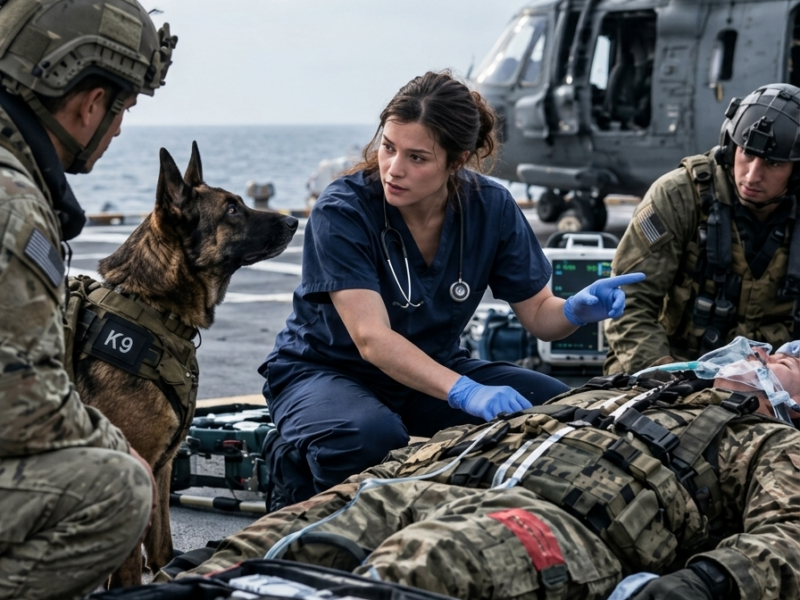
The military K9 suddenly lunged at my quiet little hospital cart in the middle of the ER, while a decorated officer accused me of hiding something and everyone stared
The emergency room at St. Jude’s was usually a place where pain was loud and chaotic, measured by the shrieking telemetry monitors, the sharp smell of rubbing alcohol, and the constant thud of heavy double doors swinging open. For seven years, I had built my life around that noise. It was a rhythmic, predictable kind of chaos that allowed me to fade into the background.
Nobody in the hospital really knew me. I arrived twenty minutes before my shift started, I left thirty minutes after it ended, and I spent my breaks sitting alone in the far corner of the cafeteria with a cold cup of black coffee. My coworkers assumed I was just quiet, maybe a little cold. They thought I was a woman whose life had simply lacked color.
That was exactly how I wanted it. Silence was safety.
Then Sergeant Mason Reed brought his military working dog into the trauma bay on a rainy Tuesday evening.
The dog was a broad-chested, scarred Belgian Malinois with dark eyes and a patched fur coat that spoke of hard service. Normally, a military dog in an urban hospital attracted a crowd of curious onlookers, but this animal was remarkably calm, keeping his eyes locked on his handler’s left thigh as they navigated through the crowded hallway.
I was leaning over my medication cart, cross-checking a dose of IV antibiotics, when the dog suddenly stopped.
His ears lifted, rotating forward like satellite dishes catching a distant signal. His nostrils flared, pulling in the heavy draft blowing down from the air conditioning vent overhead. Then, without warning, he strained against his thick leather leash, pulling Mason hard toward my cart.
Mason frowned, his jaw tightening as he pulled back on the lead. “What’s wrong with him?”
I instinctively took a step back, keeping my hands resting flat against the cold stainless steel of the cart. “Probably the smell of another dog,” I said, keeping my voice neutral, pitched low and flat. “I have two strays at home.”
It was a lie, but a plausible one.
Except the K9 wasn’t looking at my cart. He was looking directly into my eyes.
Mason studied my face, his sharp gray eyes sweeping over my worn scrubs, my tightly pinned hair, and the tense alignment of my shoulders. He had the posture of a man who spent his life analyzing threat vectors. “Have we met?” he asked.
“No,” I replied instantly. “I’ve worked night shifts here for seven years. I don’t leave the floor often.”
Before Mason could speak again, the Malinois slipped his head under his handler’s hand, walked two steps forward, and sat down directly in front of my clogs. He didn’t bark. He didn’t whine. He simply lowered his head until his brow rested against the toe of my shoe, letting out a long, heavy sigh.
My chest tightened so hard I could barely draw breath.
I knew that signal. It wasn’t an attack posture, and it wasn’t a search alert. It was a submission ritual—an ancient, deeply ingrained behavioral sequence taught only to elite special operations K9 units to indicate absolute trust in a primary handler.
He wasn’t afraid. He was remembering.
Mason’s expression changed instantly. The casual authority of an officer vanished, replaced by a sudden, razor-sharp suspicion. “That’s impossible,” he muttered under his breath.
I said nothing, gripping the edge of the metal cart so hard my knuckles turned white under my rubber gloves.
Mason crouched down beside the dog, his hand hovering over the animal’s harness. He looked up at me, his voice dropping to a harsh whisper. “Find.”
The Malinois didn’t hesitate. He stood up, bypassed my cart entirely, and pressed his damp nose against my right wrist.
My body reacted before my brain could process the danger. I instinctively pulled my sleeve down, snapping my hand back into my pocket.
Too late.
In the split second before my cuff covered my skin, Mason saw the faint, jagged white line running from my wrist up into my forearm—the distinct entrance scar of a high-velocity shrapnel fragment.
Mason went pale. The color drained from his face until he looked like a ghost under the harsh fluorescent lights of the trauma bay. “Where did you get that?”
I looked away, staring fixedly at the linoleum floor. “An accident. A car crash years ago.”
He shook his head slowly, his voice shaking. “That’s not an auto accident. That’s a 7.62 millimeter ricochet pattern.”
The ER suddenly felt terrifyingly quiet. The hum of the monitors and the distant rumble of thunder outside seemed to fade into a hollow silence.
Mason reached slowly into his tactical jacket, pulling out a worn, leather-bound pocket ledger. Tucked inside the leather cover was a small, creased photograph, its edges yellowed by time and exposure. He unfolded it and laid it flat against the stainless-steel top of my cart.
In the photo, three soldiers in desert camouflage stood in front of a dirt bunker, their arms slung around each other’s shoulders beside a younger, unscarred Malinois. The soldier standing in the center—wearing a dusty handler’s vest with tactical shears tucked into her chest rig—was me.
My throat closed completely. My eyes burned as I stared at the image. I hadn’t seen that photograph in eleven years. I thought every copy had been burned in the fire that consumed our forward operating base in the Hindu Kush.
Mason whispered, his voice trembling, “You were listed as Killed in Action during Operation Iron Sight. Your name is on the wall at Fort Liberty.”
“I know,” I whispered back.
“Then why are you here?”
I stared at the floor, my voice barely audible above the hum of the air vent. “Because someone wanted me to disappear. And because staying dead was the only way to stay alive.”
Before he could respond, the Malinois began to whine—a soft, high-pitched sound of recognition. He stepped closer, bypassing the cart entirely, and pressed his wet nose firmly against the palm of my hand.
I closed my eyes, letting out a ragged breath, and sank to my knees on the cold floor. I buried my face in his thick fur, my fingers automatically finding the familiar scar behind his right ear.
His name was Ranger.
I had raised him from a eight-week-old puppy. I had trained him through six months of intense tactical integration before the mission that destroyed our entire six-person team. For eleven years, I had suffered through nightmares, believing Ranger had been blown to pieces in the same mortar strike that killed my teammates.
Apparently, he had survived. And he hadn’t forgotten me.
Mason looked down at us, his hand shaking as he turned the photograph over. “Your commander kept this in his personal trunk,” Mason said quietly. “It was sent to my unit six months ago when his estate was settled.”
My eyes moved to the back of the card. Written in dark, faded ink was a handwritten message from Major Vance:
She knows who betrayed us.
My blood turned cold as ice.
For eleven years, I had carried the crushing weight of survivor’s guilt, believing my team had been wiped out because of a tactical miscalculation—a bad intelligence drop that led us into an ambush.
Now, in a single second, the foundation of my entire life crumbled. It hadn’t been a mistake. Someone on the inside had given our exact grid coordinates to an enemy strike team. And whoever did it knew that I had walked out of those mountains alive.
Mason looked up, scanning the crowded ER entrance with sudden urgency. “Are you safe here, Nurse?”
I wanted to say yes. I wanted to tell him that St. Jude’s was just a hospital, that I was just a civilian, that the war was a decade behind me.
Then Ranger suddenly froze. His ears pinned back flat against his skull, and a low, terrifying growl rattled deep in his chest as he glared toward the far end of the hallway.
Everyone in the trauma bay turned to look.
Standing near the glass elevator doors was a man in a dark rain jacket. He stood completely still amid the bustling crowd of paramedics and visitors. He wasn’t looking at Mason, and he wasn’t looking at the dog.
He was looking directly at me.
As I met his gaze, the man slowly raised his right hand, curled his fingers into a loose fist, and touched two fingers to his wrist.
It was the old extraction signal. Our signal.
The secret gesture that only the six members of my long-dead unit were ever supposed to know.
The air in the hallway seemed to freeze around me. The man at the elevator didn’t run. He didn’t reach for a weapon. He simply maintained eye contact for three agonizing seconds, dropped his hand back into his jacket pocket, and stepped into the opening elevator doors. The metal doors slid shut with a soft, mechanical hiss, erasing him from sight.
“Stay here,” Mason ordered, his hand immediately dropping to his sidearm beneath his jacket.
“No!” I snapped, my old handler instincts overriding seven years of learned civilian subservience. I grabbed Mason’s forearm before he could break into a sprint. “If he’s using that signal, he isn’t alone. He wants you to chase him into an unmonitored space. You sprint down that hall, and you walk straight into an ambush.”
Mason stopped, staring at me with a mix of shock and reluctant respect. “You know who that was?”
“I couldn’t see his face under the hood,” I said, my voice dropping to a sharp, clinical pitch as I stood up from the floor. “But that signal was created by my squad leader, Captain David Miller, during night ops in Helmand. It was never written down in any field manual. Whoever just gave that gesture was either standing in that dirt bunker eleven years ago… or he bought the code from the man who killed them.”
Ranger let out another low growl, pressing his flank hard against my leg, positioning himself between me and the elevator bank.
“We need to move,” Mason said, his eyes scanning the gathering crowd of nurses and patients who were staring at us. “If your cover is blown, this hospital isn’t a safe zone anymore. My vehicle is in the secure bay out back.”
I looked down at my cart, at the half-filled chart binders and the plastic medicine cups. My entire life—the quiet, invisible identity I had built out of sheer survival—was disintegrating in real time. If I stayed, I was a sitting target for whoever had tracked Ranger to this floor. If I left, I was stepping back into a war I thought had ended eleven years ago.
“Give me two minutes,” I said, turning toward the staff breakroom. “I have something hidden in my locker.”
Mason nodded once, stepping into position beside the door with Ranger at a tight heel. “Two minutes. Then we burn daylight.”
I rushed into the dim, windowless breakroom, locking the door behind me. I moved directly to Locker 42 at the end of the metal row. Reaching beneath the bottom shelf, my fingers found a small, magnetic key box taped to the steel frame. I pulled it free, unlocked it, and pulled out a heavy brass key stamped with a three-digit sequence: 314.
When I fled the field hospital in Germany eleven years ago, I knew that living as a ghost required an insurance policy. I had stashed a sealed military transit box in a rented storage unit three miles from the hospital. Inside that box was my original service record, a clean burner phone, and the encrypted drive I had recovered from Major Vance’s chest rig before his bunker collapsed. I had never opened that drive. I had been too terrified of what I might find.
Now, I knew I had no choice.
I shoved the key into my scrub pocket, grabbed my heavy winter coat, and unlocked the breakroom door.
Mason was waiting, his eyes darting toward the ceiling security cameras. “The security feeds just went black,” he whispered as I stepped out into the hall. “The monitor at the triage desk is displaying static. They’re cutting our eyes.”
“Basement loading dock,” I said immediately. “It bypasses the main lobby and exits near the ambulance bay.”
We moved quickly down the secondary service corridor, Ranger pacing ahead of us, his nails clicking against the linoleum. The hospital, usually so full of ambient noise, felt unnaturally hollow. The overhead lights flickered once, twice, then dropped into the dim, amber glow of emergency backup power.
“They cut the main line,” Mason muttered, pulling his sidearm free and keeping it pressed flat against his leg. “These aren’t local street thugs, Miller. This is a clean-up team.”
“I know,” I said, my heart hammering against my ribs. “That’s how Iron Sight started. First the comms went dark, then the grid dropped, then the mortar rounds started landing.”
We reached the heavy fire door leading to the basement stairwell. Mason pressed his hand against the crash bar, but before he could push it open, Ranger lunged forward, grabbing the hem of Mason’s jacket in his teeth and pulling him backward with immense force.
A fraction of a second later, a high-velocity round punched through the steel door from the inside, shattering the concrete wall behind us in a spray of gray dust and pulverized drywall.
There was no loud gunshot—only the sharp, metallic thud-thud of a suppressed automatic rifle.
“Suppressed 5.56!” Mason yelled, shoving me back into the alcove as a second round whistled through the air.
Ranger didn’t bark. He dropped into a deep crouch, his teeth bared, his eyes fixed on the small bullet hole in the fire door.
“They’re holding the stairwell,” I said, my handler training taking over despite the decade of disuse. “They know we’re heading for the basement. We need to force them into a choke point where they can’t use their range.”
“I’ve only got two magazines,” Mason said, checking the window of his sidearm. “We can’t win a prolonged firefight in a narrow hallway.”
I looked around the service corridor. To our right was the linen chute—a heavy, reinforced steel hatch that led directly down to the basement laundry facility two floors below.
“Ranger,” I whispered, dropping to my knees beside the Malinois. I reached out and took his snout in my hands, looking straight into his dark eyes. “Back line,” I murmured in the specific German dialect we used for non-standard entries. “Find the tail.”
Ranger’s ears perked up. He gave a single, sharp nod of his head, his tail twitching once.
I turned to Mason. “Pop the lock on that hatch. We’re taking the drop.”
Mason looked at the narrow steel chute, then at me. “Are you crazy? That’s a twenty-foot drop into a industrial hamper!”
“It’s twenty feet of steel pipe that they aren’t watching,” I replied, grabbing the handle of the linen hatch. “And right now, it’s the only way down that doesn’t involve walking into a wall of lead.”
Before Mason could argue, the fire door burst open, and a man in tactical gear stepped into the hallway, his rifle raised.
Mason fired twice, the heavy bark of his unsuppressed pistol echoing deafeningly in the narrow hall. The shooter stumbled back, his rounds tearing wildly into the ceiling tiles.
“Go!” Mason screamed.
I threw the hatch open, grabbed Ranger by his tactical harness, and jumped into the dark steel chute.
The descent down the linen chute was a terrifying, disorienting rush of cold steel, friction heat, and absolute darkness. I held Ranger tight against my chest, shielding his head with my jacket as we tumbled down the vertical shaft.
We hit the massive canvas laundry hamper at the bottom with a violent thud, tumbling through piles of soiled hospital sheets before crashing onto the concrete floor of the basement laundry room.
I scrambled to my feet, gasping for air, my knees scraped and bleeding through my scrubs. Ranger immediately bounced up beside me, shaking his fur free of lint, completely unfazed by the drop.
A second later, Mason came sliding out of the chute, landing heavily on his hip in the middle of the canvas cart. He groaned, rolling out onto the concrete with his sidearm still gripped tightly in his right hand.
“Everyone alive?” he grunted, checking his weapon’s chamber.
“Alive,” I said, wiping a mixture of sweat and dust from my eyes. “Where’s the rear exit?”
“Fifty yards down this corridor, through the boiler room,” Mason said, standing up and testing his weight on his ankle. “My truck is parked right outside the security gate.”
We moved fast, weaving through the towering industrial washers and steam pipes that lined the basement floor. The air down here was thick, hot, and smelled of heavy detergent and rust.
Ranger led the way, his nose low to the damp concrete, sweeping the corners before we stepped into them. He reached the heavy metal door at the end of the laundry bay, stopped, and gave a clear, silent indication—sitting flat on his haunches and pointing his nose toward the door handle.
“Clear,” Mason whispered, reading the dog’s body language.
We pushed through the door and stepped out into the cool, rain-soaked night air of the rear loading bay. Rain was falling in heavy, vertical sheets, pounding against the pavement and creating a thick haze that blurred the streetlights.
Mason’s dark gray pickup truck was parked thirty yards away, sitting beside a row of commercial dumpsters.
“Key,” Mason said, pressing the remote fob. The truck’s lights flashed twice in the darkness.
We sprinted across the slick asphalt, threw the doors open, and piled inside. Ranger leaped into the back seat, shaking his wet coat, while Mason slammed the truck into drive, stomping on the accelerator. The tires squealed against the wet pavement, and the truck launched out of the loading bay, tearing through the open security gate and onto the main road.
For five minutes, nobody spoke. The only sound was the heavy thrum of the engine and the rhythmic slap of the windshield wipers clearing the rain.
Mason kept his eyes locked on the rearview mirror, checking every pair of headlights that turned onto the road behind us. “We aren’t being followed,” he said finally, letting out a long breath. “At least, not close.”
I leaned my head against the cold glass of the passenger window, watching the blur of streetlights pass by. My hands were still shaking. After eleven years of pretending to be nobody, the ghost of my past had caught up to me in less than twenty minutes.
“Where are we going?” Mason asked, glancing at me.
I pulled the heavy brass key out of my scrub pocket, holding it up so it caught the dim green light of the dashboard. “Storage depot on 4th Street. Locker 314.”
Mason looked at the key, his eyebrows knitting together. “What’s in 314?”
“The reason my unit died,” I said softly. “And the reason someone just tried to kill us in a hospital.”
Ten minutes later, Mason pulled the truck into the dark, gravel parking lot of an automated storage facility near the industrial docks. The facility was surrounded by a high chain-link fence, its corrugated metal doors rusting under the constant drizzle.
We bypassed the main office and walked down row C, our boots sloshing through puddles of standing water. Ranger walked close to my hip, his ears twitching at every gust of wind that rattled the metal doors.
We reached Unit 314.
I slid the brass key into the heavy padlock, turned it until the mechanism popped, and pulled the rusted latch free. Mason helped me lift the heavy rolling door, which groaned loudly as it slid up into the ceiling.
The unit was small, dusty, and smelled of old canvas and damp cardboard. Resting in the center of the concrete floor was a single, olive-drab military transit case sealed with heavy steel latches.
I knelt beside the box, my hands trembling as I flipped the steel latches open.
Inside lay my old tactical vest—its digital camouflage faded, covered in dry mud from a battlefield thousands of miles away. Beside it sat a sealed plastic pouch containing a military-issue encrypted hard drive, a stack of heavily redacted mission logs, and a small, leather-bound diary that had belonged to Captain Miller.
Mason stepped into the locker, shining his tactical flashlight down into the open box. “Is that the drive from Iron Sight?”
“Yes,” I said, reaching out to touch the heavy black casing of the hard drive. “When our bunker was hit, Captain Miller handed me this drive. He told me to run. He said the drive contained the master ledger for a rogue military contracting firm—a group that was selling advance target coordinates to insurgent leaders in exchange for mineral rights.”
“Do you know who was running the firm?” Mason asked, his voice dropping to a low, dangerous tone.
“No,” I replied, pulling the drive out of the box. “The files were encrypted with a two-factor key. One key was on this drive. The other key was held by Major Vance.”
Mason went dead silent.
I looked up at him, caught by the sudden change in his breathing. “Mason? What is it?”
Mason reached into his pocket and pulled out his phone. He swiped through a series of secure military news feeds, finally stopping on a digital document with a black header. He handed the phone to me.
The screen displayed an official military obituary dated six months ago:
MAJOR GENERAL WILLIAM VANCE – PASSED AWAY AT AGE 68. ALL PERSONAL EFFECTS AND CLASSIFIED LOGS TRANSFERRED TO PRIVATE EXECUTOR: VECTOR DEFENSE SOLUTIONS.
My eyes locked onto the name of the private executor.
Vector Defense Solutions was the exact same contracting firm my unit had been investigating before Operation Iron Sight was compromised.
“Vance didn’t die of natural causes,” Mason whispered, staring at the hard drive in my hand. “Vector bought his estate. They got his half of the encryption key six months ago. The only thing standing between them and total exposure is the drive sitting in your lap.”
Suddenly, Ranger let out a sharp, ear-splitting bark, lunging toward the open entrance of the storage unit.
Outside, a blinding pair of high-beam headlights snapped on, illuminating the interior of Locker 314 in a wall of brilliant, suffocating white light.
The brilliant white light washed over us, casting long, stark shadows against the corrugated metal walls of the storage unit. The rain outside turned into a shimmering curtain of silver needles in the glare of the heavy halogen beams.
“Don’t move,” a voice boomed through an external vehicle loudspeaker, distorted by static and rain. “Drop the drive and step away from the container.”
Mason immediately stepped in front of me, his sidearm raised, aiming straight through the blinding light toward the source of the voice. “Who the hell are you?” he shouted into the storm.
A door clicked open, and a tall figure stepped into the light, holding a large tactical umbrella. He wore a tailored dark rain jacket, his hair neatly trimmed, his demeanor smooth and entirely unbothered by the tactical team surrounding the parking lot.
It was the man from the hospital elevator.
Now, without his hood, I could see his face clearly in the glare of the headlights. High cheekbones, a sharp jawline, and a deep, jagged scar running through his right eyebrow.
My heart stopped. My hand dropped to the concrete floor as the breath rushed out of my lungs.
“Captain Miller,” I whispered, the name choking in my throat.
The man smiled—a cold, empty expression that held no warmth, no humanity. “Hello, Handler,” he said softly, his voice carrying clearly over the patter of the rain. “It’s been a very long time.”
Mason didn’t lower his gun, but his eyes flicked toward me in absolute shock. “Captain Miller? Your squad leader? The one who was killed in the bunker?”
“He was never killed,” I said, the horrific truth settling into my brain like liquid lead. The pieces of eleven years of isolation, fear, and confusion finally clicked together into a terrifying picture. “He wasn’t the victim of the betrayal. He was the one who sold us.”
Miller took two slow steps forward, stopping just outside the threshold of the storage locker. He looked down at Ranger, who was growling violently, his teeth bared, every muscle in his broad chest strained against his harness.
“I taught that dog well,” Miller said smoothly, looking at Ranger with a mild, detached interest. “He still remembers the hand signals. That was a nice touch in the hallway, wasn’t it, Miller? A little nod to the old days.”
“You killed them,” I said, my voice shaking with a rage so intense it burned the back of my throat. “You killed David, you killed Jackson, you killed Sarah. You called in that mortar strike on our own bunker!”
“I secured our futures!” Miller snapped, his smooth tone cracking for a fraction of a second, revealing the ugly, greedy core beneath. “We were fighting a forgotten war in a forgotten corner of the world for generals who didn’t know our names! Vector offered us ten million dollars for the signal logs. Ten million, Miller! Do you have any idea what that kind of money does?”
“They died in the dirt!” I screamed, standing up from the floor, clutching the hard drive to my chest. “They trusted you! I trusted you!”
“And you were supposed to die with them,” Miller said calmly, reaching into his coat and pulling out a silenced pistol. “You were supposed to be buried under three feet of concrete in the mountains. But somehow, you dragged yourself out of that rubble, grabbed that drive, and vanished like a ghost.”
He raised the weapon, pointing it directly at my forehead. “For eleven years, Vector couldn’t liquidate Vance’s offshore accounts because we needed both halves of the ledger. Vance kept his key hidden until his death. Six months ago, we finally got his key. But we still needed yours.”
“That’s why you tracked Ranger,” Mason said, stepping into Miller’s line of fire, covering my body with his own. “You didn’t find her. You found the dog.”
“When Ranger was retired to Fort Liberty, I set a flag on his veterinary file,” Miller explained, his finger tightening slightly on the trigger. “I knew that if you were alive, and if you ever saw that dog again, your handler instincts wouldn’t let you walk away. All I had to do was wait for a medical handler to trigger the alert.”
Miller looked past Mason, locking his eyes onto mine. “Hand over the drive, Nurse. Hand it over, and I’ll make sure your death is much faster than the rest of your team’s.”
I looked at the hard drive in my hand, then at Mason, whose jaw was set in a hard, unyielding line, ready to take a bullet for a woman he had met three hours ago. Then I looked down at Ranger.
The dog wasn’t looking at Miller’s gun. He was looking at me, his eyes wide, alert, waiting for the single command that would define everything.
“You taught him well, Miller,” I whispered, my voice dropping to a low, icy tone. “But you forgot one thing.”
Miller frowned, his eyes narrowing slightly in the glare of the headlights. “What?”
“You taught him to attack on command,” I said, my fingers slipping around the heavy steel casing of the hard drive. “I taught him who to protect.”
I threw the heavy hard drive with all my strength straight into the high-beam headlights of the lead vehicle.
The glass lantern shattered with a loud explosion of sparks and darkness, plunging the storage lot into pitch-black shadow.
“Ranger! Kille!” I screamed.
The dark exploded into violence.
In the fraction of a second after the headlight shattered, Ranger launched himself through the rain like a dark projectile. He cleared the five feet between the storage locker and Captain Miller in a single, terrifying leap, his jaw clamping down on Miller’s right forearm before the traitor could pull the trigger.
Miller shrieked in pain as the silenced pistol flew from his grip, clattering across the wet gravel.
“Fire!” Miller screamed to his team. “Kill them!”
Mason moved instantly. He stepped out of the locker, his pistol barking three times in rapid succession into the darkness where the tactical team stood. Flash-suppressed muzzles flared in the rain as Miller’s men opened fire, their rounds chewing through the metal door frame of Locker 314, sending streams of red sparks cascading over our heads.
I didn’t run away. I ran forward.
Eleven years of living as a ghost—eleven years of quiet, fearful hiding in the dark corners of St. Jude’s hospital—vanished in a blinding flash of tactical clarity. I wasn’t Nurse Sarah anymore. I was the lead handler of Task Force Iron Sight.
I tackled Miller as he struggled to shake Ranger off his arm, driving my shoulder straight into his ribs. We crashed onto the wet asphalt together, rolling through the standing water.
Miller punched me across the jaw with his free hand, the ring on his finger cutting a gash across my cheek. “You should have stayed dead!” he spat, reaching for a tactical knife mounted on his vest.
I didn’t answer. I grabbed his wrist, twisted it back against his joint with every ounce of strength I possessed, and drove my knee into his chest. The knife dropped into a puddle.
Before Miller could recover, Mason stepped up beside us, driving the butt of his sidearm hard into the side of Miller’s helmet. Miller’s head snapped back, his body going limp against the wet pavement.
“Ranger, off!” I commanded in Czech.
Ranger instantly released his grip, stepping back and taking up a guard position over Miller’s chest, a low, murderous snarl echoing from his throat.
“We’ve got two more coming around the left vehicle!” Mason yelled, firing around the corner of the pickup truck.
“I’ve got the drive!” I shouted, dropping to my knees and scooping up the heavy black drive from the puddle where it had fallen.
I ran to Mason’s truck, threw the drive onto the front seat, and reached into the tactical box in the back of his cab, pulling out an emergency flare kit. I struck the ignition tab on a red highway flare, generating a brilliant, blinding white magnesium fire that burned at two thousand degrees.
I hurled the burning flare straight under the gas tank of Miller’s lead tactical SUV.
“Get down!” I screamed, grabbing Mason and dragging him flat against the concrete behind the storage unit wall.
Three seconds later, the heat from the magnesium flare ignited the broken fuel line beneath the vehicle. A massive, deafening explosion ripped through the storage facility, turning the darkness into a towering wall of orange fire and smoke. The shockwave blew the remaining attackers off their feet, scattering their weapons across the gravel.
Sirens began to wail in the distance—the high-pitched, warbling shrieks of city police and military security units responding to the explosion.
“Federal authorities are five minutes out,” Mason said, gasping for air as he checked his tactical watch. “I triggered my unit’s distress beacon when we left the hospital.”
I stood up in the rain, my face covered in soot, blood dripping from the cut on my cheek, watching the flames lick the sky above Storage Unit 314.
Miller was groaning on the ground, pinned flat under Ranger’s chest, his eyes filled with terror as he realized his eleven-year reign of greed had come to a violent, absolute end.
“It’s over, Miller,” I said, looking down at him with cold, detached pity. “The drive is going to the Department of Justice. Every name, every offshore account, every single contract you sold—it’s all coming out tomorrow morning.”
Ten minutes later, the storage lot was flooded with flashing red and blue lights. Dozens of federal agents and military police officers poured out of armored vehicles, securing the perimeter, placing Miller and his surviving men in heavy restraints, and taking control of the scene.
A high-ranking officer in a dress uniform walked up to us, his eyes wide as he looked at the hard drive resting on the hood of Mason’s truck, then at me.
“Nurse Miller?” the officer asked, holding up a file binder. “Or should I say, Sergeant Sarah Vance?”
I looked at Ranger, who was standing quietly beside my knee, his tail giving a soft, gentle wag as he looked up into my eyes.
“Sarah,” I said, letting out a breath I felt like I had been holding for eleven long years. “Just Sarah.”
Mason walked up beside me, throwing a heavy wool blanket over my shoulders to block out the cold rain. “What are you going to do now?” he asked softly. “You can’t go back to St. Jude’s. Not after this.”
I looked at the dark sky above, feeling the rain wash the soot and blood from my face. For seven years, I had lived in the shadows, terrified of being seen, terrified of the past catching up to me. But as I looked down at Ranger, and at the hard drive that would finally bring justice to the teammates I had lost, I realized the darkness was gone.
“I spent eleven years pretending to be dead,” I said, my voice strong, clear, and unyielding. “I think it’s time I started living again.”
Ranger let out a sharp, happy bark, stepping close to nudge his head under my hand. I smiled, wrapping my fingers into his fur as the morning sun began to break through the storm clouds on the horizon.
The end









