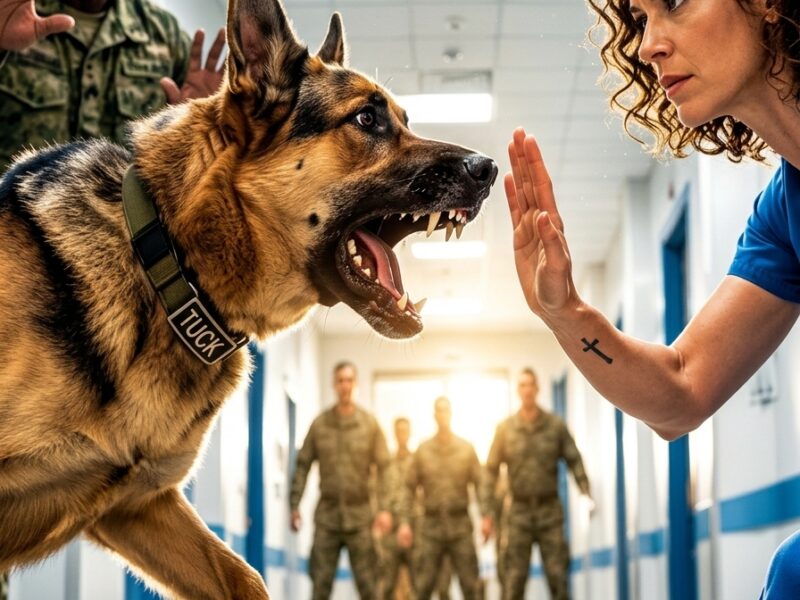
The military K9 snarled at every nurse who approached his wounded handler at Walter Reed, then I knelt beside him
The air inside Ward 4B of Walter Reed National Military Medical Center smelled of sterile floor wax, scorched cotton, and the faint, bitter metallic tang of dried blood. It was 3:00 a.m. The corridor was silent save for the rhythmic, dull hum of ventilator pumps and the distant, low squeak of rubber soles on linoleum.
In the private suite at the end of the hall, the atmosphere was suffocating.
Sitting on the cold tiles beside the stainless steel hospital bed was a Belgian Malinois. His coat was covered in fine, gray concrete dust that had settled into his thick fur, and his ears were pinned flat against his skull. His left side was wrapped in a crude compression bandage that leaked a pale yellowish fluid onto the floor. His eyes were wide, bloodshot, and locked onto the unconscious man on the bed.
His name was Callisto.
For eleven straight hours, Callisto had sat in that exact spot. He had refused bowl after bowl of water. He had ignored strips of cooked meat offered by well-meaning corpsmen. Whenever a nurse stepped within three feet of the bed, Callisto’s lip would curl back over his dark gums, unleashing a low, vibrating snarl that rattled the intravenous IV poles surrounding the room.
On the bed lay Sergeant Mason Reed. Mason was thirty-one years old, a seasoned K9 team leader assigned to a specialized reconnaissance element. His face was a patchwork of purple bruises, third-degree thermal burns, and fine surgical sutures. He had been air-evacuated out of a remote valley near the border following what the official military incident report described as an “improvised explosive device detonation during routine transport.” He was in a deep, medically induced coma, his lungs kept going by a mechanical respirator.
Dr. Vance, a senior military surgeon with graying hair and a stiff, unyielding posture, stood near the open doorway, clutching a metal clipboard like a shield.
“This is completely unacceptable,” Dr. Vance snapped, his voice sharp with frustration as he looked at the floor nurse. “We need to change the patient’s arterial dressings. We need to hang a fresh bag of plasma. I am not sending my medical staff into a room with a rogue, shell-shocked military working dog that is ready to tear someone’s throat out. Call base veterinary services and have them bring a tranquilizer gun.”
“Doctor, please,” I said, stepping forward from the shadow of the supply cart.
My name is Sarah Miller. I am a civilian trauma specialist assigned to the military liaison wing. Before I transferred to Walter Reed, I spent four years working alongside canine handling units at Forward Operating Base Shank. I knew what a rogue dog looked like. A rogue dog was erratic, panicked, and lash-out blind.
Callisto wasn’t rogue. He was on watch.
“He’s not aggressive, Dr. Vance,” I said softly, keeping my hands empty and low at my sides. “He’s protective. He thinks everyone in a lab coat or uniform is an attacker because the last thing he remembers is his handler getting blown apart.”
“I don’t care what he thinks, Nurse Miller,” Vance growled. “He is a danger to hospital personnel. You have two minutes to move that animal, or I am calling Military Police to remove him by force.”
I took a deep, steadying breath. I looked past the doctor, past the flickering digital heart monitor, and directly into the eyes of the Belgian Malinois.
Callisto’s posture shifted. His muscles coiled like steel springs, a quiet, rumbling growl building deep in his chest as I took one step past the threshold.
“Keep back, Sarah,” a corpsman whispered from the hall. “He almost bit Miller’s hand off an hour ago.”
I ignored the warning. I dropped slowly onto my knees, lowering my center of gravity until my eyes were level with Callisto’s. I didn’t reach for him. I didn’t make sudden movements. I let my hands rest flat against the cold floor tiles, open and palm-up.
“It’s okay, Callisto,” I whispered, keeping my voice low, steady, and devoid of fear.
The dog’s ears twitched. The low growl faltered for a fraction of a second, his dark nose quivering as he caught my scent—the familiar smell of antiseptic mixed with human sweat, unburdened by adrenaline or malice.
I tilted my head slightly and spoke his name again, clearer this time. “Callisto.”
The growling stopped entirely.
The heavy, tense silence in the room stretched until you could hear the drip of the IV tube. Callisto took a slow, agonizing step forward, leaning his heavy chest against my knees. He extended his dark, wet nose and pressed it firmly into the center of my palm. He gave a single, deep sigh that released the tension in his shoulders, his long tail giving one weak, hesitant thump against the floor.
Behind me, Dr. Vance let out a breath he hadn’t realized he was holding. “Unbelievable,” someone muttered from the corridor.
“Good boy,” I murmured, gently stroking the dusty fur between his ears. “I’m here for Mason. I’m going to help him.”
I stood up slowly, keeping one hand resting lightly on Callisto’s broad back. I turned toward the bed to check Mason’s arterial line.
The moment my fingers touched the plastic tube running into Mason’s arm, Callisto moved.
He didn’t bite. He didn’t growl. With a sudden, explosive surge of power, the seventy-pound dog leaped onto the foot of the hospital bed.
“Hey! Get him down!” Dr. Vance shouted, stepping into the room with his clipboard raised. “Get that animal off the patient!”
“Wait!” I barked, stepping between Vance and the bed, throwing my arm out. “Look at him! Look at what he’s doing!”
Callisto wasn’t attacking Mason. He was standing over his handler’s chest, his nose buried in the fold of Mason’s olive-drab utility jacket, which had been folded up and placed on the lower shelf of the bedside transport cart.
The dog wasn’t whimpering or pawing at his master’s face. He was frantically digging his front paws into the tough nylon fabric of the coat, using his teeth to tug violently at the inner lining near the left chest pocket.
He stopped, turned his head, and looked directly at me. His bright amber eyes were wild with an urgent, desperate intelligence. He let out a sharp, muted bark, then nudged the heavy canvas jacket off the cart, sending it hitting the floor with a dull thud right at my feet.
“What is wrong with that dog?” Vance muttered, rubbing his temples. “He’s destroying military property.”
I didn’t answer. I knelt beside the fallen jacket.
The uniform had clearly been washed by the field medics to remove the heavy mud, but as I turned the fabric over, I noticed something strange. Around the inside pocket, the fabric was discolored—not from mud, but from a dark, greasy chemical residue that smelled faintly of copper and burned synthetic oil.
The pocket was sealed with heavy duty Velcro. I pulled it open.
A small, heavy object slid out of the lining and fell directly into my open palm.
It was a ruggedized, military-grade MicroSD memory card, stained around the gold connectors with the same dark, greasy residue.
The air in the room instantly turned ice-cold.
A shadow fell over the doorway. Major Thomas Sterling, a tall, broad-shouldered officer from the division’s intelligence liaison team who had been standing silently near the door for the last hour, stepped smoothly into the room. His uniform was immaculate, his spit-shined boots reflecting the overhead lights.
He extended an open hand toward me, his face a mask of polite, unyielding authority.
“Hand that to me, Nurse,” Major Sterling said, his voice smooth, commanding, and entirely devoid of warmth. “That is classified military material belonging to Special Operations Command. You are not cleared to possess it.”
Callisto immediately dropped off the bed, placing himself directly between me and Major Sterling. His back arched, his lips pulled back to reveal his sharp, bone-crushing teeth, and a vicious, guttural snarl exploded from his chest.
I looked down at the tiny piece of plastic in my hand. I looked at the dark residue on my fingers. Then I looked into Major Sterling’s cold, calculating eyes.
I slowly closed my fingers around the memory card, pulling my hand back into my coat pocket.
“No,” I said.
Major Sterling froze. The silence that followed was suffocating. It was obvious that in his entire military career, no civilian—and certainly no nurse—had ever looked him in the eye and said that word.
“Excuse me?” Sterling whispered, his voice dropping an octave, turning razor-thin.
“This patient arrived under civilian trauma jurisdiction until his transfer papers are fully processed,” I said, my heart hammering against my ribs, but my voice remaining flat and firm. “Whatever is on this card was brought in as patient personal effects during emergency intake. Protocol dictates it goes straight to the hospital’s secure evidence locker until Armed Forces CID arrives.”
Sterling’s hand twitched toward his belt, his jaw tightening into a hard, rigid square. For three agonizing seconds, I thought he was going to reach for me. But Callisto stepped forward another inch, his paws heavy on the floor, ready to spring.
Before Sterling could move, heavy boots echoed outside in the hallway. Two armed agents from the Army Criminal Investigation Division (CID) walked briskly into the room, holding silver shields and official badges.
“Hospital staff, stand down,” the lead agent announced. “We are securing this room under Federal Order 402.”
Twenty minutes later, after the room was cleared of non-essential staff and Dr. Vance was forced to step outside, the CID agents inserted the memory card into a ruggedized, military-spec tablet. I stood in the corner near Mason’s bed, Callisto leaning heavily against my shins, watching the screen over the lead agent’s shoulder.
The file wasn’t a standard incident report. It was encrypted dash-cam and helmet-cam footage recorded the night before the convoy explosion.
The video was grainy, shot in high-definition thermal night-vision. The timestamp in the corner read 01:14 A.M.
On the screen, Sergeant Mason Reed was standing in the shadows behind a camouflaged supply truck at a forward staging area. He was shouting at another man whose back was to the camera.
“…the route is compromised!” Mason’s recorded voice rasped out of the tablet’s speaker, filled with anger. “You changed the coordinates three hours before movement! That valley is an ambush box!”
The second man turned around slowly, stepping into the dim light of the truck’s instrument panel. His face was obscured by a tactical face mask, but his shoulders bore the distinct, polished rank insignia of a field officer.
“The coordinates stand, Sergeant,” the second man said, his voice cold, calm, and hauntingly familiar. “You execute the movement as ordered.”
“This isn’t an order, it’s a death sentence!” Mason yelled, reaching for his tactical vest. “I’m logging this conversation on the team ledger. If we go into that pass, nobody comes back!”
The second man stepped closer to Mason, his hand resting on the hilt of his sidearm.
“You were never supposed to come back, Reed,” the man whispered.
The video cut to blinding white static, followed by the deafening sound of a massive explosion and tearing metal.
The room was deathly quiet.
Suddenly, a ragged, wet gasp tore from the hospital bed.
The cardiac monitor went wild, spiking from fifty beats per minute to one hundred and twenty. Mason Reed’s body shuddered violently against the restraints. His eyes snapped open—clouded, bloodshot, and filled with blind terror.
His right hand twitched wildly, searching the air, until his fingers closed weakly around my wrist. His grip was surprisingly tight, his knuckles turning white.
He looked up at the ceiling, his chest heaving as the ventilator struggled against his panicked breathing. He turned his head slowly toward me, his lips trembling beneath the oxygen mask.
Callisto whined, placing his heavy head on the mattress right beside Mason’s hand.
Mason looked at Callisto. Then his eyes drifted to me. He pulled the oxygen mask down just half an inch, his voice nothing more than a broken, terrifying rasp.
“Don’t… trust… the man in uniform,” Mason choked out.
I slowly turned my head toward the doorway.
Standing in the corridor, framed by the bright fluorescent lights of the hallway, were five men. Two military policemen. Two hospital security guards. And Major Thomas Sterling.
Every single one of them was wearing a uniform.
Beside the bed, Callisto’s body went completely rigid. He raised his head, his dark eyes locking onto one specific man standing in the doorway—not the MPs, not the security guards, but Major Sterling.
Callisto let out a single, deafening, metallic bark that echoed off the glass walls of the trauma bay.
Major Sterling’s face went completely, utterly white.
Because Callisto hadn’t just recognized the man who had tried to steal the card. Callisto had recognized the voice from the thermal video.
And as Mason’s fingers dug deeper into my wrist, I realized that the man who had ordered Mason Reed to die wasn’t waiting outside the hospital.
He was standing six feet away from us, holding the door locked from the inside.
The air in Trauma Suite 4B crystallized in an instant.
Major Sterling didn’t move a muscle, but the color had completely drained from his neck and jaw. His right hand hung loosely near the side pocket of his tailored dress uniform.
“Agents,” Sterling said, his voice remarkably calm, stepping over the threshold and closing the heavy glass door behind him, clicking the mechanical lock into place. “That video is clearly an altered deepfake engineered by hostile intelligence assets to compromise this investigation. I am commandeering that tablet and all physical evidence immediately under Directive 12.”
The lead CID agent, a seasoned investigator named Miller, didn’t hand the tablet over. He looked from the screen to Sterling, his fingers resting casually over the leather holster at his hip.
“With all due respect, Major,” Agent Miller said, “Directive 12 requires a signed warrant from the Judge Advocate General. Until I verify the digital signature on this video file, this evidence stays in CID custody.”
“You are making a critical career mistake, Agent,” Sterling replied softly.
“I don’t think he is,” I interrupted, my voice ringing out clearly over the rhythmic hiss-click of Mason’s ventilator.
I pulled my wrist gently out of Mason’s grip, stepping back until I was standing right beside Callisto. The dog was trembling, a deep, rhythmic vibration of pure tension running through his ribs. His upper lip was pulled back so far his white gums were completely exposed, a thin thread of saliva hanging from his jaw.
“The voice on that recording wasn’t synthesized,” I said, staring directly into Sterling’s eyes. “The acoustic distortion matches the sound reflex of this room. You were the officer who authorized the route change for the 3rd Battalion convoy on Tuesday morning at 0200 hours. It’s on the public base movement log.”
Sterling looked at me, his eyes narrowing into two icy slits. “You are a civilian contractor, Nurse Miller. You are far out of your depth. You have no idea what was inside those transport trucks.”
“It wasn’t medical supplies, was it?” Mason’s raspy voice cut through the air.
He had managed to push himself up against the pillows, his face pale as death, blood seeping through the white bandages wrapped around his torso. His eyes were clear now, burning with a lethal, focused rage that only a seasoned combat veteran could muster.
“It was the vanguard shipment of the heavy targeting arrays,” Mason wheezed, clutching his chest as he spoke. “You didn’t want the convoy to reach the coast, Sterling. You wanted the equipment ‘destroyed’ in an explosion so your private contractors could salvage the wreck from the valley floor and sell the optics on the black market.”
“Pure fiction,” Sterling said, taking one slow, measured step toward the bed. “A shell-shocked soldier suffering from severe traumatic brain injury.”
“He isn’t shell-shocked,” I said. “And Callisto doesn’t lie.”
At the sound of his name, the Belgian Malinois let out another sharp, explosive bark, taking a half-step forward. The dog’s eyes were locked onto Sterling’s left throat artery.
Major Sterling realized he had lost the narrative in the room. His composure cracked for a fraction of a second. He reached into his inner jacket pocket.
“Watch him!” Agent Miller yelled, reaching for his sidearm.
Before Miller could clear his holster, Sterling pulled a small, black cylindrical device from his jacket and thumbed a red button on the top.
A high-pitched, agonizing audio pulse shattered the silence of the room.
It wasn’t audible to human ears as sound—it was an ultra-high frequency acoustic deterrent designed specifically to disable military working dogs. To me and the agents, it felt like a sudden, sickening pressure spike in our inner ears that made us dizzy.
But to Callisto, it was pure, unadulterated agony.
The dog let out a sharp, pained yelp, dropping to his knees, clapping his paws over his ears, his body wracked with violent spasms as he rolled onto his side on the slick tile floor.
“Callisto!” Mason screamed, trying to swing his legs over the edge of the bed, but the IV lines and monitor wires snapped him back, tearing the skin on his arm.
Taking advantage of the momentary shock and confusion, Sterling slammed his shoulder into Agent Miller, sending the investigator crashing into the heavy crash cart. The medical supplies, glass vials, and metal trays crashed to the floor in a deafening metallic din.
Sterling grabbed the tablet from the second agent’s hands, smashed it violently over the edge of the stainless steel counter, and kicked the broken pieces under the bed.
“Lock down the floor!” Sterling shouted into a small radio unit attached to his collar as he backed out of the glass door, turning the key from the outside to lock us in. “We have a compromised bio-hazard in Suite 4B! Quarantine the room! Nobody leaves!”
The heavy magnetic locks on the door engaged with a loud CLANG.
Outside the glass, Sterling turned, dropped the key card into his pocket, and walked briskly down the corridor toward the service elevators, flanked by two military guards who immediately drew their weapons and took positions outside our door.
“Damn it!” Agent Miller cursed, pulling himself up from the floor, his forehead bleeding from a small cut. He threw his body against the reinforced glass door, but the magnetic lock held firm. “The comms are dead! He’s using an emergency containment override!”
I didn’t care about the door. I threw myself onto the floor beside Callisto.
The dog was gasping, his limbs twitching as the electronic pulse device—still humming on the floor near the doorway—continued to broadcast its horrific noise.
I grabbed a heavy stainless steel bedpan from the fallen cart, crawled across the floor, and slammed it down over the small black electronic cylinder, dampening the sound wave. Then I crushed the device beneath the heavy heel of my shoe until it shattered into useless pieces of plastic and wire.
The invisible pressure in the room vanished.
Callisto let out a long, ragged breath. He slowly raised his head, looking up at me with confused, pained eyes. I gathered his heavy head into my arms, pulling him against my chest, feeling his rapid, terrified heart beating against my ribs.
“I’m sorry, boy,” I whispered, tears stinging my eyes as I checked his ears for bleeding. “I’m so sorry. You’re okay. You’re okay now.”
“Sarah…” Mason called out from the bed, his voice weak but steady. “The card… did you give him the card?”
I reached into my scrub pants pocket and pulled out the tiny MicroSD card. I had never let go of it.
“I have it,” I said, standing up and wiping my face.
“He smashed the tablet,” Agent Miller said, inspecting the shattered screen beneath the bed. “The local file is destroyed. If we can’t get that card to a secure terminal off this base, Sterling’s story will be the only one on record by morning. He’ll have Mason moved to a psych facility and he’ll clear the evidence.”
I looked at Mason, then at Agent Miller, then out the glass door where the two guards stood with their backs to us, monitoring the hallway.
“There’s an unmonitored maintenance corridor behind the laundry chute on this floor,” I said, my mind racing as my clinical instincts took over. “It leads directly to the basement service bay where the civilian supply trucks park.”
“The doors are magnetically sealed, Sarah,” Miller pointed out.
“They’re sealed from the main security grid,” I replied, pointing up toward the ceiling ventilation intake. “But the hospital’s bio-hazard suppression system operates on a separate mechanical override. If we trigger the smoke detector in this bay, the magnetic locks automatically release to prevent trapped toxic fumes.”
Mason looked at me, a faint, proud smile breaking through his battered face. “You’re pretty sharp for a civilian, Nurse.”
“I work night shifts in a military trauma center, Sergeant,” I said, reaching for a bottle of surgical alcohol and a box of sterile gauze from the overturned cart. “I know how to break things.”
I looked down at Callisto. The dog was already back on his feet, his ears erect, his eyes clear and focused once more. He looked at the door, then at Mason, then at me.
He was ready.
The smoke detector near the ceiling flared with a sharp, blinding red light as the alcohol-soaked gauze burned brightly inside a stainless steel wastebasket.
Five seconds later, a deafening mechanical horn echoed through the room: BEEP! BEEP! BEEP!
Above us, the overhead sprinklers hissed to life, spraying a fine, misting rain of cold water over the entire suite.
On the glass door, the heavy electromagnetic lock released with a metallic THUNK.
The two guards in the hallway spun around in surprise, pulling their visors down against the water spray. Before the first guard could raise his weapon, Agent Miller slammed the glass door open, hitting the guard square in the chest and sending him flying into the opposite wall.
Callisto exploded out of the room like a dark streak of lightning.
He didn’t bite to kill—he executed a textbook military disable. He hit the second guard in the waist, bringing seventy pounds of muscular momentum down on the man’s chest. The guard hit the floor hard, his sidearm clattering across the slick linoleum. Callisto stood over him, his forepaws planted firmly on the man’s shoulders, releasing a terrifying growl that froze the guard in place.
“Don’t move!” Agent Miller ordered, picking up the fallen service weapon and securing the first guard.
“Mason, can you walk?” I asked, helping the sergeant off the bed.
Mason gritted his teeth, his face turning gray with pain as his feet hit the cold floor. He was wearing green hospital scrubs over his heavily bandaged chest. He leaned heavily on my shoulder, his breathing ragged, but he kept his head up.
“I can move,” Mason grunted. “Callisto, heal!”
The Malinois instantly released the guard, retreating to Mason’s left side, his head sitting flush against Mason’s hip, matching his slow, halting pace.
“This way,” I said, leading them down the secondary hallway toward the steel door marked STAFF ONLY – LAUNDRY SERVICES.
We slipped through the heavy door just as sirens began wailing across the entire hospital complex.
The maintenance stairwell was dark, illuminated only by the dull amber glow of emergency exit signs. The air was thick with the smell of steam, bleach, and hot metal. We descended slowly, six flights of concrete stairs, the sound of our footsteps drowned out by the thunderous echo of industrial laundry machines operating three floors below.
Every step was agony for Mason. By the time we reached the sub-basement level, he was slick with cold sweat, leaning almost his full body weight against me. Callisto walked directly beside us, constantly looking up into Mason’s face, nudging his hand with his nose to keep him conscious.
“Almost there,” I whispered, pushing open the heavy fire door at the bottom of the stairs.
We stepped into the vast, cavernous expanse of the basement loading bay. Massive concrete pillars supported the ceiling, and rows of heavy linen carts and industrial supply crates lined the walls. At the far end of the bay, three large roll-up doors opened out into the rainy night, where a civilian medical linen truck was parked, its diesel engine idling softly.
“Hold it right there,” a cold voice echoed from behind a concrete pillar.
Major Thomas Sterling stepped out into the dim yellow light of the loading bay.
He was no longer wearing his polished jacket. He was wearing a dark tactical windbreaker, and in his right hand, he held a silenced 9mm pistol equipped with a laser sight. Behind him stood two private security contractors in dark civilian clothes, carrying short-barreled carbines.
“I must admit, Nurse Miller, you are far more resourceful than your personnel file suggested,” Sterling said, stepping around a stack of wooden pallets, his weapon pointed directly at Mason’s head. “Setting off the suppression system was a nice touch. But this is where the trail ends.”
Agent Miller stepped in front of us, raising his borrowed service weapon. “Sterling, put the weapon down! This is a federal facility! CID has already broadcast an alert to the regional office!”
“The regional office is thirty minutes away, Agent,” Sterling replied coldly. “By the time they clean up the administrative mess upstairs, you, the sergeant, and the nurse will have suffered a tragic accident during an attempted escape by a rogue patient.”
Sterling looked down at the MicroSD card I was still clutching in my right hand.
“The card, Clara,” Sterling said, extending his left hand. “Give it to me, and I might let you walk out of here alive. You can go back to your quiet shift in trauma. You don’t have to die for a dead man’s secret.”
Mason took a heavy step forward, placing himself slightly in front of me, despite his torn stitches.
“She isn’t giving you anything, Thomas,” Mason said, his voice ringing through the damp basement air. “The video on that card has already been auto-synced to a cloud server the moment it touched the hospital’s open Wi-Fi network during the lockdown. It’s sitting in the inbox of the Inspector General right now.”
Sterling’s eyes twitched. For a micro-second, his glance flicked toward the ceiling, doubting his own security protocol.
“You’re bluffing,” Sterling hissed.
“Am I?” Mason replied with a ghost of a grin. “Test me.”
Sterling’s thumb slid the safety off his pistol. “I don’t need to test you, Sergeant. I just need to destroy the hardware.”
He raised the gun, aligning the red laser dot directly onto the center of Mason’s chest.
Beside us, Callisto didn’t wait for a command.
He didn’t bark. He didn’t growl. The Belgian Malinois launched himself off the concrete floor, his powerful hind legs driving his body straight through the air like a kinetic missile aimed directly at Sterling’s throat.
The dark loading bay exploded into chaos.
Sterling fired once—the suppressed THWACK of the gunshot echoing softly against the concrete—but Callisto’s airborne strike knocked his arm wide. The bullet struck a steam pipe overhead, sending a roaring jet of white, scalding vapor bursting out into the air between us.
Callisto hit Sterling with brutal force, his teeth clamping onto the heavy fabric of Sterling’s tactical windbreaker right at the shoulder. The force of the impact drove the officer backward into a row of heavy metal linen carts, sending them crashing to the floor in a thunderous avalanche of steel and white canvas.
“Get him off me!” Sterling shrieked, his polished composure completely shattering as he wrestled on the floor with the furious animal.
The two private security contractors raised their carbines, but Agent Miller opened fire from behind a concrete pillar, dropping the first contractor with two precise shots to the body armor. The second contractor ducked behind a forklift, trading automatic fire with Miller as sparks showered down from the overhead lights.
“Sarah! The truck!” Mason yelled, grabbing my arm and pulling me toward the idling medical linen vehicle forty feet away.
“I’m not leaving Callisto!” I screamed over the deafening roar of the escaping steam and gunfire.
“He’s driving them back!” Mason shouted. “Look!”
Through the thick, swirling clouds of white steam, Callisto was a whirlwind of brown fur and flashing teeth. He moved with terrifying speed, striking at Sterling’s arms, dragging him away from his fallen weapon, keeping the officer completely pinioned to the floor while avoiding the blind wild swings of Sterling’s fists.
Sterling managed to pull a tactical combat knife from his belt with his left hand, flashing the six-inch steel blade in the dim light.
“CALLISTO! OUT!” Mason roared at the top of his lungs, using the high-level operational command reserved only for extreme tactical disengagement.
The dog instantly released his grip on Sterling’s jacket, executing a sharp, ninety-degree leap backward into the steam cloud just as Sterling’s knife slashed empty air.
Callisto sprinted through the blinding white vapor, hitting the pavement at a dead run, and leaped straight through the open rear doors of the idling linen truck, landing heavily on a pile of soft canvas bags.
“Get in!” Miller shouted, scrambling into the driver’s seat of the truck, hot-wiring the ignition panel with a metallic click.
I pushed Mason into the passenger side, climbed into the back beside Callisto, and slammed the heavy roll-up aluminum door shut just as three bullets slammed into the rear bumper with loud, metallic THUDS.
The diesel engine roared to life. Miller slammed the heavy truck into gear, floor-boarding the accelerator.
The massive vehicle lurched forward, its heavy tires screeching against the wet concrete, smashing through the lowered fiberglass security gate of the basement bay, and bursting out into the pouring rain of the street outside.
Inside the dark, swaying cargo bay, I collapsed onto the floor beside Callisto.
The dog was panting heavily, his tongue hanging out, his coat soaked with steam condensation and rain. I pulled him close, running my hands franticly over his ribs, his chest, his neck, checking every inch of his fur.
“He’s not hit,” I gasped out to Mason, who was leaning against the cab partition wall, holding his bleeding side. “He’s not shot. He made it.”
Callisto rested his heavy chin on my knee, giving my wet hand three long, slow licks.
“Where are we going, Miller?” Mason called through the small sliding window to the front cab.
“Federal Courthouse in downtown D.C.,” Miller shouted back over the roar of the rain on the windshield. “The Assistant US Attorney on duty is a former JAG prosecutor. We deliver the card directly to a grand jury judge before Sterling can call in his friends at the Pentagon.”
Mason leaned his head back against the wall, closing his eyes as his body finally succumbed to the staggering weight of his injuries.
I sat beside him in the dark, the truck swaying as it navigated the slick city streets, clutching the MicroSD card tightly in my palm, while Callisto kept a steady, warm vigil over us both.
At 6:30 a.m., the rain over Washington D.C. began to taper off into a soft, cool morning mist.
The grand jury room on the fifth floor of the E. Barrett Prettyman United States Courthouse was quiet, lit by the warm, golden light of the rising sun streaming through the tall arched windows.
Sitting at the center of a long mahogany conference table was Federal Judge Eleanor Vance—a sharp-eyed woman in her sixties with silver hair and an absolute, unshakeable demeanor.
Beside her were three senior agents from the Department of Justice, two military attorneys from the Navy Judge Advocate General’s Corps, and Agent Miller, whose forehead was neatly bandaged.
On the large video screen mounted to the wall, the raw, decrypted video from Mason’s MicroSD card was playing for the third time.
The audio was crisp, clear, and unmistakable:
“…The coordinates stand, Sergeant… You were never supposed to come back, Reed.”
Judge Vance sat back in her heavy leather chair, her hands clasped tightly on top of a thick stack of legal briefs. She turned her gaze to the corner of the room.
Mason was sitting in a wheelchair, dressed in a fresh military service uniform provided by the JAG corps, his chest tightly bandaged beneath his tunic. Beside his wheel, sitting perfectly upright with his head held high, was Callisto. His left side had been cleaned and redressed with fresh medical bandages, and he wore a clean leather tactical harness.
I stood beside Mason’s chair, resting my hand lightly on the rubber handle.
“Sergeant Reed,” Judge Vance said, her voice resonant and measured. “The forensic team has verified the digital signatures on this file. It is authentic, untampered, and fully backed by the secondary telemetry logs recovered from your vehicle’s black box.”
She looked at the JAG officers. “Major Thomas Sterling was arrested forty minutes ago at an airfield in Manassas, Virginia, attempting to board an unregistered private aircraft. Three of his corporate associates have also been taken into federal custody.”
Mason took a deep, clear breath—the first one he had been able to manage without pain in three days.
“Thank you, Your Honor,” Mason said softly.
“Do not thank me, Sergeant,” Judge Vance replied, her eyes softening as she looked at Callisto, then at me. “Thank your team. If it weren’t for the extraordinary courage of Nurse Miller, and the remarkable instincts of your canine partner, this evidence would be sitting at the bottom of an incinerator right now.”
She signed a thick document on her desk with a heavy gold pen and slid it toward the JAG officer.
“Effective immediately, I am issuing a federal protective order for Sergeant Reed, Nurse Miller, and working dog Callisto. Any attempt by military or civilian authorities to interfere with their care or custody will be met with immediate contempt charges.”
Two months later.
The air in the Shenandoah Valley was crisp, cool, and carried the rich smell of autumn pine and damp earth.
I sat on the wide wooden porch of a small, quiet farm house nestled at the foot of the mountains, holding a steaming mug of black coffee.
The news on my tablet was showing a live broadcast from the Pentagon press room. The headline scrolling across the bottom read: PENTAGON PROCUREMENT FRAUD TRIAL BEGINS: FORMER MAJOR STERLING FACES TREASON AND CONSPIRACY CHARGES.
I set the tablet down on the small wooden table.
Down in the green grass of the front yard, two figures were moving under the bright morning sun.
Mason was standing without a cane, his posture straight, his color fully restored. He was throwing a heavy rubber training dummy across the yard.
A dark streak of brown fur leaped through the tall grass with incredible speed and agility. Callisto caught the dummy in mid-air, executed a graceful turn, and trotted proudly back to Mason, his tail wagging smoothly against his flank.
Mason patted the dog’s flanks, whispering a quiet praise, then looked up toward the porch.
He smiled, calling out to me over the quiet rustle of the wind through the trees.
“He wants to know if you’re coming down for the morning walk, Clara!” Mason shouted, his voice strong and clear.
Callisto stopped, turned his head toward the porch, and let out a single, happy bark, his amber eyes shining in the sunlight.
I took a sip of my warm coffee, set the mug down, and walked down the porch steps into the cool morning air to join them.
The end.









