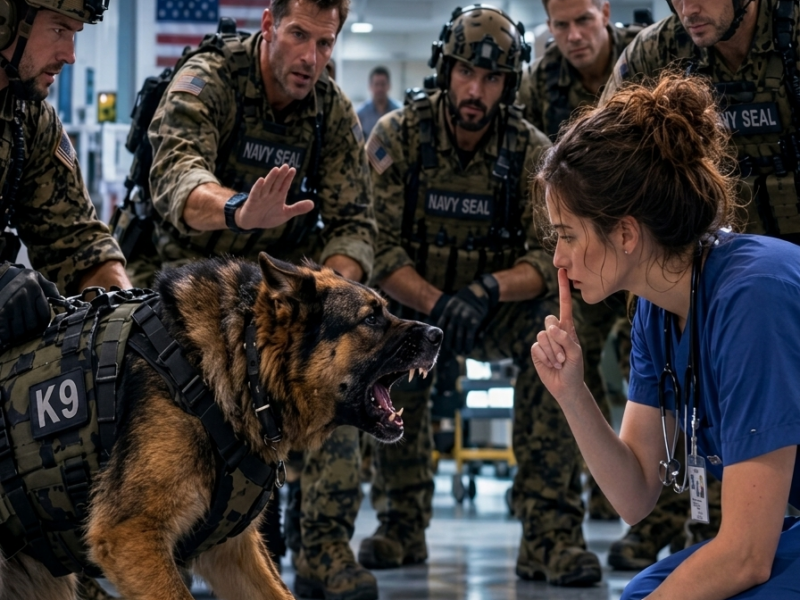
The military K9 slammed a SEAL against the concrete outside Naval Base Coronado, and while everyone shouted for someone to stop him
The fluorescent lights of the dog kennels on Naval Base Coronado flickered, casting erratic, sickly shadows across the concrete floor. Outside, the Pacific Ocean battered the shoreline, its relentless roar a stark contrast to the suffocating silence that settled over the room.
I sat frozen on the cold deck. My hand was still resting on the scarred muzzle of Ranger, a Belgian Malinois whose reputation for untamable violence had terrified the toughest operators on base. Five heavily armed SEALs stood behind me, their boots locked to the ground, their weapons slung low. Just moments earlier, Ranger had slammed one of those men into the concrete with enough force to knock the air from his lungs. Command had been seconds away from issuing an order to put him down.
Then I had walked in.
Eleven years as a trauma nurse on this base had taught me how to read pain, whether it belonged to a wounded sailor or a traumatized combat dog. When I sank to the floor and whispered those soft, familiar words, the beast that had required five men to restrain simply collapsed forward, lowering his heavy head onto my lap.
My fingers had brushed against the underside of his thick tactical collar, tracing a worn, battered metal tag. The engraving was nearly worn away by sand and conflict, but three numbers burned clearly into the aluminum: 7-1-4.
Those numbers weren’t a military tracking code. They were a date. July 14th. My younger brother Ethan’s birthday.
Three years ago, two officers in dress whites had stood on my porch to hand me a folded American flag. They told me Ethan had died instantly in an ambush during a classified night raid in the mountains of Afghanistan. They gave me a sealed coffin, a small box of his personal effects, and a wall of official silence. But before Ethan transferred to the Tier-1 SEAL element, he had been a K9 handler. The very last photo he had ever sent me was a grainy phone shot of him kneeling in the desert dust, grinning ear to ear, with a young, hyperactive Belgian Malinois leaning against his chest.
That dog was Ranger.
“You knew him,” I whispered into the dog’s soft, scarred fur. Ranger let out a long, trembling sigh and pressed the full weight of his head against my ribcage, seeking comfort he hadn’t received in years.
“That’s impossible,” a voice rasped behind me.
I turned my head. Senior Chief Master at Arms Marcus Vance—a veteran with twenty years of black-ops deployments etched into the deep lines of his face—was staring at the metal tag with a expression that looked terrifyingly like dread.
“You need to leave, Maya. Right now,” Vance said, his voice dropping an octave as he stepped forward, grabbing the iron handle of the kennel door and sliding the heavy bolt into place. He locked us inside.
“Why?” my voice trembled, my heart hammering against my ribs like a trapped bird. “Why does this dog have Ethan’s personal tag on his collar?”
Vance didn’t answer right away. He unbuttoned the top pocket of his tactical vest with slow, agonizing precision. His hand shook slightly—a detail that chilled me to the bone, because I had seen Marcus Vance stitch his own arm without flinching. He pulled out a small, laminated photograph, faded around the edges, and lowered it to the concrete floor between us.
I reached out with a trembling hand and picked it up.
The photo showed Ethan. He was thinner, his face smeared with dark greasepaint, wearing non-standard civilian tactical gear. He was kneeling beside Ranger in what looked like a dark, concrete safehouse. But what made the room tilt violently beneath my feet was the lower right corner of the print.
A digital timestamp, embedded into the film matrix: SIX MONTHS AFTER HIS OFFICIAL DATE OF DEATH.
“This… this is a mistake,” I stammered, tears instantly blinding my vision. “Ethan is buried in Arlington. I was at the service! I held the flag!”
“You held a casket weighted with seventy pounds of sand,” Vance whispered, kneeling down so his face was inches from mine. His eyes darted nervously toward the heavy metal door. “Ethan wasn’t killed in that ambush, Maya. His unit was betrayed. He was left behind because he knew something about an illegal weapons shipment that went missing from Bagram Airfield.”
“Who left him?” I demanded, the shock turning into a searing fire in my chest.
“The people who gave you that flag,” Vance replied softly. “And the person who ordered us to put Ranger down the moment he stepped off the transport plane today.”
Suddenly, Ranger’s ears snapped straight up. The dog lifted his head off my chest, his body going completely rigid. A low, guttural growl vibrated deep within his chest, rattling his ribcage against my hands.
Heavy, polished dress shoes were echoing down the concrete corridor outside the kennel block. Multiple sets of footsteps. Fast. Authoritative.
Vance’s face went bone-white. He lunged forward, grabbing my jacket, his fingers digging into the fabric.
“Listen to me very carefully,” Vance hissed, his breath hot against my ear. “Ethan is alive. He’s being held in an unsanctioned black site off the coast of Baja. Ranger is the only one who knows the coordinates—he was tracked via the dog’s GPS chip before they scrubbed the frequency. They brought Ranger here to execute him under the cover of him being ‘dangerously rabid’.”
The outer door handle began to turn with a sharp metallic clink.
“Your brother is waiting for you, Maya,” Vance whispered, shoving the photograph deep back into my pocket. “Don’t trust anyone wearing a star.”
The heavy steel door swung open, slamming against the wall with a deafening bang. Standing in the threshold, flanked by two armed Military Police officers, was Rear Admiral Arthur Sterling—the very man who had delivered the folded flag to my doorstep three years ago.
Admiral Sterling stepped into the kennel bay, his pristine whites gleaming under the harsh overhead lighting. His eyes, cold and calculating like polished steel, swept across the room. They lingered for a fraction of a second on Senior Chief Vance, then shifted down to me, sitting in the dust of the floor with Ranger’s massive head resting in my lap.
“Nurse Miller,” Sterling said, his tone dripping with smooth, practiced authority. “I was informed there was a dangerous security breach in the K9 holding area. What are you doing in this cage?”
I forced my hands to remain steady as I stroked Ranger’s neck, feeling the intense tension rippling through the dog’s muscles. Ranger was staring at Sterling, his lip curled back just enough to expose white, deadly canines. A faint, continuous growl rumbled from his throat.
“Ranger was distressed, Admiral,” I said, keeping my voice as flat and professional as my nursing training allowed. “The operators were using excessive force. I stepped in to administer a sedative.”
Sterling took a slow step forward. The two MPs behind him rested their hands uncomfortably on the holsters of their sidearms.
“You are a civilian trauma nurse, Maya,” Sterling said softly, using my first name in a manipulative attempt at intimacy. “Not a veterinary specialist. This animal is a decommissioned military asset suffered from severe, irreversible brain trauma sustained during foreign combat. He killed an handler in Ramstein three days ago. He is unstable, unmanageable, and scheduled for immediate termination.”
My breath hitched. He killed a handler? Or did he attack the men who were trying to silence him?
“He isn’t rabid,” I insisted, standing up slowly. Ranger immediately rose with me, gluing his shoulder to my hip, an unwavering shield between me and the highest-ranking officer on base. “He responded instantly to verbal commands. He just needed calm handling.”
Sterling’s eyes narrowed slightly. He looked past me toward Senior Chief Vance, who stood at rigid attention against the back wall, his face an unreadable mask of military discipline.
“Senior Chief,” Sterling commanded. “Remove Nurse Miller from the enclosure. Take the dog to the medical bay for final protocol.”
“Sir,” Vance said, his voice clipped. “With respect, the dog’s vitals are elevated. Administering the lethal compound while his heart rate is this high could cause violent thrashing and risk injury to the staff. Nurse Miller has him stabilized. It might be prudent to let her escort him to the bay.”
Sterling didn’t answer immediately. He stepped closer to the wire mesh of the cage. His gaze fell upon the tactical collar around Ranger’s neck. I instinctively shifted my leg, trying to hide the worn metal tag stamped 7-1-4, but Sterling’s sharp eyes had already caught the movement.
A flicker of something dark and dangerous passed across the Admiral’s face.
“Very well,” Sterling said, his voice dropping to a icy whisper. “Nurse Miller, you will lead the animal to Bay 4. Senior Chief Vance, you will accompany her. My security detail will follow.”
He turned on his heel and walked out, his white uniform vanishing into the dim corridor.
The moment the door closed, Vance breathed out a ragged sigh. He moved to the cage lock, opened the gate, and gestured for me to step out.
“Bay 4 is where they put assets when they want them to disappear without an autopsy,” Vance said in a rushed, quiet voice as we walked side-by-side down the corridor, Ranger trotting silently between us. “They aren’t going to let you walk out of this facility, Maya. Once they realize you saw that photograph, you become a loose end.”
“What do I do?” I whispered, my heart pounding in my ears like a war drum. “Where is Ethan?”
“The photo was taken six months ago at a private naval installation off the coast of Mexico—a decommissioned radar station called Isla Del Fuego,” Vance explained quickly, keeping his head straight while his eyes darted to the security cameras mounted along the ceiling. “It’s run by a private defense contractor called Vanguard Apex. Sterling is on their board of directors. Ethan found out that Vanguard was trafficking unregistered weapons through military channels. When he tried to blow the whistle, Sterling staged the ambush to cover his tracks.”
“Why keep Ethan alive for three years?” I asked, a sob catching in my throat.
“Because Ethan had the encryption keys to Vanguard’s black-budget accounts,” Vance replied. “They’ve been trying to break him for thirty-six months. But Ethan hid the physical drive inside Ranger’s subcutaneous tracking microchip before the dog was extracted.”
My eyes widened as I looked down at the Belgian Malinois pacing beside me. The dog wasn’t just my brother’s companion; he was the vault containing the evidence of Ethan’s survival and Sterling’s treason.
“We have thirty seconds before we reach the turn for Bay 4,” Vance muttered, reaching into his tactical belt and pulling out a small black keycard. “At the end of this hallway is the emergency transport bay. My personal truck is parked near the loading dock. Take Ranger, get into the truck, and drive straight out the north gate. I’ve already pre-cleared the duty guard for an off-site medical transport.”
“What about you?” I asked, terror gripping my stomach. “Vance, if you help us, they’ll execute you for treason!”
Vance offered a bitter, weary smile. “Ethan saved my life in Fallujah, Maya. I’ve lived with the guilt of wearing this uniform while Sterling ran his empire for three years. It’s time I cleared my ledger.”
We reached the junction. To the left was Bay 4, where two armed guards stood waiting outside a sealed steel door. To the right was the heavy red emergency exit leading to the storm-drenched tarmac.
“Go!” Vance shouted, suddenly wheeling around and slamming his shoulder into the nearest guard, driving him into the concrete wall.
“Hey! Stop them!” the second guard yelled, reaching for his sidearm.
Ranger didn’t hesitate. With a terrifying roar, the dog launched himself through the air, his jaws locking onto the guard’s forearm before the man could draw his weapon. The guard screamed as he crashed to the floor.
“Maya, RUN!” Vance screamed, struggling with the first guard on the floor.
I grabbed Ranger’s harness. “Ranger, HEEL! COME!”
The dog released the guard instantly, turning on his hind legs and sprinting beside me as I slammed my body against the emergency exit crash bar. The heavy door burst open, and the freezing rain of the Pacific storm hit my face like a thousand needles.
Alarms began to wail across the naval base—a high-pitched, screeching siren that tore through the stormy night. Red strobe lights flashed against the pouring rain.
We sprinted across the slick tarmac toward a black Ford F-150 idling near the perimeter fence. I threw the rear door open, and Ranger leapt into the back seat without a second’s hesitation. I dove into the driver’s seat, jammed Vance’s keycard into the custom ignition module, and roared the engine to life.
Behind us, the heavy steel doors of the kennel block opened, and Admiral Sterling emerged, surrounded by a dozen armed guards. He raised a hand, pointing directly at my truck.
CRACK!
A high-caliber bullet shattered my side mirror, sending shards of glass flying into my hair. I stomped on the accelerator, tires screaming against the wet asphalt, and hurled the heavy truck straight toward the closing perimeter gate.
The heavy steel gate of Naval Base Coronado surged toward us like an immovable wall. The red lights flashed furiously, and the secondary security barriers—heavy steel bollards designed to stop semi-trucks—were slowly beginning to hydraulic up from the road.
“Hang on, Ranger!” I screamed, gripping the steering wheel so hard my knuckles turned ghostly white.
I didn’t lift my foot off the accelerator. The speedometer needle climbed past sixty, seventy, eighty miles per hour. The truck’s heavy steel brush guard smashed into the chain-link gate just as the iron doors were locking together. The sound of rending metal tore through the cabin as the gate ripped completely off its hinges, flying into the darkness behind us. We clipped the rising edge of a steel bollard, sending the truck airborne for a sickening second before it slammed back onto the asphalt, tires screeching as I fishtailed onto the public highway.
In the rearview mirror, headlights were already flashing inside the military perimeter. Black SUVs were turning around to give chase.
Rain lashed against the windshield in violent sheets. The windshield wipers beat a frantic, uneven rhythm against the glass. In the back seat, Ranger lowered himself onto his belly, his dark eyes locked onto mine through the mirror. He wasn’t shaking anymore. The terrifying, wild rage that had possessed him in the cage was replaced by an eerie, deadly focus. He knew we were on a mission.
I pressed my hand into my jacket pocket and pulled out the crumpled, laminated photograph Vance had given me.
Under the dim dashboard lights, I stared at Ethan’s face. His jaw was set, his skin scarred and weathered, but those were unmistakably my brother’s hazel eyes. Three years. Three years I had cried over a grave that contained nothing but dirt and sand. Three years I had tried to rebuild a life hollowed out by grief, while he was tied to a chair in some dark hole, waiting for a rescue that never came.
A surge of protective rage—the kind only a sister could feel—flooded my veins.
“We’re coming for you, Ethan,” I whispered into the darkness of the cab. Ranger let out a short, sharp bark of agreement.
I drove south, bypassing the main Interstate 5 checkpoints by veering onto the winding coastal routes that skirted the Mexican border. Vance’s truck was equipped with military-grade scramblers, but I knew it was only a matter of time before Sterling used federal satellite tracking to pinpoint our location.
By 2:00 AM, the dense fog of the Baja coastline swallowed the truck whole. The paved roads dissolved into rough, unmaintained dirt tracks that snaked along towering cliffs above the crashing Pacific surf.
Suddenly, Ranger stood up in the back seat, letting out a low, warning growl.
I glanced at the rear monitor on the dashboard. Two dark shapes were emerging from the fog behind us—sleek, unbranded military SUVs riding low to the ground, driving completely blacked-out without headlights.
Vanguard Apex. Sterling’s private mercenaries had caught up.
Before I could react, the lead SUV accelerated, slamming its heavy armored bumper into the rear passenger side of my truck. The impact spun the F-150 violently across the slick mud. I fought the wheel, screaming as the tires skidded dangerously close to the edge of a hundred-foot cliff drop into the churning rocks below.
CLACK-CLACK.
The side window of the lead SUV rolled down, and a figure leaned out with a silenced submachine gun. A spray of bullets stitched a line across my hood, steam erupting from the radiator as fluid burst onto the windshield.
“Ranger, down!” I yelled.
The truck’s engine began to knock violently, losing power as fluid drained out. We were slowing down, trapped on a narrow cliffside road with nowhere to run. Up ahead, the dirt track terminated at a abandoned fishing pier jutting out into the black ocean—a dead end.
I slammed on the brakes, turning the truck sideways across the pier to create a temporary barricade. The engine sputtered, gasped, and died completely.
Silence descended, broken only by the roar of the ocean waves crashing against the wooden pylons below and the steady ping of cooling metal from the ruined engine.
The two black SUVs pulled up fifty yards away, blocking the only exit off the pier. Their high-beam spotlights clicked on simultaneously, blinding me in a blinding wall of white light.
Through the intercom of the lead vehicle, a cold, amplified voice echoed over the roar of the storm:
“Nurse Miller! Step out of the vehicle with your hands on your head! Leave the animal in the cab!”
I reached into the glove compartment, my fingers wrapping around a heavy steel tire iron Vance had left inside. It was an absurdly inadequate weapon against armored mercenaries with automatic rifles, but I wasn’t going down without a fight.
“Ranger,” I whispered, turning around to look the Malinois in the eyes. “When I open this door, you run into the darkness. Do you understand me? You run.”
Ranger didn’t run. Instead, he placed his large paw firmly over my wrist, pressing my hand down. He looked at me with an intelligence that felt chillingly human. Then, he leaned forward and bit cleanly through the heavy leather strap of his own tactical harness.
With a sharp snap, the thick material fell away, exposing the base of his neck.
Ranger nudged his head against my hand, forcing my fingers toward a small, raised scar beneath his left ear. I touched it. Beneath the thick skin, I felt a hard, rectangular object—larger than a standard pet microchip.
It was a encrypted satellite beacon.
“Press it,” Ethan’s voice seemed to echo in my mind.
I pressed down hard on the raised scar. A faint, crimson LED light began to pulse beneath Ranger’s fur, casting a dark red glow across the interior of the truck.
Outside, the mercenaries were stepping out of their vehicles, weapons raised, stepping slowly onto the rotting planks of the pier.
Suddenly, out in the pitch-black waters of the ocean, a massive light ignited.
A blinding beam of searchlight, ten times brighter than the SUV headlights, blasted from the pitch-black ocean water, illuminating the pier in brilliant blue-white light.
The sudden glare was accompanied by the deafening, bone-shattering thrum of massive marine engines. Rising out of the midnight fog just fifty yards off the coastline was a high-speed, military-grade stealth interceptor vessel—a black silhouette cutting through the swells like a mechanical shark.
The mercenaries on the pier froze, turning their weapons toward the ocean in confusion.
“Vanguard Mercenaries!” a roaring voice boomed from the vessel’s exterior loudspeakers, amplified by tactical megaphones. “Drop your weapons and step away from the civilian vehicle! You are in violation of international maritime security protocols!”
Before the mercenaries could react, two flashbang grenades were launched from the deck of the vessel, arching through the air and detonating directly above the pier with blinding flashes and ear-splitting booms.
The mercenaries staggered backward, clutching their ears and shielding their eyes.
“GO! GO! GO!” a voice roared from the boat.
A tactical zodiac boat detached from the larger vessel, slamming through the surf and grinding onto the rocky shore beneath the pier. Four heavily armed men in unmarked black tactical gear vaulted over the wooden railings of the pier, weapons raised, moving with lethal, terrifying speed. In less than ten seconds, the mercenaries were disarmed, forced to their knees, and zip-tied against their own vehicles.
I sat in the truck, gasping for air, holding Ranger close to my chest as the side door of my vehicle was yanked open.
I raised the tire iron, ready to strike, but the man standing outside raised his hands gently. He lowered his tactical night-vision visor, revealing a scarred face and graying hair.
“Easy, Maya,” the man said. “Marcus Vance sent us.”
I lowered the iron, my voice trembling. “Who are you?”
“Former Operators,” the man replied, extending a gloved hand to help me out of the cab. “Ethan’s old unit. The ones who refused to take Sterling’s payoffs three years ago. We’ve been hiding in international waters, waiting for someone to trigger Ranger’s internal locator beacon. When Marcus called and said you had the dog, we put the engines at full throttle.”
Ranger leapt gracefully from the truck, landing on the pier and immediately trotting up to the team leader, rubbing his head against the man’s tactical vest. The operator knelt down, his eyes softening as he rubbed the dog’s ears.
“Good boy, Ranger,” he whispered. “You brought her to us.”
He looked back up at me, his face hardening into steel. “My name is Commander Jax. And if we want to save your brother, we have less than two hours before Admiral Sterling realizes his interception team failed and orders the elimination of the Baja facility.”
“Where is he?” I demanded, stepping forward. “Take me to him.”
Jax nodded. “Get on the boat.”
Twenty minutes later, the stealth interceptor was slicing through the black ocean waters at forty knots, tearing south toward an unmapped rock formation twelve miles off the coast of Baja California: Isla Del Fuego.
Down in the ship’s tactical hold, Jax pulled up a three-dimensional holographic map of the island. It was a jagged spire of volcanic rock, dominated by a rusted, Soviet-era radar dome that had been retrofitted into a private black site.
“Sterling’s private security firm uses this facility to extract classified intelligence from high-value military targets,” Jax explained, tapping a point near the base of the cliffs. “It’s built into the rock face. There’s only one entry point from the sea—a flooded submarine pen guarded by automated gun turrets.”
“How do we get inside?” I asked, staring at the map.
Jax looked over at Ranger, who was sitting quietly in the corner of the hold, staring intently at the projection screen.
“When Ethan was captured, he knew Vanguard would try to scrub his memory using chemical interrogations,” Jax said softly. “So he trained Ranger to recognize the facility’s internal maintenance layout. Ranger spent two months on that island before he escaped into the desert. He knows the blind spots of the security cameras, Maya. He’s our map.”
I walked over to Ranger, kneeling down and taking his broad head in my hands. The scar beneath his jaw vibrated with a low, steady energy.
“Can you do this, buddy?” I asked him softly. “Can you take me to Ethan?”
Ranger let out a firm, deep bark, his tail giving a single, powerful thump against the metal deck.
“Gear up,” Jax commanded his team. “We hit the island in ten minutes.”
I strapped on a lightweight Kevlar vest and grabbed a trauma medical kit from the ship’s storage rack. I wasn’t a soldier, and I didn’t know how to fire a weapon, but if my brother was alive after three years in a dark cell, he would need a nurse more than he needed another rifle.
The interceptor slowed its engines as we approached the looming, dark mass of Isla Del Fuego. The island rose out of the mist like a jagged tooth, bathed in the red glow of distant emergency lights.
“Thermal imaging shows heightened activity on the upper helipad,” the helmsman reported from the bridge. “Sterling is on his way. His private chopper just cleared San Diego airspace.”
“He’s going there to burn the evidence,” Jax spat, racking the slide of his rifle. “We go in fast. No survivors except the prisoners.”
The zodiac boat hit the water with a soft splash. Jax, three operators, Ranger, and I piled inside. The engine hummed silently as we glided through the black waves toward the yawning, dark cave of the submarine pen.
As we crossed the threshold into the dark cavern, the sound of the ocean faded, replaced by the echoing, metallic ping of heavy machinery.
Ranger stood at the bow of the zodiac, his nose twitching in the damp air. Suddenly, he let out a low whine, staring up at a rusted steel catwalk suspended fifty feet above the water.
“He smells him,” I whispered, my heart exploding into a frenzy against my ribs. “He knows he’s here.”
The interior of the submarine pen smelled of diesel fuel, rust, and salt water. The zodiac glided up against a slippery concrete landing, and Jax stepped out first, his silenced rifle covering the dark shadows of the lower gangway.
“Clear,” Jax whispered, gesturing for us to follow.
Ranger vaulted out of the boat the moment his paws could find purchase on the concrete. He didn’t hesitate. He put his nose to the damp floor and took off down a narrow, dimly lit corridor that snaked deep into the heart of the volcanic rock.
“Ranger, wait!” I hissed, scrambling after him, with Jax and his operators maintaining a tight defensive perimeter around me.
The facility was an underground maze of corroded steel pipes, exposed wiring, and dripping groundwater. Red emergency lights bathed the walls in a bloody hue. Alarm hooters were echoing faintly from the upper levels—Sterling’s arrival was imminent.
Ranger led us through three levels of sub-basements, bypassing sealed security doors by darting through ventilation shafts and maintenance hatches that only a dog could navigate. He was moving with absolute certainty, his memory of the layout flawless.
At the end of a long, concrete corridor line with heavy steel cell doors, Ranger abruptly stopped.
He didn’t bark. He didn’t growl. He simply walked up to Cell 104, placed his front paws against the reinforced steel door, and let out a long, low, heartbreaking cry.
“Jax! Get this door open!” I screamed, dropping my medical kit onto the floor and throwing my hands against the thick iron.
Jax lunged forward, pulling a heavy hydraulic breacher from his tactical pack. He jammed the jaws of the tool into the lock mechanism and squeezed the trigger. The mechanical pump whined loudly, steel grinding against steel, until with a violent BANG, the heavy locking bolts snapped off.
I threw the door open.
The cell was tiny, windowless, and freezing cold. A single dim bulb hung from the high ceiling, flickering weakly.
Lying on a narrow cot against the back wall, chained to the concrete by heavy iron shackles around his wrists and ankles, was a man.
He was thin—so thin his ribs were visibly outlined against his pale skin. Long, matted hair hung down over his face, and his body was covered in dirt and old surgical scars. But as the door burst open, he lifted his head. His hazel eyes blinked against the sudden intrusion of light.
“Ethan…” I choked out, my voice breaking into a sob as I collapsed to my knees beside the cot.
The man stared at me, his eyes wide with disbelief, as if he were looking at a ghost. “Maya…?” he rasped, his voice a dry, cracked whisper that sounded like dead leaves dragging across pavement. “No… no, you’re not real. The drugs… they’re making me see her again…”
“It’s me, Ethan! It’s really me!” I cried, grabbing his emaciated hands and pulling them to my face so he could feel my tears. “I’m real! I came to bring you home!”
Ethan’s breathing hitched. A tear cut a clean track through the dirt on his cheek.
Before he could speak, a massive dark shape launched itself across the cell. Ranger vaulted onto the cot, burying his head into Ethan’s lap, letting out whimpering, frantic cries of pure joy, his rough tongue licking Ethan’s face furiously.
Ethan wrapped his frail, heavy-chained arms around the dog’s neck, burying his face in Ranger’s fur. “Ranger… my boy… you brought her… you found me…”
“We have to go! NOW!” Jax yelled from the doorway, watching the corridor. “Sterling’s helicopter just landed on the upper pad! His security detail is moving down the main elevator shaft!”
Jax pulled out a heavy bolt cutter and snapped the chains holding Ethan to the wall. The heavy iron fell away with a sharp clatter.
I put my arm around Ethan’s waist, lifting his light, fragile frame off the cot. He was horribly weak, his legs trembling beneath him, but the moment his feet touched the floor, a flicker of his old, invincible SEAL determination flared in his eyes.
“The drive…” Ethan rasped, clutching my shoulder. “Sterling… he can’t get the drive…”
“We have it, Ethan,” I whispered, holding his head close to mine. “Ranger had it all along. It’s over.”
“It’s not over until Sterling is in cuffs,” Jax growled, helping me support Ethan as we navigated back out into the hallway. “Up to the helipad! It’s our only exit—the submarine pen’s blast doors just slammed shut on remote override!”
We fought our way up the central stairwell, the sound of gunfire echoing from the lower levels as Jax’s rear-guard operators traded shots with Vanguard mercenaries.
We burst through the heavy roof access doors into the howling, storm-drenched air of the upper helipad.
The wind blew rain sideways across the landing deck. A massive Sikorsky helicopter sat idling on the pad, its rotor blades chopping through the foggy air with a rhythmic thump-thump-thump.
Standing near the open side door of the helicopter, flanked by four heavily armed mercenaries, was Rear Admiral Arthur Sterling. He was holding a sleek black briefcase, preparing to board.
As the heavy door burst open and we stepped onto the pad, Sterling turned around.
His eyes locked onto Ethan. For the first time, the calm, arrogant composure on Sterling’s face completely shattered, replaced by a look of sheer terror.
“You…” Sterling stammered, stepping back toward the helicopter. “You were supposed to be dead!”
“You missed a spot, Admiral,” Ethan called out, his raw voice cutting through the roar of the helicopter blades. He leaned heavily on my shoulder, but his posture was straight, his eyes burning with righteous fury.
“Kill them!” Sterling shrieked to his mercenaries, pointing a trembling finger at us. “Kill all of them!”
Before the mercenaries could raise their rifles, Ranger let out a roar that shook the very air.
The Belgian Malinois shot forward across the rain-slicked helipad like a black streak of lightning. He didn’t go for the guards; he vaulted over a steel crate and slammed his eighty-pound body directly into Sterling’s chest, knocking the Admiral backward off his feet.
The briefcase flew from Sterling’s hand, skidding across the wet decking and falling off the edge of the helipad, plunging down into the churning sea hundreds of feet below.
“GET HIM OFF ME!” Sterling screamed, his pristine white uniform covered in grease and rain as Ranger pinned him to the deck, his jaws inches from the Admiral’s throat, growling with lethal intent.
The mercenaries panicked, dropping their weapons as Jax and his operators flooded the helipad, surrounding them with rifles raised.
“STAND DOWN!” Jax roared. “Naval Special Warfare Command has been notified! Federal marshals are en route! It’s over!”
The mercenaries raised their hands in surrender, dropping to their knees on the wet concrete.
I helped Ethan walk slowly across the pad until we were standing over Sterling. Ranger lowered his head, keeping his paws planted firmly on the Admiral’s chest, waiting for a command.
Ethan looked down at the man who had stolen three years of his life, who had made his family grieve over a grave filled with sand, who had ordered the execution of his faithful dog.
“Call off your men, Sterling,” Ethan said softly.
Sterling, gasping for air under Ranger’s crushingly heavy grip, looked up at my brother, then at me, and finally at the scarred Belgian Malinois holding him down. He swallowed hard, his face pale with defeat.
“Stand… stand down…” Sterling choked out to his men.
Ethan looked down at Ranger. “Down, boy. Easy.”
Ranger immediately stepped off Sterling’s chest, returning to Ethan’s side and sitting down with rigid precision, his dark eyes fixed on my brother.
Ten minutes later, the roar of heavy military engines filled the sky as three MH-60 Black Hawk helicopters, bearing official United States Navy markings, descended through the storm clouds, their searchlights illuminating the helipad in brilliant white light. Federal agents and Navy MPs poured out of the aircraft, securing the site and placing Sterling and his remaining mercenaries in heavy steel handcuffs.
As the medical corpsmen rushed forward with a gurney for Ethan, he refused to sit on it. Instead, he wrapped one arm around my shoulders and kept his hand firmly resting on Ranger’s tactical collar.
We stood together on the edge of the helipad, watching the sun begin to break through the dark Pacific storm clouds on the eastern horizon, painting the sky in vibrant shades of gold and pink.
Ethan looked over at me, his hazel eyes wet with tears, a soft, familiar smile finally touching his lips.
“I told you I’d come back, Maya,” he whispered.
I wrapped my arms around his waist, pulling him close, feeling the warmth of his heartbeat—a heartbeat the world thought had stopped three years ago. Beside us, Ranger let out a soft, satisfied sigh, leaning his heavy head against our legs, finally at peace.
The end









