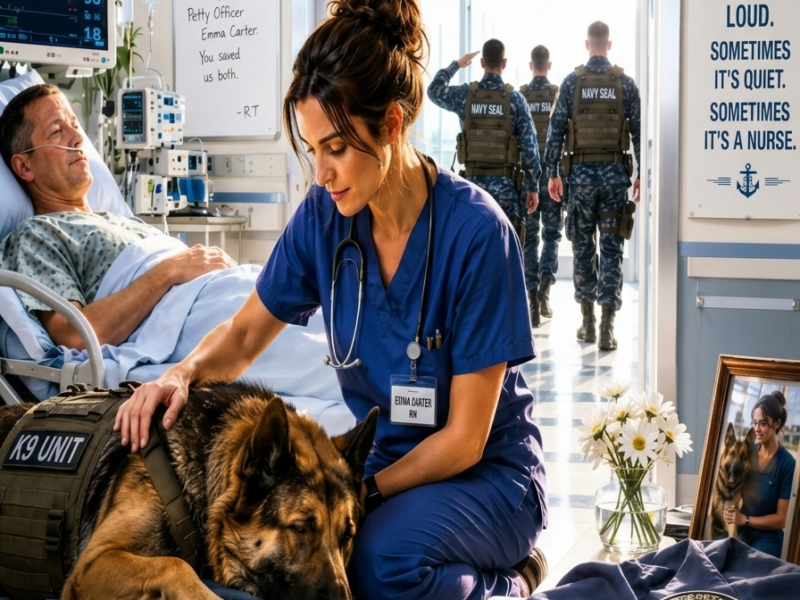
The military K9 refused every command in the hospital hallway, snapping at every handler who approached him
The clear plastic tubing slipped between my fingers as the saline bag hung suspended from its chrome pole. Outside the fourth-floor windows of Naval Medical Center San Diego, a heavy coastal fog was rolling in from Point Loma, smudging the San Diego skyline into shades of dull pewter. Inside Ward 4-East, the air smelled of stale floor wax, chlorhexidine wash, and lukewarm institutional chicken broth. It was 1640 hours. In twenty minutes, my shift would end, and I would trade my pale green scrubs for a faded denim jacket, drive my eight-year-old Civic back to a rented bungalow in Ocean Beach, and feed a stray tortoiseshell cat that lived on my porch.
Then the snarling tore the corridor open.
It wasn’t a standard, frustrated bark from an agitated stray. It was the jagged, chest-deep percussion of an 80-pound Belgian Malinois in full combat arousal. The sound hit the acoustic ceiling tiles and rattled the glass panes of the nurses’ station.
Every head in the hallway snapped toward the elevator vestibule.
“Down! Heel! Platz!”
A young Master-at-Arms third class, wearing crisp desert camouflage and heavy leather bite-gloves, was leaning back at a forty-five-degree angle, both boots skidding across the freshly buffed linoleum. The dog was ignoring him entirely. He wore a patched Cordura assault harness stripped of unit insignia, his sable-and-tan coat bristling along his spine like barbed wire. His ears were pinned flat, saliva flying in white ribbons from his black jowls as he snapped sideways, catching the reinforced sleeve of a second handler who tried to slip an emergency control loop around his neck.
“Back off! Everyone clear the deck!” the second handler shouted, stumbling into a parked linen cart with a loud metallic crash.
Three orderlies flattened themselves against the wall. A corpsman dropped a tray of oral medications, pills skittering across the floor like plastic confetti. The Malinois was not running wild; he was holding a perimeter around a gurney that had just rolled off the service lift.
On that gurney sat a man whose face I didn’t recognize, but whose posture I knew down to the marrow of my bones. He wore charcoal-gray civilian cargo trousers and an OD-green thermal undershirt, his left shoulder wrapped in bulky field dressings that were already seeping dark, venous crimson. Standing in a tight wedge around his cot were four other men.
They looked like they had been dragged out of a meat grinder. Their faces were weathered by high-altitude winds and sun glare, stubbled with days of rough growth, shadowed by the hollow, sleepless glaze of men who had spent ninety-six continuous hours surviving on amphetamines and raw adrenaline. They didn’t wear uniforms. They wore worn windbreakers, faded ballcaps with the velcro patches ripped off, and beaten combat boots caked with dry mountain dust that didn’t come from any training range in Southern California.
Navy SEALs. Not the recruiting poster variety. The dirty, quiet kind that high command only called when they intended to deny the entire continent.
The oldest of the group—a broad-shouldered man with iron-gray hair shaved high and tight, a crooked nose broken at least three times, and a faded trident tattooed on his right forearm—scanned the frozen corridor. His eyes swept past the petrified corpsmen, past the administrative clerks clutching their clipboards, and locked squarely onto me.
“Where’s the nurse?” he demanded. His voice was cracked, raw from dry heat and smoke.
The charge nurse, Mrs. Gable, pointed a trembling pencil toward the floor. “Sir, you need to bring your patient into Trauma Bay Two immediately! That animal cannot be on this deck—”
“Not you,” the gray-haired operator barked, cutting her off without looking at her. He raised a scarred index finger and aimed it directly between my eyes. “Her.”
The room seemed to drop ten degrees. My heart slammed against my ribs like a caged bird throwing itself against wire.
“I think you have the wrong person,” I said, forcing my voice into the soft, unhurried cadence I had spent seven years cultivating. “I’m just a ward nurse. If your teammate is hemorrhaging, the surgical team down the hall—”
“We don’t have the wrong person,” the older man said, stepping forward. The three handlers around the dog scrambled backward, terrified the animal would tear his arm off.
The Malinois didn’t bite. The moment the older SEAL spoke, the dog’s violent snarl cut off as if sliced by a scalpel.
The animal froze. His dark muzzle turned toward me.
His ears pricked forward. His amber eyes, cloudy around the edges from age and scarred around the left brow by a jagged shrapnel furrow, widened. He dropped his forequarters an inch, sniffing the recycled hospital air, cutting through the antiseptic, through the floor cleaner, through the sweat of the panicked crowd.
He took one step. Then another.
“Don’t move, miss!” the lead handler screamed, lunging for the leash. “He’ll take your throat out!”
“Stand down, son,” the gray-haired SEAL growled, catching the handler’s shoulder with an iron grip that dropped the younger man to his knees. “Let him walk.”
The Malinois advanced down the center of the hallway. He wasn’t tracking an enemy; his tail was lowered, sweeping the floor in slow, deliberate arches. The bristling hair along his spine smoothed out. When he reached me, he didn’t jump. He didn’t bare his teeth.
He leaned his massive, muscular head against my left thigh, letting out a long, shuddering sigh that vibrated straight through my scrub trousers, and pressed his wet, scarred nose firmly into the palm of my trembling hand.
A dam broke behind my sternum. The smell of him—gun oil, dried river silt, and the peculiar, sweet musk of a working dog who had slept on frozen dirt—pulled the ground out from beneath my feet.
“Atlas,” I breathed, the word slipping past my lips before my brain could censor it.
Seven years vanished in a heartbeat.
His official kennel number had been K9-442. His tactical handler had called him Atlas. And the woman who had spent four months sleeping back-to-back with him in a damp mud-brick compound outside the Charkh district of Logar Province had not been named Sarah Evans.
Her callsign had been Raven.
Raven was supposed to be dead. On a freezing midnight in November 2019, an eight-man reconnaissance detachment from Naval Special Warfare Development Group, designated Task Force Goshawk, had crossed the border from Paktia into an unmapped valley. We were hunting an off-the-books communications hub. We found an ambush.
The compound blew from the inside. Secondary thermite charges leveled the limestone walls. Five operators were reported missing in action, their dog tags never recovered. Atlas was logged as killed in action, crushed beneath a collapsed roof. And Lieutenant Sarah Vance—Raven, the detachment’s combat medic and intelligence specialist—was officially listed as destroyed by explosive ordnance.
Except I hadn’t died. I had crawled out of that flaming limestone crater through an irrigation tunnel, half-blind, bleeding from my ears, clutching a cracked survival compass. A local elder had hidden me in a goat shed until a private extraction team—men who refused to give their names or show their badges—shoved me onto a civilian cargo plane, handed me a forged Ohio birth certificate in the name of Sarah Evans, and gave me one order: Disappear. If you ever contact the Navy, if you ever utter the name Goshawk, you will be buried in an unmarked hole at Leavenworth.
So I became a ghost. I got a nursing degree at an obscure community college. I took night rotations. I avoided veterans’ groups. I lived in small rooms with locks on the inside.
And now Atlas was leaning against my knee, whimpering like a pup that had finally found his kennel after years in the wilderness.
“Why are you here?” I whispered, looking up from the dog to the five men. My voice was no longer that of Sarah Evans the nurse. The flat, sharp, predatory edge of a SEAL team operator cut through the hospital noise.
The gray-haired man pulled off his dirty tactical gloves, tucking them into his belt. “We came because someone is killing the people from our old unit.”
My stomach tightened into a knot of cold stone. “How many?”
“Four,” he said simply. “In thirty days. Captain Miller had a single-vehicle rollover in Coronado; his brake lines were melted with acid. Master Chief Lawson took a bullet through his bedroom window in Virginia Beach. Two of our support techs drowned in an unexplainable boating accident off Key West. All four were listed as retired or detached from Goshawk.”
The hallway had gone utterly silent. Mrs. Gable and the corpsmen stood paralyzed, realizing that whatever conversation was taking place was far beyond their security clearances.
I looked at the wounded man on the gurney. He was clutching his abdomen, his skin pale as wax, sweat rolling down his hollow cheeks. “Who’s next?”
The gray-haired SEAL stared at me with eyes that had seen empires rot. “You.”
A hollow, bitter laugh escaped my throat. “I’m a nurse in a naval hospital. I don’t exist in the DOD registry. My DD-214 was erased.”
“You think you’re hidden?” The man reached into his windbreaker and pulled out a battered, clear plastic map sleeve. Inside was a standard 4×6 surveillance print.
It showed me three days ago, walking out of the grocery store on Newport Avenue, carrying a paper bag of groceries, my hair tied back in a scrub cap. But across the glossy surface, someone had drawn a red wax grease-pencil crosshair directly over my temple.
On the back of the photo, written in thick, jagged capital letters with a permanent marker, was a six-word sentence:
SHE KNOWS WHERE THE BODIES ARE.
“I don’t know where the bodies are,” I whispered, my chest heaving, the air suddenly tasting like copper and cordite. “They died in the blast. The whole valley came down on them.”
“You don’t remember,” the SEAL said, stepping closer, his voice dropping into a harsh murmur that only I could hear. “The blast didn’t wipe your memory, Sarah. The medical team that pulled you out gave you three heavy doses of Midazolam and scopolamine before they put you on that transport. They scrambled your timeline so you wouldn’t remember who laid the thermite inside that bunker.”
My breath seized.
The fragments of that night—the parts I had spent seven years assuming were post-traumatic amnesia—flashed through my head like lightning striking water. The smell of thermite wasn’t coming from outside the compound. It had been burning inside the radio room before the mortars ever fell. I remembered a voice screaming over our secure intra-team net, an American voice, cold and measured: Wipe the cache. Leave no biological remains.
Atlas suddenly broke away from my leg.
His head snapped toward the end of the corridor, his upper lip pulling back over his yellow canines. He let out a single, deafening bark that echoed like a rifle shot down the tile hallway.
Bark.
Then another.
He didn’t look at the main elevators. He bounded toward the heavy fire doors marked Sub-Basement Maintenance / Morgue Staging Area—a restricted section of the older hospital wing that had been locked for seismic retrofitting three months ago.
Atlas planted his front paws against the reinforced steel door, whining, his claws frantic against the push bar.
The four standing SEALs unzipped their jackets in unison, their hands dropping toward concealed sidearms with the fluid, synchronized economy of men preparing for a breach.
“What is he doing?” I asked, my boots moving on their own, tracking behind the dog.
The gray-haired operator pulled a suppressed Sig Sauer from under his windbreaker, keeping it low against his thigh. “That door leads to the old steam tunnel access below Building One. That’s where they found the first body this morning. Master Sergeant Reyes. He was supposed to meet us at the safehouse on Harbor Drive.”
My pulse hammered in my ears so loudly it drowned out the hum of the overhead fixtures.
Clank.
The magnetic lock on the heavy fire door disengaged with a sharp, mechanical slap.
The handle slowly depressed. The steel slab swung open an inch, then two, groaning on rusted hinges.
A man stepped out of the shadow of the stairwell and into the cold fluorescent light.
He wore an unironed, sand-colored desert combat uniform, stripped of name tapes and branch identifiers, but on his left collar was the pinned oak leaf of a Lieutenant Commander. His face was lean, his jaw covered in a neatly trimmed beard streaked with white, his right arm tucked casually into his uniform pocket.
I knew him. Every instinct in my body screamed that I was looking at a corpse.
Lieutenant Commander Raymond Cole. The officer in tactical command of Task Force Goshawk. The man who had stayed behind in the radio bunker to transmit our final distress beacon while the mortar shells hammered the roof. The sixth man officially listed as killed in action, his memorial stone sitting in Section 60 at Arlington.
He looked past the drawn weapons of the five SEALs. He looked past the snarling, quivering dog.
His eyes fixed on me, and his lips parted in a calm, fatherly smile.
“Hello, Raven,” he said.
Atlas went for his throat.
The heavy steel fire door slammed back against the concrete wall as Atlas launched himself through the air. Eighty pounds of pure muscle and working-dog fury closed the ten-foot gap in the space of a single heartbeat.
“Atlas, out!” Cole commanded.
The voice was not panicked; it was the sharp, guttural German command used during advanced canine bite training.
Atlas did not halt, but the command caused a microsecond of hesitation in the dog’s tracking angle. Instead of crushing Cole’s windpipe, Atlas’s jaws clamped down violently on Cole’s left forearm. The heavy ripstop fabric of the desert combat uniform tore open, revealing an underlying layer of thick, custom-molded Kevlar bite-protection wrapped beneath the sleeve.
Cole didn’t flinch. He used the dog’s forward kinetic energy to pivot, driving Atlas’s flank hard into the reinforced steel frame of the stairwell door.
“Breach! Take him!” the gray-haired SEAL roared.
Gunfire in a tiled hospital hallway is not like the movies. It does not sound like fireworks; it sounds like an industrial press shattering steel plate, a deafening, concussive pressure wave that slaps the eardrums and rips the air out of the lungs. The gray-haired operator fired two suppressed rounds from his Sig Sauer. Both hollow points struck the center of Cole’s chest, but the man didn’t go down. The impacts staggered him back a half-step, the ceramic strike plate concealed beneath his blouse absorbing the lethal kinetic transfer.
Cole reached into his field jacket with his free right hand and threw an object across the floor.
It wasn’t a frag grenade. It was a heavy, cylindrical flash-bang canister labeled with military stencils.
“Down!” I screamed, dropping flat behind the steel base of the medication cart.
The hallway turned into a sunburst of blinding magnesium light accompanied by a 170-decibel concussion that rattled my dental fillings and turned my vision into a swirling vortex of white spots and purple static. The smell of burned sulfur and magnesium powder instantly overwhelmed the sterile hospital air.
Through the high-pitched ringing in my ears, I heard Atlas yelping in pain, followed by the heavy, rhythmic thud of combat boots sprinting downward into the concrete guts of the stairwell.
“Up! Move, move!” a hand clamped onto my scrub collar, hauling me to my feet with enough force to pull my clogs off the floor.
It was the gray-haired SEAL. His face was blackened by soot, his eyes wide and bloodshot, but his grip was like an iron vice. Behind him, the wounded operator was slumped against the wall, clutching his shoulder, while the other three kept their carbines raised, covering the smoky threshold of the stairwell.
Mrs. Gable and the remaining ward staff had fled through the double doors toward the ICU, their hysterical screams echoing faintly over the high-frequency hum in my ears. The fire alarm finally tripped, its red strobe lights pulsing across the ceiling in a frantic, bloody cadence.
“You okay, Doc?” the older man barked, shaking me once to clear my head.
“I can hear,” I coughed, my throat burning from the gas. “That was Cole. That was Raymond Cole. He died in Logar! I saw the ceiling cave in on the communications bunker!”
“You saw what he wanted you to see,” the SEAL said, pulling a spare Glock 19 from a concealment holster behind his back and slapping it into my palm. The grip was cold, the textured polymer instantly familiar against my skin. “My name is Miller. Master Chief Miller. Not related to the Captain who got murdered in Coronado. Take the weapon.”
My fingers closed around the frame. The safety was integrated into the trigger; the slide was cold. Seven years of civilian life—seven years of measuring glucose, charting blood pressure, and apologizing to doctors—evaporated like mist in the desert sun.
“Atlas,” I said, scanning the smoky floor.
The Malinois was on his feet three yards away, shaking his head violently to clear the ringing from the flash-bang, a trickle of blood running from his left nostril. But the moment his amber eyes found mine, he fell into an immediate, low combat crouch, his nose pointing straight down the dark, spiraling stairs.
“He went to the sub-basement,” I said, checking the chamber of the Glock with a quick press-check of the slide. “One in the pipe. Seventeen in the magazine. Where are the local police?”
“They aren’t coming,” Miller said grimly, gesturing for his two point men to take the door frame. “Cole holds an active Level-One clearance through the Defense Intelligence Agency. The moment he popped this op, he spoofed an active-shooter exercise code to the San Diego dispatch center. The local perimeter is locked down by private security contractors from Blackwood Logistics. We have eight minutes before they flood this facility to ‘contain the incident.'”
“Blackwood Logistics,” the name tasted like battery acid on my tongue. “They were the private contractors running the logistics hub at Gardez.”
“They weren’t running logistics,” Miller said, taking the point position on the threshold of the stairwell, his carbine tucked tight against his cheek. “They were running the offshore accounts. The eighty million dollars in unregistered covert funds that Task Force Goshawk was sent to recover. Cole didn’t stay behind to call in an extraction bird, Sarah. He stayed behind to make sure the seven men who saw the banking manifests didn’t leave that valley alive.”
The pieces fell into place with a sickening, mechanical finality.
The thermite charges. The missing bodies. The selective amnesia induced by the medical team that extracted me. I hadn’t been saved because I was a brave medic who survived an explosion. I had been saved because, in the final chaos before the compound detonated, I had pulled the primary encrypted solid-state drive from the communications server, believing it contained the unit’s casualty tracking data.
“The drive,” I whispered, the cold air from the stairwell washing over my face.
Miller turned his head slightly, his left eye narrowed. “You remember.”
“I took it out of the rack,” I said, my heart slamming into my throat. “I put it in my trauma kit. Inside the waterproof Pelican case with the morphine ampoules and the arterial clamps.”
“Where is it now?”
“It’s not in this hospital,” I said. “It’s buried under the floorboards of my bungalow in Ocean Beach. I thought… I thought it was just the medical journals of the men who died.”
“It’s the ledger,” Miller said. “It has the routing numbers, the Swiss clearing codes, and the signatures of three sitting members of the Joint Chiefs of Staff who authorized Blackwood to skim the procurement budgets. That drive is the only thing keeping Cole from retiring to a non-extradition country with eighty million dollars. And he knows you’re the only one who has the key.”
Atlas let out a sharp whine, his front paws stepping over the threshold into the dark.
From the depths of the stairwell, four floors down, the rhythmic thud of an industrial diesel generator kicked on. The concrete beneath our boots vibrated with a low, mechanical hum.
A voice echoed up the narrow, painted concrete cylinder—not shouted, but amplified through a bullhorn, its tone measured, aristocratic, and completely devoid of human empathy.
“Sarah,” Cole’s voice floated upward through the smoke. “Do not let Master Chief Miller get you killed. He is a blunt instrument. He thinks in terms of casualties and flag honor. You are an intelligence specialist. You understand math. Bring the drive down to the mechanical tunnels. Walk away with your pension, your new identity, and your life. Or I flood this hospital’s intake manifold with methyl isocyanate, and five hundred civilian patients die so that nobody ever asks what happened in Logar.”
Miller didn’t hesitate. He tapped the shoulder of his point man twice.
“Move down,” he whispered. “Shoot on sight.”
The concrete stairwell of Naval Medical Center San Diego was built during the late Cold War, designed to withstand the overpressure of a surface detonation. The walls were twelve-inch reinforced poured concrete, painted with peeling coats of sea-foam green, the landings separated by heavy industrial blast doors that smelled of ancient cosmoline and damp subterranean dust.
We moved in standard CQB formation. Two operators took point, their carbines swept across the descending angles; Miller covered the center with me and the wounded operator; one rear guard walked backward down the steps, his weapon trained on the door above us. Atlas moved at my left knee, his harness nylon clicking softly against the concrete steps, his nose testing the drafts rising from below.
“He’s not bluffing about the chemical manifold,” I murmured to Miller as we hit the landing for Sub-Basement 2. “The hospital’s central hyperbaric chamber and research labs keep five hundred gallons of industrial solvents stored in the lower mechanical gallery. If he taps the HVAC return vents, the entire east wing will be toxic in under six minutes.”
“He won’t tap it until he knows he can’t get you,” Miller grunted, his boots silent on the steel grid of the landing. “Cole is a sociopath, not a martyr. He wants the money. He wants to walk out of here through the utility tunnels that connect to the Balboa Park drainage system.”
We hit the final landing: Sub-Basement 4.
The door here wasn’t standard fire-rated steel. It was a four-inch-thick vault door marked RESTRICTED PERSONNEL ONLY: FLEET COMMUNICATIONS RELAY – COLD WAR INFRASTRUCTURE. The heavy wheel latch had been blown open with a localized cutting charge; molten slag was still smoking along the edges of the lock housing, filling the corridor with the acrid stench of burned sulfur.
Atlas stopped. His ears flattened. He dropped into a crawl, his belly nearly dragging on the wet concrete.
“Hostiles inside,” Miller whispered, flashing three fingers to his point men.
We stepped through the jagged, smoking hole in the vault frame.
The room beyond was massive—a cavernous, low-ceilinged mechanical gallery that stretched for a hundred yards beneath the hospital. Giant green-painted air compressors, steam boilers, and chilled water pipes hung from the ceiling like the exposed intestines of a mechanical beast. In the center of the floor was an open trench, four feet wide, carrying the roaring, churning gray runoff from the cooling towers out toward the city storm drains.
A bank of temporary halogen work-lights illuminated the center of the vault.
Standing beside an open electrical terminal, his laptop hooked into the hospital’s primary infrastructure bus, was Raymond Cole.
He had removed his blouse. Underneath, he wore a black tactical vest fitted with modular magazine pouches and a digital radio hub. But he wasn’t alone.
Flanking him were six men in gray civilian combat uniforms, their faces hidden behind black balaclavas, carrying short-barreled German submachine guns. They were not active-duty military; their posture was loose, relaxed, confident—the unmistakable body language of tier-one private military contractors who were being paid ten thousand dollars a day to commit treason.
At Cole’s feet, tied to a vertical steel support column with heavy zip-ties, was a woman.
My breath caught in my throat.
It was Elena Vance.
My sister.
She was wearing a navy blue civilian windbreaker, her face bruised, a cut bleeding sluggishly across her temple. She was an archivist for the Naval History and Heritage Command—a civilian who had never held a weapon in her life. The woman who had sent me postcards from Monterey every Christmas, the woman I had spent seven years avoiding because I believed my proximity would paint a target on her back.
“Elena,” I breathed.
“Sarah!” she choked out, her voice cracked, her eyes rolling toward me through the glare of the work-lights. “He… he came to the house… he said you were alive…”
“Don’t move, Elena!” I shouted, bringing the Glock up, centering the front sight post directly on Cole’s forehead.
Cole didn’t flinch. He didn’t even draw his weapon. He stood behind her, one gloved hand resting lightly on the cold copper of an industrial valve mounted to the wall above her head.
The valve was painted bright safety yellow, stenciled with the skull-and-crossbones symbol of chemical hazardous waste.
“You really should have answered my letters, Sarah,” Cole said, his voice echoing smoothly through the cavernous room. “I spent eighteen months looking for you in Europe. I thought you had taken the French Foreign Legion route like some of the old boys. Then my contacts in Naval Intelligence flagged a personnel file: a contract nurse with zero credit history before 2020, working the night shift three miles from Coronado. You were hiding in our backyard.”
“Let her go, Raymond,” I said, my voice dropping into that terrifyingly quiet register that meant the safety was off and the decision was already made. “She doesn’t know anything. She doesn’t have the drive.”
“Of course she doesn’t have it,” Cole said, rolling his eyes. “Elena is a librarian. She thinks the United States Navy is run by the boy scouts. But she served her purpose. She brought you to the floor. And more importantly, she brought me Master Chief Miller.”
Miller didn’t lower his weapon. “You’re a dead man, Cole. The moment you step outside this perimeter, the FBI’s hostage rescue team has the building surrounded.”
Cole laughed—a short, barking sound of pure, unadulterated contempt. “The FBI? Miller, who do you think authorized the security perimeter on the surface? Assistant Director Vance. Sarah’s dear uncle. The man who set up the shell accounts for Blackwood in the first place.”
The world tilted slightly on its axis.
My uncle. Admiral Arthur Vance. The man who had given me my commission. The man who had stood beside my mother’s hospital bed when she died of cancer and promised he would look after me.
“You’re lying,” I said, but my own voice sounded hollow in my ears.
“Why do you think you were assigned to Goshawk, Sarah?” Cole asked, leaning forward, his eyes burning with triumphant mockery. “You were the insurance policy. If the team went rogue, Arthur knew he could use you to leverage the unit. But when the ambush failed to kill everyone, Arthur had to improvise. He made you disappear under a civilian alias so he could keep tabs on you until the statute of limitations on the covert funds cleared. But now? The offshore accounts are freezing. The banks want the physical cryptographic drive. And you have it.”
“And if I give it to you?” I asked.
“Then your sister lives,” Cole said. “And you get to die in a sterile hospital bed from a massive, tragic overdose of fentanyl, administered by a distraught nurse who couldn’t handle the stress of the trauma ward. A very clean, very sad civilian tragedy.”
Atlas let out a low, vibrating growl from between my boots. He wasn’t looking at Cole.
He was looking at the contractor on the far left—the one standing near the industrial drainage trench.
The Malinois smelled the current of air rising from the water. He knew what was beneath the concrete.
“Sarah,” Miller murmured from the side of his mouth, his lips barely moving. “The drainage trench. It dumps directly into the Navy fuel depot tunnels under Harbor Drive. If he gets into that pipe, we lose him forever.”
“He’s not getting into the pipe,” I whispered.
I lowered my weapon three inches. Just enough to signal compliance. Just enough to draw Cole’s eyes to my hands.
“The drive isn’t in Ocean Beach, Raymond,” I said, stepping forward two paces, drawing the contractors’ sights directly onto my chest. “I lied.”
Cole’s eyebrows lifted. “Where is it?”
“It’s in the dog’s tracking harness,” I said.
Cole looked down at Atlas.
In that half-second of diverted attention, the world exploded into action.
“Atlas, fass!”
The German attack command left my throat like a whip crack.
The Belgian Malinois did not hesitate. He did not bark. He launched himself across the wet concrete like a black-and-tan missile, ignoring Cole, ignoring the drawn submachine guns, and drove his full weight directly into the contractor standing beside the industrial drainage trench.
The impact was catastrophic. The contractor shrieked as Atlas’s jaws clamped around his collarbone, the kinetic force carrying both man and dog over the concrete lip and down into the four-foot-deep, churning torrent of the cooling trench with a tremendous splash.
“Fire!” Cole screamed.
The mechanical gallery detonated with gunfire. The submachine guns of the Blackwood contractors chattered in rapid, ear-splitting bursts, chewing through the concrete pillars and sending sprays of pulverized stone and sparking copper through the air.
Miller and his three surviving operators answered with controlled, lethal precision.
The contractor nearest the electrical panel took two 5.56 rounds through the throat, his body thrown backward into the primary transformer bank. A shower of blinding blue electrical arcs erupted across the ceiling, plunging the sub-basement into absolute, terrifying darkness, broken only by the orange muzzle flashes of our weapons.
I dropped to the floor, rolling beneath the spray of 9mm rounds that tore through the air where my head had been half a second before.
I fired three rounds from the Glock. The muzzle flash illuminated the second contractor’s face for a fraction of a second—eyes wide behind his balaclava—before the heavy polymer-jacketed slugs punched through his chest plate, dropping him face-down onto the wet linoleum.
“Elena!” I screamed through the deafening roar of the firefight.
I scrambled on my elbows and knees through the dark, the concrete cold and slick with blood and cooling runoff.
A hand caught my hair, yanking my head back with savage force.
The barrel of a cold steel sidearm pressed hard against my temple.
“Drop it, Sarah,” Cole’s voice hissed in my ear. He was panting, his breath hot and smelling of menthol cigarettes. “Drop the weapon, or your sister’s brains are all over this floor!”
Through the strobe-like flashes of gunfire from the far end of the gallery, where Miller was methodically hunting down the remaining contractors, I saw Elena. She was still zip-tied to the pipe, weeping, her forehead pressed against the cold metal.
I let the Glock slip from my fingers. It hit the wet concrete with a dull slap.
“Wise girl,” Cole whispered, his fingers tightening in my hair as he hauled me backward toward the emergency exit tunnel behind the electrical vault. “You always were smarter than the boys. Now, where is the key?”
“The key is in the valley, Raymond,” I said, my voice completely devoid of fear.
“Don’t lie to me!” he roared, driving his elbow into my fractured ribs.
A flare of white-hot agony tore through my chest, robbing me of breath, but I didn’t cry out. My right hand, hidden beneath the shadow of his torso, slipped into the side pocket of my green scrub pants.
Not for a gun.
For the three-inch steel surgical scalpel I had slipped from the triage tray before we left Ward 4-East.
“You left five men to burn,” I whispered, the words coming out in a ragged hiss as he dragged me backward. “You left Lawson. You left Reyes. You left boys who would have taken a bullet for you.”
“They were tools, Sarah!” Cole snarled, backing toward the open metal doorway of the drainage access tunnel. “Just like you! Just like that damn dog! This country doesn’t care about tools! They care about results! And eighty million dollars buys a lot of results!”
“They weren’t tools,” I said. “They were my team.”
I drove the scalpel backward with everything I had left.
The surgical steel blade, designed to slice through human tissue with effortless ease, sank three inches deep into the femoral junction of Cole’s inner right thigh—the femoral artery.
Cole let out a high-pitched, strangled shriek of pure agony.
The gun in his hand fired blindly into the ceiling, the bullet ricocheting off a steam pipe with an ear-splitting whine. His grip on my hair tore loose as his leg buckled beneath him, arterial blood—bright, frothy, and dark—spurting across my green scrubs in rhythmic, violent jets.
He crashed to the floor, clawing desperately at his groin, trying to clamp the severed artery with his gloved hands.
“You… you bitch…” he choked, his face instantly draining of all color, turning the sickly gray of curdled milk under the emergency strobe lights. “You cut… you cut the line…”
“I’m a medic, Raymond,” I said, rolling to my feet, my breathing ragged as I looked down at him. “I know exactly where the lines are.”
From the shadows of the drainage trench, a dark, dripping shape scrambled up the concrete incline.
Atlas.
He was soaked in filthy drainage water, his coat matted with grease, blood dripping from a gash over his left ear, but his eyes were blazing. He trotted across the floor and stood directly over Cole, his muzzle inches from the dying officer’s face, his lips pulled back in a silent, terrifying snarl.
Cole stared up into the amber eyes of the dog he had left to die in the rubble of Logar Province seven years ago.
“Atlas…” Cole whispered, his bloody hands trembling as his blood pressure collapsed. “Good… good boy…”
Atlas did not move. He did not bite. He simply watched the life drain out of the man’s eyes, an impassive, merciless sentry marking the end of a long, cold debt.
Miller stepped out of the shadows, his carbine lowered, his tactical vest smeared with gray dust. Behind him, two of his surviving operators were already cutting Elena free from the steel pillar.
“Sector clear,” Miller said, looking down at Cole’s motionless body. “The contractors are neutralized. Base security is hammering on the blast doors upstairs, but the federal frequency just lit up. Admiral Vance was arrested at his home in Bethesda twenty minutes ago by the Provost Marshal and the FBI.”
Elena ran toward me, throwing her arms around my neck, sobbing into the soaked, bloody shoulder of my scrub top. “Sarah… oh God, Sarah… I thought you were dead… they told me you were gone…”
“I’m here, El,” I whispered, wrapping my arms around her, burying my face in her hair. “I’m right here.”
Miller knelt down beside Cole’s corpse, reached into the dead officer’s tactical vest, and pulled out an encrypted satellite phone and a heavy bronze challenge coin stamped with the emblem of Task Force Goshawk.
He turned the coin over in his scarred palm, then looked up at me.
“It’s over, Raven,” Miller said softly. “The records are being pulled from the Pentagon servers right now. The Secretary of Defense signed the exoneration orders five minutes ago. You don’t have to be a ghost anymore.”
I looked down at Atlas.
The Malinois was sitting on his haunches beside my knees, his tail giving a single, exhausted thump against the bloody concrete floor.
I looked at my hands—stained with the blood of a traitor, calloused from seven years of tending wounds, steady as the mountain rock.
“I was never a ghost, Miller,” I said, reaching down to scratch Atlas behind his torn, scarred ears. “I was just waiting for the team to come home.”
The morning sun broke over San Diego with the cold, crystalline clarity that only follows a winter Pacific storm.
From the bluffs of Fort Rosecrans National Cemetery, the view stretched uninterrupted across the mouth of the bay: the gray superstructures of two aircraft carriers moored at North Island, the white sails of civilian ketches slipping past the jetty, and the endless, glittering expanse of the open ocean meeting the western horizon.
The grass was damp with dew, smelling of salt spray and eucalyptus.
The ceremony was small. There were no television cameras, no congressmen looking for soundbites, no flags waving for the press. The Department of the Navy had declassified the records of Task Force Goshawk under a quiet administrative directive signed at 0300 hours, clearing the names of the seven operators who had been labeled as missing or disgraced.
Five white marble headstones stood in a fresh, perfect row beneath the shade of a Torrey pine.
Master Sergeant Reyes. Captain Miller. Master Chief Lawson. Petty Officer Miller. And the two communications operators whose names had been scrubbed from the rolls for seven years.
Standing in the front row, wearing her service dress blues with the gold oak leaves of a Lieutenant Commander and the silver trident pinned above her ribbons, was Sarah Vance.
The green scrubs were gone. The quiet, timid smile of Nurse Sarah Evans had been buried in the sub-basement of the medical center. My uniform was tailored, my posture straight, my ribbons including the Bronze Star with Combat ‘V’ and the Purple Heart with two gold stars.
Beside me stood Elena, holding a bouquet of white lilies, her hand slipped securely into the crook of my elbow. She wasn’t crying now. Her face was pale, but her eyes were clear, reflecting the brilliant blue of the morning sky.
To my right, standing at rigid parade rest, were Master Chief Miller and his surviving operators, their service dress uniforms pristine, their scarred faces set in stone as the bugler from the Navy Band sounded the long, mournful notes of Taps.
Day is done, gone the sun…
The clear, brassy notes hung in the cool maritime air, echoing off the white marble rows that stretched down the hillside toward the sea.
At my side, sitting with the regal, disciplined stillness of an old warrior, was Atlas.
He wore a new service harness of dark blue nylon, bearing the official gold insignia of a retired Military Working Dog. The wounds from the previous night had been stitched and cleaned by the veterinary surgical unit at North Island; a neat row of surgical staples closed the laceration on his shoulder, and an antiseptic wash colored his left ear. But his head was held high, his amber eyes tracking the flight of a lone osprey circling high above the bay.
The bugle notes faded into the sound of the wind through the pines.
A three-star admiral stepped forward—the Vice Chief of Naval Operations, who had flown through the night from Washington to hand-deliver the official citations. He stopped in front of me, his expression grave, his eyes carrying the heavy, unspoken apology of an institution that had failed its own.
He presented Elena with a folded American flag, encased in polished cherrywood.
Then he turned to me.
“Lieutenant Commander Vance,” the Admiral said, his voice carrying clearly across the quiet bluff. “The United States Navy owes you a debt that cannot be paid with ribbons or back-pay. You preserved the honor of your unit when your command structure fell into darkness. The President has directed me to offer you immediate reinstatement to active duty, with command of the Expeditionary Medical Unit at Coronado.”
I looked at the Admiral. I looked down at the white marble headstones bearing the names of the men I had served with in the high valleys of Afghanistan.
Seven years of hiding. Seven years of looking over my shoulder every time a black sedan slowed down on my street. Seven years of believing that the country I had sworn to defend had forgotten the meaning of the oath.
Then I looked down at the hospital across the bay—the sprawling white towers of the Naval Medical Center where I had spent seven years cleaning bedpans, changing dressings, and holding the hands of young sailors waking up from traumatic amputations.
“With respect, Admiral,” I said, my voice steady, carrying that same quiet authority that had commanded respect in the field. “I’ve had my time on the line.”
The Admiral’s eyebrows lifted slightly. “You’re declining reinstatement, Commander?”
“I’m declining tactical command, sir,” I said. “I am requesting an immediate transfer to the Department of Veterans Affairs Canine Therapy and Rehabilitation Program at Balboa. As a civilian clinician.”
The Admiral stared at me for three long seconds. Then, slowly, the rigid professional mask on his face softened. A faint, respectful smile touched the corners of his mouth.
“Request granted, Commander,” he said softly. He snapped a crisp, razor-sharp salute.
I returned it with the precision of an operator who had earned every thread of the cloth she wore.
The ceremony ended. The officers dispersed, their polished shoes crunching softly on the gravel paths as they returned to their staff cars.
Master Chief Miller walked over, his cap tucked under his arm, the salt-and-pepper hair on his temples catching the sunlight. He looked down at Atlas, reaching out a scarred hand to scratch the dog firmly behind his good ear.
“You’re sure about this, Doc?” Miller asked, looking out toward the bay. “The boys at Coronado would give their left arm to have Raven running their medical cell.”
“Coronado has plenty of medics, Miller,” I said, a genuine smile touching my lips for the first time in seven years. “The boys coming back from the desert need someone who knows what the dust tastes like. Someone who knows how to listen when they can’t talk.”
Miller nodded slowly. He reached into his pocket and pulled out the bronze challenge coin he had recovered from Cole’s vest. He pressed it into my hand, closing my fingers over the heavy, ridged metal.
“Goshawk is officially decommissioned, Sarah,” he said, his voice husky. “The files are sealed in the National Archives. But if you ever need a hand… if the night gets too long… the team is only a phone call away.”
“I know, Chief,” I said. “Fair winds.”
“Following seas, Commander.”
He turned and walked down the path toward the waiting transport, his broad shoulders squared, a man who had finally laid his ghosts to rest.
I stood on the bluff with Elena and Atlas as the morning fog completely burned away, revealing the vast, brilliant expanse of the Pacific Ocean.
Atlas leaned his heavy head against my thigh, letting out a long, contented breath, his tail giving a single, lazy sweep across the wet clover.
The name Raven was gone. It belonged to the limestone valleys, the burning thermite, and the marble stones of Section 60.
I reached up, unpinned the gold caduceus from my lapel, and dropped it into my pocket beside the bronze coin.
“Come on, boy,” I whispered, reaching down to unclip his leash, letting him walk free on the open grass. “Let’s go home.”
The end.









