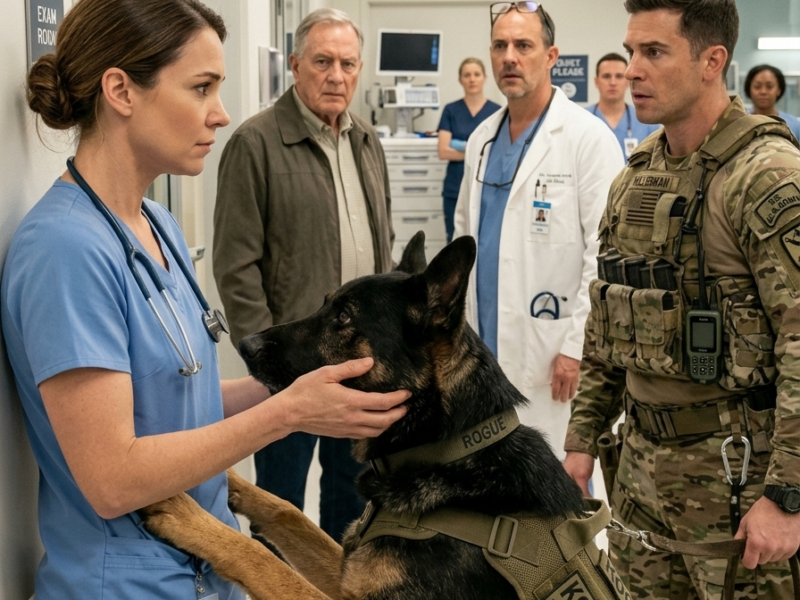
The military K9 lunged across the emergency room and pinned a Navy SEAL against the floor while everyone screamed at the “just a nurse”
The fluorescent lights of St. Jude Military Memorial Hospital flickered against the sterile white tiles, casting long, nervous shadows down the emergency corridor. Outside, a late-autumn rainstorm lashed against the heavy glass doors, but the real storm was raging inside the building.
I stood dead still in the center of the hallway, a metal tray loaded with sterile syringes, saline bags, and surgical tape balanced in my hands. Ten feet away, three heavily armed Navy SEALs in wet tactical gear were struggling to contain a nightmare.
Diesel, a ninety-pound Belgian Malinois with a fur coat the color of burnt mahogany and eyes like polished obsidian, had a veteran team leader pinned against the slick concrete wall. The dog’s jaws were locked onto the Kevlar sleeve of the operator’s tactical jacket, his hind legs digging into the vinyl floor for leverage. The hallway rang with the chaotic symphony of shouting guards, screaming civilian staff, and the deep, terrifying rumble of the dog’s vocal cords rattling through his chest.
“Get the nurse out of here!” someone yelled from the nurse’s station. “Call Base Security! He’s going to tear his arm off!”
I didn’t run. Eleven years as a trauma nurse in high-volume military emergency rooms teaches you to filter out the noise and focus on the anatomy of a crisis. But more than that, I knew the creature in front of me. I knew the angle of his ears, the specific notch torn from his left nostril, and the jagged scar running along his inner ribcage.
The SEAL holding Diesel’s primary lead tightened his grip, his boots slipping on the wet floor as he tried to wrap an arm around the dog’s neck. “Don’t move, lady! He’s unstable! He was exposed to an explosive blast in the sector two hours ago!”
I set the metal tray down on a nearby supply cart with a soft, deliberate clatter. I took three steps forward, stepping directly into the dog’s path of sight.
Diesel’s eyes locked onto mine. The terrifying, unbridled rage in his dilated pupils flickered for a fraction of a second, replaced by a sudden, jarring confusion. His ears twitched back. The continuous growl stuttered in his throat.
I looked straight into his dark eyes, kept my shoulders broad, and spoke a single, flat word in a low, guttural dialect that didn’t sound like English, Spanish, or any standard NATO command.
“Drop.”
The effect was instantaneous, as if an invisible light switch had been flipped inside the beast’s brain. Diesel released the operator’s heavy sleeve immediately. His jaws snapped shut with a dry clack. He dropped his front shoulders to the floor, his tail sweeping across the tiles once, twice, in a heavy, rhythmic thud.
Silence descended upon the corridor like a falling anvil.
The SEAL on the floor backed away slowly, clutching his shredded sleeve, his chest heaving as he stared at me in shock. The other two operators lowered their sidearms, their faces pale beneath their tactical greasepaint.
“How… how the hell did you do that?” the team leader rasped, slowly pulling himself up by the handrail. “K9 Unit’s been trying to calm this dog since we loaded him into the chopper. He bit two handlers on the tarmac.”
I kept my hands clasped loosely in front of my scrubs, letting my shoulders drop into the slouched, non-threatening posture of an overworked, underpaid hospital worker.
“I’ve worked with difficult patients,” I said softly, offering a faint, tired shrug. “Sometimes you just have to speak with authority.”
Nobody laughed. The atmosphere in the room remained taut, heavy with an unspoken suspicion. They were elite warfighters; they knew the difference between animal control and absolute, hardcoded operational command.
Commander Richard Vance, the head of the regional tactical medical detachment, stepped out from the observation bay. He was a broad-shouldered man with iron-gray hair, sharp slate-colored eyes, and a uniform so crisp it looked ironed with starch and grease. He walked toward me with slow, measured steps, his gaze sweeping over my worn sneakers, my faded blue scrubs, and my plain plastic ID badge that read simply: CLARA – RN.
“Who trained you?” Vance asked, his voice low and vibrating with a authority that demanded immediate compliance.
I kept my eyes lowered toward the floor. “No one, sir. I’m just a civilian staff nurse.”
That was my second lie of the morning.
The truth was a corpse buried five thousand miles away under six feet of scorched sand and classified operational reports. Nine years ago, long before I wore sanitized cotton and spent twelve-hour shifts hanging IV bags, I didn’t have a civilian name. I was Callsign Valkyrie, the chief trauma specialist for Vanguard-9—a ghost unit operating under the direct, unacknowledged authority of the Joint Special Operations Command. We didn’t exist on official rosters. We didn’t receive medals. We flew into dark valleys behind enemy lines in unregistered stealth helicopters to pull broken operators out of burning wreckage before the news could report the crash.
And then came Operation Black Dusk in the mountains of Badakhshan.
A localized intelligence betrayal wiped my entire twelve-person team off the map in less than seven minutes. My unit was officially listed as killed in action, their names scrubbed, their records sealed under highest-level security clearances. I was supposed to be dead in that trench alongside them. I survived only because the weight of two fallen teammates covered my broken body from the liquidation sweep.
When I crawled out of the burning valley three days later, I realized the truth: the betrayal hadn’t come from the local insurgents. It had come from inside our own command structure. Returning meant being eliminated to keep the secret safe. So I died. I let Clara exist, hiding in plain sight within the vast, nameless machine of the Department of Veterans Affairs, healing broken soldiers quietly because it was the only way to keep the nightmares from consuming me completely.
A cold wet nose pressed hard against the inner skin of my left wrist.
I flinched, my breath catching in my throat as I looked down. Diesel had crawled across the slick floor and pressed his muzzle against my skin, right over the thin, silver surgical scar that ran down my radial artery.
My heart hammered against my ribs like a trapped bird. That scar was where a piece of hot shrapnel had torn through my arm during the defense of Compound 44—the exact same night I had spent forty minutes in a mud-filled trench tying a tourniquet around Diesel’s severed leg vein while heavy machine-gun fire tore the palm trees above us to shreds.
He remembered. A dog’s memory doesn’t care about red-tape cover-ups, erased files, or official death certificates. He recognized the scent of my blood, the sound of my voice, and the touch of the hands that had saved his life when he was just a two-year-old combat pup.
Commander Vance’s eyes tracked the dog’s movement with terrifying precision. He saw the way Diesel pressed his forehead against my knees, letting out a soft, trembling sigh that sounded almost human.
“You’ve met this dog before,” Vance stated, his voice turning cold as ice. “This isn’t behavioral command, Nurse. That’s a hand-off recognition sequence.”
I clamped my jaws shut, refusing to speak, fighting to keep my facial muscles completely expressionless.
Then Diesel did something that made the blood freeze solid in my veins.
He raised his right front paw and scratched the floor beside my left shoe.
Once.
Twice.
Three times.
It was the non-verbal extraction request. The physical signal engineered specifically for Vanguard-9 operational medical personnel to indicate a compromised perimeter during silent ops. Only four people in the entire military apparatus knew that sequence. Three of them were buried in unmarked graves in northern Afghanistan.
Commander Vance’s face underwent a horrifying transformation. The suspicion in his eyes turned into raw, disbelieving shock. He took a half-step back, his hand instinctively dropping toward the sidearm holstered at his hip.
“Who are you?” Vance whispered, the color draining from his face.
I looked down at the dog, then raised my eyes to meet the Commander’s terrified gaze.
“The woman your government told you died nine years ago,” I whispered.
Nobody moved. The air in the hallway felt suddenly thin, suffocating, laden with the weight of a decade’s worth of treason. Vance’s fingers hovered over his radio clip, his mind racing as he tried to process the impossible ghost standing in front of him in a pair of stained medical scrubs.
Before he could unclip the radio, Diesel’s head snapped toward the double glass doors of the main hospital entrance. His upper lip curled back, exposing yellowed, razor-sharp canines, and a deep, demonic growl vibrated from his chest.
The automatic sliding doors glided open with a soft, mechanical hiss, letting in a gust of freezing rain and the damp smell of wet pavement.
A tall man in a dark tailored overcoat stepped into the sterile light of the lobby. He was holding a leather briefcase, his posture stiff, his eyes scanning the room with the practiced efficiency of a predator.
He stopped dead in his tracks the moment his eyes landed on me.
His face turned the color of ash. His hand, resting near the button of his coat, went entirely motionless.
I knew that face. I had seen it in my nightmares every single night for nine years.
Major Nathan Cross. The former logistics coordinator for Vanguard-9. The man who was supposed to be piloting our extraction helicopter on the night of Operation Black Dusk—the man who had logged off the radio network fifteen minutes before the mortar shells hit our compound and had never been accounted for since.
Now he was standing ten feet away, holding a briefcase in a civilian hospital, staring at the dead woman he thought he had successfully erased from the earth.
For three agonizing seconds, the hospital hallway ceased to exist. The ambient noise of heart monitors beeped in distant rooms, the rain rattled against the glass, but between Cross, Vance, the dog, and me, there was only a suffocating void.
Cross’s hand twitched beneath the flap of his dark overcoat. It was a subtle, muscle-memory movement—the reach for a concealed 9mm sidearm.
Diesel didn’t wait for a verbal command. He didn’t wait for a tactical cue. With an explosive release of kinetic energy, the Belgian Malinois launched himself off the vinyl floor, his claws tearing through the paper supply covers on my cart as he surged straight toward the lobby entrance.
“Diesel, STAY!” I roared.
The command hit the dog like a physical wall. Diesel slammed his paws onto the slippery tile just three feet from Cross, his jaws snapping inches from the man’s throat with a sickening crunch. He held his ground, quivering with violent rage, a wall of pure muscle and teeth standing between the traitor and the emergency bay.
Cross took a rapid step back, his eyes darting frantically toward the glass doors behind him, then back to my face. The sleek, polished composure he had carried into the lobby was completely gone, replaced by the frantic calculations of a cornered man.
“Clara…” Cross rasped, his voice sounding like broken glass sliding across iron. “You’re… you shouldn’t be here.”
“Neither should you, Nathan,” I said, my voice dropping into a deadly register I hadn’t used in nearly a decade. I stepped past Commander Vance, my eyes locked on Cross. “Official military records state you died of a localized detonation in Sector 4. They gave your sister a folded flag.”
“They gave everyone a flag!” Cross snapped, his eyes wild as his hand finally cleared his coat, revealing the black steel frame of a suppressed pistol. “They built a monument out of our operational graveyard, Clara! You think I wanted to stay in that hellhole? You think I had a choice?”
“Draw your weapon and you die right here, Major,” Commander Vance’s voice cut through the air like a razor.
Vance had pulled his service weapon, pointing it squarely at Cross’s chest. The three SEALs behind us instantly fanned out, their rifles coming up in a smooth, synchronized movement, forming a lethal crossfire inside the narrow reception area.
“Commander, drop your weapon,” Cross said, his lips curling into a bitter, dangerous smile. “You don’t know what you’re stepping into. This isn’t a military jurisdiction issue anymore. If I don’t walk out of this hospital with the data drive inside this medical transport case in five minutes, a secondary kill-switch will initiate across the base network.”
“What data drive?” I asked, taking another step forward.
Cross looked at me, a mixture of pity and terror flashing across his features. “You thought Vanguard-9 was an ambush, didn’t you? You thought some local commander sold our coordinates for a box of cash.” He let out a harsh, barking laugh. “It wasn’t an ambush, Clara. It was an extraction of assets. We were the assets. Vanguard-9 was never meant to come home. The medical data you collected on those black-budget surgeries… the synthetic neurological enhancements they tested on the operators… it was all sponsored by the very men sitting on the Senate Defense Committee.”
My stomach turned to lead. The memories rushed back—the strange, unlabeled serum vials I had been ordered to inject into my teammates before night drops; the uncharacteristic aggression that had overtaken them; the way their wounds healed at twice the normal speed before their nervous systems collapsed.
“The dog,” Vance muttered, his eyes shifting down to Diesel, who was still holding his stance in front of Cross. “The dog isn’t just a K9 asset.”
“No,” Cross said softly, his eyes fixing on Diesel. “Diesel is the only subject from the Vanguard project whose neural architecture didn’t decay. He carries the baseline blood profile. That’s why I’m here. I didn’t come for you, Clara. I came to retrieve the animal before Vance’s medical team realized what was running through his veins.”
Suddenly, the overhead lights in the hospital flickered wildly and died.
The entire facility was instantly plunged into pitch-black darkness. Emergency backup generators kicked in two seconds later, bathing the hallway in a eerie, red-hued emergency glow.
POP! POP! POP!
The distinct, muffled sound of a suppressed submachine gun echoed from the second-floor balcony overlooking the lobby. The glass skylight above us shattered into a shower of dangerous rain, glass cascading down onto the hard floor like crystal hail.
“SNIPER! DOWN!” one of the SEALs screamed.
Cross didn’t hesitate. He turned and threw his shoulder against the glass exit door, bursting out into the torrential rain outside.
“Diesel, HUNT!” I shouted, dropping my slouched civilian stance entirely.
The dog let out a sharp bark and sprinted through the shattered entrance into the storm. I didn’t look back at Vance or the SEALs. I lunged over the supply cart, grabbed a heavy metal flashlight and a pair of trauma shears from the medical tray, and vaulted through the broken door right behind the dog.
The freezing rain hit my face like a spray of shattered glass. The wind howled through the narrow concrete alleyways connecting the hospital to the secondary vehicle maintenance bays.
Fifty yards ahead, the red tail lights of an unbranded black SUV cut through the thick wall of fog and rain. Diesel was a streak of dark motion, his powerful hind legs eating up the distance between him and the accelerating vehicle.
Cross was scrambling into the driver’s seat, his black briefcase jammed under his arm.
“Diesel, TIRE!” I screamed into the storm, my lungs burning as my sneakers slapped against the wet asphalt.
The Belgian Malinois adjusted his angle in a fraction of a second. Instead of leaping for Cross’s throat, he dove under the rear bumper of the moving SUV, his massive jaws locking onto the rubber valve stem of the rear heavy-duty tire. With a violent jerk of his thick neck, he ripped the valve completely from the wheel rim.
The tire blew out with a loud bang, sending the heavy SUV skidding sideways across the wet asphalt. The vehicle slammed into a concrete loading dock with a metallic crunch, its radiator erupting in a cloud of blinding white steam.
Cross stumbled out of the driver’s side door, dazed, blood streaming down his forehead from where his head had struck the steering wheel. He still held the black briefcase tightly in his left hand.
I closed the distance before he could regain his footing.
Nine years of living as a quiet nurse hadn’t erased the thousands of hours of hand-to-hand combat training drilled into my bones at the covert training facility in North Carolina. As Cross raised his pistol, I lunged forward, slamming the heavy steel end of the flashlight into his wrist.
The gun clattered onto the wet pavement and slid into a storm drain.
Cross roared in frustration, sweeping his heavy arm around to strike me in the head. The blow caught my shoulder, sending me sprawling back onto the wet asphalt, but I rolled with the impact, coming up on one knee.
Diesel was on him instantly. The dog pinned Cross against the crumpled hood of the SUV, his teeth inches from his jugular vein, a low growl vibrating through the engine steam.
“Call him off, Clara!” Cross screamed, his hands raised in surrender, his body trembling with terror. “You don’t understand! If you open that briefcase, they’ll come for you! They’ll destroy this entire hospital!”
I stood up, wiping mud and blood from my chin. I walked slowly toward the steaming wreck, grabbed the leather briefcase from the hood, and brought the heavy steel trauma shears down on the electronic latch.
SNAP.
The lock broke under the mechanical leverage. I popped the briefcase open.
Inside, resting in custom-cut foam, wasn’t a biological weapon or a batch of stolen drugs. It was a military-grade satellite drive, its blue status lights pulsing steadily, connected to a physical bio-monitoring interface. And stamped on the metallic casing of the drive was a logo I recognized instantly: AETHEL-SYS PHARMA —the primary defense contractor that funded Commander Vance’s regional medical research programs.
My breath caught in my throat.
“Vance…” I whispered, the realization hitting me like a physical blow. “Vance isn’t trying to protect the base. He’s the one who authorized the Vanguard trials.”
Cross wiped the blood from his eyes, letting out a bitter laugh. “Who do you think signed off on your unit’s death certificates, Clara? Who do you think handed the coordinates to the strike team? Vance didn’t just order the hit—he’s been waiting nine years for the blood samples inside that dog to complete the patent.”
Footsteps pounded against the wet asphalt behind us.
Commander Vance stepped out of the fog, surrounded by four heavily armed private security guards wearing tactical gear devoid of any military insignia. They didn’t look like base MPs. They looked like liquidators.
Vance was holding a long tactical rifle, a suppressed barrel pointed directly at my chest.
“I hoped it wouldn’t come to this, Clara,” Vance said, his voice flat, devoid of any military warmth. “You were one of my best combat medics. You should have stayed dead.”
The wind whipped rain across the maintenance yard, swirling the white steam from the crashed SUV into eerie, ghostly shapes. The four private security operators surrounded us in an impenetrable semi-circle, their laser sights painting bright red dots across my chest and Diesel’s head.
Diesel didn’t flinch. He stayed planted beside my left leg, his fur drenched, his ears back, his eyes fixed entirely on Vance.
“Put the drive down, Clara,” Vance ordered, stepping forward. His face was cold, devoid of the administrative authority he projected inside the hospital walls. “You were always a idealist. That was your fatal flaw in Badakhshan, and it’s your flaw now. You thought you were saving lives. You never realized you were just guarding valuable property.”
“You killed twelve operators, Marcus,” I said, my voice steady despite the rain freezing the skin of my face. “Twelve men and women who trusted you with their lives. You left them to burn in a mountain trench for a corporate payout.”
“I secured the future of military medicine!” Vance barked back, his composure cracking for a second. “The genetic markers we extracted from Vanguard-9 have already saved hundreds of soldiers on the battlefield! The tissue regeneration protocols, the pain suppression systems—it required sacrifices! Your team was compromised by neural degradation. They were going to break down within months anyway. I simply turned a failed experiment into actionable data.”
“And the dog?” I asked, looking down at Diesel.
“Diesel is the bridge,” Vance said, his eyes gleaming with a obsessive, terrifying light. “His body naturally synthesized the stabilization enzyme. Without his blood, the entire secondary phase of the program fails. I’ve spent nine years searching every K9 unit in the Pacific theater to track him down after he escaped the facility.”
“He didn’t escape,” I said softly, looking Vance dead in the eye. “I set him free.”
Vance froze.
“The night of the strike,” I continued, taking a slow step toward him, ignoring the red laser dot moving across my collarbone. “Before the shells hit, I saw the secondary protocol orders on the field terminal. I knew what you were going to do to them. I unlocked Diesel’s enclosure and sent him into the mountains with a tracker override. I gave him the chance you denied my team.”
Vance’s face darkened into a violent, mask-like scowl. “Then you signed your own death warrant nine years late.”
He raised his thumb to flip the safety off his rifle.
THUD.
A heavy sniper round tore through the rain, striking the lead security guard in the side of his helmet before he could pull his trigger. The man dropped instantly onto the concrete like a sack of stones.
“COVER!” Vance yelled, diving behind a stack of wooden shipping crates.
From the top of the maintenance bay roof, two figures dropped down using tactical rappelling lines. It was the two Navy SEALs from the emergency room—the team that had brought Diesel in. They hadn’t been working for Vance; they had been tracking the suspicious communications originating from his office.
“Clear the civilian!” the lead SEAL shouted, his rifle barking as he engaged Vance’s security team in a short, brutal firefight.
“Diesel, MOVE!” I yelled, grabbing the satellite drive from the briefcase and shoving it into my jacket pocket.
I didn’t run toward the hospital entrance. I ran straight toward the heavy perimeter gate of the maintenance yard—Gate 4—which led directly to the base’s secondary communications relay tower. If I could reach the tower’s hardlined broadcast terminal, I could upload the contents of the satellite drive directly to the Inspector General’s encrypted network before Vance’s men could wipe the servers.
Cross stumbled after me, his hands raised, using the chaos of the firefight to cover his escape. “Clara! The keycard for the tower! You need my thumbprint!”
A bullet clipped the concrete wall inches above my head, spraying sharp fragments into my hair. I grabbed Cross by his collar, dragging him alongside me as Diesel cleared the path ahead, leaping over fallen debris like a dark phantom in the rain.
We reached the heavy steel doors of the relay tower. Cross slammed his blood-stained thumb against the biometric scanner.
BEEP-BEEP. ACCESS GRANTED.
The heavy reinforced door unlocked with a heavy mechanical thud. I shoved Cross inside, followed him, and slammed the door shut, throwing the manual deadbolt into place just as a hail of bullets rattled uselessly against the thick steel exterior.
The interior of the communications relay tower was loud with the hum of high-voltage server racks and cooling fans. Lights blinked frantically across red and green network boards, casting a chaotic pattern of color across the cold metal floor.
I dragged the heavy satellite drive over to the central operator terminal, pulled out the interface cable, and jammed it into the primary uplink port.
“How long to upload?” I demanded, my hands flying across the keyboard as I initiated the override protocols I had learned during my years with Vanguard-9.
“Four minutes,” Cross panted, leaning against a server rack, clutching his broken wrist. “The file architecture is massive. It contains every video log, every medical autopsy, and every financial transaction Vance made with Aethel-Sys over the last decade.”
A loud, metallic thump reverberated through the steel door behind us.
Vance was outside. And he had brought an industrial cutting torch.
A bright, blinding orange spark burst through the center of the steel deadbolt as the extreme heat began to melt the iron plate. The smell of burning metal filled the small tower room.
“They’re going to break through in two minutes,” Cross whispered, terror paralyzing his face once again. “Clara… we’re not getting out of this building.”
I looked at the terminal screen. The progress bar was moving agonizingly slow.
12%… 18%… 24%…
I looked down at Diesel. The dog sat beside the server rack, his breathing calm now, his dark eyes looking up at me with an unshakeable, profound trust. He had done his job. He had carried the truth across nine years of war, through dark cages, pain, and betrayal, just to bring it back to the only person who could finish the mission.
I reached into my pocket, pulled out the small metal dog tag I had kept hidden in my medical kit for nearly ten years—my original Vanguard-9 deployment tag. I clipped it onto Diesel’s collar alongside his military identification.
“If they get inside,” I said, looking Cross straight in the eye, “you take the dog through the secondary ventilation tunnel in the back floor. It leads to the drainage creek outside the base perimeter.”
“What about you?” Cross asked, his voice trembling.
“Someone has to hold the terminal override key manually until the upload reaches one hundred percent,” I said, setting my jaw as I picked up a heavy iron mounting wrench from the technician’s tool bench. “Otherwise, the system aborts the transfer the second the main power is cut.”
38%… 45%… 52%…
The steel deadbolt gave way with a sickening, molten crunch. The heavy door was kicked inward, flying off its upper hinge and slamming into the floor with a deafening bang.
Commander Vance stepped into the server room, his face covered in black soot, his eyes red and wild. He was holding a high-caliber pistol, his knuckles white against the grip.
“Disconnect the drive, Clara!” Vance screamed, raising the weapon. “Do it now, or I swear to God I’ll put a bullet through that animal’s head!”
He pointed the gun straight at Diesel.
Before Vance could pull the trigger, I lunged across the server console, sweeping the heavy iron wrench through the air with every ounce of strength remaining in my body.
The heavy iron tool struck Vance’s forearm with a bone-shattering crack. The pistol flew from his hand, clattering into the open server rack, where electric sparks erupted in a blinding shower of blue light.
Vance roared in pain, lunging forward to tackle me onto the metal floor. We crashed against the base of the main console, fighting violently in the narrow space between the server banks. He grabbed my throat, his hands squeezing with terrifying force, his face inches from mine.
“You were… supposed… to be dead!” Vance choked out, his eyes bulging with insane rage.
88%… 94%… 98%…
I couldn’t breathe. Black spots danced across my vision. I reached up with my right hand, feeling for the trauma shears tucked into my scrub belt. My fingers wrapped around the steel handle.
With a final, desperate surge of energy, I jammed the blunt end of the shears hard into Vance’s exposed collarbone plexus.
Vance let out a strangled gasp, his grip loosening as he reeled back in blinding pain.
I kicked him off me with both feet, sending him flying backward into the exposed high-voltage power terminal. Electric arcs instantly wrapped around his torso with a deafening, crackling roar. He collapsed onto the concrete floor, writhing once before going completely still as the circuit breakers tripped, killing the room’s main power grid.
A bright green chime echoed from the main console terminal, powered by its internal backup battery.
UPLOAD COMPLETE. SATELLITE BROADCAST SUCCESSFUL. RECIPIENT: INSPECTOR GENERAL / DEPARTMENT OF JUSTICE.
The screen went dark.
Silence returned to the tower, broken only by the sound of my heavy, ragged breathing and the soft pitter-patter of rain leaking through the ceiling vent.
I sat on the cold floor, my hands shaking, my lungs drinking in the metallic air.
From the shadows behind the server rack, Diesel stepped out slowly. He didn’t look at Vance’s body. He walked over to where I sat, lowered his massive head, and gently rested his chin upon my knee.
“We did it, buddy,” I whispered, tears finally breaking through my defenses, hot and fast, washing away nine years of dirt, grief, and hidden pain. “We brought them home.”
Outside, the faint wail of federal sirens cut through the rainstorm—not base MPs, but federal marshals responding to the automated treason alert generated by the broadcast file. Headlights flashed through the open doorway, painting the interior of the tower in brilliant white light.
Cross crawled out from the secondary maintenance hatch, looking at the terminal screen, then at me, letting out a long, shuddering breath of relief.
Ten minutes later, I walked out of the relay tower into the cool morning air. The rain had begun to stop, gray dawn breaking over the Pacific horizon, casting soft pink light across the wet tarmac.
A convoy of federal vehicles sat idling near the gate, their officers securing the perimeter and taking Vance’s surviving contractors into custody.
A high-ranking federal agent walked up to me, offering a heavy wool blanket. “Nurse Miller… or should I say, Specialist Clara. Your unit’s record has just been fully restored by executive order. The military tribunal is already issuing arrest warrants for the remaining members of the defense committee.”
I looked down at my worn scrubs, then at the sunrise breaking over the water.
“Clara is fine,” I said softly, wrapping the blanket around my shoulders. “Just Clara.”
I looked down at my side. Diesel was standing right beside me, his head held high, his ears forward, his tail giving a single, steady thump against my leg.
He didn’t belong to a K9 unit anymore. He didn’t belong to a secret program. He was just a dog who had finished his watch, standing beside the only person who truly knew his name.
I reached down, stroked the scarred fur beneath his jaw, and felt him relax completely against my side. For the first time in nine years, as the sun rose over the quiet ocean, we were both finally home.
The end









