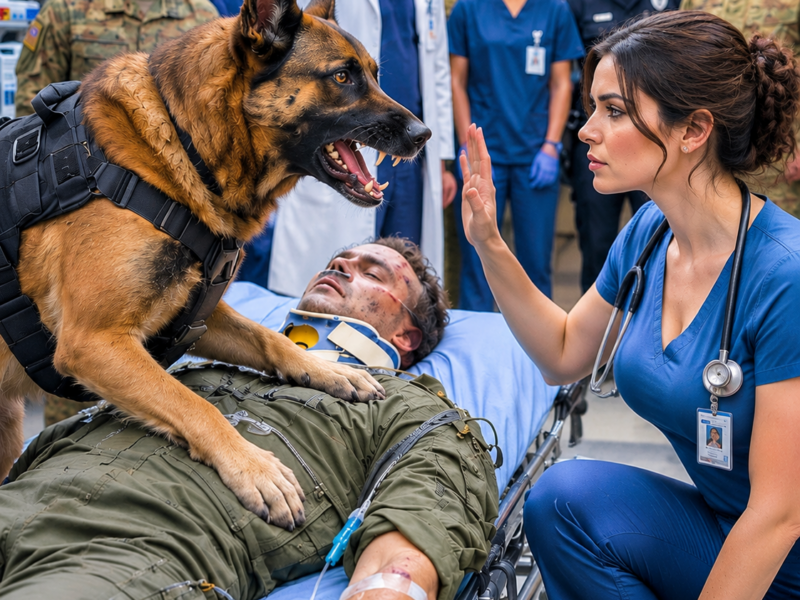
“The military K9 had snapped at three doctors, refused every attempt to examine him, and nearly dragged his handler across the emergency room floor
“What do you mean, Marcus told you to find me?” I asked.
Sergeant Daniel Brooks looked down at Ranger, then back at me.
“He didn’t just tell us to find you, ma’am. He made us promise that if anything ever happened to him, we would make sure Ranger got back to you.”
I gripped the photograph.
“That’s not possible. Marcus died five years ago.”
Daniel hesitated.
“That’s what we were told, too.”
Those seven words changed the room.
I looked toward Dr. Peterson, who was still standing beside the examination table.
“Doctor, can you give us a few minutes?”
He glanced at Ranger.
“I’d rather get that dog examined before we start discussing military history.”
“He’s allowing me near him. Let me help you.”
Dr. Peterson studied the animal.
Ranger had stopped trembling, but his breathing was still uneven. A dark patch of blood had begun spreading beneath his side.
The doctor’s expression became serious.
“All right. But we need to work carefully.”
I turned toward Daniel.
“Can you stay beside him?”
“Of course.”
I placed my hand gently against Ranger’s neck.
“Stay with your shadow, buddy.”
His ears lifted.
Then, for the first time since arriving, he allowed Dr. Peterson to approach.
We discovered a deep laceration along his right flank, several smaller cuts, and a possible injury to his rear leg.
There was also evidence of smoke inhalation.
The doctor ordered imaging and blood work while I helped prepare the examination area.
Ranger flinched when the medical assistant touched his injured side.
But whenever I spoke, he settled.
Daniel watched us in disbelief.
“How did you know that command?”
I kept my attention on Ranger.
“Because Marcus used it.”
Daniel leaned against the counter.
“You knew him?”
“I was his trauma nurse.”
I paused.
“And I was there the night they told us he didn’t make it.”
Daniel’s expression changed.
“What exactly happened?”
I looked at the dog.
“Five years ago, there was an evacuation after an explosion at a forward operating location. Several injured soldiers were brought to our medical facility. Marcus was among the missing.”
I remembered the night with painful clarity.
The alarms.
The dust.
The smell of burning fuel.
The way the medical team kept asking whether another evacuation vehicle was coming.
Marcus had been assigned to a K9 unit.
His dog had disappeared during the incident.
We received conflicting reports about both of them.
Eventually, a military liaison told us Marcus had been killed and the dog was presumed lost.
I had believed him.
For months afterward, I kept expecting to see Marcus walk through the medical tent with that familiar crooked smile.
He never did.
Daniel rubbed his forehead.
“That’s not the full story we received.”
I turned toward him.
“What story did you receive?”
He lowered his voice.
“Marcus was listed as missing during an operation. His body was never recovered. Ranger was found several days later, injured and severely dehydrated. Another unit took him in.”
I stared at him.
“Then why did everyone say Marcus was dead?”
Daniel shrugged helplessly.
“I don’t know. The paperwork said presumed deceased.”
Presumed.
That word had never reached me.
I had been told something much more definite.
Before I could ask another question, Ranger suddenly lifted his head.
His ears pointed toward the hallway.
A second later, he tried to stand.
“Easy!” Daniel said, grabbing the leash.
Ranger whined and pulled toward the entrance.
I put my hand against his chest.
“Ranger, stay.”
He stopped, but his eyes remained fixed on the door.
Daniel frowned.
“He’s been doing that all night.”
“Where did you find him?”
“Near an abandoned service road outside the training area. There had been an explosion during a vehicle exercise.”
“Was Marcus involved?”
Daniel nodded.
“He was part of the team supervising the exercise. Ranger was assigned to him temporarily for a special training assessment.”
I looked at the photograph again.
“Why was he carrying this?”
Daniel pointed to the dog’s harness.
“That was his original harness. We recovered it from storage before today’s exercise.”
I turned it over.
The scratched initials were still visible.
M.R.
“Did Marcus have anything else?”
Daniel looked uncomfortable.
“There’s something I haven’t told you.”
I waited.
“Before the explosion, Ranger became agitated. He refused to leave a particular vehicle. We thought he was reacting to the smoke.”
“And?”
Daniel looked directly at me.
“He kept pawing at the rear compartment. There was something inside.”
“What?”
“We didn’t know. The vehicle was evacuated before anyone could investigate. When the fire was brought under control, the compartment was empty.”
I felt a chill move through my shoulders.
“Empty?”
“Yes. But Ranger had blood on his paws.”
I glanced at the dog’s injured side.
“Whose blood?”
“We don’t know.”
For several seconds, I couldn’t speak.
Then Dr. Peterson returned with the initial imaging results.
“The good news is that his internal organs appear intact. We need to clean and close the wound, and he’ll need monitoring for the smoke exposure.”
I nodded.
“Thank you.”
The doctor looked at Ranger.
“I have to admit, I didn’t expect him to cooperate.”
Daniel gave a tired smile.
“Neither did I.”
We proceeded with treatment under appropriate veterinary supervision. The hospital contacted an emergency veterinarian who could provide the specialized care Ranger needed.
By three in the morning, he was resting on a padded surface in a quiet treatment room.
His breathing had improved.
I sat beside him, holding the end of his leash.
Daniel stood near the doorway.
“Ma’am?”
I looked up.
“Please don’t call me ma’am. Laura is fine.”
He smiled faintly.
“Laura, there’s something else in that photograph.”
I turned it over.
He pointed to the lower corner.
There was a tiny handwritten number beneath Marcus’s message.
17.
I recognized it immediately.
It was the number of a field medical station where Marcus and I had once worked together.
I closed my eyes.
I remembered a conversation we had there, shortly before the evacuation.
Marcus had been sitting outside the medical tent, cleaning mud from his boots.
He had told me something that sounded strange at the time.
“If anything ever happens to me, don’t believe the first report you hear.”
I had laughed.
“That’s a terrible thing to say to someone who works in trauma.”
He hadn’t laughed back.
“Promise me, Laura.”
I had looked at him.
“Promise you what?”
“Promise you’ll look at the evidence before you believe the story.”
I opened my eyes.
Daniel was watching me.
“What?” he asked.
I showed him the number.
“Marcus once told me not to believe the first report about what happened to him.”
Daniel went very still.
Then he reached into his pocket.
“I think you should see this.”
He pulled out his phone and opened a photograph.
It showed an old military document.
At the top was Marcus’s name.
Below it was a line of text:
PERSONNEL STATUS: UNACCOUNTED FOR.
I stared at the screen.
“Where did you get that?”
“From our unit’s records. I requested the original personnel file after Ranger started reacting strangely.”
“Why didn’t you tell me earlier?”
“Because I wasn’t sure what it meant.”
He zoomed in on the document.
There was a second page attached.
A handwritten note appeared near the bottom.
Potential civilian witness identified. Medical personnel: Laura Bennett.
My name.
My hands went cold.
“Daniel, I never gave a statement about this.”
“I know.”
“Who wrote that?”
He shook his head.
“That’s what we’re trying to find out.”
I looked at Ranger.
He was asleep, but one paw rested against my shoe.
For five years, I had believed I was mourning a dead man.
Now I was beginning to understand that I might have been mourning a story someone had told me.
And I had no idea why.
The following morning, I went home for the first time in nearly twenty hours.
I barely slept.
Every time I closed my eyes, I saw Marcus sitting outside that medical tent, telling me to question the first report.
At eight thirty, my phone rang.
It was Daniel.
“Ranger is stable,” he said.
I sat up.
“That’s good news.”
“There’s another development. Our commanding officer has reviewed the records. He wants to speak with you.”
“About Marcus?”
“Yes. And he says someone from the original investigation may have information.”
I looked at the clock.
“Where?”
“At the base. If you’re willing.”
I hesitated.
I had spent five years avoiding anything connected to that part of my life.
But I couldn’t ignore Marcus’s handwriting.
“I’ll come.”
The military installation was about forty minutes from the hospital.
Daniel met me at the visitor entrance.
He looked better after a few hours of sleep, although the bandage on his forehead was still visible.
He led me into an administrative building where a woman in uniform was waiting.
She introduced herself as Major Rebecca Lawson.
“Laura Bennett?”
“Yes.”
She shook my hand.
“Thank you for coming. I understand this is difficult.”
“Can you tell me what happened to Marcus?”
She looked toward Daniel.
Then she opened a folder.
“Before I answer, I want you to understand that we’re reviewing the original incident, not making assumptions about anyone’s intentions.”
I nodded.
She placed several documents on the table.
“The operation five years ago involved a transportation convoy carrying sensitive equipment. An explosion occurred during the evacuation. Several personnel were separated from their assigned teams.”
I recognized the date.
It was the night Marcus had disappeared.
“Marcus was assigned to the medical evacuation perimeter,” she continued. “He and Ranger were helping locate injured personnel.”
I leaned forward.
“What happened after the explosion?”
“According to the initial report, Marcus was separated from his team. His radio signal disappeared, and the area was considered unsafe for recovery.”
“Was he found?”
“No.”
“Then why was he declared dead?”
Major Lawson turned a page.
“The casualty report was submitted under the category of presumed deceased after the recovery window closed.”
I stared at the paperwork.
“Who submitted it?”
She showed me the signature.
I recognized the name.
Captain Robert Hale.
He had been the senior operations officer that night.
I remembered him visiting the medical facility two days later.
He had stood beside my desk and told me Marcus hadn’t survived.
He had sounded so certain.
I had never questioned him.
“Was there an investigation?” I asked.
“Yes. But several original records were missing.”
“What records?”
“Radio logs, vehicle movement reports, and the final search summary.”
Daniel shifted in his chair.
“That’s why we reopened the review.”
Major Lawson nodded.
“Ranger’s recent behavior brought some of the old details back to our attention. During the training exercise, he reacted to a vehicle that had been modified using equipment from the same storage inventory as the original convoy.”
I looked at her.
“Are you saying the explosion today was connected to the old incident?”
“We don’t know yet.”
She closed the folder.
“But we found something else.”
She handed me a photograph.
It showed a small metal case recovered from a storage facility.
A faded label was attached.
FIELD MEDICAL STATION 17.
I recognized the case.
It had belonged to the medical evacuation team.
My stomach tightened.
“What was inside?”
“A damaged recording device and several documents.”
“Have you listened to the recording?”
“Not completely. The audio is damaged.”
I looked at Daniel.
He nodded toward the device.
“We thought you might recognize the voices.”
I didn’t want to.
But I nodded.
Major Lawson pressed play.
Static filled the room.
Then came the sound of an alarm.
A man’s voice shouted something I couldn’t understand.
Another voice answered.
Then, faintly, I heard Marcus.
“Ranger, stay with your shadow.”
My breath caught.
The recording continued.
“Laura, if you can hear this, don’t trust the report.”
Then there was a loud metallic impact.
A burst of static.
And silence.
I gripped the edge of the table.
It was his voice.
There was no doubt.
“Play it again.”
Major Lawson did.
The same words.
The same voice.
The same warning.
I felt tears gathering in my eyes.
“He was alive.”
Daniel looked at the major.
Major Lawson didn’t answer immediately.
Then she said, “The recording’s timestamp places it nearly six hours after Marcus was officially listed as presumed deceased.”
I stood up.
“Then he survived the explosion.”
“Possibly.”
“Why wasn’t he recovered?”
She looked down at the file.
“That’s what we need to establish.”
I pressed my palms against the table.
“Someone knew he was alive.”
Major Lawson met my eyes.
“We have reason to believe that.”
She turned another page.
There was a communication log.
One message had been marked urgent.
Personnel recovery request: Marcus Reed.
Status: Hold pending command authorization.
The authorization field was blank.
“Who ordered the hold?” I asked.
“We’re investigating.”
I looked at the signature line.
It had been deliberately covered by a black marker.
I felt anger rising, but beneath it was something else.
Hope.
Terrifying, fragile hope.
“Is there any chance he’s still alive?”
Major Lawson took a breath.
“We cannot rule it out.”
For the first time in five years, I allowed myself to imagine Marcus walking into a room.
Not as a memory.
Not as a photograph.
As a living person.
And then I remembered the last sentence on his photograph.
If he finds Laura, let him remember.
I looked at the major.
“Why did he write that?”
She studied me.
“We don’t know. But there’s another document you should see.”
She opened a sealed envelope.
Inside was a handwritten statement.
The paper was stained and folded several times.
I recognized Marcus’s handwriting immediately.
Laura,
If you’re reading this, Ranger has done what I hoped he would.
He remembers the command.
He remembers the person who helped us when nobody else knew what to do.
Don’t let them convince you that what happened was an accident.
The rest of the page was torn away.
I looked up.
“Where did you find this?”
“In the metal case.”
“Who recovered it?”
“An independent evidence team.”
I read the statement again.
There was a small mark in the bottom corner.
A number.
17.
I felt the pieces beginning to connect.
Marcus had been trying to leave evidence at the medical station.
He had expected me to recognize it.
But why?
And what had happened to him after the recording?
The next two days were filled with interviews.
I gave a formal statement about Marcus, the medical station, and the night he disappeared.
I described the evacuation.
The conflicting reports.
The conversation outside the tent.
The major listened carefully and asked me to repeat certain details.
Daniel stayed in contact with me.
Ranger continued recovering at the veterinary facility.
Whenever I visited, he greeted me with a soft whine and pressed his head against my leg.
I began bringing him small pieces of chicken, although his veterinarian insisted that his diet remain controlled.
He seemed to remember me more clearly each day.
On the third evening, I was sitting beside his kennel when Daniel entered.
“Laura, we found something.”
I stood.
“What?”
“The original search map.”
He handed me a photograph.
A red circle marked an area several miles from the evacuation site.
It was near an abandoned maintenance building.
I studied it.
“Why wasn’t this searched?”
Daniel shook his head.
“It was marked as inaccessible.”
“By whom?”
“Captain Hale.”
I looked at him.
“Robert Hale?”
“Yes.”
The same officer who had told me Marcus was dead.
Daniel sat beside me.
“Major Lawson says the map doesn’t match the vehicle movement records.”
“What does that mean?”
“It means the convoy was redirected after the explosion. The route in the official report wasn’t the route they actually took.”
I looked again at the red circle.
“Was Marcus taken there?”
“We don’t know.”
“But someone thought he might have been.”
Daniel nodded.
“And someone made sure the area wasn’t searched.”
I stared at the photograph.
“Why?”
He didn’t answer.
The following morning, Major Lawson called.
“Laura, we need you at the base. We’ve located the maintenance building.”
My hands tightened around the phone.
“Did you find Marcus?”
“We found evidence that someone stayed there after the incident.”
“What kind of evidence?”
“Medical supplies. An old radio. And a personal identification tag.”
I closed my eyes.
“Was it his?”
“Yes.”
I drove to the base immediately.
Major Lawson met me in the same conference room.
This time, a man in civilian clothes sat beside her.
He introduced himself as a federal investigator assigned to review the missing evidence.
I sat down.
“Please tell me what you found.”
Major Lawson opened a folder.
“The maintenance building was used as a temporary shelter after the explosion. Someone had treated an injured person there.”
“Marcus?”
“Most likely.”
She showed me photographs of a blood-stained blanket, medical packaging, and a damaged radio.
Then she placed another item on the table.
A small notebook.
My name was written on the first page.
I reached for it.
The handwriting was unmistakable.
Marcus.
The first entry was dated three days after the explosion.
Laura,
I don’t know if anyone will ever find this.
Ranger is alive.
I’m alive, too, but I can’t move without help.
Someone is looking for us, and I don’t know who I can trust.
I read the sentence twice.
My eyes blurred.
The next pages described his injuries.
He had suffered a fractured leg, a head wound, and severe blood loss.
Someone had apparently moved him away from the evacuation area before the search teams arrived.
But the notebook did not identify who.
The final entry was dated six days later.
If I make it out of here, I need to find Laura.
She’ll know what happened at Station 17.
I looked at Major Lawson.
“What happened at Station 17?”
She exchanged a glance with the investigator.
Then she answered.
“Your original medical team reported several injured personnel from that convoy. One of the medical supply containers was never accounted for.”
I remembered the container.
It had been a secure medical transport case.
It contained specialized equipment and controlled supplies.
But I hadn’t known anything about its contents beyond the medical inventory.
The investigator spoke.
“We believe the explosion may have been used to conceal the unauthorized movement of that equipment.”
I stared at him.
“You’re saying someone stole medical supplies?”
“That’s one possibility. We’re also examining whether personnel records were deliberately altered to cover up the movement.”
I looked back at Marcus’s notebook.
He had been injured.
He had been separated from his team.
And someone had prevented a search.
Suddenly, the story of his disappearance looked less like a tragic accident and more like a deliberate attempt to keep him from being found.
“Who was responsible?” I asked.
The investigator folded his hands.
“We have a person of interest.”
He turned the notebook toward me.
On the final page, beneath Marcus’s handwriting, was a name.
Robert Hale.
I recognized him immediately.
For five years, I had remembered Captain Hale as the man who delivered the news of Marcus’s death.
He had looked me in the eyes and said there was no possibility of survival.
Now I was learning he had signed the report that stopped the search.
I felt sick.
“Where is he?”
“He’s no longer on active duty,” Major Lawson said. “We’re trying to locate him.”
The investigator closed the folder.
“Laura, I need you to understand something. We cannot conclude that he caused the explosion or knowingly abandoned Marcus based only on these documents.”
“I understand.”
“But we have enough evidence to question the accuracy of his original report.”
I looked at the notebook.
“Then find him.”
They did.
Robert Hale was located two days later at his home in North Carolina.
He agreed to an interview.
I wasn’t initially included.
But after investigators reviewed Marcus’s notebook and the recovered recording, they asked me to attend as a witness to the original events.
Hale looked older than I remembered.
His hair had turned almost completely white.
When I entered the room, he glanced at me and then looked away.
“Laura.”
“Captain.”
He gave a bitter smile.
“I’m not a captain anymore.”
I sat across from him.
“Then perhaps we can finally speak honestly.”
He rubbed his forehead.
“I didn’t know Marcus was still alive.”
I stared at him.
“You told me he was dead.”
“I told you what the report said.”
“You told me there was no chance.”
He lowered his eyes.
“I was wrong.”
“Did you know he was injured at the maintenance building?”
He didn’t answer.
The investigator placed a photograph on the table.
“Mr. Hale, this is a record of a recovery request that was never authorized.”
Hale studied it.
Then he leaned back.
“I received information that the area was unsafe.”
“From whom?”
He shook his head.
“I don’t remember.”
The investigator placed another document beside it.
“Your signature is on the order.”
Hale looked at the paper for a long time.
Finally, he spoke.
“The convoy had been redirected before the explosion. There were people moving equipment outside the approved chain of command.”
“What equipment?” I asked.
“Medical supplies. Sensitive inventory. Things that weren’t supposed to leave the installation.”
I felt my jaw tighten.
“Marcus discovered it?”
Hale nodded slowly.
“He noticed discrepancies in the transport manifest. He reported them.”
“And then the explosion happened.”
Hale closed his eyes.
“Yes.”
“Did you order the search to stop?”
“I approved the hold.”
“Why?”
He looked at me.
“Because I was told the area was compromised, and because I believed the people responsible had already left.”
“Did you know Marcus was there?”
He was silent.
The investigator leaned forward.
“Mr. Hale, did you receive a message indicating that Marcus Reed was alive?”
Hale’s hands began to shake.
“Yes.”
I felt the room tilt.
“What?”
“Three days after the explosion. A radio message. It was incomplete, but it included his identification.”
“Why didn’t you send help?”
Hale looked down.
“Because I was told the message was unreliable.”
“By whom?”
He shook his head.
“I don’t want to guess.”
I leaned forward.
“Then tell us what you know.”
He finally met my eyes.
“I made a decision based on what I thought would protect the operation. I thought I could resolve the problem quietly. I thought nobody else would be hurt.”
His voice cracked.
“I was wrong.”
The investigator asked him to identify the person who had given him the instruction.
Hale took a long breath.
Then he gave a name.
The name belonged to a senior logistics officer who had since been charged in an unrelated procurement investigation.
That officer had authorized unauthorized equipment transfers and falsified transport records.
The original explosion had occurred during an attempt to conceal the movement of a damaged vehicle.
Marcus had discovered the discrepancy and attempted to report it.
After the explosion, he was injured and stranded.
A local contractor found him and moved him to the maintenance building.
The contractor later left after receiving threats.
Marcus remained there for several days.
His radio message reached Hale.
But instead of authorizing an immediate recovery, Hale accepted an order to delay the search.
The delay cost Marcus his chance of being found quickly.
He was eventually discovered by a civilian relief team and transferred to a medical facility outside the original operational area.
His identity documents were damaged, and the records were incomplete.
He survived.
But his condition was severe.
I covered my mouth.
“Where is he now?”
Hale looked at me.
“I don’t know.”
For the first time, he seemed genuinely ashamed.
“I heard he was transferred for long-term rehabilitation. I assumed the military had notified his family.”
I stared at him.
“You assumed.”
He had no answer.
The investigation continued.
The logistics officer was later charged with fraud and falsification of official records. The evidence also established that he had directed the unauthorized movement of supplies and pressured personnel to conceal discrepancies.
Hale cooperated with investigators.
His role in delaying the recovery was formally reviewed, and he faced administrative and legal consequences.
But none of that answered the question that mattered most to me.
Where was Marcus?
Two weeks later, I received a call from Major Lawson.
“Laura, I think you should sit down.”
I was at the hospital break room.
My coffee was untouched.
“What happened?”
“We found him.”
I couldn’t breathe.
“Who?”
“Marcus.”
I gripped the phone.
“Is he alive?”
“Yes.”
The room seemed to move around me.
“Where is he?”
“He’s receiving rehabilitation care at a military medical center in Colorado. His condition has been stable for some time.”
I closed my eyes.
For five years, I had carried a memory of a man who I believed would never come home.
Now someone was telling me he was alive.
“Does he know about Ranger?”
“Not yet. We wanted to confirm his identity and medical condition before arranging contact.”
I wiped my face.
“Can I speak to him?”
There was a pause.
“He’s agreed to a video call.”
I sat down.
“Please arrange it.”
The call came the next afternoon.
A nurse from the rehabilitation center appeared on the screen first.
Then the camera shifted.
And there he was.
Marcus.
His hair was shorter.
There were scars along his jaw.
His left leg rested in a brace, and his right hand trembled slightly when he adjusted the camera.
But his eyes were the same.
For several seconds, neither of us spoke.
Then he smiled.
“Hey, Laura.”
I covered my mouth.
“Marcus.”
He nodded.
“I know. It’s been a while.”
I laughed through my tears.
“Five years is a little longer than a while.”
He looked down.
“I thought I’d get back sooner.”
I shook my head.
“I thought you were dead.”
His expression changed.
“I know.”
“Why didn’t you contact me?”
“I tried.”
He explained that after being rescued, he had undergone several surgeries and months of rehabilitation.
His injuries had left him unable to communicate reliably for a long time.
His military status was complicated by the investigation.
Eventually, he had been transferred to another medical center under a different administrative record.
He believed someone would notify his contacts.
But the notification never reached me.
“I kept asking about Ranger,” he said. “They told me he was missing.”
I nodded.
“He’s alive.”
Marcus leaned closer to the screen.
“What?”
“He’s alive, Marcus. He’s here. He was injured, but he’s recovering.”
His eyes filled.
“Can I see him?”
I smiled.
“Of course.”
I arranged a video call with the veterinary facility.
Daniel brought Ranger into the room.
The dog was walking carefully, his bandaged side healing.
When Marcus’s face appeared on the screen, Ranger stopped.
His ears lifted.
His body became completely still.
Then he let out a long, trembling whine.
Marcus began crying.
“Hey, buddy.”
Ranger moved toward the screen and pressed his nose against it.
Marcus laughed softly.
“You’re still looking for me, aren’t you?”
I had to turn away.
Daniel stood beside me, wiping his eyes with the back of his hand.
Marcus placed his palm against the screen.
“Good boy.”
Ranger lowered his head.
Then Marcus looked at me.
“You remembered the command.”
I nodded.
“Of course.”
“I knew you would.”
I swallowed.
“Why did you write my name on that photograph?”
He looked toward the nurse beside him.
Then back at me.
“Because you were the only person I trusted to recognize what happened.”
“Why?”
“Because you were the one who noticed something was wrong at Station 17.”
I frowned.
“What did I notice?”
Marcus smiled faintly.
“You remember the supply container with the broken seal?”
I did.
It had arrived at the medical station with a damaged locking mechanism.
I had reported it because several items inside were missing.
At the time, I thought it was a simple inventory problem.
Marcus had later told me he suspected the container had been used to conceal unauthorized transfers.
He had tried to investigate.
I had helped him identify the missing medical supplies.
But I had never known how serious the situation had become.
“I didn’t realize you were still investigating it,” I said.
“I wasn’t supposed to be. But I couldn’t ignore it.”
He paused.
“After the explosion, I thought the truth would disappear with me.”
I looked at him.
“But you left evidence.”
“I left what I could.”
He smiled.
“And I knew Ranger would remember the command. I knew if he ever found you, you’d understand that he wasn’t just another military dog.”
I looked at Ranger.
He was sitting beside Daniel, calm and attentive.
Marcus continued.
“He was the last living connection I had to the people who helped me survive.”
I wiped my cheek.
“He’s coming to see you.”
Marcus closed his eyes.
“Thank you, Laura.”
Three weeks later, Ranger was cleared for travel.
Daniel accompanied him to Colorado.
I went with them.
The rehabilitation center had arranged a private outdoor area where Marcus could meet the dog safely.
When the doors opened, Marcus was waiting in his wheelchair.
He looked nervous.
Ranger walked slowly beside Daniel.
At first, the dog simply stared.
Then Marcus spoke.
“Stay with your shadow.”
Ranger’s ears lifted.
He pulled gently against the leash.
Daniel released it.
The dog crossed the short distance between them and lowered his head into Marcus’s lap.
Marcus wrapped both arms around him.
Neither of them moved for a long time.
I stood several feet away, crying quietly.
Five years of uncertainty seemed to fall away in that one moment.
Marcus pressed his face against Ranger’s neck.
“Good boy. You found your way home.”
Ranger answered with a soft whine.
When Marcus finally looked up, he saw me.
“Laura, come here.”
I walked toward him.
He reached for my hand.
“I owe you an apology.”
I frowned.
“For what?”
“For making you carry a goodbye that was never supposed to be yours.”
I shook my head.
“You didn’t make me believe anything. I trusted the people who told me what happened.”
He nodded.
“I know. But I wish I could have told you the truth.”
I looked at his scars.
“You’re here now.”
He squeezed my hand.
“That’s enough.”
It wasn’t a perfect reunion.
Marcus still had difficult days.
His injuries would require continued rehabilitation, and Ranger would need careful medical follow-up.
There were legal proceedings still underway.
There were years of missed birthdays, lost conversations, and unanswered questions that no single afternoon could restore.
But there was something we had back.
The truth.
And the chance to begin again.
A few months later, Marcus visited St. Mary’s Regional Medical Center.
He was walking with a cane.
Ranger came beside him, wearing a new harness with his name clearly printed across the side.
The emergency department was busy.
Dr. Peterson was examining a patient.
A young nurse was trying to calm a frightened child.
When I saw Marcus standing near the entrance, I walked toward him.
“You’re getting around pretty well.”
He smiled.
“Still slower than Ranger.”
The dog nudged my hand.
I laughed and scratched behind his ears.
Daniel had returned to his unit, but he called regularly to ask about Ranger’s progress.
The three of us had become an unlikely little family connected by a dog who refused to forget.
Before Marcus left, he handed me a small wooden box.
Inside was the original metal tag from Ranger’s first harness.
The scratched initials were still visible.
M.R.
Beneath it was a new inscription.
For Laura.
The person who listened when the rest of the world stopped asking questions.
I closed the box.
“Marcus, I didn’t do anything extraordinary.”
He looked at Ranger.
“Maybe not to you.”
Then he turned toward me.
“But when everyone else saw a dangerous dog, you saw an injured friend who was waiting for someone he remembered.”
I glanced down at Ranger.
He rested his head against my knee.
I thought about the night he first arrived.
The frightened animal.
The doctors stepping away.
The handler who didn’t know how to reach him.
And six words that had traveled through five years of silence.
Stay with your shadow.
I had once believed that being a trauma nurse meant knowing how to save lives with medicine, skill, and quick decisions.
I still believed those things mattered.
But that night taught me something else.
Sometimes the most important thing you can offer a frightened soul isn’t a procedure or a prescription.
It’s the patience to stay close until they remember they’re not alone.
Marcus left the hospital that afternoon with Ranger walking beside him.
Just before they reached the automatic doors, the dog turned around and looked back at me.
I smiled.
“Go home, Ranger.”
His tail moved once.
Then he followed Marcus into the sunlight.
And for the first time in five years, neither of them had to keep looking for the other.
The end.









