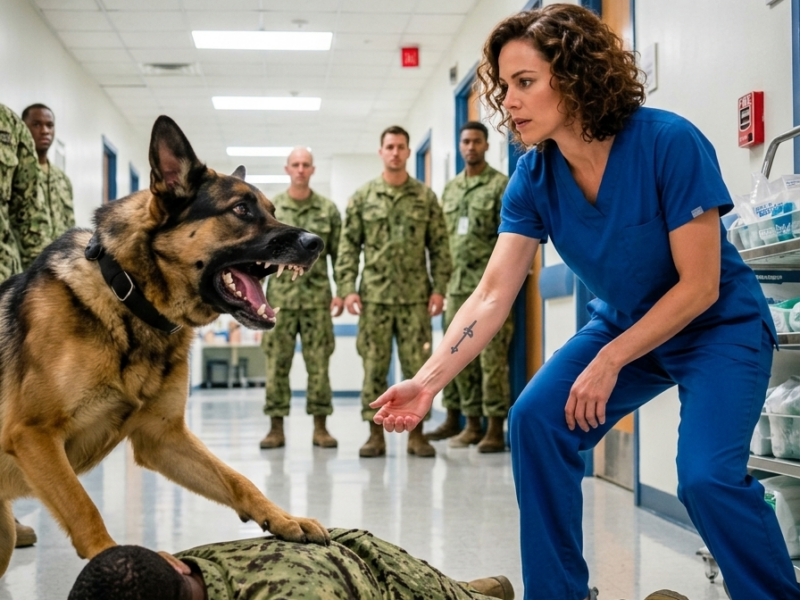
The military K9 blocked every nurse who entered the wounded soldier’s room at Walter Reed, snapping at anyone who came near his bed
The sterile scent of Walter Reed National Military Medical Center was usually a mix of industrial antiseptic, polished linoleum, and the quiet, heavy weight of human endurance. But that rainy Tuesday night, room 412 smelled like wet fur, fear, and ozone.
His name was Ranger. He was a Belgian Malinois military working dog, a towering, iron-muscled canine decorated for valor in combat zones across two continents. Now, he stood wedged squarely between the doorframe and the hospital bed, his dark eyes bloodshot, his tail stiff, and his upper lip curled back over gleaming teeth. A low, vibrating growl hummed continuously in his chest, so deep it vibrated through the floorboards.
For six hours, Ranger had held the room hostage.
Inside the bed lay Sergeant First Class Daniel Hayes. Daniel was an elite Army Ranger attached to a special operations task force, barely thirty years old, currently hooked to three IV drips, a heart monitor, and a mechanical ventilator. He had survived a devastating improvised explosive device blast in a remote valley overseas, but his body was a patchwork of third-degree burns, shrapnel scars, and critical trauma. He was unconscious, his breathing shallow, fighting a silent battle against infection and heart failure.
Every attempt to care for him had failed.
Two trauma surgeons had tried to enter with sedatives; Ranger had lunged, snapping his jaws inches from a doctor’s throat. A team of three MPs had attempted to throw a heavy tactical blanket over the dog to subdue him, but Ranger had fought with a terrifying, wild desperation, driving them back into the hallway. Even Daniel’s company commander, a decorated Captain wearing polished boots and a grim expression, had tried using official military commands. Ranger had simply bared his fangs wider, shielding his fallen handler with his own body.
“I don’t care if that animal has a Purple Heart!” Dr. Aaron Vance, the chief trauma surgeon on shift, shouted in the hallway, his voice crackling with frustration. “Sergeant Hayes’s blood pressure is spiking. His central line is slipping! If we don’t adjust his medication in the next twenty minutes, his heart is going to arrest. Get animal control! Get a tranquilizer rifle! Get that dog out of here!”
“You shoot him with a dart, and the stress might kill the dog—and if Hayes wakes up and finds out we put down his partner, there’ll be hell to pay,” Staff Sergeant Miller, the hospital’s lead MP, argued back, wiping sweat from his forehead.
I stood near the nurse’s station, gripping a sterile dressing kit against my chest. My name was Clara Mercer. I was a night-shift trauma nurse who had spent three years at Walter Reed, quietly doing my duty, avoiding base politics, and keeping my head down. I didn’t cause trouble. I didn’t ask questions about classified operations. I just patched up broken soldiers and went home to an empty apartment.
“Let me try,” I said softly, stepping into the circle of arguing men.
Dr. Vance looked at me like I had lost my mind. “Nurse Mercer, three grown men with tactical gear couldn’t get within four feet of that bed. You’ll get your face ripped off.”
“His vitals are dropping,” I insisted, pointing at the telemetry monitor outside the door. “We don’t have twenty minutes to wait for a vet with a dart gun. Let me walk in.”
Without waiting for permission, I turned and walked toward room 412. The hallway seemed to stretch out into an endless tunnel. My rubber-soled nursing shoes squeaked softly against the tile.
As soon as my shadow crossed the threshold, Ranger exploded into action. He planted his front paws firmly on the floor, his ears pinning flat against his skull, and let out a vicious, reverberating bark that echoed like a gunshot off the concrete walls.
I stopped. I didn’t raise my hands. I didn’t make myself tall. I didn’t look him directly in the eyes—a lesson I had learned from growing up around work dogs in rural Virginia. Instead, I sank slowly down to one knee, keeping my body angled sideways, making myself small and non-threatening.
“Hey, boy,” I whispered, keeping my voice low and steady despite the terrified pounding of my heart. “I’m not going to hurt him. I promise you. I just want to help Daniel.”
Ranger stepped forward, his head low, his dark nose twitching as he sniffed the sterile air. He stopped six inches from me, his jaw wide, his breath hot against my face. He smelled of rain, dried mud, and copper. One snap of his jaw could sever my carotid artery.
He lowered his snout to my hands. I kept my palms open, resting on my knee. My right sleeve slid back slightly, exposing my inner wrist.
There, etched into the pale skin just above my pulse point, was a small, faded black ink tattoo. It was a simple, eight-pointed compass rose, weathered by time and slightly blurred at the edges.
Ranger’s snout froze.
His rhythmic growl instantly died in his throat. His ears twitched forward, rising high. His tail, previously rigid with defensive fury, lowered slightly and gave a single, timid wag.
The dog leaned closer, his wet black nose pressing directly against the faded compass tattoo on my wrist. He inhaled deeply, exhaling a soft, trembling sigh that blew warm air across my skin.
Behind me, in the corridor, someone gasped. “How does he know that?” a nurse whispered in disbelief.
I didn’t answer. I couldn’t.
Because the moment Ranger touched that tattoo, the sterile white walls of Walter Reed dissolved, and I was thrown nine years into the past.
Nine years ago, long before I had ever put on a nurse’s uniform, I was a nineteen-year-old college student driving down a pitch-black country road in Western Pennsylvania during a blinding rainstorm. I remembered the sudden, horrifying crunch of metal, the smell of burning rubber, and the sight of an overturned sedan engulfed in black smoke at the bottom of a steep ravine.
I had scrambled down that muddy embankment, terrified out of my mind. Inside the burning vehicle was a little girl, no older than six, pinned beneath a crushed dashboard. And kneeling in the mud beside her was a young man in a dark hoodie—a stranger who was frantically tearing at the melted seatbelt with his bare, bleeding hands.
We had worked together in the pouring rain, barely saying a word, driven by pure survival instinct. He had used his shoulder to pry open the crushed metal door while I reached inside, pulling the crying child from the flames seconds before the gas tank exploded into a terrifying fireball.
When the local paramedics finally arrived, the stranger was standing in the shadows of the tree line. I remembered turning to him, my hands shaking, my clothes soaked in blood and rain. He had looked at me, his eyes wide with shock, and his glance had fallen on my wrist, where I had gotten the compass tattoo just two weeks prior.
“Keep her warm,” he had rasped out, his voice choked with smoke. Then, before the police could question him, he turned and vanished into the dark woods. We never exchanged names. We never spoke a word again.
Or so I had thought.
Ranger let out a soft, whimpering whine, snapping me back to the present. He stepped aside, nudging my knee with his head, completely opening the pathway to the hospital bed. He looked at me with deep, liquid eyes, as if he had recognized a smell, a memory, or an invisible mark I had carried for nearly a decade.
“Good boy,” I choked out, tears stinging my eyes. I stood up and moved quickly to Daniel’s side, checking his IV lines, stabilizing his blood pressure monitor, and clearing his airway.
Ranger didn’t watch me. Instead, he stepped up to the edge of the mattress, stood on his hind legs, and began frantically scratching at the underside of Daniel’s heavy feather pillow with his right paw.
“Ranger, settle,” I whispered.
The dog whined louder, using his snout to forcibly shove the corner of the pillow aside.
Lying hidden beneath the fabric was a small, worn plastic sleeve containing a glossy, folded photograph.
My breath hitched. I reached out with trembling fingers and pulled the photograph into the light.
It was a picture taken at a sunlit park just two years ago. In the center stood Sergeant Daniel Hayes in his military dress uniform, looking older, scarred, but smiling warmly. And standing beside him, her arm looped happily around his waist, was a young girl about fifteen years old, wearing a bright yellow sundress.
She had a small, distinct crescent-shaped burn scar on her left cheek—the exact same mark the little girl from the burning car had sustained nine years ago.
I turned the photograph over. On the back, written in thick, black permanent marker in neat military block lettering, were three short words:
She survived because.
My hands shook so violently the photo nearly slipped from my fingers. He had remembered. He had tracked down the little girl. He had carried her picture—and the memory of that night—across every war zone he had been deployed to.
Suddenly, the heart monitor beside the bed began to beep erratically.
Daniel’s chest heaved. His fingers twitched against the white hospital sheet, his knuckles turning white as his fist clenched. Slowly, painfully, his heavy eyelids fluttered open. His dark eyes were clouded with pain, fever, and medication, but they moved deliberately across the room until they locked onto my wrist.
Then, he looked up into my face.
“You… remembered,” he rasped, his voice a dry, broken whisper behind his oxygen mask.
“Daniel,” I breathed, dropping to my knees beside his mattress. “I’m here. You’re safe. You’re at Walter Reed.”
Before he could answer, the heavy wooden door to room 412 was shoved open.
A man in a sharp grey three-piece suit walked into the room, flanked by two armed federal agents holding leather briefcases. He had sharp, hawkish features, cold grey eyes, and an ID badge clipped to his lapel that bore the emblem of the Department of Defense Special Investigations Division.
“Nurse Mercer,” the man said, his voice smooth, calculated, and entirely devoid of warmth. “Step away from the patient. I am Special Agent Vance from Military Intelligence. We need to ask you some questions regarding an ongoing national security matter.”
The moment the agent stepped into the room, Ranger’s ears flattened. The dog immediately spun around, dropping into a tactical crouch, positioning his massive body like an iron shield between me, Daniel, and the investigator.
Agent Vance stopped in his tracks, his eyes narrowing as he glared at the snarling Malinois. “Control your animal, Sergeant.”
In the bed, Daniel’s hand shot out, weakly gripping my forearm with surprising strength. His breath came in panicked, shallow hitches.
“Clara…” Daniel whispered, his voice laced with absolute terror. “Don’t… don’t let them take you. Don’t answer them.”
“Why?” I asked, my heart dropping into my stomach. “Daniel, what’s going on?”
Daniel swallowed hard, his eyes fixing on Agent Vance with pure hatred. “Because… because they know what happened that night. They were there.”
The room seemed to freeze. The steady beep-beep-beep of the heart monitor sounded deafeningly loud in the sudden silence.
Agent Vance didn’t deny it. Instead, a cold, dark smile spread slowly across his thin lips. He reached inside his leather folder and pulled out a heavy, glossy 8×10 photograph, holding it up so I could see it.
It was a night-vision thermal photograph, grainy and green-hued, taken from the tree line above that Pittsburgh country road nine years ago. It showed the burning car. It showed the little girl on the grass. It showed a nineteen-year-old me kneeling in the mud.
But behind the burning wreck, partially concealed by the dark woods, stood a third figure—a man in a long coat, holding a heavy electronic device, watching the car burn without making a single move to help.
And printed in sharp, red block lettering directly beneath the image was my full legal name, my social security number, and a classification stamp:
SUBJECT OF INTEREST: CLARA MERCER. UNACKNOWLEDGED WITNESS.
Ranger stared at the agent. Then, the dog raised his head and let out a blood-curdling growl that shook the glass windows of the room.
The cold hum of the ventilator seemed to grow louder as Agent Vance stepped deeper into room 412. The two federal guards behind him remained by the door, their hands resting ominously near the sidearms holstered beneath their jackets.
“Nine years is a very long time to hold onto a secret, Nurse Mercer,” Agent Vance said, his voice calm, almost conversational, as he adjusted his silver tie clip. “You thought you were just a good Samaritan stopping on a rainy highway. You thought you were saving a child.”
“We did save a child,” I said, my voice shaking with rage as I kept one hand on Daniel’s trembling arm and the other resting on Ranger’s neck. “Who are you? What was that crash?”
“That crash was not an accident,” Vance replied smoothly, pulling a thin tablet from his briefcase. “The driver of that vehicle was Dr. Arthur Vance—my distant cousin, as it happens—a senior defense engineer carrying encrypted guidance schematics for an experimental drone defense grid. Certain interested parties wanted those schematics. They arranged for his brake lines to be severed.”
My stomach turned to ice. “There was a little girl in that car!”
“An unfortunate collateral variable,” Vance said without a shred of remorse. “My team was tasked with recovering the hard drive from the wreckage after the crash. We were supposed to retrieve the package from a dead man before the local authorities arrived. But then… you showed up. And Sergeant Hayes showed up.”
Daniel let out a harsh, coughing breath, his knuckles turning white where he gripped my sleeve. “He… he watched us,” Daniel choked out, his dark eyes locked on Vance. “I saw him in the trees… holding a camera… taking photos instead of pulling the door open…”
“I had a job to do, Sergeant,” Vance said coldly. “And my orders were clear: no survivors, no witnesses, and no trace of the military hardware. But you pulled the girl out. You dragged her into the public light. You brought paramedics, fire trucks, and local news crews to a site that was supposed to be a silent recovery operation. You ruined six months of classified intelligence work in six minutes.”
“So you hunted us?” I whispered, realization dawning on me like a wave of nausea. “You’ve been tracking us for nine years?”
“Not hunted,” Vance corrected with a dismissive wave of his hand. “Monitored. We couldn’t eliminate a decorated Army Ranger without drawing massive internal scrutiny from Joint Special Operations Command. And we couldn’t touch you without alerting Hayes that we were sweeping up loose ends. So, we waited. We waited until Sergeant Hayes was deployed into a high-threat environment where casualties are… expected.”
I looked at Daniel. The shrapnel wounds, the blast burns, the missing medical records from his field evacuation—it all suddenly clicked together into a nightmare.
“The IED,” I gasped, looking at Vance in horror. “It wasn’t an enemy trap. You tried to kill him overseas!”
“Sergeant Hayes’s unit encountered a tactical complication in the valley,” Vance said, his face an unreadable mask of bureaucratic coldness. “Regrettably, he survived. And when he was medically evacuated back to Walter Reed, my office was notified immediately. We knew he carried physical evidence regarding the Pittsburgh event. Evidence he hid.”
Vance stepped toward the bed, reaching out a gloved hand toward the feather pillow where the photograph of the young girl had been hidden.
“Hand over the file, Nurse Mercer,” Vance commanded, his tone dropping an octave, becoming dark and absolute. “Along with the cipher key Sergeant Hayes was carrying in his tactical vest when he was pulled from the blast zone.”
Ranger didn’t wait for my command.
With a deafening, terrifying roar, the Malinois launched himself off the floor, his jaws snapping shut millimeters from Vance’s extended wrist. Vance stumbled backward, tripping over a rolling IV pole and crashing heavily against the wall as his guards instantly drew their weapons.
“Hold your fire!” I screamed, throwing my body over Daniel’s chest to shield him from potential gunshots. “This is an active ICU ward! There are oxygen tanks in this wall! You shoot in here, you’ll blow the entire floor to hell!”
The two guards hesitated, their hands trembling on their side arms as they glanced nervously at the bright green high-pressure oxygen lines mounted to the wall panels.
“Stand down!” a booming voice suddenly shouted from the doorway.
Captain Marcus Brody, Daniel’s company commander, strode into the room, flanked by four heavily armed Military Police officers carrying riot shields. Brody was a mountain of a man with a shaved head, a scarred jawline, and eyes like flint.
“What the hell is going on in my soldier’s room?” Brody demanded, his eyes darting from Vance on the floor to the drawn weapons of the federal agents.
“Captain Brody,” Vance said, quickly straightening his suit jacket and smoothing his hair, though his face was flushed with anger. “This is a classified Department of Defense investigation. You and your men do not have clearance for this operation. Stand aside.”
“Clearance?” Brody scoffed, stepping into Vance’s personal space until the two men were nose-to-nose. “Agent Vance, this is a military hospital under the jurisdiction of the United States Army. Sergeant Hayes is one of my operators. Nurse Mercer is a civilian medical employee. You are bringing drawn weapons into an ICU without a warrant signed by the Provost Marshal.”
“I have executive authorization—” Vance began, reaching into his coat.
“I don’t care if you have a letter signed by the Joint Chiefs,” Brody barked. “You don’t draw iron on my men, and you don’t threaten my hospital staff. MPs! Disarm these men and escort them off this floor immediately!”
The four MPs stepped forward, their heavy tactical shields forming a wall between Vance’s agents and the bed. The federal guards, knowing they were hopelessly outnumbered and outgunned in a room full of military police, slowly lowered their weapons.
Vance glared at Brody, then turned his icy gaze back to me and Daniel.
“This isn’t over, Captain,” Vance whispered, his voice dripping with venom. “Sergeant Hayes possesses classified materials vital to national defense. He will be transferred to a secure intelligence facility at Fort Meade by 0800 hours tomorrow morning. Try to stop that transfer, and you’ll all be facing court-martials for treason.”
Vance turned on his heel and strode out of the room, his two guards falling in behind him.
The heavy silence returned to room 412, broken only by the hiss of the ventilator and Ranger’s low, cautious panting.
Captain Brody turned to me, his brow furrowed with deep concern. “Nurse Mercer… what in God’s name was he talking about?”
I looked down at Daniel. His eyes were closing again, the physical toll of the confrontation dragging him back toward unconsciousness. But his hand was still holding mine, his thumb pressing gently against the faded compass tattoo on my wrist.
“He was talking about a murder, Captain,” I said, my voice steadying as the fear in my blood turned into pure, uncompromising resolve. “And if we let them move Daniel tomorrow morning, he’s never going to wake up.”
By 0200 hours, the storm outside Walter Reed had turned into a torrential downpour. Thunder rattled the thick glass panes of the fourth-floor windows, casting flickering shadows across the darkened corridors of the trauma ward.
The floor was unnaturally quiet. Captain Brody had stationed two of his most trusted MPs outside room 412, but we both knew that standard military police wouldn’t be able to stop a federal transfer order signed by a high-ranking intelligence director once the sun came up.
Inside the room, the lights were dimmed to a soft amber glow. I was sitting on a metal folding chair beside Daniel’s bed, holding a small handheld ultrasound scanner against his abdomen, monitoring his internal bleeding.
Ranger sat on the floor beside me, his head resting heavily on my knee. Every few minutes, he would let out a soft sigh, his dark eyes watching the doorway with unyielding vigilance.
“He’s stabilizing,” I whispered to Captain Brody, who was standing near the window, peering through the blinds at the parking lot below. “His heart rate is down to seventy-eight. His oxygen saturation is back up to ninety-six percent. But he can’t travel. If they put him in an ambulance to Fort Meade, the movement alone will rupture his spleen.”
“They aren’t taking him to a hospital at Fort Meade, Clara,” Brody said grimly, turning toward me. “I checked Vance’s credentials through my contacts at JSOC. Vance doesn’t work for standard Military Intelligence. He runs a black-budget contractor group called the Apex Directorate. They handle ‘sensitive liquidations’—sweeping up military accidents before they become public scandals.”
“What did Daniel have that they want so badly?” I asked, reaching into my pocket and pulling out the worn photograph of the little girl. “Is it just this?”
“No,” a quiet, rasping voice spoke from the bed.
I spun around. Daniel was awake again. The high-potency painkillers were wearing off, leaving his eyes clear, sharp, and filled with a fierce, quiet intensity.
“Daniel!” I breathed, leaning over him. “Don’t try to move—”
“In my… tactical vest,” Daniel rasped out, his chest heaving as he fought through the pain. “When the IED went off… in the valley… my squad leader died. Before he took his last breath, he handed me a micro-SD card. He said… he said it was the original Pittsburgh crash file.”
Brody stepped forward, his eyes wide. “Your squad leader was on that recovery team nine years ago?”
“He was the driver… for Vance’s team,” Daniel nodded weakly, a tear cutting a clear path through the soot and dust on his scarred cheek. “He kept a copy of the telemetry data… the severed brake lines… the audio recordings of Vance giving the order to let the car burn. He carried the guilt for nine years. When he knew he was dying in that valley, he gave it to me.”
“Where is the card, Daniel?” Brody asked urgency in his voice.
“It’s not in his vest,” I interrupted, realization hitting me like a lightning bolt. “When they brought Daniel into the ER six hours ago, I took his personal effects to the secure inventory locker down in the basement. His tactical gear, his uniform, his belt.”
“Vance knows that,” Brody cursed under his breath. “That’s why he’s waiting until morning. He’s probably having his agents pick the lock on the inventory room right now!”
“No,” I said, a faint smile touching my lips. “The inventory room requires a dual-key authentication code. A nurse’s key and a security guard’s key. They can’t open my locker without breaking the digital alarm grid.”
“We need that card,” Brody said firmly. “If we have the original data showing Vance ordered the murder of a defense engineer and attempted to murder a child, we can take it directly to the Inspector General and the Federal Bureau of Investigation. It’s the only leverage that will strip Vance of his immunity.”
“I’ll get it,” I said, standing up.
Ranger instantly stood up with me, his ears twitching, his body tense and ready for action.
“You can’t go down there alone, Clara,” Brody warned, reaching for his sidearm. “Vance’s men are likely watching the elevators.”
“If you go down there with three MPs in full tactical gear, you’ll alert every federal agent in the building,” I pointed out, pulling a clean set of dark blue scrubs from the supply cabinet. “I’m a staff nurse. I move through the basement corridors every night. Nobody looks twice at a nurse holding a clip board.”
“She’s right,” Daniel whispered from the bed, his dark eyes fixing on mine with deep concern. “But take Ranger. He knows the scent of Vance’s men. He’ll give you a warning before they even see you.”
Brody hesitated, then nodded slowly. He unclipped a small, secure tactical radio from his vest and handed it to me. “Channel four. If you hit any trouble, tap the push-to-talk button twice. My men will hit the basement stairs in thirty seconds.”
“Understood,” I said.
I looked down at Ranger. “Come on, boy. Let’s go finish what we started nine years ago.”
The Malinois fell into step beside me, moving like a shadow through the quiet, dim hallway as we slipped toward the service elevators at the far end of the ward.
The service elevator descended with a low, mechanical groan, dropping us four floors into the sub-basement of Walter Reed.
When the doors slid open, the warm, sterile environment of the patient floors gave way to a cold, damp subterranean world of exposed concrete walls, buzzing fluorescent lights, and thick overhead steam pipes. This was where the hospital stored its linen supplies, old medical records, and secure personal effects belonging to trauma patients.
Ranger stepped out of the elevator first, his snout low to the cold floor, his nostrils flaring as he sniffed the damp air.
“Which way, boy?” I whispered, keeping my hand lightly resting on his tactical harness.
The dog turned left, leading me down a narrow corridor lined with locked stainless steel doors. The hum of the building’s main HVAC system created a heavy, rhythmic drone that drowned out the sound of our footsteps.
We reached room B-12: SECURE PATIENT PROPERTY VAULT.
I pulled my electronic keycard from my scrub pocket and swiped it through the wall scanner. A small LED light shifted from red to green with a soft click. I entered my five-digit employee PIN number, and the heavy steel door unlocked with a pneumatic hiss.
Inside, the vault was lined with hundreds of stacked metal lockers, each bearing a digital barcode.
I moved quickly down aisle three, searching for locker 412-H—Daniel’s assigned storage unit.
I found it near the bottom row. I swiped my card a second time and pulled the heavy latch. The metal door swung open.
Inside lay Daniel’s blood-stained camouflage uniform, his heavy combat boots, and his black tactical vest, wrapped in a clear plastic biohazard bag.
I unzipped the plastic bag. The smell of copper, smoke, and desert dust drifted into the air. My hands searched through the small pockets of the tactical vest, feeling past spare penlights, emergency tourniquets, and notepad sleeves.
Near the inner lining of the left chest plate, my thumb brushed against a hard, tiny rectangular object sewn into the seam of the fabric.
“Found it,” I whispered.
Using a small pair of trauma shears from my scrub pocket, I snipped the heavy tactical thread and pulled out a tiny, silver micro-SD card, encased in a waterproof clear plastic capsule.
Suddenly, Ranger let out a sharp, breathless huff.
He didn’t bark. He spun around, his fur bristling from his neck to his tail, his dark eyes locked on the open doorway of the property vault.
A shadow crossed the threshold.
“You really are a remarkably efficient nurse, Miss Mercer,” a smooth, chilling voice echoed off the steel lockers.
Agent Vance stepped into the room. He was no longer wearing his pristine suit jacket. He wore a dark tactical sweater, and in his right hand, fitted with a long black suppressor, was a sleek 9mm pistol.
Behind him stood his two federal guards, blocking the only exit from the vault.
“I took the liberty of overriding the basement security feeds ten minutes ago,” Vance said, stepping slowly into the room, raising the silenced firearm until it was pointed directly at my forehead. “Captain Brody thinks you’re just taking a quick trip to the inventory room. Nobody is coming to help you.”
My heart hammered against my ribs like a trapped bird, but I stood my ground, clutching the micro-SD card tightly in my fist. “You won’t get away with this, Vance. The evidence on this card—”
“—Will die here with you,” Vance interrupted smoothly. “A sad, unfortunate tragic accident. A civilian nurse caught in a steam pipe explosion in the hospital sub-basement. Sergeant Hayes will succumb to his injuries shortly after hearing the tragic news. And Ranger… well, a dangerous, aggressive animal who had to be put down for public safety.”
Ranger let out a roar of absolute, murderous fury. He didn’t wait for a command. He didn’t hesitate.
The Malinois leaped into the air, launching himself over a stack of metal supply crates directly toward Vance’s throat.
Pfft! Pfft!
Vance fired two silenced shots. One round whistled past Ranger’s ear, shattering a fluorescent light tube overhead, raining glass down into the aisle. The second round grazed the dog’s shoulder, spraying red blood across the white lockers.
Ranger slammed into Vance with full force, the sheer weight of the eighty-pound Malinois knocking the agent backward into the concrete wall. Vance screamed as Ranger’s jaws locked onto his arm, the heavy firearm clattering to the floor.
“Shoot it! Kill the dog!” Vance shrieked at his two guards.
The two guards raised their weapons, aiming at Ranger as he wrestled Vance on the floor.
“No!” I screamed.
I grabbed a heavy steel oxygen cylinder from a rolling rack beside me and swung it with every ounce of strength in my body. The heavy metal tank struck the first guard across the side of his helmet with a sickening CRACK, sending him crashing unconscious into a row of metal lockers.
The second guard swung his gun toward me.
Before he could pull the trigger, I brought my fingers to the secure radio clipped to my collar and tapped the push-to-talk button twice.
Click-click.
A split second later, the heavy reinforced steel door of the property vault was kicked off its frame with a deafening boom.
“US ARMY MP! DOWN ON THE GROUND! NOW!” Captain Brody roared, bursting into the room with four tactical officers behind him.
The remaining guard dropped his weapon instantly, throwing his hands above his head as two MPs slammed him face-first onto the concrete floor.
“Ranger, OUT!” I shouted, sprinting forward to the struggling men on the floor.
At my voice, the Belgian Malinois released Vance’s crushed arm, stepping back with a bloody snout, panting heavily but standing tall and victorious beside my boots.
Vance lay on the concrete, clutching his bleeding arm, his face pale and contorted with agony as Captain Brody stepped over him, pressing the cold barrel of a sidearm against Vance’s forehead.
“Special Agent Vance,” Brody said, his voice dropping into a terrifying, icy rasp. “You are under arrest for treason, attempted murder of military personnel, and conspiracy to commit assassination.”
I knelt beside Ranger, my hands trembling as I checked his shoulder. The bullet had only grazed his heavy muscle, a clean superficial wound. I tore a strip from my scrubs and bound it tightly around his leg, pulling his massive, noble head against my chest.
“You saved us again, boy,” I sobbed into his fur, feeling his hot, rhythmic breath against my neck.
Ranger let out a long, happy whine, gently pressing his nose against the faded compass tattoo on my wrist.
Six months later.
The morning sun broke over the rolling green hills of Arlington, Virginia, casting long, golden light across the quiet stone pathways of the national cemetery. The air was crisp, clean, and smelled of blooming cherry blossoms and fresh earth.
I stood near the crest of the hill, wearing a dark blue coat, holding a small bouquet of white lilies.
Beside me stood Sergeant First Class Daniel Hayes. He was no longer hooked to hospital monitors or wearing sterile dressings. He stood tall, dressed in his crisp Army Service Uniform, leaning lightly on a polished wooden cane. The burn scars on his neck and face were still visible, but his dark eyes were bright, clear, and filled with an enduring, peaceful strength.
And sitting proudly between us, his coat shining in the sunlight, was Ranger. He wore a brand-new leather service harness adorned with a shiny gold medal—the Department of Defense Distinguished Civilian and Military Valor Ribbon.
Behind us, the story had finally drawn to its absolute, uncompromising close.
The micro-SD card recovered from the Walter Reed basement had blown the Apex Directorate wide open. A joint federal grand jury had indicted Vance and eleven high-ranking military contractors. Vance was currently serving three consecutive life sentences in a federal maximum-security prison without the possibility of parole.
The little girl from the burning car—now a brilliant seventeen-year-old high school senior named Sarah—had been officially reunited with us three months ago. She was currently thriving, her education fully funded by a national heroism foundation established in her father’s memory.
“You ready?” Daniel asked softly, turning his head to look at me, his voice smooth and clear.
I looked at him, feeling a warmth in my chest that nine years of darkness and isolation had never been able to extinguish. “I’m ready.”
We walked together down the marble pathway until we reached a quiet, sunlit bench overlooking the Potomac River. Below us, the skyline of Washington D.C. gleamed beneath the brilliant blue sky.
Daniel sat down slowly, resting his cane against the wooden bench. Ranger immediately trotted over, laying his heavy head across Daniel’s knees, his tail thumping rhythmically against the grass.
Daniel reached into his pocket and pulled out a small, velvet-lined box. He opened it, revealing two matching silver bracelets, each exquisitely engraved with a delicate, sharp eight-pointed compass rose.
He picked up one of the bracelets and gently wrapped it around my right wrist, right above the old, faded ink tattoo I had gotten as a frightened nineteen-year-old girl.
“Nine years ago,” Daniel said softly, his dark eyes locking onto mine with an intensity that made my breath catch in my throat, “I thought that compass was just a tattoo on a stranger who helped me pull a child from a fire.”
He reached down, taking my hand in his, his fingers warm and strong.
“I was wrong,” Daniel continued, a soft, genuine smile spreading across his face. “It was the mark that brought me home. It was the reason Ranger knew you. It was the reason I fought to wake up in that hospital room.”
I looked down at the silver compass shining against my skin, then up at the man who had carried my memory across continents, through fire and war, without ever giving up hope.
“We aren’t running anymore, are we?” I asked softly, tears of happiness welling in my eyes.
“No more running,” Daniel promised, pulling me close until my head rested against his shoulder. “No more hiding. No more secrets.”
Ranger let out a soft, contented huff, closing his eyes as the warm morning sun washed over us.
The storm was over. The shadows were gone. And for the first time in nine years, as we sat together high above the river, the path ahead was completely, beautifully clear.
The end









