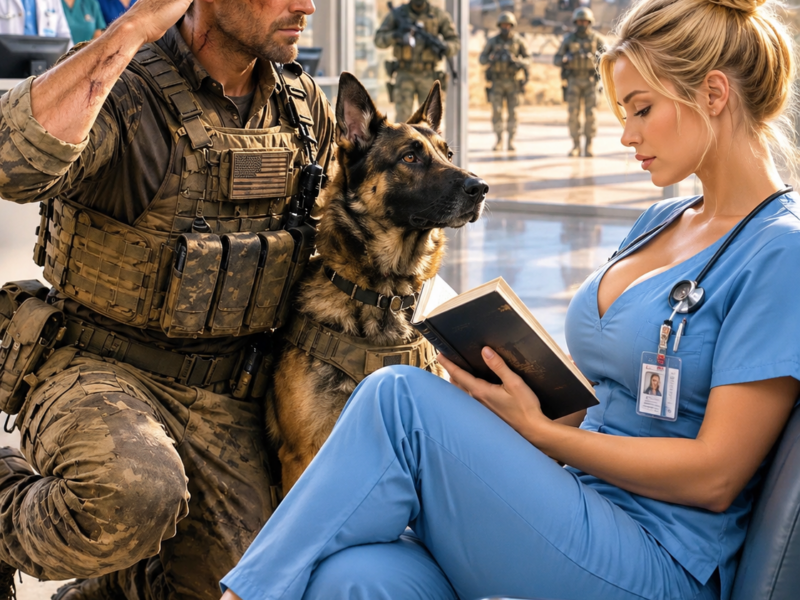
The military helicopter shattered two glass doors when it landed on the ambulance bay, and four armed operators stormed into Harlo Valley Medical Center
The captain stared at me.
“You’re making an allegation against a senior officer, Ms. Voss. I suggest you choose your words carefully.”
“I have been choosing my words carefully for three years.”
I held out my hand.
“May I see the warrant?”
He hesitated, then passed it to me.
I read the document from top to bottom.
The charges were broad enough to sound convincing and vague enough to conceal what they were really trying to accomplish.
Obstruction of a military investigation.
Interference with an active inquiry.
Unauthorized possession of classified records.
There was no specific description of the alleged records.
No dates.
No identified incident.
Just enough official language to make a civilian hospital employee look like a security risk.
“Colonel Ambrose Fitch,” I said again.
“Yes.”
“Was this warrant reviewed by independent counsel?”
“That’s not something you need to know.”
“Was the underlying complaint filed by Brigadier General Harmon Steck?”
The captain’s expression changed.
“You’re not in a position to question the investigation.”
“Then you shouldn’t have brought the investigation into a hospital without expecting questions.”
Behind him, Dr. Garrett stepped closer.
“What’s happening here?”
The captain turned.
“Military business. Please step aside.”
Garrett looked at me.
“Voss, what have you gotten yourself into?”
I didn’t answer.
Belinda stood frozen beside the charge desk.
She looked at the warrant, then at the four people surrounding me.
“Is she being arrested?”
The captain replied, “She’s being detained under military authority.”
“She’s a registered nurse at this hospital,” Belinda said.
“That doesn’t change the warrant.”
Before I could respond, Dr. Aldine appeared from the trauma bay.
She was still wearing her surgical gown.
“Nobody is taking my patient anywhere,” she said.
The captain turned toward her.
“Doctor, this doesn’t concern you.”
“It concerns me if your people intend to remove a critically injured patient from my care.”
“We have no intention of removing your patient.”
“Then perhaps you should explain why two of your officers have been asking my staff for his medical records.”
The captain glanced toward his team.
It was the first time I saw uncertainty cross his face.
Aldine stepped closer.
“Commander Ror is not medically stable for transport. I have documented that determination in his chart. Any attempt to move him without a clinical transfer plan will place his life at risk.”
“Doctor, we have authorization.”
“Authorization doesn’t make a patient stable.”
The captain looked toward the hospital security officer.
“Can you clear the area?”
The security officer didn’t move.
He glanced at Aldine.
Then at me.
“I need confirmation from hospital administration before I do anything.”
It was a small victory.
But it bought us time.
And time was the one thing Steck couldn’t afford to lose.
Decker appeared beside the captain.
“Captain, I’m going to ask you to step into a private room.”
The captain looked him over.
“Who are you?”
“Someone with an active counter-investigation.”
“Credentials?”
Decker produced identification.
The captain examined it.
His expression became noticeably less certain.
“Inspector General’s Office?”
“Counter-investigation unit.”
“You’re not listed on the warrant.”
“That’s because the warrant was issued without notifying the unit already investigating the allegations against General Steck.”
The captain looked at him.
“That’s not possible.”
“Then you should have no difficulty confirming it with your command.”
Decker handed him a number.
“Call it.”
The captain stepped away.
I watched him speak quietly into his phone.
The other agents remained in place, but their confidence had changed.
Sato came to my side.
“Your message worked,” she whispered.
“Who answered?”
“Someone who has been waiting for you to make that call.”
I glanced at her.
“Who?”
She didn’t answer.
Instead, she looked toward the main entrance.
A black SUV had pulled up outside.
A woman stepped out.
She was in her late fifties, wearing a charcoal suit and carrying a leather briefcase.
She entered the hospital without looking at the security desk.
I recognized her immediately.
Not from the hospital.
From a photograph I’d seen six years earlier.
Her name was Colonel Miriam Hale.
She had been the senior medical logistics auditor assigned to our forward support unit during my second deployment.
And she had been the first person to question the supply discrepancies.
The last time I’d seen her, she’d told me to preserve every document I could.
Two weeks later, she’d been reassigned.
I had never learned why.
Now she was walking toward me.
“Sergeant Voss,” she said.
I hadn’t heard anyone call me that in three years.
“Colonel.”
She glanced at the warrant in my hand.
“Have they already tried to take you?”
“Not yet.”
“Good.”
She turned toward Decker.
“Is Commander Ror stable?”
“Stable enough to remain here. Not stable enough for transport.”
Hale nodded.
“Then he stays.”
The captain returned.
“Colonel, I need to understand your involvement.”
“You’re going to understand it very clearly,” Hale replied. “But first, I want to know who authorized your operation.”
He handed her the warrant.
She read it.
Then she looked at him.
“Colonel Fitch signed this?”
“Yes, ma’am.”
“Did he disclose his previous working relationship with General Steck?”
The captain went silent.
Hale closed the folder.
“That’s what I thought.”
She turned to Decker.
“Get your command on the line. We are requesting an immediate suspension of this warrant pending independent review.”
Decker nodded.
For the first time that afternoon, I felt something other than pressure in my chest.
Not relief.
Possibility.
We moved into the hospital’s administrative conference room.
Hale insisted that the door remain open and that the hospital director be present.
She also requested that the captain, Decker, and Sato remain.
Garrett tried to follow us.
Hale stopped him at the doorway.
“Are you part of this investigation?”
“No.”
“Then you can return to your patients.”
He looked at me.
I didn’t smile.
I didn’t need to.
Inside the conference room, Hale placed the warrant on the table.
“Norah, I need you to tell me exactly what you have.”
I described the duplicate field log.
The notebook.
The original handwritten entries.
The records I’d kept during the second deployment and carried with me after my separation.
I explained where I’d stored it.
“East Row Storage,” I said. “Unit 47.”
Hale looked at Decker.
“Can you secure that location?”
“We can arrange it.”
“Not arrange it. Secure it. Preserve the chain of custody. Nobody enters that unit without an independent witness and a documented authorization.”
Decker nodded.
Hale turned back to me.
“Do you have the original storage agreement?”
“Yes.”
“Payment records?”
“Some. The facility accepts electronic payments, but I paid the first six months in cash.”
“Access logs?”
“I don’t know. The facility may have them.”
She wrote that down.
Then she asked the question I’d been expecting.
“Why didn’t you report the notebook after your separation?”
I looked at the table.
“Because I didn’t know who was safe to report it to.”
Hale didn’t interrupt.
“I had just been accused of falsifying records. My access had been removed. My identification was flagged. Every official document said I was the problem.”
I paused.
“I thought if I handed the notebook to the wrong person, it would disappear.”
Hale nodded slowly.
“That was a reasonable concern.”
I looked up.
“Was it?”
“Yes.”
She closed her pen.
“Your original records were not classified merely because they were created during a classified deployment. The information they contain may be protected, but that doesn’t make your possession of a personal medical log automatically criminal. The actual classification and handling requirements will need to be reviewed.”
For the first time, someone had said that plainly.
I had spent years imagining the notebook as a dangerous object I could never safely touch.
Now someone was talking about evidence.
Not contraband.
Evidence.
Hale leaned forward.
“There’s something else you need to know.”
I waited.
“Ror’s investigation wasn’t limited to missing medical supplies.”
“What else?”
“The diversion was part of a larger procurement scheme. Equipment, medication, fuel, and emergency transport resources were being redirected through shell contractors.”
“Who was receiving the money?”
“We have partial financial records. Several companies were linked to individuals who had access to the logistics system.”
She paused.
“One of those companies was owned by a relative of General Steck.”
The room went quiet.
I thought about the years of paperwork.
The strange discrepancies.
The medical supplies that had supposedly been issued but never arrived.
The medications I had been ordered to document as administered when I had never seen them.
It had never been one isolated mistake.
It had been a system.
And someone had built that system around my name.
At 5:31 p.m., the first confirmation arrived.
The counter-investigation unit had contacted the appropriate oversight authority.
The warrant was suspended pending an immediate review of its basis.
The captain received instructions not to detain me or remove Commander Ror from the hospital.
He looked unhappy.
But he followed the order.
Hale took the warrant and placed it inside a clear document sleeve.
“Preserve this,” she told him. “It may become part of the investigation.”
He nodded.
Then he looked at me.
“Ms. Voss, I was following a signed order.”
“I understand.”
“I wasn’t aware of any conflict involving General Steck.”
“I believe you.”
He seemed surprised.
I continued.
“But now you are aware.”
He gave a brief nod and left.
Decker watched him go.
“That was close.”
“How close?”
“Close enough.”
I looked toward the trauma bay.
“Ror?”
“Still stable. Aldine says his pressure is holding.”
“Can he wake up?”
“She thinks so.”
Hale gathered her documents.
“Norah, we’re going to need your cooperation. The notebook could be central to proving that the original records were altered.”
“You’ll have it.”
“Once it’s secured, we’ll arrange for an independent forensic examination. You’ll be asked to identify your handwriting, explain the entries, and help reconstruct the original supply distribution.”
“I can do that.”
She studied me.
“There’s no guarantee this will be quick.”
“I’ve already waited three years.”
Hale gave a small nod.
“Then let’s make sure you don’t have to wait three more.”
At 6:12 p.m., I returned to Trauma Bay 1.
Aldine was reviewing the latest imaging.
She glanced at me.
“Your friends have caused quite a day.”
“They’re not exactly friends.”
“Whatever they are, they’re loud.”
I looked at Ror.
His eyes were still closed.
The ventilator moved steadily.
The monitors showed a heart rate that was no longer fighting for every beat.
“How is he?”
“Better. Still critical, but better.”
“Any chance of waking him?”
“Possibly within the next hour.”
I pulled a chair beside the bed.
Aldine studied me.
“You were his medic?”
“Yes.”
“How long?”
“Several years, across two deployments.”
She nodded.
“He must trust you.”
I looked at Ror.
“He used to.”
Aldine folded her arms.
“People don’t send someone to find a person they don’t trust.”
I didn’t answer.
She returned to her workstation.
I sat beside him and watched the monitor.
For years, I had imagined what I would say if I ever saw Ror again.
I had imagined anger.
Questions.
Accusations.
I had imagined asking why he hadn’t come sooner.
But sitting beside him now, with tubes and monitors keeping him alive, all those rehearsed conversations seemed useless.
I leaned closer.
“You were right about the records,” I whispered.
“I kept them.”
His fingers moved slightly.
I looked at his hand.
Then his eyelids fluttered.
Aldine noticed immediately.
“Commander? Can you hear me?”
His eyes opened halfway.
He looked confused at first.
Then his gaze moved across the room.
It stopped on me.
For several seconds, he didn’t speak.
The ventilator continued its steady rhythm.
I leaned closer.
“You’re at Harlo Valley. You’re safe for now.”
His eyes stayed on mine.
A faint movement crossed his brow.
He tried to move his hand.
I placed mine over it.
“Don’t try to talk. You’re still intubated.”
His eyes narrowed slightly.
Then he lifted one finger.
I knew that gesture.
It was something he’d used during our deployments when he needed to communicate without speaking.
One finger meant one question.
I leaned closer.
“The notebook?”
I nodded.
“Still intact.”
His eyes closed briefly.
A single tear slipped from the corner of his eye.
I hadn’t expected that.
Neither had I expected how much it would hurt to see it.
“You don’t have to worry about it anymore,” I said.
His fingers tightened around mine.
Then Aldine adjusted his medication, and he drifted back into sedation.
I remained beside him.
For the first time in three years, I wasn’t wondering whether anyone believed me.
Someone had.
And now the evidence was finally going to speak for itself.
The storage unit was secured at 8:40 p.m.
Decker called me from the facility.
The lock had been documented.
The access records had been preserved.
An independent investigator was present.
Nobody had entered the unit.
They had located the original storage agreement in the facility’s electronic account.
I listened carefully.
“Is the notebook there?”
“We haven’t opened the sealed container.”
“Good.”
“You’re going to need to identify it.”
“I know.”
He paused.
“Norah, there’s something else.”
“What?”
“The facility has an access record from eleven days ago.”
I went still.
“Someone entered?”
“Yes.”
“Who?”
“The account doesn’t identify the individual. It only shows that the unit was opened using a manual override.”
I closed my eyes.
“Steck.”
“We can’t establish that yet.”
“Did they take anything?”
“We don’t know. The container appears untouched from the outside.”
“Then don’t open it without recording everything.”
“Already arranged.”
I looked toward the hospital window.
The parking lot lights were reflected in the glass.
Steck had known about the storage unit.
Or at least, he had known enough to search for something.
I thought about the prepaid phone.
The message I’d sent.
The notebook.
And the man who had been watching us from the corridor.
“Decker, I need the access record preserved independently.”
“It will be.”
“And I want the facility’s camera footage secured before it gets overwritten.”
“Understood.”
I ended the call.
Sato was standing near the doorway.
She had heard enough to understand.
“Someone got into the unit?”
“Eleven days ago.”
She looked toward Decker’s empty chair.
“Then we may have a bigger problem than we thought.”
“Yes.”
I glanced at the folded paper Ror had written.
The original records are intact.
She knows where.
I had always assumed he meant the notebook.
But perhaps he had known something else.
Something I hadn’t yet considered.
At 9:15 p.m., Dr. Garrett approached me outside the break room.
He looked uncomfortable.
His phone was in his hand, but he wasn’t looking at it.
“Voss.”
I turned.
“Dr. Garrett.”
“I heard the warrant was suspended.”
“That’s correct.”
He shifted his weight.
“Are you in some kind of military investigation?”
“Yes.”
He nodded.
For a moment, neither of us spoke.
Then he said, “I owe you an apology.”
I waited.
“Earlier today. The trauma bay. I should have listened when you identified the tension pneumothorax.”
“Yes.”
His expression tightened slightly.
“I was managing a difficult case.”
“So was I.”
He looked at me.
“I know.”
He rubbed the back of his neck.
“I’ve been reviewing the incident report.”
“Good.”
“I wrote that I identified the problem and initiated the intervention.”
I didn’t answer.
He looked down.
“That wasn’t accurate.”
“No, it wasn’t.”
He took a breath.
“I’m going to correct the report.”
I studied him.
“That matters.”
“I also heard about Mrs. Ferris.”
I raised an eyebrow.
“Her case is being reviewed.”
“Then the review should include the fact that I dismissed a documented warning.”
He nodded.
“I’ll make sure it does.”
I could see that he wanted me to make it easier for him.
To tell him it was all right.
To say that the pressure of the job explained everything.
But it didn’t.
“Dr. Garrett, being wrong isn’t the worst thing that can happen in an emergency department.”
He looked at me.
“What’s worse?”
“Being too proud to recognize it before someone gets hurt.”
He lowered his eyes.
“I understand.”
I wasn’t sure he did.
But for the first time, he was at least trying to listen.
The next morning, Colonel Hale returned with an update.
The independent oversight authority had accepted the counter-investigation’s request to review the original logistics operation.
The warrant against me remained suspended.
The complaint against Ror was also being examined.
More importantly, an independent team had been assigned to preserve the evidence.
Hale met me in the hospital conference room.
“Your notebook was recovered.”
I sat down.
“Was it damaged?”
“No. The container was intact. The notebook is in good condition.”
She placed a photograph on the table.
It showed a narrow, dark-blue notebook with a worn cover.
I recognized it immediately.
I had bought it in a small town near our forward operating position.
I had carried it in my medical kit.
I had written in it under red lights, during transport, and sometimes in the few minutes between patients.
I had never thought of it as important.
It was just a record of what had happened.
Until someone decided to change the record.
“There’s something else,” Hale said.
She placed another document beside the photograph.
“During the forensic review of the storage facility’s access records, investigators identified a vehicle connected to the unauthorized entry.”
I looked at her.
“Whose?”
“An administrative contractor who worked for General Steck.”
I felt my jaw tighten.
“Can you prove he entered the unit?”
“We have video showing the vehicle arriving and leaving. We also have access data. We’re still establishing who physically used the override.”
“Was anything removed?”
“Not from the container. However, the facility’s security camera shows the individual spending less than four minutes at the unit.”
I looked at the photograph again.
Four minutes.
Long enough to check whether the notebook was there.
Long enough to confirm the storage unit was still active.
Long enough to tell Steck that his old problem had not disappeared.
Hale folded her hands.
“Norah, I need you to understand something. This evidence could become the center of a serious federal and military investigation. Your cooperation will matter.”
“I understand.”
“You’re likely to be interviewed repeatedly. Your service history will be examined. Your separation will be reopened.”
I looked at her.
“Can it be reversed?”
“Potentially.”
The word landed more heavily than I expected.
For three years, I had lived with the idea that my military career had ended because I was dishonest.
I had stopped putting my decorations on display.
I had stopped answering questions about my service.
I had stopped saying I was a medic unless someone specifically asked.
Now someone was telling me that the official story might finally be corrected.
I didn’t know what to feel.
Hale seemed to understand.
“Don’t think about the outcome yet,” she said. “Think about the facts.”
I nodded.
“That’s what I’ve always done.”
Commander Ror was awake again that afternoon.
This time, the ventilator had been removed.
His voice was rough and weak, but he could speak.
I entered his room with a cup of water.
He looked at me.
“Voss.”
“Commander.”
He tried to sit up.
I stopped him.
“Don’t. You have two gunshot wounds and a surgeon who will personally throw me out if I let you move.”
He managed a faint smile.
“Still giving orders.”
“Only when people need them.”
He took a small sip of water.
Then he looked at me for a long moment.
“I’m sorry.”
I set the cup down.
“For what?”
“That it took me so long.”
I pulled a chair beside the bed.
“You were investigating.”
“I should have reached you sooner.”
“You were trying to build a case without putting me in danger.”
He shook his head slightly.
“I thought I could finish it before Steck knew how far I’d gotten.”
“And he found out.”
“Someone inside the system told him.”
I waited.
Ror’s expression became serious.
“The inquiry wasn’t only about the money, Norah. It was about who approved the diversions and who covered them up.”
“Steck.”
“Steck was involved. But he wasn’t alone.”
I leaned forward.
“Who else?”
He glanced toward the door.
“Colonel Fitch.”
I felt a cold pressure settle in my stomach.
“I suspected as much.”
“Fitch handled the administrative side of the separation. He signed the paperwork. He also approved several of the logistics reports.”
“Then the same people who falsified the supply records created the charges against me.”
Ror nodded.
“They needed someone to blame. You were the perfect target because you had access to the records and had already challenged them.”
I looked at him.
“Why didn’t you tell me?”
“I tried.”
He gave a tired breath.
“Your old contact information was gone. Your service address had been closed. The first letters came back. Then I learned that someone had been monitoring attempts to locate you.”
I sat quietly.
“Eight months ago, I found the hospital.”
“You could have contacted me directly.”
“I couldn’t risk exposing you before I had enough evidence.”
I looked at him.
“And now?”
“Now I think I owe you the truth.”
He reached toward the bedside table.
There was a small envelope there.
He handed it to me.
Inside was a photocopy of a handwritten note.
It was dated six years earlier.
My handwriting.
My original field report about a missing shipment of emergency medications.
I remembered writing it.
I remembered the conversation afterward.
I remembered Steck telling me that I had misunderstood the inventory system.
I remembered being ordered to correct the report.
I had refused.
That refusal had become the beginning of the end.
Ror watched me read it.
“I kept a copy,” he said.
“Why?”
“Because I knew you were right.”
I folded the paper.
“You should have told me.”
“I know.”
He looked away.
“I was trying to protect you. I thought if I could prove it quietly, I could get your record corrected without dragging you through another investigation.”
I looked at him.
“That isn’t protection if I don’t know what’s happening.”
He nodded.
“You’re right.”
For a moment, the room was quiet.
Then I said something I’d wanted to say for years.
“I believed you would come back for me.”
His eyes met mine.
“I should have.”
I swallowed.
“But I also know what it cost you to keep looking.”
He reached for my hand.
“I never believed you falsified those records, Norah. Not once.”
I held his hand.
For three years, I had been waiting to hear those words.
And now that I had, I realized they couldn’t give me back the years I’d spent hiding.
But they could give me something I hadn’t had in a long time.
A reason to stop.
The investigation lasted five months.
It wasn’t dramatic.
There were no public confrontations in hospital corridors.
No sudden confessions.
Just interviews, financial records, archived logistics reports, electronic access logs, and the painstaking work of comparing my notebook against the official records.
The results were devastating.
My handwritten field log showed that several shipments listed as received had never arrived.
Medication entries had been copied into patient records for treatments that had not occurred.
Some supply distributions had been attributed to patients who were not even present at the forward medical facility on the dates recorded.
My identification had been used to authenticate the false entries.
The original data had been altered after submission.
The discrepancies were too consistent to be accidental.
Investigators also found financial transfers to shell contractors connected to Steck’s family.
The same contractors had received payments for medical supplies, transport equipment, and emergency logistics that were never delivered in full.
Colonel Fitch’s approval appeared on multiple documents.
The investigation found that the administrative separation process had been manipulated using records that had already been falsified.
The charges against me were formally withdrawn.
My service record was corrected.
The two decorations I had received remained part of my official file.
A letter of apology arrived from the military.
It was formal, carefully worded, and far too late.
I read it once.
Then I put it away.
Steck was relieved of command pending prosecution.
Fitch was suspended and later charged with misconduct and conspiracy related to the falsified records.
Several contractors were investigated.
Ror’s original inquiry became a central part of the case.
And the four minutes recorded outside my storage unit became one more piece of evidence showing that someone had tried to locate and recover the original documentation before it could be examined.
When the investigation was finally announced, I watched the press conference from my apartment.
The official statement described a long-running procurement fraud and a deliberate effort to conceal the diversion of military resources.
It did not mention my name.
That was fine.
I had never needed a public announcement.
I needed the truth to be recorded correctly.
And finally, it was.
I returned to Harlo Valley after taking two weeks of leave.
The first person I saw was Belinda.
She was standing near the nurses’ station with a stack of charts.
When she noticed me, she stopped.
“Norah.”
“Morning.”
She looked me over.
“You’re back.”
“Looks that way.”
She set the charts down.
“I heard about the investigation.”
“Most of it?”
“Enough.”
She hesitated.
“I owe you an apology too.”
I waited.
“I knew Garrett had been filing complaints. I knew you were being given the worst assignments. I told myself you didn’t mind because you never complained.”
She looked down.
“I should have asked why.”
I nodded.
“That would have helped.”
She gave a small, embarrassed smile.
“I’ve also been talking to administration about changing how we handle clinical concerns.”
“Good.”
“And I want you involved.”
I raised an eyebrow.
“Doing what?”
“Training. Reviewing procedures. Helping the nurses recognize when something needs escalation.”
I looked toward the ER.
The same hallway.
The same supply carts.
The same fluorescent lights.
Three years earlier, I had come here because I wanted to disappear.
Now people were asking me to be visible.
“I’ll think about it,” I said.
Belinda nodded.
“That’s fair.”
Dr. Garrett appeared a few minutes later.
He stopped when he saw me.
“Voss.”
“Dr. Garrett.”
He looked uncomfortable, but he didn’t look away.
“I read the final report about your military separation.”
I nodded.
“I assume you did.”
“I also read the incident reports from this hospital.”
I waited.
He took a breath.
“I was wrong about you.”
“Yes.”
“I treated your experience as a threat because I didn’t understand it.”
I didn’t answer.
He continued.
“I also let my complaints influence how other people saw you. That was unfair.”
“Yes, it was.”
He nodded slowly.
“I’m sorry.”
I studied him.
There was no dramatic transformation in his expression.
No sudden humility.
Just a physician who had finally recognized that his behavior had consequences.
“Thank you for saying that,” I replied.
He seemed relieved.
Then I added, “Now make sure the next person who raises a concern doesn’t have to go through what I did.”
He nodded.
“I will.”
I hoped he meant it.
But I no longer needed his approval to do my job.
Two months later, Harlo Valley announced a new clinical training initiative.
The program focused on emergency assessment, rapid deterioration, trauma response, and communication between nurses and physicians.
Dr. Aldine recommended me to help design it.
Belinda supported the recommendation.
The hospital director approved it.
I accepted.
My title changed from staff nurse to Emergency Trauma Clinical Educator.
I still worked occasional shifts in the emergency department.
I still changed dressings.
I still checked vital signs.
I still sat on the floor with frightened children when they needed someone to slow down.
But I was no longer expected to keep quiet when something was wrong.
The first training session was held in the hospital’s small conference room.
Twenty nurses and residents attended.
Dr. Garrett sat near the back.
I stood at the front beside a monitor displaying a patient chart.
“Today we’re discussing early signs of deterioration,” I began.
I looked around the room.
“Not the obvious signs. Not the patient who is already unconscious or the monitor that is already alarming. We’re discussing the moments before that happens.”
I showed them Mrs. Ferris’s case.
I showed them the blood pressure trend.
The missing cardiac history.
The documentation.
Then I showed them the trauma case from the morning Ror arrived.
I explained the signs of tension pneumothorax and why the sequence of intervention mattered.
Nobody interrupted.
Nobody laughed.
Nobody told me to stay in my lane.
At the end, a young nurse raised her hand.
“What if the attending disagrees with you?”
I looked at her.
“Then you explain what you’re seeing, document your concern, and use the escalation process.”
“What if they still dismiss it?”
“Then you escalate again.”
She looked uncertain.
I softened my voice.
“Your job isn’t to win an argument. Your job is to protect the patient. If something doesn’t look right, you don’t stop noticing just because someone has a louder title.”
The room was quiet.
Then Dr. Garrett spoke from the back.
“That’s correct.”
I glanced at him.
He nodded once.
It was a small moment.
But it mattered.
Commander Ror visited the hospital three months after his discharge.
He was walking with a cane.
His recovery was slower than he wanted, but his surgeon had cleared him for limited travel.
I found him sitting in the cafeteria with a cup of coffee.
“You look terrible,” I said.
He smiled.
“Good to see you too.”
I sat across from him.
He looked around the room.
“Still here?”
“Still here.”
“Why?”
I thought about it.
“Because I like the work.”
He studied me.
“That’s not the answer I expected.”
“What did you expect?”
“That you’d leave. Go back to the military. Maybe take a position somewhere else.”
I shook my head.
“I spent three years trying to disappear. I’m not going to spend the next three trying to become someone I used to be.”
He nodded.
“Fair enough.”
He placed a small envelope on the table.
“What’s this?”
“Your corrected service record. A certified copy.”
I opened it.
My name was printed clearly.
My service history.
My deployments.
My decorations.
The administrative separation had been formally overturned.
There was no allegation of misconduct.
No notation suggesting falsified medical records.
Just the record of the medic I had actually been.
I stared at the page.
Ror waited.
“How long did this take?” I asked.
“Long enough.”
I folded the document carefully.
“Thank you.”
He nodded.
“You earned it.”
I looked at him.
“I didn’t do this for a piece of paper.”
“I know.”
He leaned back.
“But sometimes the paper matters.”
I looked at the record again.
He was right.
Not because it changed who I was.
Because it stopped other people from deciding who I had been.
That evening, I walked through the emergency department after the shift change.
The hallway was busy.
A patient was waiting for imaging.
A nurse was checking a medication order.
Someone was calling for respiratory therapy.
The ordinary sounds of a hospital.
I passed the supply room where I’d once sat on a box of IV fluids while Sato explained how my identity had been used to falsify records.
I passed the consultation room where Decker had first told me Ror was alive.
Then I passed Bay 1.
The trauma bay was empty.
I stopped at the entrance.
For three years, I had believed that being invisible was the safest way to live.
I had kept my head down.
I had avoided questions.
I had let people misunderstand me because correcting them seemed more dangerous than being ignored.
But the truth was that I hadn’t needed to become smaller.
I had needed to find somewhere I could stand without apologizing for what I knew.
A young nurse came out of Bay 3.
“Norah?”
I turned.
“Yes?”
“Could you take a look at this patient? Something isn’t adding up, and I can’t get the attending to understand what I’m seeing.”
I looked at her.
“Show me.”
She led me into the room.
A middle-aged man was sitting upright on the bed, breathing carefully.
His monitor showed stable numbers.
But his skin was pale.
His answers were slower than they should have been.
The nurse explained what she’d noticed.
I listened.
Then I checked the patient myself.
We reviewed his history and repeated the assessment.
Within minutes, the attending came in.
This time, the nurse spoke first.
She explained her concerns.
The physician listened.
He asked questions.
Then he ordered further evaluation.
No argument.
No humiliation.
No complaint.
Just a team doing its job.
I stepped back as the patient was moved for additional testing.
The young nurse looked at me.
“Thank you.”
I shook my head.
“You noticed it. You spoke up. That’s what mattered.”
She smiled.
I walked back into the hallway.
For years, I’d carried a notebook because I was afraid the truth would disappear.
I had kept every detail because I knew what happened when the wrong people controlled the records.
Now the notebook was evidence.
My service record was corrected.
The people responsible were being held accountable.
And I was still here.
Not hiding.
Not waiting.
Not trying to make myself small enough to be overlooked.
I was Norah Voss.
A nurse.
A medic.
A woman who had survived being erased and had finally learned that she didn’t need permission to be seen.
The hospital doors opened at the far end of the corridor.
An ambulance crew hurried in with a new patient.
The charge nurse called for assistance.
I turned toward the trauma bay.
And this time, nobody had to come looking for me.
I was already there.
The End.









