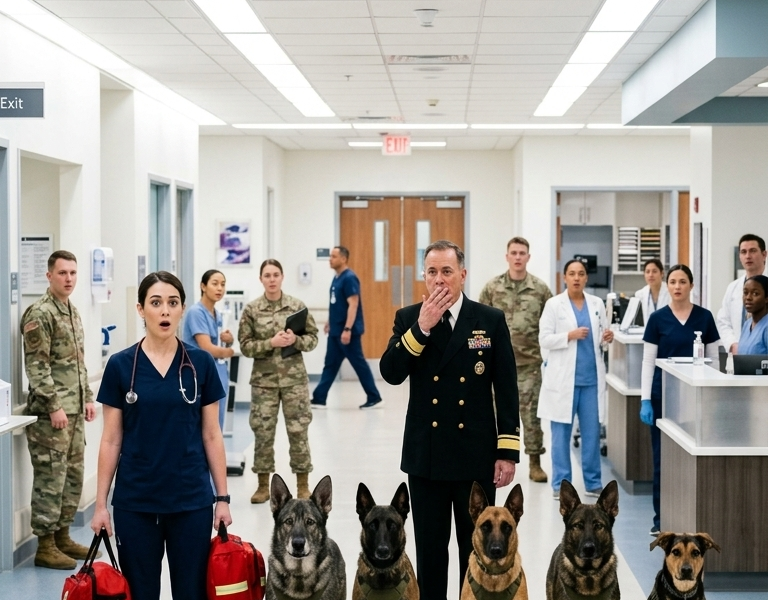
The military handlers laughed when they saw me kneeling beside five injured K9s, but their laughter died when every dog suddenly stood at once
The rain came down in heavy sheets against the corrugated steel roof of Hangar 4, creating a deafening, metallic roar that filled the vast, cold space. Outside, the military airfield at Fort Meade was swallowed in deep shadow and low-hanging clouds. It was past midnight, and the draft sweeping beneath the double doors carried the sharp scent of damp earth, jet fuel, and wet fur.
I stood near the mobile medical station, wrapped in a faded green utility coat over my navy nursing scrubs. Before me, laid out on soiled transport blankets across the concrete floor, were five military working dogs.
They had arrived twenty minutes ago in an unbadged tactical transport vehicle. All five were exhausted, their ribs showing through matted, rain-soaked coats. The largest of the group, a dark German Shepherd, lay on his side, his breath coming in shallow, painful gasps. Beside him, a Malinois had a jagged, deep cut stretching across her left shoulder that was still seeping blood onto the floor. Two younger Shepherds were curled together, trembling violently whenever a footstep echoed off the steel walls. The fifth, a small Belgian Tervuren with grey fur framing his muzzle, sat pressed into a corner, his dark eyes wide and wild with terror, his lips pulled back over his teeth in a silent, defensive snarl.
Standing near the open rear doors of the transport van were three military handlers. They wore unbadged tactical fatigues, their gear heavy and functional, their faces carved with grease, mud, and exhaustion.
The lead handler, a broad-shouldered man with a thick beard and a faded scar through his left eyebrow, unclasped his heavy gloves and tossed them onto a folding chair. He watched me reach into my medical kit for sterile gauze, antiseptic solution, and surgical tape.
“Don’t waste your time, nurse,” he warned, his voice rough from shouting over the rain. “They won’t let you touch them. Two of my men already tried to get a muzzle on the big one back at the staging site. He nearly took a hand off. They’re feral.”
I nodded slowly, keeping my eyes fixed on the concrete floor between my boots. “That’s okay.”
He let out a short, harsh laugh that echoed through the cold hangar. He turned to his fellow handlers, shaking his head. “You’re a nurse, not a dog whisperer. Call the base vet and let them hit ’em with tranquilizer darts. It’s the only way you’re touching those animals tonight.”
I didn’t answer him. I didn’t argue or explain.
Instead, I set my medical tray quietly on the floor, unbuckled my heavy utility coat, and sat down directly on the freezing concrete, ten feet away from the perimeter of the blankets. I crossed my legs, folded my hands in my lap, and lowered my head.
For ten minutes, I didn’t move. I didn’t speak. I didn’t make eye contact. In high-stress military canine psychology, eye contact from an unfamiliar human is an assertion of dominance—a challenge. I made myself invisible, breaking every instinct of urgency that my trauma training had instilled in me.
The silence grew heavy in the hangar, punctuated only by the drumming rain and the ragged breathing of the dogs.
After eight minutes, a soft scratching sound echoed against the floor. The small Tervuren in the corner shifted. He uncurled his trembling body, lowered his chest to the concrete, and began to crawl toward me inch by inch. His tail was tucked tight, his ears pinned back, but his nose was extended, catching the scent of my skin.
He reached my knee. He stopped, sniffing the cuff of my navy scrubs. Then, with a long, mournful sigh, he lowered his heavy head directly onto my left knee.
The handlers stopped talking. The room went completely quiet.
I lifted my hand slowly, giving him ample time to pull away, and gently rested my fingers behind his ears. The fur was cold and soaked through.
“You’ve been scared for a long time, haven’t you?” I whispered softly into the space between us.
The small dog’s eyes fluttered closed. The intense trembling running through his spine began to melt away, replaced by a deep, shuddering exhale.
One by one, the others approached. The female Malinois dragged herself forward, resting her chin on my boot. The two younger Shepherds shuffled over, pressing their flanks against my ribs as if seeking warmth from a fire. Finally, the largest dog rolled onto his stomach, crawling slowly until his massive muzzle was resting inches from my wrists.
The handlers watched in absolute disbelief as I reached for my medical tray. Without using restraints, without a single growl or bare tooth, I cleaned the deep cut on the female’s shoulder, wrapped her wound with clean gauze, applied soothing balm to their raw, cracked paw pads, and whispered to each dog like I had known them forever.
The handlers exchanged bewildered looks. They didn’t know that long before I ever put on a civilian nurse’s uniform, I had served as a specialized military veterinary technician attached to an elite multi-national retrieval unit. They didn’t know why I had left the service four years ago under a cloud of classified discharge papers and silent grief.
And nobody knew why the jagged, raised scars across these dogs’ muzzles looked so hauntingly familiar to me.
As I wrapped the front paw of the largest dog, my fingers brushed against a heavy, weathered leather collar tucked beneath his thick neck fur. I pulled the dense hair aside. Burned directly into the worn leather was a faded, stamped serial code: K9-17.
My breath caught in my throat. My heart slammed against my ribs with such violence I thought my chest would shatter.
I knew that number. I had memorized that number eight years ago in the dust and heat of a forward operating base in the Helmand Province.
That serial code belonged to a specialized tracker named Ranger.
Ranger had been the lead working dog of Tactical Unit Alpha—the unit my older brother, Lieutenant Thomas Vance, had commanded. During a night extraction operation that went terribly wrong, Ranger had dragged me into a drainage culvert after an IED blast, saving my life. But when the evacuation helicopters finally arrived, I was pulled out semi-conscious. I had been officially told that Thomas, his entire team, and Ranger had been killed when the primary command post was destroyed.
My hands trembled so violently I dropped the roll of medical tape onto the floor. I slowly lifted my fingers and touched the side of the large dog’s jaw, tracing the pale line of an old shrapnel scar running from his ear to his lip.
“Ranger?” I whispered, my voice breaking into a sob.
His ears instantly lifted, turning forward. His dark amber eyes locked onto mine with an intensity that made the air vanish from my lungs.
Slowly, deliberately, Ranger rose to his forepaws. He leaned forward and pressed his broad, wet forehead directly against mine, breathing in the air from my lips.
My eyes filled with hot, blinding tears.
Behind me, the lead handler stepped forward, his voice barely a breath. “That’s impossible… That dog has been unresponsive to commands for three weeks. He doesn’t recognize anyone.”
Ranger suddenly stood straight up, his stance changing in a fraction of a second from exhaustion to complete tactical readiness. The other four dogs stood up instantly beside him, moving in fluid, synchronized perfection.
All five lined up shoulder-to-shoulder in a flawless formation in front of me.
Then, as if following an invisible, unspoken command, they stood perfectly still, their chests out, their ears forward, eyes fixed directly ahead.
The military handlers laughed when they saw me kneeling beside five injured K9s, but their laughter died when every dog suddenly stood at once, faced me in perfect silence, and saluted with the only thing they had left to give me—their trust.
The room became dead silent. The only sound was the rain hitting the roof.
I looked up at the handlers, my face pale, my voice shaking with raw emotion. “Who brought them here? Where did these dogs come from?”
Nobody answered. The three handlers stood frozen, looking at the five dogs as if they were seeing ghosts.
Heavy boots echoed from the far end of the hangar. The heavy side door opened, and Colonel Arthur Vance—the base commander and my late brother’s former superior officer—entered the room. He was wearing his service dress uniform, his face weathered, grim, and lined with deep fatigue. Under his arm, he carried a thick, red-stamped sealed military file.
He stopped ten feet away, looking down at the five dogs standing in perfect formation before me. Then he looked at me, his grey eyes heavy with a mixture of sorrow and profound relief.
“I was hoping you would recognize them, Clara,” the commander said quietly.
My heart began pounding again, a dark, cold foreboding taking hold of me. “Recognize them? Colonel… I was told Ranger died eight years ago at Compound 4. I was told my brother died there.”
The commander slowly unclasped the brass seal on the red folder. “Official reports serve specific operational purposes, Clara. Sometimes to protect the living… sometimes to hide what cannot be explained.”
He opened the file, holding out a series of black-and-white surveillance photographs taken from a satellite reconnaissance feed dated three weeks ago.
There was Ranger. There were the other four dogs. And standing beside them in the center of a dense, forested compound near the northern border was a small, hidden medical bunker.
The commander lowered his voice, stepping closer to me. “These dogs weren’t rescued from an enemy site, Clara. They escaped from a private research facility two hundred miles north. And they didn’t come to this airfield by accident.”
I stared at him, my mind spinning into a void. “What do you mean?”
“They were looking for you,” the commander said softly. “They’ve been traveling south for twelve days, breaking through two security perimeters, avoiding every capture team we sent out. Ranger brought them here because he knew your medical transport unit was assigned to this sector.”
Before I could process his words, before I could ask the hundred questions screaming in my head, Ranger’s head snapped toward the heavy double doors at the far end of the hangar.
A low, vibrating growl started deep within his chest. The other four dogs instantly turned, their bodies locking into an offensive wedge formation, their teeth exposed, their ears pinned flat against their skulls.
The commander looked terrified, his hand dropping instinctively to the holster at his hip. “They’ve never done that before… What is it?”
I stood up slowly, stepping behind Ranger’s shoulder. All five dogs were staring intensely at the locked, iron access door that led out to the dark tarmac.
Then, through the sound of the falling rain, someone knocked from the other side.
Three slow, deliberate, heavy knocks. Thud. Thud. Thud.
The commander’s face went entirely white. He whispered, “That’s impossible… That sector is locked down under Code Red.”
I reached out my hand toward the heavy steel door handle.
Instantly, Ranger let out a sharp, ferocious bark and clamped his jaws gently but firmly around the sleeve of my utility coat, dragging me back three paces. It was the exact same physical warning command he had used eight years ago in Helmand right before an enemy team breached our position.
Someone was waiting outside in the storm.
And this time, the dogs knew exactly who it was.
The iron door rattled again, the sound reverberating through the cold air of Hangar 4. The three handlers drew their sidearms in unison, their boots scraping against the concrete as they took cover behind the transport van.
“Stand down! Identify yourself!” Colonel Vance commanded, his voice echoing off the steel trusses above, though his hand trembled as he unholstered his own service pistol.
No voice answered from the storm outside. Instead, the heavy brass door handle slowly turned downward.
The door swung inward, letting in a swirl of rain and freezing mist. A tall, broad silhouette stood framed against the amber floodlights of the airfield runway. He wore a dark, heavy tactical coat, dripping wet, his shoulders broad but slightly stooped with age and injury.
He took one step into the warm light of the hangar.
The overhead lights caught his face. His hair was streaked with silver at the temples, a deep, jagged scar ran down his right jawline, and his left arm was held stiffly against his ribcage.
My breath caught in my throat. The tray of antiseptics on the bench rattled as my knees nearly buckled.
“Thomas?” I gasped, my voice barely a whisper.
My older brother—the man I had buried in an empty casket eight years ago, the man whose name was carved into the granite memorial wall in my hometown—stood living and breathing twenty feet away from me.
“Clara,” Thomas said. His voice was raspy, broken, like dry leaves scraping across pavement.
Ranger didn’t attack. The low growl in his chest vanished, replaced by a deep, mournful whine. The massive Shepherd stepped out of his offensive formation, trotted slowly across the concrete, and pressed his broad snout firmly into Thomas’s right hand. Thomas dropped to his knees, his good arm wrapping around Ranger’s neck, burying his face into the dog’s wet fur.
“Colonel,” Thomas said, looking up at Vance, his eyes hard and clear despite his exhaustion. “You need to seal this hangar now. They followed us.”
“Who followed you, Thomas?” Vance demanded, though he didn’t lower his weapon. “Where have you been for eight years? You were listed as Killed in Action!”
“Aegis Defense Solutions,” Thomas spat, standing up slowly with Ranger at his hip. “The same private military contractor that funded Compound 4. They didn’t destroy the facility eight years ago, Colonel. They repurposed it. They’ve been running an off-the-books neural-behavioral research program on surviving personnel and elite K9 units.”
I stepped forward, grabbing my brother’s right arm, feeling the solid, warm reality of his flesh and bone through his wet coat. Tears streamed down my cheeks. “Thomas… how? Why didn’t you come home?”
Thomas looked down at me, his eyes softening with an agonizing mix of love and guilt. “Because if I came home, Clara, they would have used you to leverage me. They kept me in a medical isolation facility in the north. They used specialized K9 units—Ranger and these four—to track, contain, and monitor subjects. They thought they had erased our identities using experimental neurological suppression drugs.”
He looked down at Ranger, who was pressing his weight firmly against Thomas’s leg.
“They underestimated the dogs,” Thomas continued quietly. “The drugs couldn’t erase the bond between a handler and his K9. Three weeks ago, Ranger broke his restraint harness. He released the other four dogs from their holding pens, breached the sub-basement security grid, and got me out of my cell.”
“The file,” I murmured, turning to look at Colonel Vance. “The commander said they were looking for me.”
“Ranger remembered you, Clara,” Thomas said softly, touching my face with his scarred fingers. “When my memory was hazy, when I didn’t know what month or year it was, Ranger kept bringing me an old piece of cloth—a piece of your medical sleeve from Helmand that he had kept hidden in his kennel collar for eight years. He led us south. He brought us to you.”
Before Colonel Vance could speak, the hangar’s overhead lights flickered violently. The low hum of the electrical generator died, plunging the entire space into pitch-black darkness, saved only by the amber emergency beacons mounted above the exit doors.
Outside, the steady sound of rain was shattered by the high-pitched, mechanical whine of approaching engine turbines.
Two unbadged black helicopters descended out of the storm clouds, their floodlights sweeping across the hangar’s glass skylights, illuminating the rain in blinding white sheets.
“They’re here,” Thomas said, his tone instantly shifting back to the tactical officer I remembered from my youth. He reached into his coat and pulled out a heavy, ruggedized data drive. He shoved it into my hands. “Clara, take this. It contains every subject file, every illegal trial record, and the roster of every corrupt officer on Aegis’s payroll.”
“I’m not leaving you again!” I screamed over the roar of the helicopter blades.
“You aren’t leaving alone,” Thomas said, looking at the five dogs who had instantly re-formed their tight wedge around us. “Ranger! PROTECT!”
Ranger let out a fierce, deafening bark, grabbing the sleeve of my scrub top and dragging me toward the rear utility exit of the hangar. The other four dogs moved with him, forming a living wall of fur and muscle around me.
“Vance! Get her to the subterranean bunker under Building 3!” Colonel Vance ordered his handlers, drawing his weapon as the glass skylights above us shattered in a rain of dangerous shards.
Armed contractors in dark, unbadged tactical suits began rappelling down ropes through the roof of the hangar.
The world turned into a chaotic nightmare of flashing red emergency lights, shattering glass, and shouting voices.
Thomas and Colonel Vance opened fire, providing covering shots toward the rappelling contractors. “GO, CLARA! NOW!” Thomas roared through the smoke and dust.
Ranger didn’t give me time to hesitate. The massive Shepherd pulled violently on my sleeve, steering me through the narrow rear service door of the hangar just as heavy gunfire erupted behind us. The other four dogs—the female Malinois, the two young Shepherds, and the small Tervuren—bounded through the threshold alongside us, securing our flanks.
We burst out into a narrow, concrete utility trench that ran between Hangar 4 and the base communications facility. The rain was cold and relentless, soaking through my clothes within seconds, but the surge of adrenaline kept my legs moving.
To my right, the small Tervuren—whom I now recognized as K9-04 from the file—suddenly halted at a corner of the trench. He dropped low to the ground, raised his snout, and let out a sharp, warning huff.
I skidded to a halt on the wet concrete.
Ranger instantly stepped in front of me, his body rigid, his teeth exposed in a silent snarl. Through the rain and darkness, forty yards ahead near the entrance to Building 3, three Aegis contractors were advancing with silenced rifles, sweeping their flashlight beams across the alleyways.
“Back,” I whispered, pressing my hand against Ranger’s flank. “We need another way.”
Ranger nudged my hand sharply with his snout, then looked toward a heavy, iron manhole cover embedded in the concrete floor of the trench—a maintenance access hatch for the airfield’s old drainage and utility network.
The female Malinois didn’t wait for a command. She jammed her nose beneath the iron lip of the cover where a lifting notch was cut out, while one of the younger Shepherds placed his heavy front paws against the rim. Together, using pure brute force and instinct, they shoved the forty-pound iron disc aside with a loud, metallic scrape.
A warm, damp draft smelling of rust and old earth rushed up from the dark hole.
“Good girl,” I gasped, dropping to my knees.
I looked down into the pitch-black vertical shaft. An old iron ladder was bolted to the concrete wall.
Above us, heavy footsteps crunched through the gravel near the end of the trench. Flashlight beams cut through the rain, closing in fast.
“Down! Go!” I whispered to the dogs.
The small Tervuren went first, dropping effortlessly down the chute into the darkness below. The two young Shepherds followed, jumping without hesitation. I swung my legs over the edge, gripping the cold iron rungs, and climbed down as fast as my hands could move.
Ranger and the female Malinois stayed at the top until I reached the bottom floor ten feet below. Then, with an effortless, synchronized leap, both dogs jumped down into the darkness beside me, landing softly on the wet gravel floor of the drainage pipe.
Above us, the iron cover was shoved back into place by the female Malinois’s hind legs as she dropped, sealing us in complete, suffocating darkness just as footsteps thudded on the concrete above.
I knelt in the pitch black, my lungs burning, holding my breath. Beside me, I could hear the deep, steady breathing of five dogs. Not one of them whined. Not one made a sound.
I pulled out my small medical penlight from my scrub pocket and clicked it on. The narrow beam illuminated a long, arched concrete tunnel stretching into the gloom ahead.
I held up the ruggedized data drive Thomas had given me. In the dim light of the penlight, the casing shone with an engraved corporate emblem: AEGIS BIOTECH / PROJECT ORPHEUS.
My mind raced back to what Thomas had told me in the hangar. They thought they had erased our identities using experimental neurological suppression drugs.
I looked down at Ranger. The dark Shepherd pressed his head firmly against my thigh, his eyes bright in the beam of my light.
“You brought him back to me, didn’t you?” I whispered, my voice echoing faintly off the curved concrete walls. “You kept him alive for eight years.”
Ranger let out a low, soft huff, nudging the pocket where I had tucked the drive.
“We need to get to the communications center,” I murmured, studying the mental layout of Fort Meade I had learned during my orientation. “Building 3 has an independent satellite uplink. If I can plug this drive into the base command network, we can broadcast these files to the Department of Justice before Aegis can sweep this base.”
The small Tervuren trotted to the front of our group, his nose low to the damp floor, leading us down the dark subterranean vein beneath the military base.
We navigated the damp subterranean tunnels for twenty minutes, guided entirely by the sensory instincts of the five dogs. Every time a junction appeared in the concrete pipe, Ranger or the small Tervuren would scent the drafts coming from the vertical ventilation shafts, choosing the path that led away from the sound of running boots above.
We finally stopped beneath a heavy steel access hatch marked BLDG-03 / COMM-SEC SUB-LEVEL.
Ranger stood on his hind legs, planting his broad front paws against the metal ladder rungs, looking back at me.
I held my penlight between my teeth, reached up, and slowly turned the heavy iron wheel locking the hatch from below. The gears groaned, heavy with age and rust, but slowly gave way. I pushed the heavy round door upward an inch, letting in a sliver of warm, fluorescent light.
The room above was silent. The air smelled of heated electronic circuit boards and floor wax.
I pushed the hatch fully open and climbed out into the sub-basement server room of Building 3. One by one, the five dogs leaped out of the shaft, immediately fanning out into a perimeter security sweep around the rows of tall, black computer racks.
The small female Malinois gave a low huff from the main doorway, signaling that the hallway outside was clear.
I rushed to the master administrator console in the center of the room. The monitor screens were active, displaying real-time diagnostic grids for the base’s communications infrastructure.
My fingers flew across the keyboard. As a senior medical officer, I had basic network clearance, but to access the encrypted satellite uplink, I needed an executive security bypass code.
I pulled out the ruggedized drive Thomas had given me and plugged it into the console’s primary data port.
The screen instantly flickered red. A stark security dialogue box popped up:
AEGIS ENCRYPTED DATA DETECTED
REQUIRES TWO-FACTOR BIOMETRIC / COMMAND AUTHORIZATION
“Come on… come on…” I muttered, my hands shaking over the keys.
Suddenly, a prompt appeared beneath the dialogue box:
ENTER AUTHORIZATION PHRASE:
I stared at the blinking cursor. My mind raced back to the hangar—to Thomas’s voice, to the cloth Ranger had kept tucked in his collar for eight years.
I typed the words I used to whisper to Thomas before every mission he took into the desert:
RETURN WITH YOUR SHIELD
The console chimed softly. The red warning box dissolved into a bright blue progress bar:
AUTHORIZATION ACCEPTED: LIEUTENANT T. VANCE CLEARANCE VERIFIED
UPLOADING PROJECT ORPHEUS FILES TO DEPARTMENT OF JUSTICE / ARMED SERVICES COMMITTEE…
UPLOAD PROGRESS: 12% … 24% …
A wave of profound relief washed over me. Tears blurred my vision as I watched the digital progress bar advance. The truth about Compound 4, the illegal experiments, the missing soldiers, and the five brave dogs beside me was finally escaping into the light.
“Good job, Nurse Vance.”
A cold, smooth voice echoed from the open doorway behind me.
I froze. Ranger let out a ferocious snarl, stepping directly between me and the entrance.
Standing in the doorway was a man in his late fifties, dressed in a pristine grey tactical coat with no rank insignia. He held a high-caliber suppressed pistol pointed directly at my chest. Behind him stood four Aegis contractors armed with automatic carbines.
It was Dr. Victor Sterling—the chief medical officer of Aegis Defense, the man whose name was stamped on every classified report in the file.
“I must admit,” Dr. Sterling said, taking a slow, measured step into the server room, “I never anticipated that a pack of discarded test animals would possess the cognitive persistence to navigate two hundred miles of terrain simply to find their former handler’s sister.”
“They aren’t test animals,” I spat, standing my ground behind Ranger. “They are military working dogs. They have more honor in one paw than you have in your entire corrupt organization.”
Sterling smiled coldly, raising his weapon slightly. “Honor is a social construct, Clara. Data is absolute. Cancel that upload, or I will put a bullet through your head, followed by every one of these animals.”
I looked at the console screen behind me.
UPLOAD PROGRESS: 68% … 72% …
“I can’t do that,” I said quietly.
Sterling’s expression hardened. His finger tightened on the trigger. “Then you die here.”
Before his finger could finish the pull, a sudden, violent crash echoed from the hallway outside.
The heavy steel door frame of the server room bowed inward with a deafening screech of metal.
Through the doorway came a flash of blinding white light and a concussive shockwave as a military flashbang grenade detonated in the corridor. The four Aegis contractors were instantly disoriented, stumbling backward, covering their eyes and ears.
“NOW! ATTACK!” Thomas’s voice roared through the smoke.
Ranger didn’t need to be told twice. He launched his massive dark body through the air like an artillery shell. He slammed straight into Dr. Sterling before the doctor could align his weapon, his heavy jaws locking onto Sterling’s right arm, forcing the pistol to discharge harmlessly into the concrete floor.
The other four dogs moved with terrifying, fluid tactical cohesion. The female Malinois and the two young Shepherds engaged the disoriented contractors, sweeping their legs, stripping their weapons, and pinning them against the server racks with ruthless efficiency. The small Tervuren secured the rear door, ensuring no secondary team could enter.
Thomas burst into the room, flanked by Colonel Vance and a squad of heavily armed Fort Meade Military Police officers.
“ON THE FLOOR! ALL OF YOU! DOWN!” the MP commander screamed, his laser sights painting the Aegis contractors.
The contractors threw their weapons down, raising their hands in immediate surrender as the military police moved in, slapping heavy steel handcuffs onto their wrists.
Dr. Sterling screamed in agony on the floor as Ranger held him pinned, his jaws clamped tight around the doctor’s coat sleeve until Thomas stepped up and placed a hand gently on Ranger’s neck.
“Out, Ranger. Heel,” Thomas commanded softly.
Ranger instantly released his grip, stepping back and sitting at Thomas’s side, his dark eyes watching Sterling with intense vigilance.
Colonel Vance walked over to the administrator console. He looked at the screen just as a bright chime echoed through the server room speakers.
UPLOAD COMPLETE: 100%
TRANSMISSION CONFIRMED: DOJ SPECIAL INVESTIGATIONS DIVISION
Colonel Vance turned to look at Sterling, who was being hauled up by two military police officers, his face pale and ruined.
“Dr. Sterling,” Colonel Vance said coldly, “you are under federal arrest for high treason, illegal human experimentation, and multiple counts of military abduction. You will spend the rest of your natural life in a supermax facility.”
Sterling spat blood onto the floor, glaring at Thomas and me, but he said nothing as he was dragged out into the corridor.
Silence settled over the server room, broken only by the hum of the computer racks and the steady, rhythmic panting of the five dogs.
Thomas walked slowly over to me. He looked exhausted, his face bruised, his tactical coat torn, but for the first time in eight years, the dark, haunted look in his eyes was gone.
I threw my arms around his neck, burying my face into his shoulder, sobbing uncontrollably. He wrapped his arms tightly around me, holding me against his chest, resting his chin on my head.
“It’s over, Clara,” Thomas whispered, his voice thick with emotion. “It’s finally over.”
Ranger stepped up beside us, resting his heavy, broad head against both of our knees. The other four dogs gathered around, pressing their bodies against ours, forming a close, unbroken circle of warmth in the cold, sterile room.
Six months later, the morning sun broke golden and clear over the rolling green hills of the Shenandoah Valley.
A large, white-painted farmhouse sat at the end of a long gravel driveway, surrounded by twenty acres of open pasture and fenced oak groves. A carved wooden sign hanging near the front gate read: VANCE K9 RECOVERY & RETIREMENT SANCTUARY.
I sat on the wide wooden porch, holding a warm cup of coffee, watching the valley below.
Out in the green grass, Thomas was walking slowly, his limp much improved, carrying a canvas throw-toy. Running alongside him, their coats glossy, their bodies healthy and strong, were the four younger service dogs. The female Malinois was leaping into the air, chasing the ball, while the two Shepherds and the small Tervuren bounded behind her in pure, unrestrained joy.
Beside my rocking chair, laying comfortably on a thick orthopedic bed, was Ranger.
His dark fur caught the warm morning light, highlighting the pale, silver scar across his muzzle. He was officially retired from military service, awarded an honorary Medal of Heroism by the Department of Defense, and legally adopted as a permanent member of our family.
Ranger turned his head slowly, looking up at me with those deep, intelligent amber eyes.
I set my coffee down, leaned over, and gently touched the soft fur behind his ears.
“Good boy, Ranger,” I whispered softly.
Ranger let out a long, satisfied sigh, closed his eyes, and rested his chin on my boot, his tail thumping once, twice, in a steady, peaceful rhythm against the porch floor. The long, dark night was over, and we were all finally home.
The end.









