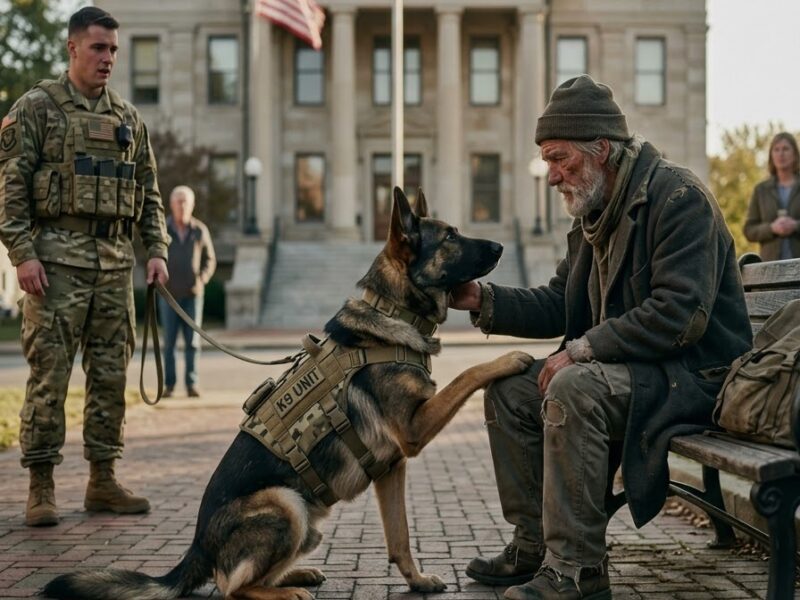
The military dog suddenly sat beside my cardboard shelter and raised one trembling paw like a salute
The frost on the iron rafters of Union Station hung like broken glass, catching the dull amber glare of the dawn overhead lights. Chicago in December was an uncompromising engine of cold, a city that didn’t just chill a man’s skin—it reached through dirty wool coats and cracked boot soles to settle deep within his marrow.
I sat with my back pressed against the soot-stained brick foundation near Track 7, my knees drawn up tight toward my chest. Beneath me was a flattened piece of corrugated cardboard; beside me, a stained paper cup containing two quarters, three copper pennies, and a dusting of dry gray snow that had drifted through the open concourse doors.
Thousands of people moved past every hour. They were a sea of expensive wool coats, polished leather shoes, and sharp-cornered briefcases, moving with the rhythmic, mechanical urgency of a world that had places to be. I knew how to exist on the margins of that movement. The secret to surviving as a homeless man in a crowded train station was simple: you had to become a piece of the architecture. You didn’t make eye contact. You didn’t ask twice. You became a shadow that people instinctively stepped around without ever actually looking at.
I was forty-two years old, but my hands looked seventy. The left one was dominated by a jagged, rope-like keloid scar that ran from the base of my wrist, crossed the knuckle of my middle finger, and disappeared into the sleeve of my oversized jacket. That scar was my only permanent souvenir from a dirt road outside Fallujah, and later, the scorched hills of Kandahar.
At 0800 hours, the atmosphere in the concourse shifted. The ambient noise—the announcements crackling over the public address system, the squeal of diesel brakes, the low hum of thousands of voices—seemed to drop half an octave.
A military recruitment detail had entered through the Adams Street doors. Four young soldiers in crisp, digital-pattern camouflage uniforms walked in formation, carrying foldable display tables and promotional banners. Leading them was a tall, sharp-jawed staff sergeant, and at his side, attached by a thick tactical harness, was a high-drive German Shepherd.
The dog was a pristine asset—deep chest, alert ears, dark muzzle, and eyes that moved with deliberate, practiced efficiency across the crowd. He wasn’t a pet; he was a working dog, bred and trained to detect nitrates, pressure plates, and human panic.
I pulled my scarf higher over my chin and leaned back farther into the shadow of the brick pillar, instinctively shrinking. I didn’t want trouble. Veterans on the street usually avoided active-duty personnel. It was too sharp a mirror. It reflected everything you used to be against everything you had failed to remain.
Then, the dog stopped.
The staff sergeant took two more steps before the tension on the leash snapped his arm back. “Duke, heel,” the young soldier commanded, his voice sharp and habitual.
The German Shepherd didn’t heel. His ears pinned back slightly, not in aggression, but in extreme focus. His head tilted, nostrils flaring as he cut through the smell of diesel, wet wool, roasted coffee, and floor wax. His dark eyes locked directly onto mine.
“Duke, forward,” the sergeant repeated, stronger this time, giving the lead a firm tug.
The animal ignored the command entirely. Slowly, deliberately, the dog pivoted away from the recruitment display and began walking straight toward Track 7. He wasn’t lunging; he was tracking.
“Sir, please stand clear,” a junior soldier called out as the dog drew closer, the small crowd of commuters beginning to part like water around a plow.
I held my breath, pressing my shoulder blades hard against the cold brick. “I’m just sitting here,” I muttered, my voice raspy from disuse. “I’m not doing anything.”
Duke stopped three feet from my cardboard sheet. The station around us seemed to lose its noise, the rushing crowd slowing down to watch the anomaly. A working military dog ignoring its handler was a rare breach of discipline.
The dog lowered his front shoulders, stepped onto my cardboard, and sat down right beside me. Then, with a slow, heavy motion, he lifted his right front paw, holding it trembling in the air between us in a stiff, undeniable gesture—a formal salute trained into combat tracking dogs to signal a stationary asset—before resting his heavy, warm head directly on my scarred left knee.
A cold jolt went down my spine. The heat of his head burnt through my dirty denim jeans. I hadn’t felt the intentional touch of another living creature in nearly three years.
The staff sergeant rushed over, his face flushed with confusion and embarrassment. “Duke! What are you doing? Get up!” He reached down to grab the tactical handle on the dog’s vest, but the dog let out a low, structural rumble from deep in his chest—not a threat to me, but a refusal to his handler.
“Don’t pull him,” I whispered, my voice shaking. “He’s… he’s resting.”
The sergeant paused, staring at me properly for the first time. He looked young—maybe twenty-three or twenty-four. His boots were immaculate, his uniform lacked a single wrinkle, and his eyes were clear, unburdened by the specific fatigue that lives in the eyes of men who have seen the world tear itself apart.
“Does he know you?” the sergeant asked, his hand hovering over the leash.
“No,” I lied softly, staring down at the dog’s dark ears. “He doesn’t know me. He knows what I am.”
“He’s a patrol and explosive detection dog,” the soldier said, his tone softening slightly as he noticed the way my hands shook. “He doesn’t just lay down for civilians.”
“I’m not a civilian,” I said.
The soldier fell silent. He crouched down on one knee, bringing himself level with my seat on the floor. The commuters were forming a loose ring around us now, whispers bouncing off the vaulted ceilings.
“Where did you serve?” the soldier asked quietly.
“Afghanistan. Paktika Province. 2012.”
The soldier’s posture stiffened instantly. He eyed the faded, ink-smudged tattoo barely visible under the collar of my shirt—the double-A badge of the 82nd Airborne Division. “What unit?”
“2nd Battalion, 508th Parachute Infantry Regiment.”
The young sergeant’s breath hitched. The professional composure on his face cracked, revealing a sudden, raw vulnerability. “The 508th?”
“Yeah.” I turned my face away, uncomfortable with the sudden scrutiny. “A long time ago.”
I reached into the deep pocket of my coat, my fingers wrapping around a piece of cold, notched steel I had carried every single day for fourteen years. It was an old dog tag, dull, scratched, and bent slightly at the corner. I pulled it out and let it hang from my fingers. The silver chain rattled softly in the freezing concourse air.
The young soldier’s eyes dropped to the piece of metal. His chest heaved once, heavily.
“Where did you get that tag?” he asked, his voice suddenly dropping an octave, stripped of all military authority.
“It belonged to a sergeant,” I said, my thumb tracing the embossed letters I knew by heart without looking. “Michael Reed. He was my squad leader. He died in an ambush outside a village called Haji Lalo. Our Stryker took an IED, and the fuel line blew. Michael pulled three of us out of the crew compartment before the ammunition cooked off. He went back in for the driver. The hull collapsed.”
My voice cracked on the last word. It was the first time I had spoken Michael’s name out loud since the Veterans Affairs hospital discharged me into the street six years ago.
“He didn’t die instantly,” the young soldier whispered, his eyes locked on the metal tag swinging from my hand.
I looked up, frowning. “What?”
“The army report said he died instantly,” the sergeant said, his voice trembling now. He reached down to his own chest, unbuttoning the front pocket of his camouflage tunic. He pulled out a worn, leather-bound notebook, folded over an old, yellowed piece of paper protected by a clear plastic sleeve. “That’s what they told my mother. That’s what they put on the medal citation. But it wasn’t true.”
I stared at him, my heart hammering violently against my ribs. “Your mother?”
The young soldier looked me dead in the eyes, tears brimming at the corners of his eyelids. “My name is Sergeant Thomas Reed. Michael Reed was my father. I was nine years old when he went to Afghanistan.”
The air left my lungs all at once. The bustling train station, the cold wind, the stares of a hundred strangers—everything faded into a suffocating, high-pitched static. I stared at the boy’s face. Now that I was looking, the resemblance was brutal. He had Michael’s sharp jawline, the same brow, the same direct, unyielding gaze.
“He… he was your father?” I managed to choke out.
“Before he boarded the transport in Fort Bragg,” Thomas said, unwrapping the plastic sleeve with trembling fingers, “he wrote a letter to my mother. He told her that if anything happened to him, if he didn’t come back, there was only one man who knew what really happened in that valley. He said the military bureaucracy would wrap everything in neat ribbons, but the truth belonged to the men who were in the dirt.”
Thomas unfolded the yellowed paper. The handwriting was jagged, written in blue ballpoint pen on standard military notepad paper.
“He left a directive for me,” Thomas continued, his voice shaking with intense emotion. “He said: ‘If you ever grow up and wear the uniform, find the man who carried my tag out of the fire. Find the man with the scar on his left hand.'”
I looked down at my left hand. The thick, white scar stood out starkly against my dirt-ingrained skin.
“I’ve been looking for you for five years,” Thomas whispered. “Ever since I finished my first tour. I transferred to recruitment in Illinois because your last known VA record was out of Hines Hospital.”
I couldn’t move. My hand remained frozen around Michael’s tag. For fourteen years, I had believed I was a ghost, a forgotten survivor who had let his squad leader burn while I crawled away with my life and a scarred hand. I had lived on the streets because I believed I didn’t deserve a roof, didn’t deserve warmth, didn’t deserve to exist in the world Michael had been forced to leave behind.
“He wrote something else,” Thomas said, his fingers pressing into the letter. “In the last line. He said… ‘Tell him it wasn’t his fault. Tell him he carried the line.'”
A sob tore out of my throat before I could stop it—a raw, ugly sound that had been trapped inside my chest for over a decade. I leaned forward, pressing my forehead against Duke’s thick coat. The dog didn’t move; he simply leaned his heavy body into mine, anchoring me to the earth while the world spun out of control.
Suddenly, Duke’s body went completely rigid beneath my hands.
The dog lifted his head off my knee, his ears shooting forward, his lips pulling back over his teeth in a deep, violent snarl. He turned toward the crowded main entrance of the station—toward the concourse doors leading out to Canal Street.
“Duke! Down!” Thomas barked, startled by the dog’s sudden shift in posture.
The German Shepherd ignored him completely. He stood up, his fur standing on end along his spine, barking frantically at a tall man in a dark gray overcoat who was standing near the security kiosk.
The man in the gray overcoat had been standing there, watching us. The moment Duke barked, the man pulled his hat down low over his eyes, turned abruptly on his heel, and pushed aggressively through the incoming crowd toward the street exit.
Thomas turned to look at the man, his brow furrowing. “What is wrong with him?”
I looked at the retreating figure in the gray coat. As the man pushed through the glass doors, he lifted his left hand to adjust his collar. On the back of his wrist was a distinct, branded mark—a heavy, circular scar shaped like an iron ring.
My blood turned to ice water.
I knew that mark. It wasn’t a military tattoo. It was the mark of the insurgent militia network that had set the ambush at Haji Lalo—the same group that had tracked our unit for three weeks before detonating the charge under our lead vehicle.
“Thomas,” I grabbed the young soldier’s arm, my voice dead serious, stripped of all street-shuffled defeat. “That man isn’t a commuter.”
Thomas looked from my face to the glass doors where the man had just disappeared. “What are you talking about?”
“He’s been watching me,” I said, my mind racing as long-buried combat instincts flooded back into my bloodstream. “Not today. For the last three weeks. I thought I was being paranoid. I thought it was just the PTSD.”
Duke let out a sharp, piercing bark, pulling hard against his leash toward the doors.
“He didn’t just happen to be here,” I looked at Thomas, the cold reality settling over me. “He followed you.”
“Explain that,” Thomas demanded, his hand dropping instinctively to his sidearm holster, though he was currently unarmed under domestic recruitment protocols.
The concourse around us had scattered slightly at Duke’s violent barking, leaving a twenty-foot ring of open space. The commuters were looking at us with suspicion now—not just at the homeless man, but at the uniform.
“When our convoy was hit in 2012,” I said, standing up slowly, my joints popping like dry twigs, “it wasn’t an accident. We were set up. Someone gave our route to Tariq’s network—a local warlord who ran the district between Haji Lalo and the border.”
Thomas stared at me, his jaw working. “The official report said it was a routine patrol ambush.”
“It wasn’t routine,” I spat out, pulling my coat tight around myself. “We changed our route thirty minutes before we rolled out. Only four people in the operational center knew the new coordinates. When the IED went off, it was placed on a culvert we hadn’t used in six months. They were waiting for us.”
I pointed toward the glass exit where the man in the gray coat had vanished. “That brand on his wrist—that’s the mark of Tariq’s inner circle. They called themselves the Sorkh Dast—the Red Hands. They didn’t just fight; they hunted.”
“That was fourteen years ago, halfway across the world,” Thomas said, trying to anchor himself to logic, though his eyes showed he was processing the terror of what I was saying. “Why would someone from that network be in Chicago, following a military recruiter?”
“He wasn’t following you because you’re a recruiter,” I said softly, looking the boy straight in the eye. “He was following you because you’re Michael Reed’s son. And you’ve been asking questions.”
Thomas went pale. “I… I requested my father’s classified casualty file three months ago through a congressional inquiry. The Department of Defense flagged it for review, but they granted partial access.”
“Who processed the request?”
“A private contractor out of Virginia,” Thomas whispered. “Global Defense Logistics. They handle the archival migration for older combat records.”
The pieces began falling into place with a terrifying, mechanical precision. Global Defense Logistics wasn’t just a contractor; they were one of the massive private security firms that had absorbed dozens of former military intelligence personnel and foreign assets after the withdrawal.
“They didn’t want the file opened,” I said. “Because if you dig deep enough into the Haji Lalo ambush, you don’t just find an IED. You find the missing intelligence payroll. Two million dollars in cash that vanished from the command vehicle right after the blast.”
Thomas’s mouth opened slightly. “My father was accused of stealing that money. That’s why his Silver Star was held up for three years!”
“Michael didn’t steal it,” I said, my voice hardening into iron. “He found out who did. That’s why he went back into that burning vehicle, Thomas. It wasn’t just to save the driver. He was trying to retrieve the encrypted drive from the tactical terminal—the drive that proved our company commander had routed the funds to a private account in Dubai.”
Duke whined, pressing his body against Thomas’s leg, his tail stiff.
“Who was the company commander?” Thomas asked, his voice barely audible above the hum of the station.
“Captain Marcus Vance,” I replied. “He left the Army six months after the deployment. He didn’t stay in the military. He founded a security firm.”
Thomas looked down at his father’s letter, then at the glass doors. “Global Defense Logistics.”
“Vance owns it,” I said. “And if he saw your congressional request, he realized Michael Reed’s son was pulling on the thread that could tear down his entire empire. He didn’t follow you to kill you in a public train station. He followed you to see who you were talking to. And now he knows you found me.”
“We need to go to the police,” Thomas said, reaching for his radio.
I caught his wrist. My grip was rough, calloused, and surprisingly fast for a man who looked like he was dying of malnutrition. “The police won’t help you with this, kid. Vance has federal contracts, retired generals on his board, and local law enforcement liaisons. If you go to a precinct, the report gets flagged in their system before you finish typing your statement. You’ll be picked up for ‘questioning’ by federal marshals who work for Vance’s friends, and I’ll disappear into an unmarked van.”
Thomas looked at my hand on his wrist, then at my face. He saw the cold, calculated clarity of a man who had survived four years of infantry combat and six years of urban survival. I wasn’t a broken vagrant anymore. The fog of alcohol and trauma that had clouded my brain for a decade was burning off, replaced by the lethal, singular focus of an airborne soldier protecting his squad leader’s son.
“What do we do?” Thomas asked.
“Where is your unit stationed right now?”
“We’re based out of the armory in Riverside,” he said. “We have a recruitment van parked in the station’s subterranean loading bay. Level B2.”
“Is it secure?”
“It’s an armored transport vehicle,” Thomas said. “Keycard access only.”
“Good,” I said, picking up my small canvas bag—my only possession in the world—and slinging it over my shoulder. “We move now. Duke leads.”
We moved quickly through the concourse, bypassing the main passenger corridors and taking a concrete stairwell down toward the service levels. The temperature dropped significantly as we descended, the ambient smell of diesel fumes and damp concrete growing stronger.
Duke walked between Thomas and me, his ears rotated backward, listening for footsteps behind us.
“You said my father left a letter,” Thomas said as our boots echoed off the cinderblock walls of the stairwell. “How did you get his tag?”
I took a deep breath, the memories tearing through my mind like shrapnel. “After the blast, the vehicle was engulfed in magnesium fires. The heat was unbearable. I was blown ten meters clear into a drainage ditch. I had two broken ribs and my left arm was burned to the bone.”
I looked down at my scarred hand.
“I saw Michael crawl out of the rear hatch. His uniform was on fire. He had the hard drive in his right hand. He saw me in the ditch, crawled over, and shoved the drive and his dog tag into my chest pocket. He looked me in the eyes and said, ‘Get this to the colonel. Don’t let Vance touch it.'”
“What happened to the drive?” Thomas asked, stopping on a stair landing.
“I hid it,” I said. “Before the MEDEVAC chopper arrived, I buried it under a marker stone near the airfield perimeter in Bagram. Two days later, I was medevaced to Germany. By the time I woke up from my third surgery, Vance had already declared the drive lost in the explosion and court-martialed my dead squad leader for missing funds. I tried to tell the investigators, but they said I was suffering from traumatic brain injury and toxic psychosis. Nobody believed the corporal with third-degree burns.”
“Where is the drive now?”
“It’s still in Afghanistan,” I said softly. “Or at least, I thought it was. But three months ago, a friend of mine from the VA told me that the old Bagram materials were being shipped to a federal storage depot right here in Illinois—at the Joliet Logistics Hub.”
Thomas stared at me. “The crate with the airfield markers… it was imported during the base closure?”
“If it was,” I said, “that encrypted drive is sitting in a cardboard box forty miles from here. And Vance knows it.”
Before Thomas could answer, a heavy steel door at the top of the stairwell slammed shut above us with a loud, metallic clatter.
Duke let out a sharp, low growl, dropping into a defensive posture.
Footsteps began descending the concrete stairs—slow, heavy, and deliberately unhurried.
I looked down over the railing into the stairwell below. Coming up from Level B2 were two men in dark tactical jackets, their hands tucked inside their coats. Above us, coming down from the concourse level, was the man in the gray coat with the iron-ring scar on his wrist.
We were trapped on the landing of a closed service stairwell.
“Thomas,” I said quietly, stepping in front of the young sergeant. “Get behind the dog.”
“I’m an active sergeant in the United States Army,” Thomas said, stepping up alongside me, his knuckles white. “I’m not hiding behind anyone.”
The man in the gray coat stopped five steps above us. Up close, his face was a mosaic of old weather-beaten scars, his eyes cold, milky, and entirely devoid of human empathy. He spoke with a heavy, flat Eastern European accent.
“Corporal Miller,” the man said, recognizing me instantly. “You have been very hard to keep track of. Living like a rat has made you slippery.”
“Karel,” I said, recognizing his voice from a radio intercept fourteen years ago. “I see Vance pays well enough to keep you in tailored coats.”
The man smiled, revealing a row of discolored teeth. “Mr. Vance values loyalty. And he values clean accounting. You have something that belongs to our firm’s historical record.”
“I don’t have anything,” I lied.
“You have the location,” Karel said, reaching slowly inside his coat. “And the sergeant’s son was kind enough to file the paperwork that brought us all together today. It is remarkably easy to track a boy who uses his military ID to access classified archives.”
“He’s an active-duty soldier,” Thomas barked. “If you touch us, every federal agency in this city will be on you within twenty minutes.”
Karel chuckled softly. “In a concrete stairwell under a train station? Nobody hears anything down here, Sergeant. By the time your recruitment office notices you are missing, your van will be at the bottom of Lake Michigan, and you will be listed as a deserter who stole two million dollars—just like your father.”
Karel pulled a suppressed 9mm pistol from his coat.
Before his arm could level the barrel at Thomas, Duke launched himself.
The German Shepherd didn’t bark as he left the ground. He hit Karel in the chest with ninety pounds of muscle, speed, and teeth, the impact slamming the armed man back against the concrete wall. The suppressed pistol discharged once with a soft thwip, the bullet spalling off the concrete step where Thomas had been standing a second before.
“Go!” I screamed, grabbing Thomas by the collar of his tunic and throwing him toward the descending stairs. “Level B2! Move!”
The two men coming up from the lower level lunged forward, drawing collapsible batons. I didn’t have a weapon, but I had two years of close-quarters combat training and six years of fighting for survival in alleyways.
I dropped low under the first man’s swing, driving my shoulder directly into his knee joint. The bone popped with a sickening crunch, and he collapsed down the stairs, screaming. The second man swung high, the steel baton catching me across the left cheekbone. Pain exploded in my skull, blinding my right eye with red sparks, but I didn’t stop. I grabbed his collar with my scarred left hand, hooked my heel behind his ankle, and threw my entire body weight sideways, sending us both tumbling down the concrete steps.
We hit the Level B2 landing in a tangled mess of elbows and boots. The man was stunned; I wasn’t. I drove my elbow into his solar plexus, grabbed his dropped baton, and scrambled to my feet.
Above us, a heavy gunshot echoed through the stairwell, followed by a sharp yelp from Duke.
“DUKE!” Thomas yelled, sprinting back up the steps.
“Thomas, NO!” I roared, grabbing his belt and hauling him back.
Karel was coming down the stairs, bleeding heavily from his face where Duke had torn his cheek, his jacket ripped to shreds. He was holding his arm, his pistol lowered, but Duke was not behind him. The dog was down on the upper landing, whimpering but trying to stand, his rear leg bleeding from a graze.
“He’s alive!” I yelled, seeing the dog move. “He’s buying us time! Get the van open!”
Thomas’s eyes were wild with rage and fear, but the military training kicked in. He pulled his electronic keycard, smashed it against the proximity scanner of the heavy steel fire door on Level B2, and shoved the bar down.
The door swung open into the massive, echoing cavern of the underground loading bay. Parked thirty yards away in a secure bay was the military recruitment vehicle—a heavy-duty, matte-black Ford F-550 equipped with an armored crew cab and tactical communications gear.
“Run!” I shouted.
We sprinted across the oil-stained concrete floor. Behind us, the fire door burst open. Karel stepped out, raising his pistol with his good arm. Thwip. Thwip. Bullets slapped into the concrete near our feet, sending sharp stone fragments biting into my calves.
Thomas hit the unlock button on his key fob. The recruitment van’s heavy doors clicked open. We dove inside through the side passenger door just as another round shattered the side mirror.
“Driver’s seat! Now!” I yelled, slamming the heavy armored door shut and locking the deadbolts.
Thomas scrambled into the front seat, jammed the tactical key into the ignition, and turned it. The heavy V8 diesel engine roared to life with a deep, mechanical growl that echoed through the cavernous loading bay.
“Look!” Thomas pointed at the side camera monitor.
Karel was standing ten feet away, aiming his pistol directly at the driver’s side window. But before he could pull the trigger, a dark shape burst out of the concrete stairwell like a rocket.
It was Duke. Despite his injured leg, the dog slammed into Karel from behind, biting deep into his shoulder and pulling him to the ground in a spray of blood and dark fabric.
“Hold on!” Thomas roared.
He slammed the heavy transport into reverse, the tires screaming against the slick concrete floor. The truck surged backward, smashing through the light security gate blocking the exit ramp. Thomas threw the gear shift into drive, stomped the accelerator, and the heavy armored vehicle surged forward, sweeping past the fallen men.
Thomas slammed the brakes right beside Karel and Duke. He threw open the side door. “DUKE! UP!”
The bloodied German Shepherd released Karel’s shoulder, scrambled up the steel steps of the van, and collapsed onto the rubber floorboards, panting heavily, his eyes bright with intelligence. I pulled him inside and slammed the door shut just as Karel began firing wild shots from the floor. The heavy-gauge steel of the transport absorbed the impacts with dull, hollow thuds.
Thomas smashed the accelerator down. The F-550 surged up the concrete exit ramp, breaking through the plastic boom barrier and bursting out into the blinding snowstorm on Canal Street.
The city was a blur of gray buildings, flashing red traffic lights, and thick, falling snow. Thomas drove like a man possessed, weaving the heavy military transport through the slow-moving afternoon traffic, turning three times in rapid succession to break any immediate tail.
My chest was heaving. Blood was dripping from my split cheekbone onto the front of my dirty coat. I dropped to my knees beside Duke, examining his hind leg. The bullet had torn through the outer muscle of his thigh, but it was a clean graze—no shattered bone, no hit to the femoral artery.
“He’s going to be okay,” I panted, tearing a strip of cloth from my inner shirt and wrapping it tightly around the dog’s leg to stop the bleeding. “He’s tough. Tougher than any of us.”
Duke licked my blood-stained knuckles, his tail giving two weak thumps against the floorboards.
Thomas stared into the rear-view mirror, his knuckles white on the steering wheel. “They tried to kill us. In broad daylight. In the middle of Chicago.”
“Vance knows the window is closing,” I said, leaning my back against the van’s interior storage lockers. “If the Joliet hub is finishing its inventory migration this week, those crates are going to be cataloged, digitized, and moved to permanent government storage in Maryland. Once that evidence enters the federal system, Vance can’t destroy it without leaving an electronic paper trail that points straight to his executive board.”
Thomas glanced back at me through the cab partition. “How do you know the drive is still functional after fourteen years?”
“It’s a military-grade, hardened tactical drive,” I said. “Built to withstand electromagnetic pulses, saltwater submersion, and extreme thermal impact. It was sealed in a classified evidence bag with silica gel. If the seal wasn’t broken, that drive is as clean as the day Michael saved it.”
Thomas looked back at the road, his jaw set in a hard, rigid line. “Where in Joliet?”
“The intermodal freight facility off Route 53,” I said. “It’s a three-hundred-acre logistics depot run jointly by the Department of Defense and private rail operators. If the Bagram base closure crates were processed through the Midwest corridor, they’re sitting in Warehouse 4B.”
“That’s a high-security facility,” Thomas said. “Armed guards, perimeter fencing, automated manifest scanners. I have military clearance, but not for a classified archival warehouse.”
“We don’t need clearance,” I said, looking down at the dog tag hanging around my neck. “We have Michael’s squad code.”
Thomas frowned. “What squad code?”
“Michael didn’t just give me the drive, Thomas,” I said, my memory sharpening with crystalline clarity. “He gave me his master authentication key. The five-digit sequence he used to sign off on company inventory before every mission. In 2012, all tactical hardware logged under a squad leader’s command was indexed using that key. If those crates are marked as unclassified battlefield salvage from the 508th, that key is the manifest password.”
Thomas was silent for a moment, listening to the steady hum of the diesel engine and the rhythmic slap of the windshield wipers against the heavy snow.
“He knew,” Thomas whispered. “My father knew someone would come back for it.”
“He knew you would come back for it,” I corrected softly. “He didn’t trust the generals, he didn’t trust the politicians, and he certainly didn’t trust Vance. He trusted the blood.”
Thomas looked at me through the mirror, the suspicion and fear in his eyes completely replaced by an ancient, shared grief—and an unyielding resolve.
“We have about forty minutes before Vance’s people track this van’s GPS,” Thomas said, reaching down to hit a toggle switch on the dashboard. He flipped a heavy plastic cover and pulled a wire harness, disabling the vehicle’s commercial satellite locator. “That gives us a half-hour head start.”
“That’s all we need,” I said.
I looked down at my hands. The dirt was still embedded in the lines of my skin, but the scar on my left hand wasn’t a mark of shame anymore. It wasn’t the signature of a coward who had survived while better men died in the dirt. It was a bridge. It was the mark that had brought Michael’s son to me in a cold train station, and it was the key that was about to burn Vance’s empire to the ground.
Duke let out a soft sigh and laid his head across my boots. Outside, the gray sky above the Interstate began to darken into night, the snow falling thicker, blowing across the asphalt like smoke.
The Joliet Intermodal Facility looked like an industrial fortress rising out of the flat, snow-covered Illinois prairie. Row upon row of thirty-foot steel shipping containers stretched as far as the eye could see under the harsh, buzzing glow of sodium-vapor floodlights. High chain-link fences topped with razor wire enclosed the perimeter, flanked by patrol roads where private security vehicles moved with slow, predictable regularity.
Thomas pulled the recruitment transport into an unlit staging lane behind an abandoned farm equipment dealership three hundred yards from the facility’s western perimeter gate.
He killed the engine. The sudden silence inside the cab was deafening, broken only by the wind howling across the flat expanse of snow.
“We can’t take the van through the main gate,” Thomas said, pulling a tactical flashlight and a heavy utility tool from the rear storage locker. “The gate guards are private contractors from Vance’s subsidiary.”
I peered through the snow-streaked windshield. “There’s a rail spur line on the south side. That’s where the flatcar trains pull in from the west coast. The fence there has a manual maintenance hatch for track inspectors.”
Thomas handed me a dark tactical jacket from his extra gear bag. “Put this on. It’ll keep you warm, and it’s dark enough to blend into the shadows.”
I pulled the jacket on. It fit snugly, the clean nylon fabric smelling faintly of CLP gun oil and laundry detergent. For the first time in six years, I wasn’t wearing another man’s discarded rags. I adjusted my posture, standing up straight, feeling the old, familiar muscle memory of a paratrooper returning to my shoulders.
“How’s the leg, Duke?” I asked, crouching beside the dog.
Duke stood up instantly, testing his bandaged hind leg. He gave a single, firm tail wag, his eyes wide and ready. He was a military working dog; as long as he had a mission, he didn’t feel the pain.
“He stays close,” Thomas said, clipping a short tactical lead to Duke’s harness. “If anyone spots us, we move fast and hard.”
We left the transport and moved low through the drainage ditch running parallel to the southern fence line. The snow was knee-deep here, crunching softly under our boots, but the bitter wind worked in our favor, masking the sound of our approach and cutting down the visibility of the security cameras mounted on the tall light towers.
We reached the rail spur hatch within five minutes. Thomas used a bolt cutter from his kit to snap the heavy padlock securing the steel gate. We slipped through one by one, ducking behind a stack of creosote-soaked railroad ties as a patrol pickup truck swept past two hundred yards away, its searchlight cutting a yellow swath through the falling snow.
“Warehouse 4B is the third structure on the left,” I whispered, pointing through the blizzard toward a massive, corrugated steel building with yellow-painted loading bays. “That’s where the long-term quarantine and uncataloged military crate holds are kept.”
We moved between the rows of shipping containers like ghosts. The environment felt eerily similar to the supply depots in Bagram—the smell of hydraulic fluid, wet metal, and cold exhaust bringing back memories so sharp they made my teeth ache.
We reached the side personnel entrance of Warehouse 4B. Thomas pulled an electronic bypass tool from his kit, jamming it into the digital card reader beside the door frame. The light flickered from red to yellow, then clicked green with a soft hydraulic hiss.
We slipped inside, closing the heavy steel door behind us.
The inside of the warehouse was vast, silent, and freezing cold. Racks of wooden crates, aluminum transport cases, and heavy machinery stretch fifty feet into the rafters, organized by alphanumeric codes stenciled in faded white paint. High above, a few mercury-vapor lamps hummed softly, casting long, dramatic shadows across the concrete floor.
“Section 82,” I said, scanning the row markers. “Airborne logistics overflow.”
We moved down the central aisle, our footsteps swallowed by the vast, cavernous space. Duke walked in front, his nose working frantically, sniffing the air for any sign of human presence.
Near the back of the building, under a section marked 82-ABN-ARCHIVE-2012, sat six heavy, green wooden crates bolted to a steel pallet. They were covered in thick plastic sheeting, coated in a fine layer of gray dust.
Stenciled on the side of the center crate in bold black lettering was: TASK FORCE DEVIL – PAKTIKA PROVINCE – SALVAGE HOLD #4.
Thomas dropped to his knees, his flashlight beam illuminating the heavy steel latch securing the lid. “This is it.”
“Look at the serial lock,” I pointed out.
The lock wasn’t a standard mechanical padlock. It was a legacy digital security clasp—a tactical seal used by battalion supply sergeants to secure sensitive equipment during transit. It featured a small, dark LCD screen and a rubberized numeric keypad.
“It requires an authorization key,” Thomas said, his hands hovering over the keypad. “If I enter an invalid code three times, it triggers an internal thermite seal that incinerates the contents.”
He looked up at me, his eyes wide in the dark. “What was Michael’s key?”
I stood over the crate, staring down at the rubber buttons. Fourteen years melted away. I could hear the roar of the Stryker engine, the crackle of the tactical radio, and Michael’s voice shouting orders over the thunder of mortar fire.
“5-0-8-2-2,” I recited softly. “508 for the regiment, 22 for his squad radio designation.”
Thomas reached out and pressed the numbers into the pad.
5… 0… 8… 2… 2…
The small LCD screen flickered to life, its green backlight illuminating Thomas’s face. A red light flashed twice, held steady, and then turned a solid, brilliant green.
A heavy mechanical latch inside the crate unclasped with a loud, satisfying CLACK.
Thomas grabbed the steel lip of the crate and pulled it open.
Inside, resting in a custom-cut foam insert alongside damaged radios, melted night-vision goggles, and scorched vehicle armor, was a small, black, rectangular box made of reinforced titanium. It was the size of a paperback book, sealed with a rubber gasket, and bearing the yellow stencil: HARD DRIVE – AN/PRC-117F TACTICAL LOGS.
Thomas reached down and lifted the drive out of the crate with both hands, holding it like a sacred artifact.
“We found it,” he whispered, a tear breaking through his dusty cheek. “My dad… he really did it.”
“He kept his word,” I said, my voice thick with emotion. “He kept his word to all of us.”
Before Thomas could answer, the sudden, sharp glare of high-intensity halogen spotlights blinded us from the far end of the aisle.
“Don’t move,” a cold, metallic voice echoed through the vast warehouse, amplified by the high ceilings. “Drop the drive, Sergeant, or your dog dies first.”
The glare of the spotlights washed out everything, creating a blinding wall of white light that made it impossible to see the men standing behind it. But I didn’t need to see his face to recognize the voice.
It wasn’t Karel. It was older, more refined, but cold as surgical steel.
“Captain Vance,” I said, taking a slow step in front of Thomas, shielding him and the drive with my body.
A man stepped out from behind the light frame. He was in his late fifties, dressed in a tailored navy-blue overcoat over a dark suit, his hair neatly silvered at the temples. He moved with the effortless, casual arrogance of a man who owned armies, politicians, and security firms. Behind him stood four heavily armed men in black tactical gear, their assault rifles raised and locked onto our chests.
“It’s Mr. Vance now, Corporal,” he said, holding a sleek silver cane in his right hand. “Though I appreciate the nostalgia. I must admit, I am impressed. I thought you died in a ditch in Chicago three years ago. When my people reported that a homeless veteran was wandering around Union Station, I didn’t think much of it—until my system flagged young Thomas here filing congressional inquiries.”
“You murdered my father,” Thomas said, his voice terrifyingly calm, his thumb pressing hard into the casing of the hard drive held tightly against his ribs.
“Your father was a stubborn idiot,” Vance said smoothly, stopping fifteen feet away. “He was a sergeant who thought he could play moral judge in a war where billions of dollars were floating around without receipts. That two million dollars wasn’t stolen, Thomas. It was redirected. It funded operations that saved dozens of American lives—operations that couldn’t be cleared through congressional committees.”
“It went into your private accounts in Dubai,” I spat out. “I saw the manifest logs before the explosion, Vance. You were buying real estate and private security contracts before our deployment was even half over.”
Vance’s eyes flicked to me, a thin, patronizing smile touching his lips. “And who would ever take the word of a shell-shocked vagrant against a man who sits on three defense advisory boards? You see, Corporal, credibility isn’t about truth. It’s about infrastructure. I have the infrastructure. You have a dirty blanket and a paper cup.”
“We have the drive,” Thomas said, lifting the heavy titanium box into the glare of the lights. “And this drive has the unedited cryptographic signature of every transaction made from the command terminal on June 14, 2012. It’s signed with your private officer key, Vance. The Department of Justice doesn’t need my word or Miller’s word. They just need this code.”
Vance’s smile slowly faded, replaced by a cold, flat void. “You won’t live long enough to hand it to them. Did you really think you could slip into a Department of Defense logistics facility without triggering a silent perimeter alarm? This entire sector was locked down ten minutes ago. No one is coming to save you. In ten minutes, this warehouse will experience an accidental electrical fire. Tragically, a disgraced soldier and a homeless veteran will be found inside, along with the destroyed evidence of an old crime.”
Vance raised his silver cane slightly—a signal to his men to open fire.
“Duke! Attack!” Thomas screamed.
The German Shepherd didn’t hesitate. Despite his wounded hind leg, Duke launched himself forward into the space between us and the armed men. But he didn’t attack the guards. He leaped straight toward the portable generator powering the high-intensity halogen spotlights.
Ninety pounds of muscle slammed into the metal light frame, knocking the thousand-watt lamps violently onto the dry wooden pallets below.
The massive halogen bulbs shattered on impact. The white-hot filaments instantly ignited the dry wood and plastic sheeting, creating a blinding explosion of sparks, thick black smoke, and intense heat.
BOOM!
The warehouse was instantly plunged into chaos. The blinding glare vanished, replaced by roaring orange flames, dense clouds of black smoke, and screaming fire alarms that began blaring from the ceiling. Water sprinklers burst to life overhead, raining cold water down into the rising heat.
“Kill them!” Vance roared, his voice drowned out by the deafening alarm.
Automatic gunfire shattered the darkness, muzzle flashes strobing through the thick smoke. Bullets tore into the wooden crates around us, sending wood splinters flying like shrapnel.
“Move!” I yelled, grabbing Thomas by his tactical vest and shoving him into the adjacent storage aisle.
We sprinted through the blinding smoke, Duke running right alongside us, his instincts guiding us through the maze of towering shelves. The fire was spreading with terrifying speed, fueled by dry packaging materials and chemical coatings stored in the warehouse.
“The rear emergency exit!” Thomas shouted, pointing toward a red illuminated exit sign glowing faintly through the black smoke fifty yards away.
A guard stepped out of the smoke right in front of us, his rifle raised. Before he could squeeze the trigger, I lunged forward, swinging the steel baton I had kept from the stairwell fight with all the strength in my upper body. The heavy steel ball at the tip caught him full in the side of his helmet, knocking him off his feet and sending his rifle skittering across the wet concrete.
Thomas didn’t slow down. He hit the emergency exit bar with his full weight.
The heavy steel door burst open into the freezing prairie night. We tumbled out onto the snow-covered loading dock, gasping for fresh air as cold wind whipped through our wet clothes.
Behind us, a sharp voice cut through the sound of the blaring alarms.
“STAND STILL!”
We turned around slowly.
Vance was standing in the doorway, framed by the roaring orange fire inside the warehouse. His coat was singed, his face streaked with soot, but his hand was steady. He was holding a heavy black service pistol, aimed squarely at Thomas’s chest.
His guards were nowhere to be seen, trapped or separated by the wall of fire inside. It was just Vance, the gun, and the three of us standing on the ice-slicked loading dock.
“Give me the drive, Thomas,” Vance said, his voice hoarse from the smoke, his eyes wild with the desperation of a man watching his empire collapse around his ears. “Give it to me, and I let you walk away. I swear it on my honor as a former officer.”
“You have no honor,” Thomas said, stepping forward, placing himself between the gun and the drive held in his left hand. “You never did.”
“I will kill you, boy!” Vance shouted, his finger tightening on the trigger. “Just like I killed your father!”
“NO YOU WON’T!” I roared.
I didn’t tackle Vance. I didn’t try to disarm him. Instead, I grabbed the metal dog tag hanging around my neck—Michael’s tag—and ripped the steel chain from my collar. With a violent, practiced motion, I threw the heavy metal tag straight into Vance’s face.
The steel tag caught Vance sharp across his left eye, cutting the skin and blinding him for a fraction of a second.
Vance flinched, his head jerking back, his gun hand wavering.
In that single fraction of a second, Duke struck.
The dog leaped off the ice, his jaws locking onto Vance’s gun wrist with crushing, undeniable force. Vance let out a high-pitched scream of pain as the pistol was torn from his hand, clattering harmlessly off the steel dock and falling into the three-foot snowbank below.
Thomas closed the distance instantly. He drove a hard, military-issue right hook straight into Vance’s jaw.
The former captain’s head snapped back, his knees buckled, and he collapsed backward onto the snow-covered steel dock, completely unconscious.
In the distance, the wail of approaching sirens began to fill the night sky—Chicago Police, State Troopers, and Federal Marshals, alerted by the automated facility alarms and the smoke rising high into the winter clouds.
Thomas stood over the fallen man, breathing heavily, his hands shaking as the adrenaline slowly drained from his body. Duke released Vance’s wrist, stepped over his body, and sat down beside Thomas, his tail giving a single, exhausted thump against the snow.
I walked over, picked up Michael’s dog tag from where it had fallen on the dock, and wiped the snow off the dull metal surface. I held it out to the young soldier.
“This belongs to you now, Sergeant,” I said softly.
Thomas looked at the tag, then at me. He took the tag, but instead of putting it in his pocket, he reached out and wrapped the silver chain around his own wrist, securing it tightly beside his watch.
“It belongs to both of us,” Thomas said, his voice thick with emotion. He reached out with his other hand, grasping my scarred left wrist in a firm, unbreakable military grip. “You carried the line, Corporal. Now let us bring you home.”
Three months later.
The spring sun was breaking through the light morning clouds over the rolling green hills of Arlington National Cemetery. The air was crisp, clean, and filled with the gentle rustle of oak leaves.
A full military honors detail stood at attention beside a newly carved white marble headstone. A seven-man rifle team fired three crisp volleys into the clear sky, the sharp reports echoing across the silent rows of white markers. A bugler played the final, haunting notes of TAPS.
The folded American flag was presented to Thomas, who stood in his full dress uniform, his brass gleaming in the morning light.
Standing right beside him, wearing a tailored navy suit provided by the Veterans Affairs readjustment program, was me. My hair was cut, my face was clean-shaved, and for the first time in fourteen years, my eyes were clear of the fog.
Beside my leg, wearing an official service vest bearing the insignia of retired military working dogs, sat Duke. His leg had healed completely, his coat thick and healthy under the spring sun.
The federal investigation triggered by the hard drive had dismantled Vance’s security firm within six weeks. Vance and three former DOD officials were currently facing trial for treason, fraud, and corporate embezzlement. Michael Reed’s name had been fully cleared, his Silver Star officially restored and upgraded to the Distinguished Service Cross.
When the ceremony concluded and the crowd began to disperse, Thomas and I remained standing before the headstone.
Engraved on the crisp white marble were the words:
SERGEANT MICHAEL REED
82ND AIRBORNE DIVISION
HE CARRIED THE LINE
I reached down, resting my scarred left hand on the top of the smooth marble stone. The stone was warm from the morning sun.
“We did it, Mike,” I whispered to the quiet hills. “We finally brought the truth home.”
Thomas stepped up beside me, placing his hand over mine. “He knew you would, Corporal. He always knew.”
I looked down at Duke, who looked up at me with bright, intelligent eyes, giving a single, quiet woof of approval.
I took a deep breath of the clear spring air. The cold of Union Station, the hunger, the endless nights spent hiding in shadows—they were all gone, swept away like smoke in the wind. I wasn’t invisible anymore. I was a soldier who had finished his mission.
I turned my back on the grave, walking down the tree-lined avenue alongside Michael’s son and the dog who had saved us both, walking forward into a life I was finally ready to live.
The end.









