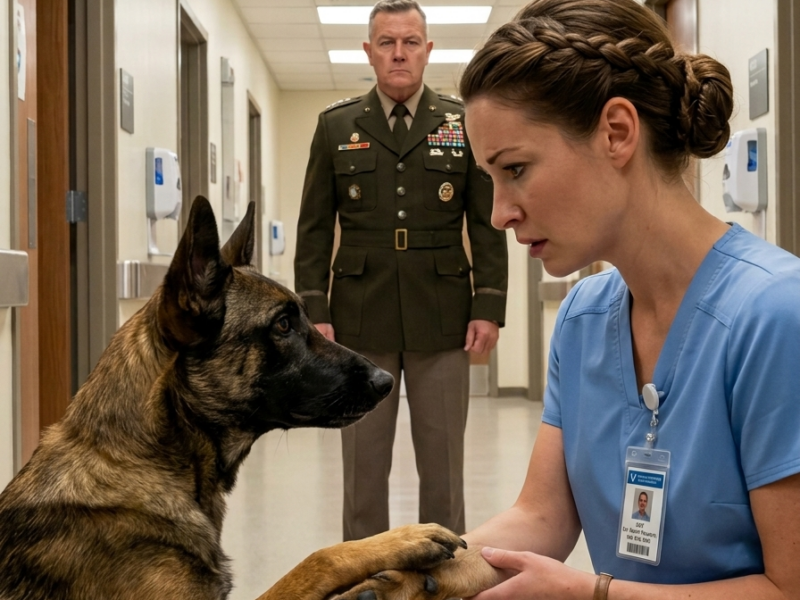
The military dog lunged at me in the middle of the VA hospital lobby, barking so violently that everyone stopped to stare, while my supervisor coldly ordered security to restrain me
The paper cup crumpled beneath my fingers, spilling lukewarm dark roast across the linoleum floor. The brown liquid crept toward the scuffed tips of my nursing clogs, but I could not look down. My eyes were locked on the muscular, quivering frame of the Belgian Malinois five feet in front of me. His sable coat bristled along his spine, every sinew wound like a tripwire, his dark muzzle parted to reveal teeth white as bone. He was not barking in aggression; he was barking with the frantic, desperate cadence of a creature that had stumbled upon a ghost.
Around us, the cavernous atrium of the Richmond Veterans Affairs Medical Center had ground to an absolute halt. The dull murmur of elderly veterans waiting for pharmacy numbers, the squeak of orderly carts, the distant chime of the elevators—all evaporated into a suffocating quiet. Dozens of eyes fixed on me. I was just Emily Carter, the quiet night-shift triage nurse who took extra rotations on holidays, lived in a sparse garden apartment, and never stayed long enough at potlucks to talk about family.
“Ma’am, step away from the dog,” the handler commanded, his boots scraping the floor as he fought the leash. He wore the olive fatigue trousers and black polo of a specialized canine unit, his arms tattooed in fading tribal ink. His jaw was clenched, his knuckles white against the heavy nylon lead. “Do not make any sudden movements.”
“I didn’t do anything,” I whispered, my voice dry as parchment. “I’m just coming off my shift.”
From behind the high curved reception desk, Dr. Miller stepped into the light. Dr. Arthur Miller, the chief of clinical operations—a man who had signed my credentialing paperwork six years ago, a man who had presented me with an employee excellence pin just last winter. But as he looked at me now, the warm paternal demeanor he wore for donors and hospital boards was completely gone. His face had hardened into sharp, cold angles. His eyes were narrowed, assessing me not as a dedicated subordinate, but as a dangerous foreign object that had slipped past a sterile field.
“Take her to the security office,” Miller said, his voice flat, dropping like an iron bar onto the marble floor.
Two armed hospital security guards stepped out from the perimeter, hands hovering inches from their utility belts. My stomach plummeted through the floor. A cold dread, ancient and familiar, flooded my veins. It was the exact sensation of being trapped in an armored cabin while the undercarriage of a vehicle groaned against an unseen pressure plate.
“Doctor Miller, what is this?” I managed, backing up until my shoulder hit the cold drywall. “He startled me, that’s all. It’s a working animal, he might be smelling an antiseptic—”
Before the handler could shorten his grip, Ranger gave a sharp, violent wrench. The clasp tore from the handler’s grip with a loud snap of leather. Women gasped. A retired infantryman in a wheelchair shoved himself backward. But Ranger did not bite. He lunged straight across the slick floor, skidded on the spilled coffee, and planted his broad front paws directly against my chest.
I braced for impact, but the blow was extraordinarily gentle. He leaned his immense weight into me, his warm, wet nose pressing dead-center against the V-neck of my faded blue scrubs. He took one deep, trembling inhalation, and then he dropped into an immediate, textbook sit. He didn’t blink. He looked up at my face, letting out a thin, high-pitched whine that sounded like a tea kettle coming to a boil.
The handler stood frozen, the loose leash dragging on the floor between his combat boots. “So that’s what he remembers,” he said softly, almost to himself.
“Get that animal off her and secure the corridor!” Miller barked, though his voice wavered slightly. His skin had turned the color of wet chalk. His fingers twitched against the hem of his pristine white lab coat. He knew. I could see it in the slight tremor of his bottom lip. He understood what the dog was signaling.
I looked down at Ranger. The dog’s muzzle nudged insistently against my collarbone. Beneath the cotton fabric of my uniform hung a thin, tarnished silver chain. Hidden beneath my undershirt was a thumb-sized silver pendant, shaped like an artillery casing with a small cross notched into the primer. It had belonged to Sergeant Daniel Hayes.
Twelve years. For twelve years, four thousand three hundred and eighty days, I had lived inside the skin of Emily Carter. I had arrived in the United States with a forged birth certificate from an obscure county in Ohio, a clean social security card, and an absolute, non-negotiable directive handed down by men who wore suits without badges: disappear, or be buried.
Before Emily Carter, I was someone else entirely. I had been an operative and field surgeon attached to a covert medical intelligence unit designated as Task Force Blackwood. We did not wear patches. We did not exist on the Department of Defense payroll. We were sent into the border valleys between Khost and North Waziristan to patch up assets that Washington could never officially acknowledge.
Nobody in Richmond knew about the black-budget operations. Nobody knew about the three-vehicle convoy that had rolled into the shadow of the Spinghar mountains on a freezing midnight in November. Nobody knew about the thermite blast that had turned the lead Humvee into molten slag, or the secondary ambush that had claimed the lives of seven men who were officially listed as training casualties across four different military installations.
And nobody knew about Daniel. Sergeant Daniel Hayes had been our point man, the guardian who had pulled my shattered body from the burning wreckage of the second vehicle, his own Kevlar vest soaked in his blood. He had dragged me into an irrigation ditch, shoved his pendant into my hand, and turned back toward the gunfire so the extraction bird could lift off with me inside. The last thing I had seen through the smoke was Daniel collapsing into the mud as the chopper rose.
I reached up with a trembling hand and lightly touched the silver pendant through my shirt. Ranger let out another low, mournful sound, pressing his wet nose firmly against the metal.
The handler reached slowly into his tactical vest. He pulled out a small, battered manila folder, extracted a laminated 4×6 photograph, and held it out. His hand was shaking. “We pulled this from Ranger’s original deployment jacket when his handler records were declassified last week. Take a look, nurse.”
My fingers felt numb, like dead wood, as I took the photograph.
The image was grainy, taken under the sickly green wash of night-vision illumination. There was Daniel, his helmet strapped tight, soot smudged across his cheekbones, his arm slung around a young woman in tactical combat gear. The woman was drenched in arterial blood, holding a trauma kit in one hand and a suppressed sidearm in the other. That woman was me.
My face had been circled in thick, bleeding red grease pencil. And beneath it, written in sharp, block capital letters, were six words that felt like a death sentence:
IDENTITY COMPROMISED. DO NOT TRUST HER.
My lungs seized. “This… this is an old photo,” I stammered, fighting to keep my voice even, fighting the instinct that screamed at me to sprint toward the emergency exits. “This isn’t me.”
“Save it, Emily,” Dr. Miller said. He stepped forward, but he stopped three feet away, as if standing near an unexploded ordnance. He would not meet my eyes. He was looking at the dog, and then at the floor. “Or whatever your name is. We knew this day might come. We just didn’t expect it to happen in the main lobby on a Tuesday.”
“Doctor Miller, you know me,” I pleaded, though every word tasted like ash. “I’ve saved lives in your trauma bays for six years. I’ve covered your shifts. I’ve—”
“You’re a ghost with a pulse,” Miller interrupted, his voice dropping into a harsh, frantic whisper. “And ghosts bring shovels.”
Ranger suddenly broke his sit. His ears swiveled backward, his lips curling over his incisors as a deep, chest-rattling growl vibrated through his ribcage. He spun around, putting his body between me and the hallway, facing the heavy, reinforced steel door of the administrative security office directly behind the reception counter.
The door was locked with an electronic keypad. A red LED glowed above the handle.
Ranger began to bark again—not the searching, recognition bark he had given me, but a vicious, territorial warning. He slammed his front paws against the metal frame of the door, his claws scraping violently against the paint.
The lobby had gone so dead silent that the hum of the fluorescent fixtures sounded like a scream.
Then, from the other side of that reinforced steel door, through the narrow ventilation slit near the floor, a voice drifted out. It was a raspy, damaged voice, scarred by smoke and dry heat, barely louder than a whisper, but it cut through the room like an obsidian blade.
“Layla.”
The name hit me like an electric current.
Layla Vance.
The name had not crossed human lips in twelve years. It was buried in the desert, sealed under three layers of classification, known only to three people in the world. My director, who had died of an apparent stroke in Vienna eight years ago. Dr. Miller, who had clearly known more than he ever let on.
And Daniel Hayes.
The doorknob of the security office slowly, deliberately began to turn.
The heavy brass handle of the security door rattled against its latch, the internal locking mechanism groaning as someone applied immense force from within. Ranger lunged forward, throwing his entire body against the industrial steel slab, his teeth snapping at the air inches from the door’s seam.
“Ranger, heel!” the handler yelled, lunging forward to grab the trailing nylon lead. But the Malinois was completely deaf to commands now. His tail was stiff, his hackles raised in a jagged ridge from his neck to the base of his spine.
“Get him away from that door!” Dr. Miller screamed, his face shedding every ounce of bureaucratic composure. He waved wildly at the two security guards who had originally approached me. “Don’t just stand there! Call code black! Lock down the lobby! Lock it down right now!”
“Doctor Miller, who is in that room?” I demanded, my voice cutting through his panic. The timid nurse persona was sloughing off me like peeling skin. My spine straightened; the muscle memory of combat posture, dormant for over a decade, took over before my conscious mind could stop it. I stepped toward Miller, my eyes locking onto his darting gaze. “Who is in there?”
“You don’t understand what you walked into today, Layla,” Miller whispered, his voice cracking on the syllables of my true name. “You think you were hidden? You think this hospital was a coincidence? You think I gave you a nursing credential out of the goodness of my heart?”
The security guards moved in. The taller one, a burly man named Davis whom I had shared coffee with in the breakroom just yesterday, reached for my wrist with a pair of steel handcuffs. “Ma’am, please keep your hands where I can see them.”
I didn’t think; I reacted. As Davis’s fingers grazed my forearm, I caught his thumb, stepped inside his reach, and twisted his wrist downward in a fluid, circular motion. The joint locked. Davis let out a sharp cry of pain, his knees buckling toward the floor. In the same breath, I reached with my left hand, slipped the retention strap on his duty holster, and pressed the palm of my hand firmly against the butt of his sidearm, preventing him from drawing it.
The lobby erupted into screaming. Elderly patients scattered toward the glass automatic doors, walkers and canes clattering against the ground. Hospital receptionists ducked beneath their desks, pulling telephone cords and slamming panic buttons.
“Nobody touch her!” the dog handler shouted, drawing his own weapon—a standard-issue compact Glock—and pointing it not at me, but directly at the locked security door. “Miller! Who is on the other side of that access point? That’s a restricted sector! The badges are tied to regional command!”
“He wasn’t supposed to wake up yet!” Miller shrieked, backing away toward the pharmacy corridor, his hands clawing at the wall for balance. “The transfer was scheduled for zero-three-hundred tomorrow! He was chemically sedated!”
A heavy, metallic thud echoed from the other side of the security door. Then another. It wasn’t the sound of someone knocking. It was the sound of a heavy fire extinguisher or an oxygen tank being used as a battering ram against the reinforced electronic strike plate.
Crack.
The red LED above the handle blinked violently, flickered to yellow, and then went dark. The lock shattered.
The door swung outward with a deafening screech of stressed hinges.
Ranger let out an ear-splitting bark and sprang forward, but he didn’t attack. The moment the door cleared the frame, the dog dropped flat onto his belly, whining in absolute submission, his front paws stretched out, his tail thumping the floor in a frantic, desperate rhythm.
A man stepped through the threshold.
He was tall, but his frame was dangerously gaunt, draped in gray institutional scrubs that hung from his wide shoulders like a shroud. His skin had the sickly, translucent pallor of someone kept away from natural sunlight for years. Thick, jagged scar tissue ran from behind his left ear, across his jawline, and down into his collar, puckering the skin where severe burns had healed without proper plastic surgery. His right eye was clouded with a pale milky film, completely blind, but his left eye—a piercing, storm-gray iris—was wide, focused, and burning with feral intelligence.
In his right hand, he held an empty, dented steel oxygen canister, its valve hissing faintly.
“Daniel,” the breath left my lungs in a ragged gasp.
Twelve years of grief, twelve years of sleepless nights staring at the ceiling of my apartment, twelve years of telling myself that the smoke in the valley had swallowed him whole—shattered in a fraction of a second. He was alive. Broken, scarred, emaciated, but breathing.
Sergeant Daniel Hayes lowered the heavy steel canister. His left eye traveled slowly across the room, ignoring the weapons drawn on him, ignoring the flashing red emergency strobes that had begun to pulse along the ceiling, until his gaze landed squarely on my face.
A ghost of a smile touched his chapped, scarred lips. “You kept the chain, Doc.”
“Daniel… how?” I took a step toward him, tears blurring my vision for the first time since the night we burned in Afghanistan. “They told me you were KIA. They showed me the incident report. They gave me your personal effects.”
“They lied to you, Layla,” Daniel said, his voice grating like stones grinding together in a riverbed. He raised his left arm. Around his wrist was an orange biometric tracking band, pulsing with a faint blue synchronization light. “Just like they lied to me. They told me you died in the helicopter. They told me you bled out before you hit the field hospital in Bagram.”
“Step back from the prisoner!” a new voice barked from the far end of the lobby.
Three men in dark civilian suits and tactical vests, bearing no insignia, stepped into the lobby from the administrative elevator bank. They were carrying short-barreled carbines, their movements synchronized, professional, lethal. They were not hospital security. They were private contractors—the same breed of clean-cut mercenaries who used to handle perimeter security for Task Force Blackwood’s black sites.
“Contain the perimeter,” the lead contractor ordered into a throat mic, raising his weapon. “Non-lethal authorization is revoked. Subject Hayes is active and hostile. The female is the compromised asset. Terminate on sight if resistance is offered.”
“Miller, you bastard!” Daniel roared.
With blinding speed that defied his wasted physique, Daniel hurled the steel oxygen canister across the lobby. It whistled through the air and struck the lead contractor squarely in the chest with a sickening crunch of Kevlar and bone. The man collapsed like a marionette with severed strings.
“Layla, down!” Daniel shouted, lunging forward.
Gunfire erupted. The sharp, concussive cracks of suppressed 5.56 rounds tore through the lobby, shattering the heavy glass windows of the administrative offices into shimmering curtains of ice. Ranger sprang into action, biting down viciously on the arm of the second contractor, dragging him to the floor in a flurry of snarling fury and tearing fabric.
I didn’t hesitate. Twelve years of peaceful civilian life vanished into thin air. I scooped up the sidearm from the holster of the unconscious guard at my feet, dropped behind the reinforced concrete lip of the reception counter, and returned fire. Two controlled rounds struck the remaining contractor’s tactical vest, knocking him off balance and driving him back into the elevator alcove.
“The service stairs!” Daniel yelled, grabbing my wrist with a grip that was cold, hard, and desperate. “Move, Doc! Before they drop the blast gates!”
I held tight to his hand, feeling the severe ridges of scar tissue beneath his skin. Behind us, Ranger broke off his attack and fell into position at Daniel’s flank, bounding across the slick floor as the three of us sprinted toward the double doors marked Emergency Maintenance Only.
As we burst through the doors and into the dim, concrete stairwell, Dr. Miller’s frantic voice echoed over the hospital’s public address system, warped by panic and static:
“Attention all units! Facility breach! Lock the subterranean exits! They cannot be allowed to reach the archives!”
The heavy fire door slammed shut behind us, cutting off the immediate chaos of the lobby, but the rhythmic blare of the facility’s alarm system chased us down the concrete stairwell. The sirens down here were different—not the high-pitched digital warble used for civilian fire drills, but a low, vibrating horn that pulsed through the concrete walls, shaking the dust from the overhead conduits.
“Down! Not up!” Daniel gasped, his boots clattering against the metal grid of the stairs. His breath came in ragged, wheezing pulls, one hand clutching his side where his ribs had clearly been broken and poorly set.
“Daniel, the lower levels are dead ends,” I said, keeping my sidearm raised as I scanned the descending landings. “The basement only leads to the laundry facilities, the morgue, and the boiler rooms. If they seal the elevator shafts, we’re cornered.”
“That’s what the blueprints show on the civilian permits,” Daniel said, coughing hard into the crook of his elbow. A fleck of dark blood stained his gray sleeve. Ranger stayed tight to his hip, descending the steps two at a time, pausing at each landing with his nose pressed against the fire doors, checking the scent before clearing the way. “Blackwood didn’t leave this hospital when the war ended, Layla. They bought it. They built beneath it.”
We hit the sub-basement landing—a level marked on the wall as B-3: HVAC & Maintenance. The air was noticeably colder here, thick with the scent of ozone, damp concrete, and industrial hydraulic fluid.
Daniel bypassed the primary maintenance door and limped ten yards down the narrow corridor to an unmarked utility alcove lined with heavy copper pipes. Behind a nest of insulated coolant lines sat an old circuit-breaker panel, rusted around the screws. He shoved the panel door open, reached inside past the dead fuses, and pulled a heavy mechanical lever downward with all his remaining strength.
A low hiss of compressed air echoed beneath our feet. A ten-foot section of the poured concrete wall shuddered, ground back half an inch, and slid horizontally on hidden steel rollers, revealing a brightly lit, sterile white corridor that stretched into the subterranean darkness.
The contrast was shocking. The hallway was pristine, lined with frosted glass panels, stainless steel conduits, and recessed fluorescent lighting that flickered with sterile white brilliance. It smelled of clinical disinfectant and cold air-conditioning—the unmistakable scent of a deep-tier research facility.
“What is this place?” I asked, my heart hammering against my ribs as Daniel led the way inside. Ranger trotted ahead, his nails clicking sharply on the polished composite floor, completely comfortable in the environment.
“This is Project Lethe,” Daniel said, leaning against the sterile wall to catch his breath. He looked at me with his one good eye, the pale iris reflecting the clinical glare of the ceiling. “Do you remember the night the convoy was hit in the valley?”
“I think about it every single day,” I said, swallowing hard. “We were transporting medical crates from the field lab outside Gardez. We hit an anti-tank mine. The thermite blew the lead truck.”
“It wasn’t a mine, Layla,” Daniel said quietly. He pushed himself off the wall and began walking down the corridor. “And the crates weren’t containing plasma or antibiotics. They were containing us. Our blood samples. Our neurological scans. The clinical trial records from the third battalion.”
I stopped dead in the center of the white hallway. “What are you talking about?”
“Why do you think only our unit was sent into those valleys without radio clearance?” Daniel turned, his scarred face twisted in bitter anger. “Why do you think you were ordered to administer those experimental neuro-protectant cocktails to the men before every high-altitude recon run? You thought you were protecting us from nerve agents. You were injecting us with synthetic viral delivery vectors designed to inhibit traumatic memory consolidation.”
The memory hit me with the force of a physical blow. The small, unmarked vials of amber liquid. The strict orders from the Task Force commander: Administer within twenty minutes prior to breach. No documentation required in standard field journals. I had pressed those syringes into the shoulders of Daniel and six other men. I had watched their pupils dilate, had logged their vitals, believing I was their shield against unconventional biological warfare.
“They were testing chemical amnesia on combat units,” I whispered, the horror rising in my throat like bile. “They wanted soldiers who couldn’t be broken by PTSD.”
“They wanted soldiers who didn’t remember what they were ordered to do,” Daniel corrected fiercely. “They wanted wetware that could execute black-bag operations on sovereign soil and wake up the next morning without a conscience. But the cocktail had a flaw. It caused acute hemorrhagic necrosis in seventy percent of the test subjects after sixty days. The six men in our vehicle weren’t killed by the ambush, Layla. They died before we ever reached the valley floor. Their organs failed. That ambush was staged by Blackwood to incinerate the evidence.”
“Then why were we spared?”
“You weren’t supposed to be spared,” Daniel said, his voice dropping into a dark register. “You survived the blast because you were in the rear jump seat. When I pulled you out, I realized what was happening. I had swiped the operational logs from the commander’s safe before we rolled out. I took your dog tags and swapped them with a local casualty we had in the body bag. I hid you. But Miller… Miller was the senior medical officer on the extraction bird. When he saw you were alive, he couldn’t kill you openly because the conventional aircrew was watching. So he made you disappear under a deep-cover alias, keeping you close where he could monitor your blood chemistry.”
“The hospital…” My mind raced through the past six years. “Every year, during the mandatory employee health screenings… the blood draws. The cognitive baseline surveys Miller personally administered to me.”
“He was testing you,” Daniel said. “Making sure the secondary exposure to the aerosolized agent during the explosion didn’t trigger delayed recall. He was keeping you in a cage with invisible bars. And me? They locked me down here. For twelve years, Layla. Twelve years of spinal taps, electro-convulsive resets, and chemical washes. They wanted to know why my brain resisted the compound. They wanted to extract the antibody.”
A soft, mechanical chime sounded down the hall.
At the far end of the white corridor, a pair of heavy pneumatic doors began to retract. From the ceiling, high-definition security cameras swiveled in unison, their red optical sensors tracking our movements.
A voice boomed through hidden intercom speakers—not Dr. Miller’s frantic voice, but a deep, cultured baritone that sent a wave of icy terror down my spine.
“Fascinating reunion, isn’t it?”
Daniel froze, his hands clenching into fists so hard the scars on his knuckles stretched white.
“General Vance,” Daniel hissed.
I felt the ground disappear beneath me. Vance.
“Hello, daughter,” the voice purred through the speakers. “I must admit, Arthur Miller was entirely too soft on you. I told him six years ago that keeping you within sight was a sentimental indulgence. But then again… you always did have your mother’s stubborn heart.”
The name echoed off the polished composite floor, vibrating through the cold, artificial air until it felt like the walls were pressing in against my ribs.
General Marcus Vance.
My father.
The man whose military uniform had hung pressed and immaculate in our hall closet throughout my childhood. The man who had presented me with my commission into the Army Medical Corps with a solemn, unsmiling salute. The man who had supposedly suffered a fatal cerebral hemorrhage in an Austrian field hospital eight years ago, his ashes buried with full honors in Arlington National Cemetery.
“He’s dead,” I said, my voice barely carrying over the hum of the ventilation shafts. My fingers were trembling against the grip of the stolen pistol. “I attended the memorial service. I stood by the empty casket.”
“An empty casket is the easiest thing in the world to buy, Layla,” the intercom speaker responded smoothly. “Especially when you write the manifest for the transport plane.”
A soft pneumatic hiss sighed along the corridor walls. The frosted glass panels lining the hallway suddenly shifted from opaque white to transparent, revealing the monstrous truth of what lay beneath the civilian hospital.
Behind the glass were rows of pressurized containment suites. Inside each suite sat a hospital bed, surrounded by banks of automated intravenous pumps, EEG monitors, and cryo-preservation cylinders. And in those beds were men and women. Some were young, barely twenty years old, dressed in standardized gray scrubs; others were older veterans with fading service tattoos on their forearms. Clear silicone masks covered their noses and mouths, pumping a faintly iridescent vapor into their lungs. Their eyes moved rapidly beneath closed lids in the fitful, endless rhythm of chemically induced REM sleep.
“Project Lethe didn’t die in the Spinghar mountains, my dear,” Marcus Vance’s voice continued, reasonable and calm, like a professor explaining a rudimentary biological mechanism to a lecture hall. “It merely matured. Those men and women behind the glass are our nation’s finest combat veterans, broken by the horrors of urban warfare, crippled by guilt, suicide risk, and phantom limbs. We are offering them the greatest gift a soldier can receive: the erasure of consequence.”
“You’re lobotomizing them,” I shouted at the security camera mounted above the door, fury burning away the last remnants of my shock. “You’re wiping their minds and turning them into lab rats!”
“We are curing trauma at the cellular level,” Vance replied, his tone chillingly dismissive. “A soldier who cannot remember fear cannot be broken by it. A nation that can deploy lethal force without the subsequent burden of veteran care, psychiatric collapse, and political dissent is an invincible nation. But the original synthetic vector had an unfortunate design limitation. It decayed rapidly unless bound to a specific genetic receptor—a rare mitochondrial enzyme mutation.”
Daniel stepped forward, positioning his body directly between the overhead camera and me. “Leave her out of this, Vance. You’ve got me. You’ve been draining my bone marrow for a decade. Let her walk.”
“Don’t be absurd, Sergeant Hayes,” the voice chuckled softly. “You were merely the accidental carrier. Your genetic resistance was an anomaly, a damaged sequence caused by your childhood malaria treatments in East Africa. It took my researchers seven years to realize that the stable, transferable genome wasn’t in your marrow. It was in Layla’s.”
The cold air rushed out of my lungs. “What?”
“Why do you think I sponsored your medical education, Layla?” Vance said, the voice dripping with predatory pride. “Why do you think I assigned you to Task Force Blackwood? You carry a natural, hereditary duplication of the CHRNA7 neuro-receptor gene. My gene. Your mother fought me when I tried to sequence your blood as a child. She called it monstrous. So I waited until she was gone, and I waited until the war gave me the operational freedom to harvest what was rightfully mine.”
The realization settled into my bones like lead. The deployment to Afghanistan. The specific medical unit. The strange blood work Miller had ordered every year under the guise of an occupational health screen. I wasn’t just a compromised witness hiding in plain sight.
I was the seed stock.
“Miller didn’t keep you here to protect you from the government, Layla,” Vance said. “He kept you here as an incubator. We needed your immune system to fully mature past your thirty-fifth year to harvest the stable stem-cell cultures from your lumbar spine. And tomorrow morning was scheduled to be your harvest date. But Sergeant Hayes, with his infuriating habit of surviving explosions, managed to regain consciousness three days ahead of schedule.”
A heavy steel security gate at the far end of the corridor slid open with a deafening screech.
Three figures stepped through. In the center walked Dr. Arthur Miller, his lab coat stained with coffee and soot, holding a tablet computer that controlled the facility’s internal magnetic locks. Flanking him were two heavily armed private security operators wearing full tactical helmets, their assault rifles leveled squarely at our chests.
Behind them, seated in a high-backed mechanized wheelchair, sat General Marcus Vance.
His hair was pure white, cut in a severe military trim. His face was identical to the portrait I had kept on my mantle for a decade, except for the cold, dead mechanical gaze in his eyes and the network of surgical tubes disappearing beneath the collar of his tailored wool suit. A portable filtration unit hummed softly beside his chair, recycling the blood through his frail, dying body.
“Layla,” Miller said, his hands visibly shaking as he tapped the tablet screen. “Please. Just put the weapon down. Nobody wants to hurt you. The General needs the bone marrow synthesis. His renal systems are collapsing. If we perform the extraction today, you’ll survive. You’ll wake up in forty-eight hours with no memory of this room, no memory of Daniel, no memory of the war. You’ll just be Emily Carter. A happy, peaceful nurse with a clean slate.”
“A clean slate?” I echoed, stepping out from behind Daniel. My grip on the pistol was rock solid now. The terror had calcified into a pure, incandescent rage. “You murdered seven soldiers in that valley. You kept Daniel in a cage for twelve years. You turned this hospital into a slaughterhouse for the minds of men who gave everything for this country.”
“They gave their minds to save their lives!” Vance snapped from his chair, his pale hand gripping the armrest so hard the knuckles clicked. “Look at Hayes! A broken, scarred derelict! What did his memories buy him? Twelve years of agony! If he had forgotten the valley, he would have lived in peace!”
“I remembered her,” Daniel said quietly, his voice low, steady, and filled with a terrifying, serene power. “Every time you strapped me to that table, every time you ran the high-voltage currents through my temporal lobes, I held onto her face. I held onto the necklace. You can burn out the names, Vance. You can burn out the dates and the maps. But you can’t burn out love. It leaves a scar you can’t erase.”
Vance’s face darkened, twisting with disgust. “Shoot the dog. Restrain the subjects.”
The contractor on the left raised his weapon, shifting his sight toward Ranger.
Before his finger could depress the trigger, Ranger acted. Belgian Malinois do not hesitate; they do not calculate odds. Trained on the frontline of combat, his instincts were wired for one thing: protect the handler. Ranger leaped six feet through the air, his jaws clamping like a hydraulic vice around the operator’s forearm, dragging the barrel downward just as a burst of automatic fire erupted into the floor tiles.
“Daniel, run!” I screamed, firing two rounds directly into the chest plate of the second contractor.
The enclosed concrete corridor detonated with sound. The muzzle blasts were blinding, the concussive pressure waves slapping against my eardrums as the contractor I had shot stumbled backward, his body armor absorbing the kinetic energy of the 9mm rounds.
Daniel didn’t run. He lunged straight for Dr. Miller.
With a feral roar that tore the remaining scar tissue in his throat, Daniel tackled Miller to the floor, driving his knee into the doctor’s sternum. The tablet computer flew from Miller’s hands, skittering across the polished floor toward the wheelchair where my father sat.
The first contractor slammed Ranger against the reinforced glass of a containment suite, trying to dislodge the dog’s crushing grip on his forearm. The glass cracked in a spiderweb pattern, but Ranger refused to release, his growls vibrating through the operator’s tactical sleeve as he dragged the man down to the ground by sheer deadweight.
I pivoted toward the second contractor. He was recovering, swinging his short-barreled carbine toward my center mass. I didn’t have time to re-acquire a sight picture. I dropped my center of gravity, slid across the slick composite tiles beneath his line of fire, and drove my right foot directly into the side of his knee joint.
Crack.
The contractor shrieked in agony as his leg buckled inward at a grotesque angle. As he fell, I swept his rifle aside with my forearm, pressed the muzzle of my sidearm against the unarmored junction between his neck and shoulder, and pulled the trigger.
The man went limp.
Across the hallway, Daniel had Miller pinned by the throat against the shattered glass partition. The doctor’s face was turning purple, his hands clawing uselessly at Daniel’s scarred, sinewy wrists.
“The overrides!” Daniel snarled, spitting blood onto Miller’s glasses. “Where are the primary storage servers? Tell me before I tear your windpipe out of your neck!”
“Console… behind the General,” Miller gasped, his eyes bulging with terror. “The red interface… it purges the local backups… it dumps the environmental data to the external network…”
“Enough!”
A voice like dry leaves scraping over stone cut through the smoke.
I spun around.
Marcus Vance had risen from his mechanized wheelchair. In his withered, trembling right hand, he held a sleek, silver palm-sized detonator. His breathing was rapid, shallow, his pale skin glistening with cold sweat as his failing kidneys buckled under the strain of standing.
“You think you’ve won something here, Layla?” Vance wheezed, his mouth twisting into a ghastly, ruined smile. “You think you can expose this? The moment this facility’s perimeter is breached by unauthorized personnel, the emergency protocol initiates. In three minutes, sixty liters of chlorine trifluoride will vent through the HVAC system of this sub-basement. Every living cell down here will be reduced to ash. The bodies behind that glass. Hayes. You. Me. The research is already backed up on offshore servers in Zurich. You change nothing.”
“You’d kill your own men?” I said, raising my weapon until the front sight was aligned dead-center between his cold, gray eyes. “You’d incinerate forty veterans to hide your failure?”
“They are casualties of war,” Vance said, his finger tightening over the illuminated button on the detonator. “Just like you were supposed to be.”
“No,” a voice rasped from the floor.
Ranger had broken away from the incapacitated guard. The Malinois was bleeding from a deep laceration across his shoulder, his breath coming in shallow pants, but his dark eyes were locked on the silver metal cylinder in Vance’s hand.
To a military working dog, a small, metallic object clutched in an aggressive posture isn’t a detonator. It’s an ordnance. It’s a threat.
“Ranger, take!” Daniel roared, pointing his arm forward.
The dog did not hesitate. He launched himself across the six-foot gap between the floor and the wheelchair, his jaws closing around Marcus Vance’s right wrist with bone-shattering force.
Vance shrieked in genuine, pathetic terror as he was violently ripped off his feet, crashing onto the hard floor. The detonator tore free from his grip, sliding across the bloody floor toward my feet.
I stepped forward and brought my combat boot down with all my weight, smashing the plastic casing and its electronic circuitry into a dozen useless fragments.
“No!” Vance screamed, his voice cracking into a high-pitched wail as Ranger stood over him, pinning the old man’s chest to the floor with two massive paws, a single warning growl rumbling in the dog’s throat. “Layla! I am your father! You cannot leave me down here! You took an oath! You are a physician!”
I walked over to the primary console mounted behind his wheelchair.
The terminal was active, its screen displaying the internal schematics of Project Lethe. Columns of encrypted medical data, neuro-chemical formulas, and patient manifests flickered in green text. Beside the keyboard sat a heavy, industrial red lever marked FACILITY WIDE VENTILATION PURGE / CIPHER BROADCAST.
Beside the console lay a standard USB data drive used for classified server migration. I grabbed it, jammed it into the master terminal, and typed the single access code that had been burned into my mind during my officer training—my mother’s maiden name followed by the coordinates of our home in Ohio.
Access Granted.
The transfer began. Millions of pages of illegal human trials, black-budget financial records, operational logs from Task Force Blackwood, and the true death manifests of seven soldiers who had been declared collateral damage.
I routed the broadcast destination not to a private server, but to the public press room of the Department of Veterans Affairs, the Inspector General’s office, and three major national news networks simultaneously.
Transmission Complete: 100%.
“It’s done,” I said quietly.
I pulled the red ventilation lever.
Across the facility, the low, suffocating hum of the recycled chemical air stopped. Overhead vents hissed open, and the fresh, cold autumn air from the ground-level intake shafts rushed into the sterile white tomb, clearing the smoke, the ozone, and the chemical fog.
Behind the glass, the automated drug delivery pumps clicked off one by one. The iridescent vapor cleared from the breathing tubes. In the nearest suite, a young soldier with a sleeve of Marine Corps tattoos blinked his eyes open, his chest rising with natural, clean air for the first time in months.
Daniel walked over to me, his hand resting gently on my shoulder. His breathing was still rough, his body pushed far past the limit of human endurance, but the shadow that had lived in his eyes for twelve years was finally gone.
“Where do we go now, Doc?” he asked softly.
Ranger stepped away from the weeping, defeated old man on the floor and trotted over to us, pressing his cold nose against my hand.
I looked down at the silver pendant resting against my collar, the small cross shining under the clean, white light. I thought of the small apartment in Virginia, the cheap groceries, the quiet life of Emily Carter that had kept me safe in the dark.
That life was over. The ghost had dug herself out of the grave.
“We go upstairs, Daniel,” I said, sliding the data drive into my pocket and reaching down to scratch Ranger behind his torn ears. “We tell the world their names.”
The end









