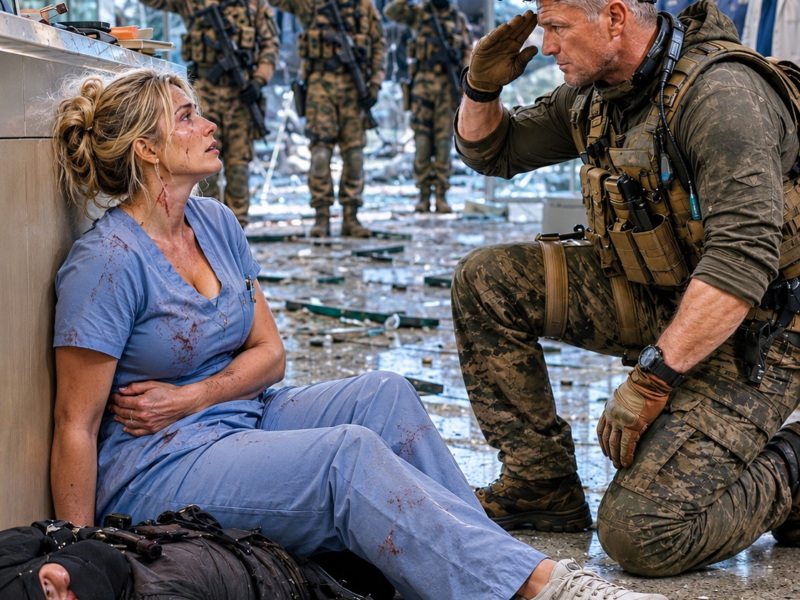
The men who stormed the emergency room thought they had walked into a hospital full of helpless people
The gunshot echoed through Hargrove Memorial Hospital.
For one suspended second, nobody moved.
Then Marcus Rasque raised his weapon and gave a sharp signal to his team.
“Second floor. East corridor. Move.”
Four operators separated immediately, two heading toward the stairwell and two taking the service access Norah had identified. The remaining members secured the emergency department, keeping their weapons trained on the entrances and the men already lying on the floor.
Norah stood beside the central nursing station, the radio still in her left hand.
Blood had dried along her cheekbone. Her scrubs were torn near the shoulder, and her breathing was finally beginning to slow.
Rasque looked at her.
“Put the weapon down, Voss.”
She glanced at the pistol in her right hand.
“There’s a patient in the waiting area with a probable heart attack. Your perimeter is going to interfere with the transfer if you close the main corridor.”
“Norah.”
“His symptoms started before the hostage situation. He needs monitoring, an EKG, and cardiology. Dr. Walsh is treating him.”
Rasque stared at her for another moment.
Then he turned toward one of his operators.
“Keep the medical corridors open. Coordinate with hospital staff. Nobody interferes with patient transfers unless there’s an immediate threat.”
Only then did Norah lower the pistol.
Rasque approached her slowly.
“Four years,” he said.
“Almost four.”
“I heard you left.”
“I did.”
“I heard you weren’t coming back.”
“I wasn’t planning to.”
He looked at the blood on her face.
“Apparently, nobody asked the people who needed you.”
Norah didn’t answer.
Across the emergency department, Dr. Preston Walsh was standing beside the cardiac cart. He had just finished reviewing the older patient’s EKG and was speaking with the cardiology team over the phone.
He looked up.
For the first time since Norah had joined Hargrove Memorial, he seemed completely unsure what to say to her.
The first tactical operator returned seven minutes later.
“East corridor clear. We found an access door propped open near radiology. No confirmed subject.”
Rasque nodded.
“What about the overhead walkway?”
“Still checking.”
Norah looked toward the ceiling.
“There’s another way into that walkway.”
Rasque turned.
“Where?”
“Maintenance access behind the old imaging storage room. It connects to the second-floor service corridor.”
“How do you know?”
“I used it when I was looking for a faster route between the medication room and the monitored bays.”
He studied her.
“You’ve been mapping this building?”
“I’ve been working here.”
The distinction seemed to amuse him, although he didn’t smile.
“Show me.”
Norah started toward the corridor.
Rasque immediately stepped in front of her.
“No.”
She stopped.
“That access point is closer to the emergency department than the stairwell. If someone’s still there, you need to know.”
“I have people for that.”
“I know.”
“Then let them work.”
Norah looked at him.
Four years ago, she would have recognized the tone immediately. It was the same voice he used when he was trying to keep a medic out of a dangerous position because he needed that medic alive for the people behind him.
It wasn’t an insult.
It was concern.
She handed him the radio.
“Then give me a medical assessment of the injured officers and I’ll stay here.”
He accepted the compromise.
“Good.”
Norah returned to the treatment area.
The moment she stepped through the doors, the familiar hospital environment came rushing back.
Except nothing was familiar anymore.
The floor was littered with discarded gloves, overturned equipment, and broken pieces of ceiling tile. Several patients were crying. One nurse was sitting against a wall with her hands wrapped around her knees.
Lena Marsh emerged from examination room two.
She looked as though she’d aged ten years in the last hour.
“Norah?”
Norah turned.
Lena walked toward her, then stopped when she saw the cut on her cheek.
“You’re hurt.”
“It’s superficial.”
“You were bleeding.”
“So were several other people.”
Lena’s eyes filled.
“I thought they were going to kill us.”
Norah looked at the young nursing assistant for a moment.
“I know.”
Lena swallowed.
“You told me to stay under the table. I heard everything. I heard them moving around outside. I thought they were going to come back.”
“You did exactly what I asked.”
“I couldn’t do anything.”
“You stayed alive. That mattered.”
Lena lowered her head.
For the first time since the attack began, Norah saw someone look at her without fear, suspicion, or professional judgment.
Just gratitude.
“Thank you,” Lena whispered.
Norah nodded and moved toward the next patient.
She didn’t know what else to say.
At 12:43 a.m., the hospital’s emergency department was officially placed under a temporary security lockdown.
Local police arrived in numbers. Paramedics transported the injured officers. The seven attackers were accounted for, though several required medical treatment before they could be transferred into custody.
The suspected organizer outside the building remained unidentified.
The man from Bay 7 was still alive and remained under police protection.
And the man who had fired the warning shot from the overhead walkway was missing.
That last detail bothered Norah.
She had expected the tactical team to find him quickly.
They hadn’t.
Rasque returned to the central station with a tablet in his hand.
“Voss.”
She was documenting the waiting-room patient’s condition.
“Yes?”
“I need you to look at something.”
She finished the entry and followed him to an unused consultation room.
He closed the door.
For several seconds, neither spoke.
Then he placed the tablet on the table.
A photograph appeared on the screen.
It showed the second-floor walkway, taken from a security camera positioned near the radiology entrance.
A man was standing beside the glass railing.
He wore dark civilian clothing and carried a small black bag.
His face was partially turned away from the camera.
Norah studied the image.
“Is that the shooter?”
“We don’t know.”
“How long was he there?”
“According to the footage, at least twenty minutes before the first gunman entered the emergency department.”
Norah leaned closer.
“That means he wasn’t reacting to the situation.”
“Correct.”
“He was waiting.”
Rasque nodded.
“There’s something else.”
He swiped to another photograph.
This one showed the ambulance bay entrance.
A vehicle had been parked across the street, partially hidden behind a delivery truck.
The image was grainy, but the license plate was visible.
“Police traced it to a rental company,” Rasque said. “The vehicle was rented under a false identity.”
“Who rented it?”
“We’re still working on that.”
Norah looked at the photograph again.
“What’s in the bag?”
“We don’t know.”
“Did your people recover it?”
“No.”
She looked up.
“Then where is it?”
Rasque didn’t answer immediately.
“That’s what we’re trying to determine.”
Norah sat back.
The attack had been too coordinated to be improvised. Someone had known exactly which patient they wanted, how many officers were guarding him, and how to enter a hospital without immediately triggering a full evacuation.
The man on the walkway had been positioned as a contingency.
But a contingency for what?
“Who was the patient in Bay 7?” she asked.
Rasque watched her carefully.
“His name is Daniel Mercer.”
“Why did those men want him?”
“He’s connected to an investigation involving a trafficking network operating across several states.”
Norah’s expression didn’t change.
“Connected how?”
“He was arrested after a vehicle stop. He sustained gunshot wounds before police brought him here. Investigators believe he was involved in transporting people and coordinating payments.”
“Then why rescue him?”
“Because he may have information about the organization.”
“Or because they don’t want him talking.”
“Exactly.”
Norah looked down at the photograph.
“Someone knew he’d be here.”
“Yes.”
“Someone knew the police would be guarding him.”
“Yes.”
“And someone knew this hospital’s layout.”
Rasque nodded.
“That’s why we’re investigating the possibility of an information leak.”
Norah looked at him.
“Inside the hospital?”
“Possibly.”
He let the word sit between them.
Then he asked the question she had been avoiding.
“How long have you been working here?”
“Fourteen months.”
“Have you told anyone about your previous service?”
“No.”
“Not even Walsh?”
“Especially not Walsh.”
Rasque finally smiled.
It was brief and tired.
“Still the same.”
Norah didn’t return the smile.
“I’m not the same.”
“I know.”
He looked at the tablet again.
“That’s actually why I came to speak with you.”
Four years earlier, Norah had been stationed at a temporary medical facility overseas.
She had been twenty-four.
Her team supported special operations units operating in difficult terrain, often working far beyond the reach of conventional medical facilities.
Their job was simple to describe and difficult to survive.
Keep people alive long enough to get them home.
Norah had been exceptionally good at it.
She wasn’t the loudest medic. She didn’t compete for attention or tell stories about dangerous assignments.
She remembered details.
Which soldier had an old shoulder injury. Which operator concealed pain. Which patient was likely to deteriorate before his vital signs made it obvious.
Rasque had noticed her during a difficult deployment.
He was leading a small operational element when an unexpected attack left several members injured.
Norah worked through the casualties with a calmness that had impressed even the most experienced people in the unit.
She treated injuries, coordinated evacuation, and stayed with a critically wounded operator until transport arrived.
Nobody called her a hero.
They didn’t need to.
She had become someone the team trusted.
But the final months of her service changed everything.
A mission ended badly. Several people were injured, and Norah was involved in the medical response that followed.
The official reports were classified.
The personal consequences weren’t.
She lost people she had worked beside. She began having difficulty sleeping. Ordinary sounds sometimes pulled her attention toward exits and corners before she even understood why.
She finished her service and left.
Rasque had spoken to her before she departed.
He told her she had done enough.
She remembered answering that she wanted a life where saving someone didn’t involve looking over her shoulder.
He hadn’t tried to convince her otherwise.
Now, four years later, he was standing in front of her in a Nevada hospital.
And she was once again the person everyone expected to know what to do.
At 1:20 a.m., Dr. Walsh found her outside the medication room.
He was carrying two cups of coffee.
He offered one.
Norah looked at it.
“Is this an apology?”
Walsh paused.
“No.”
“Then what is it?”
“Coffee.”
She accepted it.
He leaned against the wall.
For a while, neither spoke.
Then Walsh said, “I watched you tonight.”
Norah took a sip.
“I noticed.”
“I don’t think I understood what I was looking at.”
“Most people don’t.”
He looked toward the treatment area.
“I’ve worked with you for fourteen months. I’ve written you up twice. I’ve criticized your communication. I’ve told people you weren’t leadership material.”
Norah didn’t interrupt.
“I thought you lacked initiative,” he continued. “I thought you were competent at routine nursing tasks but didn’t have the confidence to make decisions.”
She looked at him.
“And now?”
He exhaled.
“Now I’m wondering how many times you recognized something important and I never noticed because I wasn’t paying attention.”
Norah considered that.
“Tonight wasn’t about proving anything.”
“I know.”
“I didn’t do what I did because I wanted you to see it.”
“I know that too.”
He looked genuinely uncomfortable.
“That doesn’t make what I did acceptable.”
“No.”
The answer was quiet.
Walsh nodded.
He seemed to have expected an easier response.
“I owe you an apology,” he said.
“Yes.”
“I should have listened to you more carefully. Especially when you flagged that woman with the STEMI earlier.”
Norah looked at him.
“She got to the cath lab.”
“Because you caught it.”
“Because you acted on it.”
He shook his head.
“You’re giving me too much credit.”
“Then stop giving me too little.”
Walsh looked at her for several seconds.
Then, unexpectedly, he laughed once.
Not because anything was funny.
Because he recognized the truth of what she’d said.
“Fair enough.”
He placed his coffee on the counter.
“I don’t know what happens after tonight. There’ll be investigations, reports, interviews. Hospital administration will want to know everything.”
“They can ask.”
“Will you tell them about your service?”
“If it becomes relevant.”
“Will you stay?”
That question took longer to answer.
Norah looked through the glass toward the emergency department.
Lena was helping another nurse organize supplies. Drummond was speaking to an officer. The older man from the waiting area was being prepared for transfer.
The hospital was slowly returning to the business of keeping people alive.
“I don’t know,” she said.
Walsh nodded.
“I wouldn’t blame you if you left.”
Norah didn’t answer.
She wasn’t ready to make that decision.
At 2:05 a.m., the missing attacker was still unaccounted for.
The tactical team had searched the second-floor corridor, radiology access, and the overhead walkway.
They found no one.
But they did recover something.
A small black bag had been discovered behind an access panel near the walkway’s maintenance door.
Rasque brought it to the consultation room.
He didn’t open it immediately.
“Before you see this,” he said, “I need you to understand something. You’re not part of this investigation. You’re a witness and a hospital employee. If you want to leave, nobody is going to stop you.”
Norah looked at the bag.
“What’s inside?”
“Equipment. A second radio. A printed floor plan.”
He removed a folded document from a protective sleeve.
Norah unfolded it.
It was a detailed diagram of Hargrove Memorial’s emergency department.
The ambulance entrance was marked.
So were the patient bays, medication storage, the secondary staff corridor, and the maintenance access points.
She studied it carefully.
Then she noticed something.
A small red circle had been drawn around the supply corridor.
Her supply corridor.
“Who made this?” she asked.
“We don’t know.”
She looked closer.
There were handwritten notes beside several locations.
The triage desk.
The central station.
The monitored bays.
Then, near the supply corridor, a short notation.
VOSS — POSSIBLE STAFF ACCESS.
Norah felt something tighten in her chest.
Rasque noticed.
“You recognize it?”
“No.”
“But?”
She placed the paper on the table.
“They knew my name.”
Rasque leaned closer.
“That’s what concerns me.”
“They could have gotten it from a staff schedule.”
“Possibly.”
“But why mark the supply corridor?”
He didn’t answer.
Norah looked at the drawing again.
Fourteen months.
She had worked in that building for fourteen months.
She knew the staff routes, the storage areas, the maintenance access doors, and the places where security cameras didn’t cover.
Someone had taken the time to study the same things.
And someone had specifically noted her.
“Rasque,” she said.
He looked up.
“I think this was planned around more than the patient.”
At 2:37 a.m., hospital administration arrived.
The chief operating officer, a man named Richard Bell, entered the emergency department accompanied by two security managers.
Bell was in his late fifties and had spent most of his career managing hospitals from offices rather than treatment rooms.
He immediately asked for Drummond.
Then Walsh.
Then the hospital security director.
He didn’t ask for Norah.
She was documenting the condition of an injured officer when she heard his voice.
“Who authorized the nurse to handle a firearm?”
Norah looked up.
Bell was standing near the central station, his face red.
Walsh turned toward him.
“Mr. Bell, there are more important questions right now.”
“That nurse was involved in a violent incident inside my hospital.”
“That nurse protected your patients.”
“She used force against multiple individuals.”
“Armed individuals who were threatening patients and staff.”
Bell glanced at the tactical officers.
“I want her removed from the floor until we establish exactly what happened.”
Norah put down her clipboard.
She had heard this kind of language before.
Different setting.
Different people.
Same instinct.
Find the person who looks easiest to control and make them the center of the problem.
She walked toward the station.
“Mr. Bell.”
He turned.
“Yes?”
“I’m not leaving until the injured patients have been transferred and the nursing staff have been relieved.”
His eyebrows rose.
“Excuse me?”
“There are patients in monitored bays who still require care. The night team is short-staffed. Lena Marsh has been working since the beginning of the incident, and two nurses have sustained injuries. I can provide my statement when patient care is covered.”
Bell looked toward Walsh.
“Is this normal behavior?”
Walsh didn’t hesitate.
“It’s good nursing.”
Drummond, who had been standing nearby, cleared her throat.
“I agree.”
Bell looked at her.
Drummond was not a woman who agreed with Norah often.
In fact, Norah couldn’t remember the last time she had voluntarily supported one of her decisions.
But tonight, something had changed.
Drummond stepped forward.
“She kept this department functioning while the rest of us were under threat. She also saved Lena. Whatever questions you have, they can wait until the patients are safe.”
Bell looked around.
For once, nobody seemed interested in backing him.
He turned and walked toward the administrative corridor.
Norah watched him leave.
Walsh approached her.
“That was probably the first time I’ve ever heard Drummond defend you.”
“People change.”
“Do they?”
“Sometimes.”
He nodded.
Then he looked at her cheek.
“Come on. You need stitches.”
At 3:10 a.m., Norah finally sat in an examination room.
Walsh cleaned the cut and began preparing the wound.
It wasn’t serious, but the skin had split enough to require several sutures.
Norah sat still.
Walsh worked carefully.
“Does this hurt?”
“No.”
“You’re allowed to admit it.”
“It hurts.”
“Thank you.”
He continued.
After a few minutes, he asked, “What happened to you?”
Norah looked at him.
“I fell.”
“Norah.”
She didn’t answer.
He tied another stitch.
“I don’t mean tonight. I mean before you came here.”
She looked toward the ceiling.
“Nothing you need to worry about.”
“That’s not an answer.”
“It’s the only one I have.”
Walsh nodded.
He finished the final stitch and covered the wound.
“There.”
Norah touched the edge of the dressing.
“Thank you.”
He removed his gloves.
“You know, I’ve always believed people should be judged by what they contribute.”
“That’s a reasonable belief.”
“But I think I confused how people contribute with how loudly they announce it.”
Norah looked at him.
“Quiet people aren’t necessarily uncertain.”
“I understand that now.”
He paused.
“Maybe I should have understood it earlier.”
“Maybe.”
For the first time, Walsh seemed willing to let the silence remain without filling it.
At 4:18 a.m., Marcus Rasque returned.
He had a different expression now.
Less military composure.
More concern.
“Voss. I need you.”
Norah stood.
“What happened?”
“We identified the man on the walkway.”
“Who is he?”
“Not one of the seven attackers.”
“Then who?”
Rasque opened a folder.
Inside was a photograph of a man in his early forties.
Norah recognized him from the surveillance image.
“His name is Evan Kessler,” Rasque said. “Former security contractor. He worked for a private logistics company that provided transportation services to several federal agencies.”
“Why was he here?”
“We believe he was coordinating the operation.”
“Was?”
Rasque placed another photograph beside the first.
This one showed a vehicle leaving the hospital parking area.
“We found his car abandoned three miles from here. He wasn’t inside.”
Norah looked at the photograph.
“Did he escape?”
“Possibly.”
“Then you haven’t secured the building.”
“We have.”
“Not the investigation.”
Rasque studied her.
“That’s why I wanted to talk.”
He closed the folder.
“Kessler’s company had access to several secure medical transportation contracts. We’re looking into whether he used those contracts to identify vulnerable individuals and move them without proper oversight.”
Norah frowned.
“You’re saying he used medical transport?”
“That’s one possibility.”
“And Daniel Mercer?”
“May have been involved in the network, or he may have been trying to cooperate with investigators. We don’t know yet.”
Norah thought about the patient in Bay 7.
A man who had been shot twice.
A man whose medical care had been interrupted by armed strangers.
A man who had become the center of an operation involving at least eight people.
“Have you spoken to him?”
“Not yet. He’s being treated.”
“Then let the doctors do their work.”
Rasque nodded.
“That’s the plan.”
He hesitated.
Then he asked, “Can I speak to you outside?”
The sun was beginning to rise when they stepped onto the hospital’s rear terrace.
Clover Falls was quiet.
A thin line of pale orange stretched across the horizon, and the parking lot was filled with emergency vehicles.
Norah stood beside the railing.
Rasque leaned against the wall.
For several moments, neither spoke.
Then he said, “I need to ask you something.”
“Go ahead.”
“Have you ever thought about coming back?”
Norah looked at him.
“To what?”
“Medical support. Training. Advisory work. Something that uses your experience without putting you back where you were.”
She looked out over the parking lot.
“I left because I wanted a different life.”
“I know.”
“I wasn’t looking for another unit.”
“I know that too.”
“Then why ask?”
“Because I saw you tonight. Not because you fought those men. Because you kept treating people. Even when you were injured. Even when you could have walked away.”
Norah didn’t answer.
Rasque continued.
“You haven’t lost what made you good at the work.”
“That’s not the problem.”
“What is?”
She looked at him.
“I’m tired of being the person who has to be useful when everything goes wrong.”
The words surprised her.
She hadn’t planned to say them.
But once they were out, she realized how long she’d been carrying them.
“I wanted to have ordinary problems,” she continued. “A difficult supervisor. A broken sink. A patient who needs another pain assessment. I wanted to go home and think about groceries instead of whether somebody was going to make it through the night.”
Rasque listened.
“And now?”
“Now I’m standing here with blood on my clothes, wondering if I can ever make this place feel ordinary again.”
He looked toward the hospital.
“Maybe you don’t have to decide that today.”
Norah nodded.
That was the first thing anyone had said all night that felt like something she could accept.
At 6:30 a.m., the hospital began its morning shift.
The day staff arrived expecting a normal Thursday.
Instead, they found police officers in the corridors, security checkpoints at the entrances, and a temporary command center occupying two consultation rooms.
News of the attack had already begun spreading.
A local reporter was standing outside the main entrance.
Several patients were being transferred to other hospitals.
The staff who had been present during the incident were being interviewed.
And Norah was sitting alone in the break room.
The sink was working.
She noticed that first.
Then she noticed the empty chair opposite her.
Lena entered carrying two cups of coffee.
“Can I sit?”
Norah nodded.
Lena placed one cup in front of her.
“I wasn’t sure how you take it.”
“Black is fine.”
Lena sat down.
For a moment, she just stared at her hands.
Then she said, “I want to ask you something.”
“Okay.”
“How did you do it?”
Norah looked at her.
“When they came in, everyone was scared. I was scared too. But you looked like you weren’t.”
“I was scared.”
“You didn’t look scared.”
Norah took a sip.
“That’s because I was concentrating on what needed to happen next.”
Lena considered that.
“Did you know you could do all those things?”
Norah looked at her coffee.
“Yes.”
“Then why didn’t you tell anyone?”
“Because it wasn’t relevant to the job I was hired to do.”
Lena nodded slowly.
Then she said something Norah didn’t expect.
“I think I want to become a better nurse.”
Norah looked up.
Lena’s voice was still unsteady.
“Before tonight, I thought being good at this job meant being fast. Not making mistakes. Never needing help. That’s what everyone seemed to reward.”
“And now?”
“Now I think it means noticing when someone needs help, even when nobody else notices.”
Norah smiled faintly.
“That’s a good place to start.”
Lena looked at her.
“Would you teach me?”
Norah was quiet for a moment.
Then she nodded.
“Yes.”
At 8:15 a.m., Phyllis Drummond called a meeting.
The remaining emergency department staff gathered in the conference room.
Some looked exhausted. Others were still visibly shaken.
Drummond stood at the front.
She had changed clothes, but the tension in her face remained.
“I know everyone wants answers,” she began. “We don’t have all of them yet. The hospital is cooperating with law enforcement, and patient care remains our priority.”
She paused.
“Before we discuss staffing and schedules, I want to acknowledge something.”
Her eyes moved toward Norah.
“Last night, we were placed in a situation none of us expected to face. Several people acted courageously. Several people followed instructions that helped protect patients and colleagues.”
She looked down at her notes.
“Norah Voss made decisions that prevented further injuries and allowed emergency care to continue under extraordinary circumstances.”
Nobody spoke.
Drummond took a breath.
“I have not always treated her fairly.”
Norah looked up.
“I have criticized her communication style without making enough effort to understand how she worked. I have assigned her responsibilities without recognizing the experience she brought to this department. That was my mistake.”
The room remained quiet.
Drummond looked directly at her.
“I’m sorry.”
Norah didn’t immediately respond.
She had imagined many conversations with Drummond over the past fourteen months.
None had involved an apology.
“Thank you,” she said finally.
Drummond nodded.
Then she continued with the meeting.
It wasn’t dramatic.
There were no speeches about changing the entire hospital.
But something had shifted.
And everyone in the room knew it.
By noon, the hospital’s legal department had requested Norah’s formal statement.
She gave it in a private conference room with two investigators and a hospital representative present.
She described what she had heard, what she had seen, and what she had done.
She didn’t exaggerate.
She didn’t minimize.
When they asked about her previous military service, she provided the information necessary to establish her qualifications and referred them to the appropriate records.
One investigator asked why she hadn’t told the hospital about her background.
Norah answered simply.
“I was hired as a nurse. That’s the job I wanted.”
The investigator nodded.
“Did you expect something like this to happen?”
“No.”
“Did you feel prepared?”
She thought about the question.
“I recognized the situation. That doesn’t mean I wanted to be in it.”
The investigator wrote something down.
Then he asked whether she believed the hospital’s security procedures were adequate.
Norah took a moment.
“No.”
The hospital representative shifted in his chair.
“Could you elaborate?”
“Your staff had no clear emergency communication plan for an armed threat. The secondary exits weren’t adequately monitored. Several employees didn’t know where to go when the department was compromised. And your security response relied too heavily on the assumption that help would arrive before the situation escalated.”
The representative looked uncomfortable.
“Those are significant claims.”
“They’re observations.”
The investigator looked up.
“Can you provide recommendations?”
“Yes.”
She listed them.
Clearer evacuation procedures.
Better emergency communication.
Training for staff who might be trapped with patients.
A review of access points.
A system for protecting vulnerable patients during a security incident.
She finished without raising her voice.
When the interview ended, the investigator thanked her.
The hospital representative said nothing.
Norah stood and walked out.
She had spent fourteen months being told she needed to communicate better.
Apparently, someone was finally listening.
The next two days were difficult.
The hospital remained under heightened security.
The injured officers were recovering.
Lena had returned to work, although she still startled whenever the ambulance bay doors opened unexpectedly.
Drummond began reviewing department procedures.
Walsh contacted Norah twice to ask about the patients involved in the attack.
And Marcus Rasque stayed in Clover Falls.
The investigation was expanding.
Daniel Mercer, the patient in Bay 7, had undergone another procedure and was stable enough to speak with investigators.
He confirmed that he had been involved in the trafficking network.
But he also provided information about its leadership and several transportation routes.
He had agreed to cooperate before the attack.
That was why the extraction had been organized.
The network had learned that he intended to provide information and wanted him removed before investigators could obtain it.
The man on the walkway, Evan Kessler, had coordinated the operation.
He had escaped before tactical officers reached his position.
However, the evidence recovered from the black bag gave investigators something they hadn’t expected.
A list of names.
Not all were confirmed members of the organization.
Some were transportation contacts. Others were associated with companies that had provided logistical services.
One name stood out.
A hospital security consultant who had previously worked at Hargrove Memorial.
He had left the company six months earlier.
The investigation now had a second direction.
Someone had known the hospital.
Someone had understood its routines.
And someone had known Norah’s name.
On the third morning, Rasque asked Norah to meet him in the hospital cafeteria.
He was dressed in civilian clothes.
For the first time since arriving, he looked less like a team leader and more like the man she remembered from years earlier.
He pushed a folder across the table.
“Your name appears in another document.”
Norah opened it.
The page contained a list of hospital employees.
Her name was near the top.
Beside it was a handwritten note.
Former military medical background. Unknown operational connections. Monitor.
Norah read it twice.
“Who wrote this?”
“We’re still working on attribution.”
“Why monitor me?”
“That’s one of the questions we’re investigating.”
She closed the folder.
“Could be coincidence.”
“It could.”
He didn’t sound convinced.
“Have you received any unusual calls or messages since the attack?”
“No.”
“Any contact from someone you don’t recognize?”
“No.”
“Keep it that way. If anything changes, contact me.”
She nodded.
Then she looked at him.
“Rasque, I need to ask you something.”
“Go ahead.”
“Are you going to tell me what’s actually happening?”
He leaned back.
“I’ve told you what I can.”
“That’s not the same thing.”
“No.”
“Then tell me what you can’t.”
He studied her.
For several seconds, she thought he might refuse.
Instead, he said, “The investigation has uncovered evidence that the hospital wasn’t the only target considered.”
Norah’s expression changed slightly.
“What do you mean?”
“Another patient. Different facility. Similar circumstances.”
“Was there an attack?”
“An attempted one. It was stopped before anyone was injured.”
Norah looked down.
“So this is bigger than Daniel Mercer.”
“Yes.”
“And the people behind it are still operating.”
“Yes.”
She pushed the folder away.
“Then you don’t need me.”
Rasque frowned.
“That’s not what I was going to say.”
“I left, Marcus.”
“I know.”
“I don’t want another assignment.”
“I’m not offering one.”
“Then what are you asking?”
He took a breath.
“Would you be willing to help us review the medical security procedures at the other facilities? Not operational work. Not field work. Training and planning.”
Norah looked at him for a long time.
“Why me?”
“Because you’ve worked on both sides of the problem. You understand what happens when a medical environment becomes a security problem, and you understand what patients need when everyone else is focused on the threat.”
She looked toward the cafeteria windows.
Outside, the parking lot was full.
People were arriving for appointments.
A delivery truck was unloading supplies.
Ordinary life was continuing.
She wanted to keep it that way.
“I’ll think about it,” she said.
Rasque nodded.
“That’s all I’m asking.”
A week later, Hargrove Memorial reopened its emergency department to normal operations.
The repairs were mostly complete.
The damaged equipment had been replaced.
The security system had been upgraded, and additional emergency procedures were being developed.
Norah returned to her regular schedule.
Not because everything was fixed.
It wasn’t.
But because the patients were still coming.
And someone needed to take care of them.
Her first shift back began at 7:00 p.m.
Drummond met her near the nursing station.
“Norah.”
“Phyllis.”
“I’ve reviewed your recommendations.”
“Okay.”
“I want you to help implement them.”
Norah looked at her.
“With what authority?”
Drummond hesitated.
“Temporary clinical safety coordinator. You’ll work with administration and the emergency department team.”
Norah considered it.
“Will I still be assigned patients?”
“Yes. But you’ll have protected hours for the safety work.”
“And will the position be permanent?”
“That depends on the review.”
Norah nodded.
“I’ll consider it.”
Drummond seemed surprised.
“I thought you’d accept.”
“I haven’t decided.”
Drummond looked down.
Then she said, “Fair enough.”
It was a small exchange.
But for Norah, it represented something important.
She was finally being asked what she wanted rather than simply being told what she needed to do.
That evening, Lena approached her with a clipboard.
“I finished the patient reassessment notes.”
Norah reviewed them.
Everything was complete.
The observations were detailed.
The documentation was clear.
There was even a note about a patient whose symptoms had changed during the previous hour.
Norah looked up.
“You caught this?”
Lena nodded.
“I wasn’t sure at first, but I asked the physician to review her.”
“Good.”
“I remembered what you said.”
“What did I say?”
“That noticing something matters, even if you’re not the person who makes the final decision.”
Norah smiled.
“Exactly.”
Lena looked relieved.
Then she glanced toward the supply corridor.
“Do you ever think about what happened?”
“Sometimes.”
“Does it bother you?”
Norah considered the question.
“Yes.”
Lena nodded.
“I thought so.”
“Why?”
“Because you never talk about it.”
Norah placed the clipboard on the counter.
“Not talking about something doesn’t mean it doesn’t matter.”
Lena looked at her for a moment.
Then she nodded.
“I think I’m starting to understand that.”
Norah returned to her charting.
A monitor beeped in the next room.
Someone called for assistance.
The emergency department continued moving.
And for the first time in a long while, Norah felt something close to belonging.
Three weeks after the attack, Marcus Rasque returned to Clover Falls.
He found Norah in the same stairwell where she’d once taken her coffee breaks.
She was sitting on the third step from the bottom.
There was a fresh cup beside her.
Rasque stopped at the doorway.
“Still avoiding the break room?”
Norah looked up.
“Still finding me?”
He smiled.
“Occupational hazard.”
He sat two steps above her.
For a while, they listened to the ventilation system.
Then he said, “We found Kessler.”
Norah turned.
“Where?”
“Out of state. He was arrested yesterday.”
“Did he talk?”
“Enough.”
Rasque explained that investigators had uncovered a network of people who had used private transportation companies and compromised security arrangements to move vulnerable individuals.
Daniel Mercer had been one of several people involved.
The attempted hospital extraction had been intended to prevent him from cooperating.
Kessler had also maintained contact with someone who had access to hospital security information.
That person was now under investigation.
Norah listened without interrupting.
“Does that mean it’s over?” she asked.
“The immediate threat is contained.”
“That’s not what I asked.”
Rasque nodded.
“No. The larger investigation isn’t over.”
She looked at her coffee.
“I suppose that’s how these things work.”
“Usually.”
He reached into his jacket and handed her a folded document.
It was an invitation to participate in a medical safety training program for civilian hospitals.
The work would involve advising medical teams on emergency preparedness, patient protection, and coordination with law enforcement.
There was no requirement to return to active operational service.
Norah read the document.
“You really want me doing this?”
“I think you’d be good at it.”
She folded the paper.
“I don’t know if I want to spend the rest of my life preparing for the worst thing that could happen.”
Rasque nodded.
“Then don’t.”
She looked at him.
He continued.
“You can teach people how to respond without living inside the emergency yourself. You can give them the tools you wish everyone had before something went wrong.”
Norah looked down at the invitation.
For years, she had thought leaving her former life meant leaving behind everything she had learned.
Maybe that wasn’t true.
Maybe she could carry the useful parts forward without returning to the parts that had hurt her.
“I’ll think about it,” she said.
Rasque stood.
“That’s enough.”
He walked toward the door.
Then stopped.
“One more thing.”
Norah looked up.
“Walsh called me.”
She raised an eyebrow.
“Why?”
“Apparently, he wanted to make sure I knew you weren’t interested in being recruited into anything that would take you away from the hospital.”
Norah stared at him.
Then, unexpectedly, she laughed.
It was the first genuine laugh Rasque had heard from her in years.
“That sounds like Walsh.”
“He also said he intends to nominate you for a clinical leadership position.”
Norah looked down at her coffee.
“He’s moving fast.”
“He said he’s been late before.”
She shook her head.
Rasque smiled.
“Take care of yourself, Voss.”
“You too.”
He left.
Norah stayed in the stairwell for another few minutes.
Two months later, Hargrove Memorial held a small staff recognition ceremony.
There were no television cameras.
No reporters.
No dramatic speeches.
Just a gathering in the hospital conference room, with coffee, sandwiches, and a group of tired medical professionals who had spent too many nights working together to pretend they were strangers.
Walsh stood at the front.
He spoke about the importance of clinical judgment, communication, and teamwork.
He acknowledged the people who had protected patients during the attack.
Then he called Norah forward.
She looked uncomfortable immediately.
Lena nudged her gently.
“Go.”
Norah stood.
Walsh handed her a framed certificate.
It recognized her actions during the incident and her continued work improving emergency department safety.
The room applauded.
Norah accepted the certificate.
She didn’t make a speech.
She simply thanked the staff and returned to her seat.
But something unexpected happened afterward.
Anita Oay, the nurse who had once told Norah she didn’t belong in emergency medicine, approached her near the refreshments.
“I owe you an apology,” Anita said.
Norah looked at her.
“For what?”
“For the way I treated you.”
Anita seemed uncomfortable.
“I thought you were distant. I thought you didn’t want to be part of the team. I didn’t understand why you never defended yourself.”
Norah waited.
“I was wrong,” Anita continued. “I should have judged your work instead of deciding what your silence meant.”
Norah nodded.
“Thank you for saying that.”
Anita looked toward the other staff members.
“I hope we can start over.”
Norah considered it.
“We can work together.”
It wasn’t a dramatic reconciliation.
It wasn’t forgiveness wrapped in a perfect speech.
It was simply a professional beginning.
Sometimes that was enough.
By the end of the year, Norah had accepted a new role at Hargrove Memorial.
She remained a practicing nurse but also helped oversee emergency preparedness and clinical safety.
The hospital implemented new communication procedures, improved staff training, and established clearer protocols for protecting patients during security incidents.
Lena became one of her most enthusiastic trainees.
She still asked questions.
She still made mistakes.
But she was learning to trust her judgment.
Walsh changed, too.
Not overnight.
He still had a demanding manner, and he still expected people to work hard. But he began listening more carefully when nurses raised concerns.
He stopped treating quietness as a weakness.
And when Norah flagged a problem, he no longer asked whether she was sure before looking at the evidence.
He simply looked.
One evening, nearly six months after the attack, Norah was restocking Trauma Bay 3.
The supplies were organized.
The saline bags were properly dated.
The tourniquets were checked.
She had just finished the inventory when a young resident approached.
“Norah?”
She turned.
“Yes?”
“I need your opinion on a patient.”
She followed him.
The patient was a middle-aged man with abdominal pain and an unusual pattern of vital signs.
Norah reviewed the chart.
She asked a few questions.
Then she looked at the resident.
“I think you should get the attending to reassess him.”
The resident nodded immediately.
“Okay.”
No argument.
No dismissive comment.
No suggestion that she was stepping outside her role.
Just a colleague recognizing another colleague’s judgment.
Norah watched him leave.
Then she returned to the supply bay.
The hospital was noisy.
A monitor alarmed.
Someone laughed near the nurses’ station.
An ambulance arrived outside.
A patient called for water.
Ordinary things.
Necessary things.
She looked down at the inventory sheet and made one final note.
The emergency department had never become a perfect place.
It probably never would.
There would still be difficult shifts, demanding patients, disagreements, and supervisors who sometimes got things wrong.
But Norah no longer felt invisible.
And she no longer believed she needed to explain every part of herself to earn the right to be respected.
She had spent years believing she needed to choose between the woman she had been and the woman she wanted to become.
Now she understood something different.
She could be both.
She could be the medic who knew how to function when everything fell apart.
And she could be the nurse who remembered that a frightened elderly patient deserved patience, that a young assistant deserved encouragement, and that a quiet colleague might be carrying more experience than anyone realized.
One night, Lena came into the supply corridor carrying a clipboard.
“Norah?”
“Yes?”
“I finished the inventory.”
Norah looked at the sheet.
Everything was accounted for.
“Good work.”
Lena smiled.
Then she hesitated.
“Can I ask you something?”
“Of course.”
“Do you ever miss the person you were before all this?”
Norah considered the question.
She thought about the years overseas.
The people she’d lost.
The moments she remembered clearly and the ones she had worked hard to leave behind.
Then she thought about the hospital.
The patients.
The team.
The quiet stairwell.
The life she had chosen.
“Sometimes,” she said. “But I don’t want to go back.”
Lena nodded.
“That’s understandable.”
Norah handed the clipboard back.
“Come on. We have patients waiting.”
They walked toward the main department together.
And as they passed the central station, Dr. Walsh looked up.
“Norah, when you have a minute, I need your opinion on something.”
She stopped.
“What’s going on?”
He showed her the chart.
She leaned forward and began reading.
Nobody made a ceremony of it.
Nobody announced that the quiet nurse had finally earned a place in the room.
They simply listened when she spoke.
And perhaps that was the most meaningful change of all.
Because Norah Voss had never needed the hospital to believe she was extraordinary.
She had only needed it to recognize that she was there.
That she was paying attention.
That she cared.
And that sometimes, the person standing quietly in the corner was the person everyone else would be grateful to have when the world suddenly stopped making sense.
The end.









