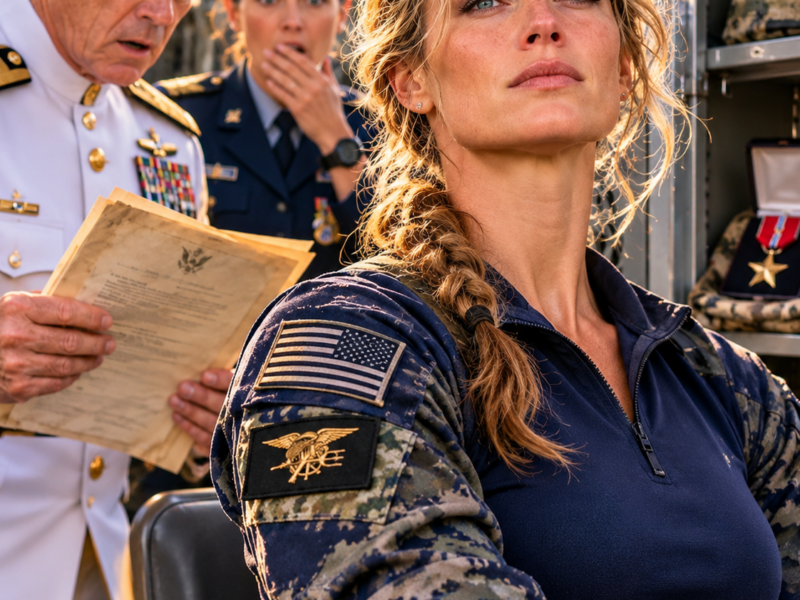
“The medal hidden beneath my old Navy SEAL uniform was never supposed to be found, especially not by the new commander
For several seconds, I couldn’t hear anything except the fluorescent lights buzzing overhead.
The photograph lay between us.
Three people beside a military transport aircraft.
Me.
Daniel Reeves, the intelligence officer we’d been sent to recover.
And Chief Petty Officer Marcus Cole.
Marcus was supposed to be dead.
I had watched the transport leave without him.
I had spent twelve years believing he had died somewhere beyond the extraction perimeter, and I had carried that belief so quietly that even the people closest to me had never known his name.
Now Commander Hayes was telling me Marcus had requested a meeting.
“Where is he?” I asked.
Hayes closed the folder.
“At the naval medical facility in Bethesda. He’s been there for two days.”
“Is he injured?”
“Not physically, as far as the report says.”
“Then why hasn’t anyone told me?”
“Because the request came through a restricted channel. I was instructed to verify your identity before releasing anything.”
I looked at the photograph again.
“Who gave you this?”
“Admiral Warren’s office.”
That name made me straighten.
Admiral Warren had been a senior officer in the joint command during Operation Night Harbor. He’d been one of the people who approved the original mission and one of the people who signed the final report.
He had also told me, personally, that Marcus Cole had not survived.
“Sir,” I said carefully, “I need to know whether this is an official order or a personal request.”
Hayes looked at me for a long moment.
“It’s an official request for you to meet with him. The details are restricted.”
“Then I want the authorization in writing.”
“You’ll have it.”
He returned the medal to the bench.
I reached for it, but stopped before touching the ribbon.
“Did anyone else see this?”
“Only the team members who were here when I opened the locker.”
“Who?”
“Brooks, Miller, Chen, Alvarez, and Price.”
I nodded.
“Tell them the medal is personal property and that its existence isn’t a subject for discussion.”
Hayes raised an eyebrow.
“You don’t think they’ll ask?”
“They can ask. I don’t have to answer.”
For the first time since he’d entered the locker room, he almost smiled.
“You’re very good at giving orders for someone who doesn’t like attention.”
“I’m not trying to give orders, sir. I’m trying to protect my team from a story they don’t understand.”
He studied me.
Then he picked up the folder.
“Your transportation leaves at fourteen hundred. I’ll have your authorization sent to your office.”
He paused at the door.
“Lieutenant Commander Morgan?”
“Sir?”
“Whatever happened twelve years ago, I don’t think the Navy has finished dealing with it.”
Neither did I.
I took the medal back to my locker and placed it inside its small velvet pouch.
For years, I’d kept it beneath a folded uniform, not because I was ashamed of receiving it, but because I didn’t want the award to become the most important thing about that night.
I remembered the men who hadn’t come home.
I remembered the wounded intelligence officer.
And I remembered Marcus Cole.
Marcus had been thirty-one, a Navy chief with a crooked smile and an irritating habit of calling every difficult assignment “a pleasant little vacation.”
He’d been the most experienced member of our team.
He taught me how to read a room before entering it, how to recognize when a radio operator was hiding fear behind confidence, and how to keep moving when the plan stopped making sense.
He’d also been the first person to tell me that being a woman in the SEAL community didn’t mean I had to prove I belonged every minute of every day.
“Do the work,” he’d told me. “Let the results speak.”
I had followed that advice.
When I walked out of the locker room, Brooks was waiting in the corridor.
He was leaning against the wall with his arms crossed.
“Commander.”
“Brooks.”
“Everything all right?”
“Yes.”
He looked at me carefully.
“Hayes looked like he’d seen a ghost.”
“Maybe he did.”
Brooks glanced toward the locker room.
“That medal was real, wasn’t it?”
“Yes.”
“Silver Star?”
“Yes.”
He let out a slow breath.
“Why didn’t you ever tell us?”
I stopped walking.
“Would it have made me a better officer?”
“No.”
“Would it have made you trust me more?”
He considered that.
“No.”
“Then I don’t think it mattered.”
Brooks nodded.
“Fair enough.”
I started walking again.
He fell into step beside me.
“Just so you know, nobody’s going to think differently of you because you kept something private.”
I looked at him.
“Thank you.”
He hesitated.
“Though I reserve the right to be annoyed that you apparently have a more interesting military history than the rest of us.”
That earned a small smile.
“Get back to training, Chief.”
“Aye, ma’am.”
At fourteen hundred, I left for Bethesda.
The weather had turned cold, and the sky was a flat sheet of gray. I sat in the back of the government vehicle with the authorization document open on my tablet.
The visitor request was signed by Admiral Warren.
The meeting was approved by Naval Intelligence.
And beside Marcus’s name was a classification notation I hadn’t seen in years.
It made my stomach tighten.
Operation Night Harbor had officially ended twelve years earlier.
At least, that was what our records said.
The mission began as a recovery operation.
Daniel Reeves was a civilian intelligence officer working under a diplomatic cover. His assignment had been compromised, and an urgent report indicated he was being held inside a compound near the coast.
The joint command assembled a small team.
Marcus Cole was the senior enlisted operator.
I was the junior officer responsible for coordinating the ground element.
Two other operators supported us, along with a communications specialist.
We were told that the extraction window would be short.
We were told the intelligence was reliable.
We were told the route had been cleared.
Three of those statements turned out to be wrong.
Our vehicle was struck before we reached the compound.
The blast killed our driver and injured two operators. The radio antenna was destroyed, and our communications specialist lost contact with the aircraft.
We continued on foot.
The plan had collapsed, but Reeves was still inside.
Marcus took the lead.
I stayed with the wounded.
When we reached the compound, we found Reeves in a storage room, barely conscious and bleeding from a wound in his side.
He had a small data device attached to a cord around his neck.
“Don’t let them get this,” he’d whispered.
I didn’t know what he meant.
We moved toward the extraction point.
Then the second attack came.
Marcus ordered us to split up.
He took Reeves through a narrow drainage route while I led the wounded operators toward the alternate position.
We were supposed to regroup in twenty minutes.
We never did.
At the extraction point, one aircraft landed.
The wounded were loaded.
I waited for Marcus.
The pilot told me the window was closing.
I refused to leave.
Then a radio transmission came through.
It was broken and barely recognizable.
“Take the officer. Get him home.”
I knew Marcus’s voice.
I also knew he hadn’t said where he was.
I asked for another minute.
The pilot refused.
The aircraft had taken damage, and staying longer could have cost everyone their lives.
I boarded with the wounded and Reeves.
The aircraft lifted.
I looked through the rear opening until the ground disappeared.
Marcus never came.
Two days later, I was informed that the search team had found evidence of an explosion near his last known position.
No body had been recovered.
The official assessment was that he had been killed during the withdrawal.
I asked for the full report.
I was told it was classified.
I asked whether the search had continued.
I was told the operation had been terminated.
I asked one more question.
“Did anyone actually see him die?”
Nobody answered.
The vehicle pulled up outside the medical facility.
I closed the report.
A uniformed officer met me at the entrance and checked my authorization.
“Lieutenant Commander Morgan?”
“Yes.”
“Please follow me.”
We passed through two security doors and entered a quiet corridor.
At the end was a private consultation room.
The officer opened the door.
A man sat beside the window.
His hair was almost entirely gray.
He had a deep scar running from his left temple toward his jaw, and his right hand rested on a walking stick.
But his eyes were unmistakable.
Marcus looked up.
For a moment, neither of us spoke.
Then he smiled.
“Well, Lieutenant Morgan.”
I couldn’t move.
He leaned back.
“Still making people wait for you?”
I crossed the room.
“You’re alive.”
“Last time I checked.”
I stopped in front of him.
“Marcus.”
His smile faded.
“Come here.”
I hugged him carefully, afraid of hurting him, afraid that if I held on too tightly he would somehow disappear.
He wrapped his left arm around me.
For twelve years, I’d imagined what I might say if I ever saw him again.
I had prepared questions.
Accusations.
Explanations.
None of them came.
I just held on.
When we finally separated, he pointed toward the chair.
“Sit down before you fall over.”
I sat.
He studied my uniform.
“Look at you. Lieutenant Commander.”
“Look at you. Still giving orders.”
“Somebody has to.”
I laughed, but my eyes were burning.
“Where have you been?”
Marcus’s expression changed.
“That’s a long story.”
“Then start talking.”
He looked toward the closed door.
“Before I do, I need to ask you something. Did anyone explain why you were awarded the Silver Star?”
“Your citation said I stayed with Reeves and coordinated the extraction.”
“That’s what they told you?”
“Yes.”
He shook his head.
“That’s not the whole story.”
I leaned forward.
“What do you mean?”
Marcus took a breath.
“Night Harbor wasn’t just a recovery mission. Reeves had discovered that someone inside our own command was selling operational information.”
The room seemed to go still.
“Who?”
“At the time, we didn’t know. Reeves had evidence. Names, payment records, communications. He was supposed to bring it out with him.”
I remembered the small device around Reeves’s neck.
“That’s what he was carrying.”
Marcus nodded.
“Exactly.”
“Why wasn’t that in the mission briefing?”
“Because the people who authorized the briefing didn’t want the team to know what we were actually retrieving.”
I stared at him.
“You’re saying we were sent in without being told the real objective?”
“I’m saying the mission had two purposes. Recover Reeves and recover the evidence. The second purpose was kept off the operational record.”
“Who authorized it?”
Marcus hesitated.
“Admiral Warren.”
I sat back.
Admiral Warren.
The same man who had approved the meeting that brought Marcus back into my life.
“Why would he hide it?”
“Because the evidence implicated someone senior. Someone with access to mission schedules, equipment inventories, and intelligence briefings.”
“Who?”
Marcus looked directly at me.
“Captain Richard Sloane.”
I knew the name.
Sloane had been a senior intelligence officer attached to the joint command. He had since retired, and I’d heard he was working as a consultant for defense contractors.
“Was he involved in the attack?”
“We believe he passed our route to the people holding Reeves.”
I felt a coldness spread through my chest.
“How do you know?”
“Because I found the original communication.”
Marcus explained that after the attack, he had been captured while trying to draw the enemy away from Reeves and the extraction team.
He had been held for several months.
During that time, he learned that the group responsible for the ambush had received precise information about our route, timing, and team composition.
The information had come through an intermediary.
That intermediary had received it from someone inside the command.
Marcus eventually escaped with help from a local contact, but he had been badly injured.
He was moved through several locations before reaching a secure medical facility.
“Why didn’t you contact us?” I asked.
“I tried.”
“Who did you contact?”
“Admiral Warren.”
My jaw tightened.
“And?”
“He told me the mission had been closed. He said the evidence had been recovered and that the command had already dealt with the people responsible.”
“Was that true?”
Marcus shook his head.
“No.”
I stared at him.
“Then why did you stay silent?”
“Because he told me the evidence was compromised. He said the people who had helped me escape were in danger. He said if I contacted anyone else, they could be identified.”
“Did you believe him?”
“At first.”
“And later?”
Marcus looked down at his hand.
“Later, I realized he was buying time.”
He reached into a small bag beside his chair and removed a sealed envelope.
“I kept copies.”
I looked at it.
“Of what?”
“The original communications. The payment records. The report showing who changed our extraction coordinates.”
I didn’t touch the envelope.
“Why bring this to me now?”
“Because Sloane is being considered for a position on a defense advisory board. And because the people who covered up Night Harbor are trying to close the file permanently.”
I stared at him.
“Why me?”
Marcus gave me a tired smile.
“Because you were there. Because you never lied about what happened. And because you were the only officer on that team who refused to accept the first explanation.”
I remembered the questions I’d asked.
The missing body.
The terminated search.
The classified report.
I had been young.
I had believed that if I asked enough times, someone would eventually tell me the truth.
Instead, my questions had been filed away.
“Did Admiral Warren know you were alive?”
“Yes.”
“Does he know you have those documents?”
“I believe so.”
I looked at the envelope.
“Then this meeting was never supposed to be a reunion.”
Marcus shook his head.
“It was supposed to be a warning.”
Before I could respond, someone knocked on the door.
A medical officer entered with a tablet.
“Chief Cole, your next appointment is ready.”
Marcus nodded.
“Thank you. Give us five minutes.”
The officer left.
Marcus looked at me.
“There’s something else.”
I waited.
“Your medal.”
“What about it?”
“You didn’t receive it just for getting Reeves out.”
I felt my throat tighten.
“Then why?”
Marcus looked at me for a long moment.
“Because you stayed behind when you could have left. Because you made sure the wounded got on that aircraft. Because you refused to abandon the people who were still alive just to chase the person who might already be lost.”
He paused.
“And because when the command wanted to close the case, you kept asking what happened to me.”
I looked away.
“I couldn’t bring you home.”
“You brought the others home.”
“Not you.”
He leaned forward.
“Rachel, listen to me. You were a junior officer in a situation that was already falling apart. You made the best decision you could with the information you had. Don’t spend twelve more years punishing yourself for surviving.”
I couldn’t answer.
He pushed the envelope toward me.
“Now help me make sure nobody else gets left behind.”
I took it.
The envelope felt heavier than paper should.
That afternoon, I reported the meeting through the appropriate restricted channel.
I did not open the envelope.
I did not make copies.
I did not call General Vance or Admiral Warren.
I contacted the designated inspector general office and requested a secure evidence intake.
The response came within the hour.
They wanted the material transferred immediately.
I arranged for a two-person evidence team to collect it from Marcus.
I also requested that his medical and security status be reviewed independently.
When I returned to my command, Commander Hayes was waiting in his office.
“How was the meeting?”
“Complicated.”
He studied my face.
“Is Cole really alive?”
“Yes, sir.”
Hayes exhaled.
“Good.”
I placed the official meeting summary on his desk.
“I need to notify the inspector general about a potential breach connected to Operation Night Harbor.”
His expression sharpened.
“How serious?”
“Serious enough that I don’t want to discuss details outside the restricted channel.”
He nodded immediately.
“I’ll support the request.”
I hesitated.
“Sir, I also need the locker-room incident documented. The medal was exposed during an inspection, and several team members saw it.”
Hayes looked uncomfortable.
“That was my mistake.”
“Thank you for acknowledging it.”
“I should have asked you privately.”
“Yes, sir.”
He nodded.
“I’ll speak to the team. Nobody will be asked to discuss the medal.”
“That would be appreciated.”
I returned to my office.
On my desk was a message from Brooks.
The team had completed training, and he wanted to know whether I would be available for the afternoon debrief.
I replied that I would.
Then I sat quietly for a moment.
For twelve years, I’d carried the belief that Marcus was dead.
Now he was alive, but the truth behind his disappearance threatened to reopen a case that powerful people had spent years trying to bury.
I knew the next steps would be difficult.
I also knew I couldn’t let the past dictate how I handled them.
The inspector general’s investigation began quietly.
The first interviews focused on the original mission authorization and the changes to our extraction route.
The investigators requested my testimony.
I provided a factual account.
I described the vehicle strike, the communications failure, the separation of the team, and the final transmission from Marcus.
I explained that I had never received direct confirmation of his death.
I also provided the questions I’d raised afterward and the responses I’d received.
The investigators asked whether Admiral Warren had ever contacted me.
“Only to tell me the mission was closed.”
“Did he say Chief Cole had been killed?”
“Yes.”
“Did he provide evidence?”
“No.”
They recorded the answer.
I didn’t embellish it.
I didn’t accuse anyone.
I simply told them what had happened.
The evidence Marcus provided was authenticated.
The original communications matched the time stamps in the operational logs.
The payment records linked a consulting company to an account controlled by an intermediary associated with Sloane.
More importantly, the extraction coordinates had been changed from the approved route to the location where our vehicle was hit.
The change had been authorized using a credential assigned to an intelligence office.
The investigators found that the credential had been accessed from Sloane’s workstation.
But there was another problem.
The final report had been altered after the operation.
A paragraph confirming that Marcus’s body had never been recovered had been removed.
The revised report described him as killed in action.
The person who approved the revision was Admiral Warren.
When I learned that, I requested another interview.
This time, the investigators asked me to explain my relationship with Warren.
I told them there was no personal relationship.
He had been a senior officer.
He had approved the mission.
He had told me Marcus was dead.
That was all.
The lead investigator looked at me.
“Do you believe he knew Chief Cole was alive when he signed the report?”
“I can’t answer that.”
“Do you believe he deliberately concealed evidence?”
“I can tell you what the records show. I can’t tell you what was in his mind.”
She nodded.
“That’s fair.”
A week later, Admiral Warren was placed on administrative leave pending review.
Sloane was removed from consideration for the advisory board.
The case was referred for further investigation.
And Marcus was moved to a protected medical facility.
I visited him twice.
The first time, he was sitting outside in a wheelchair, watching a group of young sailors walk past.
“Still avoiding paperwork?” I asked.
He smiled.
“Paperwork is the enemy.”
“That’s not what the regulations say.”
“Regulations have never been right about everything.”
I sat beside him.
For a while, we watched the sailors.
Then he said, “I heard about Warren.”
“Yes.”
“How are you doing?”
“I’m fine.”
He gave me a look.
“You’re still terrible at answering that question.”
I smiled.
“I don’t know how I’m doing.”
“That’s better.”
I told him the evidence was being reviewed and that the investigators were following the proper process.
He nodded.
“Good.”
“Are you angry?”
“At Warren?”
“At all of it.”
Marcus looked down at his hands.
“I was angry for a long time. Then I got tired.”
He turned toward me.
“I missed twelve years, Rachel. I can’t get those back. But I can decide what I do with the years I have left.”
I nodded.
“That’s a good way to look at it.”
“Don’t make it sound like I learned it from a motivational poster.”
I laughed.
For the first time since the White House-style seriousness of our old command days, it felt possible to talk without carrying the weight of the mission between every sentence.
A month later, the Navy held a formal review of the Night Harbor casualty determination.
The original finding was withdrawn.
Marcus Cole was officially recognized as having survived the operation and his subsequent captivity.
His service record was corrected.
The Navy also issued a formal statement acknowledging that the original report had been inaccurate and that the circumstances surrounding his disappearance had not been properly investigated.
The statement did not explain every failure.
It did not restore the years he had lost.
But it corrected the record.
Marcus asked me to attend the ceremony.
I agreed.
The event was held in a small auditorium at the naval facility.
There were no television cameras.
No speeches about heroism.
Just a few officers, a handful of former teammates, and the people who had spent years waiting for answers.
Brooks attended with two members of my current team.
He sat near the back.
When Marcus entered, the room rose.
He walked slowly, leaning on his cane.
His uniform had been carefully prepared, and his old chief’s insignia gleamed against the fabric.
The commanding officer read the corrected service record.
Then he presented Marcus with a replacement medal recognizing his actions during the mission.
Marcus accepted it without saying anything.
When the ceremony ended, he came over to me.
“Well,” he said, “I suppose we finally got the paperwork right.”
“Only twelve years late.”
“Don’t be greedy.”
We laughed.
Then he looked at my uniform.
“Where’s yours?”
I knew what he meant.
The Silver Star.
“I left it in my locker.”
“Still hiding it?”
“I’m not hiding it.”
He raised an eyebrow.
“Right.”
I smiled.
“I just don’t need to wear it every day.”
He nodded.
“Fair enough.”
Brooks approached us.
“Chief Cole, it’s an honor.”
Marcus shook his hand.
“You’re on Morgan’s team?”
“Yes, Chief.”
“Then keep her out of trouble.”
Brooks glanced at me.
“I’ll do my best, sir.”
Marcus looked at me again.
“See? You’ve got people.”
I felt a quiet warmth in my chest.
“Yes,” I said. “I do.”
The investigation continued for several months.
The final findings confirmed that Sloane had passed restricted operational information to an intermediary in exchange for financial benefits. The altered extraction coordinates had contributed to the attack on our team.
Admiral Warren had approved the false casualty determination and withheld information about Marcus’s survival. He was found responsible for serious failures in oversight and the improper handling of classified evidence.
The case proceeded through the appropriate military and civilian channels.
I didn’t attend every hearing.
I didn’t need to.
The truth was finally in the hands of people who had the authority to act on it.
My own role in the matter was reviewed as well.
The investigators confirmed that I had not participated in the original intelligence handling beyond my operational responsibilities and that my subsequent actions had followed reporting requirements.
The medal remained in my official record.
The Navy also updated the citation to include the full context of the extraction, while protecting the details that remained classified.
I was offered the opportunity to speak publicly about the award.
I declined.
Some stories belong to the people who lived them.
Others belong to the people who didn’t make it home.
I wasn’t going to turn either into a performance.
A few months after the review, Commander Hayes called me into his office.
He had a folder on his desk.
“Your team has been asking questions,” he said.
“About what?”
“About the medal.”
I waited.
“I told them I wouldn’t discuss your personal history. But they wanted to know whether there was something they should learn from the situation.”
I considered that.
“Tell them the medal doesn’t change the job.”
Hayes nodded.
“Anything else?”
“Tell them that the people who do the work aren’t always the people who get recognized. And that nobody should confuse a quiet officer with an inexperienced one.”
He smiled.
“I can deliver that message.”
When I returned to the locker room, Brooks was waiting beside my open locker.
He looked at the velvet pouch.
“Are you going to put it back?”
I held the medal in my palm.
The silver was still scratched.
The ribbon was still faded.
It looked exactly as it had twelve years earlier.
“No,” I said.
Brooks raised an eyebrow.
“Where are you putting it?”
I looked around the room.
The lockers.
The benches.
The boots lined up beneath them.
The place where people prepared for difficult work and returned from it carrying things they didn’t always know how to explain.
“Somewhere I can remember what it means.”
I took the medal to my office and placed it inside a small display case beside a photograph of our original team.
Marcus stood in the center, smiling with his crooked grin.
I stood beside him, younger and uncertain.
The two other operators were there too.
One of them had not survived the mission.
I had never forgotten him.
I never would.
The medal was no longer something I needed to keep out of sight.
It wasn’t proof that I was better than anyone.
It wasn’t a reason for my team to treat me differently.
It was a reminder of the people who had trusted me when everything went wrong.
That afternoon, Brooks knocked on my office door.
“Ma’am, team debrief in five minutes.”
“On my way.”
He glanced at the display case.
“That’s a good picture.”
“It is.”
“Chief Cole looks exactly like someone who’d get us all in trouble.”
“He usually did.”
Brooks laughed.
Then his expression became serious.
“Glad he’s back, ma’am.”
“So am I.”
He left.
I stayed for another moment, looking at the photograph.
Twelve years earlier, I had walked away from that operation believing I’d lost someone who had taught me how to lead.
Now I understood that leadership had never been about carrying every burden alone.
It was about trusting the people beside you.
It was about asking difficult questions, even when the answers were uncomfortable.
And it was about refusing to let a convenient story replace the truth.
I closed the display case and headed for the team room.
My people were waiting.
They didn’t need to know every detail of my past.
They needed to know they could count on me in the present.
And that was exactly where I intended to be.
The End.









