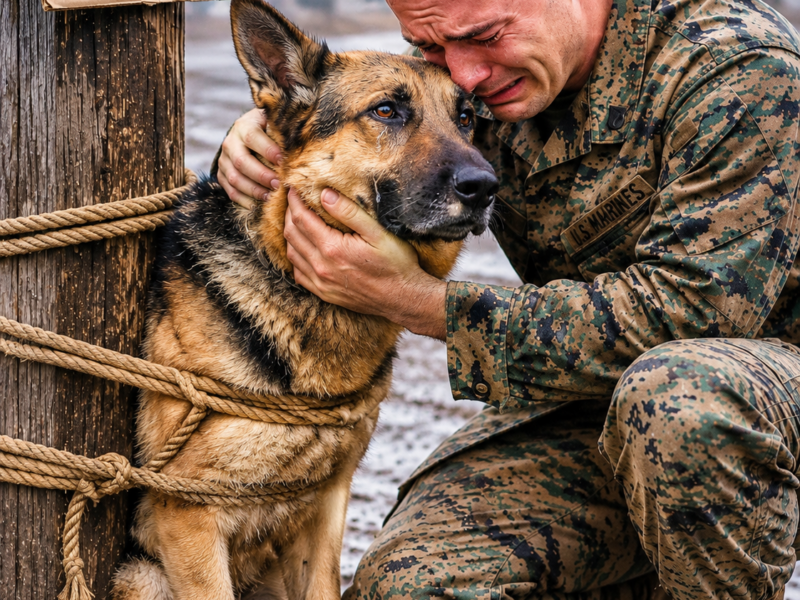
The Marine thought he was buying a broken military dog for one dollar.
Daniel Hayes had spent four years learning how to live with a question that never seemed to have an answer.
What happened to Rex?
For twelve years, Daniel had served in the United States Marine Corps. During that time, he’d seen men come and go, watched friendships survive deployments and fall apart under pressure, and learned that some experiences were impossible to explain to anyone who hadn’t lived through them.
But the bond he’d shared with Rex was different.
Rex was a German Shepherd trained as a military working dog. He was intelligent, disciplined, stubborn when he wanted to be, and remarkably good at reading Daniel’s movements.
They had served together overseas, completing patrols, checking buildings, and working in situations where a moment of hesitation could have serious consequences.
Daniel trusted Rex with his life.
And Rex trusted Daniel with his.
Their partnership had begun during Daniel’s second deployment. At first, the dog had been assigned to him as part of the unit’s working-dog program. Daniel had assumed it would be a professional arrangement.
He was wrong.
Within weeks, they had developed a rhythm that needed very few commands. Rex learned Daniel’s habits. Daniel learned the slightest changes in Rex’s posture, breathing, and attention.
When Daniel sat down after a long patrol, Rex usually settled beside his boots.
When Daniel prepared his equipment, Rex was already waiting.
And whenever they returned safely from a mission, Daniel had a small ritual. He would crouch, scratch the dog behind his left ear, and say the same words.
“Good work, partner.”
Rex would respond by pressing his head against Daniel’s chest.
It was a simple relationship, but it meant more than Daniel could easily put into words.
Then came the mission that separated them.
Four years earlier, Daniel’s unit had been operating in a dangerous area overseas. During a routine assignment, an explosion disrupted the operation.
The blast threw Daniel off balance and left him injured. The scene became chaotic. Communications were interrupted, personnel were moved, and the team was forced to focus on getting everyone to safety.
Rex was separated during the confusion.
Daniel remembered calling his name.
He remembered trying to get back toward the area where he’d last seen him.
But his injuries eventually forced him to be evacuated.
He woke up later in medical care and immediately asked about the dog.
At first, nobody could give him a clear answer.
Then the report came.
Rex was missing.
The military began its search and reviewed the available information. Daniel contacted people who had been involved in the operation and followed every lead he could find.
Weeks passed.
Then months.
Eventually, the official status became increasingly discouraging.
There was no confirmed recovery. No reliable information about where Rex had gone. No definite answer about whether he had survived.
Daniel never received the kind of closure that would have allowed him to stop looking.
He kept Rex’s old photograph in a drawer.
He kept the dog’s original identification information in a folder.
And every time he heard about a retired military working dog becoming available for adoption, he wondered whether it could somehow be his missing partner.
He never imagined he would find him at an auction for one dollar.
The day Daniel found Rex had started like any other.
He had attended a small military surplus auction, intending to look at some equipment. He wasn’t particularly interested in buying anything.
Then he noticed the kennel.
The German Shepherd inside looked nothing like the strong, athletic dog Daniel remembered.
His coat was dull and patchy. His body was thin, and his rear leg appeared stiff and painful. An old scar crossed his muzzle.
A small sign identified him as a retired military working dog.
Injured.
Non-operational.
Starting bid: $1.
Daniel initially thought the dog might simply be another retired K9 who had been overlooked.
But when he crouched beside the cage, something caught his attention.
The Shepherd was watching him.
Not aggressively. Not fearfully.
Just watching.
Daniel approached slowly and offered his hand.
The dog sniffed his fingers, then turned his head slightly.
That’s when Daniel noticed the faded identification tattoo beneath the fur on the dog’s neck.
He asked the attendant to check the number.
The first response was that the records were incomplete.
Daniel insisted.
A few minutes later, the attendant returned with an old file.
The identification number matched Rex.
Daniel read it several times.
He couldn’t believe what he was seeing.
“Rex?”
The dog’s ears lifted.
Daniel said the name again.
This time, Rex moved toward him.
His legs trembled, but he tried to stand. He pushed his nose against Daniel’s hand and began making small, uncertain sounds.
Daniel lowered himself to the concrete floor.
He had imagined this moment for four years.
In some versions, Rex would run toward him.
In others, Daniel would find him healthy and strong.
He had never imagined seeing him injured, frightened, and barely able to stand.
“Hey, buddy,” Daniel whispered.
Rex leaned against him.
For several minutes, neither moved.
The auction attendant stood quietly nearby.
Daniel eventually signed the paperwork and paid the dollar.
It was the smallest amount of money he’d ever spent on something that meant so much.
Daniel drove directly to a veterinary clinic.
He had placed a blanket in the back of his truck and helped Rex settle onto it. The dog was exhausted, but he seemed calmer whenever Daniel was nearby.
Every few minutes, Daniel glanced into the rearview mirror.
Rex was still there.
Still breathing.
Still alive.
At the clinic, a veterinarian named Dr. Emily Carter examined him.
She began with his weight and general condition. Then she checked his teeth, ears, paws, and injured leg.
The examination took longer than expected.
Rex was severely underweight. He had old scars, muscle loss, and evidence of previous injuries. His rear leg showed signs of chronic damage that required further evaluation.
There were also signs that he had not received consistent veterinary attention.
Daniel listened carefully, asking questions and taking notes.
“Can he recover?” he finally asked.
Emily paused.
“I don’t want to promise you something before we’ve completed the tests. But he’s not beyond help. He’ll need careful treatment, rehabilitation, proper nutrition, and time.”
Daniel looked through the examination room window.
Rex was lying on a padded surface, his head turned toward the door.
Even after everything, he was still watching for Daniel.
“Then we’ll give him time,” Daniel said.
Emily looked at him.
“He’s lucky you found him.”
Daniel shook his head.
“I think I was the lucky one.”
The veterinarian arranged imaging and additional testing.
The results showed that Rex’s leg injury was old. It appeared to have healed improperly, leaving him with chronic pain and limited mobility.
There was no simple overnight solution.
He would need medication, controlled exercise, and a rehabilitation plan. Surgery might be considered depending on how he responded to treatment.
His nutritional condition also required careful management.
Daniel wanted to take Rex home immediately, but Emily explained that the first stage of recovery needed to be monitored.
Daniel agreed.
He stayed at the clinic until visiting hours ended.
Before leaving, he crouched beside Rex’s bed.
“I’ll be back tomorrow.”
Rex lifted his head.
Daniel reached through the opening and rubbed behind his left ear.
“Good work, partner.”
The dog’s eyes slowly closed.
The next morning, Daniel returned before the clinic had finished its first round of examinations.
He brought a familiar blanket, a soft toy, and a small container of the food the veterinarian had approved.
Rex recognized him immediately.
His ears lifted.
His tail moved against the bedding.
Daniel smiled for the first time in what felt like years.
“There’s my boy.”
Emily watched from the doorway.
She had examined hundreds of injured animals, but she understood that this reunion was about more than an owner finding a dog.
Daniel knew Rex’s history.
He recognized his habits.
He knew exactly where to scratch behind his ears and when to give him space.
And Rex responded to him with a familiarity that seemed to reach beyond the condition of his body.
Over the next several days, the clinic focused on stabilizing Rex.
Daniel visited whenever he could.
He also began asking questions about the dog’s history.
The auction attendant had given him a collection of documents, but the paperwork was fragmented.
Some records listed Rex by his military identification number. Others used a temporary name. A few contained transfer dates without clear explanations.
There were references to a civilian animal-care facility.
There were medical notes.
And there were gaps.
Large gaps.
Daniel decided to investigate.
He started with the most recent facility listed in the documents.
After several calls, he reached a former administrator who remembered a German Shepherd with an injured hind leg.
The dog had arrived through a transfer arrangement involving retired working animals.
The administrator remembered that the paperwork had been incomplete.
When Daniel asked where the dog had come from, she checked an archived file.
“He was transferred from another organization,” she said. “We weren’t given much background.”
“Do you still have the original transfer documents?”
There was a pause.
“I’ll have to look.”
Daniel gave her Rex’s identification number.
A few hours later, she called back.
She had found another reference.
It pointed to a private animal-care contractor that had handled several former working dogs.
Daniel wrote down the name.
He felt something he hadn’t felt in four years.
Not anger.
Not yet.
It was the possibility of finally understanding what had happened.
The next week, Daniel visited the contractor’s former office.
The business had changed ownership, but an employee who had worked there during the relevant period agreed to speak with him.
Her name was Laura Mitchell.
She was careful about what she said, explaining that she could only discuss records she was authorized to access.
Daniel showed her the identification number.
Laura looked at it.
Then she looked at him.
“You were his handler?”
“Yes.”
She returned her attention to the file.
“I remember this dog.”
Daniel leaned forward.
“Do you know where he was after the transfer?”
Laura opened a second folder.
According to the available records, Rex had been recovered after the overseas incident and entered a temporary care arrangement.
His original military identification had been recorded, but the later civilian documents did not consistently carry the same information.
At some point, the dog had been moved to another facility.
Then another.
The records suggested that his injuries had made long-term placement difficult.
One facility had classified him as requiring specialized care.
Another had listed him as unsuitable for adoption without further medical evaluation.
Eventually, he had entered a private holding arrangement.
The file did not explain every decision or establish why Daniel had never been contacted.
But it did establish something important.
Rex had survived the incident.
He had been moved through several facilities.
And for years, his original military history had not been properly connected to the records associated with his later care.
Daniel stared at the documents.
“Was there ever an attempt to contact his original handler?”
Laura searched the file again.
“I don’t see one documented here.”
Daniel leaned back.
He had spent four years wondering whether Rex had died.
Meanwhile, the dog had been alive.
He had been injured, moved, and passed between organizations.
Daniel closed the folder.
“Thank you for finding this.”
Laura nodded.
“I’m sorry. I wish I had a better answer.”
Daniel left with copies of the records and the name of another organization that had handled one of the transfers.
He wasn’t looking for someone to blame without evidence.
He wanted the truth.
Most of all, he wanted to make sure Rex would never disappear into an incomplete file again.
Meanwhile, Rex was beginning to improve.
The first changes were small.
He started eating consistently.
His eyes appeared brighter.
He became more interested in the sounds around him.
When Daniel entered the room, Rex began lifting his head before he even reached the kennel.
Emily was encouraged by the progress.
However, the leg remained a serious concern.
Rex could stand for short periods, but his movement was uneven. The muscles in his injured leg had weakened significantly.
The rehabilitation specialist recommended a gradual program.
There would be controlled walking, careful strengthening exercises, and regular assessments.
Daniel listened to every instruction.
He wanted Rex to get better, but he understood that pushing him too quickly could cause further damage.
When the veterinarian finally approved Rex’s discharge, Daniel prepared his home.
He placed nonslip mats along the hallway.
He moved furniture to create wider walking paths.
He arranged a comfortable bed in the living room, where Rex could rest without needing to climb stairs.
He also installed a small ramp near the entrance.
Emily reviewed the setup before allowing Rex to leave.
“Remember, he’s not the dog you brought home in your memories,” she told Daniel. “He has limitations now. Let him show you what he can do.”
Daniel nodded.
“I understand.”
She handed him the medication schedule and rehabilitation instructions.
“Then take him home.”
Rex’s first night in Daniel’s house was quiet.
Daniel had expected him to explore.
Instead, the Shepherd remained near the front door for a long time.
He sniffed the room, looked toward the hallway, and then settled beside the blanket Daniel had brought from the clinic.
Daniel sat on the floor a few feet away.
He didn’t try to force interaction.
After a while, Rex approached.
He lowered himself carefully and rested his head on Daniel’s knee.
Daniel placed a hand on his back.
“You remember this place?”
Rex closed his eyes.
Daniel wasn’t sure whether the dog remembered the house or simply recognized the comfort of being near someone familiar.
It didn’t matter.
For the first time in four years, they were in the same room without the threat of another separation.
Daniel slept on the living room couch that night.
Whenever Rex shifted, he woke up to check on him.
Around three in the morning, he felt something touch his hand.
Rex had moved closer.
Daniel opened his eyes.
The dog was looking at him.
“What’s wrong, buddy?”
Rex gently placed his nose against Daniel’s fingers.
Daniel rubbed his ears.
“You’re home.”
The first month was difficult.
Rex had good days and bad days.
Some mornings, he could walk across the living room without much difficulty.
On others, his injured leg caused enough discomfort that he preferred to remain on his bed.
Daniel followed the rehabilitation plan carefully.
He measured Rex’s food.
He administered medication on schedule.
He kept a notebook recording his progress, including weight, appetite, movement, and behavior.
The veterinarian explained that recovery would be measured in small improvements rather than dramatic changes.
Daniel learned to appreciate those improvements.
The first time Rex walked from the living room to the kitchen without stopping, Daniel celebrated quietly.
The first time Rex carried his toy to the couch, Daniel took a photograph.
And the first time the dog wagged his tail when Daniel picked up his leash, Daniel felt something loosen inside his chest.
It was as if a part of his life that had been frozen for four years was slowly moving again.
But there was another challenge.
Rex occasionally woke from sleep suddenly.
His breathing would become faster. His ears would flatten, and he would look around as though trying to understand where he was.
Daniel never knew exactly what the dog was experiencing.
He avoided making assumptions.
Instead, he kept the room quiet, spoke gently, and gave Rex time to settle.
Some nights, that was enough.
Other nights, Rex needed Daniel to sit beside him for several minutes.
Daniel began to understand that bringing Rex home was only the beginning of their reunion.
The dog needed more than food, medicine, and a comfortable bed.
He needed patience.
And Daniel was prepared to give him as much as he needed.
Two months after the auction, Daniel received a phone call from Laura.
She had located another set of archived documents.
This time, the records included a more complete transfer history.
There were several entries Daniel hadn’t seen before.
One confirmed that Rex had been recovered after the explosion and placed under temporary veterinary supervision.
Another showed that he had later been transferred to a civilian care organization.
A subsequent note indicated that his identification information had been entered incorrectly in one database.
That error had carried forward.
It was not the only reason the search had failed, but it had made it harder to connect the dog in civilian custody with the military record Daniel had been searching.
The file also included a note from a veterinarian who had evaluated Rex shortly after his recovery.
The veterinarian had recommended specialized rehabilitation.
The recommendation had been included in the transfer paperwork.
But the later records did not clearly show whether the recommended care had been completed.
Daniel read the documents twice.
He felt a mixture of relief and sadness.
Rex had survived.
That mattered more than anything.
But he also wondered how many times the dog had been moved without anyone understanding his history.
Laura offered to send the documents to the appropriate military records office for review.
Daniel agreed.
He wanted the records corrected.
He wanted Rex’s identity and service history restored.
And he wanted to make sure that the people responsible for his care understood that he was not simply an injured dog with an incomplete file.
He was a military working dog with a history, a handler, and a partnership that had never truly ended.
By the third month, Rex had developed a routine.
He woke when Daniel did.
He ate breakfast in the kitchen.
He spent time resting in the living room while Daniel worked.
In the afternoons, they went outside for short walks, following the rehabilitation schedule.
Rex could not run.
He could not jump like he once had.
But he could walk farther than he had at the beginning.
Daniel adjusted his pace to match the dog’s.
They no longer had to hurry anywhere.
One afternoon, Daniel took Rex to a quiet park.
He chose a shaded area away from crowded walking paths.
Rex sniffed the grass and watched a few birds near the trees.
For a while, Daniel simply sat beside him.
Then he noticed something.
Rex had picked up a small branch.
He carried it several steps before placing it on the ground.
Daniel smiled.
“Still trying to bring me things?”
Rex looked at him.
Daniel remembered the old days when Rex would return from training exercises carrying a toy, waiting for Daniel’s approval.
The memory was so vivid that he almost expected the younger, stronger dog to appear beside him.
But when he looked down, he saw the real Rex.
Older.
Injured.
A little slower.
And still there.
Daniel reached down and scratched behind his left ear.
“Good work, partner.”
Rex leaned into his hand.
For a long time, Daniel had thought the greatest thing he could do was find Rex.
Now he understood that finding him was only one part of keeping their promise.
The other part was staying.
Several weeks later, the military records office completed its review of the information Daniel had submitted.
Rex’s service history was confirmed.
His identification records were corrected, and the documentation connecting him to Daniel’s former assignment was restored.
Daniel received copies of the updated records.
He sat at his kitchen table reading them while Rex slept nearby.
The paperwork included his original identification information, service details, and the history of the transfers that had followed the overseas incident.
It wasn’t a perfect account.
Some gaps remained.
Some decisions could not be fully explained.
But the most important part was no longer uncertain.
Rex was alive after the incident.
He had survived.
And he had finally returned to the person who had been searching for him.
Daniel placed the documents in a folder.
Then he looked at Rex.
“Well, buddy. Looks like we got your name back.”
The dog lifted his head.
Daniel laughed softly.
“Not that you ever forgot it.”
Six months after the auction, Daniel returned to the veterinary clinic for another examination.
Emily was pleased with the progress.
Rex had gained healthy weight. His coat had improved, and his overall condition was significantly better.
The leg injury remained.
It would likely always affect how he moved.
But the rehabilitation had helped him regain strength and comfort.
“He may never return to the level of activity he had during service,” Emily explained. “But he’s doing well for a dog with his history.”
Daniel nodded.
“That’s enough.”
Emily smiled.
“He’s got a good life ahead of him.”
Rex stood beside Daniel, leaning slightly against his leg.
The veterinarian examined him one last time and gave Daniel updated recommendations.
Before they left, Emily crouched down and offered Rex her hand.
The Shepherd sniffed it.
Then he turned toward Daniel.
Emily laughed.
“I think we know who his favorite person is.”
Daniel looked down.
“He’s always been particular.”
On the drive home, Daniel stopped at a quiet open area.
He opened the truck door and allowed Rex to step down carefully.
The dog looked around.
The wind moved through the grass.
Daniel took a moment to watch him.
He remembered the auction cage.
The faded identification tattoo.
The trembling legs.
The one-dollar price tag.
And the moment when the dog had finally recognized his voice.
It was difficult to believe that only six months had passed.
A year after the auction, Daniel organized a small gathering with several former members of his unit.
He hadn’t planned anything elaborate.
He simply wanted to spend an afternoon with people who understood what Rex had meant to him.
When the former Marines arrived, they immediately recognized the dog.
One of them crouched beside Rex.
“Well, I’ll be.”
Another looked at Daniel.
“You actually found him.”
Daniel nodded.
“Four years later.”
They spent the afternoon sharing memories from their deployment.
Some remembered Rex’s discipline.
Others remembered his stubborn refusal to leave a particular training exercise until he had completed it correctly.
One former teammate recalled how Rex used to position himself beside Daniel whenever the group stopped for a break.
Daniel listened, smiling.
Rex rested nearby, enjoying the attention without needing to move around much.
At one point, someone asked whether Daniel had ever considered adopting another working dog.
Daniel looked at Rex.
“I’ve thought about it,” he answered. “But right now, this is where I need to be.”
Nobody questioned him.
They understood.
The dog had spent years moving between places, while Daniel had spent years wondering where he was.
Now they were together.
That was enough.
Later that evening, after everyone had gone home, Daniel sat on the back porch.
Rex lay beside his chair.
The sun was setting, and the neighborhood was quiet.
Daniel reached down and rubbed the familiar spot behind the dog’s left ear.
“You know,” he said softly, “I used to think I’d have to find you before I could finally move on.”
Rex shifted slightly.
Daniel looked out into the yard.
“For four years, I kept thinking about that day. I kept wondering whether I should have done something differently. Whether I should have stayed longer. Whether there was some way I could have gotten back to you.”
He paused.
“I don’t know if I’ll ever stop thinking about it.”
Rex lifted his head and rested it on Daniel’s knee.
Daniel smiled faintly.
“But I know you’re here now.”
He stayed there for another hour.
There was no dramatic moment.
No sudden recovery.
No miraculous return to the way things had been before.
There was simply a Marine, an old German Shepherd, and a quiet evening they were finally able to share.
The following spring, Daniel took Rex back to the place where they had first been reunited.
The auction facility was holding another event.
Daniel had contacted the organizers beforehand and arranged to bring Rex for a brief visit.
The attendant who had helped him the previous year was still working there.
When she saw the Shepherd, she stopped.
It took her a moment to recognize him.
“Is that the same dog?”
Daniel smiled.
“Same dog.”
She looked at Rex’s healthier coat and the way he stood beside Daniel.
“He looks wonderful.”
“He has good days and bad days. But he’s doing well.”
The woman crouched slightly.
“Hello again, sweetheart.”
Rex sniffed her hand.
Then he looked toward Daniel.
Daniel laughed.
“He’s not much for making new friends.”
The attendant smiled.
She remembered the day Daniel had first approached the kennel.
She remembered the paperwork.
And she remembered how quietly the Marine had spoken the dog’s name.
“One dollar,” she said. “That’s all you paid for him.”
Daniel looked down at Rex.
“That’s what the paperwork says.”
Then he added something that made her smile.
“But that dollar didn’t buy him.”
He paused.
“It brought him home.”
That evening, Daniel placed a photograph on the shelf in his living room.
It showed him and Rex standing together outside the veterinary clinic.
Rex looked healthier, his ears raised and his expression alert.
Daniel was kneeling beside him, one hand resting on his shoulder.
Underneath the photograph, Daniel placed Rex’s old military identification tag.
He didn’t put it there as a reminder of what had been lost.
He put it there to remember what had survived.
Rex was no longer expected to perform military duties.
He would never return to the patrols, training exercises, or demanding assignments that had once defined his life.
His days now consisted of short walks, meals, naps, occasional visits to the park, and a person who made sure he never had to wonder where he belonged.
Sometimes Daniel still caught himself watching Rex sleep.
He would remember the four years of uncertainty and feel grateful that the story had not ended in that auction kennel.
He couldn’t change what had happened.
He couldn’t give Rex back the years they had lost.
But he could give him every peaceful day that remained.
One night, Daniel was preparing for bed when he noticed Rex standing near the bedroom doorway.
The dog was waiting.
Daniel patted the floor beside his bed.
“Come on, partner.”
Rex walked over slowly and settled onto his blanket.
Daniel turned off the light.
For a few moments, the room was completely quiet.
Then he heard the familiar sound of Rex breathing beside him.
Daniel smiled in the darkness.
Four years ago, he had lost his partner in a place where neither of them had any control over what happened next.
He had spent four years searching for him.
And he had finally found him in the last place he expected.
A small cage.
A faded tattoo.
A one-dollar price tag.
But the most important part of their story wasn’t the auction, the paperwork, or even the reunion.
It was what came afterward.
Because Daniel hadn’t brought Rex home expecting him to become the dog he used to be.
He brought him home because Rex was still Rex.
Still his partner.
Still worthy of love, patience, and a place to belong.
And every morning, when Daniel opened his eyes and saw the old German Shepherd resting nearby, he was reminded of something he had learned long ago.
Some partners don’t need to run beside you anymore. They just need to know you haven’t left them behind.
The End.









