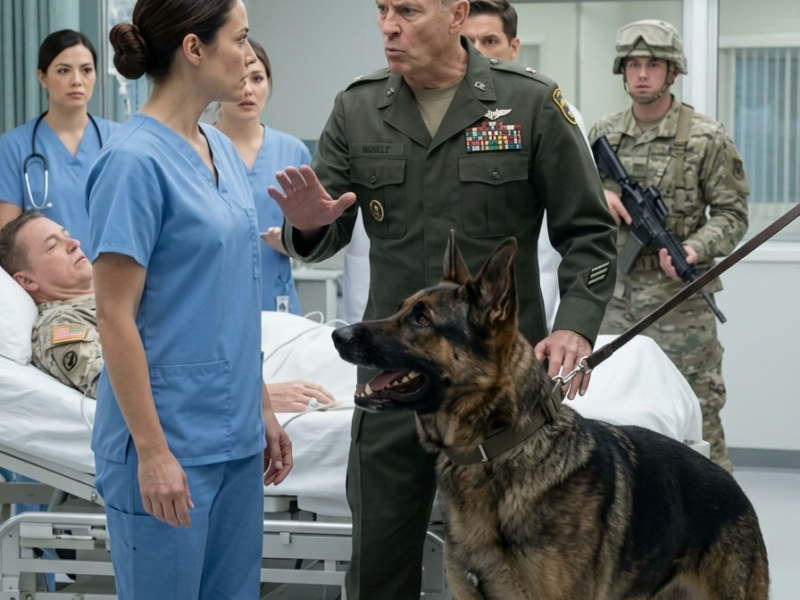
The Marine general was dying on a hospital bed when his K9 suddenly lunged at every doctor who approached
The trauma bay at Walter Reed National Military Medical Center was an orchestra of controlled panic. The sharp, rhythmic blare of physiological monitors bounced off sterile tile walls, competing with the frantic shouts of residents, respiratory therapists, and circulating nurses. Overhead fluorescent lights hummed with an aggressive, buzzing glare that stripped the dignity from everyone beneath them. It was 0240 on a bitter Thursday morning in early November, the kind of night where the Potomac wind carried a bone-chilling mist through the security gates.
I stood three paces back from Trauma Bay One, my gloved hands holding two pre-packaged units of O-negative blood, my scrubs pulled tight over the tension coiled inside my shoulders. To the surgical team and the civilian staff, I was simply Nurse Sarah Drake: quiet, hyper-competent, six weeks into a transfer from a small VA clinic in Baltimore. I kept my head down, signed my charts in black ink, took the overnight shifts without complaining, and never joined the communal lunches in the breakroom. They thought I was shy. They thought the faint white scar winding around my left wrist was from an old kitchen accident.
None of them knew that before I learned to titrate levophed and insert central venous lines, I had spent seven years attached to Marine Special Operations Command as an operator and lead handler for special reconnaissance canines. None of them knew the government had officially retired my service record nine years ago with a sealed file and a non-disclosure agreement backed by federal prison time.
Then the automatic double doors blew open, and the world I thought I had buried beneath layers of gauze and antiseptic came roaring back.
Paramedics wheeled the gurney in at a dead sprint. On the backboard lay a broad-shouldered man in his late fifties. His service uniform was torn down the center seam, soaked in dark arterial blood and rain. Ribbons and four silver stars were crushed beneath the webbing of the chest compressor. General Thomas Hayes, Vice Chief of Naval Operations and one of the most powerful military officers in the United States, was dying on the table. His skin was the color of damp ash, his pupils sluggish, his pulse thready and bounding at a desperate 148 beats per minute.
Yet the chaos of his injuries wasn’t what had halted the surgical residents in their tracks.
It was the animal standing over him.
A massive, solid-black Belgian Malinois occupied the head of the gurney, his hindquarters braced against the edge of the mattress and his forepaws planted firmly on either side of the general’s shoulders. He was scarred—ragged missing patches of fur along his ribs from ancient shrapnel, a notched left ear, and a muscular chest covered in tactical load-bearing nylon that had been shredded and scorched. Every time Dr. Richardson, the chief surgical fellow, stepped forward with an endotracheal tube, the dog’s lips peeled back in a terrifying, silent snarl that exposed four inches of glistening ivory teeth.
“Get that animal out of here!” Richardson bellowed, retreating two steps as the Malinois snapped violently at his latex-covered wrist. The jaws slammed shut with a wet, bone-jarring crack that echoed across the ceiling tiles. “Security! Where the hell is military police? I need an intubation tray, not a rabid stray!”
Two armed base police officers hurried through the threshold, unsnapping the leather retention straps of their holsters. Their expressions were taut, their boots slipping on the bloody linoleum.
“Don’t shoot him,” one officer shouted, his voice cracking. “That’s a registered Tier-One asset! His ID chip flagged him as an active service member attached directly to the Joint Chiefs!”
“I don’t give a damn if he’s the Secretary of Defense!” Richardson screamed, sweat dripping from the bridge of his nose. “The general has massive hemothorax and penetrating trauma to the left flank. If I don’t vent his chest in forty seconds, he arrests! Put a taser in that dog or shoot him!”
I didn’t move my feet at first, but my gaze locked onto the dog’s posture.
It wasn’t panic. It wasn’t the blind aggression of an untrained animal driven mad by the smell of blood. It was a textbook, defensive cordon posture. The animal was guarding a VIP who had been compromised, treating every human in the room as an active hostile until proven otherwise.
Then the dog turned his head.
His eyes—deep, pale amber, rimmed with dark, intelligent rims—cut directly through the throng of white coats, bypassed the trembling police officers, and locked squarely onto mine.
The fur along his spine slowly flattened. His nostrils flared, pulling in the scent of bleach, iron, and sweat, searching through the chemical wash of the hospital until he found the specific scent of the skin beneath my sleeves. His breathing hitched, dropping from a defensive pant into a sharp, shuddering inhalation.
My heart felt like it had been struck by a hammer.
The blood bags nearly slipped from my fingers. I stepped forward, bypassing the gurney containing the sterile cut-down trays, ignoring Richardson who was screaming at me to stay back.
“Nurse Drake, back away from the gurney!” an orderly warned.
I didn’t hear him. The noise of the emergency ward receded into a deafening, underwater silence.
Nine years.
The last time I had seen this animal was in a ruined mud-brick compound in the Sangin valley, surrounded by smoke that smelled of sulfur, burning tires, and cooked propellant. I had been pinned behind a collapsed courtyard wall, pressing my thumbs into the severed brachial artery of Staff Sergeant Marcus Reed—my spotter, my partner, the man who had promised to buy a house with me in the pine hills of Montana when our contract expired. The dog had been lying across Marcus’s legs, shielding him from sniper fire until an RPG struck the perimeter lintel. Everything had gone white.
When I awoke three days later in Landstuhl, Germany, a chaplain and a colonel with no unit patch stood at the foot of my bed. They handed me a folded flag and Marcus’s posthumous Navy Cross. When I begged to know about the dog, the colonel looked at me with cold, empty eyes and said the ordnance had vaporized the entire courtyard. Nothing survived. No body. No dog.
I had spent nine years waking up in cold sweats, carrying the ghost of that black Malinois in every shadow of my quiet, broken civilian life.
“Easy, boy,” I whispered.
The dog didn’t lunge. He didn’t snarl. He slowly lifted his heavy muzzle, his eyes never leaving mine, and stepped down off the mattress. He moved with a measured, deliberate gait, his claws clicking softly on the blood-spotted floor, until he was standing directly in front of me.
Dr. Richardson reached for a heavy metal defibrillator paddle, ready to strike, but froze as the eighty-pound war dog lowered his forehead until it rested firmly against the center of my chest, exactly where my dog tags used to hang.
A soft, mournful whine escaped his chest—a sound so human and full of grief that the nurse beside me gasped.
“Ghost,” I breathed, my hand burying itself into the thick, coarse fur behind his scarred ears. The familiar scent of lanolin, gun oil, and rain surged into my senses.
He leaned all his weight against my shins, shuddering as if an intolerable burden had just been lifted from his spine.
On the trauma bed, the monitors screamed louder. General Hayes’ oxygen saturation dipped to eighty percent. His arterial line was flatlining into a lethal rhythm.
I stepped back to the bed, Ghost moving with me in perfect unison, his shoulder glued to my left knee. Richardson moved in, his hands shaking as he grabbed the scalpel to perform a thoracostomy, but the general’s eyelids fluttered open. His gaze was glassy, drowning in hypovolemia, but his cloudy pupils found my face.
“Who… are you?” the general rasped, blood bubbling at the corner of his lips.
I looked at the officers. I looked at the surgical team. Then I leaned down until my lips were an inch from Ghost’s notched ear, speaking the words that had been scrubbed from every classified manifest in the United States military:
“Blue Lantern.”
Ghost went rigid as stone.
On the bed, General Hayes convulsed. His monitor’s heart rate trace spiked violently from 140 to 180. His hand, covered in grease and dried plasma, shot out and seized my forearm with the strength of a dying man grasping for a lifeline.
“No,” Hayes whispered, his gray lips parting in raw, unadulterated terror. “No… that’s impossible.”
“General, you need to lie still!” Richardson yelled, trying to peel the general’s fingers from my arm.
“They told me you were dead,” Hayes choked out, ignoring the surgeon, staring directly into my eyes as tears cut lines through the grime on his cheeks. “The file said the medic died in Landstuhl.”
My throat closed up. “Who told you that, General?”
Weakly, his fingers trembling, Hayes reached beneath the foam pillow beneath his neck and withdrew a small, oxidized metal dog tag threaded onto a loop of black gutted 550-cord. He pressed it into my palm.
The metal was cold. I looked down.
Stamped into the steel were the letters: REED, MARCUS A. – USMC.
“He wasn’t killed overseas,” General Hayes whispered, his voice failing as his lung collapsed further. “Marcus came home. He’s alive.”
The floor seemed to drop away beneath my feet.
Before I could form a single word, Ghost let out a sharp, bone-chilling snarl toward the corridor. Outside the bay doors, three heavy sets of tactical boots stopped abruptly.
General Hayes closed his eyes, his grip slackening into lifelessness.
“Too late,” the general whispered. “They’re here.”
The brass door handle began to turn, and Ghost stepped between me and the threshold, his teeth bared for war.
The door handle clicked down, and the heavy metal fire door of Trauma Bay One swung inward.
Two men stepped into the glare of the trauma suite. They were not Walter Reed security, and they were not wearing standard military police brassards. They wore dark gray tactical windbreakers stripped of all insignia, subdued Kevlar body armor beneath their jackets, and wireless earpieces looping behind their ears. Their expressions were flat, clinical, and completely devoid of the panic that usually accompanied an emergency room resuscitation.
The man in the lead was tall, with cropped silver hair, sunken cheekbones, and the rigid, predatory balance of a retired operative who had spent twenty years in the private contractor circuit. An identification lanyard hung around his neck, identifying him as Special Agent Vance from the Defense Intelligence Agency.
“Clear the room,” Vance said. His voice was quiet, but it had the authority of a suppressed gunshot. “This patient is classified under Title 10 Special Access Programs. Local medical staff will surrender their badges and step into the conference room down the hall.”
Dr. Richardson bristled, wiping blood from his forehead with the back of his sterile sleeve. “I have an open chest on this bed, Agent Vance! The general has three minutes of reserve brain oxygenation! If I step away from this table, he dies!”
Vance didn’t argue. He didn’t even look at Richardson. He reached beneath his windbreaker with slow, deliberate precision and produced an official, red-bordered laminated order bearing the digital signature of the Undersecretary of Defense for Policy.
“You are officially relieved, Doctor,” Vance said. “My surgical transport team is five minutes out. Step back, or you will be arrested under the National Security Act for compromising an active counter-intelligence cordon.”
Ghost didn’t look at the paper. He didn’t care about the Undersecretary of Defense.
The dog took two paces forward, placing his front paws squarely on the red warning line painted on the linoleum floor that separated the sterile operating zone from the observation corridor. His head was lowered, his spine straight as an iron girder, his ears pinned flat. The growl rumbling in his ribcage was so deep it rattled the aluminum trays on the crash cart.
Vance’s gaze dropped to the dog. For a split second, the contractor’s cold demeanor fractured, replaced by a flash of genuine, visceral recognition.
“Where did you get that animal?” Vance demanded, his hand drifting instinctively toward his concealed holster beneath his armpit.
“He came in with the general’s ambulance,” I answered, stepping into the space between Vance and Ghost. My voice was pitched perfectly flat, the dull, compliant tone of a civilian nurse who understood nothing about military hierarchy. “He’s agitated by the monitors, sir. I was just trying to coax him away so Dr. Richardson could place the chest tube.”
Vance’s eyes shifted from the dog to my face. He studied the paper badge clipped to my scrubs: SARAH DRAKE, RN – EMERGENCY SERVICES.
“You’re the night nurse assigned to this bay?” he asked, taking a step forward.
Ghost lunged half an inch, snapping his jaws in a dry, terrifying strike that stopped Vance’s combat boot mid-stride.
“He doesn’t like strangers,” I said softly, my left hand resting casually against Ghost’s flank. Beneath my fingers, I gave the dog two rhythmic taps—the old combat signal to hold position and prepare for immediate breach. Ghost’s muscles knotted beneath his black coat, coiled like a sprung spring.
Vance leaned his head slightly to the side, speaking into the low-profile collar mic tucked into his zipper. “Target is secured in Trauma One. Hayes is non-responsive. We have an unregistered animal on site. Bring the containment kit and the neural sedatives. Now.”
Behind Vance, the second agent reached into his pocket and pulled out a heavy, pneumatic animal-control catch pole, fitted with an electrified steel cable loop.
They weren’t here to save General Hayes.
I looked at the cardiac monitor over the bed. The general’s tracing had degraded into ventricular fibrillation—a chaotic, dying flutter of electricity that meant his brain had less than ninety seconds of perfusion left. If Richardson didn’t fire the defibrillator paddles right now, Hayes would flatline permanently.
And if Hayes died, whatever secret he carried about Marcus would die with him.
“Dr. Richardson,” I said clearly, not breaking eye contact with Vance. “Charge the paddles to two hundred joules.”
“Nurse Drake, I told you to step away from the gurney!” Vance warned, his hand closing around the grip of his pistol.
“Clear the bed!” I shouted.
Instead of backing away, I grabbed the metal tray of surgical instruments beside me and hurled it directly at the second agent’s face.
The stainless steel basin struck him square across the bridge of his nose with a loud, metallic clatter, spraying scalpel blades, betadine, and bloody gauze into his eyes. He stumbled backward with a muffled curse, dropping the electrified catch pole onto the wet floor.
“Ghost, take!” I screamed.
The codeword broke nine years of domestic conditioning in an instant.
Ghost didn’t hesitate. Eighty pounds of black muscle launched across the red line like an artillery shell. He bypassed the flailing agent and slammed his full weight directly into Vance’s chest, the impact driving the silver-haired operative against the door frame. Vance let out a ragged gasp of pain as Ghost’s teeth clamped around his right forearm, tearing through the heavy nylon windbreaker and sinking into the muscle beneath.
The second agent drew a suppressed Glock from his belt, leveling it toward the dog.
I moved with the muscle memory of five combat deployments.
I grabbed the heavy, six-pound oxygen cylinder from the rack beneath the crash cart, pivoted on my right foot, and swung the rounded steel base like a sledgehammer into the second agent’s solar plexus. The air left his lungs in a sickening, whistling groan. Before he could recover, I drove the butt of the cylinder down onto his right wrist, shattering the small bones. The Glock clattered harmlessly across the linoleum, sliding beneath the medication counter.
“Richardson! Defibrillate him now!” I roared, my nurse persona completely evaporated, replaced by the commanding bark of a squad leader under fire.
Richardson, paralyzed with shock, looked at the chaos around him, then looked at the monitor. His doctor’s training took over. He grabbed the paddles, slammed them against General Hayes’ exposed chest, and yelled, “Clear!”
The general’s body arched violently off the mattress as two hundred joules surged through his myocardium.
Beep… beep… beep.
The monitor snapped back into sinus rhythm. Fragile, erratic, but alive.
“Ghost, out!” I commanded.
Ghost released Vance’s arm instantly, retreating three steps to my side, his lips covered in dark wool and blood, his chest heaving, his amber eyes locked on the fallen man.
Vance was on his knees, clutching his mangled forearm, blood pumping between his fingers. He looked up at me through tears of agony, his face twisted in disbelief.
“You’re not a nurse,” Vance wheezed, his teeth stained with blood. “Who the hell are you?”
I knelt down, picked up the suppressed Glock from beneath the counter, cleared the chamber with a single, sharp rack of the slide, and leveled the barrel directly between Vance’s eyes.
“Blue Lantern,” I whispered.
Vance’s face went chalk-white. “You… you were buried in Arlington.”
“Marcus,” I said, leaning closer until the cold steel of the suppressor touched the bridge of his nose. “Where is he?”
Before Vance could speak, the hospital’s master alarm system tripped. The overhead lights went out simultaneously, plunging the entire floor into darkness, replaced two seconds later by the blood-red, pulsing strobes of the auxiliary emergency system.
Over the facility intercom, an automated voice repeated with chilling calm:
Security condition Delta. Level four containment breach. All exterior blast doors are now sealed.
Through the shattered glass of the bay window, Ghost let out a low, warning whine, his nose pointed toward the ceiling.
From the floor above us came the heavy, coordinated thump of twelve men fast-roping onto the hospital roof.
The red emergency strobes transformed the trauma ward into a slaughterhouse of shadows. The rhythmic, mechanical pulse of the alarm klaxon drowned out the distant sirens of approaching local police, turning the hospital into an isolated fortress cut off from the rest of the world.
“Richardson,” I barked, grabbing a roll of two-inch silk tape and a sterile pressure dressing from the cabinet. “Pack the general’s flank wound, tape the chest tube down, and bag him. We have less than three minutes before that roof team breaches the stairwell.”
Richardson stood frozen, his eyes darting between the suppressed pistol in my hand and Vance, who was groaning on the floor, leaving a pool of dark blood on the tiles.
“Sarah… you just assaulted a federal officer,” Richardson stammered, his fingers trembling as he reached for the manual resuscitator bag. “They’re going to put us in Leavenworth for the rest of our lives.”
“That man isn’t federal, Doctor,” I said, ripping the tape with my teeth and securing the chest tube to Hayes’ ribs. “He’s with a private defense contractor called Vanguard Aegis. If they get inside this room, they aren’t arresting anyone. They’re going to administer sixty milligrams of potassium chloride into the general’s IV port, call it a myocardial infarction, and shoot you through the back of the head so there are no witnesses.”
Richardson swallowed hard. He looked down at the general’s face, then looked at the cold, calculating posture of the dog beside me. He didn’t ask another question. He grabbed the Ambu-bag, hooked it to Hayes’ endotracheal tube, and began squeezing the bladder with steady, professional rhythm.
I knelt beside General Hayes, leaning close to his ear.
“General,” I said, tapping his cheek firmly. “Wake up. Hayes, focus on my voice. Where is Marcus?”
Hayes’ eyelids fluttered. The burst of electrical current from the defibrillator had shocked his failing heart back into rhythm, but his body was slipping into profound hemorrhagic shock. He raised his trembling, blood-crusted hand, pointing a single finger toward the ceiling.
“Sub-basement… three,” Hayes whispered, his breath whistling through his teeth. “The old cyclotron bunker. He’s… he’s trapped inside the vault.”
“Why did they bring you here?” I demanded.
“The key,” Hayes rasped, his eyes rolling back slightly. “Marcus… he wouldn’t turn the terminal key without my retina print. Vanguard… they intercepted my convoy on Interstate 270. They shot my driver… brought me here to use the retinal scanner in the secure morgue.”
“What’s on the drive, General?”
Hayes grabbed my wrist, his grip surprisingly desperate. “The names of every politician on the Vanguard payroll. The real reason Marcus was left behind in Sangin. It wasn’t an extraction failure, Sarah… it was an execution order. Marcus found fifty million dollars in cash hidden in the opium bunkers. Vanguard paid our division commander to leave him there.”
A cold, ancient fury bloomed behind my breastbone, burning away nine years of grief and passive survival.
Marcus hadn’t been killed by the Taliban. He hadn’t died in a tragic fog of war. He had been sold out by the men who wore the same uniform, left to die in a burning ditch so a defense contractor could pocket black-budget drug money.
Ghost stepped toward the door, his ears rotating toward the corridor. A sharp, muffled crack echoed through the drywall—the sound of the stairwell fire door being breached with a linear shaped charge.
“They’re on the floor,” I whispered.
I turned to Vance, who was attempting to crawl toward his fallen sidearm.
I kicked the weapon under the heavy steel refrigeration unit, reached into my scrub pocket, and pulled out an ampoule of rocuronium—a fast-acting, nondepolarizing paralytic agent. I drew five milliliters into a syringe with a flick of my wrist and drove the needle straight into Vance’s quadriceps.
Vance’s eyes widened in sheer terror as the paralytic entered his bloodstream. Within ten seconds, his muscles went completely flaccid, his jaw dropping open, unable to speak, move, or pull a trigger.
“Richardson,” I said, handing the doctor a surgical marker. “Take off your white coat. Put on the general’s torn jacket. When they come through that door, you stay behind the equipment partition. If you move, they shoot. If you stay still, they’ll check the bed first.”
“Where are you going?” Richardson asked, his voice shaking.
“I’m going to finish the mission we started nine years ago,” I said.
I looked down at Ghost. “Heel.”
The Malinois fell into position behind my left heel, his breathing silent, his paws moving like velvet across the linoleum.
I slipped through the secondary access door that led to the clean linen chute and the service elevators. Walter Reed was built on an ancient, sprawling foundation dating back to the early 20th century. Beneath the modern surgical towers lay a labyrinth of decommissioned cold-war fallout shelters, forgotten steam tunnels, and heavy concrete research bunkers constructed during the height of the nuclear testing era.
If Marcus was in Sub-basement Three, he was fifty feet below the Potomac water table, encased in six feet of reinforced concrete.
We moved down the unlit concrete stairwell, two flights at a time. The red emergency beacons grew dimmer with every level, replaced by the damp, metallic chill of subterranean Virginia. The air down here smelled of rust, standing water, and old industrial grease.
Ghost led the way, his head low, tracking a scent that only he could perceive.
At the landing for Sub-basement Two, Ghost suddenly halted. He pressed his flank against the wall, lifting his right paw an inch off the concrete—the combat signal for an active tripwire.
I stopped immediately, dropping to one knee.
In the faint red glow of an exit sign, I saw it: a monofilament wire stretched two inches above the stair tread, connected to a military-grade M18A1 Claymore mine taped to the riser of the eighth step. The steel body of the mine was turned upward, designed to sweep the entire stairwell in a hail of seven hundred steel ball bearings moving at four thousand feet per second.
Vanguard hadn’t just secured the building. They had turned the basement into an active kill zone.
I looked at the detonator cap screwed into the top of the green plastic casing. It was a mechanical pull-fuze, tension-released.
“Good boy,” I whispered, scratching Ghost behind his ears. “Back.”
Ghost stepped backward up three stairs, keeping his weight low.
I pulled a pair of trauma shears from my belt. Carefully, sliding the blunt edge beneath the wire, I clamped the steel blades together, applying counter-tension to the spring mechanism with my left thumb, and cleanly snipped the monofilament. The tension released with a microscopic snap. The firing pin held.
I exhaled a breath I hadn’t realized I was holding.
We slipped past the mine, reaching the heavy blast door marked VAULT 3-C: DECOMMISSIONED RESEARCH ARCHIVE.
The heavy steel hatch was secured with an electronic magnetic lock, but the keypad had been smashed open with a hammer. Through the glass observation port, a faint blue light flickered in the darkness.
Inside, sitting at a military terminal in the center of the dust-covered concrete bunker, was a man.
He was thin, his hair long and streaked with gray, his shoulders wrapped in a frayed wool field blanket. On the table beside him sat an open satellite uplink terminal and a battered, empty Colt .45 pistol.
Ghost let out a single, sharp yip that echoed through the concrete chamber.
The man at the desk stiffened. He slowly turned his head toward the door.
Even through the scarred, aged features, I recognized the line of his jaw. The curve of his nose. The eyes that had haunted every dream I had ever had for a decade.
Marcus.
The steel wheel of the blast door groaned under my hands as I threw my full weight against the locking dogs. The heavy hinges shrieked with nine years of rusted neglect, swinging open into an airless, concrete chamber that smelled of battery acid, old paper, and human sweat.
Marcus didn’t stand up. He sat motionless in the swivel chair, his gaunt face illuminated by the harsh blue glow of the terminal screen, his hands resting flat on the steel desk. In his right hand, he still held the empty .45, the slide locked back over an empty magazine chamber.
Ghost crossed the room like a shadow, making no sound as he closed the distance.
He didn’t jump. He didn’t whine. He simply walked to the side of the chair, slid his massive head beneath Marcus’s limp right arm, and shoved his snout upward against the man’s ribs until Marcus’s knuckles uncurled from the pistol grip.
The gun hit the concrete floor with a dull, heavy clatter.
Marcus looked down at the dog. For five seconds, the man looked like a statue carved from gray stone, unable to process the living, breathing reality resting against his hip. Then, slowly, with fingers that shook with the palsy of prolonged starvation and trauma, he buried both hands into Ghost’s black fur.
“Ghost,” Marcus croaked. His voice was a ruined rasp, scarred by desert dust and years of silence. “Good boy. You brought him… you brought the general.”
“The general is on Trauma Bay One, Marcus,” I said, stepping into the blue light of the terminal.
Marcus froze.
He didn’t turn around immediately. He closed his eyes, his shoulders hitching, as if the sound of my voice were an auditory hallucination he had fought off a thousand times in the dark.
“Sarah?” he whispered, not daring to look. “They told me you died at Landstuhl. The convoy took an airburst… they said your medevac crashed in the mountains.”
“I was in a coma for three months, Marcus,” I said, my voice breaking as the tears finally spilled over my eyelashes. “When I woke up, they gave me an empty coffin and your name on an Arlington memorial ledger. They erased you. They erased both of us.”
Marcus turned around.
The man before me was twenty pounds lighter than the sergeant who had held my hand in the dust of Sangin. His left temple bore a wide, puckered scar where a bullet had creased the bone, and his combat fatigues were held together with duct tape and safety pins. But the eyes—pale green, stubborn, and burning with a fierce, unbreakable light—were the exact same eyes that had sworn to survive the war with me.
He stood up, his knees shaking with exhaustion, and took one uncoordinated step forward.
I didn’t care about the gunfire upstairs. I didn’t care about the contractors hunting us through the hospital tunnels. I crossed the concrete floor and threw my arms around his neck, burying my face into the worn fabric of his collar. He smelled of salt, gun oil, and the cold iron of the vault. His arms wrapped around my waist with a crushing, desperate strength, lifting me an inch off the floor as he buried his face into my hair.
“You’re real,” he choked out, his chest hitching with silent, tearing sobs. “You’re real. God, Sarah, you’re alive.”
“I’m here,” I whispered, clutching his shoulders, my fingers memorizing the reality of his breath against my neck. “I’m right here. I’m not leaving you again.”
Ghost leaned his entire body against our shins, letting out a deep, contented sigh that vibrated through the floorboards. For sixty seconds, the war, the betrayal, and the blood receded, leaving only the three of us standing together in the subterranean gloom.
Then, the satellite uplink terminal on the desk let out a high-pitched, persistent chirp.
AUTHENTICATION ERROR: SECONDARY DUAL-KEY REQUIRED.
UPLINK WINDOW CLOSING IN: 04:00.
Marcus pulled back, the soldier returning to his eyes, wiping his face with the back of his sleeve.
“Hayes didn’t make it down here, did he?” Marcus asked, looking past me toward the open blast door.
“He’s dying on the table upstairs,” I said, checking the magazine of Vance’s suppressed Glock. “He had a hemothorax and massive internal bleeding. I shocked him back into sinus rhythm, but he won’t survive another ten minutes. What is this, Marcus?”
Marcus pointed toward the terminal. On the screen was a directory of encrypted files, stamped with the seal of the Department of Defense and the private emblem of Vanguard Aegis.
“The Sangin manifest,” Marcus said, his voice hardening into steel. “Nine years ago, our unit wasn’t deployed to hunt insurgents, Sarah. We were escorting twenty pallets of unmarked treasury bonds intended for the reconstruction of Helmand Province. Vanguard intercepted the convoy. They had an agreement with General Vance and the division staff. They wanted the cash to fund an off-the-books intelligence network operating outside congressional oversight.”
“General Hayes told me,” I said. “He gave me your tag.”
“Hayes was the only officer who refused the payout,” Marcus said, gesturing to the keyboard. “He helped me fake my death after the airstrike. He hidden me in a safehouse outside Richmond for eight years while we decrypted the backup server Vanguard kept at the Pentagon. Everything is here: the transaction logs, the offshore accounts, the assassinations of three federal judges who tried to audit Vanguard’s defense contracts. If this file uploads to the Department of Justice server, the entire conspiracy comes down.”
“Then why hasn’t it uploaded?”
“The terminal requires dual biometric authentication,” Marcus said, his jaw tightening. “It was designed by Hayes himself. One key is my thumbprint. The other… the other is Hayes’ retinal scan. Without his physical eye in front of that sensor, the terminal wipes itself at the end of the four-minute window.”
I looked at the terminal’s digital timer.
03:12.
03:11.
“We can’t bring him down here,” I said, my medical training calculating the grim reality. “Moving him off that ventilator will kill him in thirty seconds. His thorax is full of blood.”
Marcus closed his eyes, his fists clenching until the knuckles were white. “Then it’s over. Eight years of hiding in the dark. Eight years of watching you live a ghost life… and they win anyway.”
“No,” I said, grabbing his arm. “They don’t win.”
I looked at Ghost. The dog was staring at the ventilation duct above the main terminal, his ears swiveling toward the corridor.
From the hallway outside the vault came the slow, metallic click of tactical boots walking across the concrete floor.
A voice boomed through the open hatch, amplified by a megaphone:
“Sergeant Marcus Reed. You have two minutes to surrender the terminal drive. We have secured Trauma Bay One. General Hayes is officially deceased.”
Marcus’s face drained of color.
“The general is dead,” he whispered.
“It doesn’t matter,” I said, my mind racing through every protocol I had ever learned at Walter Reed. “The retinal scanner on that terminal—is it a standard optical reflection sensor or an active vascular pulse scanner?”
Marcus blinked, confused. “It’s an optical reflection sensor. Defense standard 2014.”
“Then we don’t need the general,” I said, my heart slamming against my ribs with terrifying clarity. “We just need his medical file.”
“What are you talking about?” Marcus asked, his hand dropping to the spare magazine on the desk. “A medical file won’t trip an optical scanner.”
“Walter Reed is the primary military research hospital for the eastern seaboard,” I said, stepping to the terminal and grabbing the secondary fiber-optic cable connected to the local hospital intranet. “Every flag officer who receives medical treatment here undergoes a high-resolution retinal angiogram during their annual flight physical to screen for micro-vascular degeneration. General Hayes had his physical six weeks ago. His raw high-resolution retinal scans are stored on the local PACS radiology server on this very network.”
Marcus looked at the terminal, then at the intranet cable in my hand. A savage, brilliant grin cut through his exhaustion. “You can route the image buffer through the terminal’s test diagnostic port.”
“I can,” I said, plugging the cable into the terminal’s auxiliary jack. “If you can buy me ninety seconds to bypass the firewall.”
Outside the vault, the speaker boomed again, closer this time:
“Sergeant Reed! Step out with your hands behind your head! We are deploying flash-grenades in thirty seconds!”
Marcus reached beneath the desk and pulled out a heavy twelve-gauge shotgun—an old Remington 870 with a shortened barrel and an extended magazine tube. He racked the slide with a violent, metallic clack.
“Ghost,” Marcus commanded, his voice dropping into the low, deadly cadence of an active squad leader. “Hold the threshold. Lethal force authorized.”
Ghost didn’t bark. He bounded to the heavy steel doorframe, pressing his back against the jamb, his eyes fixed on the smoke swirling down the corridor, his lips pulled back in a silent, murderous snarl.
“Do it, Sarah,” Marcus said, stepping beside the dog, his shotgun leveled at the corner of the hallway. “I’ll hold the door.”
My fingers flew across the terminal keyboard.
I had logged into Walter Reed’s medical records system a thousand times over the last six weeks. I bypassed the administrative login using my emergency nurse credential, navigated past the pharmacy logs, and punched through the local radiology directory.
DIRECTORY: OPHTHALMOLOGY / RETINAL MAPPING.
SEARCH: HAYES, THOMAS – O-10.
The terminal screen flickered. A progress bar crawled across the monitor:
ACCESSING RECORD… 35%… 50%…
A sudden, blinding flash of white light exploded in the corridor, followed by the deafening, bone-shattering CRACK of a stun grenade. The concussion wave slapped against the concrete walls of the vault, rattling the teeth in my jaw and filling the air with the sharp, acidic tang of burnt magnesium.
Ghost didn’t flinch. He had lived through mortar barrages in the Sangin valley; a civilian stun grenade was nothing.
The first contractor rounded the corner in full tactical gear, his rifle raised to his shoulder.
Marcus fired.
The twelve-gauge roared in the enclosed space, a massive tongue of flame erupting from the muzzle. The blast caught the contractor full in the chest, the heavy double-aught buckshot punching through his Kevlar plate and throwing his body backward into the dust.
Ghost surged forward.
Before the second contractor could clear the door, Ghost slammed into him like an eighty-pound iron projectile, his jaws clamping around the shooter’s neck seal, crushing the trachea through the Nomex fabric. The man’s rifle discharged into the concrete ceiling in a wild, three-round burst before he crumpled to the floor beneath the dog’s weight.
“One more!” Marcus yelled, pumping the shotgun slide and firing through the smoke.
A rifle bullet whined off the heavy steel frame of the blast door, grazing Marcus’s right shoulder and tearing a three-inch furrow through his jacket. He grunted, stumbling back half a step, but kept his weapon leveled.
“Sarah! How much time?”
“Five seconds!” I screamed.
On the screen, the high-resolution vascular map of General Thomas Hayes’ right retina appeared—a brilliant, intricate web of scarlet capillaries over a pale optic nerve.
I brought up the terminal’s diagnostic menu, initiated the loopback emulation test, and mapped the image directly into the optical sensor buffer.
SIMULATING RETINAL REFLECTION…
SCANNING…
MATCH VERIFIED: HAYES, T. – 4-STAR COMMAND.
“Marcus, your thumb!” I shouted.
Marcus lunged across the desk, slamming his scarred, bloody right thumb onto the secondary glass scanner beside the keyboard.
The terminal emitted a low, musical chime.
The red warning timers vanished, replaced by a brilliant green status display that illuminated the entire concrete bunker:
AUTHORIZATION CONFIRMED: FULL EXECUTIVE DISCLOSURE.
UPLINK SECURED: US DEPARTMENT OF JUSTICE – SPECIAL PROSECUTOR.
TRANSMITTING: 42,000 ENCRYPTED CASE FILES.
BROADCAST COPIES SENT: ASSOCIATED PRESS / REUTERS / SENATE ARMED SERVICES.
The terminal began to hum with frantic energy as millions of packets of data surged through the fiber-optic cables, spreading the truth across every newsroom and federal server on three continents. The nine-year secret was out. Vanguard Aegis, the generals who had taken their blood money, and the politicians who had signed the execution orders were officially exposed to the light of day.
In the corridor, the gunfire abruptly ceased.
The remaining contractors, hearing the automated confirmation chime echoing through the subterranean bunker, knew their mission was dead. With the evidence already published on open news wires, assassinating us was no longer a cleanup operation—it was first-degree murder with forty thousand reporters watching in real time.
We heard the rapid, panicked sound of their tactical boots retreating down the corridor, heading for the emergency exit stairs.
Silence descended upon the bunker, thick, ringing, and absolute.
Marcus lowered the shotgun, his hands trembling as he leaned his forehead against the edge of the steel monitor. The wound on his shoulder was bleeding freely, dripping onto the concrete floor, but he didn’t seem to notice.
Ghost walked back into the room, his breath coming in ragged, panting gasps. He was covered in soot, drywall dust, and the blood of the men who had tried to silence us, but his tail gave a single, slow, victorious thump against the desk leg.
I stood up from the chair. My scrubs were torn, my hands were covered in grease and cordite, and my ears were ringing from the shotgun blasts.
I walked to Marcus, taking the heavy twelve-gauge from his fingers and laying it on the table.
He looked at me, the gray light of dawn beginning to filter through the ventilation grates fifty feet above us, catching the tears tracking through the dirt on his face.
“It’s over,” Marcus whispered, his voice cracking. “The war is over, Sarah.”
“It’s over,” I said, stepping into his arms, feeling the steady, rhythmic beat of his heart against my chest.
Ghost circled us once, then lay down across our boots, resting his massive, scarred chin on my left ankle. He closed his pale amber eyes, letting out a long, shuddering breath of complete and final peace.
Above us, in the streets of Washington, the morning sirens of federal law enforcement were finally beginning to wail, converging on the hospital to take down the men who had lived in the shadows for a decade.
We had spent nine years running from the dead.
Now, as the sun broke over the Potomac and the truth echoed across the world, we were finally going home.
The end.









