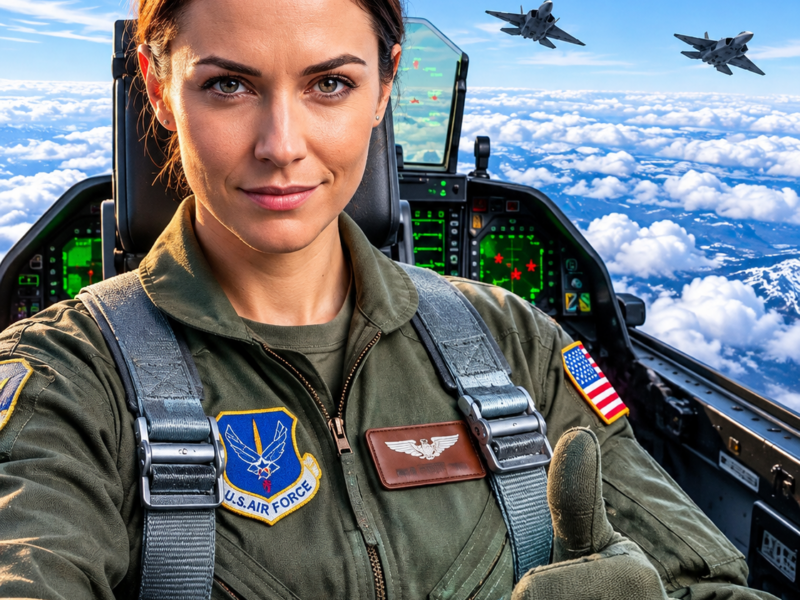
The loudest pilot in the squadron had just forgotten how to fly
The heavy steel door sealed behind them with a low mechanical thud.
Captain Norah Whitaker stood in the center of the secure command vault, her flight suit still carrying the smell of jet fuel and scorched insulation. Her helmet rested beneath one arm. Across the room, First Lieutenant Brett Conincaid looked as though he had aged ten years in the last hour.
Major Raymond Hollis stood near the main console, his arms folded.
On the enormous encrypted screen, General Walter Straoud appeared from a command facility thousands of miles away.
For several seconds, nobody spoke.
Then the general leaned toward the camera.
“Captain Whitaker, that was one of the most extraordinary engagements I’ve witnessed in thirty years of service.”
“Thank you, sir.”
“You destroyed five hostile aircraft, prevented an attack on our airborne command platform, and helped protect this installation. You did all of that while flying as part of a routine patrol.”
Norah remained at attention.
“We had some advantages, General.”
Straoud gave a short, humorless laugh.
“Advantages? Captain, those pilots came prepared to destroy an American formation. They had electronic warfare support, superior numbers, and a coordinated attack plan. You turned their operation into a disaster.”
Norah said nothing.
The general’s expression changed.
“Now we need to discuss why they were here.”
Hollis stepped toward the console and brought up a classified intelligence report.
The display showed a map of the northern maritime border, followed by several flight paths and satellite images.
“Naval intelligence has been examining the aircraft we recovered from today’s engagement,” Hollis explained. “Their equipment doesn’t match any recognized military inventory. Their flight patterns suggest they were operating under a deniable program.”
Conincaid frowned.
“Sir, they were trying to shoot us down. What else would they be doing?”
“They were trying to blind our radar plane,” Hollis answered. “The two aircraft that broke away from the engagement were moving toward Citadel. Their objective wasn’t simply to destroy our fighters.”
The general continued.
“Citadel was providing surveillance for this entire sector. Had those aircraft succeeded in disabling it, we would have lost visibility over the surrounding airspace for a critical window.”
He paused.
“That window was intended to cover an attack on this base.”
Conincaid looked around the room.
“An attack? On the squadron?”
“Not the squadron,” Norah said.
Her voice was calm, but something about it made Conincaid turn toward her.
She walked to the console and entered a command.
The map disappeared.
In its place appeared a complicated network of shipping routes, industrial suppliers, financial transfers, and military procurement records.
Conincaid stared at the display.
“What is that?”
“A supply-chain intelligence network,” Norah replied.
She enlarged a section of the map.
“For the last three years, I’ve been monitoring the movement of materials used in advanced military aircraft. Titanium alloys, specialized electronic components, avionics processors, and other restricted equipment.”
She pointed toward a cluster of highlighted routes.
“Military production leaves traces long before an aircraft reaches an operational squadron. Parts move through manufacturers, shipping companies, subcontractors, and financial intermediaries. When enough of those movements are connected, they reveal where new capabilities are being assembled.”
Conincaid looked at her.
“You’ve been doing this from the scheduling office?”
“Among other things.”
Hollis finally spoke.
“Captain Whitaker wasn’t assigned to routine administration. Her position here was part of a classified intelligence operation. Her apparent duties gave her access to maintenance schedules, aircraft availability, procurement records, and personnel movements without drawing attention.”
Norah turned back toward the display.
“Nobody pays much attention to the person who manages the paperwork.”
The general nodded.
“That was the point.”
He explained that the intelligence network had recently identified unusual activity around several suppliers connected to the enemy aircraft. The pattern suggested that a new combat capability was being assembled somewhere beyond the border.
Then the network detected something more troubling.
Someone had begun searching for the source of the intelligence.
Someone had discovered that a critical part of the program was operating from the American installation.
Today’s attack had been designed to destroy that capability before it could reveal anything further.
Conincaid looked at Norah again.
“So they came here specifically for you?”
“Not necessarily for me,” she answered. “They came for the information. I happened to be standing between them and it.”
The general’s expression hardened.
“Which is why this engagement remains classified. The details of the intelligence program are restricted. The aircraft losses will be handled through the appropriate channels, and the surviving pilot we allowed to retreat will be monitored.”
Norah nodded.
“Understood, sir.”
The general looked directly at her.
“Captain, I want you to know that your actions today were not simply appreciated. They were essential.”
“Thank you, General.”
“And I want your assessment of the enemy’s remaining capabilities by tomorrow morning.”
“I’ll have it ready.”
Straoud smiled faintly.
“Of course you will.”
The screen went dark.
For a moment, the only sound in the room was the ventilation system.
Then Conincaid finally spoke.
“Captain, I don’t understand something.”
Norah turned.
“What is it, Lieutenant?”
“Why didn’t you tell us?”
She considered the question.
“Because you didn’t need to know.”
“But you let us treat you like you were some kind of secretary who couldn’t handle a real mission.”
“I let you make your own assumptions.”
Conincaid lowered his eyes.
“I made some pretty terrible assumptions.”
“Yes,” she said.
There was no anger in her voice. Somehow, that made the answer more uncomfortable.
Hollis opened the vault door.
“Both of you are dismissed. Captain Whitaker, I want your intelligence assessment on my desk tomorrow. Lieutenant Conincaid, I suggest you get some rest.”
They stepped into the hallway.
The sounds of the squadron drifted toward them: laughter, conversations, the clatter of coffee cups, and the familiar noise of pilots returning to their ordinary routines.
Nobody outside the vault knew what had happened.
Nobody knew that six enemy fighters had crossed the border.
Nobody knew that the base had nearly become the target of a coordinated attack.
And nobody knew that the quiet captain walking down the hallway had just saved 24 people aboard an airborne radar aircraft.
Norah stopped at the administrative office.
“Good night, Lieutenant.”
Conincaid hesitated.
“Captain?”
She looked back.
“Yes?”
“I owe you an apology.”
Norah waited.
“I spent months making jokes about you. I thought you were wasting everyone’s time. I thought you didn’t belong in a fighter squadron.”
He swallowed.
“Today, I couldn’t even keep my aircraft under control. You saved my life, and then you trusted me with a job I didn’t think I could do.”
Norah studied him for a moment.
“Then remember what happened today.”
“I will.”
“Good. That’s all I need.”
She opened the office door.
Conincaid remained in the hallway, watching her disappear behind it.
For the first time since joining the 58th Fighter Squadron, he had nothing clever to say.
THE NEXT MORNING
At 0600, the squadron briefing room was already full.
The pilots had heard rumors about the previous day’s engagement. They knew something unusual had happened, but the official information was limited.
Five enemy aircraft had been destroyed.
One had escaped.
All American aircraft had returned safely.
The details remained classified.
Conincaid sat near the back of the room, unusually quiet.
When Norah entered carrying a folder and a yellow highlighter, several pilots glanced at her.
One of the younger officers leaned toward his neighbor.
“Looks like Ditto survived another day of paperwork.”
Normally, that remark would have earned a few laughs.
This time, nobody joined in.
Conincaid turned around.
“Watch your mouth.”
The younger pilot blinked.
“What?”
“You heard me.”
Norah didn’t look up. She placed her folder on the table, opened her notebook, and continued reviewing the schedule.
Major Hollis entered a moment later.
“All right. Settle down.”
The room became quiet.
He began with the official mission summary. He discussed the radar interference, the unidentified contacts, and the importance of maintaining formation discipline during unexpected engagements.
He did not mention the classified intelligence operation.
He did not reveal the details of Norah’s past.
But when he finished, he closed the folder and looked toward the administrative desk.
“Captain Whitaker.”
Norah stood.
“Sir.”
“Yesterday, you demonstrated exceptional tactical judgment under pressure. You also prevented the loss of an airborne surveillance platform and protected this installation from a coordinated threat.”
The pilots exchanged glances.
Hollis continued.
“Effective immediately, Captain Whitaker will resume a more active role in advanced flight training and operational readiness.”
A few heads turned.
Norah’s expression remained unchanged.
“Thank you, sir.”
“You’re welcome. And for the record, Captain, I believe the squadron can benefit from having someone with your experience in the training room.”
Conincaid sat straighter.
Hollis looked around the room.
“Any questions?”
Nobody spoke.
Then Conincaid raised his hand.
“Sir.”
“Yes, Lieutenant?”
“Can I request a simulator slot?”
Hollis glanced at him.
“You already have one.”
“I’d like another.”
“Why?”
Conincaid looked toward Norah.
“Because I have a lot to learn.”
A few pilots smiled.
Hollis nodded.
“Then speak with Captain Whitaker. She’s managing the schedule.”
Norah picked up her pen.
“Friday afternoon is available, Lieutenant.”
Conincaid smiled awkwardly.
“I’ll take it.”
“Noted.”
The briefing continued.
For the rest of the morning, Norah returned to her usual responsibilities. She updated the simulator roster, checked aircraft maintenance reports, and reviewed the next training cycle.
To anyone passing the office, she looked exactly as she had the day before.
Quiet.
Focused.
Unremarkable.
But something had changed.
The pilots no longer laughed when she entered the room.
THE FILE THAT SHOULD HAVE STAYED CLOSED
Later that afternoon, General Straoud called Major Hollis through a secure channel.
Hollis entered his office and closed the door.
“General.”
“Major. I’ve reviewed the initial intelligence report.”
“Yes, sir.”
“Captain Whitaker’s performance was exactly what we expected.”
Hollis paused.
“With respect, sir, I don’t think anyone expected her to engage six aircraft alone.”
“That’s true.”
Straoud looked down at a document.
“There’s another matter. The Pentagon has requested a review of her operational status.”
Hollis frowned.
“Are they considering returning her to full combat duty?”
“They’re considering it. But there are concerns.”
“Her record is clean.”
“Her record is classified, Major. That’s not the same thing.”
Hollis understood.
Norah’s earlier operation over Palmyra had left questions that had never been fully resolved. Her decision to remain in the fight had saved the extraction team, but it had also brought her dangerously close to violating a strategic restriction.
Some senior officers had praised her.
Others had considered her actions reckless.
The disagreement had followed her for years.
Straoud continued.
“The review board wants a full assessment. They want to know whether yesterday’s engagement represents a return to operational readiness or an isolated response under extraordinary circumstances.”
Hollis leaned forward.
“Sir, I watched her fly. She wasn’t improvising blindly. She understood the entire engagement before the rest of us had identified the threat.”
“Then put that in your report.”
“I will.”
“And Major?”
“Yes, sir?”
“Make sure she knows the board is reviewing her file. I don’t want her hearing about it from someone else.”
Hollis nodded.
“Understood.”
When the call ended, he remained seated for a moment.
He knew Norah well enough to understand that the review might not be welcome news.
She had spent years building a life around a job that allowed her to stay useful without returning to the kind of combat that had nearly consumed her.
Now the sky was calling again.
And he wasn’t sure whether she wanted to answer.
A CONVERSATION WITH THE PAST
That evening, Norah sat alone in the small administrative office.
The squadron had mostly emptied. The hallway lights were dim, and the distant sound of maintenance crews working on the flight line occasionally reached her through the window.
She had finished the next month’s simulator roster.
Her technical manual lay open beside the keyboard.
A secure message appeared on her screen.
FROM: GENERAL WALTER STRAOUD
SUBJECT: OPERATIONAL STATUS REVIEW
Norah read the message twice.
The review board would meet within the next several weeks. Her performance during the engagement would be considered alongside her classified operational record.
She leaned back in her chair.
For a moment, the room seemed very quiet.
She remembered Palmyra.
She remembered the radio calls, the damaged aircraft, and the long minutes when every decision had seemed to carry the weight of another person’s life.
She remembered the ground team waiting for air support.
She remembered the aircraft she had lost.
And she remembered the silence afterward.
For years, people had described her actions as heroic. Others had called them reckless.
Neither word had ever felt particularly accurate.
She had simply made the decision she believed was necessary.
Norah closed the message.
A knock came at the open door.
Major Hollis stood there.
“You’re still working?”
“Finishing tomorrow’s schedule.”
“Of course you are.”
He stepped inside and sat opposite her.
“I assume you saw the message.”
“Yes, sir.”
“The review board wants to evaluate your operational status.”
“I understand.”
Hollis watched her carefully.
“How do you feel about that?”
Norah looked at the maintenance manual.
“I’m not sure.”
“That’s honest.”
She turned toward him.
“Major, I’ve spent a long time doing work that doesn’t require me to make those decisions anymore.”
“And you’ve done that work well.”
“Then why change it?”
Hollis considered his answer.
“Because yesterday reminded everyone what you can do. But that doesn’t mean you have to return to the cockpit full-time.”
Norah said nothing.
He continued.
“You can help train these pilots. You can improve their readiness. You can use your experience without putting yourself back into every engagement.”
“Is that what you recommend?”
“It’s what I recommend if that’s what you want.”
For the first time, Norah seemed unsure of her answer.
Hollis stood.
“Take some time. The board won’t meet tomorrow.”
He reached the door, then stopped.
“One more thing.”
“Sir?”
“Conincaid asked me to approve additional simulator time. I think he intends to become a better pilot.”
Norah’s expression softened slightly.
“That’s good.”
“Apparently, he also wants you to be his instructor.”
She looked down at the schedule.
“Friday afternoon is still available.”
Hollis smiled.
“Then I suppose he’ll get his wish.”
TITAN LEARNS TO LISTEN
Friday afternoon arrived with clear skies and a cold wind across the runway.
Conincaid was waiting outside the simulator building when Norah arrived.
He stood with his flight helmet tucked under one arm.
“Captain.”
“Lieutenant.”
“Ready?”
“Have you reviewed the mission objectives?”
“Twice.”
“Threat identification?”
“Yes.”
“Emergency procedures?”
“Yes.”
“Then let’s begin.”
Inside the simulator, Norah took the instructor’s seat while Conincaid climbed into the cockpit.
The first exercise was straightforward: a routine patrol with several unidentified radar contacts.
Conincaid handled the initial approach well.
Then Norah introduced electronic interference.
His radar picture became cluttered. Several false contacts appeared and disappeared.
He immediately reached for the active radar controls.
“Hold,” Norah said.
He stopped.
“What do you see?”
“Multiple contacts.”
“Are they reliable?”
“I don’t know.”
“What does your passive receiver show?”
He checked the display.
“Interference in the radar band.”
“Is it random?”
He studied the signal.
“No.”
“Then what are you looking at?”
He thought for a moment.
“Someone is trying to manipulate our picture.”
“Good. What do you do?”
“Reduce emissions. Switch to passive detection.”
“Proceed.”
The exercise continued.
A simulated missile warning sounded.
Conincaid reacted quickly, deploying countermeasures and beginning a defensive maneuver.
He survived the first attack.
Then another appeared.
This time, he tried to solve everything himself.
Norah stopped the simulation.
“Why did you leave your wingman?”
“I was trying to defeat the threat.”
“You were trying to defeat the threat alone.”
He looked at her.
“What’s the difference?”
“One is a tactical decision. The other is an assumption that you don’t need anyone.”
She restarted the exercise.
“Again.”
They repeated the scenario several times.
Each time, Conincaid improved.
He learned to trust his instruments without becoming dependent on them. He learned to listen to the radio instead of filling it with unnecessary commentary. He learned that a flight leader’s responsibility was not to appear fearless.
It was to keep the formation alive.
After the final exercise, he climbed out of the simulator and removed his helmet.
“How bad was it?”
“Better than last time.”
“That’s not exactly a compliment.”
“It’s an assessment.”
He laughed.
Then he became serious.
“Captain, can I ask you something?”
“Go ahead.”
“Back during the engagement, when you told me to turn my radar on and make myself visible, you knew they’d target me.”
“Yes.”
“You knew I could be killed.”
“Yes.”
He looked down.
“How did you know I would do what you asked?”
Norah thought for a moment.
“I didn’t.”
“Then why trust me?”
“Because you were the only pilot in position to do it.”
He considered that.
“So you weren’t sure I’d succeed.”
“No one is ever completely sure.”
She picked up her folder.
“That’s why preparation matters.”
Conincaid nodded slowly.
He had spent most of his career believing confidence was the same thing as competence.
Norah had just taught him otherwise.
THE REVIEW BOARD
Three weeks later, Norah entered a secure conference room at the regional command headquarters.
The room was plain and cold. A long table occupied most of the space, and several senior officers sat behind folders containing her operational record.
Major Hollis was present.
General Straoud appeared through a secure video connection.
Norah stood at attention.
“Captain Whitaker,” the board chairman began. “Please take your seat.”
She sat.
The chairman opened the first folder.
“We’ve reviewed your previous operational history, including the events of Operation Iron Lantern and your recent engagement over the northern maritime border.”
“Understood, sir.”
“Your performance during the recent engagement has been described as exceptional. However, the board is also reviewing the circumstances surrounding your previous removal from combat rotations.”
Norah nodded.
The chairman continued.
“During Operation Iron Lantern, you remained in contested airspace after receiving instructions to withdraw. Your decision resulted in the successful extraction of the ground team, but it also created strategic and operational concerns.”
“I understand.”
“Do you believe you made the correct decision?”
Norah paused.
“I believe I made the best decision I could with the information available at the time.”
“Would you make the same decision again?”
She looked directly at him.
“If the circumstances were the same, and the lives of the people on the ground depended on it, yes.”
The room became quiet.
One of the officers leaned forward.
“Captain, some might interpret that answer as an unwillingness to follow orders.”
“That isn’t what I said, sir.”
“Then explain.”
Norah placed both hands on the table.
“Orders are issued to accomplish a mission. In combat, the situation can change faster than a command structure can respond. A pilot has to understand the intent behind the order, evaluate the threat, and make decisions based on what is actually happening.”
She paused.
“I don’t believe following a procedure blindly is the same as exercising good judgment. But I also don’t believe personal instinct gives anyone permission to ignore command authority whenever they disagree.”
The chairman watched her.
“Then how do you distinguish between the two?”
“Preparation. Experience. Understanding the mission. And accepting responsibility for the consequences.”
The officer leaned back.
“Do you believe you are ready to return to operational flying?”
Norah looked toward Major Hollis.
He gave no signal.
She turned back to the board.
“Yes, sir. Subject to the required medical and flight qualifications.”
The chairman closed the folder.
“That is all we needed to hear.”
The board deliberated for nearly an hour.
When they returned, the chairman read the decision.
“Captain Norah Whitaker’s suspension from operational combat rotations will be reconsidered. Her performance during the recent engagement demonstrates that her tactical abilities remain exceptional. However, any return to full operational status will require completion of the prescribed flight evaluations, simulator assessments, and medical review.”
Norah remained still.
“Pending successful completion, the board authorizes her return to an operational flight-training role.”
It wasn’t an unconditional return to the cockpit.
But it was a door opening.
“Thank you, sir.”
The chairman nodded.
“Dismissed, Captain.”
Outside the room, Hollis caught up with her.
“How do you feel?”
Norah looked down the hallway.
“Like I have a lot of training to complete.”
He laughed.
“That sounds about right.”
THE LAST SIMULATOR TEST
Norah’s qualification process lasted several weeks.
She completed medical assessments, emergency procedure reviews, and repeated simulator evaluations.
The instructors tested her ability to manage multiple threats, recover from equipment failures, and make decisions under extreme workload.
She passed each stage.
But the final assessment was different.
It simulated a complex air engagement in which the aircraft suffered a series of system failures while the pilot was responsible for protecting another aircraft.
The scenario began with a routine patrol.
Then the radar failed.
Then the navigation system became unreliable.
Then the simulated aircraft suffered a major hydraulic malfunction.
The instructor watched from behind the control console.
Norah remained focused.
She reduced the workload, stabilized the aircraft, and began working through the emergency procedures.
The simulation introduced additional threats.
She ignored the distractions that did not affect the immediate survival of the aircraft and concentrated on the most urgent problems.
When the exercise ended, the simulator froze.
The instructor removed his headset.
“Captain, you completed the emergency recovery within the required parameters.”
“Thank you, sir.”
“Your tactical assessment was also excellent.”
Norah waited.
He glanced at the evaluation sheet.
“You’re cleared for the next phase.”
She nodded.
There was no celebration.
No dramatic expression.
Just a quiet acknowledgment that she had one more requirement behind her.
Outside, Major Hollis was waiting.
“Well?”
“Passed.”
He smiled.
“I expected nothing less.”
Norah looked toward the runway.
A pair of F-22s were taxiing toward the departure end.
The sight of them brought back a familiar feeling.
Not fear.
Not excitement.
Something quieter.
Recognition.
She was ready to fly again.
BACK WHERE SHE BELONGED
The following Monday, Norah entered the squadron briefing room.
The pilots were already seated.
Conincaid was near the front, reviewing a mission packet. When he saw her, he stood.
“Captain Whitaker.”
“Lieutenant.”
He gave her a proper salute.
She returned it.
Hollis walked to the front of the room.
“All right, everyone. We have a new training schedule.”
He activated the projector.
The first slide showed the next month’s flight assignments.
Norah’s name appeared beside an advanced tactical training flight.
Several pilots looked at the screen.
Then at her.
Hollis continued.
“Captain Whitaker will be assisting with operational training and will also be returning to selected flight assignments following qualification.”
There was a brief silence.
Then Conincaid raised his hand.
“Sir?”
“Yes, Lieutenant?”
“Can I request to be assigned to her flight?”
A few pilots smiled.
Hollis looked toward Norah.
“Captain?”
She glanced at the schedule.
“Lieutenant Conincaid has shown improvement. I don’t see a problem.”
“Excellent,” Hollis said. “Then it’s settled.”
The briefing moved on.
When it ended, the pilots began gathering their folders.
Norah returned to the administrative office to collect the flight documents.
Conincaid appeared at the doorway.
“Captain?”
“Yes?”
“I wanted to say something.”
She looked up.
“Go ahead.”
“I used to think the best pilot in the room was the one who talked the loudest, flew the hardest, and made everyone else feel like they were behind.”
He paused.
“I was wrong.”
Norah closed the folder.
“Most people learn that eventually.”
“I also wanted to thank you.”
“You already did.”
“I know. But I don’t think I said it properly.”
He stood straighter.
“You saved my life. You protected the rest of the formation. And you gave me a chance to prove I could do better.”
Norah looked at him for a moment.
“Then do better.”
“I will.”
“Good. You’re scheduled for the simulator on Friday.”
He smiled.
“I’ll be there.”
She picked up her pen.
“Don’t be late.”
“No, ma’am.”
He turned to leave, then stopped.
“One more thing. About your callsign.”
Norah raised an eyebrow.
“What about it?”
“I think Ditto is a pretty good callsign.”
She gave him a faint smile.
“Careful, Lieutenant. You might be the only person in this squadron who thinks so.”
He laughed.
“Maybe that’s because I’m the only one who understands it now.”
Then he left.
THE QUIET PILOT
That evening, Norah stayed late to finish the next week’s schedule.
The squadron was quiet.
Outside, the last maintenance crews were finishing their work beneath the hangar lights. A distant aircraft engine started, then faded as a jet moved toward the runway.
Norah closed her laptop.
On the desk beside it sat the technical manual she had been reading on the morning of the engagement.
A yellow line still marked the section on hydraulic actuators.
She ran a finger along the page and smiled faintly.
For years, people had mistaken her silence for weakness.
They had mistaken her patience for hesitation.
They had assumed that because she did not brag about her abilities, she must not have any worth mentioning.
Norah had never felt the need to correct them.
She had learned a long time ago that the sky did not care about reputation.
It did not care about confidence, popularity, or who had the loudest voice in the briefing room.
When the warning alarms sounded, only preparation mattered.
When the radar went dark, only awareness mattered.
And when another pilot was in trouble, what mattered most was whether someone was ready to help.
She switched off the office light and stepped into the hallway.
A framed squadron photograph hung beside the door. It showed the 58th Fighter Squadron standing together on the flight line, helmets under their arms, aircraft lined up behind them.
Norah was near the edge of the photograph.
Not in the center.
Not trying to stand out.
Just another pilot in a flight suit.
She looked at the picture for a moment before walking away.
The next morning, she would be back in the briefing room. She would update the training calendar, review maintenance reports, and prepare for another flight.
Some people would still call her Ditto.
Some would still see the quiet woman with the folders and the yellow highlighter.
That was fine.
She didn’t need the room to know who she was.
She didn’t need applause.
And she certainly didn’t need to remind anyone what had happened over the frozen ocean.
Because the people who mattered already knew.
They knew that when six enemy fighters appeared out of nowhere, the loudest pilot froze.
They knew that when a missile was seconds from impact, the woman everyone underestimated took command.
And they knew that when the fight was over, she never asked for recognition.
She simply returned to her desk and prepared for the next mission.
Captain Norah Whitaker had never needed to be the loudest person in the squadron.
She only needed to be the one who was ready when everyone else needed her.
The end.









