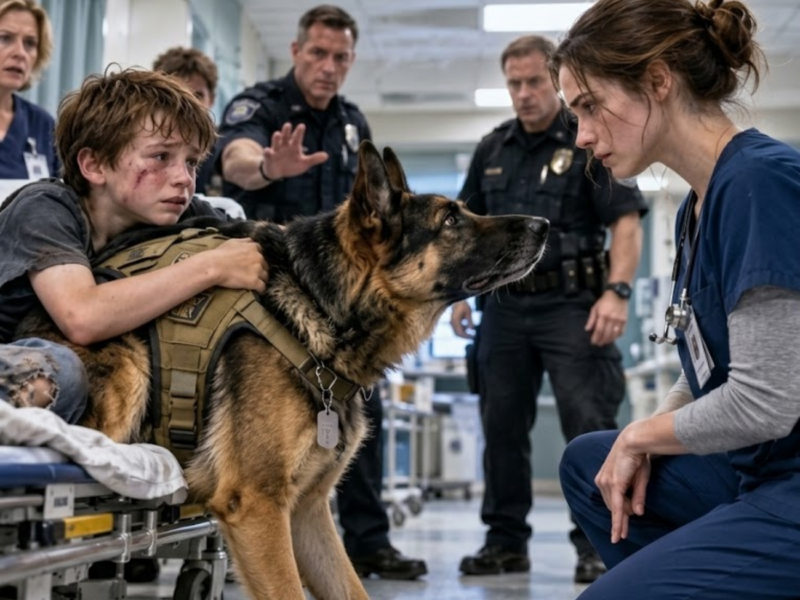
The little boy refused to release the military K9 in the crowded VA hospital lobby, while the dog trembled against his chest and the rookie nurse beside me suddenly
The air in the VA hospital lobby felt heavy with the scent of floor wax, stale coffee, and old wool. I stood motionless, my knuckles white against the thick stack of blue patient files in my arms, listening to the static sizzle of my brother’s voice filtering through the tinny speaker of an old digital recorder hidden in an eight-year-old’s coat pocket.
“If you’re hearing this, Emma, I’m sorry I lied,” Daniel’s voice rasped. It was distorted by background wind—the distinct, whipping hum of an open aircraft cargo bay—but the cadence was unmistakably his. “Whatever happens next, don’t trust the Army officer who tells you I’m dead.”
The mechanical slide of the glass automatic entrance doors sounded like a gunshot in the vaulted room.
The man in the gray coat stepped across the rubber welcome mat. He was broad-shouldered, carrying himself with the disciplined, rigid posture of an active-duty commander despite his civilian wool overcoat. His silver hair was cropped close to his skull, and his right hand rested casually inside his pocket. He stopped ten feet away, his leather dress shoes clicking against the terrazzo floor. When his dark, unblinking eyes swept past the boy and locked onto me, a slow, thin smile stretched across his face.
Beside me, Ranger didn’t just growl; he lowered his front quarters, his rear legs coiling like steel springs. The 85-pound war dog’s ears flattened hard against his skull, and a low, terrifying vibration rattled deep within his chest.
“Ranger, steady!” I gasped, dropping the patient files onto a nearby waiting room chair. Papers scattered across the floor, but I didn’t care. I grabbed the loop of the dog’s tactical harness with my left hand and pulled the boy, Leo, behind my hip with my right.
To my left, Maya, the rookie triage nurse who had gone dead pale seconds earlier, backed away toward the reception desk. Her eyes flicked from the dog tags hanging off Ranger’s neck to the man in the coat, her lips trembling. “Nurse Hayes…” she whispered, her voice barely audible over the lobby’s ambient chime. “That’s… that’s Colonel Vance. He’s on the regional medical review board. He came in for a facility walkthrough twenty minutes ago.”
Colonel Vance took two slow, deliberate steps forward. “Emma,” he said. His voice was smooth, deep, and dripping with practiced authority. “I see you’ve met Sergeant Brooks’ canine. And… Daniel’s secret.”
My heart pounded against my ribs like a trapped bird. Four years ago, Colonel Thomas Vance was the uniformed casualty notification officer who had stood on my mother’s front porch in Tacoma, wearing crisp dress blues, holding a folded brass-framed certificate. He was the man who had sat at our kitchen table, drank black coffee, and explained in meticulous detail how my younger brother, Staff Sergeant Daniel Hayes—who had used his stepfather’s surname, Brooks, on his tactical gear—had been killed when an insurgent command-detonated device destroyed his convoy near the Syrian border.
We had buried an empty casket. The military had cited explosive thermal destruction. No remains. Just a folded flag and a dog tag replica.
“You told us he died in an IED blast, Colonel,” I said. My voice quivered for a fraction of a second before the cold instinct of a trauma nurse took over, locking my tone into a flat, hard edge. “You stood in my living room and swore he didn’t suffer.”
Vance didn’t flinch. He looked down at the boy cowering behind my scrubs. “Military intelligence requires classified compartmentalization, Emma. Families are told what is necessary to protect operational security. Your brother was involved in assets and recovery operations far beyond EOD clearance. He went off-grid. He compromised a multi-billion-dollar joint task force operation.”
“He was running from you,” Leo cried out, his small fingers digging violently into the fabric of my scrub top. “Dad said you were a bad man! He told me to find Aunt Emma if the men in the black vans came to the house!”
Vance sighed softly, a subtle gesture of theatrical pity. He reached inside his gray coat.
Ranger let out a sharp, ear-splitting bark and lunged. The force of the dog nearly dragged me off my feet, his claws skidding helplessly on the slick floor. I threw my full body weight backward, wrestling the dog’s harness until he was pinned against my thighs.
Vance pulled his hand out, revealing not a weapon, but a sleek silver satellite phone and a laminated federal warrant. “The child is a ward of a active federal fugitive investigation, Nurse Hayes. The animal is government property—a highly specialized military working dog carrying sensitive tracking hardware in his subdermal chip. Hand the boy and the dog over to my transport team outside. Do not make this a public incident.”
Two men in dark tactical trousers and plain black windbreakers stepped through the automatic doors behind Vance. Their hands were tucked loosely under the flaps of their coats, eyes scanning the lobby with practiced, lethal efficiency.
I looked down at Leo. His face was streaked with dust and tears, his small hands clutching the worn, yellowed photograph of Daniel smiling in front of the transport truck. Then I looked at Ranger. The dog turned his head, looking straight into my eyes. He didn’t look wild or rabid; he looked like he was waiting for a command. Daniel’s command.
“Maya,” I said quietly, not taking my eyes off Vance.
“Y-yes, Emma?” the young nurse stammered from behind the counter.
“Trigger the Code Silver alarm under the main desk.”
Maya didn’t hesitate. She slammed her palm upward under the lip of the desk.
Instantly, the high-pitched, warbling siren of a facility-wide security breach shrieked through the overhead speakers. Strobe lights began flashing red along the white corridor walls. “ATTENTION ALL PERSONNEL: CODE SILVER, MAIN LOBBY. ACTIVE THREAT. LOCKDOWN PROCEDURES IN EFFECT.”
Panic erupted instantly. Dozens of elderly veterans, visitors, and administrative staff screamed, surging toward the side exits and elevators in a chaotic wave of blue blazers, wheelchairs, and rolling IV poles.
“Now, Ranger!” I screamed.
The dog didn’t need to be told twice. Ranger sprinted forward, driving his massive shoulders straight into the chest of the nearest tactical agent, throwing the man backward through the glass door frame.
I grabbed Leo by his arm, pulled him into my chest, and sprinted toward the restricted emergency basement stairwell.
The heavy steel door of the basement stairwell slammed shut behind us, cutting off the deafening shriek of the lobby alarms and replacing it with the dull, metallic echoing of our own ragged breathing.
Ranger bounded down the concrete steps ahead of us, stopping at every landing, his ears swiveling toward the top of the shaft to listen for pursuing footsteps.
“Aunt Emma?” Leo panted, his small legs struggling to keep up as we descended deep into the subterranean foundation of the hospital. “Are they gonna hurt Ranger?”
“No one is touching this dog, Leo,” I said, my teeth clenched so hard my jaw throbbed. “And no one is taking you.”
We reached the subterranean service level—a sprawling network of concrete tunnels, steam pipes, and fluorescent lighting that connected the VA hospital to the old naval supply depot two blocks away. As a senior trauma nurse who had worked night shifts here for six years, I knew these passageways better than the hospital security director.
I pulled Leo into a narrow maintenance alcove behind a massive industrial air-handling unit. The machine roared with a heavy, steady thrum, masking the sound of our breathing. I dropped to my knees in front of the boy, holding his shoulders firmly.
“Leo, look at me,” I said. “Where is your dad right now?”
The boy wiped his nose with his dusty sleeve. “In the woods. Near the water. We were staying in an old cabin near the lake. Dad told me to stay inside, but then three men with night-vision glasses came up the driveway. Dad gave Ranger his harness, put this tape in my pocket, and told Ranger to take me to the bus stop.”
My heart sank. “He sent an eight-year-old on a city bus alone?”
“Ranger rode the bus with me,” Leo said simply, as if a 90-pound war dog sitting on a transit bus was the most natural thing in the world. “The bus driver was scared, but Ranger showed him the tag on his collar. It had the hospital address written on the back.”
I reached for the silver dog tags hanging off Ranger’s neck. I turned the primary stainless-steel tag over. On the front was engraved BROOKS, DANIEL – 752ND EOD / 75TH RANGER. But etched crude and deep on the back with a handheld dremel tool was my name, my personal mobile number, and a series of ten digits: 47.6062 N, 122.3321 W – CODE 0914.
Coordinates.
“He didn’t just send you to me,” I whispered, the realization hitting me like a physical blow. “He sent you with the key.”
Ranger suddenly pushed his snout into my jacket pocket, whining softly. I pulled out my personal phone. The device was buzzing violently—dozens of automated hospital emergency alerts flashing across the screen, followed by a text message from an unknown, encrypted burner number.
The text contained a single line of text: DON’T GO HOME. VANCE HAS THE APARTMENT COVERED. TAKE THE DOG TO THE STORAGE YARD ON 4TH.
My fingers hovered over the glass screen. “Daniel?” I typed frantically. “Is that you? Are you alive?”
The reply came back three seconds later: I HAVE 20 MINUTES BEFORE THEIR DIRECTIONAL SCANNERS TRIANGULATE THIS SIM CARD. GET OUT OF THE TUNNELS VIA THE DOCK THREE LAUNDRY CHUTE. VANCE IS NOT WORKING FOR THE ARMY. HE IS WORKING FOR BLACKWALL PRIVATE SECURITY.
A chill ran down my spine, turning my blood to ice water.
Blackwall Logistics was a massive private military contractor that had secured billions of dollars in cleanup and ordnance disposal contracts in Iraq and Afghanistan over the past decade. During my own brief stint as an Army EOD tech before nursing school, our unit had crossed paths with Blackwall contractors multiple times. They operated with zero congressional oversight, absolute legal immunity, and unlimited corporate funding.
If Vance was Blackwall, then Daniel wasn’t a military deserter. He was an eyewitness to something that threatened a multi-billion-dollar corporate entity.
Above us, the heavy iron security door at the top of the stairwell groaned as it was forced open. Heavy, rhythmic footfalls began pounding down the concrete stairs.
“They’re inside the shaft,” I whispered, grabbing Leo’s hand. “Ranger, heel.”
We moved silently through the maze of steam pipes, creeping toward the laundry processing facility at the far eastern end of the basement. Huge canvas carts filled with soiled linens lined the walls. At the end of the hall sat the automated industrial chute system—a motorized conveyor belt designed to move heavy laundry bins up to the street-level loading docks.
“In here,” I told Leo, lifting him into a deep, padded canvas hamper. “Stay flat. Don’t make a sound.”
I turned to Ranger. “Hop in, boy.”
The war dog didn’t hesitate. He leapt smoothly into the hamper beside Leo, curling his large body into a tight circle, his chin resting protectively over the boy’s knees.
I pulled a mountain of white hospital sheets over them, leaving just enough space for air, then threw my own weight onto the motorized lift control panel. I hit the green OVERRIDE toggle.
The heavy hydraulic engine roared to life. The belt began moving up the steep, forty-five-degree incline toward the daylight streaming through the loading dock hatch above.
Before I could climb onto the trailing edge of the cart, the maintenance room door behind me burst open.
Colonel Vance stood in the doorway, holding a suppressed 9mm pistol in his gloved hand. He didn’t look like a bureaucrat anymore; the calm mask was entirely gone, replaced by the lethal, calculating coldness of a predator.
“Step away from the control panel, Nurse Hayes,” Vance said, his voice level and flat. “Or I will end your brother’s legacy right here on this floor.”
I didn’t move my hands from the control panel. The hydraulic hum of the conveyor belt was getting louder, the canvas hamper carrying Leo and Ranger disappearing into the dark metal tunnel rising toward the street level.
“Shoot me, Colonel,” I said, stepping directly between his pistol sightline and the chute entrance. “Shoot an unarmed nurse in a hospital basement. See how fast your Blackwall backers cover up a murder on government property.”
Vance’s eyes narrowed slightly. “You think you’re being brave, Emma. You think you’re protecting your family. But you don’t have the slightest idea what your brother stole from Site 14.”
“He didn’t steal anything,” I spat back. “He survived. You lied to my mother. You let us grieve over an empty box while you hunted him through the woods like an animal.”
“Your brother was supposed to disarm a nerve-agent storage vault outside Mosul in 2022,” Vance said, taking two slow steps closer, the suppressor on his pistol pointed steady at my sternum. “Instead, he logged the inventory serial numbers into an unencrypted personal file. He found out that three chemical warheads didn’t exist on official DoD manifests. They were purchased by Blackwall executives for private resale to foreign intelligence contractors. Daniel wasn’t a hero, Emma. He was a whistle-blower who threatened to dismantle a forty-billion-dollar defense infrastructure.”
“He was an honest soldier,” I corrected, my chest heaving. “Something you forgot how to be twenty years ago.”
Vance raised the gun to eye level. “It doesn’t matter anymore. The boy has the encryption key on his collar chip. Once I take him, your brother will come out of the dark. He has no choice.”
Before Vance could pull the trigger, a blinding white flash exploded in the narrow hallway behind him.
A heavy industrial fire extinguisher slammed directly into the side of Vance’s head with a sickening CRACK.
Vance stumbled sideways, his pistol firing wildly into the concrete floor, sending sparks flying.
Standing behind him, breathing heavily and wielding the steel fire extinguisher like a battering ram, was Maya. The rookie nurse’s face was beet red, her scrub top torn at the shoulder, but her eyes were wild with fury.
“Get out of here, Emma!” Maya screamed, swinging the heavy red cylinder a second time, striking Vance across his chest and knocking him to his knees.
I didn’t waste a microsecond. I turned, leapt onto the moving metal teeth of the conveyor belt, and pulled myself into the dark ascending tunnel just as the steel fire-door below slammed shut with a deafening bang.
The conveyor belt dumped me out onto the concrete apron of the hospital’s rear loading dock. The midday sun blared down, blinding me for a brief second.
“Aunt Emma!” Leo’s voice called out.
The canvas cart had tipped over onto the asphalt near a line of commercial recycling bins. Ranger was already on his feet, standing guard over Leo, his nose turned toward the fence line.
“I’m here!” I gasped, scrambling off the conveyor apron and grabbing Leo’s arm. “Run!”
We sprinted past the loading dock gates, diving into the maze of industrial warehouses that lined 4th Avenue. The air smelled of salt water, diesel fuel, and creosote from the nearby railway docks.
My phone buzzed again in my pocket.
STORAGE YARD 12. RED DOOR. NOW.
We crossed the train tracks, Ranger leading the way with his nose to the ground, his body low and fast. We reached the rusted chain-link fence of an abandoned maritime equipment yard. Behind a row of rusted shipping containers sat a small corrugated tin office building with a peeling red door.
Ranger didn’t wait. He threw his heavy shoulders against the wood, busting the latch open.
We tumbled inside, slamming the door behind us and sliding a heavy iron security bar into place.
The room was pitch black, lit only by narrow slivers of sunlight cutting through the cracked metal walls. Dust motes floated in the still air. High-frequency radio gear, solar charging banks, and maps of the Pacific Northwest were scattered across a wooden work table in the center of the floor.
From the shadows in the corner, a figure stood up slowly.
He was thin—far thinner than the muscular EOD soldier I remembered. His left leg was stiff, wrapped in a heavy tactical brace, and a jagged, pale purple scar ran from his temple down into his beard line. He wore a faded flannel shirt and dirty jeans, a worn military field jacket thrown over his shoulders.
Ranger let out a low, desperate whine and sprinted across the room, throwing his front paws onto the man’s chest.
The man collapsed back into his chair, his arms wrapping tightly around the dog’s neck, burying his face into the shepherd’s thick fur.
“Good boy,” the man rasped, his voice trembling with emotion. “Good boy, Ranger. You brought them.”
Leo broke away from my side and flew across the concrete floor, throwing his small arms around the man’s waist. “Dad! Dad, we found her!”
I stood by the door, my hand pressed over my mouth, my vision blurring with hot, overwhelming tears.
The man looked up from his son, his hollow, storm-gray eyes locking onto mine.
“Hey, Em,” Daniel whispered softly. “I’m sorry I missed the funeral.”
I couldn’t move for three long seconds. My mind was a chaotic war between six years of professional grief and the impossible reality standing ten feet in front of me. Then my legs gave out, and I stumbled across the room, throwing my arms around my brother’s neck, pulling him so tight I could feel the sharp ridge of his ribs through his shirt.
“You idiot,” I sobbed into his shoulder, laughing and crying at the same time. “You absolute idiot. We buried a flag, Dan. Mom cried until she was sick.”
“I know,” Daniel choked out, his rough hand pressing against the back of my head. “I know, Em. I’m so sorry. If I contacted you, Vance would have put a scope on your house the same night. They murdered three guys in my unit just for asking where the Mosul manifests went.”
I pulled back, looking at the deep scar on his face, the dark circles under his eyes. “Vance is here. He’s at the hospital. He knows about Leo.”
Daniel’s expression instantly turned to cold iron. He reached onto the work table and picked up a heavy, rubberized military laptop connected to a high-gain satellite antenna mounted on the roof.
“He knows about the chip,” Daniel said, tapping the screen. “When I fled Mosul, I didn’t just take files. I extracted the digital cryptographic keys from the Blackwall internal server. I encoded the master file into a micro-drive and implanted it beneath Ranger’s skin during his last veterinary check in Germany before we crossed the border.”
I stared at the dog, who was sitting contentedly at Leo’s feet, letting the boy stroke his ears. “Under his skin?”
“It’s a passive RFID microchip—looks like a standard pet tracking ID to any basic scanner,” Daniel explained, flipping the laptop screen toward me. “But when brought within five feet of an encrypted DIA terminal, it unlocks forty gigabytes of internal corporate communications, weapon serial numbers, and off-shore payment logs linking Vance directly to private war-profiteering.”
“Then why haven’t you uploaded it to the press?” I asked.
“Because Blackwall controls the primary military routing servers in the region,” Daniel said, his jaw tightening. “If I upload it from a public network, their automated firewalls scrap the data packet before it ever reaches a civilian news desk or federal prosecutor. The file has to be manually patched into a secure, unmonitored federal backbone line.”
“Where?”
Daniel looked out the small, dusty window toward the skyline. “The regional Department of Justice main frame at the Federal Courthouse downtown. They have a direct, unmonitored optical line to the Inspector General’s office in Washington.”
A heavy thumping noise suddenly echoed from the street outside—the deep, rhythmic rumble of low-frequency diesel engines idling.
Ranger’s head snapped up. He let out a low, threatening growl, his hackles raising along his spine.
I crept toward the edge of the corrugated metal wall, peering through a small rust hole.
Three dark, unmarked suburban SUVs had blocked off both ends of the industrial alleyway. Dozens of men in black tactical gear and helmets were fanning out around the perimeter, carrying suppressed short-barreled rifles. Standing near the hood of the lead vehicle was Colonel Vance, holding a handheld signal directional scanner. A white bandage was wrapped tightly around his head where Maya had struck him with the fire extinguisher.
“They tracked my burner phone SIM before I could pull the battery,” Daniel gritted his teeth, grabbing a tactical chest rig from the chair. “They’re locking down the block.”
“Dan, you can’t fight ten armed men with a leg brace,” I said, my nurse’s eye immediately calculating his restricted mobility. “You can barely walk without a cane.”
“I don’t need to fight them, Em,” Daniel said, reaching down to unclip a heavy iron key from his belt and pressing it into my hand. “I need you to take Leo and Ranger through the old rail tunnel behind this yard. It leads directly beneath the Federal Courthouse three miles north.”
“No!” Leo screamed, clutching his father’s waist. “I’m not leaving you again!”
“Listen to me, Leo,” Daniel dropped down on one knee, holding his son’s face gently in his hands. “You are a Hayes. Your aunt is the strongest person I know, and Ranger is the best war dog in the Army. You stick with them. You take that drive to the courthouse. I’m going to make sure these guys stay right here.”
“Daniel, no!” I grabbed his arm. “They’ll kill you!”
Daniel looked at me, a calm, terrifying smile touching his lips—the exact same smile he used to give me when we were kids right before he did something dangerously brave.
“They think I’m a ghost, Em,” Daniel whispered, pulling a tactical detonator remote from his pocket. “It’s time to show them what an EOD tech can do with an abandoned maritime warehouse.”
The damp darkness of the abandoned BNSF railway tunnel smelled of wet earth, rust, and old coal dust. I ran as fast as I could, holding Leo’s hand, while Ranger trotted steadily beside us, his ears constantly swiveling backward toward the entrance behind us.
Five hundred yards behind us in the dark, a sound like thunder shook the underground passage.
The ground beneath our boots vibrated violently. A deep, roaring shockwave of air rushed through the tunnel, blowing rust flakes off the iron ceiling beams. Daniel had blown the support pillars of the maritime storage yard, triggering a massive structural collapse that blocked the alleyway and buried Blackwall’s tactical vehicles under fifty tons of concrete and rusted steel.
“Dad…” Leo sobbed, stumbling on a wooden tie.
“He’s okay, Leo! Keep moving!” I shouted over the echoing rumble, pulling him forward. “He knew what he was doing! Keep running!”
We emerged from the subterranean rail exit twenty minutes later, breaking into the bright, manicured plaza of the Federal Courthouse building in downtown Seattle.
The plaza was filled with afternoon crowds—lawyers in business suits, news reporters with camera crews covering a high-profile municipal trial on the courthouse steps, and local police officers standing near their patrol cruisers.
“There!” I pointed toward the glass doors of the federal building.
Before we could cross the plaza fountain, two black SUVs slammed over the curb, mounting the sidewalk and scattering terrified pedestrians in every direction.
The doors flew open. Four Blackwall contractors, covered in gray concrete dust from the warehouse explosion, leapt out with drawn sidearms.
“SECURE THE CHILD!” one of them screamed.
The crowd erupted into chaotic screaming. Pedestrians threw themselves onto the concrete, news cameras dropped, and police officers drew their weapons, completely confused by the sudden appearance of armed tactical operatives on federal property.
I didn’t stop. I grabbed Leo, hoisted him into my arms, and sprinted straight up the massive granite steps of the courthouse.
“Ranger, BLOCK!” I screamed.
The German Shepherd turned on a dime. He didn’t attack; he stood at the top of the steps, his body broad and rigid, placing himself directly between the approaching gunmen and the civilian crowd. He let out a series of deafening, booming barks that echoed off the high marble pillars of the courthouse facade, commanding the attention of every federal marshal inside the glass doors.
Heavy glass doors burst open from the inside. Six heavily armed United States Marshals, dressed in tactical vests bearing gold badges, rushed onto the steps with shotguns and rifles raised.
“U.S. MARSHALS! DROP YOUR WEAPONS! ON THE GROUND NOW!” the lead Marshal roared through a megaphone.
The Blackwall contractors froze on the stairs, caught between the federal marshals above and the local police cruisers pulling up with sirens blaring below.
I threw open the inner doors of the courthouse rotunda, carrying Leo inside, with Ranger bounding right behind us.
Sitting at a secure terminal behind bulletproof glass was a senior Federal Marshal supervisor. I pulled the silver dog tags off Ranger’s neck, slammed them onto the metal transfer tray, and pressed my hands against the glass.
“My name is Emma Hayes,” I panted, my voice echoing through the vaulted rotunda. “I am the sister of Staff Sergeant Daniel Brooks, 752nd EOD. On this animal’s microchip is an encrypted federal file containing evidence of high treason, war profiteering, and attempted murder by Colonel Thomas Vance and Blackwall Security.”
The supervisor looked at my blood-stained scrubs, then at the trembling boy, and finally at the massive war dog whose military harness was covered in concrete dust and blood.
He picked up the silver tags, looked at the dremel-etched coordinates on the back, and plugged the chip scanner into his main console interface.
For three seconds, the terminal screen flickered with red warning banners. Then, suddenly, the screen shifted to a bright, solid blue. Thousands of classified documents, satellite video feeds, and encrypted financial ledgers began scrolling across the federal network at light speed.
The supervisor’s eyes widened in absolute shock. He slowly reached for his red emergency line handset.
“Get the Regional Inspector General,” the Marshal whispered into the receiver. “And send a tactical team to 4th Avenue. We have a national security situation.”
Three days later, the rain was falling soft and clean over the rolling green hills of the Tahoma National Cemetery.
I stood under a large black umbrella, holding Leo’s hand. The boy was wearing a brand-new navy blazer, his hair neatly combed. Beside him, Ranger sat perfectly still, a clean leather service harness strapped across his chest, wearing a brass medal awarded by the Department of Defense for exceptional service in combat logistics.
Stepping out of a black government sedan parked on the gravel lane was a man walking slowly with a polished wooden cane.
Daniel wore his restored Army Service Uniform, his chest decorated with the Bronze Star and the Purple Heart. His left leg was braced, but he walked erect, his head held high.
He walked over to us, dropping a hand onto Leo’s shoulder, then looked down at the fresh, marble headstone set into the grass in front of us.
The inscription read:
STAFF SERGEANT DANIEL BROOKS (HAYES)
752ND EOD COMPANY
HONORABLY RESTORED TO FULL LIFE AND SERVICE
TRUTH NEVER DIES
“They arrested Vance at the border yesterday,” Daniel said quietly, his voice calm and steady. “And six Blackwall executives were indicted by a federal grand jury this morning. The Army cleared my record, Em. Fully reinstated. Full retirement pension.”
I leaned my head against my brother’s arm, feeling the warmth of his jacket. “And what about Maya?”
“The hospital dropped all disciplinary actions,” I smiled through my tears. “She’s being promoted to head ER nurse next month for stopping Vance in the basement.”
Daniel looked down at Leo, then at Ranger, who nudged his wet nose softly against my knee.
“What are you gonna do now, Dad?” Leo asked, looking up with big, clear eyes.
Daniel knelt down on the damp grass, wrapping his arms around his son and pulling Ranger into the fold. He looked up at me, a real, genuine smile breaking across his scarred face—the first true smile I had seen from him in over six years.
“I think,” Daniel said softly, “we’re gonna go home, Leo. We’re finally going home.”
The end.









