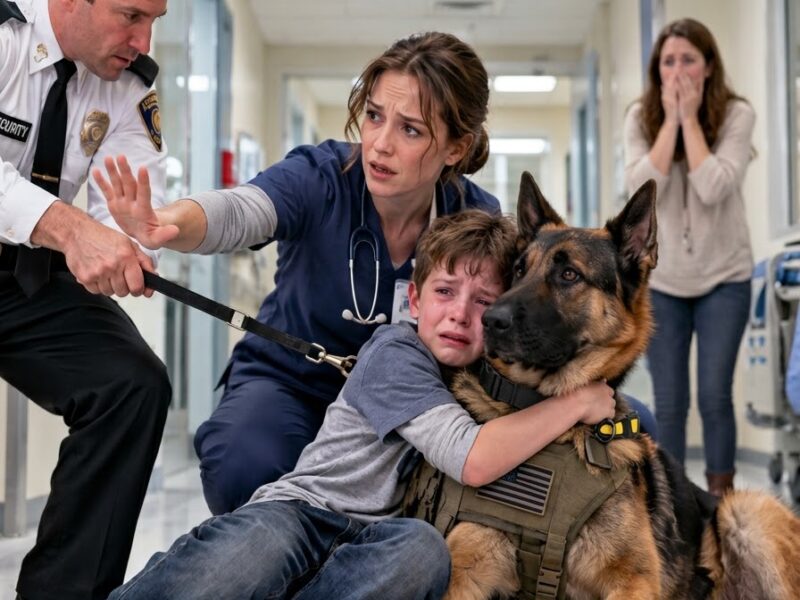
The little boy clung desperately to a retired military K9 in a crowded Texas hospital, refusing to let go even as security pulled him away
The fluorescent lights of the Dallas VA Hospital’s emergency wing hummed with a cold, monotonous buzzing that always managed to give me a headache by the end of a twelve-hour shift. It was 2:00 AM on a muggy September night. The corridors smelled of antiseptic, burnt coffee, and the stale, lingering exhaustion of a facility that never truly slept.
I had been working as a civilian registered nurse here for only three months. After six years as an Army combat medic, the transition to civilian healthcare was supposed to bring peace. Instead, it brought an unsettling stillness—a constant, creeping feeling that I was waiting for an explosion that never came.
That night, the explosion arrived not with a bang, but with the desperate crying of a little boy.
“Please! Don’t take him away!”
The voice echoed down the sterile hallway, sharp and trembling with a terror far too heavy for a child.
I set down my clipboard at the triage station and walked toward the source of the commotion near the double doors of the west wing. A crowd of restless patients and tired staff had formed a loose circle around a heart-wrenching scene.
In the center of the floor, a little boy—no older than seven, wearing an oversized gray hoodie with frayed cuffs—was on his knees, clinging desperately around the neck of a massive, black-and-tan German Shepherd. Tears soaked the fabric of his hood as he buried his face in the dog’s thick fur.
Standing over them was Marcus Vance, a broad-shouldered, gray-templed veteran who volunteered with the hospital’s therapy dog program. Marcus held a thick leather leash, his face a painful mask of sympathy as two hospital security guards stood awkwardly nearby.
“Buddy, you need to let him go,” Marcus said, his deep voice soft and patient. “Blue has to go back to his kennel for the night. You’re safe here. I promise.”
“No!” the boy sobbed, his small fingers twisting tightly into the dog’s leather harness. “He stays with me! Daddy said he’d stay!”
The German Shepherd remained perfectly still, resting its massive chest on the linoleum floor. In my time at the VA, I had seen dozens of service dogs, but I had never seen a working K9 react quite like this. The dog wasn’t growling, nor was it showing any signs of aggression.
It was trembling.
Its dark brown eyes were locked entirely on the child, its posture tense, hyper-alert, and entirely protective. It didn’t look like a therapy dog offering comfort; it looked like a sentry holding a line against an invisible enemy.
“Ma’am, we need to clear the hallway,” one of the security guards said gently to a stressed-looking woman standing nearby, before turning back to Marcus. “If the kid won’t let go, we’re going to have to pull him off. It’s a hospital policy violation to have a non-admitted animal in the pediatric wing.”
“Don’t touch him,” Marcus warned the guard, his voice dropping an octave. “Blue is a retired military working dog. He’s gentle, but if you startle the kid while he’s holding him, the dog’s instincts might kick in.”
I stepped closer, my medical instincts overriding my desire to stay out of administrative drama. The little boy was shivering violently. Beneath the oversized hood, I caught a glimpse of dark hair plastered to a pale forehead, and eyes wide with an absolute, haunting fear.
Then, the boy leaned down until his lips were inches from the Shepherd’s pointed left ear.
He whispered two soft, distinct syllables, followed immediately by a sharp, barely audible double-click of his tongue against the roof of his mouth.
“Blue, stay.”
Click-click.
The moment those sound frequencies hit the air, my hands stopped moving. The breath froze in my throat.
To anyone else in that hallway, it sounded like a frightened child talking to a pet. But to me, it was a ghost pulling a trigger.
It wasn’t a standard command. It was a specialized tactical directive used exclusively by covert canine handlers in the military—a sequence designed to instruct a patrol dog to enter an absolute, immobile protective perimeter around a high-value asset, ignoring all secondary commands from anyone other than the handler.
And the last time I had heard those exact two syllables, delivered with that precise double-click inflection, was six years ago in the dust and heat of the Korengal Valley in Afghanistan.
I had been a twenty-two-year-old combat medic attached to a special operations support unit. I remembered the sound of incoming mortar rounds, the metallic tang of blood in the air, and the steady, unbreakable voice of a young sergeant named Ethan Cole. I had watched Ethan use those exact words to calm his K9 during a brutal midnight ambush that nearly wiped out our platoon.
Ethan Cole had been my friend. He was a brilliant, fierce handler who talked endlessly about his pregnant wife back home in Texas.
Three weeks after that ambush, Ethan’s patrol was ambushed near the Pakistani border. His unit took heavy fire. When the extraction team arrived, they found burned wreckage and discarded equipment. Ethan’s body was never recovered. Two months later, the Department of Defense officially declared Sergeant Ethan Cole killed in action, his name etched into a dark granite wall.
At least, that’s what the military reports told us. That’s what I had believed for six long years.
My heart began hammering against my ribs like a trapped bird. I stepped past the security guards, my eyes fixed entirely on the little boy.
“Marcus,” I said, my voice barely steady. “Give me a second.”
Marcus looked at me, surprised, but nodded slowly and gave me space. I sank down onto my knees on the cold floor, keeping my body language relaxed and non-threatening, just three feet from the child and the dog.
Blue turned his head slightly. His deep brown eyes met mine, and for a split second, I saw a flicker of recognition in the animal’s posture, as if he recognized the scent of combat boots and military starch lingering on my skin.
“Hi,” I said gently, looking at the little boy. “My name is Sarah. I’m one of the nurses here.”
The boy pulled back slightly, burying his chin into his hoodie, but he didn’t let go of the dog. “Hi,” he whispered, his voice hoarse from crying.
“What’s your name?”
He hesitated, looking up at me with large, sorrowful dark eyes. “Noah.”
“That’s a strong name, Noah,” I said softly. I gestured toward the Shepherd. “And who’s this big guy?”
“This is Blue,” Noah murmured. “He’s my daddy’s dog.”
The air in the hallway seemed to plummet twenty degrees. A cold sweat broke out across the back of my neck.
“Your daddy’s dog?” I asked, keeping my voice entirely even, though my mind was reeling. “Where did your daddy go, Noah?”
Noah lowered his head, resting his forehead against the dog’s flank. “Daddy told us to stay in the car. He said he had to go make sure it was safe. He said Blue would guard us… but then the bad men came, and Mommy grabbed me and we ran.”
The bad men.
My chest felt tight, as if a iron band were squeezing my lungs. I looked over at Marcus, who was watching me with a mix of confusion and growing concern.
“Marcus,” I murmured, never taking my eyes off the boy. “Where did this dog come from? How did he end up in the VA therapy program?”
“He was turned in as a stray six months ago outside Fort Worth,” Marcus whispered back, leaning down. “He had a military tattoo in his ear, so the shelter scanned him and transferred him to our retired service animal network. He was fully trained, calm, perfectly socialized… until tonight. When this kid walked into the ER, Blue almost snapped his leash trying to get to him.”
“Daddy said he’d come back for us,” Noah whimpered, his tiny body trembling against the dog’s fur. “He promised.”
Something inside my chest broke completely. I reached out, gently hovering my hand near Noah’s arm. “Noah… what’s your daddy’s name?”
Before the child could answer, the heavy double doors at the end of the corridor burst open.
“Noah!”
A woman hurried down the hallway toward us, her breath coming in ragged gasps. She looked exhausted, her hair pulled back into a messy bun, wearing a faded denim jacket and jeans. Her face was pale, lined with terror and sleep deprivation.
His mother.
She rushed forward, grabbing Noah by his upper arms and pulling him abruptly away from the dog. “Noah, what are you doing?! I told you to stay near the waiting room!”
“Mommy, it’s Blue!” Noah cried, reaching back toward the German Shepherd. “Look! It’s Daddy’s dog!”
“Don’t talk about your father!” the woman snapped, her voice sharp, high-pitched, and laced with a terrifying edge of pure panic. “Don’t talk to strangers about your father! We have to leave. Now!”
Her reaction was far too intense, far too defensive.
Blue suddenly stood up. His lip curled back slightly, and a low, resonant growl rattled deep inside his chest. He took two steps forward, placing his heavy body directly between the woman and the little boy.
Marcus stiffened, gripping the leash tightly. “Whoa, Blue! Easy!”
The woman froze, stepping backward, her eyes wide with shock as she stared at the dog. “He… he’s dangerous. He’s sick. Noah, get away from him!”
“He’s not sick, ma’am,” I said, standing up slowly and facing her. “He’s protecting your son. The question is… who is he protecting him from?”
The woman stared at me, her chest heaving, tears threatening to spill from her eyes. “We don’t want any trouble, nurse. Please, just let us go.”
As she turned to pull Noah away, the boy’s sleeve rode up his arm. In the bright fluorescent light of the hallway, two distinct marks caught my eye.
The first was a thin, white surgical scar running down the skin beneath his right ear.
The second was a small, dark tattoo stamped onto the inside of his tiny wrist—a stylized emblem of a trident crossed over a tactical dagger.
My breath hitched in my throat. I recognized that symbol instantly. It was the unofficial insignia of Task Force Vanguard—a highly classified, black-budget joint rescue unit operating out of the Department of Defense. A unit that officially didn’t exist. A unit Ethan Cole had been secretly interviewed for just weeks before his disappearance.
I turned to Marcus, my voice dropping to an urgent whisper. “Marcus. Pull off the dog’s collar.”
“What?” Marcus frowned. “Sarah, what are you talking about?”
“Pull off his tactical collar!” I demanded, my tone so sharp it shocked him. “Check the inside lining! Now!”
Marcus looked at me for a second, seeing the absolute, undeniable terror in my eyes. He reached down, unclipped the heavy nylon collar from Blue’s neck, and turned it inside out.
Sealed beneath a clear, waterproof plastic sleeve stitched into the heavy military webbing was a tiny, weathered photograph.
Marcus pulled it out and handed it to me.
My fingers shook so hard I almost dropped it.
The photograph showed a tall, lean soldier in desert camouflage, his arm thrown around the shoulders of a smiling young woman holding a newborn baby. Standing at the soldier’s side, looking young and muscular, was Blue.
The soldier in the picture was Ethan Cole.
He wasn’t dead. The photo showed him holding a child—a child who was clearly Noah. And judging by the date stamp auto-printed on the bottom right corner of the photograph—March 14, 2024—this picture had been taken just two years ago.
Ethan Cole was alive.
I turned the photograph over. Written across the back in faded, blue ballpoint pen, in Ethan’s distinctive, jagged handwriting, were six words:
If I disappear, protect my son.
My breath caught in my throat. “That’s impossible…” I whispered, looking up at the woman standing in the corridor.
She was the woman in the photograph. Older, paler, and marked by years of running, but unmistakably Ethan’s wife, Clara.
Clara saw the photograph in my hand. The last bit of color drained from her face, leaving her a ghostly, terrifying shade of white.
“You knew him,” she gasped, her voice breaking. “You… you were with him in Afghanistan.”
“I was his medic,” I whispered, taking a step toward her. “Clara… they told us he died six years ago. They told us his unit was ambushed. What happened to Ethan?”
Clara shook her head violently, tears finally spilling over her cheeks, running down into the collar of her jacket. “He didn’t die in the ambush. They took him. They made him work for them… and when he tried to walk away, when he realized what they were doing…”
Suddenly, Clara’s eyes shifted past my shoulder toward the main entrance doors of the emergency room.
Two tall men in dark charcoal suits had just walked into the lobby. They weren’t doctors. They didn’t walk like patients. They moved with a terrifying, synchronized efficiency, their hands tucked casually inside their jackets, their eyes scanning the room like predators tracking prey.
Clara gasped, a sound of pure, unadulterated horror escaping her throat. “Oh God. They found us.”
Without another word, Clara grabbed Noah by the hand and bolted toward the rear emergency exit doors.
“Clara, stop!” I shouted.
“Security! Stop that woman!” the head guard yelled.
Blue didn’t hesitate. The moment Clara ran, the Shepherd broke free from Marcus’s grip, sprinting down the hallway with terrifying speed. But he didn’t attack. He leaped ahead, his heavy body skidding across the floor to block the exit doors, standing tall and barking fiercely, refusing to let Clara step out into the dark alleyway where two dark SUVs were idling in the rain.
Clara stumbled to a stop, clutching Noah against her legs, trapped between the dog at the exit and the guards approaching from behind.
I ran up to her, putting my body between Clara and the two suited men who were now walking rapidly down the corridor toward us.
“Clara, look at me!” I demanded, grabbing her arms. “Where is Ethan? Is he alive?!”
She looked at me, her eyes filled with an unbearable, suffocating grief. She shook her head slowly, her jaw trembling.
“He isn’t dead,” she whispered, her voice barely a thread. “But what they turned him into… is worse than death.”
My heart slammed against my ribs so violently I thought it would crack. “What do you mean? Who are those men?!”
Before she could answer, a sharp, high-pitched ringing echoed from inside Clara’s heavy coat pocket.
She froze. Her entire body stiffened, as if the ringtone itself were a weapon pointed at her heart. Slowly, with trembling fingers, she pulled out a small, disposable burner phone.
The screen displayed a caller ID from an unknown, restricted number.
Clara looked at the screen, then looked up at me, her eyes wide with a terrifying, hollow dread.
“It’s him,” she whispered.
With shaking fingers, she pressed the speakerphone button and held the device between us.
A heavy beat of static filled the air. Then, a dark, low, metallic voice came through the small speaker—a voice stripped of all human warmth, yet carrying a familiar, chilling cadence that made the hair on my arms stand straight up.
“Tell the nurse to stay away from my son, Sarah,” the voice rasped softly through the static. “Or the next bullet doesn’t miss.”
I froze, the blood turning to ice in my veins.
I knew that voice. I had listened to that voice six years ago over tactical radios in the mountains of Afghanistan.
It was Ethan Cole.
And as I looked at the dark glass of the emergency room doors, I realized that the man I thought had died a hero six years ago was standing somewhere in the dark outside—and he was targeting his own family.
The voice on the phone hung in the air like a drop of liquid nitrogen, freezing the room in absolute silence.
Tell the nurse to stay away from my son, Sarah.
He knew my name. He had recognized me through the hospital security feeds or from the darkness outside. The man I had treated in medical tents, the man whose wounds I had bandaged while he showed me picture printouts of his baby—he was watching us right now.
Click.
The line went dead.
Clara dropped the phone. It shattered against the hard linoleum floor, its plastic casing popping open, battery rolling away under a row of plastic chairs. She fell to her knees, burying her face in her hands, her shoulders shaking violently with silent, agonizing sobs.
“Mommy, don’t cry,” Noah whimpered, kneeling beside her, his small hand patting her trembling shoulder. “Blue is here. Blue will protect us.”
The two suited men who had entered the lobby were stepping rapidly down the corridor toward us now, their strides long and purposeful. The taller one had his hand tucked inside his suit jacket, his eyes fixed entirely on Noah.
“CPD! Halt!” Detective Miller’s voice boomed from down the hall.
Detective Frank Miller—a veteran Dallas Homicide detective who happened to be in the ER interviewing a witness for a separate case—stepped out of an intake room, his badge hanging from a leather strap around his neck, his hand resting on his service weapon. “You two! Stand right there! Show me some ID!”
The two suited men didn’t panic. They stopped instantly, displaying a level of cold, professional discipline that screamed high-level military training. The taller man pulled a sleek, leather credential wallet from his breast pocket and flipped it open for Miller.
“Special Agent Vance, Department of Homeland Security,” the man said, his voice flat and entirely devoid of emotion. “We are executing a federal protective custody warrant for this woman and child. They are key witnesses in an ongoing national security investigation.”
“I don’t give a damn if you’re the Director of the CIA,” Miller growled, looking at Clara’s terrified state and the retired military dog guarding her. “Nobody takes a terrified mother and child out of my jurisdiction without a local judge’s signature. Show me the hard-copy warrant.”
While Miller distracted the two agents, Marcus leaned down toward me, his voice barely audible. “Sarah. The service elevator behind the pathology lab leads straight to the underground parking structure. I have my truck parked in the physician bay.”
I looked at Marcus, then down at Clara and Noah. If those men took Clara and her son, they would vanish into the opaque machinery of dark-budget military contracts, and the truth about Ethan Cole would be buried forever.
“Can you get us out?” I whispered to Marcus.
“Blue knows the route,” Marcus whispered back, his jaw locked tight. “I trained him on this facility’s layout six months ago.”
Marcus subtly tapped Blue’s flank twice. The Shepherd lowered his head, turning his body toward a narrow side hallway marked AUTHORIZED PERSONNEL ONLY – PHARMACY SUPPLY.
“Clara,” I hissed, grabbing her elbow and forcing her to her feet. “Get Noah. Now.”
Before the DHS agents realized what was happening, Marcus stepped in front of Agent Vance, faking a sudden stumble. “Oh, sorry about that, chief! Lost my balance!”
“Hey! Stop them!” Vance shouted, trying to push past Marcus, but Miller stepped directly into his path, drawing his weapon.
“Hold it right there!” Miller barked. “Hands where I can see them!”
We ran.
We bolted down the dim, narrow supply hallway, Blue leading the way with terrifying precision, his claws clicking rapidly against the floor tiles. Noah held my hand, his small legs pumping as fast as they could, while Clara ran beside us, her face pale with desperation.
We burst through a set of double swinging doors into the underground service bay. The subterranean garage was cold, dark, and filled with the heavy rumble of ventilation fans and the smell of exhaust.
“Over here!” Marcus called out, running ahead toward a dark blue Ford F-150 parked in the corner bay. He hit the key fob, and the truck’s headlights flashed twice, cutting through the shadows.
“Get in the back!” I shouted to Clara, pushing her and Noah into the heavy extended cab. Blue leaped in after them without hesitation, taking up a defensive position across the rear seat, his body pressing against Noah’s chest.
Marcus slammed his foot onto the gas pedal. The truck’s V8 engine roared to life, tires squealing against the slick concrete as we rocketed toward the exit ramp leading up to the street.
As we tore out of the garage into the pouring rain of the Dallas night, I looked in the side mirror. A heavy black SUV burst out of the adjacent parking structure behind us, its dark-tinted windows reflecting the streetlights as it swung into pursuit.
“We’ve got a tail!” I yelled, gripping the dashboard as Marcus hard-steered the truck onto Industrial Boulevard.
“I see ’em!” Marcus gritted his teeth, his massive hands gripping the steering wheel. “Hold on!”
Rain lashed against the windshield in violent sheets. Streetlights blurred into long streaks of yellow and red as Marcus wove through the midnight traffic, trying to lose the heavy SUV behind us. But the pursuer moved with lethal precision, matching every turn, closing the distance between us block by block.
“Clara!” I shouted over the roar of the rain and engine, turning around in my seat to face her. “You have to tell me what’s going on! Why is Ethan alive?! Why is he targeting you?!”
Clara pulled Noah close, burying the boy’s face against her shoulder so he couldn’t see the dark roads outside.
“He… he didn’t die in Afghanistan, Sarah,” Clara sobbed, her voice breaking against the noise of the storm. “The ambush was staged. His entire unit… they were selected by a private defense contractor called Aegis Tactical Solutions. They were recruited into a black-project neural trial.”
“A trial?” I repeated, my stomach twisting into a knot. “What kind of trial?”
“They were testing a medical interface,” Clara explained, her eyes wide with terror. “A synthetic neural block designed to erase fear, doubt, and empathy in covert operatives. They wanted to create soldiers who could execute high-risk black-ops without hesitation, without psychological trauma, without remorse.”
My blood ran cold. “A neural block…”
“It worked,” Clara whispered, a tear running down her nose. “It worked too well. It erased his memories of us. It erased his humanity. For five years, Ethan was just a designation to them—a ghost they sent into dirty wars across the world to carry out assassinations and extractions.”
“Then how did he find you?” I asked.
“Eight months ago, something happened,” Clara said, looking down at Noah. “He was deployed on a mission in Colombia. He took a hit to the head—a severe concussion. The physical trauma damaged the neural implant. His memories started leaking back through the block. He remembered Noah. He remembered me.”
Clara took a shaky breath, clutching her hands together. “He went rogue. He broke out of their facility in Virginia and came to find us. He took us to a safehouse in New Mexico. For three months… we had him back, Sarah. He was confused, in pain, but he was my Ethan again. He played with Noah. He bought Blue…”
“Then what changed?” Marcus asked, glancing in the rearview mirror as he slammed the truck into another sharp right turn.
“The implant has an internal power decay,” Clara whispered, her voice dropping to a horrifying, hollow tone. “It was designed to degrade if it wasn’t recalibrated every ninety days by Aegis technicians. When the power decayed… it didn’t shut down. It began releasing continuous, high-frequency electrical pulses directly into his frontal lobe.”
I gasped, my combat medic training instantly visualizing the terrifying reality. “Neurological degradation… severe paranoia, violent aggression, extreme psychosis…”
“He lost his mind,” Clara sobbed. “Two weeks ago, he woke up in the middle of the night screaming that Noah was an asset that needed to be secured. He locked us in the basement. He started talking to people who weren’t there. He thought he was still in Afghanistan. I managed to break out with Noah while he was in a trance state… but he’s been hunting us ever since. He doesn’t see us as his family anymore, Sarah. He sees us as a mission.”
“LOOK OUT!” Marcus roared.
A blinding flare of high-beam headlights smashed through the driver’s side window.
The heavy black SUV slammed violently into the side of Marcus’s truck, sending us skidding sideways across four lanes of rain-slicked asphalt. Metal shrieked against metal, sparks flying into the night air as the heavy vehicle tried to ram us off the road toward an iron guardrail overlooking the Trinity River.
“HOLD ON!” Marcus screamed, slamming the brakes and cranking the wheel hard to the left.
The truck spun three hundred and sixty degrees, rubber burning, before coming to a violent stop against the curb of an abandoned industrial park. The engine sputtered and died, steam pouring from beneath the crumpled hood.
Across the dark, rain-soaked road, the black SUV pulled to a halt, blocking the street.
The driver’s door swung open slowly.
A tall figure stepped out into the pouring rain.
He was dressed in a dark tactical jacket, combat boots, and black trousers. He held a high-powered tactical rifle lowered at his side. As the beam of a streetlamp hit his face, my breath left my body entirely.
It was Ethan.
His short hair was dusted with gray at the temples. His face was leaner, harder, scarred across his jawline. But his eyes—the eyes that used to laugh in medical tents, the eyes that had looked so warmly at his newborn son—were completely dead. They were wide, dilated, and filled with a cold, terrifying, mechanical void.
“Ethan…” I whispered, stepping out of the steam-filled truck, raising my hands slowly into the pouring rain. “Ethan, look at me!”
Rain lashed against my face, soaking my scrubs instantly.
Ethan adjusted his grip on the rifle, stepping slowly across the dark asphalt toward us. He didn’t look at the damaged truck. He didn’t look at the storm. His dead, hollow eyes were fixed entirely on me.
“Medic Sarah Mercer,” Ethan said. His voice was cold, raspy, stripped of all human cadence, sounding like a machine reading from a pre-recorded log. “Service Number 884-91-Delta. You are interfering with a Department of Defense asset recovery operation.”
“Ethan, it’s me!” I cried, taking a small step forward, rain blinding my eyes. “It’s Sarah! We were in the Korengal together! You showed me photos of Noah when he was born! You talked about Clara every single night!”
Ethan’s head tilted slightly, a tiny twitch pulling at the muscle beneath his left eye. A flicker of intense, agonizing confusion flashed across his features for a fraction of a second, before the cold, dead mask slammed shut once more.
“Target alpha: Clara Cole. Target beta: Noah Cole,” Ethan recited mechanically, raising the barrel of his rifle toward my chest. “Return the targets to my custody, Medic. Or I will neutralize you.”
“Ethan, please!” Clara screamed, throwing her door open, stepping out into the rain, pulling Noah behind her. “Look at your son! Look at Noah!”
Noah stood in the rain, his small body shivering, water streaming down his face. He didn’t run. He didn’t hide.
He looked at the terrifying man holding a gun at his mother, took a deep breath, and stepped forward.
“Daddy…” Noah cried out, his small voice cutting through the sound of the falling rain.
Ethan froze. The barrel of his rifle trembled slightly.
Noah took another step toward the man holding the weapon, his small hand reaching out through the dark storm.
“Daddy, it’s me,” Noah sobbed. “You promised you’d come home. You promised Blue would protect us until you got back.”
Ethan stared at the little boy. The muscle in his jaw twitched violently. Sweat mixed with rain on his pale forehead as he fought an invisible, agonizing war inside his own skull. The neural block was firing, fighting against the overwhelming surge of genuine human memory trying to break through the artificial darkness.
“Noah…” Ethan rasped, his voice suddenly sounding human, fragile, and utterly broken. “Noah… run…”
Suddenly, a loud, sharp metallic click sounded from inside Ethan’s tactical jacket.
A red LED light beneath his collar began to pulse rapidly, emitting a high-pitched, agonizing frequency that only a human ear at close range could hear.
Ethan gasped, dropping his rifle onto the wet pavement, clutching his head with both hands, dropping to his knees with a blood-curdling shriek of pure, unbearable agony.
“AAAAAHHHHHH!” Ethan screamed, his fingers digging into his scalp as he thrashed on the wet ground. “GET OUT OF MY HEAD! GET OUT!”
“ETHAN!” Clara shrieked, trying to run toward him, but Marcus grabbed her arm, pulling her back.
From down the road, two more black SUVs roared into view, their high beams blinding us as they skidded to a halt around us. Four armed men in dark tactical gear leaped out, weapons raised.
“SECURE THE SUBJECT!” a voice barked through a megaphone. “EXECUTE NEURAL OVERRIDE!”
One of the tactical operatives stepped forward, holding a heavy electronic transmitter, pressing a button that amplified the pulsing red light on Ethan’s collar. Ethan let out one final, strangled gasp, his eyes rolling back into his head, before his body went limp, collapsing unconscious onto the wet pavement.
They dragged his limp body into the back of the lead SUV like a piece of broken machinery.
“GET THE CHILD!” the lead operative ordered, pointing toward Noah.
Before they could reach us, Detective Miller’s police cruiser burst onto the scene, sirens wailing, followed by four Dallas Police patrol cars, their red and blue lights flashing wildly against the pouring rain, cutting off the tactical team’s retreat.
“DALLAS PD! DROP YOUR WEAPONS!” Miller shouted over his cruiser’s loudspeaker, leaning over his door with his weapon trained on the operatives. “EVERYBODY ON THE GROUND NOW!”
The lead operative stared at the arriving police cars, then down at his watch. He spat on the ground, signaled to his team, and leaped back into the SUV. “FALL BACK! WE HAVE THE PRIMARY SUBJECT!”
The dark SUVs slammed into reverse, tires spinning, spraying water into the air, before executing a violent J-turn and speeding away into the dark night, disappearing into the storm with Ethan Cole.
Silence returned to the rain-soaked industrial park, broken only by the wailing of police sirens and the quiet, heartbreaking sobbing of a seven-year-old boy.
I sank down onto the wet asphalt, rain drenching my clothes, watching the red taillights of the dark SUV vanish into the shadows.
We had saved Noah. But Ethan was gone—trapped inside a living nightmare, a prisoner of the weapon they had built inside his own mind.
The briefing room at the Dallas FBI Field Office was small, windowless, and smelled of stale coffee and ozone. It was 6:00 AM.
Noah was asleep on a small leather couch in the corner, wrapped in a warm fleece blanket, Blue resting his heavy head across the boy’s lap like a silent, immovable shield. Clara sat at the center conference table, clutching a foam cup of hot tea with both hands, her eyes red-rimmed and staring blankly at the wall.
Detective Miller stood near the door, his arm still in a sling, while Special Agent Evelyn Carter tossed a thick, red-stamped classified folder onto the table between us.
“What you saw last night on Industrial Boulevard officially did not happen,” Agent Carter said, her voice dry and serious. “The Department of Defense has already filed a national security gag order regarding the incident. As far as the news is concerned, it was a high-speed pursuit involving an armed carjacking suspect.”
“Don’t give me that government garbage, Carter,” Miller growled, leaning against the doorframe. “A military contractor just executed an armed assault on a veteran, a nurse, and a seven-year-old child in the middle of my city. I want answers.”
Carter looked at me, then at Clara, sighing deeply before sliding the red folder open.
“The contractor is Aegis Tactical Solutions,” Carter explained, pointing to a series of high-resolution satellite photos and organizational charts. “They were awarded a secret two-billion-dollar contract seven years ago under a black-budget research initiative called Project Vanguard.”
“What was the goal?” I asked, leaning forward, my hands tightly clasped.
“To engineer the ultimate covert operative,” Carter said solemnly. “They developed a micro-neural interface—a bio-synthetic chip implanted directly into the central nervous system near the brainstem. It uses low-level electromagnetic stimulation to manipulate neurotransmitters, suppressing fear, doubt, and emotional empathy while enhancing physical reflexes and tactical processing.”
“They turned soldiers into weapons,” Clara whispered, her voice filled with a hollow, sickening bitterness.
“They selected twenty elite soldiers who were reported missing or killed in action during overseas operations,” Carter continued. “Sergeant Ethan Cole was one of them. His death in Afghanistan six years ago was fabricated by Aegis operatives who intercepted his extraction team.”
“Where are they holding him now?” I demanded, my pulse racing. “Where did they take him last night?”
Carter pulled a topographical map from the folder and laid it on the table.
“Aegis operates a decommissioned Cold War-era underground facility thirty miles outside Abilene, Texas,” Carter pointed to a remote grid coordinate surrounded by miles of flat scrubland. “Officially, it’s a private agricultural testing site. Unofficially, it’s their primary research and containment facility. That’s where they take subjects whose implants experience neural decay.”
“Neural decay…” I murmured, remembering the agonized screams of Ethan in the rain. “What happens when the implant decays, Agent Carter?”
Carter looked away, her jaw clenching. “The brain attempts to fight the artificial signals. The conflict creates severe neurological inflammation, leading to extreme violence, hallucinations, and eventually… complete cerebral shutdown. When a subject reaches that stage, Aegis doesn’t fix them.”
Clara dropped her tea cup, her hands flying to her mouth. “They… they terminate them.”
“They treat them as degraded hardware,” Carter said quietly. “Once a subject becomes uncontrollable, they harvest the neural chip for data and dispose of the body.”
“How long does Ethan have?” I asked, my voice deadly quiet.
“Based on the frequency pulses you described last night,” Carter said, looking directly into my eyes, “his neural system will sustain catastrophic overload within twenty-four to forty-eight hours. Once total inflammation sets in… it’s irreversible.”
“Then we’re going to Abilene,” I said, standing up from the table.
“Are you insane, Sarah?!” Miller shouted, stepping forward. “That’s a fortified private contractor facility guarded by mercenaries! You’re a hospital nurse!”
“I was a combat medic first, Miller!” I snapped, turning on him, my eyes burning with a fierce, unyielding light. “I watched Ethan Cole bleed for this country in Afghanistan! I listened to him pray for his wife and son while I stitched his shoulder together under mortar fire! I am not going to sit in a air-conditioned office and let a corrupt defense contractor slaughter him like broken equipment!”
“Sarah is right,” Marcus’s deep voice echoed from the doorway. He stepped into the room, wearing his tactical veteran jacket, his face set in hard, unbreakable lines. “I spent twelve years in Army Special Forces. I know how those contractor facilities are laid out. They rely on automated perimeter security and small, high-paid guard details. They aren’t expecting a surgical recovery team.”
“You two can’t take on an entire contractor site alone,” Carter warned. “If I send an official FBI tactical team, it’ll take seventy-two hours to clear the federal warrants through Washington—and by then, Ethan Cole will already be dead.”
“Then don’t send an official team,” I said, looking Carter straight in the eye. “Give us the blueprints. Give us the security layout. And look the other way for six hours.”
Carter stared at me for a long, heavy moment. The silence in the room was deafening.
Slowly, without saying another word, Carter reached into her leather briefcase, pulled out a encrypted silver flash drive containing the complete architectural schematics of the Abilene facility, and laid it softly on the table in front of me.
“If you’re caught or killed out there,” Carter whispered, “the Bureau will deny all knowledge of your actions.”
“I know,” I said.
As I picked up the flash drive, a small hand tugged gently at the hem of my jacket.
I looked down. Noah was awake, standing beside me, holding his tiny hand out. In his palm was the weathered photograph of Ethan, Clara, and Blue that we had found inside the dog’s collar.
“Bring my daddy home, Sarah,” Noah whispered, his dark eyes brimming with pure, unconditional trust. “Please.”
I took the photograph, tucked it safely into my breast pocket right over my heart, and knelt down to look the boy in the eye.
“I promise you, Noah,” I said softly, resting my hand on his head. “I am bringing your daddy home.”
Blue stepped up beside the child, leaning his heavy head against my knee, letting out a low, soft whine of agreement.
Marcus checked his watch, his face cold as iron. “We have three hours before daylight, Sarah. Let’s go get our soldier.”
The West Texas scrubland stretched out under a moonless, ink-black sky, cold and silent. A biting wind blew across the flat terrain, rustling the dry mesquite bushes and carrying the faint smell of dust and diesel fuel.
Marcus’s backup vehicle—a matte-black Chevrolet Suburban equipped with night-vision optics and tactical gear—sat idling in a dry creek bed three hundred yards perimeter south of the Abilene facility.
Through a pair of high-powered thermal binoculars, I scanned the target.
The facility looked unimposing from the surface: a cluster of windowless corrugated steel industrial buildings surrounded by a double-layered chain-link fence topped with razor wire. High-intensity floodlights illuminated the perimeter, while four motion-tracking security cameras swept the gravel access road.
“Surface security is light,” Marcus whispered from the driver’s seat, pulling up the facility schematics on a tactical tablet mounted to the dash. “Two perimeter guards on foot, four more inside the central monitor station. But the real facility isn’t up top.”
He tapped the screen, highlighting a deep subterranean structure extending three floors into the limestone bedrock beneath the main building.
“The research labs, containment cells, and medical bays are all on Level B3,” Marcus explained, pointing to a service shaft marked VENTILATION SHAFT 4. “That shaft bypasses the main security checkpoints in the lobby. It drops straight down into the primary medical corridor.”
“How do we clear the alarm sensors in the shaft?” I asked, checking the seals on my medical field kit and securing a tactical flashlight to my vest.
“We don’t,” Marcus grinned grimly, pulling a handheld electronic frequency jammer from his gear bag. “We clone the maintenance override signal using the codes Agent Carter gave us on that drive. We’ll have a seven-minute window before the central system detects a signal anomaly and resets.”
“Seven minutes to get down, find Ethan, and get out,” I said, my heart pounding a steady, focused rhythm against my ribs.
“Blue stays in the Suburban until we clear the shaft,” Marcus said, looking back at the German Shepherd resting patiently in the cargo area. “Once we open the lower access door, I’ll signal him down.”
We moved out under the cover of shadow, staying low in the brush, moving like dark ghosts across the cold sand. The cold night air whipped against my face, but my focus was razor-sharp.
We reached Ventilation Shaft 4 at the rear of the perimeter fence. Marcus attached the electronic jammer to the lock housing. The digital display flickered from red to green with a soft click.
Access Granted.
Marcus pulled the heavy iron hatch open, exposing a dark, vertical shaft with a steel ladder leading down into the pitch-black depths.
“I’ll lead,” Marcus whispered, clicking his night-vision goggles down over his eyes, slipping silently into the darkness.
I followed immediately behind him, descending step by step into the cold, mechanical hum of the underground complex. The air grew rapidly colder, smelling heavily of ozone, industrial bleach, and metal.
At the bottom of the ladder, thirty feet below the surface, Marcus used a bolt-cutter to snap the latch on the ventilation grate. We stepped out onto the polished concrete floor of Sub-Basement Level 3.
The corridor was stark, sterile, bathed in the dull, eerie glow of emergency green night-lighting. Rows of heavy steel doors flanked the hallway, each marked with electronic keycard scanners and bio-hazard warnings.
“Medical Bay 2 is at the end of the hall,” I whispered, referencing the map memorized in my head.
We moved down the hall, weapons held low, our footsteps silent against the concrete.
As we approached the heavy reinforced glass doors of Medical Bay 2, a chilling sight stopped us in our tracks.
Inside the sterile, stainless steel operating theater, bathed in harsh overhead surgical lights, Ethan was strapped securely to a tilt-table by heavy steel restraints around his wrists, ankles, and chest.
He was conscious, but his body was convulsing violently, his teeth clenched, sweat drenching his bare torso. A complex surgical monitor beside his bed displayed his vitals: his heart rate was soaring at 180 beats per minute, his core body temperature spiking into dangerous fever territory.
Standing over him were two men in white lab coats and a heavily armed tactical guard holding a submachine gun.
One of the doctors held a long, stainless steel pneumatic bone drill, positioning the bit directly over the base of Ethan’s skull behind his left ear.
“The neural chip is experiencing total thermal overload,” the lead doctor said coldly, his voice echoing through the intercom speaker outside the room. “Extract the hardware before cerebral necrosis destroys the data architecture. Dispose of the organic tissue immediately afterward.”
They were going to drill into his skull and kill him right now.
“No,” I growled, my combat medic instincts snapping into total control.
I didn’t wait for Marcus. I stepped directly in front of the glass door, raised a heavy tactical breach-hammer from my harness, and smashed it with all my strength against the electronic door panel.
SPARK! SHATTER!
The lock housing exploded in a shower of blue sparks. The heavy glass doors slid open with a violent metallic screech.
“SECURITY BREACH!” the guard inside yelled, spinning around, raising his submachine gun toward the door.
BANG! BANG!
Marcus fired two precise shots from his suppressed sidearm from behind me. The guard dropped instantly to the floor, his weapon clattering across the tiles.
The two doctors screamed, dropping their instruments, backing away against the stainless steel cabinets with their hands raised in terror.
“STAY WHERE YOU ARE!” Marcus roared, keeping his weapon trained on the scientists.
I rushed directly to the tilt-table. “Ethan!”
Ethan turned his head slowly. His eyes were completely bloodshot, dilated to the edge of blackness, his jaw locked in agonizing tension. The skin around his neck was burning hot to the touch, the micro-implant beneath his skin pulsing a terrifying, angry red.
“Sa… rah…” Ethan rasped, his voice a horrifying, choked whisper. “It’s… burning… my brain is… on fire…”
“I know, Ethan! I know!” I cried, grabbing my medical kit, ripping open a sterile surgical pack. “I’m going to turn it off! I’m going to get it out!”
“You can’t!” the lead doctor shouted from the corner, his voice trembling with fear. “The implant is integrated into his central nervous system! If you disrupt the circuit without the factory override codes, the emergency failsafe will discharge a lethal electrical voltage directly into his brainstem! It will kill him instantly!”
I froze, my scalpel hovering inches from Ethan’s skin.
My heart felt like it was going to explode in my chest. “Override codes… what are the override codes?!”
“I don’t have them!” the doctor whimpered. “Only the project director has access to the master key!”
Suddenly, a loud, heavy alarm began to wail throughout the subterranean facility.
BEEP! BEEP! BEEP! CODE RED! AUTOMATED CONTAINMENT LOCKDOWN IN EFFECT! ALL SECTORS SEALING IN SIXTY SECONDS!
Heavy iron blast doors at both ends of the corridor began to slide downward, threatening to seal us in the underground tomb forever.
“Sarah! We have to go NOW!” Marcus yelled, looking back toward the corridor. “The perimeter guards are heading down the main stairwell!”
“I’m not leaving him!” I screamed, tears spilling over my eyes as I looked down at Ethan’s agonizing face.
Ethan looked at me through his haze of unbearable pain. His chest heaved. He weakly pressed his knuckles against the steel restraint table, his eyes suddenly clear for one brief, miraculous second.
“Sarah…” Ethan whispered, his hand shaking violently as he reached out toward me. “Noah… is he… safe?”
“He’s safe, Ethan,” I sobbed, pulling the weathered photograph from my pocket and pressing it into his trembling hand. “Noah is waiting for you. He loves you so much.”
Ethan looked at the photograph of his wife, his son, and his dog. A single, clear tear escaped his bloodshot eye, running down his scarred cheek into his hair.
“Noah…” Ethan murmured, his heart rate monitor suddenly spiking to a critical, fatal threshold.
BEEP-BEEP-BEEP-BEEP-BEEP!
The red light on his neck flared with a blinding, terrifying intensity. The neural chip was entering its final, fatal overload sequence.
At that exact moment, a loud, fierce bark echoed down the ventilation shaft from above.
WOOF! WOOF!
A heavy black-and-tan shape launched itself through the shattered glass door of the medical bay.
It was Blue.
The German Shepherd hadn’t waited in the truck. He had followed our scent down the shaft, breaking through the perimeter line, his instincts guiding him straight to his master.
Blue sprinted across the room, ignoring the alarms, ignoring the doctors, leaping directly onto the tilt-table beside Ethan.
The dog buried his face against Ethan’s neck, whining frantically, licking the sweat and tears from his master’s face.
“Blue…” Ethan gasped, his body shaking violently.
Blue lowered his head, pressing his cold nose directly against the burning red light pulsing beneath the skin behind Ethan’s ear.
The dog didn’t pull away. He held his nose firmly against the hot skin, emitting a deep, low, vibrating hum from his throat—a resonant sound that vibrated directly through Ethan’s skull.
Suddenly, the high-pitched, lethal whining of the micro-chip stopped.
The pulsing red LED light flickered… dimmed… and vanished completely.
The heart rate monitor beside the bed instantly stabilized, dropping from a fatal 200 beats per minute down to a steady, calm 72.
The doctor in the corner gasped, his eyes wide with absolute, disbelieving shock. “That’s… that’s impossible… The canine’s vocal resonance and body mass grounded the electrical loop! It triggered a thermal discharge reset!”
The neural chip hadn’t killed Ethan.
The dog’s physical contact and low-frequency vocalization had short-circuited the artificial signal, forcing the military chip into an absolute, permanent shut-down state.
Ethan’s body relaxed completely. His muscles unlocked. The violent shaking stopped, and his breathing became deep, peaceful, and natural.
The dead, hollow look in his eyes was gone. In its place were the soft, warm, human eyes of the soldier I had known six years ago in Afghanistan.
He looked at me, then down at the dog resting on his chest, and then at the photograph held tightly in his hand.
“Sarah…” Ethan whispered, a genuine, beautiful smile breaking across his exhausted face. “I remember. I remember everything.”
“MARCUS! GET HIM UP!” I shouted, tears of pure joy flooding my face as I used the medical shears to slice through the restraint straps.
Marcus grabbed Ethan under his shoulders, pulling the weakened soldier to his feet, while I grabbed our medical gear. Blue walked right alongside us, his head pressed tightly against Ethan’s hip, providing balance and support.
We sprinted out of Medical Bay 2 just as the heavy blast doors slammed shut behind us, slipping through the narrowing gap into the service shaft.
We climbed up into the cold night air, leaving the dark, underground house of horrors behind forever, rising under a sky where the first light of dawn was finally breaking across the West Texas horizon.
The morning sun rose over the hills of Fort Worth, casting a brilliant, golden light across the green fields of a quiet suburban park.
The air was crisp, cool, and smelled of wet grass and morning dew. The terrifying rainstorm of two nights ago was completely gone, leaving behind a clear, infinite blue sky.
I sat on a wooden park bench, holding a warm paper cup of coffee, watching the peaceful scene unfolding thirty yards away near the duck pond.
Clara stood on the grass, wearing a warm sweater, tears of quiet, overwhelming happiness flowing down her cheeks.
Standing across from her was Ethan. He was dressed in clean civilian clothes—jeans, a dark green jacket, and a soft cap covering the small, neat bandage behind his left ear where FBI medical specialists had safely removed the dormant, deactivated neural chip twenty-four hours earlier.
And running across the grass toward Ethan, his arms outstretched, screaming with pure, unadulterated joy, was Noah.
“DADDY!”
Ethan sank down onto his knees on the grass, his arms wide open.
Noah slammed into his father’s chest, throwing his tiny arms around Ethan’s neck, burying his face into his jacket, crying and laughing all at once.
“I got you, buddy,” Ethan choked out, his voice thick with tears as he lifted his son into the air, spinning him around in the bright morning sunlight before pulling him into a tight, fierce embrace. “I got you. I’m home. I’m never leaving again.”
Blue bounded across the grass after the boy, barking happily, leaping around father and son, his tail wagging so hard his entire body shook with joy.
Clara walked forward, stepping into the embrace, leaning her head against Ethan’s shoulder as he wrapped his arm around her, pulling his family together into one complete, unbroken circle.
I took a slow sip of my coffee, feeling a profound, quiet warmth fill every corner of my soul—a peace I hadn’t felt since the day I stepped off that military transport plane from Afghanistan six years ago.
Footsteps crunched against the gravel path beside my bench.
Special Agent Evelyn Carter and Detective Frank Miller walked up, both holding their own cups of coffee.
“Aegis Tactical Solutions is officially no more,” Carter said softly, looking out at the family on the grass. “Federal raids were executed simultaneously on their headquarters in Virginia and four regional testing sites at midnight. Over forty executives, scientists, and covert handlers have been indicted under federal domestic terrorism and human rights violation charges.”
“And the other soldiers?” I asked, looking up at her. “The other men who were implanted?”
“We’ve recovered nine of them alive,” Carter smiled warmly. “They are undergoing medical extraction right now at Walter Reed. They’re going home to their families, Sarah. Every single one of them.”
“What about Ethan’s official record?” Miller asked, his arm still resting comfortably in his sling.
“The Department of Defense has officially corrected Sergeant Ethan Cole’s file,” Carter said proudly. “His classification as Killed in Action has been revoked. He has been awarded the Distinguished Service Cross for his courage under covert captivity, and full medical retirement benefits have been restored to his family.”
Carter looked at me, her eyes filled with a deep, unspoken respect. “You did a good thing, Sarah. You saved a lot of lives.”
“We all did,” I smiled softly, looking over at Miller and Marcus, who was standing near his truck, watching Blue play with Noah.
Agent Carter nodded, turned, and walked back toward her official vehicle, leaving Miller and me sitting together on the bench in the warm sunshine.
A few minutes later, Ethan walked across the green grass toward us, holding Noah on his hip, Clara walking beside him holding his hand, with Blue trotting proudly at his side.
Ethan stopped in front of my bench. He set Noah down gently on the grass, looked me straight in the eyes, and slowly stood at attention.
He raised his right hand to his brow, rendering a crisp, perfect, flawless military salute—a soldier honoring the medic who had refused to leave him behind in the dark.
“Thank you, Medic Mercer,” Ethan said, his voice ringing strong, clear, and completely free of pain. “For not giving up on me.”
I stood up from the bench, returning his salute with a proud, steady hand, tears of joy sparkling in my eyes.
“Welcome home, Sergeant Cole,” I whispered.
Noah ran up to me, grabbing my hand and pulling me toward the grass. “Sarah! Look! Blue wants to show you his new trick!”
I laughed, letting the little boy pull me out into the warm, bright morning air.
As I watched Noah toss a tennis ball across the lawn, watched Blue sprint joyfully across the grass to retrieve it, and saw Ethan and Clara standing hand-in-hand beneath the blue Texas sky, I realized something profound.
The dark memories of Afghanistan, the ghosts of the past, and the terrifying shadows of the last three days were finally gone.
The war was over. And for the first time in a very long time, everyone had finally made it home.
The end.F









