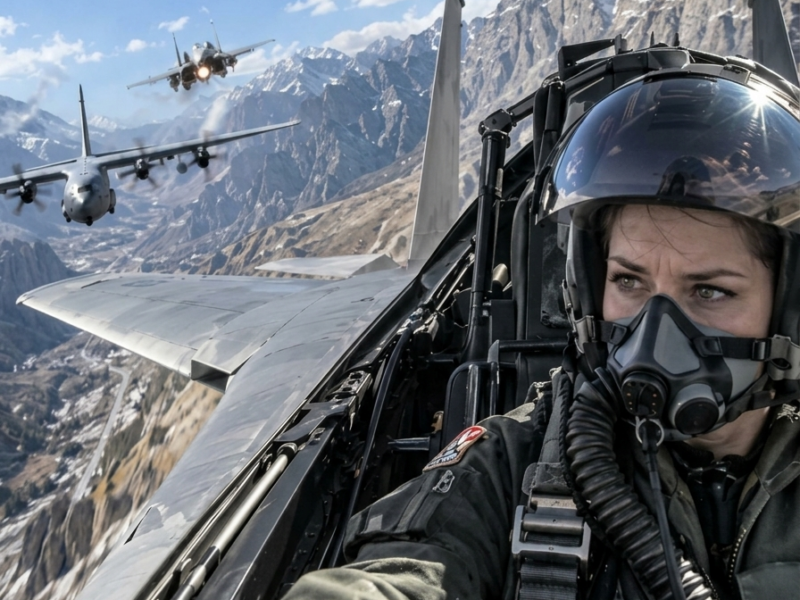
The laughter stopped when enemy fighters locked onto my cargo plane over the Black Sea, because the woman they had mocked as “just a cargo pilot”
The morning briefing room at Andrews Air Force Base smelled of stale coffee, jet fuel, and the silent, unspoken hierarchies of military aviation. Outside the high arched windows, a dense grey mist clung to the tarmac, obscuring the hulking silhouetted shapes of the heavy transports lined up along the runway. Inside, the neon lights hummed loudly, casting a clinical glare over the dozen pilots gathered around the tactical briefing board.
I sat near the back, my flight suit zipped high against the chill, my gloved hands resting quietly on my lap. I was Captain Maya Vance, command pilot for the C-17 Globemaster III—a massive, four-engine strategic airlifter designed to haul tanks, troops, and supplies across oceans. To the uninitiated, it was a sky-truck. To the elite, it was a flying target.
Near the podium, two young F-35 Lightning II pilots stood leaning against a whiteboard, their helmets resting on their hips. They wore the distinctive flight suits of the elite 94th Fighter Squadron, their patches clean, their boots polished to a high sheen. They were our assigned escorts for the long, tense leg across the Atlantic into the contested airspace over the Black Sea.
As I stood up to retrieve my flight folder, one of them—a lieutenant with a razor-thin mustache and a permanent smirk—turned his head toward me. His tag read VANCE. He scanned my uniform, his eyes lingering on the heavy transport crest stitched above my left breast pocket.
“Cargo pilot?” he said softly, making sure his voice carried just far enough for his buddy to hear. He let out a dry, nasal chuckle. “Try not to lose the groceries out there, Captain. It’s going to be a bumpy ride over the water, and we hate having to turn around for spilled milk.”
His wingman snickered, tapping his flight helmet against his leg.
I stopped for a fraction of a second, feeling the cool weight of the leather flight gloves in my hands. A dozen retorts flashed through my mind—stories of dead-stick landings in combat zones, night landings in dust storms with zero visibility, emergency evasives under heavy small-arms fire. But I didn’t say any of it. I simply looked him dead in the eyes, let a faint, neutral smile touch my lips, and kept walking toward the door.
I smiled and said nothing.
They didn’t know why I had volunteered for this specific flight, a mission that had popped up on the board less than twelve hours ago with top-secret clearance tags pinned to its manifest. They didn’t know why my commander, Colonel Marcus Vance—who shared my last name but was no blood relation, a man who rarely spoke to junior officers without a formal summons—had personally signed my flight orders in his private office at three in the morning, his hand trembling slightly as he handed me the paper.
And they definitely didn’t know what was hidden beneath the reinforced steel flooring of my aircraft’s main cargo hold.
Twenty minutes later, the four massive Pratt & Whitney engines roared to life, vibrating through the titanium frame of the aircraft. My copilot, First Lieutenant David Miller, sat in the right seat, frantically running through the pre-flight checklists. He was young, meticulous, and visibly nervous. The mission parameters were bizarre: no standard freight loading crew had been allowed near the plane. A specialized black-ops logistics team had loaded three oversized, unmarked steel containers under heavy security at 0200 hours, bolted them directly to the deck plates, and sealed the entire lower compartment behind heavy hydraulic doors.
“Checklist complete, Ma’am,” David said, his voice tightening over the intercom as we taxied out onto the runway. “Tower cleared us for direct climb to flight level thirty-five. Fighter escorts are taking off behind us.”
“Copy,” I replied quietly, resting my left hand on the primary throttles. “Let’s get this bird airborne.”
The takeoff was heavy, the aircraft groaning under a weight that didn’t match the official cargo manifest on my clipboard. The paper claimed we were carrying standard radar equipment and field rations for deployed garrisons in Eastern Europe. But as the nose lifted and the ground melted away into the thick overcast sky, I could feel the center of gravity shifting in ways no civilian cargo ever caused.
Hours passed in a hypnotic blur of hums, static, and endless gray clouds. We crossed the Atlantic, refueled in mid-air over Germany, and pushed steadily southeast toward the dark, volatile expanse of the Black Sea. The sun had long since dipped below the horizon, leaving the sky a bruised velvet purple above a sea of black fog.
Halfway through the flight, as we cleared international airspace and entered the designated high-risk transit corridor, the crisp hum of the cockpit instruments was shattered.
The long-range radio crackled violently, the static cutting through our headsets like broken glass.
“Bogeys approaching. Zero-four-zero, distance sixty miles, closing fast.”
The cockpit went dead silent. David stopped mid-breath, his hands hovering over the sensor displays.
On the primary radar display, four distinct red blips emerged from the dark eastern edge of the radar screen, moving at Mach 1.8. They weren’t flying standard patrol patterns. They were vectoring directly onto our intercept path.
Immediately, the radio chirped with the sharp, panicked voice of our escort leader—the same F-35 pilot who had joked about groceries back at Andrews.
“Flight, this is Eagle One! We have active hostile radars scanning the area. Tighten formation! Intercept vector set! Cargo aircraft, maintain heading and altitude. Do NOT break!”
I stared through the thick armored windshield at the dark, roiling clouds ahead. The moonlight flickered off the leading edge of our wings. My hands tightened around the control yoke, my knuckles turning white beneath the black gloves.
“Ma’am,” David whispered, his eyes wide as he stared at the tactical warning panel. “We’re being painted. Ground-based and airborne tracking radars!”
I knew.
A high-pitched, continuous warning tone suddenly screamed through the cockpit—a deafening, pulse-pounding signal that made the blood run cold in every aviator’s veins.
LOCK-ON.
One of the approaching enemy fighters had locked its fire-control radar directly onto our giant, slow-moving fuselage.
“Break right! Cargo, break right now!” someone shouted hysterically over the tactical radio channel. “They’re preparing to fire!”
Standard doctrine for an unarmed transport plane caught in a missile lock was simple: bank hard, deploy chaff and flares, descend into the clouds, and pray your fighter escorts could kill the attacker before the missile closed the distance.
But I didn’t bank right. I didn’t drop flares.
Instead, with a calm that terrified even me, I pushed all four throttles flat against the forward panel.
David turned toward me, his face pale in the green glow of the instrument panel, his eyes filled with pure panic. “What are you doing?!”
I didn’t look at him. My eyes were fixed on the tactical screen, tracking the closing distance of the lead interceptor.
“I’ve been waiting for this,” I said softly.
The roaring engines screamed as the heavy transport accelerated past its normal operating limits. The airframe vibrated violently, rivets groaning under the sudden, massive strain of airspeed and thrust.
“Captain! You’re overspeeding the airframe!” David yelled, grabbing the grab-bars on the control console. “The fighters told us to maintain course or bank right! We’re turning straight into their fire envelope!”
“Trust me, David,” I snapped, my voice steady as steel. “Hold on.”
Without another word, I yanked the control yoke hard to the left and hauled back with everything I had. The massive 200-ton cargo plane did something no transport aircraft was ever designed to do. It banked sharply on its wingtip, pitching upward at an impossible angle. The artificial horizon spun wildly.
I was pulling the aircraft completely away from the safety of our F-35 escort formation, flying directly toward the lead enemy fighter that was rushing toward us through the dark clouds.
“She’s crazy! Cargo pilot has lost control!” the escort leader screamed over the radio. “Eagle Two, break off and cover her! She’s flying right into their line of sight!”
The enemy fighters saw the massive plane separate from its escorts. To them, it looked like a panicked, amateur pilot making a fatal mistake—exposing the belly of the transport to their radar-guided missiles.
The lead enemy fighter banked hard, falling right onto my tail. A second fighter rolled in close behind it, closing the trap.
For several terrifying seconds, I let them believe they had cornered a slow, defenseless cargo plane. I held the pitch, letting our speed bleed off just enough to make us look like a dying bird fluttering in the dark.
“Target lock confirmed! Missile launch detected!” David screamed, pointing at the flashing red warning light on the dash. Two bright white smoke trails ignited in the night sky behind us, cutting through the clouds at three times the speed of sound.
“Now,” I muttered.
I slammed the throttles back to flight-idle, kicked the left rudder pedal with all my weight, and dumped the nose completely. The C-17 dropped like a stone through the cloud deck.
The sudden drop in speed and altitude caused the two incoming missiles to lose their radar tracking solution. They passed harmlessly overhead, exploding in the upper atmosphere with blinding flashes of orange light that illuminated the cloud deck below.
The enemy fighters slammed on their airbrakes, diving through the clouds to pursue us, confident they could gun us down in the low-altitude darkness.
But as we plummeted through five thousand feet, I reached down to the center pedestal, flipped open a guarded red switch that wasn’t listed in any standard operational manual, and keyed the internal tactical frequency.
I transmitted one sentence to the dark crew compartment below:
“Package is exposed.”
David stared at me, his mouth open, completely speechbound as a heavy mechanical thump reverberated through the entire floorboards of the flight deck.
Behind us, in the unpressurized lower cargo bay, the massive rear cargo doors were hydraulicly unlocking and slowly swinging open into the roaring slipstream of the night air.
What the enemy had been chasing wasn’t an ordinary cargo plane hauling supplies.
Inside the three sealed steel containers were advanced, secret military systems—high-powered airborne electronic warfare decoys equipped with active radar reflectors and signal replicators. The moment the rear doors opened, the automated deployment racks extended into the open air.
Three massive decoy pods fired out into the night sky, instantly deploying motorized radar arrays that bloomed like dark metallic flowers in our wake.
The moment they activated, the electromagnetic spectrum over the Black Sea went completely chaotic.
The decoys didn’t just jam enemy radar—they generated hundreds of false target signatures. To the enemy fighters’ advanced radar processors, our single cargo plane suddenly multiplied into a fleet of thirty heavy bombers, fifty incoming stealth fighters, and dozens of anti-radiation missiles approach from every conceivable angle.
The entire enemy radar tactical display turned into a screaming wall of red static and phantom targets.
The four enemy fighters scattered in absolute panic, breaking their tight attack formations, dumping their fuel, and firing defensive chaff in every direction as their radar screens warned them they were surrounded by an entire armadas of non-existent warships.
“What… what is that?!” the F-35 escort leader stammered over the radio, his voice completely stripped of its former arrogance. “My radar is showing a strike force! Where did they come from?!”
“Eagle Leader, clean up the sky,” I ordered over the comms, my voice icy calm. “Their formation is broken. They’re blind.”
Our F-35 escorts didn’t hesitate. With the enemy interceptors disoriented, confused, and flying in circles trying to acquire non-existent targets, the escorts moved in swiftly. Within minutes, the threat was neutralized, the enemy fighters forced to turn tail and flee back to their coastal airbases at supersonic speeds.
The sky went deathly quiet. The warning tones ceased.
David sat back in his seat, drenched in cold sweat, staring at me as if he were looking at a complete stranger.
“Captain…” he whispered, his hands trembling. “Who are you?”
I didn’t answer. I pulled the throttles back up, leveled the aircraft off at cruising altitude, and guided the quiet giant back onto its flight path toward our staging base on the coast.
Two hours later, the heavy transport touched down on the rain-slicked runway of an isolated airbase near the coast. The landing was soft, the massive rubber tires kissing the wet asphalt with a quiet hiss of steam and smoke.
As we taxied toward a heavily guarded, floodlit hangar at the far edge of the airfield, I looked out the side window. A convoy of black SUVs and armored military vehicles stood waiting, their flashing red and blue lights reflecting off the wet pavement.
Back at the base ramp, nobody laughed when I climbed out of the aircraft.
The two F-35 pilots who had mocked me at Andrews were already standing near the edge of the tarmac, their flight helmets held loosely in their hands. As I walked down the boarding stairs, they stepped back, staring at me with a mixture of shock, awe, and deep embarrassment. Neither of them uttered a word.
Standing directly in front of the primary black SUV was my commander, Colonel Marcus Vance. He wore his full dress uniform beneath a dark raincoat, his hands clasped tightly behind his back. His face was carved out of granite, pale and devoid of emotion despite the brilliant success of the survival maneuver.
He didn’t offer a smile. He didn’t congratulate me on saving a multi-million-dollar aircraft or completing a high-stakes electronic warfare trial under actual combat conditions.
He simply looked past me toward the open, shadowy interior of the rear cargo bay and asked in a low, gravelly voice, “Did they see it?”
I understood what he was asking. He was asking if the enemy—or my own crew—had caught a glimpse of the core technology inside the secondary containers before the decoys were ejected.
I shook my head slowly. “No. The deployment was clean. Everything wiped automatically upon ejection.”
Colonel Vance exhaled slowly, a long plume of white condensation rising into the cold night air. His shoulders sagged just an inch, revealing a profound, crushing exhaustion.
“Good,” he muttered. “Get your gear, Captain. You’re debriefed in thirty minutes.”
He turned on his heel to walk toward his staff car.
I thought it was over. I thought I would turn in my flight logs, write my operational report, go to the officers’ quarters, and finally get a few hours of sleep after the most terrifying night of my life.
Then I noticed something strange inside the cargo bay.
The specialized black-ops team was already up on the ramp, securing the remaining heavy containers with thick steel chains. But one of the secondary sealed steel boxes—the one located furthest back near the tail section, the container that wasn’t supposed to have been touched during the decoy deployment— sat with its heavy pneumatic lock swinging open.
A narrow gap of dark space yawned open in the metal door.
My brow furrowed. I stepped away from the escort team and walked up the hydraulic ramp into the quiet, echoey belly of the plane. The smell of hot hydraulic fluid and ozone filled the space.
I walked toward the opened container. Lying in the center of the cold, corrugated steel floor of the hold was a single item.
It wasn’t a piece of high-tech military hardware. It wasn’t an electronic component or a classified manual.
It was a bright, wax-sealed red envelope.
It lay on the metallic floor, bright and jarring against the dull grey surroundings, as if it had been intentionally left there for me to find after the chaos of the flight.
I knelt down, my heart suddenly racing faster than it had when the enemy missiles were locked onto my tail. I picked up the envelope.
My name—MAYA—was written across the front in dark blue ink.
The handwriting was jagged, precise, and unmistakable. It was a slant-script style I hadn’t seen in over twelve years.
It was my father’s handwriting.
My father, Colonel Thomas Vance, had been a legendary test pilot for secret military aircraft. According to the official Air Force records, he had died in a catastrophic, classified flight accident over the Nevada desert when I was sixteen years old. His body had never been recovered; the impact had allegedly vaporized his aircraft at Mach 4. His loss was the very reason I had joined the military—to walk in his footsteps, to conquer the sky that had claimed his life.
My fingers trembled violently as I broke the thick red wax seal and pulled out the contents.
Inside was a single, faded color photograph.
It showed my father standing on a sun-drenched runway twelve years ago. He was wearing an unmarked black flight suit, smiling at the camera. And directly behind him, looming in the background of the photograph, was the exact same C-17 aircraft I had just flown tonight—identified by the distinct tail number painted on its vertical stabilizer.
I turned the photograph over with shaking hands.
On the back, written in the same dark blue ink, were four words:
“Your mother lied to you.”
The paper felt like ice in my hand.
I stood frozen in the cold cargo hold, the distant sound of rain beating against the metal roof of the hangar fading into a dull, distant hum. My chest tightened until I could barely breathe.
Your mother lied to you.
My mother had spent the last twelve years living in a quiet suburban town in Virginia, tending her garden, wearing her husband’s posthumous Distinguished Flying Cross around her neck on special occasions, and weeping every time she looked at photos of my father. She was the one who had held me when the Air Force casualty notification officers knocked on our door. She was the one who had buried an empty casket in Arlington National Cemetery.
How could she have lied? About what?
“Maya.”
A voice cut through the stillness of the cargo bay like a knife.
I spun around, reflexively shoving the red envelope into the inner pocket of my flight suit.
Colonel Vance was standing at the edge of the cargo ramp. He hadn’t left in his staff car after all. He was standing under the harsh yellow floodlights of the hangar, his hands thrust deep into the pockets of his trench coat.
His face had gone completely pale. His eyes weren’t looking at me—they were locked onto the open, swinging steel door of the opened container behind me.
He saw the broken lock. He knew.
“You weren’t supposed to go back in there,” the Colonel said softly. His voice lacked its usual command; it sounded hollow, broken, and ancient.
“Colonel…” I took a step toward him, my hand instinctively resting over the pocket where the photograph was hidden. “What is this aircraft? Why did my father’s handwriting just show up inside a sealed black-budget container on a flight over the Black Sea?”
Colonel Vance looked around the shadowy hangar. The logistics team had mysteriously vanished, leaving the two of us completely alone in the echoing silence of the vast structure.
“Your father didn’t die in Nevada, Maya,” he whispered, staring at the floorboards.
The world seemed to tilt beneath my feet. “What?”
“The accident twelve years ago… it was a cover,” Colonel Vance said, stepping up onto the ramp and coming to a halt a few feet away from me. “Thomas didn’t crash. He discovered something inside the program—something about the true nature of the atmospheric reconnaissance operations we were conducting over foreign territories. When he tried to shut it down, they realized he couldn’t be controlled.”
“Who is ‘they’?” I demanded, my voice cracking with emotional fury. “And why did my mother tell me he was dead?!”
“Because she was protecting you!” Colonel Vance snapped, his eyes flashing with sudden, desperate intensity. “If you believed he was dead, you were safe! If the Department knew Thomas Vance had a daughter who knew the truth, you never would have been allowed near a cockpit! You would have spent your life under twenty-four-hour surveillance—or worse!”
I shook my head, tears of confusion and betrayal stinging the corners of my eyes. “Then why am I here? Why did you sign my orders for this mission?!”
Colonel Vance took a deep breath, his chest heaving under his uniform coat.
“Because Thomas isn’t dead, Maya,” he said quietly. “He’s been living in deep hiding for twelve years, operating a shadow network inside foreign intelligence corridors. And this flight… this entire mission over the Black Sea wasn’t a military trial for electronic warfare decoys.”
He stepped closer, lowering his voice to a barely audible whisper.
“It was an extraction signal. Thomas needed to know if he could trust the pilot flying this specific airframe tonight. He told me that if his daughter was half the aviator he was, she would break formation, survive the lock-on, and activate the primary payload.”
I stared at my commander in absolute disbelief. The mission, the enemy fighters, the lock-on—it had all been a test. A lethal, terrifying test designed by my own father from the shadows of a world I didn’t know existed.
“And now?” I asked, my blood running cold as I realized the terrifying depth of the web I had just stepped into. “What happens now?”
Colonel Vance looked past me, pointing toward the dark dashboard of the empty cockpit up above.
“Now,” he said, “the red envelope isn’t the only thing he left behind. Check the secondary radio frequency on your console. He’s waiting for your response.”
My heart hammered against my ribs like a trapped bird as I turned away from Colonel Vance and climbed the narrow spiral stairs back up to the flight deck.
The cockpit was dark, illuminated only by the faint green standby lights of the emergency power unit. The silence up here felt heavy, almost sacred, filled with the ghost of a man I had spent half my life mourning.
I sat down in the pilot’s seat—the same seat my father had sat in twelve years ago, according to the photograph in my pocket.
My fingers trembled as I reached out to the primary radio control panel. I flipped the dial away from the standard military tactical channels, bypass-routing the encrypted military comms, and manually entered the secret frequency hidden on the back corner of the red photograph: 121.505.
I put on my flight headset. Static hissed softly in my ears—a steady, hypnotic white noise.
I pressed the push-to-talk button on the control yoke.
“Father?” I whispered into the microphone, my voice shaking with twelve years of unexpressed grief, anger, and awe. “This is Maya. I… I completed the flight.”
For three long, agonizing seconds, there was nothing but static. The silence was suffocating. I began to wonder if Colonel Vance was wrong, if this was all some elaborate psychological operation, a nightmare cooked up by intelligence agencies to test my loyalty.
Then, through the static, a sound broke through.
It was the faint, rhythmic beep of a specialized flight transponder. And then, a clear, deep voice—older, rougher, but instantly recognizable—resonated in my headphones.
“I saw the maneuver over the cloud deck, Maya,” my father said softly. “The low-altitude dive… the inverted roll. You always did have better hands than I had at your age.”
Tears spilled over my eyelashes, running down my cheeks and dripping onto the fabric of my flight suit.
“Why?” I choked out, gripping the steering yoke until my hands throbbed. “Why did you let me believe you were dead? Why did Mom lie to me for twelve years?!”
“To keep you alive, sweetheart,” he replied, his voice heavy with an unbearable sadness. “The men who ruined my life—the men inside our own government who turned black-budget programs into private war machines—they were watching our family. If your mother hadn’t convinced them I was gone forever, they would have used you to pull me out of hiding.”
“And now?” I demanded, wiping the tears from my face with the back of my glove. “You just brought me into the middle of it! I broke formation! I bypassed military protocol! I’m standing in a hangar with a commander who knows everything!”
“Colonel Vance is the only reason I’ve survived this long,” my father answered quietly. “He signed your orders tonight because the window is closing, Maya. The technology inside that aircraft… the decoys you launched… they weren’t designed to trick enemy fighters. They were designed to upload a hard-coded virus into the global military radar network—a virus that exposes every illegal shadow facility operating across Europe and Asia.”
I gasped, looking back down at the center pedestal of the control panel. The guarded red switch I had flipped during the dogfight wasn’t just a release mechanism. It was a transmitter.
“You used my plane to broadcast the truth to the entire world,” I realized, the full magnitude of what had just happened crashing down on me.
“Yes,” my father said. “And within ten minutes, every intelligence agency on earth—including the rogue faction inside the Pentagon—will know that Captain Maya Vance was the pilot who pressed the button.”
I stood up from the pilot’s seat, stepping toward the cockpit window. Outside on the dark runway, the headlights of three new, unmarked black sedans suddenly turned on, speeding across the wet tarmac toward our hangar.
They weren’t Air Force vehicles. They didn’t have military insignias.
“They’re coming for you, Maya,” my father’s voice cracked in my headset, urgent and sharp. “You have a choice right now. You can hand over the aircraft records, tell them you were following orders, and spend the rest of your life in a military prison…”
He paused, the static rising softly in the background.
“…or you can start those engines, take off into the dark, and help me finish the war I started twelve years ago.”
I looked out the window at the approaching black sedans, their tires kicking up plumes of water in the night air. Then I looked down at my hands—hands that had just outmaneuvered four enemy fighters, hands that belonged to a test pilot’s daughter.
I didn’t hesitate.
I reached out, flipped the engine master switches to manual override, and felt the heavy, terrifying roar of four massive engines thunder back to life beneath my feet.
The end,









